
TLDR
- A generic checkout or invoice API generates a payment but rarely tracks link-level events like opens, shares, and expiry across connected accounts without custom middleware.
- Platform-native payment link APIs handle account routing, webhook fan-out, and hosted page branding for each sub-merchant as first-class features, not bolted-on configs.
- The four providers that actually fit a SaaS platform workflow are Stripe, Adyen, PayJunction, and Paddle, each with distinct trade-offs on platform account architecture, event granularity, and pricing.
- Webhook reliability at the link level is the first thing to test: a missed
payment_link.payment_succeededevent on a connected account is harder to reconcile than a failed charge. - If your platform manages sub-merchant payouts or white-labels the payment page, the hosted payment link API choice directly affects your compliance posture and revenue recognition workflow.
The four best payment link APIs for SaaS platforms are Stripe Payment Links (best for platforms on Connect with per-account webhook fan-out), Adyen for Platforms (best for enterprise platforms needing multi-currency hosted links with balance account routing), PayJunction (best for vertical SaaS in professional services where payment links replace terminal swipes), and Paddle (best for B2B SaaS selling software products where the platform wants full Merchant of Record coverage on every generated link).
Why Invoice APIs and Payment Link APIs Are Not the Same Decision
Most platform teams conflate three different primitives: an invoice API, a checkout session API, and a payment link API. They are related but solve different operational problems. An invoice API creates a document with line items and terms, often with net-30 logic and PDF generation. A checkout session API creates a time-bound, session-specific URL for a single buyer flow.
A payment link API creates a persistent, shareable URL that can be generated programmatically, sent across any channel (email, SMS, WhatsApp, QR code), tracked across its full lifecycle, and attributed to a specific connected account or sub-merchant on your platform. The lifecycle events matter most: created, viewed, payment attempted, payment succeeded, link expired, link reused. That event chain is what most invoice APIs do not emit at the link level.
For a SaaS platform with 50 or 500 sub-merchants, the routing question is equally important. When a connected account generates a payment link through your API, does the payment settle directly into that account’s balance, or does it flow through your platform account first? The answer determines your compliance exposure. Our breakdown of the best payment infrastructure tools for SaaS founders covers this platform account architecture in more detail, but the short version is: settlement routing should be explicit, not inferred from a default config.
What Should a Platform Payment Link API Actually Do?
Before evaluating vendors, it helps to define what a purpose-built platform payment link API needs to handle. The FintechSpecs Platform Link API Checklist breaks this into four layers:
- Generation: The API creates a hosted URL with metadata attached (amount, currency, description, connected account ID, expiry). No redirect to a dashboard. Pure API response.
- Routing: Payment funds settle to the correct sub-merchant account without manual intervention. The API call specifies destination at creation time, not after the fact.
- Event tracking: Webhooks fire at every meaningful state change, scoped to the platform account, the sub-merchant account, or both. Link opened, payment attempted, payment succeeded, refund initiated.
- Hosted page control: The platform can pass branding parameters or use a white-labeled domain. The buyer sees the sub-merchant name, not your platform name, unless you want them to.
Any API that handles all four deserves to be on your shortlist. Any API that requires you to build event tracking in a separate layer is adding engineering cost that compounds as your platform scales.
The 4 Best Hosted Payment Link APIs for SaaS Platforms
1. Stripe Payment Links on Connect
Stripe Payment Links combined with Stripe Connect is the most complete implementation of the platform payment link pattern available today. The API lets you create a payment link on behalf of a connected account in a single call, specifying the destination account in the request header. Settlement goes directly to the connected account’s Stripe balance, with the platform taking an application fee if configured.
Webhook fan-out is where Stripe earns its position here. When a payment link generates a successful payment on a connected account, Stripe fires the event to both the platform-level webhook endpoint and the connected account’s endpoint. You do not need to poll. You do not need to build a secondary event pipeline. The checkout.session.completed and payment_intent.succeeded events carry the connected account ID, so your platform knows which sub-merchant received money without a database join.
According to Stripe’s public pricing page, the standard rate is 2.9% plus 30 cents per successful card transaction. Connect platform fees are layered on top at whatever rate the platform configures. There is no additional fee for creating payment links as a product feature. The hosted payment page is Stripe-branded by default, but custom domains are available on paid plans.
The practical constraint is that Stripe Connect’s onboarding requirements for connected accounts can be demanding for some verticals. If your sub-merchants are small service businesses with inconsistent documentation, the account verification friction is real. That said, for a SaaS platform already on Stripe, adding payment link generation through Connect is a one-sprint integration.
Best for: SaaS platforms already running Stripe, with 10 to 500 connected accounts, where per-link webhook tracking and direct settlement are the primary requirements.
2. Adyen for Platforms with Pay by Link
Adyen for Platforms offers Pay by Link as an API-generated hosted payment URL that routes through Adyen’s balance account architecture. The key structural difference from Stripe is that Adyen uses balance accounts tied to legal entities, which gives enterprise platforms more flexibility in how they represent their sub-merchant hierarchy, particularly for multi-country operations.
When you generate a Pay by Link URL through Adyen’s API, you specify the balance account that should receive the funds. The hosted page supports multiple payment methods by geography, card networks, local payment methods, and digital wallets, determined automatically based on the payer’s browser locale. That auto-detection matters for platforms selling internationally because you do not need to hardcode payment method lists per region.
Adyen does not publish per-transaction rates on a public rate card. Pricing is negotiated based on volume and disclosed under contract. For platforms under roughly $10 million in annual payment volume, Adyen’s minimum commitment structure typically makes it more expensive on a per-link basis than Stripe. For platforms above that threshold, the interchange-plus pricing model and direct acquiring relationships can reduce effective rates. Teams running this comparison will find more context in our Stripe vs Adyen for B2B SaaS breakdown.
Webhook coverage on Pay by Link events is documented in Adyen’s developer documentation and includes authorization, capture, refund, and chargeback events tied to the originating balance account. The events do not currently include a link-viewed or link-opened hook, which matters if your platform wants to track open rates for payment links sent via email.
Best for: Enterprise platforms processing high volumes internationally, where multi-currency settlement to balance accounts and local payment method auto-detection justify the enterprise negotiation overhead.
3. PayJunction Smart Terminal and Link API
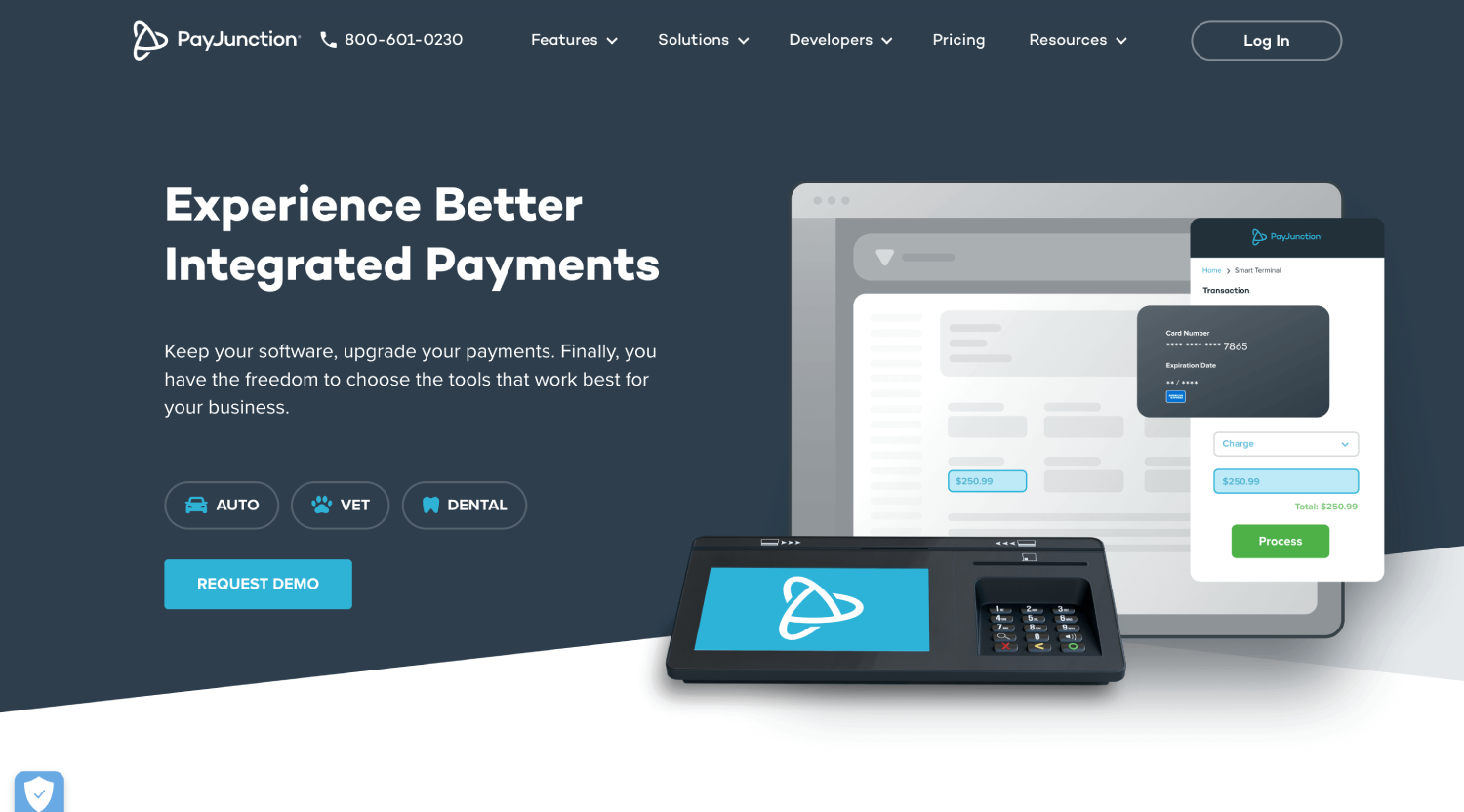
PayJunction occupies a narrower but defensible position in this list. Its payment link API is built primarily for professional service verticals including healthcare, legal, and home services, where the use case is replacing a paper invoice or terminal swipe with a texted or emailed payment link. The platform model here is a software vendor embedding PayJunction’s link generation into their vertical SaaS product.
What distinguishes PayJunction for this use case is its zero-fee ACH processing. According to PayJunction’s public pricing page, that zero-fee ACH applies to payment links as well as terminal transactions. Card transaction pricing and other fees are not publicly listed and vary by merchant agreement. For professional service platforms where average transaction values are $500 or higher, routing customers toward ACH through a payment link can materially reduce the platform’s payment cost. The hosted link page presents both card and ACH options to the payer.
The trade-off is platform account architecture. PayJunction’s partner program is designed for ISVs referring merchants, not for a true multi-tenant platform where a single API key manages hundreds of dynamically created sub-merchant accounts. If your platform needs to generate payment links and route settlement to 200 different businesses through a single API integration, Stripe or Adyen is a better structural fit. PayJunction works well when each merchant is onboarded individually through a reseller relationship.
Best for: Vertical SaaS platforms in professional services where ACH payment links at zero processing cost are a meaningful product differentiator and sub-merchant count is under 50.
4. Paddle Payment Links
Paddle is a Merchant of Record, which means when your SaaS platform uses Paddle’s payment link infrastructure, Paddle is the entity collecting payment from the end customer, handling sales tax, VAT, and chargebacks. The payment link is not just a hosted checkout URL; it carries Paddle’s full tax calculation engine and compliance layer baked in.
For B2B SaaS platforms selling software subscriptions and one-time licenses, Paddle’s payment links API generates a shareable URL tied to a specific price or product. The platform does not need to register for sales tax in 50 US states or manage VAT across the EU. Paddle handles that liability as the seller of record. That is a meaningful operational trade-off if your platform supports sub-merchants selling software to global buyers.
According to Paddle’s public pricing page, the standard rate is 5% plus 50 cents per transaction. That rate is higher than Stripe’s card rate, but it includes tax compliance, payment processing, and chargeback management in one fee. For a software platform with significant cross-border sales exposure, the tax compliance savings can offset the rate premium. For a platform where all buyers are domestic and tax nexus is simple, the premium is harder to justify.
Webhook coverage includes payment.succeeded, payment.refunded, and subscription events at the payment link level. Paddle’s platform model is different from Stripe Connect, since there is no direct sub-merchant settlement architecture. The platform receives net revenue from Paddle after Paddle takes its cut and handles taxes. That settlement model fits software marketplaces but does not fit platforms where sub-merchants need same-day access to their own payment balances.
Our full Stripe vs Paddle merchant of record comparison covers the structural differences between processor and MoR models in more depth, which is worth reading before committing to either architecture.
Best for: B2B SaaS platforms selling software products globally, where the platform wants Merchant of Record coverage and tax compliance built into every generated payment link without building a separate tax integration.
Payment Link API Lifecycle Comparison Table
| API | Link Created via API | Sub-Merchant Routing | Link-Level Webhooks | Hosted Page Branding | ACH Support on Link | MoR Coverage | Pricing (current, per public pricing pages) |
|---|---|---|---|---|---|---|---|
| Stripe (Connect) | Yes | Direct to connected account | Yes, dual fan-out | Custom domain on paid plan | Yes (2.9% + $0.30 cards / 0.8% ACH) | No | 2.9% + $0.30/transaction |
| Adyen (Platforms) | Yes | Balance account routing | Yes, auth and capture | Configurable | Yes | No | Negotiated (no public rate card) |
| PayJunction | Yes | ISV/reseller model | Partial (payment events) | Limited | Yes, $0 ACH fee (confirmed public); card rates not publicly listed | No | Card pricing not publicly disclosed; ACH confirmed at $0 |
| Paddle | Yes | Net settlement to platform | Yes (payment, subscription) | Paddle-branded with product logo | No | Yes | 5% + $0.50/transaction |
How Do SaaS Payment Link Webhooks Actually Work at the Platform Level?
Webhooks on payment links sound simple until you have 200 sub-merchants generating links independently. The event routing architecture is what separates a usable implementation from a debugging nightmare.
Stripe’s model routes events at two levels. The platform account receives all events across all connected accounts in a single stream, each event tagged with the connected account ID. The connected account receives only its own events. Your platform’s event consumer needs to filter by account ID to attribute revenue correctly. This dual-stream architecture means you can build a platform-level dashboard without polling individual account APIs, and each sub-merchant can optionally receive their own webhook feed.
Adyen’s event model routes notifications to the endpoint registered at the platform level, with the balance account reference embedded in the notification body. There is no automatic sub-merchant-level webhook delivery unless the sub-merchant has their own API credentials configured. For most enterprise platforms, that means events go to a central ingestion system and your backend handles fan-out logic. That is more engineering work than Stripe’s native dual-stream, but it also gives you more control over event processing order.
The event that most platforms underestimate is the link expiry event. If a payment link is created with a 48-hour expiry and the customer does not pay, your platform needs to know. Some billing workflows depend on that signal to trigger a follow-up. Stripe fires a payment_link.expired equivalent through the checkout session lifecycle. Adyen’s Pay by Link does not currently document a dedicated expiry webhook, so platforms need to handle expiry through TTL logic on the link creation call and check status via API if needed.
What Is the Right Platform Account Architecture for Generated Payment Links?
The architecture question is less about the payment link API and more about how your platform model maps to the provider’s account structure. There are three common patterns.
In the aggregated model, all sub-merchants settle through your platform’s master account and you redistribute funds via payouts. Stripe Connect’s standard accounts support this. Paddle’s MoR model is a forced version of this. The risk is that your platform holds funds in transit and bears more regulatory weight. Our piece on the best outbound payment APIs for B2B SaaS covers the payout side of this model in detail.
In the direct model, each sub-merchant has their own account with the payment provider and funds settle directly. Stripe Express accounts are the most common implementation. The platform never touches the funds. This reduces regulatory exposure for the platform but requires each sub-merchant to complete KYC with the payment provider. For platforms onboarding SMBs, that friction can hurt conversion.
In the split model, the platform collects and immediately splits: a portion to the sub-merchant, a portion to the platform as a fee. Stripe’s application fee parameter on payment links implements this natively. Adyen’s split configuration handles the same use case. This is the most common architecture for marketplace-style SaaS platforms and the one that makes most payment link APIs relevant to the platform context, since the split logic needs to be specified at link creation time.
Illustrative Scenario: A Field Services SaaS Platform at Scale
Consider a vertical SaaS platform serving 300 HVAC and plumbing contractors. Each contractor closes jobs by texting a payment link to homeowners. Average transaction is $600. The platform takes 0.5% of each transaction as a software fee.
On Stripe Connect with the split model, the platform creates a payment link via API, specifying the contractor’s connected account as the destination and a 0.5% application fee. When the homeowner pays, Stripe settles $597 to the contractor and $3 to the platform account. The platform receives a checkout.session.completed webhook with both IDs attached. No reconciliation query needed. No manual payout to run.
At 300 contractors each generating 15 payment links per month, the platform is processing 4,500 link-initiated payments monthly. At an average of $600, that is $2.7 million in GMV per month. The platform’s 0.5% fee generates $13,500 per month in net revenue from payment links alone, before any subscription revenue. That revenue stream only exists cleanly if the settlement routing is correct at link creation time, not corrected after the fact.
If the platform tried to use a generic invoice API for this workflow, it would need to build its own hosted payment page, manage its own link lifecycle events, and run a separate payout process to distribute funds to each contractor. That is three additional systems. A purpose-built platform payment link API collapses those into one API call and one webhook handler.
Frequently Asked Questions
What is the difference between a payment link API and an invoice API for SaaS platforms?
An invoice API creates a structured document with line items, payment terms, and often PDF generation. A payment link API creates a persistent, shareable URL with lifecycle tracking events, platform account routing, and a hosted payment page. The two are complementary but not interchangeable. If your platform needs to track who opened a link, route settlement to a sub-merchant account, and fire webhooks on link expiry, an invoice API alone will not cover that workflow without significant custom middleware. For a full invoice workflow comparison, see the best invoicing APIs for SaaS platforms.
Can Stripe Payment Links be used on Connect for sub-merchant accounts?
Yes. Stripe lets you create a payment link on behalf of a connected account by passing the connected account ID in the API request header. The hosted payment page URL is generated for that account’s configuration. Settlement goes to the connected account’s Stripe balance, optionally with an application fee splitting revenue to the platform. Webhook events fire to both the platform and the connected account endpoints, with the account ID embedded in the event payload. This is documented in Stripe’s Connect integration guide and is the primary reason Stripe ranks first for multi-tenant platform payment link use cases.
How do SaaS payment link webhooks handle events for 200+ sub-merchants?
The practical approach is to register a single platform-level webhook endpoint that receives events for all connected accounts. Each event payload includes the originating account identifier. Your backend processes the stream and routes events to per-account handlers or writes them to a database keyed by account ID. Stripe’s Connect webhook model does this natively. Adyen routes notifications to a central platform endpoint with the balance account reference in the body. Neither model requires a separate webhook endpoint per sub-merchant, though Stripe does support per-account endpoints if your sub-merchants need direct event access.
Does Paddle’s payment link API support platform sub-merchant routing?
Paddle does not support direct sub-merchant routing in the same way Stripe Connect does. Paddle is a Merchant of Record, so it collects payment from the end buyer and settles net revenue to the platform account after taking its fee and handling tax. Platforms that use Paddle typically receive aggregated payouts, not per-sub-merchant immediate settlement. This model suits software marketplaces where the platform owns the buyer relationship and redistributes earnings on a schedule, not platforms where sub-merchants need real-time access to their own payment balances.
What payment link expiry webhook events are available across these APIs?
Stripe fires checkout session lifecycle events that cover link expiry states, available on connected accounts through platform-level webhook fan-out. Adyen does not currently document a dedicated Pay by Link expiry notification, so platforms need to track expiry via link status polling or TTL logic on creation. PayJunction and Paddle both fire payment completion events but have more limited lifecycle coverage on the pre-payment link states, including open and expiry. If expiry tracking is a first-class feature for your platform’s billing logic, Stripe is currently the strongest implementation.
How does a SaaS platform monetize payment links without becoming a payment processor?
The standard approach is the application fee model, where the platform charges a percentage of each transaction processed through a payment link it generates on behalf of a sub-merchant. Stripe Connect’s application fee parameter implements this directly at link creation time. The platform never holds funds in transit under this model; it receives its fee portion automatically at settlement. Platforms that want to build this revenue stream without the compliance weight of holding funds should use a direct or split settlement model rather than aggregating and re-disbursing. Our breakdown of how fintech companies monetize payments without hurting UX covers the full range of platform monetization patterns.
Which Payment Link API Fits Which Platform Type?
The honest answer is that most SaaS platforms evaluating this decision should start with Stripe Connect. The platform account architecture, the dual-stream webhook model, and the direct sub-merchant settlement are built exactly for the multi-tenant payment link API use case in SaaS platforms. The documentation is comprehensive, the sandbox is functional, and the Connect model is widely understood by fintech engineers. Those are real advantages that reduce integration risk.
Adyen becomes the right answer when platform volume is high enough to justify a contract negotiation, when international payment methods matter at the hosted page level, or when the platform already runs Adyen for its own payments and extending to sub-merchant links is a natural expansion. The engineering overhead is higher, but the acquiring relationships and interchange-plus pricing can materially improve unit economics at scale. Teams evaluating Stripe vs Adyen for B2B SaaS will find that the threshold for Adyen making sense on cost alone is roughly $10 million in annual payment volume, though that number varies by negotiation.
Paddle and PayJunction each serve a narrower brief. Paddle is for software-selling platforms that want compliance offloaded entirely. PayJunction is for vertical SaaS in professional services where ACH payment links are a cost lever. Neither is wrong if the use case matches.
The most expensive mistake in this category is choosing an API based on the checkout experience and discovering six months later that the webhook model does not support the event granularity your billing reconciliation requires. The link lifecycle table above is the right starting point for the conversation. Build the event map before you build the integration.