
TLDR
- Plugging an ACH API into your checkout is not the same as offering pay-by-bank checkout as a consumer payment method. The UX, risk handling, and settlement timing require separate decisions.
- The three providers most relevant to US ecommerce pay-by-bank checkout API evaluation are Stripe (broadest payment stack, ACH built in), Dwolla (checkout-first design), and Modern Treasury (payment operations backbone for teams that need ledgering alongside bank payments).
- Return and dispute handling differs sharply across providers. ACH reversals can take days, and not every provider gives you the same tooling to catch them before they hurt cash flow.
- Settlement speed is a real differentiator: same-day ACH, standard next-day ACH, and RTP are three separate choices, and your provider must support the rail you actually need.
- Pricing is not disclosed publicly for most pay-by-bank checkout products. Expect to negotiate based on volume, return rates, and risk profile.
The three strongest pay-by-bank checkout API providers for US ecommerce are Stripe, Dwolla, and Modern Treasury. Stripe is best for merchants already on its stack who want ACH as an add-on payment method with minimal new infrastructure. Dwolla fits teams building a bank-funded checkout flow from scratch where the UX and return handling need to be explicitly designed. Modern Treasury works for operations-heavy merchants who need payment orchestration, ledgering, and real-time rails alongside ACH in a single API.
Why an ACH API Is Not a Pay-by-Bank Checkout Product
Most merchants searching for a pay-by-bank checkout API have already looked at ACH payment APIs for backend payment automation. That research covers a different problem. An ACH API handles the movement of funds between accounts. A pay-by-bank checkout product handles the moment a consumer decides to pay, verifies their bank account in real time, presents a low-friction UI, and routes the payment while managing return risk.
Those are three separate engineering and product problems collapsed into one phrase. A merchant who solves only the funds-movement part will ship a checkout that asks consumers to type routing and account numbers manually, waits 3 to 5 business days to know if the payment cleared, and has no mechanism to prevent returns from draining cash flow. That is not competitive with a card checkout in 2025.
The gap between “we have ACH” and “we have pay-by-bank checkout” comes down to three things: account verification UX, return risk management, and settlement rail selection. Every provider in this article addresses all three to some degree, but they address them differently. The right fit depends on where you are in your payment stack and what your customers expect at checkout.
If you are still evaluating whether to build on a raw ACH API versus a full checkout layer, the ACH payment APIs for vertical SaaS comparison covers the lower-level infrastructure decision in more depth.
What Should a Pay-by-Bank Checkout Product Actually Do?
Before evaluating providers, it helps to define what “pay-by-bank checkout” requires in a US ecommerce context. The FintechSpecs Pay-by-Bank Readiness Test breaks this into four layers, and any provider you shortlist should pass all four.
Layer 1: Real-Time Account Verification
Consumers cannot be expected to enter routing and account numbers at checkout. The standard today is instant account verification via bank login, powered by aggregators like Plaid, MX, or Stripe Financial Connections. This step confirms the account exists, checks that it belongs to the person paying, and optionally reads the available balance before the payment is submitted.
Layer 2: Return Risk Controls
ACH returns are the defining operational risk of bank-funded checkout. Return codes like R01 (insufficient funds), R02 (account closed), and R10 (unauthorized) can hit days after the payment appears to succeed. A checkout-grade provider needs either a prefunded float, risk-based return scoring, or both. Without this layer, your ACH checkout is just moving the dispute problem from chargebacks to returns.
Layer 3: Settlement Rail Choice
Standard ACH settles next business day for credits. Same-day ACH settles the same day for an additional per-transaction fee. RTP (The Clearing House’s Real-Time Payments network) settles in seconds, 24/7, but cannot be reversed once sent, which shifts the risk model entirely. Your provider needs to support whichever rail your business model requires.
Layer 4: Consumer-Facing UX Components
This is what most ACH API providers skip entirely. A checkout product should include a prebuilt or embeddable UI for the bank selection and login step, a clear disclosure for the consumer, and a confirmation state that shows pending settlement without alarming the buyer. Building all of this from a raw API adds significant frontend engineering time.
Which Pay-by-Bank Checkout Providers Work for US Ecommerce?
1. Stripe
Stripe is the default starting point for any merchant already running card payments on Stripe’s stack. Its ACH Direct Debit product is integrated into Stripe Checkout and Payment Intents, which means adding bank payment as a checkout option does not require a separate vendor relationship or a separate integration path.
Account verification is handled through Stripe Financial Connections, which covers the major US banks and uses bank login for instant verification rather than microdeposits. For merchants who cannot afford a 2 to 3 day microdeposit verification window at checkout, this matters.
Return risk management on Stripe ACH is real but limited. Stripe does not absorb ACH return losses by default. The merchant bears the return risk, and Stripe will debit the merchant account for returned payments. Stripe does offer balance checks through Financial Connections for supported banks, which reduces R01 exposure, but this is not a full guarantee product. Merchants with high average order values or first-time buyers should layer in additional return risk controls independently.
Settlement defaults to standard ACH timing (1 to 2 business days after the charge initiates), with the payment typically appearing as pending. Same-day ACH is available on Stripe for an additional fee; the exact per-transaction cost is not publicly listed on Stripe’s ACH pricing page and varies by account type and volume.
The honest limitation is that Stripe’s ACH checkout UX is functional but not specialized. It is built to serve card-first merchants adding bank payments as an option, not merchants building a bank-payment-first checkout experience. Teams that want a bank payment UI that feels native rather than secondary should evaluate Dwolla.
2. Dwolla
Dwolla takes a different approach. Its product is a payments API purpose-built for bank transfers, not a card processor with ACH added on. That distinction matters for teams designing a bank-payment-first checkout experience.
Dwolla’s account verification integrates with Plaid, MX, and other open banking providers out of the box, giving merchants flexibility on the bank data layer rather than locking them into one aggregator. For merchants who already have a Plaid relationship or want to compare aggregators on coverage and cost, this is a meaningful architectural advantage. The Plaid vs MX vs Finicity comparison covers the aggregator-level tradeoffs in more detail.
Return handling is more explicit in Dwolla’s model. Dwolla surfaces return codes directly in its webhook events, and its documentation addresses how merchants should build return logic into their payment flows. Dwolla does not absorb return risk on behalf of merchants, but the tooling for managing returns is better documented than most alternatives.
Settlement rails include standard ACH, same-day ACH, and RTP. Dwolla’s support for real-time payments via RTP is relevant for merchants where immediate payment confirmation changes the fulfillment model, such as digital goods delivery or same-day service bookings.
Dwolla does not publish its pricing publicly. According to Dwolla’s website, pricing is custom and based on transaction volume and use case. This is consistent with what B2B-focused payment APIs charge at scale, but it means smaller merchants or early-stage teams will need to go through a sales conversation to get a number. The lack of a public pricing tier is a friction point for merchants trying to model unit economics before committing.
One real trade-off: Dwolla does not include prebuilt consumer-facing UI components in the way a hosted checkout product does. Merchants are integrating a payment API and building their own checkout UI on top of it. Teams without frontend engineering capacity should factor that build time into the evaluation.
3. Modern Treasury
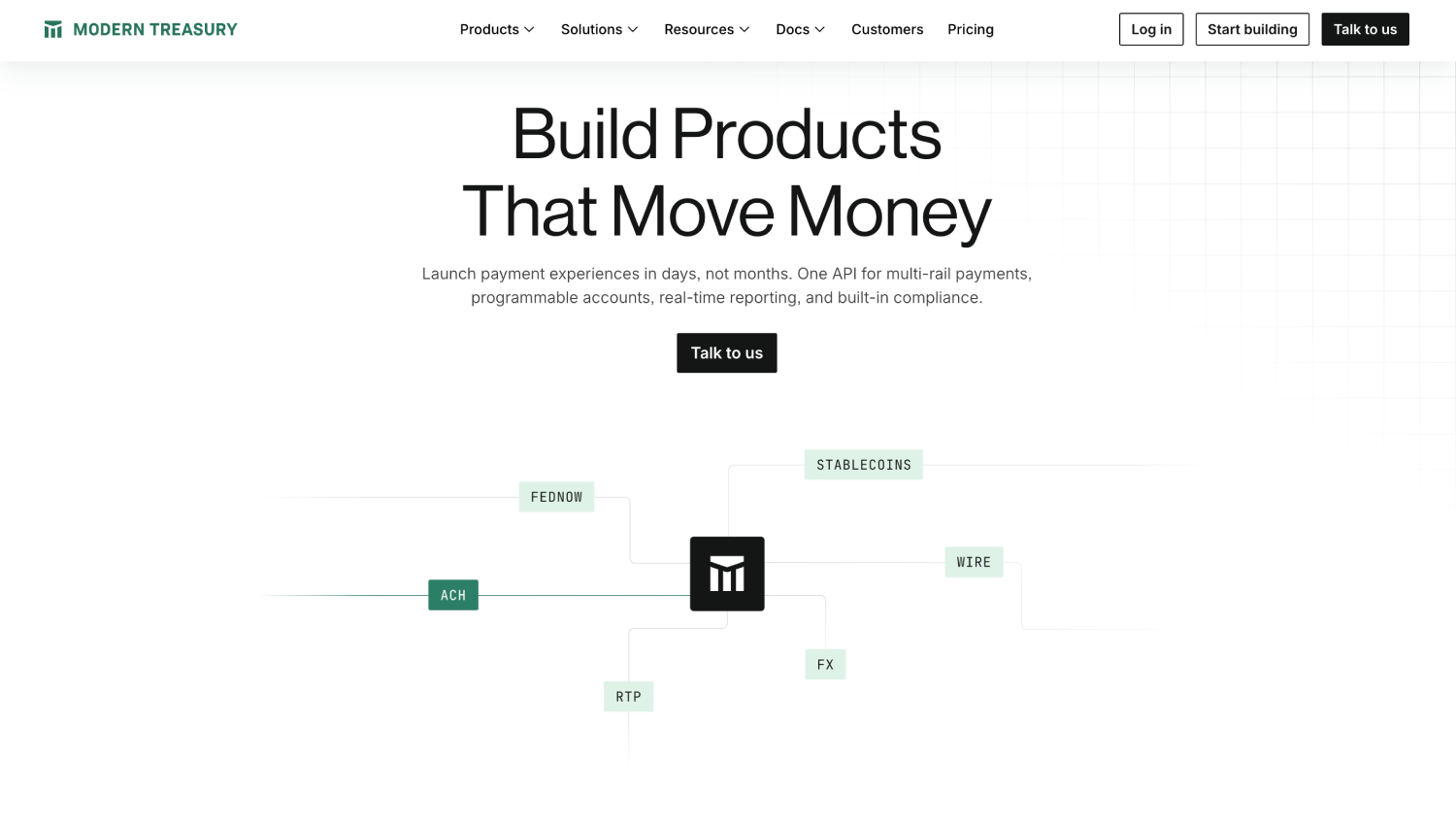
Modern Treasury is not a checkout product in the traditional sense. It is a payment operations platform that handles payment initiation, ledgering, reconciliation, and return management across ACH, RTP, wire, and other rails. For certain ecommerce merchants, that distinction actually makes it the right choice.
The merchants who belong on Modern Treasury are running high volumes of bank payments where the reconciliation and ledger state matter as much as the payment initiation itself. Think subscription businesses collecting large recurring ACH payments, marketplaces disbursing and collecting funds from multiple parties, or any merchant where a payment that returns three days later has downstream effects on account balances, fulfillment states, or compliance records.
Modern Treasury’s return handling is the most sophisticated of the three providers here. Its ledger API tracks payment state in real time, marks returns against the correct ledger entries automatically, and gives finance teams a clean audit trail without manual reconciliation. For a business doing significant volume, the operational cost savings on reconciliation alone can justify the platform fee.
Account verification is handled via integrations with Plaid and other bank data providers. Modern Treasury does not build or maintain its own aggregator, so the verification layer is a configuration choice the merchant makes during setup.
Settlement rails include ACH, same-day ACH, RTP, and wire. Modern Treasury’s instant payment API coverage across FedNow and RTP is documented and production-tested, which matters for merchants who need real-time rails at scale.
Pricing is not publicly listed. Modern Treasury is an enterprise-grade product, and its pricing reflects that positioning. Smaller merchants processing occasional ACH transactions will find better unit economics elsewhere.
How Do These Three Providers Compare on the Dimensions That Matter?
| Dimension | Stripe | Dwolla | Modern Treasury |
|---|---|---|---|
| Account Verification | Stripe Financial Connections (proprietary) | Plaid, MX, and others (merchant’s choice) | Plaid and others (merchant’s choice) |
| Return Risk Management | Merchant bears risk; balance checks available | Merchant bears risk; detailed return event webhooks | Merchant bears risk; ledger-integrated return tracking |
| Settlement Rails | Standard ACH, same-day ACH | Standard ACH, same-day ACH, RTP | Standard ACH, same-day ACH, RTP, wire |
| Consumer-Facing UX | Included in Stripe Checkout | API only, merchant builds UI | API only, merchant builds UI |
| Ledgering and Reconciliation | Basic, via Stripe Dashboard | Standard payment events | Native double-entry ledger API |
| Pricing Model | Per-transaction (ACH pricing via Stripe’s ACH pricing page; exact per-transaction cost not publicly listed) | Custom, volume-based | Custom, enterprise |
| Best Fit | Stripe-native merchants adding bank payments | Bank-first checkout builders | High-volume ops-heavy merchants |
What Does ACH Return Risk Actually Cost at Checkout Scale?
Consider a merchant running $500,000 per month in ACH checkout volume with an average order value of $200. At a 1% return rate , Nacha’s operational guidance suggests overall return rates above 3% trigger ODFI review, and industry experience with first-time consumer ACH puts typical returns well below that ceiling but meaningfully above zero , that is $5,000 per month in returned payments. If returns are not caught before goods ship or digital access is granted, the merchant bears the full loss plus the ACH return fee from their provider.
At 2% returns, the number is $10,000 per month. That is enough to make ACH checkout economically worse than card payments for merchants in categories with higher fraud or insufficient-funds risk, even after accounting for lower ACH processing fees. This illustrative scenario is why return risk controls are not an optional feature for pay-by-bank checkout. They are the central operational design question.
None of the three providers above guarantee returns. They differ in how much tooling and visibility they give the merchant to manage return exposure before it compounds. Stripe offers balance checking as a signal. Dwolla gives granular return event data for building custom logic. Modern Treasury tracks return state in a ledger that can trigger downstream actions automatically. The sophistication of your return handling should match your volume and your engineering capacity to act on it.
Merchants evaluating this trade-off in the context of their broader fraud stack should read the fraud prevention versus user experience trade-off in fintech framework, which covers how to set thresholds without killing conversion.
How Does Pay-by-Bank Checkout Affect Conversion Compared to Cards?
Bank payment conversion at checkout is lower than card payment conversion for most consumer categories. Consumers are accustomed to cards. Adding a bank login step creates friction, and not every consumer bank is covered by every aggregator, which produces a subset of would-be buyers who cannot complete the flow at all.
The case for pay-by-bank checkout is not conversion parity with cards. It is margin improvement for the merchant on transactions that do convert, plus access to consumer segments who prefer or are more likely to pay via bank (recurring billing, high-AOV categories, customers without cards).
Stripe’s hosted checkout gives merchants the ability to present both card and ACH as options in the same flow, letting the consumer choose. For merchants adding bank payments to an existing card checkout, this approach avoids cannibalizing card conversion by keeping both options visible. Dwolla and Modern Treasury require the merchant to decide which payment method to present and when, which is more work but also more control.
The practical advice: do not launch pay-by-bank as a card replacement unless your category and customer base clearly support it. Launch it as an additional option, measure conversion and return rates separately, and optimize from real data rather than theoretical savings on interchange.
What Are the Compliance and Licensing Considerations for US Pay-by-Bank Checkout?
ACH payments in the US operate under Nacha rules. Merchants initiating ACH transactions are classified as originators and are subject to Nacha’s operating rules, which include requirements around authorization language, return rate thresholds, and data security.
Return rate thresholds are the compliance dimension most merchants underestimate. Nacha sets maximum return rate limits for unauthorized returns (0.5%) and overall returns (3%). Merchants who consistently exceed these thresholds can be suspended from ACH origination by their bank. This is not a theoretical risk. It is an operational guardrail that makes return rate management a compliance function, not just a finance function.
All three providers in this article operate as or through ODFI-connected infrastructure, meaning the compliance layer is handled at the bank level. But the merchant’s authorization practices, return rates, and dispute handling all affect that relationship. Getting the compliance fundamentals right before scaling ACH volume is worth the upfront work. The fintech product and compliance readiness checklist covers the authorization and recordkeeping requirements in detail.
Frequently Asked Questions
What is the difference between a pay-by-bank checkout API and a standard ACH API?
A standard ACH API handles the movement of funds between bank accounts and is typically used for backend payment automation, payouts, or B2B billing. A pay-by-bank checkout API adds the consumer-facing layer: real-time bank account verification via bank login, a checkout UI, return risk controls, and settlement rail selection. Merchants who integrate only an ACH API typically end up with a manual account-entry flow, slow settlement confirmation, and no mechanism to manage ACH returns at scale.
Which US pay-by-bank checkout provider has the fastest settlement?
Dwolla and Modern Treasury both support RTP (Real-Time Payments) through The Clearing House, which settles in seconds and operates 24/7. Stripe supports standard ACH and same-day ACH but does not currently support RTP for outbound merchant receipts in its standard checkout product. If same-day or real-time settlement is a business requirement, Dwolla or Modern Treasury should be on your shortlist. Note that RTP payments cannot be reversed once sent, which shifts the return risk model significantly compared to ACH.
What ACH return rate will trigger compliance issues with Nacha?
Nacha’s rules set a maximum unauthorized return rate of 0.5% for the codes R05, R07, R10, R29, and R51. The overall administrative return rate cap is 3% for codes R02, R03, and R04. Merchants who breach these thresholds risk being identified as a potential risk by their ODFI (originating bank) and can lose ACH origination access. Monitoring your return rates by code, not just in aggregate, is the correct operational practice for any merchant processing meaningful ACH volume at checkout.
Does pay-by-bank checkout work for one-time purchases or only subscriptions?
Pay-by-bank checkout works for both. Subscriptions and recurring billing are the most common use case because ACH authorization can be stored and reused, making the per-transaction cost low after the initial setup. One-time purchases are possible but require real-time account verification at the point of sale, which adds UX friction. For one-time purchases above approximately $500, the lower processing cost versus cards often justifies the added checkout step, particularly for categories like home goods, software licenses, or professional services where consumers expect a less card-centric flow.
Is Stripe’s ACH checkout sufficient for a high-volume ecommerce merchant?
Stripe’s ACH Direct Debit is sufficient for merchants processing moderate ACH volumes who want bank payments as one option alongside cards, without building separate payment infrastructure. At high volumes, the limitations become visible: Stripe’s return management tooling is less granular than Dwolla’s, and its ledgering is not designed for the reconciliation complexity that high-volume ACH generates. Merchants processing tens of thousands of ACH transactions per month, or those where ACH is the primary payment method rather than a secondary one, should evaluate Dwolla or Modern Treasury for the operational layer.
Can I use a pay-by-bank checkout API without a money transmitter license?
In most cases, yes. Merchants accepting ACH payments for their own goods and services operate as ACH originators under their ODFI’s sponsorship, not as money transmitters. The licensing requirement for a money transmitter license applies to platforms that hold or move funds on behalf of third parties, such as marketplaces or payment facilitators. If you are a direct merchant accepting payment for your own products, you typically do not need a money transmitter license to offer ACH checkout. Platforms enabling other merchants to accept ACH should consult legal counsel, as the licensing analysis differs by state and business model.
What bank coverage should I expect from a pay-by-bank checkout product in the US?
Bank coverage depends on the account verification layer, not the ACH provider itself. Plaid’s public documentation lists coverage across thousands of US financial institutions, though instant bank login (as opposed to microdeposits) is available for a subset of that total. Stripe Financial Connections covers the major US banks for instant verification. Smaller regional banks and credit unions may fall back to microdeposit verification or manual entry in some flows, which means a portion of your customers will face a slower verification path regardless of which checkout provider you choose. For a detailed look at how the major aggregators compare on coverage, see the Plaid alternatives and bank data connectivity comparison.
How do I evaluate pay-by-bank checkout providers before signing a contract?
Run the FintechSpecs Pay-by-Bank Readiness Test: confirm each provider’s account verification method and coverage, ask explicitly how returns are handled and who bears the financial exposure, verify which settlement rails are available and at what per-transaction cost, and determine whether a prebuilt checkout UI is included or whether your engineering team must build it. Request sandbox credentials and test a full payment-to-return cycle before committing. The fintech vendor evaluation framework covers contract and due diligence steps that apply directly to this category.
The Decision Comes Down to One Question Before the Others
Before evaluating features, every merchant selecting a pay-by-bank checkout API for US ecommerce should answer one operational question: who bears the return risk, and do you have the systems to manage it? None of the three providers in this article take that risk off your balance sheet. They differ in how much visibility and tooling they give you to control it. If your average order value is low, your buyers are repeat customers, and you have balance-check verification turned on, return exposure is manageable. If you are selling high-AOV goods to first-time buyers, the return math can undermine the economics of offering ACH checkout entirely.
The separation between ACH infrastructure and pay-by-bank checkout as a product category is real, and it has practical consequences for merchants. Stripe is the right choice if you are adding bank payments to an existing card-first checkout and want one vendor. Dwolla is the right choice if the checkout experience itself should be bank-payment-native, with flexibility on verification and real-time settlement. Modern Treasury is the right choice if payment operations, ledgering, and reconciliation are as important as the payment initiation itself.
The merchants who get the most out of pay-by-bank checkout are the ones who treat it as a product decision, not just an API integration. That means designing the authorization flow, testing the return handling before launch, and measuring conversion and return rates separately from the rest of the payment stack. Merchants who skip that work tend to discover the operational complexity of ACH returns at exactly the wrong moment: after volume has scaled.