
TLDR
- Renegotiating processor rates addresses markup, not interchange. The larger cost lever is qualifying transactions at a lower interchange category by submitting complete Level 3 card data fields on every eligible B2B sale.
- Level 3 data requires passing line-item detail, commodity codes, tax amounts, and ship-to information at the point of authorization or settlement. Missing even one required field drops the transaction to a higher-cost interchange tier.
- The gap between a Level 2 and Level 3 interchange rate on a corporate card can be meaningful on large-ticket B2B transactions. The exact rate depends on the card network, card type, and transaction size.
- Visa, Mastercard, and their respective issuing banks each publish interchange tables that govern which fields qualify a transaction. Any software claim about savings must be verified against current published rates for your specific card mix.
- A fee audit is retrospective. If you have been accepting commercial cards without passing Level 3 data, you can estimate what qualification would have saved before you buy any software.
B2B interchange optimization software for Level 3 data captures and transmits the extended transaction fields, such as line-item descriptions, quantity, unit of measure, commodity codes, and customer reference numbers, that card networks require before they will qualify a commercial card transaction at their lowest published interchange rates. Three vendors dominate the shortlist for B2B suppliers: PaymentWorks, Corcentric, and Billtrust. Each handles data capture and enrichment differently, and processor compatibility determines which one actually works for your stack.
Why Do Level 3 Card Data Fields Change What You Pay in Interchange?
Card networks publish tiered interchange schedules. A corporate purchasing card or government card that settles without Level 3 data fields downgrades automatically to a standard commercial rate. That downgrade is not a processor decision. It is a network rule baked into the interchange tables that Visa and Mastercard publish publicly each year.
Level 1 data is what every transaction submits: merchant name, date, amount. Level 2 adds tax amount, customer code, and postal code. Level 3 adds line-item detail for every product or service on the invoice: quantity, unit price, commodity code (typically an UNSPSC or similar code), product description, ship-from and ship-to postal codes, and in some programs a freight amount. Each field has a format requirement. A malformed commodity code fails the same as a missing one.
The practical implication for a B2B supplier is that most payment gateways and ERPs do not pass Level 3 fields by default, even when that data already exists in your order management system. Interchange optimization software exists to close that gap, either by enriching outbound authorization requests in real time or by re-submitting settlement batches with complete data before the settlement window closes.
What Is the Level 3 Data Qualification Table for Visa and Mastercard?
Interchange rates change periodically, and the exact basis points that separate Level 2 from Level 3 vary by card type, ticket size, and program. The table below reflects the general structural hierarchy. For current published rates, refer directly to Visa’s interchange reimbursement fee page and Mastercard’s interchange rate page, which both update rates periodically and represent the authoritative source for qualification.
| Data Level | Minimum Required Fields | Eligible Card Types | Interchange Tier |
|---|---|---|---|
| Level 1 | Merchant name, date, total amount | All cards | Standard commercial (highest cost) |
| Level 2 | Tax amount, customer code, postal code | Purchasing, corporate, government | Reduced commercial |
| Level 3 | All Level 2 fields plus line-item detail, commodity codes, ship-to/from postal codes, unit price, quantity | Purchasing, corporate, government (Visa/MC only) | Lowest published B2B rate |
American Express handles large and middle market corporate cards through its own proprietary rate structure. AmEx does not participate in the same Level 3 interchange framework as Visa and Mastercard. If your commercial card volume includes significant AmEx spend, the interchange optimization math looks different, and you should verify qualification criteria directly with American Express.
The FintechSpecs B2B Interchange Qualification Audit: Four Checks Before You Buy Software
Before evaluating any vendor, run what we call the B2B Interchange Qualification Audit. It takes roughly two weeks using data you already have, and it frames the software decision around actual recoverable cost rather than vendor-quoted percentages.
Check 1 , Card type mix. Pull your last 90 days of processor statements and isolate every transaction on a corporate, purchasing, or government card. Consumer Visa and Mastercard cards do not qualify for Level 3 rates even if you submit every field. If commercial cards represent a small share of your volume, the addressable cost gap shrinks proportionally.
Check 2 , Current qualification rate. Your processor statement should show downgrade codes or non-qualified buckets. If more than 20 percent of commercial card transactions are settling at non-qualified or standard commercial rates, Level 3 data submission is almost certainly the reason.
Check 3 , Gateway compatibility. Level 3 data must be submitted through a payment gateway or processor that supports it. Not all do. Confirm your current gateway supports Level 3 fields for both Visa and Mastercard before signing any enrichment software contract. Gateway and payment infrastructure compatibility is the single most common reason Level 3 implementations stall.
Check 4 , Source data availability. Does your ERP, order management system, or billing platform already capture commodity codes, quantity, and line-item descriptions? If that data exists, an enrichment layer can map and transmit it. If your invoicing system does not capture it at all, you need data entry tooling upstream, not just transmission software.
Which Vendors Handle B2B Interchange Optimization Software for Level 3 Data?
The market for dedicated Level 3 card data optimization software is narrower than the broader payments space. Most general-purpose gateways offer Level 3 field support as a configuration option, not as a managed optimization service. The vendors below operate specifically in the B2B card data enrichment and interchange optimization space.
1. Billtrust
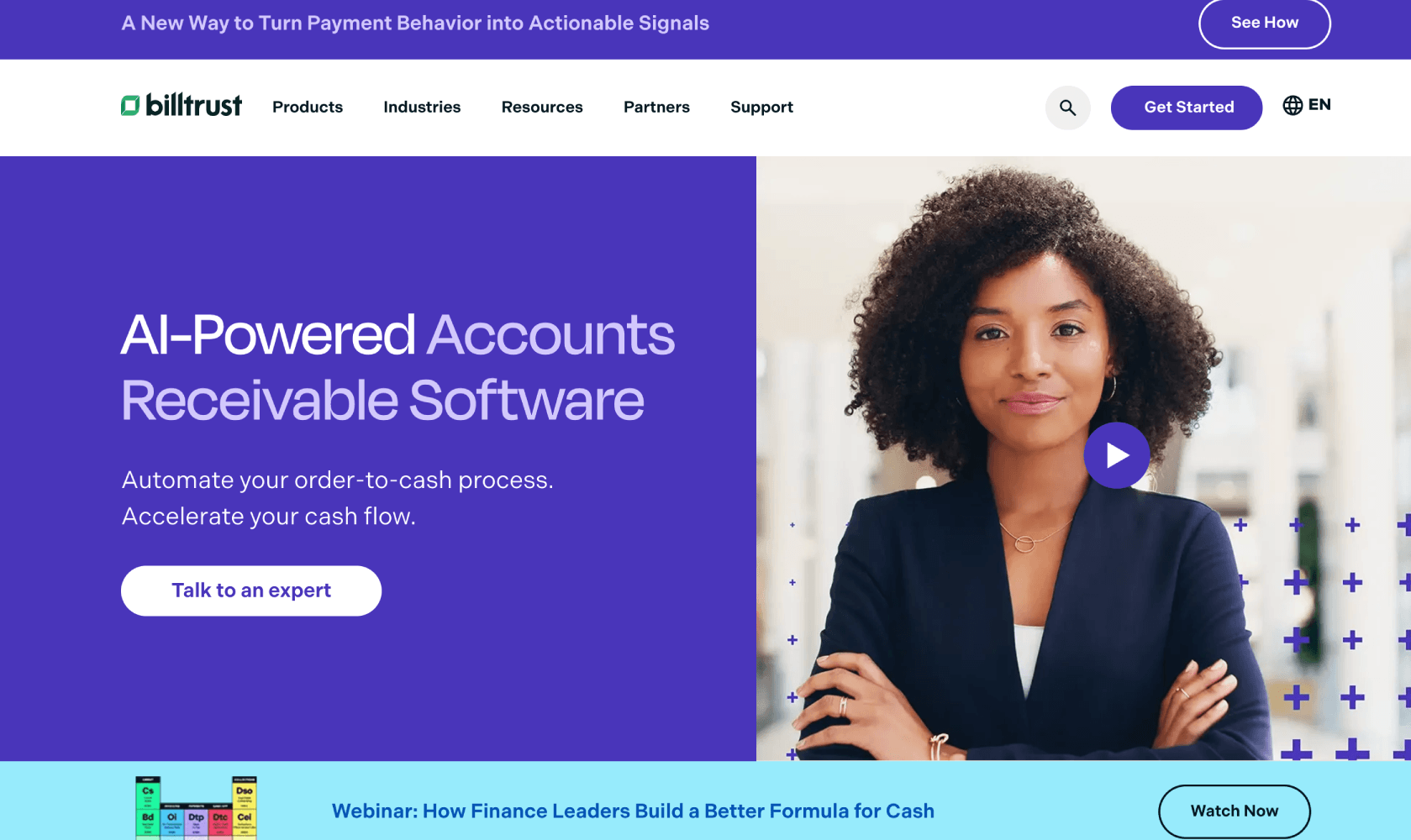
Billtrust focuses on B2B order-to-cash automation and includes Level 2 and Level 3 data optimization as part of its payment acceptance module. The core product captures invoice-level data and maps it to card network field requirements at settlement. For suppliers already using Billtrust for electronic invoicing and cash application, the Level 3 optimization layer works from invoice data that already exists in the system rather than requiring a separate enrichment workflow.
Billtrust integrates with major ERP platforms including SAP, Oracle, and Microsoft Dynamics. The platform also handles the downstream reconciliation, which matters because Level 3 settlement data is more granular and requires matching at the line-item level. If reconciliation is a friction point for your finance team, the payment reconciliation workflow integration is worth evaluating during the demo.
Billtrust does not publicly disclose per-transaction pricing for its Level 3 optimization module. Pricing is contract-based and varies by annual card volume. Prospective buyers should request a statement of work that ties fees to qualified transaction volume rather than total card volume, since only commercial card transactions are eligible for the rate benefit.
2. Corcentric
Corcentric approaches Level 3 optimization from the accounts payable and procurement side of the transaction, which makes it more relevant to companies that both issue and accept commercial cards. On the acceptance side, Corcentric’s payment services layer handles Level 2 and Level 3 data enrichment for suppliers receiving corporate purchasing cards from buyers in its network.
The practical advantage Corcentric offers is network effect. When both buyer and supplier operate within the Corcentric network, the transaction data needed for Level 3 qualification, including PO numbers, line-item descriptions, and commodity codes, flows through the platform without requiring custom integration on either side. For suppliers selling to large enterprise buyers that already use Corcentric’s procurement tools, this reduces implementation friction substantially.
Corcentric does not publish per-transaction or module-level pricing publicly. It operates on enterprise contracts. The vendor is best suited to mid-market and enterprise B2B suppliers with structured procurement relationships rather than suppliers with a broad, diverse SMB buyer base. Corcentric’s public positioning confirms enterprise as its target segment, though it does not publish minimum volume thresholds.
3. EVO Payments (now part of Global Payments) with Level 3 Optimization
Global Payments completed its acquisition of EVO Payments in March 2023 and offers Level 3 data processing through its B2B-focused payment acceptance products. Rather than a standalone enrichment layer, Global Payments bakes Level 3 handling into its gateway and processing stack for commercial card acceptance. For companies that want a single vendor to handle both processing and Level 3 qualification rather than layering an optimization tool on top of an existing processor, this is the structural difference.
The trade-off is portability. When Level 3 logic sits inside your processor rather than in a middleware layer, switching processors later means rebuilding the enrichment workflow. For businesses that prioritize simplicity over flexibility, that trade-off is acceptable. For companies that may want to run multiple processors or route by card type, a processor-agnostic enrichment layer is a better architecture. See the broader comparison of payment orchestration approaches for how that routing logic works in practice.
Global Payments does not publish interchange optimization pricing separately from its processing rates. All pricing is quote-based and negotiated based on volume and vertical. For current pricing, contact Global Payments directly through their sales inquiry page.
How Do These Three Tools Compare on the Criteria That Actually Matter?
| Criterion | Billtrust | Corcentric | Global Payments |
|---|---|---|---|
| Primary use case | AR automation, supplier-side acceptance | Procurement and AP/AR, network buyers | Payment processing, gateway-level enrichment |
| Level 3 data approach | Enrichment from invoice data | Pass-through from buyer-side platform | Gateway-integrated at settlement |
| ERP integration | SAP, Oracle, MS Dynamics | SAP Ariba, Coupa, internal procurement | Varies by gateway integration |
| Processor agnostic? | Partial (own gateway) | Partial (own network) | No (processor-native) |
| Best fit | Mid-market B2B suppliers, AR teams | Suppliers with enterprise procurement buyers | Companies consolidating processor and enrichment |
| Pricing model | Contract, not publicly disclosed | Contract, not publicly disclosed | Quote-based processing agreement |
What Are the Most Common Reasons Level 3 Qualification Fails in Practice?
Software alone does not guarantee Level 3 qualification. The most common failure modes are operational, not technical.
Commodity code errors account for a large share of failed qualifications. Each line item requires a valid UNSPSC, SIC, or network-accepted commodity code. If your team maps product categories manually or uses legacy codes that have been retired, the transaction fails validation and downgrades. Any enrichment tool you evaluate should show you its commodity code validation logic and explain how it handles unmapped SKUs.
Settlement timing is another common issue. Level 3 data must accompany the settlement batch, not just the authorization. Some gateways allow a re-submission window of 24 to 72 hours after authorization for Level 3 enrichment. If your fulfillment or invoicing system generates line-item data after the settlement window closes, the transaction cannot be re-qualified retroactively. The software you choose needs to integrate with your order management timeline, not just your payment gateway.
Partial data on split shipments creates a third failure mode. If a buyer places a single purchase order that ships in multiple batches, each settlement must carry the line-item data corresponding to that specific shipment. Many suppliers submit the full PO data against the first settlement and nothing against subsequent ones. Each partial shipment settlement must be treated as a standalone Level 3 submission.
How Does a Retrospective Fee Audit Work Before Choosing a Vendor?
Before committing to a software contract, run a retrospective audit on three to six months of processor statements. The goal is to quantify how much interchange you paid at non-qualified commercial rates on transactions that would have qualified for Level 3 rates had you submitted complete data. This number gives you a realistic ceiling for what any optimization tool can recover, and it makes vendor ROI claims verifiable rather than hypothetical.
The following is a walkthrough scenario, not a real case study. Say a B2B distributor processes $3 million per month in commercial card volume. If 40 percent of that volume consists of corporate purchasing cards that settled at standard commercial rates rather than Level 3 rates, the addressable volume is $1.2 million per month. The difference in interchange between a standard commercial rate and a Level 3 rate varies by card program and is published in Visa and Mastercard’s current interchange tables. Apply that difference to your addressable volume, subtract the monthly software cost, and you have a rough payback calculation.
This estimate is a floor, not a guarantee. Not all commercial cards in your mix will be eligible. Some transactions may have characteristics that prevent Level 3 qualification regardless of data completeness. Any vendor quoting you a specific savings figure should be able to show you their methodology against your actual statement data, not just an industry average.
Finance teams running this analysis sometimes discover that their processor is already failing to pass Level 2 data correctly, let alone Level 3. That finding changes the priority order: fix the Level 2 submission first, then layer in Level 3 enrichment. For a fuller look at how payment operations and cost management intersect, the hidden costs that compress B2B payment margins piece covers related fee structures worth understanding before you audit your statements.
Does Level 3 Data Apply to International Commercial Card Transactions?
Level 3 interchange rates apply to US domestic commercial card transactions processed through Visa and Mastercard. Cross-border transactions do not qualify for the same Level 3 rate categories because international interchange is governed by separate rate schedules that do not include the same data-level qualification structure.
If your B2B card volume includes non-US-issued commercial cards, those transactions will not benefit from Level 3 optimization regardless of what data you submit. Segment your statement analysis to isolate domestically issued commercial cards before calculating the addressable opportunity.
Frequently Asked Questions
What specific fields are required for Level 3 card data?
Visa and Mastercard each publish their own field requirements, and the exact list varies slightly between networks. At minimum, Level 3 requires all Level 2 fields (tax amount, customer code, merchant postal code) plus line-item detail for every item on the invoice: item description, quantity, unit of measure, unit price, commodity code, ship-from postal code, ship-to postal code, and in some programs a discount amount and freight amount. Missing or malformed fields fail the same as missing fields. Always verify required fields against the current network specifications for your gateway, since networks update requirements periodically.
Can I submit Level 3 data through Stripe or other standard payment processors?
Stripe supports Level 2 card data for eligible US corporate and purchasing cards through its payment intents API. Level 3 line-item data submission has not been part of Stripe’s standard documented offering based on publicly available API documentation, though Stripe’s product capabilities evolve and you should verify current support directly with Stripe or via their developer documentation before making a processor decision. Processors with documented Level 3 support include Worldpay, Fiserv, and TSYS, among others. Before selecting an enrichment tool, confirm that your processor’s API accepts and passes Level 3 fields to the card networks. For more on how payment processor capabilities differ across B2B stacks, the Stripe versus Adyen comparison for B2B SaaS covers relevant infrastructure trade-offs.
How do I know if my commercial card transactions are currently downgrading?
Your monthly processor statement should show interchange categories for each transaction batch. Look for line items labeled as “commercial standard,” “non-qualified,” “EIRF” (Electronic Interchange Reimbursement Fee), or “standard” in the interchange summary section. These categories indicate transactions that did not qualify for preferred Level 2 or Level 3 rates. Some processors provide interchange detail at the transaction level in their reporting portal. If your processor does not break out interchange by qualification category, request a detailed interchange report or consider whether the processor relationship itself is worth reviewing.
Are Level 3 interchange rates better for Visa or Mastercard commercial cards?
Both Visa and Mastercard offer Level 3 reduced interchange rates for qualifying commercial cards, and both publish these rates in their annual interchange tables. The rate difference between Level 2 and Level 3 qualification varies by card program, ticket size, and merchant category code. Neither network is universally “better.” The benefit you see depends on the mix of Visa versus Mastercard commercial cards in your transaction volume and the specific card products your buyers use. Run the analysis against your actual card mix rather than relying on network-level generalizations.
What is B2B interchange qualification and how is it different from card acceptance?
Card acceptance means you can process a commercial card transaction and receive funds. B2B interchange qualification means that transaction settles at the lowest interchange tier your card mix is eligible for. Acceptance is binary. Qualification is a spectrum. A transaction on a corporate purchasing card can be accepted regardless of data quality, but it will only reach Level 3 interchange rates if you submit complete line-item data in the format the card network requires. Most B2B suppliers accept commercial cards but qualify very few at Level 3, leaving the interchange gap in their processor’s pocket.
How long does it take to implement a Level 3 data enrichment tool?
Implementation timelines vary by vendor and by how much data mapping work is required on your side. If your ERP or order management system already captures commodity codes and line-item data in a structured format, a typical integration takes four to twelve weeks. If commodity code mapping requires manual work or your product catalog lacks structured line-item data, expect the timeline to extend to three to six months. The vendor’s pre-sales process should include a data readiness assessment. If they skip that step and quote a standard timeline, treat it as a red flag.
The Two Things That Determine Whether This Is Worth Your Time
Level 3 interchange optimization only makes economic sense when two conditions exist simultaneously: a meaningful share of your card volume comes from corporate purchasing cards or government cards on Visa or Mastercard, and those transactions are currently settling below their eligible interchange tier. If your commercial card mix is small or your processor is already passing Level 3 data correctly, there is no gap to close.
The retrospective audit described earlier is not optional groundwork. It is the analysis that separates a real procurement decision from a speculative one. Any vendor that asks you to sign before showing you the qualification gap in your own statement data should not be on your shortlist. The numbers are there in your processor reports. Pull them first.
Once you have a qualified addressable volume figure, the vendor choice follows logically. Billtrust fits suppliers who need Level 3 optimization as part of a broader AR automation investment. Corcentric fits suppliers embedded in enterprise procurement networks where buyer-side data already flows through the platform. Global Payments fits companies that want to consolidate enrichment inside their processing relationship rather than manage a separate middleware layer. None of those is universally the right answer. The right answer is the one that closes the specific qualification gap your audit uncovered, on the processor and gateway stack you already operate.