
TLDR
- Billing engines process charges; they do not audit whether every chargeable event actually reached an invoice. That gap is where revenue leakage lives.
- Alguna targets contract-to-invoice reconciliation for teams with complex enterprise agreements and manual billing workflows.
- xfactrs focuses on usage-event auditing, catching unbilled usage before it falls through the cracks between your metering layer and your billing engine.
- Trullion sits closest to the accounting and revenue recognition layer, flagging leakage that shows up as ASC 606 discrepancies rather than missing invoices.
- The right tool depends on where your records diverge: contract versus invoice, usage event versus billing record, or recognized revenue versus cash collected.
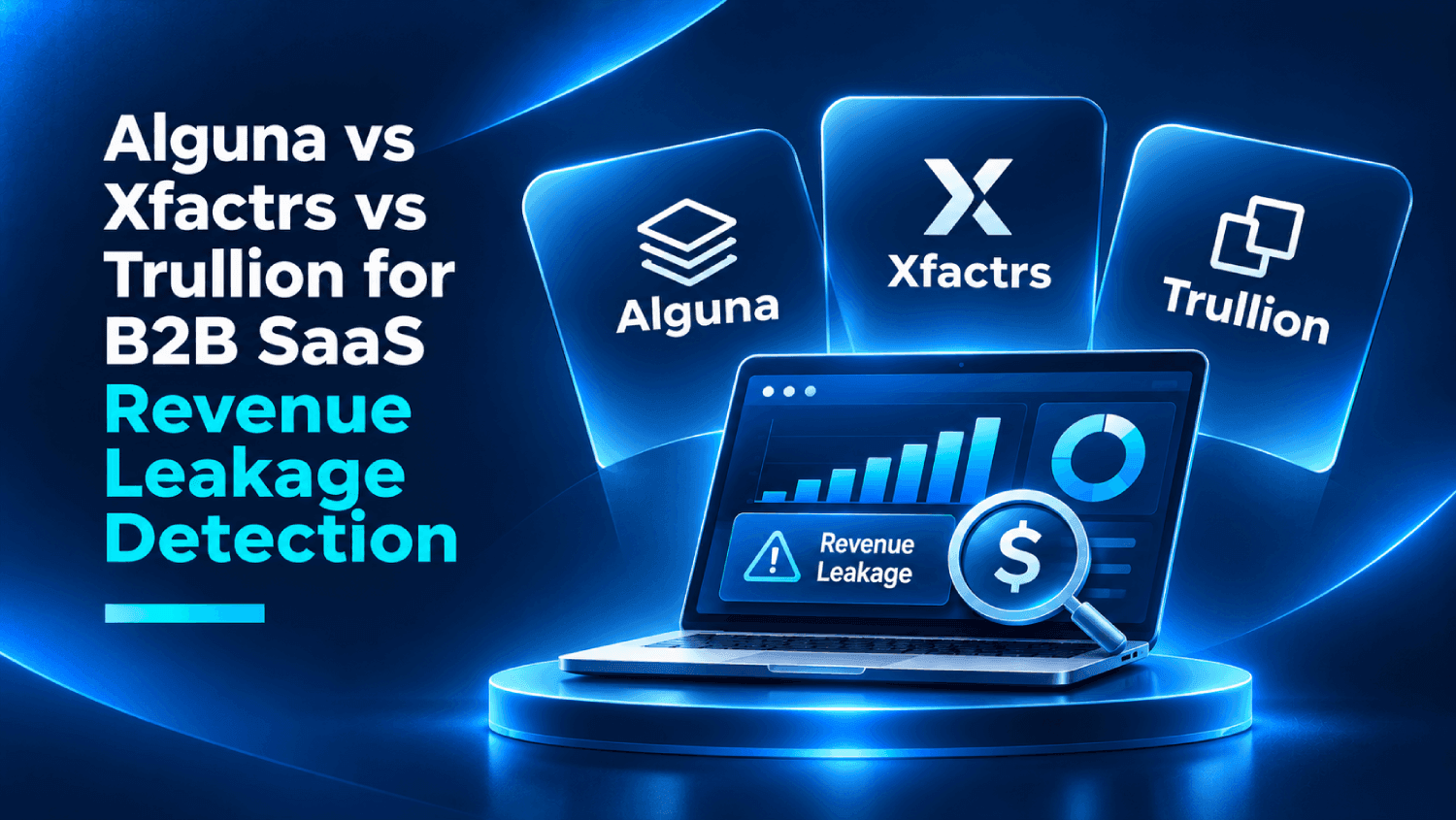
For B2B SaaS companies with usage-based or hybrid pricing, Alguna is best when leakage stems from mismatches between contract terms and what gets invoiced, xfactrs is best when the problem is unbilled usage events that never reach the billing engine, and Trullion is best when finance teams need leakage detection tied directly to revenue recognition and audit trails. No single tool covers all three failure points equally well.
Why Your Billing Engine Does Not Catch Revenue Leakage
A billing engine like Metronome, Orb, or Lago does exactly what it promises: it takes a usage record, applies a rate, and generates a charge. What it does not do is verify that every usage event was delivered to it in the first place, or that the rate applied matches what the customer’s contract actually says. For a detailed comparison of how these billing engines differ in architecture and pricing model support, see the Metronome vs Orb vs Lago comparison.
Revenue leakage in SaaS almost always originates at one of three divergence points. First, usage events fail to reach the billing engine because of pipeline gaps, event deduplication errors, or schema mismatches between your product and your metering layer. Second, the billing engine receives the events but applies the wrong rate because contract amendments were never reflected in the billing configuration. Third, an invoice is generated but does not match the contract’s payment terms, minimums, or committed spend thresholds.
Each of these failure points requires a different detection method. That is the structural problem with expecting one tool to find all three. Most teams discover leakage during a quarterly reconciliation or an audit, not in real time, which means they are recovering revenue that is already months old.
The FintechSpecs Leakage Detection Layer Matrix
To evaluate these three products honestly, it helps to map each tool to the specific layer where it detects divergence. We call this the Leakage Detection Layer Matrix, a framework that separates revenue leakage detection by the system of record where the gap originates.
| Leakage Source | System of Record | Best-Fit Tool | What Gets Caught |
|---|---|---|---|
| Usage event not reaching billing engine | Event pipeline / metering layer | xfactrs | Dropped events, schema mismatches, deduplication errors |
| Contract terms not reflected in invoices | CRM / contract repository | Alguna | Wrong rates, missing minimums, unapplied amendments |
| Revenue recognized differently than cash collected | ERP / general ledger | Trullion | ASC 606 schedule mismatches, unbilled AR, deferred revenue errors |
Most SaaS finance teams operate with leakage at all three layers simultaneously. The sequence in which you address them matters: fixing invoice-to-contract gaps while usage events are still being dropped means you are auditing an already incomplete record.
What Is Alguna and Who Is It Built For?
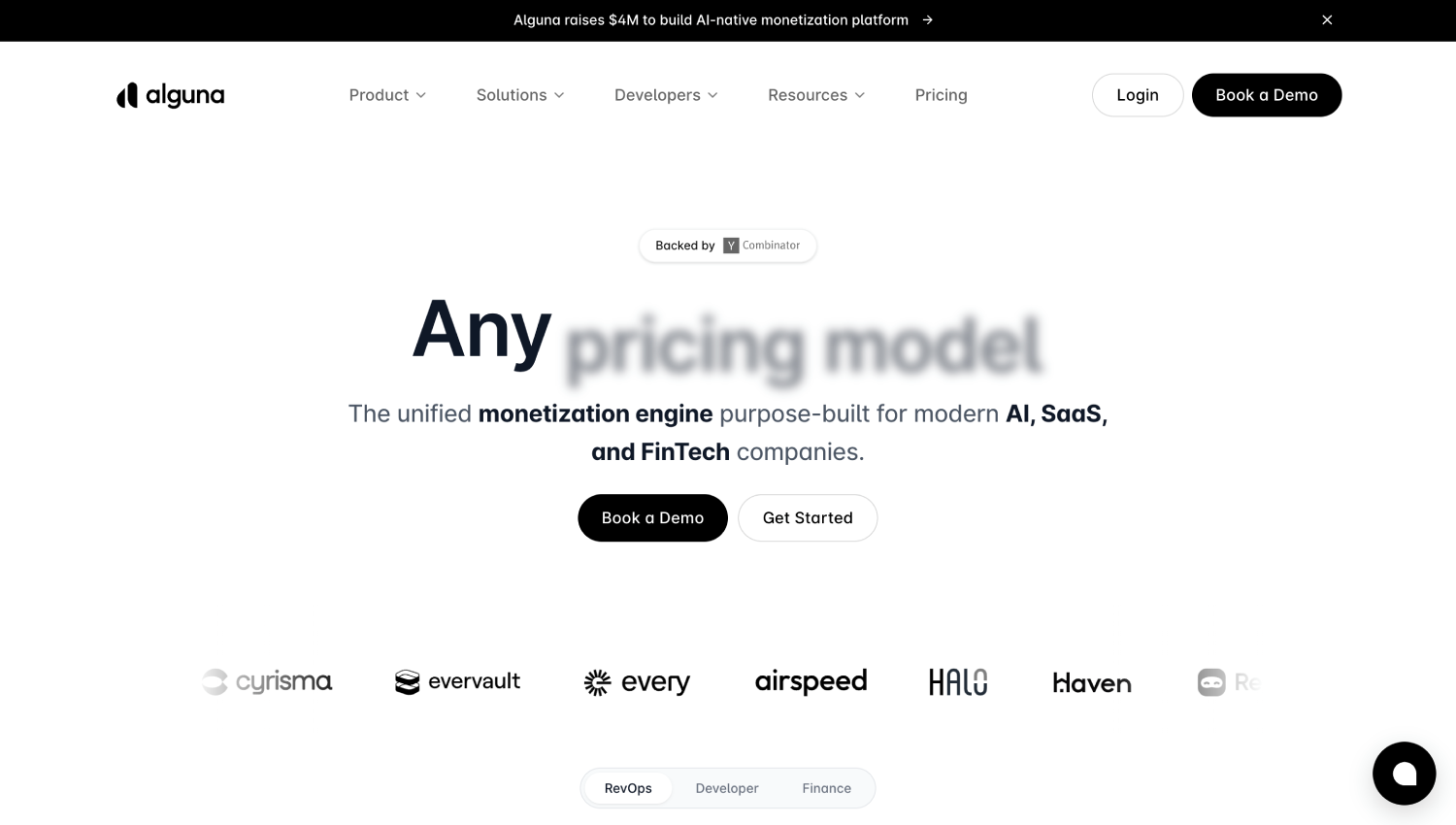
Alguna is a contract-to-invoice audit platform built for B2B SaaS companies with complex, enterprise-style pricing. Its core function is ingesting contract data from sources like Salesforce or HubSpot, then comparing what the contract says against what the billing system actually invoiced. The gap between those two records is flagged as potential leakage.
Alguna’s strength is handling the kind of contracts that break standard billing configurations: multi-year deals with annual true-ups, minimum commit thresholds, overage tiers that kick in at non-standard periods, and ramp schedules that change quarter by quarter. These are the contracts most likely to generate leakage because they require ongoing manual attention to stay synchronized with the billing engine.
The platform is best suited for companies where the sales team negotiates custom terms frequently and the finance team is responsible for confirming those terms make it into the billing system accurately. If your pricing is largely standardized and your contracts look similar across customers, Alguna’s overhead may outweigh its value. The tool earns its place when contract complexity is the primary driver of billing errors. Alguna does not publicly list pricing on its website (verified as of this article’s publication); teams need to request a demo for contract details.
What Is xfactrs and Who Is It Built For?
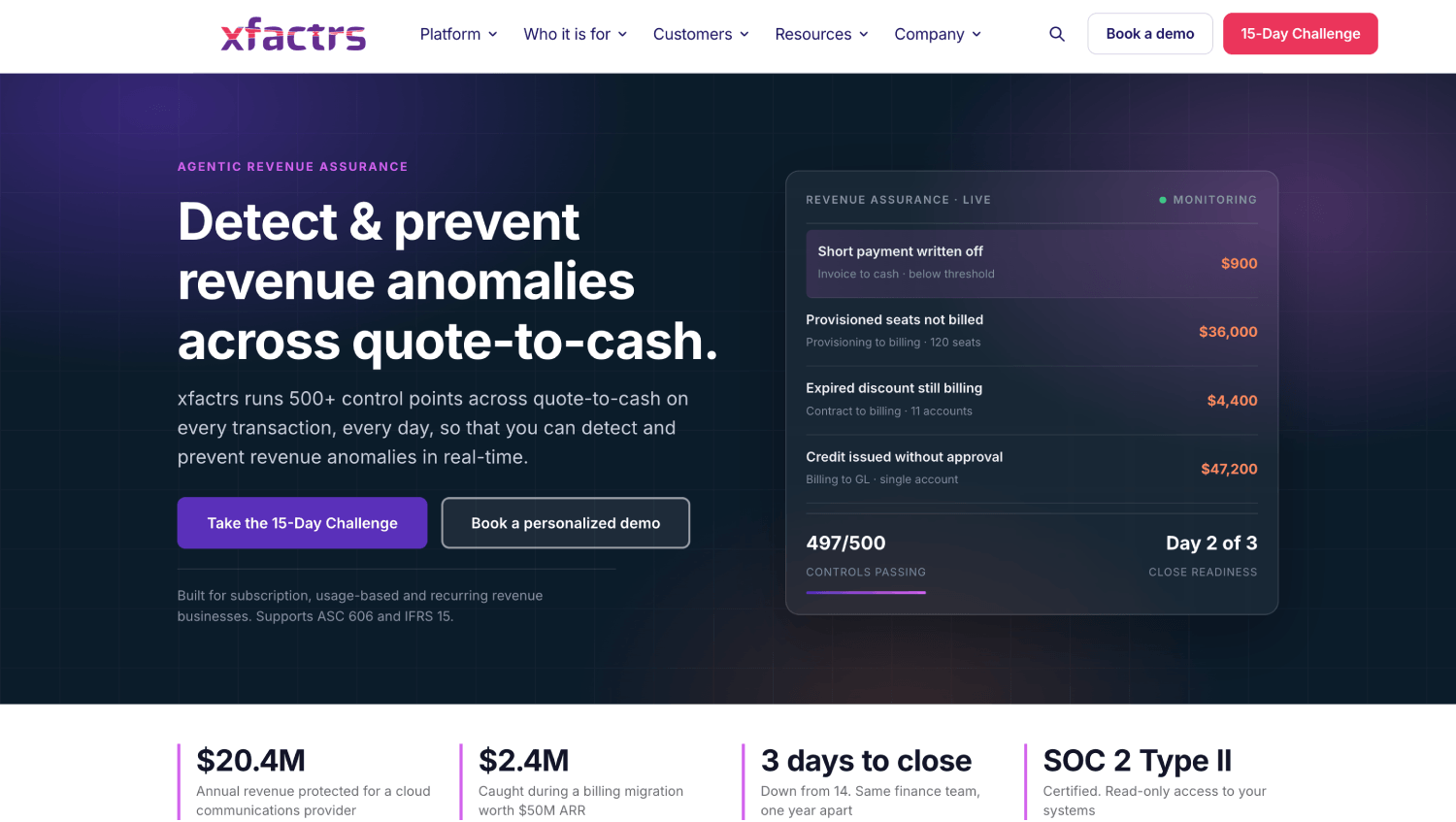
xfactrs addresses a different problem entirely. Rather than comparing contracts to invoices, it audits the upstream data pipeline, the path from raw product usage events to the billing engine’s input. If an API call, a compute minute, or a seat-activation event never reaches the billing engine, xfactrs is designed to surface that gap before the billing cycle closes.
SaaS unbilled usage detection at this layer requires the tool to understand your event schema, your expected event volumes, and the normal patterns of your usage data. xfactrs can flag anomalies like a customer whose event volume dropped to zero (suggesting pipeline failure rather than product abandonment), events that arrived but were filtered out during deduplication, or events that were received but failed schema validation and were silently discarded.
The ideal buyer is an engineering or FinOps team at a usage-based SaaS company where billing runs on metered events. If your product generates high volumes of discrete, billable events and you have experienced unexplained revenue variance between what your product telemetry shows and what your billing engine charges, xfactrs is the most direct tool for diagnosing that gap. xfactrs does not publicly list pricing on its website (verified as of this article’s publication); expect to engage their sales team for a custom quote based on event volume.
What Is Trullion and Who Is It Built For?

Trullion is an AI-powered revenue recognition and contract management platform built primarily for accounting teams and controllers. Its approach to leakage detection is downstream of both Alguna and xfactrs: it looks at the revenue recognition schedule and flags discrepancies between what ASC 606 requires and what the general ledger reflects.
Where Alguna catches a contract amendment that never updated the invoice rate, and xfactrs catches usage events that never reached the billing engine, Trullion catches the downstream accounting consequences of both: unbilled accounts receivable, deferred revenue that should have been recognized, or recognized revenue that does not match the contract’s performance obligation structure. This makes Trullion more audit and compliance-oriented than operationally preventive.
The platform is built for companies preparing for a Series C or later raise, going through a Big Four audit, or approaching an IPO, where revenue recognition accuracy is under formal scrutiny. Finance teams at companies with complex multi-element arrangements, software plus services bundles, or milestone-based billing will find Trullion’s ASC 606 automation more relevant than a CFO at a simple seat-based SaaS company would. Trullion does not publicly list pricing on its website (verified as of this article’s publication); enterprise contracts are negotiated directly.
Alguna vs xfactrs vs Trullion: Side-by-Side Comparison
| Dimension | Alguna | xfactrs | Trullion |
|---|---|---|---|
| Primary leakage layer | Contract-to-invoice | Usage event-to-billing engine | Invoice-to-revenue recognition |
| Primary buyer | Finance / billing ops | Engineering / FinOps | Controller / VP Finance |
| Best pricing model fit | Custom enterprise contracts | Usage-based / metered | Multi-element, milestone, or complex SaaS |
| Integrations | Salesforce, HubSpot, billing engines | Event pipelines, billing engines | ERP, GL, billing engines |
| Leakage detection timing | Pre- or post-invoice | Pre-billing (real-time or near real-time) | Post-invoice / month-end |
| Audit trail for compliance | Moderate | Low (operational focus) | High (built for auditors) |
| Pricing transparency | Not publicly listed | Not publicly listed | Not publicly listed |
Which Scenario Calls for Each Tool?
Scenario: Usage-Based SaaS With Unexplained Revenue Variance
Say a Series B SaaS company sells an API product charged per call, with roughly 200 million events processed monthly. The finance team notices that billed calls are consistently 3 to 5 percent below what the product telemetry reports, but cannot identify whether the gap is in the event pipeline, the billing engine configuration, or the invoice calculation. This is exactly the problem xfactrs is built to solve. The tool audits the pipeline between event generation and billing engine input, surfacing where events drop or transform incorrectly.
Alguna and Trullion would not catch this. Alguna compares contract terms to invoices, but if events never reach the billing engine, the invoice itself reflects the incomplete data. Trullion looks further downstream at the accounting ledger, where the gap has already been absorbed into recognized revenue figures.
Scenario: Enterprise SaaS With High Contract Amendment Volume
A company with 50 enterprise customers, each with custom negotiated terms, processes contract amendments several times per quarter. The billing team manually updates the billing configuration after each amendment, but errors slip through, particularly on ramp schedules and minimum commit thresholds. Alguna’s contract-to-invoice reconciliation surfaces these mismatches before or after invoice generation, depending on where in the billing cycle the team chooses to run audits.
xfactrs would not add value here because the usage events are likely reaching the billing engine correctly. The problem is not upstream data loss; it is configuration drift between the contract and the billing system. Teams dealing with this pattern should also look at how their billing ops processes connect to their invoicing infrastructure to reduce manual amendment steps in the first place.
Scenario: Pre-Audit or Pre-IPO Revenue Recognition Review
A company preparing for a Series C raise or an IPO needs its revenue recognition schedules to hold up under external audit. Trullion is the most relevant tool here because it maps contract performance obligations to the accounting entries, flags unbilled AR that should have been recognized, and produces the documentation trail auditors actually request. Neither Alguna nor xfactrs generates the ASC 606 schedule reconciliation that this scenario requires.
Can You Use More Than One of These Tools at the Same Time?
Yes, and for companies with mature billing infrastructure, using all three in sequence is the most complete approach. The order matters. Start with xfactrs to confirm your usage event pipeline is complete. Then run Alguna to confirm that complete usage data is being invoiced at the correct contract rates. Then use Trullion to verify that the invoiced amounts are recognized correctly in the general ledger under ASC 606.
This layered approach maps to the full revenue lifecycle from event generation to recognized revenue. Each tool hands off a cleaner record to the next layer, which is why buying Trullion without first addressing upstream pipeline and invoicing gaps often surfaces symptoms without fixing causes. Teams scaling toward $10M ARR and beyond frequently underestimate how quickly these layers compound, a pattern explored in detail in the Fintech SaaS Scale Checklist.
The practical constraint is budget and integration effort. All three vendors require custom onboarding, and none publicly list pricing, which means procurement involves a sales cycle with each vendor. For most companies at seed to Series A, one tool aligned to the dominant leakage layer is the right starting point.
How Do These Tools Differ From a Billing Engine Like Metronome or Orb?
Billing engines generate invoices from usage data. Leakage detection tools audit whether that generation was complete and accurate. The distinction matters because billing engines trust the data they receive; they do not audit the data source or verify that the resulting invoice matches the governing contract.
If you are evaluating billing infrastructure alongside leakage detection, the Metronome vs Orb vs Lago comparison covers which usage-based billing engine fits which architecture. That choice determines which leakage layer is most exposed: a billing engine with weak event ingestion validation creates more upstream risk (xfactrs territory), while one with rigid pricing plan structures creates more contract configuration drift (Alguna territory).
Some billing engines include built-in reconciliation features, but these typically compare their own output to their own input, which does not catch the external divergences that Alguna, xfactrs, and Trullion are built to find. The blind spot is structural, not a product shortcut.
What Should Finance and Engineering Teams Look for During Evaluation?
For xfactrs, the most important evaluation question is integration depth with your specific event pipeline. If your metering layer is Kafka-based, the tool needs to consume from Kafka in a way that does not introduce latency into your billing cycle. Ask for a demo that shows real gap detection on a sample event stream, not just a dashboard of pre-loaded examples.
For Alguna, the evaluation should focus on how the tool handles contract data that is stored inconsistently, because most SaaS companies have contract terms distributed across PDF attachments, Salesforce fields, and spreadsheets simultaneously. The tool’s ability to ingest and normalize that data without requiring a full contract migration upfront determines how quickly it generates value. Finance teams evaluating billing ops tools more broadly may also find the Chargebee vs Recurly vs Maxio comparison useful for understanding how billing platform choice shapes the leakage surface.
For Trullion, ask specifically how the platform handles revenue allocation for multi-element arrangements under ASC 606, particularly when standalone selling prices change mid-contract. This is where many revenue recognition tools break down, and it is the scenario most likely to cause restatements during an audit.
Frequently Asked Questions
What is revenue leakage detection software for SaaS?
Revenue leakage detection software identifies gaps between what a SaaS company should have billed and what it actually invoiced or collected. These tools audit one or more layers of the revenue lifecycle, including usage event pipelines, contract-to-invoice reconciliation, and revenue recognition schedules. They are distinct from billing engines, which generate charges but do not verify their own completeness or accuracy against contracts and usage sources.
What causes SaaS unbilled usage and how do you detect it?
SaaS unbilled usage occurs when product usage events fail to reach the billing engine, typically because of event pipeline failures, schema validation errors, or deduplication logic that discards valid events. Detection requires auditing the pipeline between the product’s metering layer and the billing engine’s input, comparing expected event volumes to actual billed quantities. Tools like xfactrs are built specifically for this layer of SaaS unbilled usage detection.
How is a contract-to-invoice audit different from payment reconciliation?
Payment reconciliation matches payments received to invoices issued, confirming that money collected is correctly recorded. A contract-to-invoice audit compares what the contract obligates the customer to pay against what the invoice actually charged, catching errors like wrong rates, missing minimums, or unapplied amendments before or after payment. Payment reconciliation finds accounting discrepancies; contract-to-invoice auditing finds billing configuration errors. Both are necessary, but they address different failure points. See the payment reconciliation software comparison for the former category.
Does Trullion replace a revenue recognition tool like NetSuite’s RevRec module?
Trullion is not a general-ledger replacement. It layers on top of existing ERP and accounting systems, ingesting contract data and GL entries to validate that revenue recognition schedules comply with ASC 606. NetSuite’s RevRec module automates recognition within NetSuite but does not audit contract terms against what was recognized. For companies already on NetSuite, Trullion serves as an external validation and documentation layer, not a replacement for the ERP’s native recognition engine.
At what company stage does revenue leakage detection become worth the investment?
Contract-to-invoice and usage auditing tools typically generate positive ROI when a company has 20 or more enterprise customers with custom contract terms, or when usage-based revenue exceeds roughly $1M ARR. Below that scale, manual audits during the billing cycle are usually faster to implement. The calculus shifts when billing cycles grow too complex for a spreadsheet reconciliation to catch edge cases reliably, or when an external audit requires documented leakage controls.
What is the difference between revenue leakage and revenue churn?
Revenue churn is revenue lost because a customer downgrades or cancels. Revenue leakage is revenue that should have been billed to an active customer but was not, due to billing errors, pipeline gaps, or contract misconfiguration. Leakage does not appear in churn metrics because the customer is still active; it shows up as a gap between usage telemetry and billed amounts, or between contract terms and invoice totals. Leakage is often invisible in standard SaaS metrics dashboards, which is why dedicated detection tooling is necessary.
The Leakage Layer You Fix First Determines How Much the Others Matter
Revenue leakage in B2B SaaS is three distinct failure modes, each living at a different layer of the revenue lifecycle, and each requiring a different kind of detection. Buying a contract audit tool when your usage pipeline is leaking events means you are auditing an already incomplete record. Buying a revenue recognition tool before fixing invoice accuracy means your ASC 606 schedules are built on wrong numbers.
The practical approach is to map your specific divergence point first. If your finance team cannot reconcile product telemetry to billed amounts, start upstream with xfactrs. If your billing team is manually tracking contract amendments and suspects misconfiguration, start with Alguna. If you are in pre-audit preparation and your revenue recognition schedules are under scrutiny, Trullion is the right entry point. The hidden costs that compress SaaS margins frequently include unbilled usage and billing errors that go undetected for quarters, not weeks.
All three tools address real problems. None of them is a substitute for the others. The mistake most SaaS finance teams make is assuming that because they have a billing engine configured, the leakage problem is solved. The billing engine is the middle of the chain. The leakage almost always lives at the edges.