
TLDR
- Card account updaters and dunning retries solve different problems. Updaters refresh expired or reissued credentials before a charge attempt fails. Dunning retries fire after the charge already declined.
- Three distinct delivery models exist for card on file account updater providers: standalone network access (Pagos), vault-bundled updates (Spreedly), and PSP-bundled updates (Checkout.com). Each has a different integration footprint and geographic reach.
- Visa Account Updater and Mastercard Automatic Billing Updater are the two primary card network programs. Real-time updates from both networks have expanded, but issuer participation rates vary by geography , coverage is strongest for major US and Canadian banks, and weaker outside North America where local card schemes and regulatory differences reduce program enrollment.
- The right model depends on where your card vault lives. If you own the vault, standalone or vault-bundled is cleaner. If your PSP controls the vault, PSP-bundled is the path of least resistance.
Pagos, Spreedly, and Checkout.com each offer card account updater access, but they deliver it differently. Pagos connects to Visa Account Updater and Mastercard Automatic Billing Updater as a standalone network-access layer, independent of your payment processor. Spreedly bundles updater access into its payment orchestration vault. Checkout.com includes updater functionality for merchants processing through its platform. The right choice depends on who owns your vault, which markets you serve, and whether you want updater logic decoupled from your PSP.
Why Dunning Retries Cannot Replace a Card Account Updater
Most subscription payment teams discover this distinction the hard way. A dunning tool retries a failed charge, often with smart scheduling logic, after the initial authorization was declined. A card account updater refreshes the stored card number or expiry date before any charge attempt is made, so the transaction never fails in the first place.
These two tools operate at different points in the payment lifecycle. Dunning lives in the post-decline recovery layer. Account updating lives in the pre-decline credential management layer. Running retries without fresh credentials means you are repeatedly attempting to charge a card that the issuer has already replaced. If you are evaluating dunning tools for SaaS payment recovery, they belong in your stack alongside an account updater, not instead of one.
The practical difference in revenue recovery is significant for subscription businesses with large stored card populations. A card that was reissued due to fraud or expiry will decline on every retry until the credential is refreshed. Dunning retries accumulate failed-payment fees and churn signals without resolving the root cause.
How Do Card Account Updater Programs Actually Work?
Visa Account Updater (VAU) and Mastercard Automatic Billing Updater (ABU) are the two programs that matter for North American merchants. Both allow participating issuers to push updated card credentials, including new card numbers from reissuances and updated expiry dates, to merchants or their processors before the next billing cycle.
The mechanics differ slightly. VAU operates on a batch basis, though Visa has expanded real-time update capability for enrolled issuers. Mastercard ABU also offers real-time updates alongside batch processing. In both cases, the merchant or vault provider submits stored card tokens to the network, and the network returns any available credential updates from participating issuers.
Issuer participation is not universal. Smaller regional banks and credit unions may not participate in either program, which means their cardholders’ credential changes will not be reflected through network updater queries. This coverage gap is worth understanding before you assume an account updater will close all your passive churn. It will not. It will close a significant portion of it, particularly for Visa and Mastercard consumer cards issued by major US banks.
What Is the Difference Between Standalone, Vault-Bundled, and PSP-Bundled Updater Access?
This is the structural decision most teams do not think through before they build. The three delivery models create meaningfully different integration architectures.
Standalone Network Access (Pagos Model)
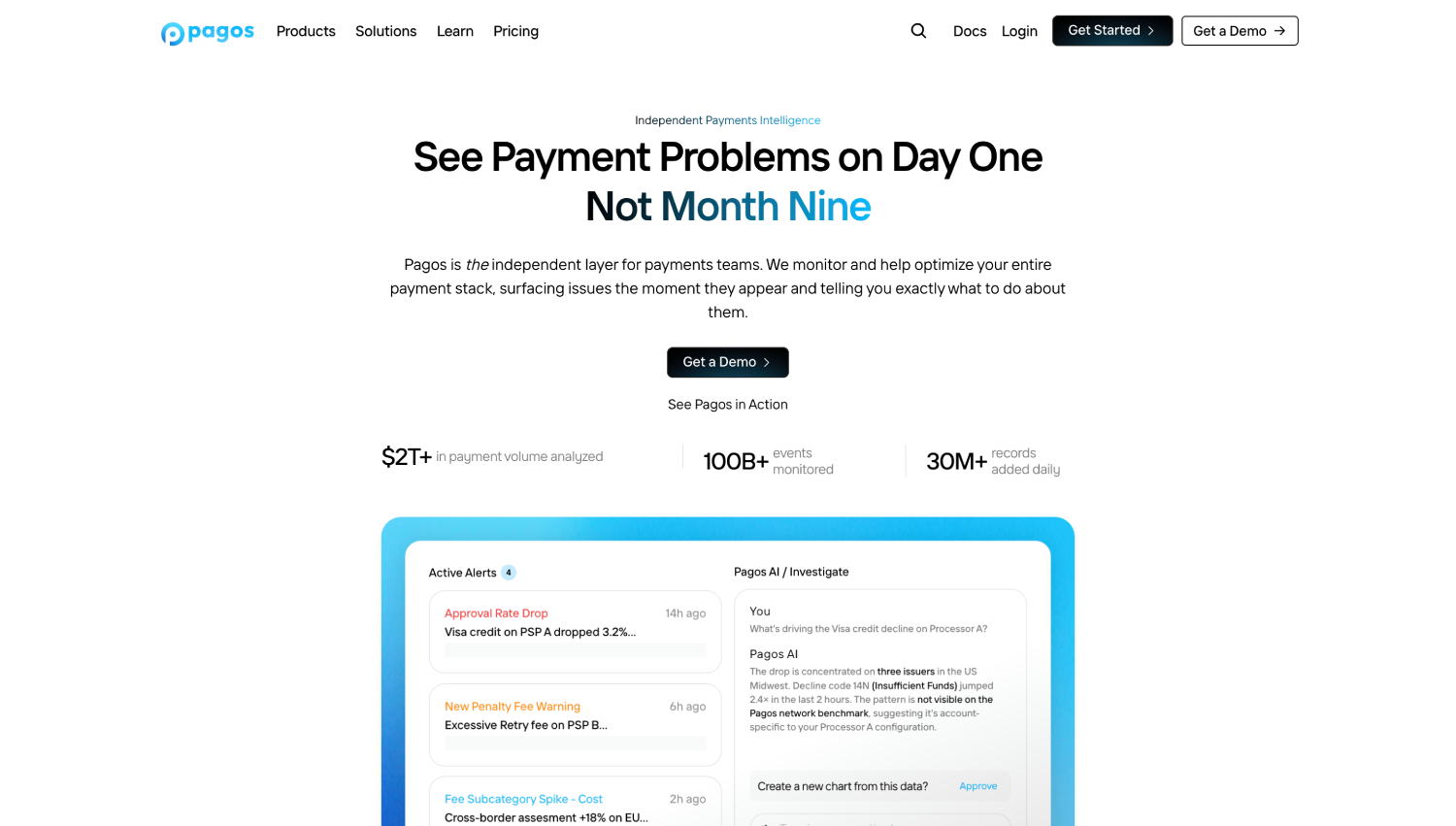
Pagos provides network-level access to VAU and ABU as a dedicated product called Loon, designed to connect to your vault regardless of which processor you use. The value proposition is processor independence. You can run Pagos alongside Stripe, Adyen, Checkout.com, Braintree, or any other PSP, and the updater logic sits outside the PSP relationship entirely.
This model fits teams with multi-processor setups or those who want to avoid being locked into a single PSP’s updater implementation. It also gives payment engineers direct visibility into which cards were updated, which queries returned no match, and which issuers are not participating, without filtering through a PSP’s abstraction layer. Pagos does not publicly list per-query pricing, so you will need a direct conversation for cost benchmarking.
Vault-Bundled Updates (Spreedly Model)
Spreedly is a payment orchestration platform with its own card vault, and account updater access is built into that vault layer. When you store cards in Spreedly’s vault, the platform can query VAU and ABU against those stored payment methods and return refreshed credentials that you can then route to any downstream processor.
The architectural advantage here is that credential refresh happens at the vault level, so every processor in your Spreedly routing setup benefits from updated credentials without any additional integration work. The tradeoff is that this model assumes you are using Spreedly as your vault. If your cards live in Stripe’s vault or Adyen’s token system, the Spreedly account updater does not apply to those tokens. Spreedly’s public pricing page does not list account updater fees discretely, so pricing is negotiated as part of an overall platform agreement. Spreedly’s orchestration capabilities also connect directly to the broader question of whether you need a payment orchestration platform at your current transaction volume.
PSP-Bundled Updates (Checkout.com Model)
Checkout.com includes account updater functionality for merchants using its processing infrastructure. Cards stored in Checkout.com’s network token or card-on-file system are eligible for credential refresh through the platform’s integration with VAU and ABU. This is the lowest-friction entry point if Checkout.com is already your primary processor, since there is no separate vendor relationship, no additional vault integration, and no separate credential synchronization logic to build.
The limitation is obvious: this model only covers cards vaulted within Checkout.com. Any cards you store with a secondary processor, or in a third-party vault, fall outside its scope. For merchants running a single-processor setup on Checkout.com, this is a reasonable fit. For multi-PSP architectures, the coverage gap grows proportionally with volume routed elsewhere.
The FintechSpecs Updater Delivery Model Table
| Dimension | Pagos (Loon) | Spreedly | Checkout.com |
|---|---|---|---|
| Delivery model | Standalone network access | Vault-bundled | PSP-bundled |
| Vault requirement | Bring your own vault | Must use Spreedly vault | Must use Checkout.com vault |
| Processor independence | Yes, works with any PSP | Yes, routes to any PSP via Spreedly | No, tied to Checkout.com processing |
| Networks covered | VAU and ABU | VAU and ABU | VAU and ABU |
| Real-time update support | Yes | Yes | Yes (for enrolled issuers) |
| Multi-PSP architecture | Strong fit | Strong fit via orchestration | Weak fit |
| Public pricing | Not listed | Not listed discretely | Not listed |
| North America coverage (VAU/ABU) | Full program access | Full program access | Full program access |
| International markets | Dependent on issuer participation | Dependent on issuer participation | Dependent on issuer participation |
| Best for | Multi-PSP or PSP-agnostic teams | Orchestration-first stacks | Single-PSP Checkout.com merchants |
What Does the GEO (Geographic) Coverage Difference Actually Mean?
All three providers rely on the same underlying network programs, VAU and ABU, so the geographic coverage question is not really about which vendor you pick. It is about which issuers participate in those programs in your target markets.
In the United States, major Visa and Mastercard issuers including Chase, Bank of America, Capital One, Citi, and Wells Fargo participate in both VAU and ABU. Coverage for US consumer credit and debit cards from large issuers is high. Canada has strong participation from the major schedule I banks through both programs.
Coverage declines outside North America. European issuers have patchier participation rates, partly due to PSD2 dynamics and local card network variations. In Asia-Pacific, local card schemes often operate outside VAU and ABU entirely. Latin American issuer participation is limited. If your subscription business has significant revenue from Europe or APAC, your account updater hit rate on non-US cards will be lower than your North American rate, regardless of which vendor delivers the program access. This geographic reality should temper expectations about total passive churn reduction for globally distributed user bases.
The FintechSpecs Vault-Lock Test: Which Delivery Model Fits Your Architecture?
Before evaluating vendor-specific features, the structural decision is which delivery model matches where your card credentials actually live. This is what we call the Vault-Lock Test: a four-question diagnostic that eliminates at least one delivery model before you spend time on demos.
Question 1: Who owns your card vault? If your cards are stored in Stripe’s vault or Adyen’s vault, PSP-bundled updaters from other PSPs are irrelevant. Standalone or vault-bundled (via migration) are your paths. If your cards live in a third-party vault like Spreedly or Basis Theory, vault-bundled updates are native to that layer.
Question 2: Are you routing payments through more than one processor? Multi-processor architectures almost always benefit from standalone or orchestration-layer updater access, since PSP-bundled solutions only refresh credentials in that PSP’s vault. If you are building toward a multi-PSP stack, see the broader analysis on payment infrastructure tools for SaaS founders for context on how vault and processor relationships compound.
Question 3: Do you need update event data for your own analytics? Standalone providers like Pagos give you event-level data on which cards were queried, which returned updates, and which returned no match. PSP-bundled implementations often handle this transparently without surfacing granular event data to the merchant. If your RevOps or FinOps team wants to track saved card health as a metric, standalone access gives you a cleaner data feed.
Question 4: Is Checkout.com already your sole processor with no plans to diversify? If yes, the PSP-bundled path is the fastest and cheapest integration path. No new vendor, no new contract, no additional vault integration. The simplicity is real, and for single-processor setups it is a legitimate advantage.
How Does Vaulted Card Refresh Work in a Real Scenario?
Consider a SaaS company with 50,000 active monthly subscribers, all billed on stored cards. Cards expire continuously throughout the year, and issuers reissue cards for fraud-related reasons at a rate that varies by portfolio but is not trivial. Without an account updater, every reissued card in that population becomes a failed charge at the next billing date, generating a dunning sequence and, for some percentage, involuntary churn.
With an account updater in place, the platform submits stored card tokens to VAU and ABU on a rolling basis, say weekly or monthly in batch, plus real-time queries triggered at billing time. The network returns new card numbers or expiry dates where the issuer has participated and pushed the update. The vault is refreshed before the charge attempt. The subscriber never sees a declined payment, never enters a dunning flow, and never receives an email asking them to update their card.
The portion of subscribers whose cards are covered by participating issuers get this silent refresh. The remainder, cards from non-participating issuers or non-participating card schemes, still need dunning and manual update flows. A well-instrumented account updater setup will surface which portion of your card population has issuer participation, letting you forecast how much passive churn the tool will realistically close versus how much still requires reactive intervention.
Which Card on File Account Updater Provider Is Best for SaaS Subscription Billing?
For subscription platforms already using Spreedly as their orchestration layer, the vault-bundled model is the clearest fit. Credential refresh at the vault level means every downstream processor benefits automatically, and the integration is already embedded in the platform relationship. The tradeoff is that you are committing to Spreedly’s vault as your primary token store.
For teams building or maintaining a multi-processor setup without a centralized orchestration layer, Pagos gives you network access that is portable across PSP relationships. The integration requires engineering effort to connect your existing vault or token system to the Loon API, but the resulting architecture is processor-agnostic. This matters if you are routing by card type, geography, or authorization rates across multiple acquirers, a setup that is increasingly common at Series B and beyond. The relationship between vault architecture and processor strategy is covered in more depth in the fintech infrastructure stack overview.
Checkout.com’s bundled updater is straightforwardly the right answer only for merchants already committed to Checkout.com as a single processor. It eliminates vendor complexity and integration overhead, but it creates processor lock-in for credential management. If you ever split volume to a second acquirer, you will need an additional updater solution for cards migrated or newly stored outside Checkout.com’s vault.
Frequently Asked Questions
What is the difference between a card account updater and dunning?
A card account updater queries the card networks (Visa Account Updater and Mastercard Automatic Billing Updater) to refresh expired or reissued card credentials before a payment is attempted. Dunning is a post-decline recovery process that retries failed charges and prompts customers to update payment methods. Updaters prevent the failure. Dunning responds to it. Running dunning without an updater means retrying charges against stale credentials that the issuer has already replaced.
Can I use a card account updater if my cards are stored in Stripe’s vault?
Stripe offers its own account updater functionality for cards stored in its vault, using VAU and ABU access, as documented on Stripe’s public documentation for automatic card updates. If you are using Stripe as your vault and processor, you do not need a separate account updater vendor. The Stripe-native updater applies automatically to recurring charges on stored cards. You would need a standalone provider like Pagos or a vault migration to Spreedly only if you want processor-agnostic updater access or if you are routing volume to processors other than Stripe.
How often should stored cards be queried for account updates?
Most platforms run batch queries monthly, aligned with billing cycles, and supplement with real-time queries at the point of transaction for high-value charges. The card networks impose query limits and have rules about query frequency relative to billing relationships, so you cannot query the same card token arbitrarily often. Your account updater vendor or the card network program documentation will specify the applicable rules for VAU and ABU. Weekly batch queries are common for large stored-card populations with continuous billing.
Does a card account updater work for international cards?
VAU and ABU are most effective for US and Canadian Visa and Mastercard cards issued by major participating banks. Coverage drops meaningfully for European, Asia-Pacific, and Latin American issuers, where local card schemes and lower issuer participation rates reduce the hit rate. Cards issued on American Express, Discover, and regional networks operate under different updater programs and are not covered by VAU or ABU. For globally distributed subscription businesses, account updaters close a significant portion of passive churn but do not eliminate it for non-North American card populations.
What data does a standalone account updater like Pagos return that a PSP-bundled updater does not?
Standalone network access typically returns event-level data on every card queried: whether the query returned a credential update, a no-change response, a close response indicating the account was closed, or a contact cardholder response. PSP-bundled implementations often handle this transparently and do not expose the same granularity to the merchant. For teams tracking saved card health, churn attribution, or issuer participation rates as operational metrics, event-level data from a standalone provider is a meaningful advantage.
Is there a minimum volume requirement to justify a standalone account updater?
None of the three vendors publicly disclose minimum volume thresholds. In practice, the engineering overhead of integrating a standalone provider like Pagos makes economic sense at higher stored-card volumes, typically tens of thousands of active payment methods or more, where the incremental authorization recovery justifies the integration cost. Smaller subscription businesses on a single processor are better served by the PSP’s bundled updater before building a separate vendor relationship. Pagos and Spreedly both require a sales conversation for pricing, so the break-even analysis requires a direct quote.
How does a card account updater interact with network tokenization?
Network tokenization, as offered by Visa Token Service and Mastercard Digital Enablement Service, provides a different but complementary mechanism. Network tokens are managed by the card network and updated automatically by the issuer when a physical card is reissued, without requiring a separate updater query. For merchants using network tokenization through a provider like Spreedly or a processor with network token support, the need for traditional account updater queries is reduced but not eliminated, since not all cards are enrolled in token services and not all issuers push credential updates through the token lifecycle automatically. For more on how network tokenization relates to vault architecture, see the Spreedly vs Basis Theory network tokenization comparison.
The Structural Insight Most Teams Miss
Account updating is not a feature you add to your billing stack. It is a decision about where credential authority lives in your architecture. The moment you choose a vault, you have implicitly chosen a delivery model for account updates, because the two are inseparable. Teams that realize this late tend to discover it when they try to migrate processors or add a second acquirer and find that their updater logic is embedded in a PSP relationship they are trying to move away from.
The practical implication is that the account updater decision should happen at the same time as the vault and orchestration decision, not afterward. If you are early enough in your infrastructure build to choose where cards live, the choice between Spreedly’s vault-bundled model, Pagos’s standalone access, and a PSP-bundled approach is a first-principles architecture call, not a feature comparison. Thinking through common fintech infrastructure mistakes at this stage is more useful than any vendor demo.
What the FintechSpecs Vault-Lock Test ultimately reveals is that two of the three providers, Pagos and Spreedly, are building toward a world where credential management is decoupled from payment processing. Checkout.com is building toward deeper integration within its own processing stack. Neither direction is wrong. They reflect different bets about how payment infrastructure consolidates. The question is which bet matches your own roadmap.