
TLDR
- Virtual card issuing APIs handle the buyer side of the transaction. Suppliers need separate tooling to capture, authorize, and reconcile incoming virtual cards on the receivables side.
- Without dedicated acceptance automation, AR teams handle virtual cards manually: reading card details out of an email, keying them into a payment terminal, then hunting for the remittance data that tells them which invoice to close.
- The three tools in this list each solve a distinct part of the inbound workflow: card capture, straight-through processing, and remittance matching. Some combine two or all three.
- Interchange rebates flow to the buyer’s bank, not the supplier. Acceptance automation does not change that math, but it does eliminate the labor cost that makes manual virtual card acceptance economically irrational at volume.
- The right tool depends on where the bottleneck sits: upstream (card capture), midstream (authorization and processing), or downstream (cash application and ERP posting).
Virtual card acceptance automation for accounts receivable refers to software that captures incoming single-use virtual card numbers from buyer-side AP systems, processes the authorization, extracts remittance data, and posts the matched payment to open invoices in an ERP or AR platform. It operates on the supplier side of a B2B card transaction, not the issuing side. The three leading categories are automated card capture portals, integrated payment processing networks, and AI-driven cash application engines with virtual card modules.
Why Do Suppliers Need a Separate Tool for Virtual Card Acceptance?
Most AR teams discover this problem the hard way. A buyer switches their AP program to virtual cards, and suddenly the supplier’s finance team is receiving emails with 16-digit card numbers, expiration dates, and a dollar amount. Somebody has to key that card into a terminal or virtual payment gateway, then manually match the payment to the right invoice. At ten cards a month, that is annoying. At three hundred, it consumes headcount.
The confusion comes from conflating the issuing side with the acceptance side. Card issuing APIs like Marqeta, Lithic, or Stripe Issuing exist to help buyers create and distribute virtual cards through their AP platforms. Those tools generate the cards. They do not help suppliers receive, process, or reconcile them. If you are evaluating virtual card issuing APIs for AP and procurement , or exploring how a virtual card API connects to buyer-side workflows , that is a different buying decision entirely, covered separately in our guide to virtual card issuing APIs for AP and procurement.
The supplier’s problem has three distinct stages, and most off-the-shelf payment tools solve only one. Card capture pulls the number and authorization data out of buyer emails or EDI files. Payment processing routes that card through a merchant acquirer. Remittance matching closes the invoice in the ERP. Tools that break the chain at any stage put the remaining work back on a human.
What Does the Inbound Virtual Card Workflow Actually Look Like?
Understanding the step sequence is the prerequisite for evaluating any vendor. The FintechSpecs Inbound Card Workflow maps the five discrete handoffs where automation can replace manual labor.
| Stage | What Happens | Manual Failure Mode | Automation Target |
|---|---|---|---|
| 1. Card Delivery | Buyer AP system emails or EDIs card number, expiration, CVV, and authorized amount to supplier | Email sits unread; card expires unused | Automated ingestion from email or EDI feed |
| 2. Card Capture | Card data is extracted and validated against an expected payment amount | Keying errors; wrong amount charged | Optical or API-based card data extraction |
| 3. Authorization | Card is charged through a merchant acquirer before the card expires (often 24-72 hours) | Card expires before staff process it; lost revenue | Straight-through processing with acquirer |
| 4. Remittance Extraction | Payment detail is matched to invoice numbers, POs, or buyer references included with the card | Remittance arrives separately; matching done manually | Structured data extraction from remittance files |
| 5. ERP Posting | Payment closes open AR in NetSuite, SAP, Oracle, or similar | AR team manually posts; DSO does not move | Bi-directional ERP connector |
A tool that automates stages one through three but leaves four and five to humans has not solved the AR problem. It has moved the bottleneck. The vendors below are evaluated against all five stages, with explicit gaps noted where they exist.
Which Virtual Card Acceptance Automation Tools Cover the Full AR Workflow?
1. Paymerang
Paymerang (now Corpay) built its platform for the supplier side of B2B card payments, which makes it one of the few tools in this space that treats virtual card acceptance as an AR problem rather than a payments problem. The core product intercepts incoming virtual card payments from buyer AP programs, processes the authorization through Paymerang’s acquiring relationship, and delivers a matched remittance file back to the supplier’s ERP.
The practical value is in the authorization timing. Single-use virtual cards issued by buyer AP platforms like SAP Concur, Coupa Pay, or AvidXchange carry an expiration window that can be as short as 24 hours. Paymerang’s automated processing routes the card through authorization without waiting for a staff member to log in, which matters for suppliers receiving cards outside business hours or across time zones.
Remittance handling is where Paymerang differentiates from general-purpose payment processors. The platform extracts invoice-level detail from buyer remittance data and formats it for direct posting into NetSuite, Sage Intacct, Microsoft Dynamics, and several other ERP connectors. This covers stages four and five in the inbound card workflow, not just the authorization step. Pricing is not publicly disclosed; teams should request a quote.
Best for: Mid-market suppliers receiving high volumes of virtual cards from enterprise buyer AP programs who need ERP-ready remittance without manual cash application.
2. Billtrust
Billtrust approaches virtual card acceptance as one module within a broader AR automation suite. The company’s Business Payments Network connects buyers and suppliers through a shared remittance network, which means that when a buyer pays via virtual card, the supplier receives not just the card number but structured payment data that maps directly to open invoices.
The key architectural difference from standalone card capture tools is that Billtrust sits between buyer payment systems and supplier AR systems as a persistent network, not a one-time transaction processor. Buyers enrolled in the network transmit payment instructions and remittance detail together, which collapses the gap between stages four and five in the workflow table above. For suppliers already using Billtrust for broader AR automation, adding virtual card acceptance is an extension of existing infrastructure rather than a new vendor relationship.
Billtrust also handles the merchant acquiring relationship on the supplier’s behalf, so the supplier does not need a separate payment gateway or merchant account configured for card-not-present B2B transactions. Card-not-present interchange rates in B2B are higher than card-present, and suppliers with high average ticket sizes can capture Level 2 and Level 3 card data through Billtrust’s processing to qualify for lower interchange, which reduces the effective cost of card acceptance. For a deeper look at how B2B interchange optimization works with structured card data, see the guide to B2B interchange optimization tools for Level 3 card data. Pricing is not published; it is enterprise-quoted. Billtrust was acquired by FLEETCOR (now Corpay) in 2023, according to Billtrust’s own public communications.
Best for: Suppliers with complex, high-volume AR operations who want virtual card acceptance as part of a broader automated cash application and payment network strategy.
3. Versapay
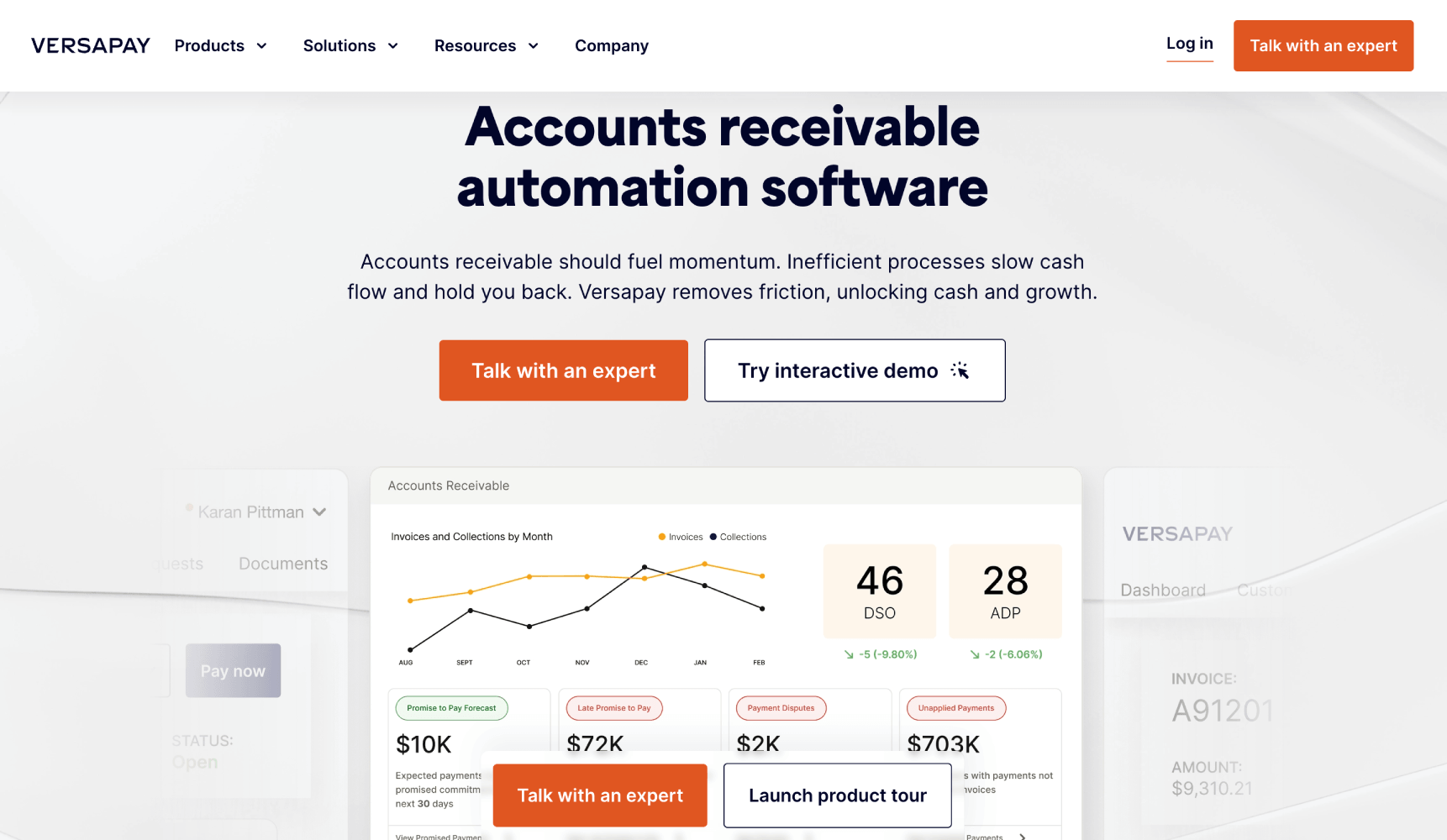
Versapay takes a collaboration-first angle on B2B payments. Its platform connects buyers and suppliers through a shared portal where both sides can communicate about invoices, disputes, and payment methods, with virtual card acceptance built into the payment options on the supplier side.
When a buyer pays via virtual card through Versapay’s portal, the platform handles card capture and authorization, then posts the matched payment to the supplier’s ERP. The differentiated feature is the dispute and exception workflow: if a buyer pays a partial amount or attaches a remittance that does not match an invoice, the platform surfaces the discrepancy in a shared workspace rather than dropping it into an AR team’s inbox as an unmatched exception.
Versapay’s ERP integration list includes NetSuite, SAP, Microsoft Dynamics 365, Sage, and Oracle, with pre-built connectors that sync AR aging, invoice status, and payment posting bi-directionally. For teams evaluating Versapay against comparable platforms, the comparison of Versapay alternatives for mid-market AR automation covers the competitive field in detail. Versapay’s pricing is not publicly listed; the company serves mid-market to enterprise buyers and structures contracts based on payment volume. The company was acquired by DadeSystems and subsequently by AvidXchange’s parent company, though it operates independently as of this writing.
Best for: Suppliers whose AR process involves frequent invoice disputes or partial payments, where a collaborative buyer-supplier portal reduces back-and-forth over email and creates a documented resolution trail.
How Do These Three Tools Compare Across the Inbound Card Workflow?
| Capability | Paymerang | Billtrust | Versapay |
|---|---|---|---|
| Automated card capture (email/EDI) | Yes | Yes | Yes (portal-based) |
| Straight-through authorization | Yes | Yes | Yes |
| Remittance data extraction | Yes | Yes (via network) | Yes |
| ERP posting connectors | Yes | Yes | Yes |
| Level 2/3 card data for interchange | Not confirmed publicly | Yes | Not confirmed publicly |
| Buyer-supplier dispute portal | No | Partial (network alerts) | Yes (core feature) |
| Standalone virtual card module | Yes (primary product) | No (part of AR suite) | No (part of AR suite) |
| Pricing model | Enterprise quote | Enterprise quote | Enterprise quote |
What Should Suppliers Evaluate Before Choosing a Virtual Card Acceptance Tool?
The buying decision breaks into four questions, each of which eliminates at least one tool from the shortlist depending on the answer.
How do your buyers send virtual cards today?
Buyer AP platforms deliver virtual card data through email (the most common), through EDI 820 payment files, or through buyer-supplier portals where the supplier logs in to retrieve card details. A tool built around email ingestion does not automatically handle EDI feeds. Confirm the delivery channel your top ten buyers use before evaluating any vendor’s capture capability.
What is your average card expiration window?
Enterprise AP platforms issue virtual cards with tight expiration windows to reduce fraud exposure. If your buyer’s AP platform issues cards that expire in 24 hours and your AR team works a standard 9-to-5 schedule, any card delivered at 4 PM on a Friday is at risk of expiring before Monday morning processing. Straight-through authorization, running without human intervention, is non-negotiable for suppliers in this position.
Does your ERP require a custom integration?
All three tools claim ERP connectivity, but the depth of that integration varies. A pre-built NetSuite connector that syncs invoice status and posts payments bi-directionally is materially different from an outbound CSV export that your team imports manually. Ask each vendor to demonstrate the specific integration with your ERP version, not just confirm that the ERP name appears on their supported list.
What percentage of your virtual card payments arrive with incomplete remittance data?
If fewer than five percent of incoming cards have remittance exceptions, automated cash application handles the volume and Versapay’s dispute portal is overhead you do not need. If exceptions run above fifteen percent because your buyers frequently pay partial invoices or combine multiple invoices under one card, the collaborative portal becomes genuinely valuable. This is where AR automation tools that handle broader cash application workflows, as covered in the guide to cash application software for B2B payment matching, are worth evaluating alongside dedicated virtual card acceptance tools.
What Is the Real Cost of Not Automating Virtual Card Acceptance?
Consider a supplier receiving 400 virtual card payments per month from enterprise buyers. Each card requires a staff member to open the notification email, extract the card data, key it into a payment terminal or gateway, locate the matching invoice or PO, post the payment in the ERP, and file the remittance confirmation. At a conservative 12 minutes per card, that is 80 hours of AR staff time per month spent processing one payment type.
For example: assuming a burdened rate of $35 per hour, that works out to $2,800 per month in direct processing cost, before accounting for errors (wrong amount charged, card expired before processing, payment posted to the wrong invoice). Errors on virtual card payments create chargeback exposure and strain buyer relationships. A supplier with high virtual card volume that rejects virtual card payments from buyers is leaving interchange-funded rebates in the buyer’s treasury while also signaling operational friction to a customer they want to retain.
AR automation broadly is covered in the roundup of accounts receivable automation tools that cut DSO for B2B SaaS, but virtual card acceptance is a distinct workflow within that broader category. Generic AR tools handle invoice delivery, payment reminders, and ACH matching. They do not handle the card capture and authorization steps that make virtual card acceptance operationally different from every other B2B payment type.
Frequently Asked Questions
What is virtual card acceptance automation for accounts receivable?
Virtual card acceptance automation for accounts receivable is software that handles the inbound side of a B2B virtual card payment on behalf of the supplier. It captures the card number and authorization data delivered by a buyer’s AP system, processes the charge through a merchant acquirer, extracts remittance detail, and posts the matched payment to open invoices in the supplier’s ERP. It is distinct from card issuing tools, which exist on the buyer side to create and distribute virtual cards.
Why can’t suppliers just use a standard payment gateway for virtual card acceptance?
A standard payment gateway handles authorization but does not solve the upstream problem of capturing card data from buyer emails or EDI files, nor does it solve the downstream problem of matching the payment to an invoice and posting it to an ERP. Suppliers who use a gateway alone still require manual steps at both ends of the transaction. Virtual card acceptance automation tools are built to cover all five stages of the inbound workflow, from card delivery through ERP posting, without manual intervention at each handoff.
Do virtual card acceptance tools charge suppliers a fee per transaction?
All three tools in this list price on an enterprise contract basis and do not publish per-transaction rates publicly. Suppliers should expect to pay some combination of a platform fee, a percentage of card volume processed, or both. The card interchange itself flows to the buyer’s bank as a rebate, not to the supplier. The supplier bears the merchant discount rate on card acceptance, though Level 2 and Level 3 card data submission can reduce that rate on qualifying B2B transactions.
How long does it take to implement a virtual card acceptance automation tool?
Implementation timelines depend primarily on ERP integration complexity and the number of buyer AP platforms whose card delivery formats must be configured. Suppliers with a single ERP and buyers who deliver cards via standard email format typically go live in four to eight weeks. Suppliers with multi-entity ERP environments or buyers using EDI 820 file formats should budget for a longer integration phase. None of the three vendors in this list publicly quotes a standard implementation timeline.
Can virtual card acceptance automation tools handle cards from multiple buyer AP platforms?
Yes. Enterprise buyer AP platforms including SAP Concur, Coupa Pay, AvidXchange, and others issue virtual cards through different delivery mechanisms and formats. Mature virtual card acceptance tools maintain libraries of format parsers for the most common buyer AP platforms, so incoming cards from different buyers are normalized into a single processing workflow. Suppliers should confirm that their top buyers’ specific AP platform formats are supported before signing a contract.
What happens if a virtual card expires before the supplier processes it?
An expired virtual card cannot be charged. The supplier must contact the buyer’s AP team to request a reissued card, which creates friction, delays DSO improvement, and can strain the buyer relationship. This is the primary operational risk of manual virtual card acceptance and the strongest argument for straight-through authorization that runs without waiting for a staff member to initiate processing. Automated tools with 24/7 processing eliminate expiration risk for cards delivered outside business hours.
Is virtual card acceptance automation the same as B2B card remittance automation?
They overlap but are not identical. B2B card remittance automation specifically addresses the extraction and matching of payment detail from remittance files delivered alongside a card payment. Virtual card acceptance automation covers remittance handling as one stage within a broader five-stage workflow that also includes card capture and authorization. Some tools specialize in remittance matching and connect to external payment processors; others provide end-to-end coverage from capture through ERP posting.
How do virtual card acceptance tools connect to accounts payable automation on the buyer side?
They connect through the card itself. The buyer’s AP platform issues a virtual card and transmits the card data to the supplier via email, EDI, or a shared portal. The supplier’s virtual card acceptance tool picks up that delivery and processes it independently. The two tools do not share a direct API connection in most deployments. The card network rails (Visa or Mastercard) carry the authorization between the supplier’s acquirer and the buyer’s card program, with the buyer’s AP platform receiving confirmation of the charge through standard card network settlement reports.
The Workflow Problem Precedes the Vendor Decision
A frequent mistake AR teams make when evaluating virtual card acceptance tools is starting with vendor demos before mapping their own inbound card workflow. A tool that solves card capture but not remittance matching is not a partial solution. It is a full solution to the wrong problem. Before requesting a demo from any vendor in this category, complete the five-stage workflow table for your own operation and mark which stages currently have no automation coverage.
Paymerang fits suppliers whose primary problem is processing speed and ERP posting and who want virtual card acceptance as a focused capability rather than part of a larger AR suite. Billtrust fits suppliers who are already running automated AR and need virtual card acceptance to integrate with an existing payment network that buyers in their industry already participate in. Versapay fits suppliers whose AR exceptions rate is high enough that a collaborative dispute resolution layer pays for itself in reduced back-and-forth. These distinctions are operational, not feature-sheet comparisons.
The broader payment infrastructure decisions that sit around this category, including how payment reconciliation connects to financial close, are worth reviewing in the context of payment reconciliation software for fintech finance teams. Virtual card acceptance automation is one input into that reconciliation workflow, and the tool that handles it best is the one that produces ERP-ready output your existing close process can consume without additional transformation.