
TLDR
- Not every bulk payout API speaks native UPI. Several route payouts through IMPS or NEFT with a UPI wrapper, which changes your failure-code surface and status callback behavior.
- VPA validation before payout dispatch is the clearest differentiator. Providers that skip pre-validation push failures downstream to reconciliation, not the initiation layer.
- Per-transaction limits, daily caps, and NPCI-imposed ceilings vary by provider and by the underlying bank partner, not just by the API tier you sign.
- Payout status callbacks differ sharply across providers: some fire webhooks on every state change, others require polling, and a few only confirm terminal states.
- India-specific compliance touchpoints, including VPA resolution, beneficiary name matching, and payout reversals, are absent from most global payout API lists.
The best UPI payout API for platforms doing India domestic disbursement depends on three things: whether the provider validates VPAs before money moves, what failure codes it surfaces and when, and how it handles payout reversals for rejected credits. Cashfree Payouts, Decentro, Razorpay X, PayU PayOuts, Juspay, iServeU, and Open Money all support UPI transfers to VPAs, but they differ significantly on bulk throughput limits, real-time status callbacks, and the depth of their payout status APIs.
Why Generic Bulk Payout APIs Fail on UPI-Specific Flows
UPI payouts are not interchangeable with IMPS or NEFT transfers wrapped in a UPI label. When a payout targets a VPA rather than an account number and IFSC pair, the resolution path runs through NPCI’s VPA registry, and a failed resolution produces a different failure class than a failed credit. Providers that do not expose pre-validation endpoints force that failure onto the payout itself, which means your refund and reconciliation logic has to handle a wider failure surface.
The practical gap shows up in production. A gig platform disbursing earnings to 50,000 workers per day will see roughly three distinct failure types on UPI: VPA not found, VPA registered but bank account inactive, and NPCI timeout. If your payout API only returns a generic “failed” status, you cannot build automated retry logic that distinguishes a permanent failure (delete the VPA, ask the user) from a transient one (retry after 15 minutes). That is the operational problem this list is designed to solve.
For teams evaluating broader payout infrastructure beyond UPI, the comparison of outbound payment and payout APIs for B2B SaaS covers the global rails context worth reading before committing to an India-specific stack.
The FintechSpecs VPA Payout Stress Test: Four Checks Before You Sign
Before evaluating any individual provider below, run what we call the FintechSpecs VPA Payout Stress Test. It has four gates:
- Pre-dispatch VPA validation: Does the API offer a standalone endpoint to verify a VPA resolves to an active account before the payout is initiated? A provider that bundles validation into the payout itself cannot distinguish between a bad VPA and a bank-side rejection.
- Failure code granularity: Does the API return NPCI-level reason codes (or a mapped equivalent) for each terminal failure, not just HTTP 200 with a “failed” body? You need enough signal to route retries differently from permanent failures.
- Status callback coverage: Does the payout status API fire webhooks on queued, processing, success, and failed states, or only on terminal states? Partial coverage forces polling for in-flight batches.
- Reversal handling: When a UPI credit bounces back (e.g., the destination bank rejects the credit), does the reversal land automatically in your source account with a tagged reason, or does it sit in a suspense pool waiting for manual review?
Providers that clear all four gates are genuinely suitable for high-frequency VPA disbursement. The profiles below note which gates each provider passes.
UPI Payout Availability, Limits, Response Codes, and Failure States: Comparison Table
| Provider | UPI Payout to VPA | Bulk / Batch API | VPA Pre-Validation | Per-Transaction Limit | Webhook on All States | Failure Code Granularity |
|---|---|---|---|---|---|---|
| Cashfree Payouts | Yes | Yes | Yes (Verification API) | Up to ₹1 lakh per NPCI UPI limits | Yes | High (mapped NPCI codes) |
| Decentro | Yes | Yes | Yes (VPA resolution endpoint) | Subject to bank partner limits | Yes | Medium (reason codes exposed) |
| Razorpay X | Yes | Yes | Yes (Fund Account Validation) | Up to ₹1 lakh per NPCI UPI limits | Yes | High |
| PayU PayOuts | Yes | Yes | Partial (at transfer time) | Subject to NPCI UPI ceiling | Partial (terminal states) | Medium |
| Juspay | Yes | Yes | Yes | Subject to NPCI UPI ceiling | Yes | High (payment reason codes) |
| iServeU | Yes | Yes | Yes (VPA validation API) | Subject to NPCI UPI ceiling | Varies by integration mode | Medium |
| Open Money | Yes | Yes | Partial | Subject to NPCI UPI ceiling | Partial | Medium |
Note: NPCI’s standard UPI per-transaction ceiling is ₹1 lakh for most transaction categories as of their published guidelines. Some categories (IPO, healthcare, insurance) carry higher limits under NPCI notifications. Providers pass through these limits, they do not set them independently.
1. Cashfree Payouts: Best for Platforms That Need VPA Validation and Batch UPI Together
Cashfree Payouts is the most direct fit for India platforms running high-volume VPA disbursements. Its Verification API lets you confirm a VPA resolves to an active, named bank account before any money moves. That means your failure surface at payout time shrinks to bank-side rejections and NPCI timeouts rather than a combined pile of bad VPAs plus bank failures.
The batch API accepts bulk payouts across UPI, IMPS, NEFT, and RTGS in a single call, and Cashfree returns mapped NPCI response codes per transaction in the payout status callback. Webhooks fire on all state transitions, not just terminal ones, which makes in-flight monitoring for large batches practical without polling. Per-transaction pricing is not publicly disclosed on their site (as of this writing); contact Cashfree directly for volume-based quotes.
Passes all four gates of the FintechSpecs VPA Payout Stress Test.
2. Decentro: Best for Fintech Developers Who Want Banking APIs With UPI Payout Built In
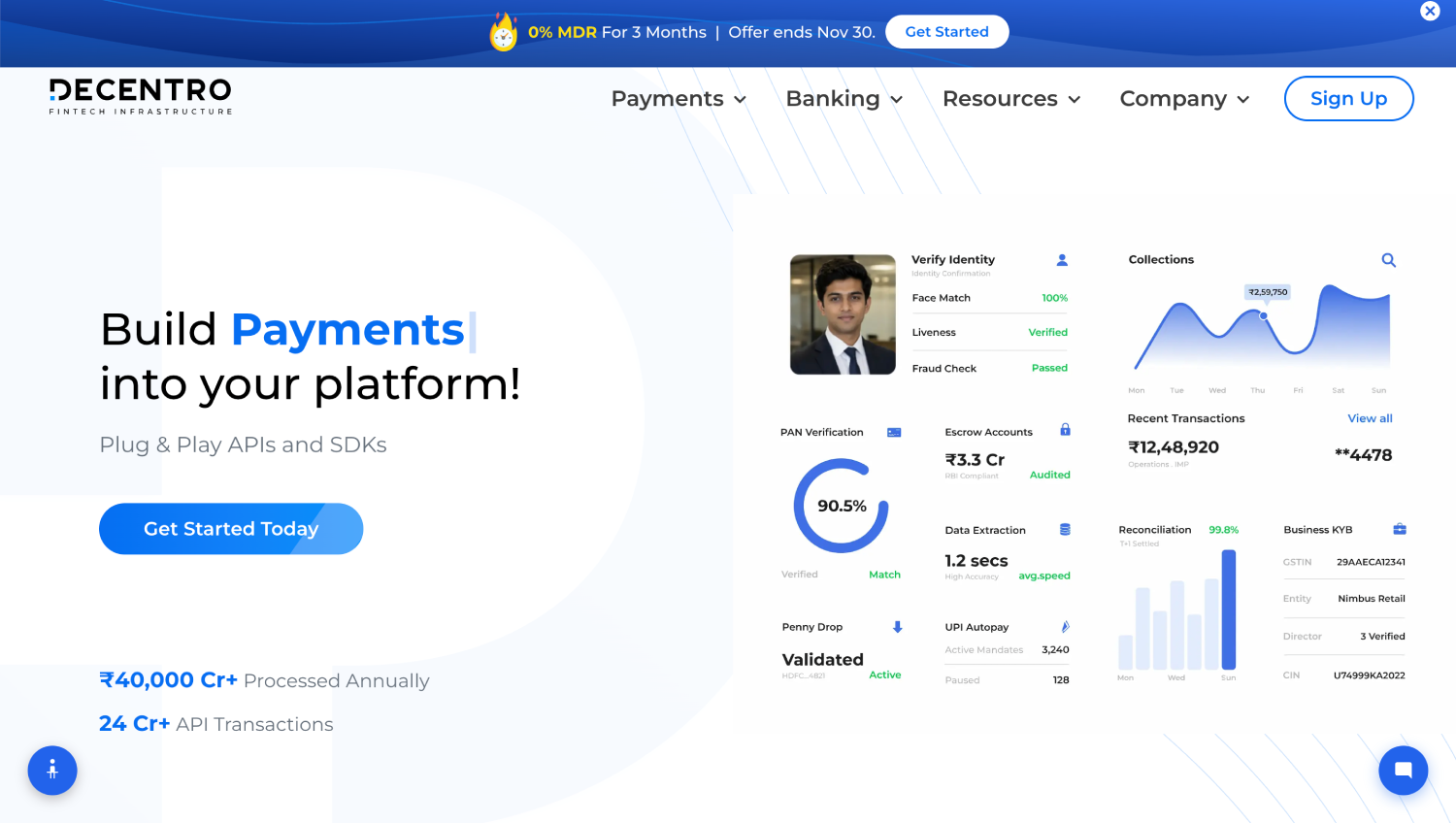
Decentro positions itself as a banking API layer for fintechs rather than a pure payouts product, which makes it appealing for teams that also need account issuance, collections, and UPI payouts under a single API contract. Its UPI payout module supports VPA-to-VPA transfers and exposes a VPA resolution endpoint for pre-dispatch validation.
Failure codes surface through reason codes in the payout response body. Coverage is solid but Decentro’s documentation describes the codes at a mapped level rather than raw NPCI codes, so your engineering team will need to map their taxonomy to your retry logic. Webhook coverage spans all state transitions per their developer documentation. Decentro does not publish per-transaction pricing publicly (as of this writing); enterprise pricing is negotiated.
Passes three of four gates: pre-validation, webhook coverage, and reversal handling are confirmed. Failure code granularity is medium rather than high due to the mapped taxonomy layer.
3. Razorpay X: Best for Platforms Already on the Razorpay Stack
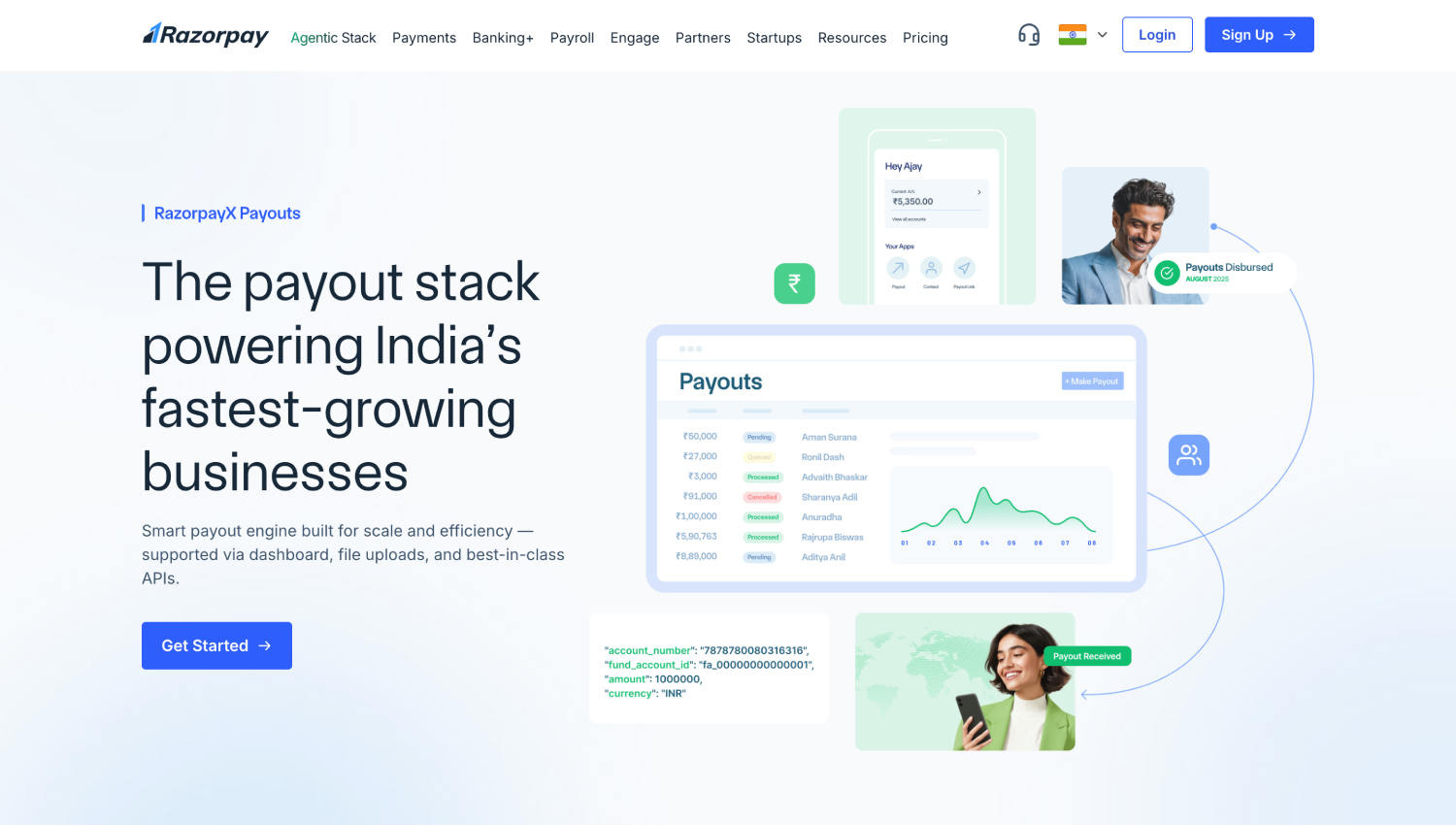
Razorpay X is Razorpay’s business banking and payouts product. It supports UPI payouts to VPAs through its Payout API, and its Fund Account Validation endpoint lets you verify a VPA is active before initiating a transfer. That validation step matters for platforms where beneficiary data is user-submitted rather than KYC-verified, because bad VPAs discovered at payout time create reconciliation noise.
Razorpay X publishes detailed payout status codes in its developer documentation. Terminal failure reasons include categories like “BENEFICIARY_BANK_CONFIRMATION_PENDING,” “LOW_BALANCE,” and VPA-specific rejection codes. Webhooks fire on all state changes: queued, processing, processed, and failed. For teams already using Razorpay for payment collection, X’s shared dashboard and common API key structure reduce integration overhead. Per-payout pricing requires direct inquiry; Razorpay does not list payout fees on its public pricing page (as of this writing).
Passes all four gates. The main constraint is that X’s full feature set integrates most cleanly with the broader Razorpay product suite, which may be a lock-in consideration for platforms using multiple payment providers.
4. PayU PayOuts: Best for Platforms With Existing PayU Collection Relationships
PayU offers a payouts product that includes UPI transfers to VPAs alongside IMPS and NEFT. The API supports both single and bulk disbursements. PayU’s pre-validation happens at payout initiation rather than through a separate pre-dispatch endpoint, which means you cannot batch-validate VPAs before submitting a payout job. That architecture pushes a larger share of VPA failures into the payout failure class rather than a validation pre-check class.
Status callbacks cover terminal states (success and failure) with reason codes. In-progress webhook coverage is partial, which means monitoring a large batch requires polling the payout status API for in-flight transactions. Reversal handling returns funds to the source account with a tagged reason code on most failure types. PayU does not publish per-payout pricing publicly (as of this writing).
Passes two of four gates fully (failure codes and reversal handling). Pre-validation and in-flight webhook coverage are partial, which is a meaningful gap for platforms disbursing at scale.
5. Juspay: Best for Payment Orchestration Platforms That Need UPI Payouts as Part of a Broader Stack
Juspay started as a payment orchestration layer for large merchants and has extended into payouts. Its UPI disbursement API supports VPA payouts and exposes a pre-validation step. What sets Juspay apart from the other providers on this list is the depth of its payment reason code taxonomy, which is built around handling high-volume scenarios where differentiating between NPCI timeout, bank timeout, and VPA resolution failure at the API level determines how retry logic is built.
Juspay’s webhook infrastructure covers all state transitions, including intermediate processing states that matter when a payout sits in the NPCI queue before the destination bank acknowledges it. Pricing is enterprise and not publicly disclosed (as of this writing). Juspay is a stronger fit for platforms already using its orchestration layer for collections who want a unified provider rather than a standalone payouts vendor.
Passes all four gates. The integration complexity is higher than a single-purpose payouts API, so smaller teams without dedicated payment engineering may find the setup cost disproportionate.
6. iServeU: Best for Regional Platforms and BC Network Operators Needing UPI Payouts at the Distribution Edge

iServeU targets a different buyer profile than the others on this list. Its platform is built for business correspondents, regional fintech operators, and platforms that need to push payouts through agent networks or last-mile distribution channels, not just direct API integrations into a web or mobile product.
According to iServeU’s published product documentation, the platform supports UPI payouts to VPAs and includes a VPA validation API for pre-dispatch checks. Webhook behavior varies by integration mode: direct API integrations support state-change callbacks, while some channel integrations rely on polling the payout status API. Failure code coverage is medium rather than granular, with reason categories exposed rather than raw NPCI codes. iServeU does not publish per-payout pricing (as of this writing).
Passes three of four gates: pre-validation, reversal handling, and failure reason exposure are confirmed. Full webhook coverage depends on how your integration is structured, so this requires explicit confirmation during your technical evaluation.
7. Open Money: Best for SMB-Focused Platforms Looking for a Combined Current Account and Payout Product
Open Money (Open Financial Technologies) combines a neo-banking product with a payout API, targeting small and mid-sized businesses rather than enterprise platforms. Its UPI payout capability supports transfers to VPAs and handles bulk disbursement through its payouts API. Pre-validation is partial: Open performs a VPA check at the point of payout initiation rather than through a dedicated standalone validation endpoint.
Status webhooks cover terminal states. In-progress state coverage requires polling the payout status API for batches, which adds engineering overhead for high-frequency disbursement scenarios. Failure codes are returned at a reason-category level rather than granular NPCI code level. Open’s pricing is not publicly listed for payouts (as of this writing); it is bundled with the broader banking product for most customers.
Passes two of four gates fully (reversal handling and failure reason exposure). Pre-validation and webhook coverage gaps mean Open Money works best for platforms disbursing at moderate volumes where full in-flight monitoring is not operationally critical.
How to Evaluate UPI Bulk Payout API Throughput for Your Platform’s Actual Volume
Consider a hypothetical: a gig economy platform processing 80,000 UPI payouts per day, spread across two disbursement windows. At that volume, the difference between a provider that validates VPAs in a pre-check batch versus one that surfaces bad VPAs as payout failures is the difference between a reconciliation job that completes in a single short pass and one that grinds through a larger pool of mixed failure types requiring manual triage. The engineering cost of building retry logic that correctly handles mixed failure classes is not trivial.
At that scale, throughput limits matter more than per-transaction pricing on a basis-points basis. The effective limit on UPI batch payouts is typically set by the bank partner sitting behind the API provider, not by the API provider itself. When evaluating a shortlist, ask specifically: what is the bank partner, what is their daily UPI payout settlement window, and what happens to payouts submitted after the NEFT cutoff if the UPI path fails? Those questions separate providers who understand their own infrastructure from those who are reselling without full visibility into the rails.
Teams building payment infrastructure for Indian platforms will also find context in the overview of fintech APIs for SaaS products useful for understanding how UPI payout APIs fit alongside other infrastructure choices. For platforms that also need to understand payout infrastructure design more broadly, the guide to how payout APIs work covers rails, funding, compliance, and reconciliation in depth.
What Does a VPA Disbursement API Response Actually Look Like?
When a UPI payout succeeds, a well-structured VPA disbursement API returns at minimum: the payout reference ID, the UTR (Unique Transaction Reference) number assigned by NPCI, the destination VPA, the VPA resolved name (for name-match auditing), and a timestamp. Providers that omit the UTR from the success callback force you to call a separate status endpoint to retrieve it, which adds latency to your reconciliation pipeline.
When a UPI payout fails, the failure response should include a reason code that maps to a human-readable failure category. At minimum you need to distinguish: VPA not found or inactive, destination bank declined, NPCI timeout, and insufficient balance in source account. Providers that collapse these into a single “failed” status with no reason code are unsuitable for production disbursement systems where automated retry logic is a requirement.
India’s UPI MDR structure is also changing the economics of payout operations. The introduction of MDR on certain UPI transaction categories, as covered in the breakdown of India’s UPI MDR changes and what they mean for platforms, means per-payout cost modeling now has a regulatory variable that did not exist previously. Factor that into your total cost comparison across the seven providers above.
Frequently Asked Questions
What is a VPA disbursement API?
A VPA disbursement API is a programmatic interface that lets a platform send money directly to a UPI Virtual Payment Address (VPA), such as user@upi, rather than requiring the recipient’s bank account number and IFSC code. The API resolves the VPA through NPCI’s registry, credits the linked bank account, and returns a transaction status with a UTR reference. Platforms use VPA disbursement APIs for gig worker payouts, marketplace seller earnings, insurance disbursements, and similar use cases where recipients have UPI IDs on file rather than bank details.
What is the per-transaction limit for UPI payouts via API?
NPCI sets a standard UPI per-transaction ceiling of ₹1 lakh for most transaction categories under its published UPI circulars. Some categories, including IPO applications, healthcare payments, and insurance premiums, have higher limits under separate NPCI notifications. API providers pass through these NPCI limits and do not set independent ceilings above them, though some bank partners impose lower operational limits during high-traffic periods. Always confirm the effective limit with your provider’s bank partner, not just the API provider’s sales team.
How does UPI payout status API work?
A UPI payout status API lets you query the current state of a payout using its reference ID. States typically include: initiated, queued (accepted by NPCI), processing (sent to destination bank), processed (credited successfully), and failed (with a reason code). Better providers also push state changes via webhooks so your system does not need to poll. The key data points in a terminal success response are the UTR number and the timestamp of credit. In a terminal failure response, the key data point is the reason code, which determines whether you retry, flag for manual review, or prompt the user to update their VPA.
Can you batch validate VPAs before sending bulk UPI payouts?
Yes, providers including Cashfree, Decentro, Razorpay X, Juspay, and iServeU offer VPA validation endpoints that can be called independently of the payout itself. This lets you submit a list of VPAs for pre-dispatch validation, receive active or inactive status for each, and filter out bad VPAs before submitting your payout batch. The result is a smaller, cleaner payout job with fewer terminal failures to reconcile. PayU and Open Money perform VPA checks only at payout initiation, which is less useful for pre-batch cleanup workflows.
What failure codes should a UPI payout API return?
At minimum, a production-grade UPI payout API should return failure codes that distinguish between: VPA not found (permanent, requires user action), VPA found but bank account inactive or dormant (may resolve on retry after user action), destination bank declined or timed out (transient, eligible for automatic retry), NPCI timeout (transient, retry after delay), and source account insufficient balance (requires platform-side action). Providers that collapse all failures into a single generic code force engineering teams to build failure-classification logic outside the API, which creates maintenance overhead as failure patterns evolve.
Which UPI payout API is best for marketplace platforms paying sellers at scale?
Cashfree Payouts and Razorpay X are the strongest fits for marketplace platforms disbursing to large seller bases. Both offer pre-dispatch VPA validation, granular NPCI-mapped failure codes, and webhooks on all state transitions. Cashfree’s batch API handles mixed-rail payouts (UPI plus IMPS plus NEFT) in a single call, which matters for seller bases where some recipients have VPAs and others provide only bank details. Razorpay X integrates more tightly with Razorpay’s collection stack, making it more efficient for platforms already collecting on Razorpay.
How do UPI payout reversals work?
When a UPI payout credit is rejected by the destination bank (for example, because the account linked to the VPA was closed after validation), NPCI returns the funds to the originating bank, which credits them back to your payout source account. Well-implemented APIs tag this reversal with the original payout reference ID and a reason code. Providers that handle this cleanly will fire a webhook on the reversal event and reflect the reversal in your wallet or source balance automatically. Providers that route reversals through a manual settlement process introduce delays and reconciliation complexity that grows proportionally with payout volume.
The Differentiator That Most Evaluations Miss
Most teams evaluating a UPI payout API for platforms start with pricing and end with integration documentation. The more productive frame is to start with failure taxonomy and work backward to pricing. How a provider handles the 2 to 5 percent of payouts that fail at any point in the NPCI chain tells you far more about its operational maturity than its success-path documentation.
The seven providers profiled above all support UPI payouts to VPAs. The gap between a good one and a poor one for your use case is almost entirely in the four dimensions of the VPA Payout Stress Test: pre-dispatch validation, failure code granularity, in-flight webhook coverage, and reversal handling. Cashfree, Razorpay X, and Juspay clear all four. Decentro and iServeU clear three. PayU and Open Money clear two, and both have the same gaps (pre-validation and in-flight webhooks), which makes them appropriate for lower-volume or less operationally complex disbursement scenarios.
For teams building compliance-sensitive disbursement flows, the intersection of payout API choice and product and compliance readiness is worth reviewing before you go into production. The payout API is not a standalone infrastructure decision: the compliance obligations around beneficiary verification, audit trails, and failed payment reporting attach to the platform, not the API provider.