
TLDR
- RTP Request for Payment (RfP) is a pull-collection workflow, not an instant credit push. The biller sends a request; the payer’s bank presents it; the payer approves; only then does the RTP credit move.
- Bank reachability is the most underrated variable. If the payer’s bank does not receive RfP messages, the request goes nowhere regardless of which API you use.
- Four platforms cover this workflow for US billers today: Modern Treasury, Finzly, Cross River, and TabaPay. Each reaches the RTP network through a different model, with different integration surfaces.
- The payer-approval step produces distinct response codes (Accept, Reject, No Response) that your system must handle. Treating RfP like a fire-and-forget credit push will break your reconciliation logic.
- Pricing across these platforms is not publicly disclosed in full. Contact each vendor directly for per-request and per-credit-transfer fees.
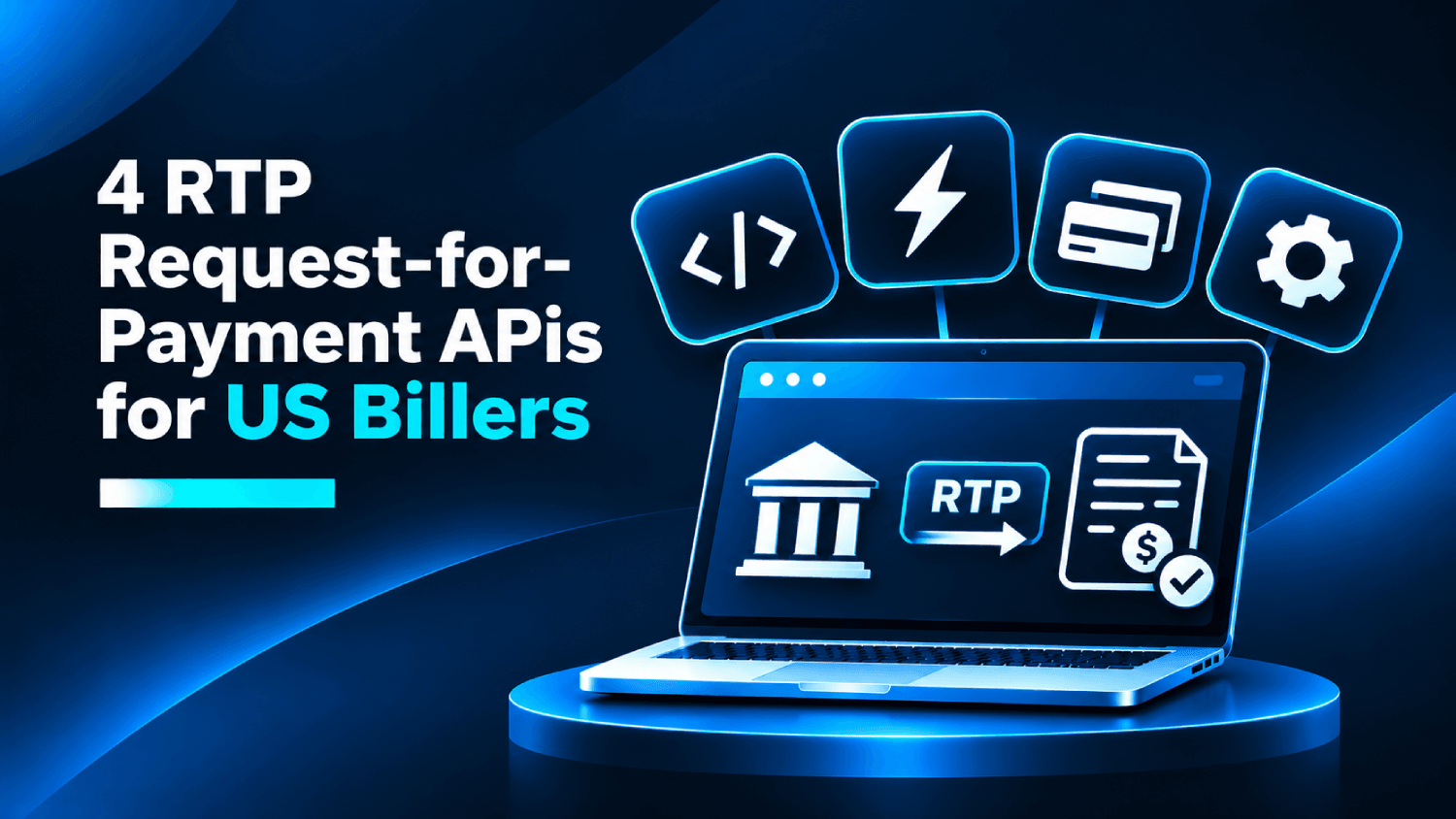
Four RTP Request for Payment API providers currently serve US billers building inbound collection workflows: Modern Treasury, Finzly, Cross River, and TabaPay. Each connects to The Clearing House RTP network and supports the full RfP lifecycle: request initiation by the biller, payer-side approval or rejection at the receiving bank, and final RTP credit push with settlement-status callbacks. Payer bank participation, request expiry handling, and response-code coverage differ meaningfully across these four options.
What Is RTP Request for Payment and Why Is It Not the Same as Sending an RTP Credit?
An RTP credit transfer is a push. Your system instructs your bank to move money to a destination account, and barring a technical failure, it settles in seconds. RTP Request for Payment is the opposite direction: your system sends a structured message to the payer’s bank asking that bank to present a payment request to the account holder. The payer then decides to approve, reject, or ignore it.
The two-step nature matters for billers. With a plain RTP credit push, you already have the funds or you are disbursing them. With RfP, you are requesting them from someone who has not yet agreed to pay in this moment. The payer’s consent is embedded in the workflow, which means the receiving bank must support inbound RfP messages, the payer must act within the request’s expiry window, and your API layer must handle at least three distinct response states before you can book a received payment.
The practical gap between “we support RTP” and “we support RTP RfP” is significant. Many platforms that advertise real-time payment APIs only wrap outbound RTP credit transfers, which are useful for payouts but useless for collections. The four platforms profiled here specifically support inbound RfP initiation for billers, where the biller originates the request and collects the resulting credit.
What Is the RTP RfP Workflow That All Four Platforms Must Implement?
The Clearing House RTP network defines the RfP message set as part of its ISO 20022-based message schema. A conforming implementation must support at minimum four workflow stages.
First, the biller’s system calls the API to construct and transmit a Request for Payment message. That message includes the payment amount, the payer’s account details, a due date, and an expiry timestamp. Second, the platform routes the message to the payer’s receiving bank over the RTP network. The receiving bank must be an active RTP participant that has opted into the RfP message type. Third, the payer’s bank presents the request through its own banking interface. The payer approves or rejects it. Fourth, the platform returns a response message to the biller’s system: an Accept (triggering the inbound RTP credit), a Reject (with a reason code), or a No Response once the expiry window closes.
Your engineering team needs to map all three terminal states to actual outcomes in your ledger. For teams building full payment automation, the invoicing API layer upstream of RfP initiation also needs to store the RfP message ID to match the eventual credit to the right invoice.
How Do You Evaluate an RTP RfP API? The FintechSpecs RfP Readiness Checklist
Most vendor comparison frameworks for instant payment APIs focus on latency and uptime. For RfP specifically, those dimensions are secondary. What actually differentiates these four platforms is a different set of questions.
The FintechSpecs RfP Readiness Checklist defines four evaluation axes:
- Request initiation surface: Does the API expose a dedicated RfP endpoint, or is RfP bundled inside a broader payment orchestration flow? A standalone RfP endpoint gives your team cleaner error handling and message lifecycle control.
- Payer approval handling: Does the platform return structured response codes for Accept, Reject, and Expiry, or does it surface a generic webhook? Generic webhooks push the state-mapping work onto your team.
- Participant reach: Which banks in the payer’s network actually receive RfP messages? Receiving-bank participation in the RTP RfP message type is a subset of overall RTP participation. A platform connected to the most RTP-receiving banks does not automatically cover the most RfP-capable banks.
- Settlement-status linkage: When a payer approves the request and the resulting RTP credit arrives, does the platform link the inbound credit to the originating RfP message ID? Without this linkage, reconciliation requires manual matching.
Run every vendor through these four checks before evaluating pricing or integration complexity.
Modern Treasury: Payment Operations Platform With Native RfP Support
Modern Treasury is a payment operations API that connects to bank partners to access multiple payment rails including RTP. Its architecture separates the payment rail from the operational layer: developers interact with a single API and Modern Treasury routes through the appropriate bank partner and rail.
Modern Treasury supports RTP Request for Payment as part of its payment order and incoming payment detail model. According to Modern Treasury’s developer documentation, the platform exposes payment order objects with direction and type fields that distinguish RfP initiation from standard RTP credit pushes. Incoming payment details returned to the biller include the payment type, the originating RTP message, and status data.
The platform’s ledger and reconciliation layer is a distinguishing feature for finance-heavy teams. Modern Treasury’s documentation describes the ability to match inbound payments against expected payment objects using its ledger transaction model. Teams should verify against Modern Treasury’s current API reference whether automatic posting against expected ledger entries is supported for RfP-triggered credits in their specific integration configuration, as behavior may depend on how expected payments are pre-registered. Teams building on double-entry ledger infrastructure inside their product will find this integration point more useful than a plain webhook callback.
Modern Treasury: RfP Checklist Scores
| Evaluation Axis | Coverage | Notes |
|---|---|---|
| Request initiation surface | API endpoint (payment orders) | Direction and type fields distinguish RfP from credit push |
| Payer approval handling | Incoming payment detail objects with status | Accept, Reject, and expiry mapped to object states |
| Participant reach | Via bank partner network | Dependent on Modern Treasury’s partner banks; verify current RfP-capable reach directly |
| Settlement-status linkage | Yes, via ledger layer | Matching inbound credits to expected payment objects supported; confirm auto-posting behavior with Modern Treasury for your integration |
Modern Treasury does not publish per-transaction RfP pricing publicly. As of their public documentation, pricing is custom and quote-based (verify current terms at moderntreasury.com). Teams evaluating Modern Treasury alongside other platforms should also review the Modern Treasury pricing breakdown for platform fee context before entering commercial conversations.
Finzly: Bank-Native RTP RfP With a Direct Network Connection
Finzly operates as a payment hub vendor whose core product, BankOS, is deployed inside banks and credit unions. For fintechs and billers, Finzly’s relevance to RTP RfP comes from its network connectivity model: Finzly connects financial institutions directly to The Clearing House RTP network, and its platform supports the full ISO 20022 RfP message set including request initiation, response handling, and status tracking.
Finzly’s product documentation describes RTP RfP support as a component of its real-time payments module. The platform supports both send and receive sides of the RfP flow, meaning a bank or biller using Finzly can originate requests and receive the resulting credit transfers in a linked workflow. This end-to-end coverage within a single platform reduces the integration surface compared to building request initiation on one provider and credit receiving on another.
For billers that partner with a Finzly-powered bank, the access model is bank-mediated rather than direct API access from the biller to Finzly. This is an important architecture distinction. Finzly is not a direct-to-biller API in the same way Modern Treasury is. Access depends on whether your sponsoring or operating bank runs Finzly’s payment hub, which makes it more relevant to teams building inside or alongside a financial institution than to fintechs seeking direct API access.
Finzly: RfP Checklist Scores
| Evaluation Axis | Coverage | Notes |
|---|---|---|
| Request initiation surface | Payment hub API (bank-mediated) | Direct bank integration required; not a standalone biller-facing API |
| Payer approval handling | Full RfP response message set | Accept, Reject, and expiry per ISO 20022 message schema |
| Participant reach | Direct TCH RTP connection | Reach depends on the bank’s RfP opt-in configuration |
| Settlement-status linkage | Yes, within BankOS platform | RfP message ID linked to inbound credit in the same hub |
Finzly does not publish public pricing for its bank technology platform. Pricing is negotiated with the financial institution that licenses BankOS, which then determines what it charges billers or business clients accessing RfP through that bank.
Cross River: Sponsor Bank With RTP RfP as a Managed Service
Cross River Bank is an FDIC-insured bank that provides banking infrastructure to fintechs, including direct access to payment rails through a sponsor bank relationship. Cross River supports RTP as a direct TCH network participant, and its technology platform exposes payment APIs including RTP to fintech partners.
Cross River’s RTP access covers both credit push and Request for Payment flows. For billers accessing RTP RfP through Cross River, the relationship is a direct bank partnership rather than a middleware API layer. This matters for two reasons. First, your company operates as a client of an actual FDIC-insured bank, which affects your compliance posture and onboarding requirements. Second, as a direct RTP network participant, Cross River’s RfP message delivery does not pass through an intermediary bank partner, which can simplify the participant-reach calculation.
Cross River has historically served fintechs at scale across multiple payment rails including ACH and RTP. Teams that need RTP RfP alongside ACH origination and FedNow access under a single sponsor bank relationship will find Cross River’s multi-rail coverage relevant. The tradeoff is onboarding friction: a sponsor bank relationship involves underwriting, compliance review, and a more involved commercial process than signing up for a middleware API.
For teams already evaluating sponsor bank options, the broader context on program structure and what these relationships actually cost is covered in the sponsor bank program evaluation guide.
Cross River: RfP Checklist Scores
| Evaluation Axis | Coverage | Notes |
|---|---|---|
| Request initiation surface | Direct bank API (partner access) | Requires established fintech partnership with Cross River |
| Payer approval handling | RTP RfP response codes supported | Accept, Reject, No Response; confirm specific webhook schema with Cross River technical team |
| Participant reach | Direct TCH RTP participant | No intermediary bank layer; reach determined by TCH RfP-enabled member banks |
| Settlement-status linkage | Via platform API callbacks | Inbound credit correlated to originating RfP at the platform layer |
Cross River does not publish per-transaction RTP pricing. Fees are negotiated as part of the fintech partnership agreement. As of their public product pages, access to RTP is included in the payments infrastructure offering available to bank technology partners.
TabaPay: Payments Infrastructure With RTP RfP for Platforms and Billers

TabaPay is a payments infrastructure provider that offers API-based access to multiple US payment rails including card networks, ACH, RTP, and FedNow. TabaPay is a direct TCH RTP participant and supports RTP Request for Payment as part of its real-time payments product suite.
TabaPay’s model is closer to Modern Treasury in terms of access model: billers and platforms can integrate directly against TabaPay’s API without needing a separate bank sponsor relationship for the payment rail. TabaPay handles the bank sponsorship and network connectivity on its end. For engineering teams, this means a single API contract covering RfP initiation, response handling, and inbound credit receipt.
TabaPay’s RTP RfP implementation includes support for the ISO 20022 message fields required for US RfP flows: creditor reference, payment purpose, expiry timestamp, and the response message set. The platform returns webhook events for each RfP state change, allowing biller systems to update payment status records without polling. For teams building collections flows at volume, this event-driven response model reduces latency between payer approval and biller-side reconciliation.
TabaPay also supports FedNow alongside RTP, which matters when you are thinking about payer-side bank coverage. Some banks participate in FedNow but not RTP, or participate in RTP but have not enabled RfP message receipt specifically. A platform supporting both rails gives you more options as the RfP adoption picture matures, though these remain distinct workflows with different message schemas. Teams looking at the full instant payments API landscape should reference the instant payment API comparison across FedNow and RTP for broader rail coverage context.
TabaPay: RfP Checklist Scores
| Evaluation Axis | Coverage | Notes |
|---|---|---|
| Request initiation surface | Direct API (no separate bank sponsor required) | RfP initiation endpoint within the RTP product suite |
| Payer approval handling | Webhook events per state change | Accept, Reject, Expiry events; ISO 20022 response fields returned |
| Participant reach | Direct TCH RTP participant | RfP delivery subject to receiving-bank RfP opt-in status |
| Settlement-status linkage | Yes, event-driven | Inbound credit event references originating RfP message ID |
TabaPay does not publish per-transaction RTP pricing publicly. Pricing is available on request and varies by volume and product configuration (verify current terms at tabapay.com).
Side-by-Side Comparison: RTP RfP APIs for US Billers
| Provider | Access Model | RTP Network Status | RfP Initiation | Response Code Coverage | Settlement Linkage | Pricing |
|---|---|---|---|---|---|---|
| Modern Treasury | Middleware API via bank partners | Via partner banks | Payment order API | Accept, Reject, Expiry (object states) | Yes, ledger layer | Custom, quote-based (verify at moderntreasury.com) |
| Finzly | Bank-mediated (BankOS platform) | Direct TCH participant (bank) | Payment hub API | Full ISO 20022 RfP response set | Yes, within BankOS | Negotiated via bank |
| Cross River | Sponsor bank relationship | Direct TCH participant | Partner API | Accept, Reject, No Response | Via platform callbacks | Negotiated partnership |
| TabaPay | Direct API | Direct TCH participant | RfP API endpoint | Webhook per state (ISO 20022) | Yes, event-driven | Custom, quote-based (verify at tabapay.com) |
What Is the RTP RfP Payer Bank Reachability Problem and How Should Billers Think About It?
The most common misconception billers bring to RfP evaluation is assuming that if their platform is connected to the RTP network, their requests will reach all payers. The Clearing House maintains a public list of RTP-participating financial institutions. The number of those institutions that have specifically enabled RTP Request for Payment message receipt is a smaller subset, and it is not static. Confirm current RfP-enabled counts directly with The Clearing House or with your chosen vendor before building participation assumptions into your product.
When a biller sends an RfP through any of these four platforms, the request routes to the payer’s receiving bank. If that bank is not an RTP RfP-enabled participant, the request either fails at routing or returns a negative response before the payer ever sees it. The biller’s API platform cannot force a bank to accept RfP messages. This is a network adoption constraint, not a vendor limitation.
The practical implication: before committing to RfP as a primary collection method for a specific payer segment, map your payer base against current RfP-enabled receiving banks. The Clearing House publishes its participant list at the link above, and all four vendors should be able to confirm current reachability for specific routing numbers before you go live. Consider building a fallback path , ACH or card , for payers whose banks have not yet enabled RfP receipt. Teams building the payment infrastructure stack around this decision should map it against the broader question of which rails belong in which part of the stack, a topic covered in the payment infrastructure tools overview.
How Should You Handle RfP Response Codes in Your System?
Every RTP RfP implementation produces three terminal states for each request. Your system must map each one to a specific action.
An Accept response means the payer approved the request and an RTP credit transfer has been initiated. Your system should wait for the inbound credit webhook or status callback before marking the invoice paid. The RfP Accept and the resulting credit are two separate events, and a small window exists between them. Book on the credit receipt, not the Accept.
A Reject response means the payer actively declined. The ISO 20022 schema supports reason codes on rejections, and all four platforms above should return whatever reason code the payer’s bank provides. Your system should use the reject reason to determine the next step: re-present via a different channel, escalate to collections, or flag for manual review.
A No Response or expiry state means the request timed out without payer action. The RTP network allows billers to set an expiry timestamp on the original request. When that window closes without an Accept or Reject, the platform should return an expiry event. This is not a rejection and should not be treated as one. Many payers who do not respond to a first RfP will respond to a re-send with a shorter expiry window.
Engineering teams should build distinct handlers for all three states from day one. Collapsing Reject and Expiry into a single “failed” state is a common shortcut that breaks re-presentment logic downstream.
Frequently Asked Questions About RTP Request for Payment APIs
What is the difference between an RTP credit transfer and an RTP Request for Payment?
An RTP credit transfer is a push payment initiated by the sender to move funds to a destination account. An RTP Request for Payment is a pull-collection message sent by a biller to a payer’s bank, asking the payer to approve a payment. The payer must actively accept before any funds move. These are distinct message types on The Clearing House RTP network, and not all RTP-connected platforms support both.
Can any US bank receive an RTP Request for Payment message?
No. A bank must be an active RTP network participant and must specifically support the RfP message type to present requests to its account holders. The Clearing House publishes a list of RTP-participating institutions, but RfP enablement is a separate configuration step that not all participants have completed. Before deploying RfP-based collection flows, verify that your target payer base banks with RfP-capable institutions.
How do Modern Treasury, Finzly, Cross River, and TabaPay differ in access model?
Modern Treasury and TabaPay offer direct API access where the biller integrates against the vendor’s API without establishing a separate bank relationship. Finzly is a bank technology platform, so access is mediated through a bank that licenses BankOS. Cross River provides access through a sponsor bank partnership, which involves underwriting and a formal commercial agreement. Access model affects onboarding time, compliance overhead, and pricing structure for each option.
What response codes does the RTP RfP workflow produce?
The three terminal states in the RTP RfP workflow are Accept (payer approved; RTP credit initiated), Reject (payer declined; reason code typically included per ISO 20022), and No Response or Expiry (request timeout without payer action). Your system must handle all three with distinct logic. Treating Reject and Expiry identically will cause errors in re-presentment and collections workflows.
Does RTP Request for Payment work for recurring billing?
RfP as defined on the RTP network is a per-transaction request, not a standing authorization like ACH direct debit. A biller must send a new RfP for each billing cycle, and the payer must approve each one. This makes it less efficient than ACH for high-frequency recurring billers, but more transparent for payers, since each payment requires explicit consent. Some platforms are building pre-authorization frameworks on top of RfP, but these are vendor-specific implementations, not a base RTP network feature.
Is RTP Request for Payment available through FedNow?
The Federal Reserve’s FedNow service supports a Request for Payment message type that is functionally similar to the RTP RfP workflow. FedNow and RTP are separate networks with separate participant sets. A biller that wants to reach payers across both networks needs a platform that connects to both rails. TabaPay and Modern Treasury both have FedNow access alongside RTP, though the RfP implementations are distinct per network. Confirm FedNow RfP support and participant reach separately from RTP RfP support when evaluating vendors.
Conclusion
RTP Request for Payment is a materially different infrastructure commitment from RTP credit push. The payer-consent step, the three-state response model, and the receiving-bank participation constraint all require deliberate engineering decisions that generic “instant payments API” vendors do not address. The four platforms profiled here , Modern Treasury, Finzly, Cross River, and TabaPay , each cover the full RfP lifecycle, but they differ in access model, network architecture, and how tightly they link the inbound credit to the originating request.
For most fintechs and billers building a direct API integration without a pre-existing bank relationship, Modern Treasury and TabaPay offer the fastest path to production. For teams already operating inside or alongside a financial institution, Finzly’s bank-native model provides deeper integration with the payment hub and the bank’s RfP opt-in configuration. Cross River suits teams that need a full sponsor bank relationship covering multiple rails under one roof, and are prepared for the longer onboarding that entails.
The variable that none of these platforms can fully solve for you is payer bank reachability. Run your payer routing numbers against the current RfP participant list before you finalize rail strategy. Build the fallback. Treat RfP as a primary collection method for the payers it can reach, and ACH or card as the default for everyone else, until network adoption catches up with the architecture’s potential.