
TLDR
- Managing bank connectivity bank by bank compounds maintenance costs every time a banking relationship changes, a file format shifts, or a new geography is added.
- A multi-bank connectivity platform replaces that web of one-off integrations with a single normalized layer covering SWIFT, host-to-host, and API channels.
- The five platforms profiled here span SAP Multi-Bank Connectivity, Fides ONEConnect, Atlar, TIS (Treasury Intelligence Solutions), and Coupa Treasury, each serving a different point on the company-size and connectivity-complexity spectrum.
- Bank protocol support, geographic coverage, and implementation model are the three variables that most often determine whether a platform fits or creates new bottlenecks.
- None of these platforms publicly disclose per-connection or per-transaction pricing; every evaluation should include a formal RFP with line-item cost disclosure.
The five most widely evaluated multi-bank connectivity platforms for corporate treasury are SAP Multi-Bank Connectivity, Fides ONEConnect, Atlar, TIS (Treasury Intelligence Solutions), and Coupa Treasury. Each routes payment instructions and bank statement data through a normalized layer that sits between your ERP or treasury management system and your banking partners, covering protocols including SWIFT, host-to-host SFTP, and direct bank APIs. The right choice depends on your ERP environment, the number of banking relationships you manage, and whether you need payment execution alongside data aggregation.
Why Do Corporate Treasury Teams Need a Multi-Bank Connectivity Platform?
Every bank has its own file format, authentication method, and transmission protocol. A European bank might expect MT940 statements over SWIFT FileAct, while a US regional bank delivers BAI2 files via SFTP, and a Nordic bank offers a direct API in ISO 20022. Managing those three connections separately means three sets of credentials, three monitoring pipelines, and three remediation workflows every time something breaks.
At ten banking relationships, that fragmentation becomes a full-time operational problem. At thirty, it becomes a material risk. A connectivity layer absorbs format translation, protocol handling, and bank-side authentication into a single managed integration, so treasury teams see one normalized data feed regardless of what the bank sends underneath.
The less obvious benefit is speed to onboard new banks. Without a connectivity layer, adding a new banking partner typically requires IT involvement, format mapping, and a testing cycle measured in weeks. With a platform that already has that bank in its network, the onboarding can compress to days. For companies growing through acquisition or expanding into new markets, that compression has real cash-management implications. Teams evaluating their broader fintech infrastructure stack often find that bank connectivity is the layer with the highest hidden maintenance cost. The same goes for companies mapping out their ERP integration strategy: bank connectivity decisions and accounting integration decisions are often made in parallel and affect the same data flows.
What Should You Evaluate in a Multi-Bank Connectivity Platform?
The FintechSpecs Treasury Connectivity Scorecard organizes evaluation into four criteria, applied in sequence before shortlisting vendors.
Protocol depth: Does the platform support the specific channels your banks actually use? SWIFT Service Bureau access, host-to-host SFTP, and direct bank API connectivity are not interchangeable. A platform strong in SWIFT but thin on direct API connectivity will create a gap if your primary banking partners have moved to API-first connections.
Bank network breadth: Pre-certified bank connections reduce implementation risk. A vendor claiming “SWIFT connectivity” technically reaches any SWIFT-member bank, but pre-built, tested connections to a specific bank mean fewer surprises at go-live.
Format normalization: The platform should translate incoming statement formats (MT940, BAI2, CAMT.053, proprietary formats) and outgoing payment formats (MT101, pain.001, NACHA) without requiring your team to build or maintain those mappings.
ERP and treasury management system compatibility: Some platforms are designed as native modules within a specific ERP. Others are ERP-agnostic middleware. That distinction determines implementation path, data model, and long-term flexibility. For companies running complex multi-entity structures, this compatibility question also intersects with financial consolidation software choices.
Protocol, Coverage, and Implementation: Side-by-Side Comparison Table
| Platform | Primary Protocol Support | Connectivity Method | Bank Network / Coverage | ERP Fit | Implementation Model |
|---|---|---|---|---|---|
| SAP Multi-Bank Connectivity | SWIFT, Host-to-Host, ISO 20022 | SWIFT Service Bureau, SFTP, direct bank APIs | Global; pre-certified connections for major banks across EMEA, Americas, APAC | Native SAP S/4HANA and ECC | SAP-managed cloud service; SAP partner-led implementation |
| Fides ONEConnect | SWIFT, H2H, ISO 20022, local formats | SWIFT Service Bureau, host-to-host, direct API | Global; 13,000+ bank connectivity points per Fides’ product page | ERP-agnostic; connects to SAP, Oracle, Microsoft Dynamics, TMS platforms | Managed service; Fides-led onboarding |
| Atlar | Direct bank APIs, SWIFT (via partnership) | API-first; real-time bank connections | Primarily Northern Europe; expanding coverage | ERP-agnostic; API and webhook-based integration | Self-serve API onboarding; developer-led |
| TIS (Treasury Intelligence Solutions) | SWIFT, Host-to-Host, ISO 20022, EBICS | SWIFT Service Bureau, SFTP, EBICS, direct API | Global; 11,000+ bank connectivity points per TIS’s product site | ERP-agnostic; SAP, Oracle, Microsoft Dynamics, TMS integrations | Managed service; TIS-led implementation |
| Coupa Treasury | SWIFT, Host-to-Host, ISO 20022 | SWIFT Service Bureau, SFTP | Global; major bank coverage across EMEA, Americas, APAC | Native to Coupa BSM platform; integrations with major ERPs | Coupa-partner-led implementation |
SAP Multi-Bank Connectivity: Best for SAP-Native Environments
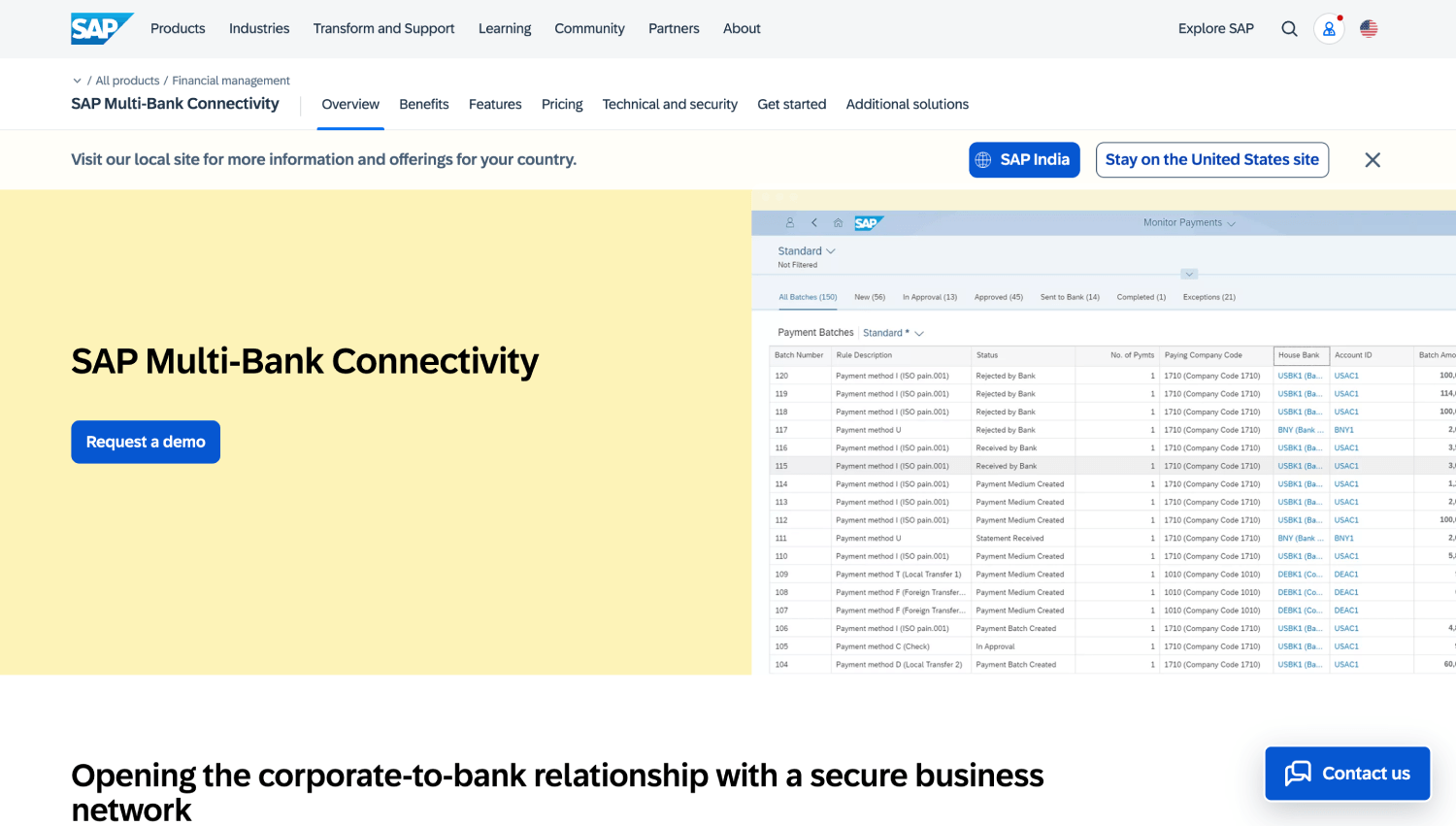
SAP Multi-Bank Connectivity is a cloud service delivered by SAP that sits between SAP S/4HANA Finance (or SAP ECC) and banking partners. It handles outbound payment file creation, format mapping, SWIFT transmission, and inbound bank statement normalization within the SAP data model, without requiring a separate middleware layer. For companies already running SAP as their core ERP for finance, the treasury management system functions and bank connectivity operate within the same environment.
The core advantage is native ERP integration. Payment runs initiated in SAP Treasury flow directly into the connectivity service using SAP’s standard Financial Supply Chain Management objects, so reconciliation happens within the same system where the payment originated. Teams running SAP S/4HANA avoid the data-mapping overhead that an external middleware layer would introduce.
The constraint is equally clear: if your ERP is not SAP, this platform does not apply. It is also delivered as a managed SAP cloud service, meaning you depend on SAP’s bank network expansion roadmap and release cycle for new bank certifications. For companies already committed to the SAP environment and banking across EMEA, Americas, and APAC, it removes a significant layer of integration complexity. For companies running Oracle or Microsoft Dynamics, it is not a viable path.
SAP does not publish per-connection pricing publicly. Costs are typically bundled within SAP Financial Services Network agreements and negotiated as part of broader SAP contracts.
Fides ONEConnect: Best for ERP-Agnostic Multi-Bank Coverage
Fides ONEConnect is a managed connectivity platform that positions itself as bank-agnostic and ERP-agnostic. According to Fides’ product page, the platform connects to more than 13,000 bank connectivity points globally, covering SWIFT, host-to-host SFTP, and direct bank API channels. It normalizes incoming statement formats including MT940, CAMT.053, and BAI2, and handles outgoing payment formats including MT101, pain.001, and local domestic formats.
The practical value of ERP-agnosticism becomes clear in multi-ERP environments, common after acquisitions. A company running SAP in Germany and Oracle in the United States can route both through Fides without building separate bank connectivity for each ERP instance. Fides manages the bank relationships, format translations, and transmission monitoring centrally.
Fides operates as a SWIFT Service Bureau, which matters for companies that want SWIFT connectivity without the overhead of becoming a direct SWIFT member or managing their own SWIFT connectivity infrastructure. The platform also supports EBICS, which is relevant for companies with significant German, French, or Swiss banking activity.
Pricing is not publicly disclosed. Implementation is handled by Fides as a managed service, with onboarding timelines varying based on the number of banking relationships and ERP complexity.
Atlar: Best for API-First Treasury Teams in Northern Europe
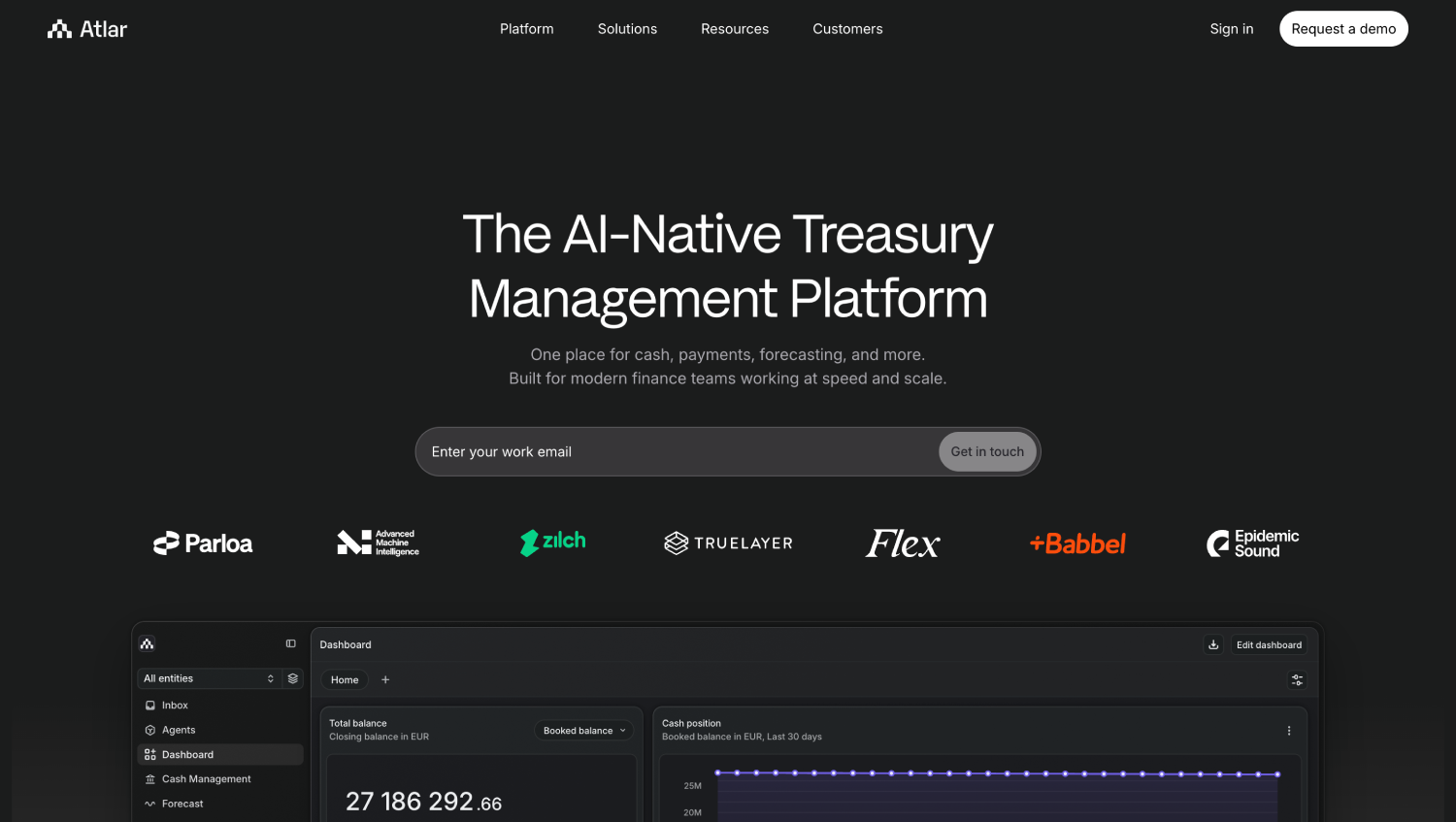
Atlar takes a different architectural approach than the other four platforms on this list. Rather than routing through SWIFT or SFTP file-based channels, Atlar connects directly to banks via their native APIs, delivering real-time balance and transaction data alongside payment initiation through the same connection.
That architecture has a meaningful implication: latency. File-based SWIFT and SFTP connections typically deliver statement data with a lag measured in hours. API-direct connections deliver transaction data as it happens. For treasury teams managing daily liquidity positions across multiple accounts, the difference between a morning BAI2 file and a real-time API feed changes the accuracy of the cash position.
One practical constraint worth noting is geographic scope. Atlar’s current bank coverage is concentrated in Northern Europe, with the strongest connectivity in the Nordic markets. Companies with banking relationships primarily in the US, APAC, or Southern Europe will find gaps. Atlar’s product page indicates ongoing coverage expansion, but as of this writing, it is not a global-coverage platform in the way Fides or TIS are.
Atlar is designed for developer-led integration, with an API and webhook model that treasury technology teams and FinOps engineers can work with directly. It is the right fit for a company with a modern tech stack, an engineering team willing to own the integration, and banking relationships concentrated in the Nordic region. It is not the right fit for a multinational with 40 banking relationships across six continents that needs a managed service to handle the operational overhead.
TIS (Treasury Intelligence Solutions): Best for Large Enterprise Payment Factories
TIS is a cloud platform built specifically around payment execution and bank connectivity at enterprise scale. According to TIS’s product site, the platform connects to more than 11,000 bank connectivity points globally and supports SWIFT, host-to-host SFTP, EBICS, and direct bank API channels.
Where TIS differentiates from a pure connectivity platform is payment workflow. TIS includes payment approval workflows, payment screening (including sanctions screening), and audit trails within the same platform as the connectivity layer. For companies building a payment factory, that bundling reduces the number of systems a payment instruction touches between creation in the ERP and transmission to the bank. This makes it relevant not just as a connectivity tool but as a broader treasury management system component.
EBICS support is worth calling out explicitly. EBICS (Electronic Banking Internet Communication Standard) is the dominant bank connectivity protocol in Germany, France, Switzerland, and Austria. Companies with significant Central European banking activity often find that SWIFT-only platforms require supplemental EBICS connections, adding complexity. TIS supports both natively.
TIS operates as a managed service with a partner-led implementation model. Implementation timelines for large enterprise deployments with multiple ERPs and dozens of banking relationships are typically measured in months, not weeks. Pricing is not publicly disclosed and is scoped based on payment volume, number of connections, and modules selected. Teams running a formal vendor evaluation should review the treasury management system RFP question set before entering negotiations.
Coupa Treasury: Best for Companies Already on the Coupa BSM Platform
Coupa Treasury is the treasury and cash management module within the Coupa Business Spend Management platform. Its bank connectivity capabilities cover SWIFT, host-to-host SFTP, and ISO 20022, with global bank coverage across EMEA, Americas, and APAC.
The strategic case for Coupa Treasury rests almost entirely on existing platform context. If a company already runs Coupa for procurement, AP automation, and spend management, adding treasury within the same platform consolidates cash visibility and payment data under one data model. Payment runs approved in the AP module can feed directly into treasury workflows without an export and re-import cycle.
For companies not already on Coupa BSM, the calculus reverses. Adopting Coupa Treasury as a standalone connectivity solution means committing to a broader platform relationship to access a module. The ERP integrations Coupa offers are solid, covering SAP, Oracle, and Microsoft Dynamics, but companies outside the Coupa environment will find Fides or TIS offer comparable connectivity coverage with less platform lock-in.
Coupa does not publish treasury module pricing publicly. Costs are negotiated as part of broader Coupa platform agreements. Teams evaluating AP and treasury spend consolidation together will find the platform most relevant; those evaluating connectivity in isolation should shortlist Fides or TIS instead.
How Do These Platforms Handle ISO 20022 Migration?
ISO 20022 is the payment messaging standard that SWIFT’s cross-border network is migrating to, with the global migration window running through November 2025 for SWIFT’s FIN-to-MX transition. All five platforms on this list support ISO 20022 message formats, but the implementation depth varies.
SAP Multi-Bank Connectivity and TIS both support pain.001 (payment initiation) and CAMT.053 (bank statement) natively within their format libraries. Fides supports the same formats and handles the translation layer for banks still sending legacy MT formats during the coexistence period. Atlar, being API-first, delivers data in normalized JSON rather than raw ISO 20022 XML, which simplifies consumption but means the ISO 20022 structure is abstracted away rather than surfaced directly.
For companies with treasury teams that have invested in ISO 20022 data richness (the extended remittance information in pain.001 drives more automated reconciliation), the choice of platform affects how much of that richness survives the connectivity layer. Platforms that simply convert ISO 20022 to a proprietary normalized format may strip fields that drive downstream reconciliation matching. This is a specific integration question worth raising in every vendor demo.
What Is the Realistic Implementation Timeline for Each Platform?
Implementation timelines vary more than vendors typically advertise in sales conversations. The ranges below reflect typical timelines based on vendor-published documentation and case study references; your actual timeline will depend on the number of banking relationships, ERP complexity, and bank-side readiness.
- SAP Multi-Bank Connectivity: 8 to 20 weeks for SAP S/4HANA environments, depending on the number of banking relationships and payment types. SAP partner involvement is typically required.
- Fides ONEConnect: 6 to 16 weeks for a mid-market deployment with 5 to 15 banking relationships. Complex multi-ERP environments extend timelines.
- Atlar: Faster for API-ready banks in Nordic coverage. Developer-led integrations with covered banks can go live in weeks. Gaps in bank coverage extend timelines significantly.
- TIS: 12 to 26 weeks for enterprise deployments with payment factory configuration, approval workflow setup, and multiple ERP connections. TIS positions this as a comprehensive implementation, not a plug-in.
- Coupa Treasury: Dependent on the broader Coupa BSM implementation stage. Companies already live on Coupa can add treasury faster; greenfield Coupa deployments are measured in months.
The variable that most consistently extends timelines across all five platforms is bank-side readiness. Even with pre-certified connections, banks require their own testing cycles, credentialing, and in some regions, regulatory sign-off on new connectivity arrangements. Build that into any project plan. Teams managing broader finance technology rollouts should also account for how bank connectivity timelines interact with AP automation implementation and payment reconciliation workflows, which often run in parallel.
Frequently Asked Questions
What is a multi-bank connectivity platform?
A multi-bank connectivity platform is middleware that sits between a company’s ERP or treasury management system and its banking partners. It handles the format translation, protocol management, and transmission logistics for both outbound payment instructions and inbound bank statement data, replacing point-to-point bank integrations with a single normalized connection. The platform supports protocols including SWIFT, host-to-host SFTP, EBICS, and direct bank APIs depending on the vendor.
How does SWIFT connectivity differ from host-to-host connectivity?
SWIFT connectivity routes payments and statements through the SWIFT interbank messaging network, which requires either direct SWIFT membership or access via a SWIFT Service Bureau. It is well-suited for cross-border payments and global bank relationships. Host-to-host connectivity is a direct bilateral connection between a company and a specific bank, typically over SFTP, using the bank’s proprietary file formats. Host-to-host is often faster to set up with a single bank but does not generalize across the banking network.
What payment formats do these platforms typically support?
The major outbound payment formats covered by enterprise connectivity platforms include MT101 (SWIFT payment order), pain.001 (ISO 20022 credit transfer initiation), NACHA (US ACH), SEPA credit transfer, and various domestic formats. Inbound statement formats include MT940 and MT942 (SWIFT statement formats), CAMT.053 and CAMT.054 (ISO 20022 equivalents), and BAI2 (US standard). Platform-specific format support should be verified against your banks’ actual delivery formats before signing a contract.
Can these platforms replace a treasury management system?
No. Multi-bank connectivity platforms handle the data transport and format normalization layer. They do not replace the cash positioning, forecasting, risk management, and investment functions that a full treasury management system provides. Some platforms, like TIS and Coupa Treasury, include payment workflow and approval functionality alongside connectivity, but they remain connectivity-focused tools rather than full TMS replacements. Companies needing both should evaluate treasury management platforms like Trovata and Kyriba alongside a connectivity layer.
How should a company evaluate bank coverage claims?
Bank network numbers (such as “13,000 connectivity points”) count individual bank connections, not necessarily unique banking institutions. One bank with five subsidiaries in different countries may appear as five connections. The more useful question for your evaluation is whether the specific banks you use today, and expect to add in the next three years, are in the vendor’s pre-certified network. Request a coverage confirmation in writing for each of your top banking relationships before shortlisting.
What is EBICS and which companies need it?
EBICS (Electronic Banking Internet Communication Standard) is a bank communication protocol dominant in Germany, France, Switzerland, and Austria. It is the standard corporate banking channel in those markets, used for both payment transmission and statement retrieval. Companies with banking relationships at Deutsche Bank, Commerzbank, BNP Paribas, Credit Suisse, or other major Central European banks will need EBICS support from their connectivity platform. TIS and Fides both support EBICS natively. SAP Multi-Bank Connectivity supports EBICS within the SAP environment.
Do any of these platforms support real-time payment initiation?
Atlar is the most explicitly API-first and real-time-capable platform among the five profiled here, delivering live balance and transaction data for supported banks. The other four platforms are primarily built on file-based and batch transmission models, though they increasingly support API channels where banks have published them. Real-time payment execution via SWIFT gpi is supported across SWIFT-connected platforms, but intraday liquidity visibility is a function of both the platform’s polling frequency and the bank’s statement delivery timing.
The Decision Matrix: Which Platform Fits Which Company
SAP Multi-Bank Connectivity is the default choice for companies where SAP S/4HANA is the system of record and treasury teams want to avoid a middleware layer outside the SAP environment. Fides ONEConnect suits multinational companies running multiple ERPs that need a single managed connectivity layer without ERP lock-in. Atlar fits growth-stage companies with modern tech stacks and Nordic banking concentration willing to trade global coverage for real-time data quality. TIS fits large enterprises building a centralized payment factory with approval workflows, payment screening, and multi-ERP connectivity all managed in one platform. Coupa Treasury fits companies already on the Coupa BSM platform that want treasury connectivity within the same data environment as procurement and AP.
The trap most treasury teams fall into is evaluating these platforms on feature lists rather than on their specific bank roster and ERP configuration. A platform with 13,000 connection points that lacks pre-certified connectivity to your primary cash management bank will still require custom work at go-live. Confirm coverage for your actual banking relationships first, then evaluate features. Teams building out a broader payment infrastructure should consider how bank connectivity intersects with their cash flow forecasting stack and payment reconciliation workflow before finalizing the vendor selection.
The connectivity layer does not make treasury decisions. It makes the data to support those decisions available faster, with fewer format errors, and without an IT ticket every time a bank changes its statement delivery method. That is the real case for a multi-bank connectivity platform, and it compounds in value every time a new banking relationship is added without touching the integration layer.