
TLDR
- Most cash flow forecasting software lives in your FP&A stack or a rolling 13-week spreadsheet. Bank-connected treasury tools update daily from live account data and flag shortfalls before your monthly model even refreshes.
- The tools on this list pull from bank feeds directly, not from your ERP’s ledger, which means they catch timing mismatches between receivables and payables that planning software misses entirely.
- Trovata and Kyriba are the two most-cited names in corporate treasury, but they serve different company sizes and complexity levels. Agicap and Tesorio address narrower, high-value problems in SMB cash management and AR-driven forecasting respectively.
- Pricing is rarely public at this tier. Where vendors do not publish pricing, this article says so rather than estimating.
- Bank connectivity quality varies more than vendors admit. The number of supported bank connections and the refresh frequency of those feeds is the single most important variable to test before signing.
The best cash flow forecasting software for treasury and finance teams connects directly to your bank accounts, updates balances daily, and generates rolling forecasts that catch shortfalls weeks before your FP&A model would surface them. For companies running multi-bank, multi-entity structures, dedicated tools like Trovata, Kyriba, Nomentia, Agicap, Tesorio, Cashbook, Netting360, Cashforce, HighRadius Treasury, and GTreasury cover the spectrum from seed-stage cash visibility to enterprise-grade treasury management systems.
Why Your FP&A Tool Is Not a Cash Forecasting Tool
FP&A software models the future from assumptions. Treasury cash forecasting reads the present from bank data. Both jobs matter, but conflating them is how companies get surprised by a payroll shortfall on a month where revenue looked fine on paper.
A typical monthly FP&A model closes on day five or ten of the following month. A bank-connected forecasting tool shows yesterday’s closing balances across every account, entity, and currency. That 10-to-30-day lag is where cash crises form. If you want to understand how FP&A software compares in scope and intent, our breakdown of FP&A and financial planning tools covers that adjacent category in full.
The 13-week cash flow format exists specifically because treasurers need a short-horizon, operationally grounded view that no annual plan can provide. The tools below are built around that use case, not around board reporting or scenario modeling.
The FintechSpecs Treasury Readiness Screen: Four Checks Before Buying
Before evaluating any vendor on this list, run what we call the Treasury Readiness Screen. It surfaces the deal-breakers that vendor demos rarely show upfront.
Bank connectivity depth: How many of your actual banking relationships does the vendor support natively, versus through a third-party aggregator? Aggregator-based connections often have 24-to-48-hour lag, which defeats the purpose of daily cash visibility.
Entity and currency scope: If you run three entities in two currencies, any tool handles that. If you run 12 entities in six currencies with intercompany netting, you need to confirm the data model supports it before the sales process ends.
ERP write-back: Some tools are read-only analytics layers. Others push forecasts back into NetSuite, SAP, or Oracle. Know which you need before evaluating features that do not matter to your workflow.
Forecast methodology: Does the tool use rules-based categorization of bank transactions, machine learning on historical patterns, or a hybrid? Rules-based is faster to implement and more auditable. ML-based is more accurate over time but requires 6-to-12 months of transaction history to calibrate.
A practical addition to these four checks: ask each vendor to demonstrate connectivity against your specific bank list during the proof-of-concept, not a generic demo environment. Vendors will show their strongest connections by default. The gaps only appear when you name your actual institutions.
Which Cash Flow Forecasting Software Should You Actually Use?
Below is the full comparison table across the ten tools, followed by individual assessments. Pricing is noted where publicly available; where vendors require a sales conversation, that is stated directly.
| Tool | Best For | Bank Connectivity | Pricing | ERP Integration |
|---|---|---|---|---|
| Trovata | Multi-bank US corporates, Series B+ | Direct API to major US banks | Not publicly disclosed | NetSuite, Workday, SAP |
| Kyriba | Enterprise treasury, multi-entity | 800+ bank connections | Not publicly disclosed | SAP, Oracle, NetSuite |
| Nomentia | European corporates, SEPA-heavy | SWIFT + local bank files | Not publicly disclosed | SAP, Microsoft Dynamics |
| Agicap | SMB and growth-stage companies | Open banking aggregator | Not publicly disclosed | QuickBooks, Xero, Sage |
| Tesorio | AR-driven cash forecasting | Via ERP + bank feed | Not publicly disclosed | NetSuite, Sage Intacct |
| Cashbook | SAP-heavy finance teams | Direct SAP integration | Not publicly disclosed | SAP (native) |
| GTreasury | Mid-market treasury operations | Bank file + API connectivity | Not publicly disclosed | SAP, Oracle, NetSuite |
| Cashforce | AI-driven working capital forecasting | ERP-led + bank feed | Not publicly disclosed | SAP, Oracle, JD Edwards |
| HighRadius Treasury | Enterprise AR + treasury combined | Bank API + SWIFT | Not publicly disclosed | SAP, Oracle, Workday |
| Statement | Early-stage teams needing bank visibility fast | Open banking aggregator | Not publicly disclosed | QuickBooks, Xero |
1. Trovata: Best for Multi-Bank US Corporates That Need Daily Cash Visibility
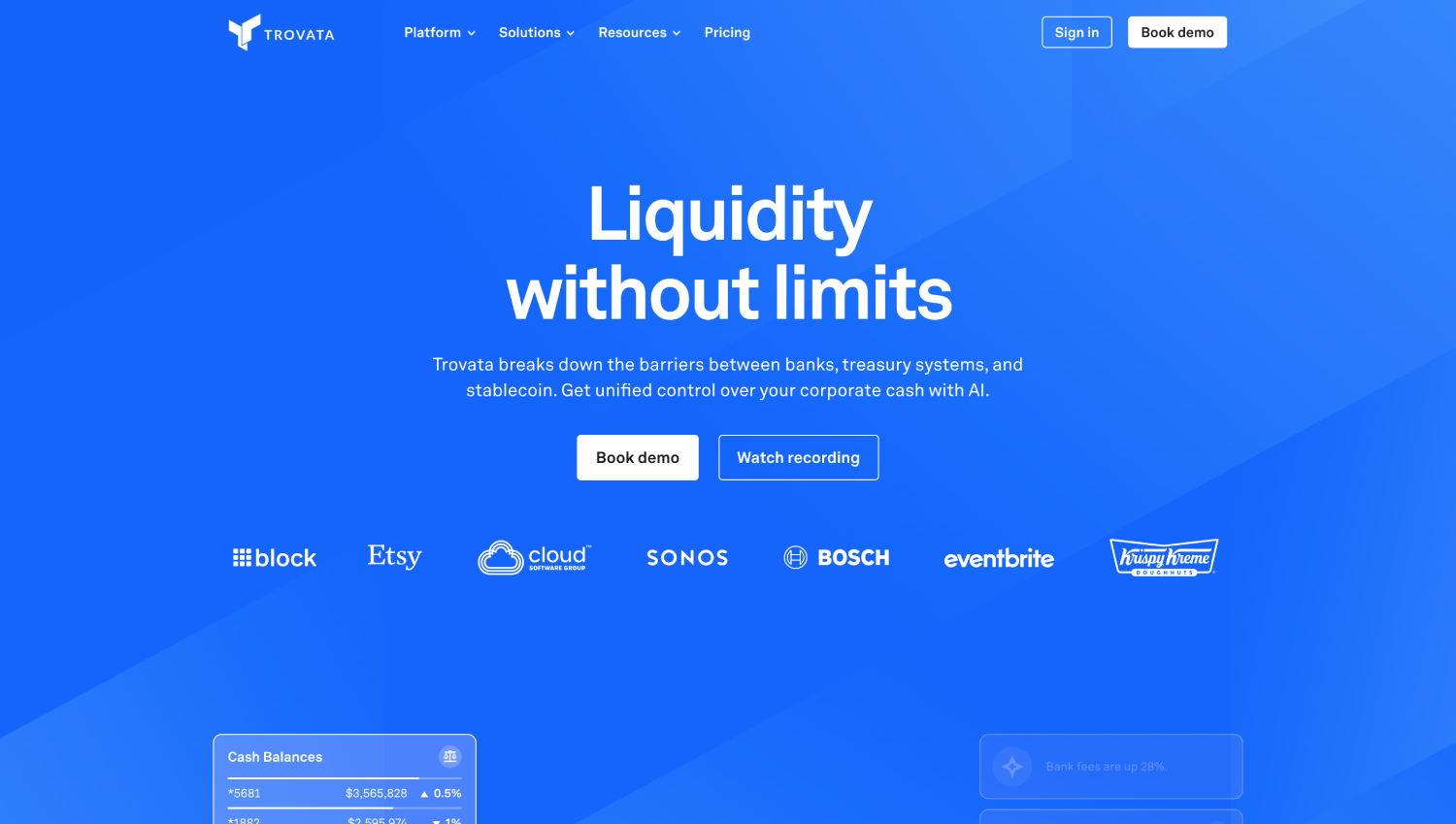
Trovata built its product around direct API connections to major US banks, including Bank of America, JPMorgan Chase, Wells Fargo, and Citibank. That direct-bank model means balance data typically arrives same-day rather than through a third-party aggregator with a 24-to-48-hour delay.
The forecasting layer uses historical transaction patterns to categorize cash flows automatically, then projects forward across a 13-week or rolling horizon. Treasury teams at companies running 10 to 50 bank accounts across two or three entities describe the setup time as measured in days, not months, which distinguishes it from enterprise TMS implementations that can run for a year before going live.
Trovata is not the right choice if your banking relationships are primarily outside the US. Its bank connectivity strength is concentrated in North American institutions. For the Trovata-versus-Kyriba question that comes up constantly for scaling finance teams, our direct Trovata vs. Kyriba comparison works through that decision in detail.
2. Kyriba: Best for Enterprise Treasury with Complex Multi-Entity Structures
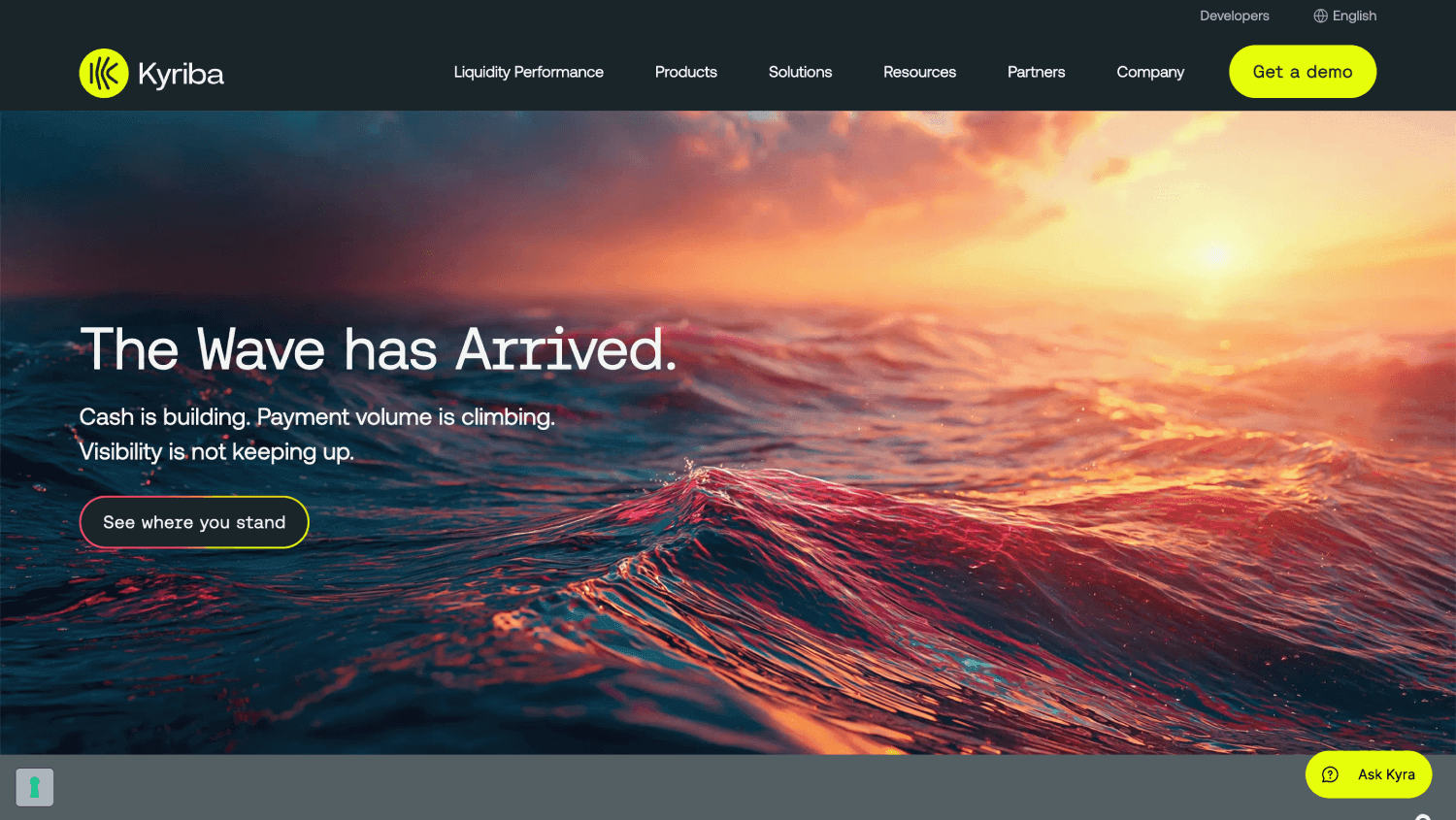
Kyriba is a full treasury management system, which means cash forecasting is one module inside a broader platform that includes payments, bank account management, FX risk management, and in-house banking. That scope is its strength and its complication.
According to Kyriba’s published materials, the platform connects to more than 800 banks globally. For a company running entities in North America, Europe, and Asia-Pacific with intercompany netting requirements, that breadth matters in a way it simply does not for a 50-person US company with two bank accounts.
Implementation timelines are long. Treasury teams that have gone through Kyriba deployments typically describe six-to-twelve-month rollouts for the full platform. If you only need the cash forecasting module, a lighter tool will get you live faster. Kyriba makes most sense when the treasury operation is already complex enough that a point solution creates integration debt. If Kyriba’s pricing or scope feels like a mismatch, the Kyriba alternatives breakdown covers ten other options across different company sizes.
3. Nomentia: Best for European Corporates Running SEPA Payment Flows
Nomentia is built around European bank connectivity, SWIFT file formats, and the SEPA payment infrastructure that US-centric tools tend to handle poorly. It covers cash forecasting, bank account management, and payments in a single platform, with particular depth in Nordic and Central European banking relationships.
For a company headquartered in Europe or managing significant euro-denominated cash flows, Nomentia’s native SEPA and local file format support removes a layer of integration work that typically falls on IT. For US companies with European treasury operations, it is worth evaluating alongside Kyriba, which covers similar breadth but with stronger US implementation resources.
4. Agicap: Best for Growth-Stage Companies That Outgrew Spreadsheets

Agicap targets the gap between a 13-week spreadsheet and a full treasury management system. It connects to bank accounts through open banking aggregators, pulls transaction data automatically, and lets finance teams build rolling forecasts without manual bank statement downloads.
The platform is strongest for companies with one to five entities, revenues in the $5M to $100M range, and finance teams of one to five people who cannot justify a Kyriba deployment. The interface is designed for CFOs who want to see cash positions without learning treasury software jargon, which is a real differentiator at the SMB tier.
Bank connectivity relies on aggregators rather than direct bank APIs, which means refresh frequency depends on the aggregator’s relationship with each bank. For companies where same-day cash visibility is critical, this distinction matters. For companies where daily-updated (rather than real-time) data solves the problem, aggregator-based connectivity is fine.
5. Tesorio: Best for Cash Forecasting Driven by Accounts Receivable
Most cash forecasting tools start from bank balances and project forward using historical patterns. Tesorio starts from the AR ledger, pulling invoice-level aging data from NetSuite or Sage Intacct, and builds cash inflow forecasts from actual expected customer payments weighted by historical collection rates.
For companies where receivables timing is the primary driver of cash position uncertainty, that approach is materially more accurate than pattern-based projection. A SaaS company with 200 enterprise customers on net-60 terms knows exactly when cash should arrive; Tesorio surfaces which invoices are running late and recalculates the cash forecast accordingly.
If your cash flow uncertainty is primarily on the payables or payroll side rather than receivables, Tesorio’s advantage shrinks. It is a focused tool, not a full treasury platform. Teams evaluating it alongside broader accounts receivable automation should see our AR automation comparison for how the receivables-to-cash pipeline connects.
6. Cashbook: Best for SAP Shops That Want Cash Management Without a New System
Cashbook runs inside SAP environments as a native extension rather than a separate platform that integrates with SAP. For finance teams where the ERP is SAP and the IT policy requires all financial data to stay in that system, that native architecture removes the security review, data residency, and integration maintenance that a separate SaaS tool would require.
The cash forecasting functionality reads directly from SAP’s cash management module and adds a cleaner forecasting interface, bank statement automation, and reconciliation tooling. The limitation is obvious: if your stack is not SAP, Cashbook is not relevant.
7. GTreasury: Best for Mid-Market Companies Needing a Full TMS Without Enterprise Pricing
GTreasury positions itself between Kyriba’s enterprise tier and the SMB-focused tools like Agicap. The platform covers cash forecasting, bank connectivity, debt and investment management, and FX risk tracking in a single system, with implementation timelines that are generally shorter than Kyriba.
Bank connectivity uses a combination of API connections and bank file formats (MT940, BAI2). The breadth of supported formats matters for companies with a mix of US and international banking relationships that do not all offer modern API access.
GTreasury is worth evaluating for companies in the $100M to $1B revenue range that need more than a cash visibility point solution but are not ready for the implementation complexity of a tier-one TMS.
8. Cashforce: Best for Working Capital Forecasting Tied to ERP Data
Cashforce (by TIS) started as a cash flow analytics platform specifically for SAP and Oracle environments, and its forecasting methodology reflects that heritage. It pulls AR, AP, inventory, and payroll data from the ERP, then builds a cash forecast from those operational data sources rather than relying primarily on bank statement history.
The advantage of that approach is granularity. A Cashforce forecast can show which specific AP invoices are scheduled for payment in week three, and what the AR pipeline suggests for week five, rather than projecting a historical average. For supply-chain-heavy businesses where working capital is the main cash driver, that operational linkage is meaningful.
9. HighRadius Treasury: Best for Enterprises That Already Use HighRadius for AR
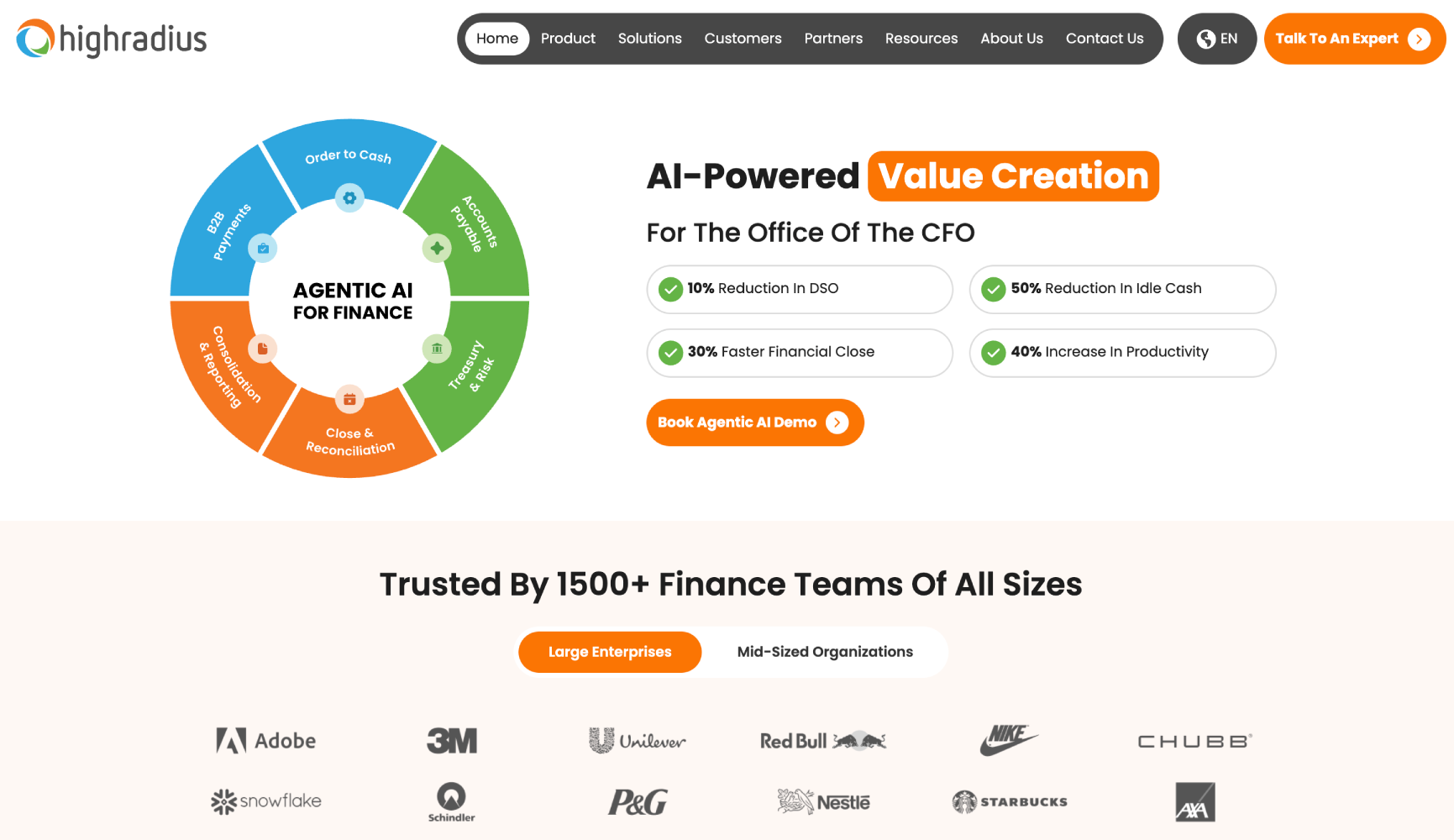
HighRadius built its reputation in AR automation and collections, then extended into treasury with a cash management and forecasting module that connects to the same data models its AR platform uses. For enterprises already running HighRadius for collections and cash application, the treasury module avoids duplicating data pipelines.
Standalone, HighRadius Treasury competes with Kyriba and GTreasury on features. The differentiated use case is the AR-to-treasury data flow: predicted collection dates from the AR module feed directly into the treasury forecast, which is the same value proposition as Tesorio but within a much larger enterprise platform. Teams managing both AR automation and treasury on a single vendor should evaluate this combination seriously.
10. Statement: Best for Early-Stage Teams That Need Bank Visibility Before a TMS Makes Sense
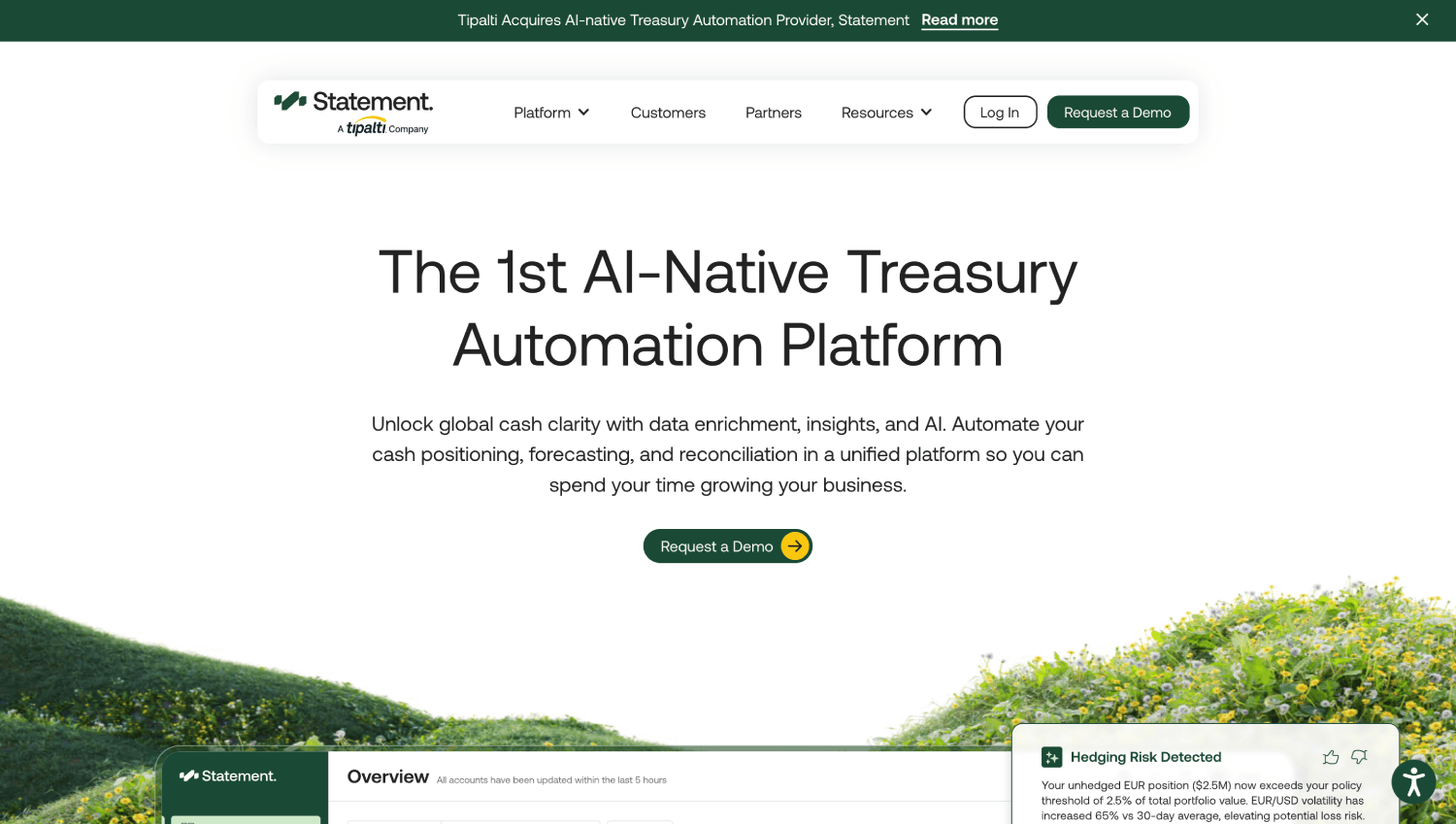
Statement is designed for finance teams that have outgrown a spreadsheet but are not ready to buy a full treasury platform. It connects to bank accounts through open banking APIs, aggregates balances across accounts and entities, and presents a daily cash position with a simple rolling forecast.
The tool does not try to compete on forecasting sophistication or multi-entity treasury complexity. It competes on speed-to-value: a finance team of two people can be connected and viewing consolidated cash positions within a day. For seed-to-Series A companies where the primary problem is simply knowing what is in every account right now, that focus is appropriate.
As companies grow past 10 entities or begin managing significant FX exposure, Statement’s scope becomes a ceiling rather than a feature. The right time to evaluate a migration is before that ceiling becomes a crisis, not after.
How Does 13-Week Cash Flow Software Actually Work?
The 13-week cash flow format is the standard short-term treasury tool because it covers a full quarter at weekly granularity. That window is long enough to surface upcoming debt maturities, payroll cycles, and seasonal revenue dips, while short enough to keep the forecast grounded in data rather than assumptions.
In a bank-connected tool, the 13-week view is built from three data layers. The first is actual bank balances pulled from yesterday’s closing statements. The second is scheduled outflows: payroll runs, scheduled AP payments, debt service, and tax payments pulled from the ERP or entered manually. The third is projected inflows: AR aging data, contracted recurring revenue, or historical collection rate patterns applied to open invoices.
The tools that do this well let treasury teams override any line item with a manual adjustment, flag variances between forecast and actual automatically, and run scenario versions (base, stress, upside) in parallel. The tools that do it poorly treat the 13-week model as a static report rather than a live, editable forecast.
What Bank Connectivity Actually Means (and Why It Matters More Than Features)
Bank connectivity is the technical mechanism by which a forecasting tool pulls data from financial institutions. There are three architectures in use across this market, and they differ meaningfully in speed, reliability, and coverage.
Direct bank API: The vendor has a negotiated data-sharing agreement with the bank, pulling balance and transaction data through a certified API. Data typically arrives same-day or within hours. Trovata uses this model with major US banks.
SWIFT network: Common in enterprise TMS deployments. The company’s banking relationships are connected through the SWIFT network, which supports virtually any global bank but requires SWIFT connectivity infrastructure. Kyriba and Nomentia lean on this for international coverage.
Third-party aggregator: The vendor connects to your bank through an open banking aggregator (similar to the infrastructure discussed in our Plaid vs. MX vs. Finicity comparison). This is faster to set up and supports more banks, but data refresh rates vary by bank and aggregator relationship. Agicap and Statement use this model.
The right model depends on your banking relationships and your refresh tolerance. If you bank primarily at JPMorgan, Bank of America, and Wells Fargo, a direct API connection to those three institutions covers 80% of your cash. If you bank at 40 institutions across 12 countries, SWIFT connectivity becomes necessary regardless of the aggregator options available.
Frequently Asked Questions
What is the difference between cash flow forecasting software and FP&A software?
FP&A software builds forward-looking financial models from assumptions and accounting data, typically for board reporting and annual planning. Cash flow forecasting software pulls live or daily bank data and generates short-horizon rolling forecasts that reflect actual cash positions. FP&A tools are designed for monthly or quarterly cycles; treasury forecasting tools are designed for daily or weekly cash management. The two are complementary, not interchangeable, and finance teams at companies above roughly $10M in revenue typically need both.
How does 13-week cash flow software connect to bank accounts?
The three main connection methods are direct bank APIs, the SWIFT network, and third-party open banking aggregators. Direct bank API connections offer same-day data and are available from vendors like Trovata for major US banks. SWIFT connectivity covers virtually any global bank but requires more infrastructure. Aggregator-based connections are easiest to set up but may have 24-to-48-hour data lags depending on the bank and aggregator relationship. The right choice depends on which banks you use and how frequently you need data updates.
Is Kyriba worth the cost for a mid-market company?
Kyriba is a full treasury management system with pricing and implementation timelines designed for enterprise deployments. For a company with fewer than five entities and straightforward bank relationships concentrated in one or two countries, the implementation effort and total cost of ownership will exceed the value delivered relative to lighter tools like GTreasury or Trovata. The crossover point where Kyriba’s breadth justifies its complexity is typically around 10 or more entities, significant multi-currency exposure, or a need for in-house banking or netting center functionality.
Can cash flow forecasting software integrate with NetSuite or Sage Intacct?
Yes. Trovata, Tesorio, GTreasury, and HighRadius Treasury all support NetSuite integration. Tesorio is particularly tightly integrated with both NetSuite and Sage Intacct, since its forecasting methodology is built on AR aging data that lives in those systems. Cashbook integrates natively with SAP but not with cloud ERPs like NetSuite. Before buying, confirm whether the integration is bidirectional (the tool writes forecast data back to the ERP) or read-only, since that distinction affects how much manual reconciliation your team still has to do.
What is the minimum company size where dedicated cash forecasting software makes sense?
A company with a single bank account, one entity, and predictable weekly cash flows will not get meaningful value from a dedicated tool over a well-maintained spreadsheet. The inflection point is typically when manual bank statement consolidation takes more than two to four hours per week, when cash positions across multiple accounts cannot be seen in one place without effort, or when a near-miss on a covenant or payroll obligation reveals that the monthly review cycle is too slow. For most companies, that inflection point arrives somewhere between $3M and $15M in annual revenue.
How accurate are AI-powered cash forecasts compared to manual models?
Accuracy depends heavily on the stability and volume of historical transaction data. Tools like Cashforce and HighRadius Treasury use machine learning trained on ERP transaction history; accuracy improves over the first 6 to 12 months as the model calibrates. Rules-based tools that categorize bank transactions by pattern and project forward perform well when cash flow patterns are seasonal and structured, but degrade when the business model changes quickly. Neither approach is inherently superior. The more important variable is whether the tool gives treasury teams clear visibility into what the model assumes, so they can override lines where operational knowledge diverges from the pattern.
The Right Tool Depends on Where Your Cash Uncertainty Comes From
Every finance team thinks their cash forecasting problem is distinct. It almost never is. The underlying source of cash uncertainty falls into one of three buckets: receivables timing (when do customers actually pay), payables scheduling (when do large obligations hit), or bank consolidation (just knowing what is in all accounts right now). The tool selection becomes clearer once you know which bucket drives 80% of your exposure.
If the answer is receivables timing, Tesorio’s AR-first approach and HighRadius Treasury’s integrated collections-to-treasury pipeline both outperform general-purpose tools. If the answer is payables scheduling tied to a complex ERP, Cashforce or Cashbook will surface that data more cleanly than a bank-feed-only tool. If the answer is consolidation across many bank accounts, Trovata’s direct bank API model or Kyriba’s global bank breadth are the right starting points. Knowing which problem you are actually solving shortens the evaluation cycle by two or three vendor conversations.
One pattern worth watching as this category matures: the line between bank connectivity infrastructure and treasury forecasting software is thinning. Companies building on open banking APIs for other purposes, including the infrastructure covered in our fintech API comparison for SaaS, are increasingly finding that same connectivity layer can feed a rolling cash forecast with minimal additional tooling. That may not replace a dedicated treasury platform for complex organizations, but it is already shifting the calculus for seed-to-Series B companies that once defaulted to a spreadsheet out of perceived necessity rather than actual fit.
Finance teams evaluating this category for the first time should also read our 7-point fintech vendor evaluation framework before entering any sales process. The questions that reveal connectivity gaps and implementation risk are rarely surfaced in demo environments, they come from a structured evaluation process applied before you get to the contract stage.