
TLDR
- FloQast built its reputation on checklist-driven close management, but AI-native competitors now automate the reconciliation and flux analysis that FloQast still largely requires humans to run.
- The strongest FloQast alternatives split into three camps: enterprise platforms (BlackLine, Trintech Adra), AI-native upstarts (Numeric, Nominal, Double), and planning-adjacent tools (Prophix, Ledge) that close the loop between the close and the forecast.
- Migration effort varies sharply by ERP and team size. A NetSuite team with 15 close tasks can move to Numeric in under four weeks. A multi-entity SAP shop replacing BlackLine should budget three to six months regardless of vendor.
- Pricing across this category is almost entirely quote-based. The one exception is Numeric, which publishes a starter tier.
- The right swap depends on one question: do you need better task coordination, or do you need the software to do more of the accounting work itself?
The best FloQast alternatives for mid-market finance teams are Numeric, Nominal, Double, Ledge, Trintech Adra, BlackLine, Prophix, Workiva, and HighRadius. Each serves a different maturity level and automation appetite. AI-native platforms like Numeric and Nominal now automate reconciliations and flux commentary that FloQast surfaces but leaves to the accountant. Enterprise platforms like BlackLine and Trintech Adra offer deeper controls for multi-entity or public-company requirements. The right choice depends on team size, ERP stack, and how much automation you actually want the software to own.
Why Are Finance Teams Reconsidering FloQast Right Now?
FloQast occupies a specific niche: it maps close tasks to the general ledger, assigns owners, and tracks progress against a calendar. For a team moving off spreadsheets, that structure is genuinely valuable. The problem surfaces once the team realizes FloQast surfaces status but does not substantially reduce close work.
A reconciliation still needs a human to build it. A flux explanation still needs someone to type it. FloQast will tell you the rec is overdue. It will not tell you why the variance exists or suggest a draft explanation. Newer AI-native platforms have made that gap more visible by demonstrating what automated recs and machine-drafted flux commentary actually look like in production.
There is also a pricing sensitivity shift at the Series B to Series C stage. Finance teams that signed FloQast at 50 employees are now at 200, running multi-entity structures and reporting to audit committees. The close management problem has changed, and the same tool may no longer match the problem.
What Is the FintechSpecs Close Platform Stack Test?
Before mapping vendors to use cases, it helps to have a framework for evaluation. The FintechSpecs Close Platform Stack Test runs four checks against any close management tool:
- Automation depth: Does the tool execute accounting work (auto-certify matched recs, draft flux commentary, post journal entries) or does it only track whether a human did those things?
- ERP surface area: Does it connect to your general ledger bidirectionally, or does it sync read-only data and require manual exports for anything write-adjacent?
- Entity architecture: Can it handle a multi-entity or multi-currency structure without a professional services engagement every time you add a subsidiary?
- Audit trail quality: Does every certification, override, and status change produce a timestamped, role-attributed record that survives an SOC 2 or external audit without supplemental screenshots?
Run every vendor in this list through those four checks before shortlisting. Most category pages lead with feature marketing. The Stack Test forces you to ask what the software actually does versus what it tracks.
Which Platform Is the Closest Direct FloQast Replacement?
Numeric is the closest like-for-like FloQast replacement for a mid-market team that wants more automation without a platform rebuild. It replicates FloQast’s checklist and reconciliation structure while adding automated reconciliation matching and AI-drafted flux explanations. Teams that have published reviews on G2 and Capterra describe getting the same close-coordination benefit with meaningfully less manual work per period.
For teams that need FloQast’s exact feature set but with better ERP depth and multi-entity support, Trintech Adra is worth a serious look. It is more implementation-heavy, but the reconciliation engine is more mature than FloQast’s.
9 Best FloQast Alternatives Compared
1. Numeric
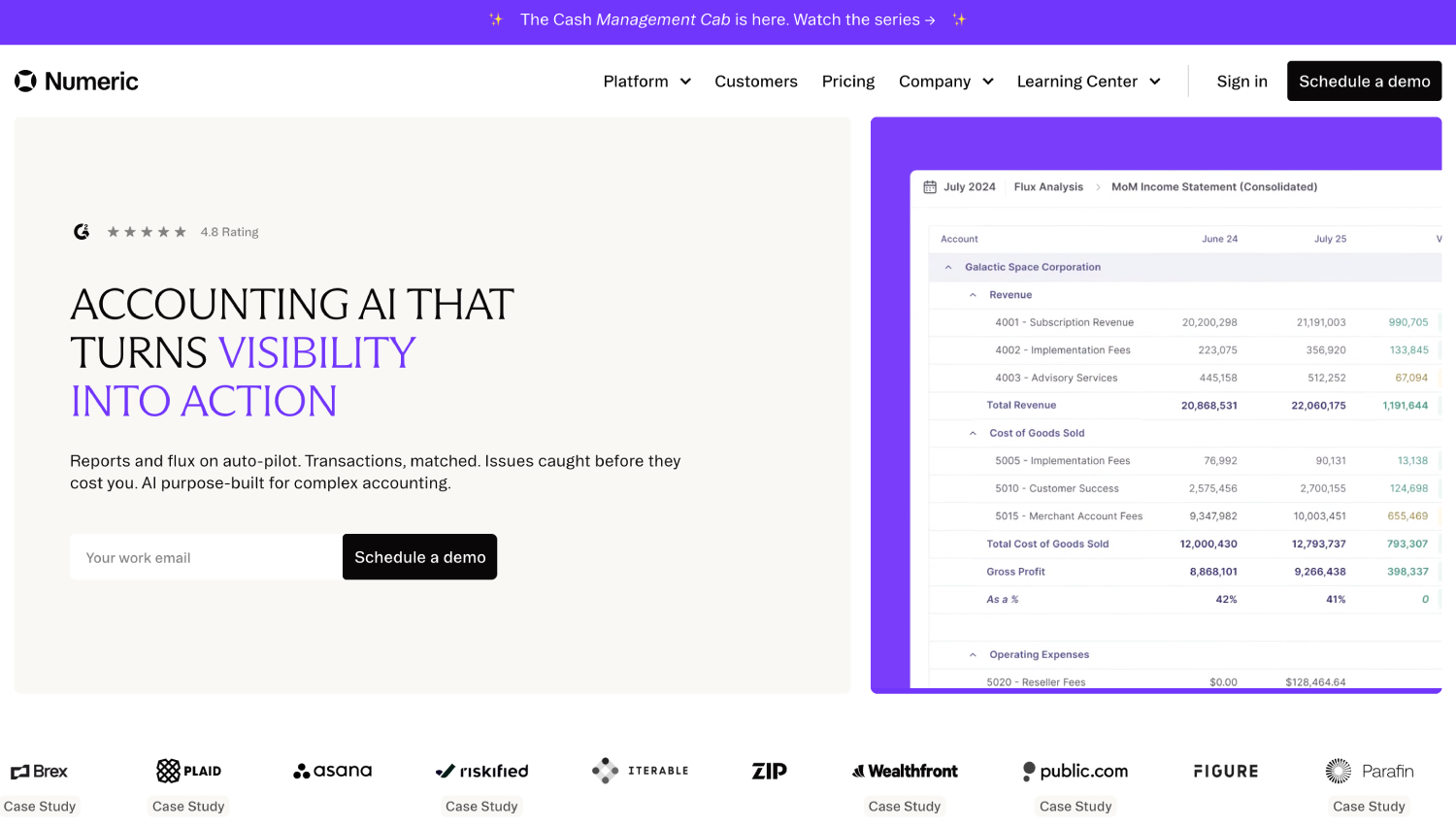
Numeric is the platform most frequently named in direct FloQast comparison searches, and the positioning is accurate. It covers close task management, account reconciliations, and flux analysis in one interface. The differentiator is that Numeric uses AI to draft flux explanations based on transaction data rather than prompting the accountant to write them from scratch.
Numeric connects to NetSuite, QuickBooks Online, and Xero. Its ERP write-back support is more limited than BlackLine’s, but for a company running a single-entity or simple multi-entity NetSuite instance, the integration is fast. Numeric is one of the only vendors in this category with a published pricing tier; as of their public pricing page (verified July 2025), a starter plan is listed. Enterprise pricing is quote-based.
Best for: Series A to Series C companies on NetSuite or QBO that want automated flux and faster recs without a six-month implementation.
2. Nominal
Nominal takes a more agentic approach than any other platform in this list. Rather than layering checklists over an ERP, it connects directly to GL data and runs automated close workflows that include reconciliation, journal entry drafting, and anomaly detection. The product is designed for teams that want the software to do more of the close rather than coordinate humans doing the close.
Nominal is earlier-stage than FloQast or Numeric and is best suited for fast-moving finance teams that have enough GL hygiene to trust automated outputs. Teams with complex manual adjustments or heavy accrual workloads will hit limitations faster. Pricing is not publicly disclosed.
Best for: Seed to Series B teams with clean ERP data who want the most aggressive automation posture available.
3. Double
Double covers close management and reconciliation with a strong emphasis on the interplay between finance and FP&A data. It connects close status to forecasting outputs, which matters for teams whose CFO wants close-to-forecast handoffs to happen faster than the current spreadsheet shuffle allows.
Double is positioned closer to an all-in-one finance operations layer than a pure close tool. That is an advantage for lean teams who cannot justify separate close management and FP&A tools, and a potential mismatch for teams that already have a well-embedded FP&A platform they intend to keep. Pricing is quote-based and not publicly disclosed.
Best for: Series A to Series B teams that need close management and want the output to feed directly into planning without a manual handoff.
4. Ledge

Ledge focuses on reconciliation automation with a particular emphasis on high-volume transaction matching. Finance teams at companies processing large numbers of payment transactions (SaaS billing, marketplace payouts, lending repayments) will find Ledge’s matching engine more capable than FloQast’s reconciliation feature, which was designed for balance sheet recs rather than transaction-level matching.
Ledge does not cover the full close task management surface that FloQast does. It solves one piece of the close, and it solves that piece more deeply. Teams evaluating Ledge as a FloQast replacement should be honest about whether their close problem is primarily a reconciliation problem or a broader task coordination problem. If it is the former, Ledge is worth serious evaluation. Pricing is quote-based.
Best for: Finance teams at fintech or marketplace companies where transaction reconciliation volume is the primary close bottleneck. For context on why this problem is harder than it looks, the payment reconciliation software breakdown for fintech finance teams covers the matching approaches in more detail.
5. Trintech Adra

Trintech Adra is the most mature mid-market close management platform in this list by years in market. It covers task management, account reconciliations, journal entries, and financial reporting with a depth that FloQast does not match on controls. Adra is SOX-capable without supplemental tooling, which matters for companies that are pre-IPO or that have institutional investors requiring public-company-grade close processes.
The trade-off is implementation time and administrative overhead. Adra is not a tool you deploy in two weeks. Professional services are typically involved, and the configuration effort reflects a platform built for complex close environments rather than fast-growing startups. Pricing is quote-based. Trintech does not publicly disclose implementation costs.
Best for: Companies at Series C and beyond with multi-entity structures, external audit requirements, or a near-term path to public markets.
6. BlackLine

BlackLine is the enterprise benchmark against which every other platform in this category is measured. Its reconciliation engine, journal entry management, variance analysis, and intercompany hub are more capable than anything else listed here. The reason BlackLine appears on a FloQast alternatives list rather than the other way around is price and implementation complexity: BlackLine is expensive, requires dedicated admin resources, and is designed for companies with dozens of legal entities and hundreds of close tasks.
A mid-market team of three to five accountants closing a single-entity business will almost certainly overbuy on BlackLine. A 20-person finance team at a Series D company with four subsidiaries, an external audit, and a board that receives close packages within five business days is exactly who BlackLine serves well. The BlackLine versus FloQast comparison covers the capability and pricing gap in detail for teams trying to place that decision.
Best for: Companies with complex multi-entity or multi-currency close requirements, external audit obligations, and the admin bandwidth to run an enterprise platform.
7. Prophix
Prophix is primarily an FP&A and financial performance management platform that includes close and consolidation functionality. Teams evaluating Prophix as a FloQast alternative are typically doing so because they want to consolidate their close tool and planning tool into one platform rather than because they specifically need better close automation.
The close capabilities in Prophix are real but not the deepest in the category. Reconciliation automation is less mature than Numeric or Trintech Adra. Where Prophix wins is on the planning and reporting side: if a finance team is replacing both FloQast and a separate FP&A tool, Prophix can serve both functions at a lower combined cost than running two specialized platforms. Pricing is quote-based.
Best for: Mid-market finance teams consolidating their close and planning stack into a single vendor, where deep close automation is less important than a unified workflow.
8. Workiva
Workiva approaches close management from the reporting and compliance direction. It is best known for SEC filing preparation and controls documentation, but it includes close workflow management that ties task completion directly to the financial statements and disclosures being prepared. For companies with formal external reporting obligations, that link between close task and report is genuinely valuable.
Workiva is not a natural FloQast replacement for a startup running a lean monthly close. It is overkill unless external reporting, ESG disclosure, or regulatory compliance documentation is part of the close workload. Teams comparing Workiva against FloQast should read the HighRadius versus Workiva versus Numeric financial close comparison before committing to a demo cycle. Pricing is quote-based.
Best for: Companies with SEC reporting requirements, complex ESG or regulatory disclosures, or governance needs that extend beyond the close itself into the reporting output.
9. HighRadius
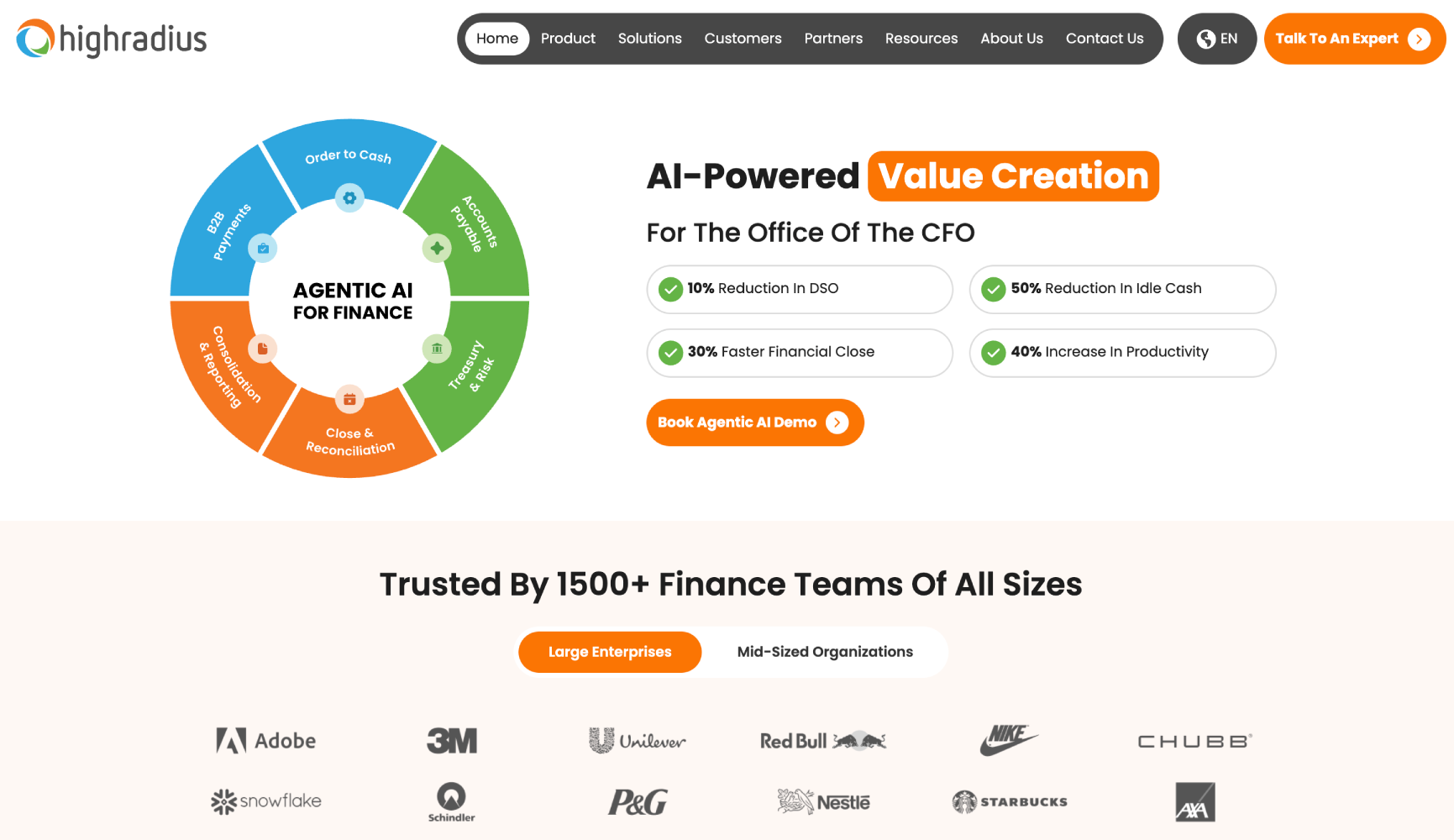
HighRadius covers the full record-to-report cycle including account reconciliations, journal entry management, financial close management, and accounts receivable automation. Its AI capabilities in the close and reconciliation space are more developed than FloQast’s and more comparable to what BlackLine offers at the enterprise tier.
HighRadius is priced and structured for mid-to-large enterprise. The minimum deal sizes and implementation timelines reflect that. A Series B company of 80 employees will find HighRadius harder to justify than Numeric or Nominal on both cost and implementation burden. At 300 employees with a complex close environment, the calculus changes. Pricing is quote-based and not publicly disclosed.
Best for: Upper mid-market and enterprise companies that want AI-assisted close and reconciliation in a single platform with AR automation included.
How Do Migration Effort and Timeline Compare Across FloQast Alternatives?
The migration decision is often where teams stall. Below is an honest effort estimate based on vendor implementation documentation and user-reported timelines on G2’s financial close category, not vendor marketing commitments.
| Platform | Typical Implementation Time | ERP Integration Complexity | Admin Resource Required | Best Migration Fit |
|---|---|---|---|---|
| Numeric | 2 to 4 weeks | Low (NetSuite, QBO, Xero) | Light, team-managed | Single-entity, NetSuite/QBO teams |
| Nominal | 2 to 6 weeks | Low to medium | Light | Teams prioritizing automation over coordination |
| Double | 3 to 6 weeks | Medium | Light to moderate | Teams wanting close plus FP&A in one tool |
| Ledge | 3 to 8 weeks | Medium (depends on payment stack) | Moderate | High-volume transaction environments |
| Trintech Adra | 6 to 14 weeks | Medium to high | Dedicated admin or PS engagement | Multi-entity, SOX-adjacent teams |
| BlackLine | 3 to 6 months | High (deep ERP write-back) | Dedicated admin required | Enterprise, multi-entity, public-company-grade |
| Prophix | 6 to 12 weeks | Medium | Moderate | Teams replacing both close and FP&A tools |
| Workiva | 8 to 16 weeks | Medium to high | Dedicated admin or PS engagement | Teams with external reporting or SEC obligations |
| HighRadius | 3 to 6 months | High | Dedicated admin plus PS | Upper mid-market to enterprise with full R2R scope |
These timelines assume a clean ERP with documented chart of accounts and existing close task documentation. Teams migrating from a spreadsheet-based close rather than from FloQast should add two to four weeks for GL mapping and task documentation before any vendor goes live.
How Do Pricing Models Differ Across FloQast Competitors?
Almost every platform in this category prices by annual contract on a quote basis. FloQast itself does not publish pricing. The meaningful pricing signal is not the list price but the structure: per-user, per-entity, per-reconciliation, or flat annual platform fee. Those structures create very different total cost outcomes as teams scale.
Say a company has 8 accounting staff and closes 120 accounts per month across three entities. A per-user model at a mid-market rate compounds differently than a per-entity model as that team grows. Before entering a negotiation, confirm whether adding a subsidiary triggers a step-change in price or a linear increase. Some vendors treat multi-entity as a base feature. Others gate it at higher tiers.
Numeric is the only platform on this list with a publicly accessible pricing page that indicates a starter tier exists. All others require a sales conversation to get to a number. If budget transparency early in the evaluation matters to your team, that is a genuine differentiator for Numeric at the initial scoping stage.
What Features Separate AI-Native Close Platforms from First-Generation Tools?
The divide in this category is sharpening. First-generation close management tools (FloQast, older versions of Adra) are fundamentally workflow orchestration tools: they tell the right person to do the right task at the right time and record that it happened. That is genuinely useful, but it does not reduce the accounting work itself.
AI-native platforms (Numeric, Nominal, Double) are attempting something different. They connect to GL transaction data, apply matching logic, surface unexplained variances, and draft explanatory text that an accountant reviews rather than writes. The close still requires human judgment. Fewer minutes per account is the operative claim.
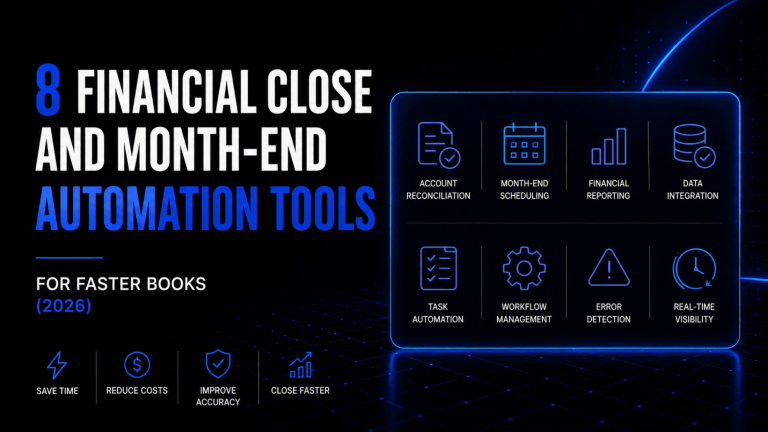
The practical test is flux analysis. Ask any vendor on a demo to show you what happens when a revenue account has a 15% month-over-month variance. A workflow tool will flag it as needing explanation. An AI-native tool should surface the underlying transaction detail, identify the likely driver, and draft a sentence the controller can edit rather than write from scratch. That specific demo scenario separates the two categories faster than any feature checklist. Finance teams navigating the broader question of what close automation tools actually exist right now can reference the financial close and month-end automation tools comparison for the full category overview.
Frequently Asked Questions About FloQast Alternatives
Is FloQast still worth it for a company under 50 employees?
For a company under 50 employees with a single entity and a straightforward close, FloQast may be more structure than necessary. At that size, a team closing 30 to 40 accounts with two or three accountants can often achieve the same coordination benefit with a well-maintained shared tracker. The value case for FloQast or any close platform strengthens as close task count, entity count, or team size grows and creates genuine coordination risk, missed certifications, unclear ownership, or close dates that slip because no one had visibility. If you have missed a reconciliation because no one knew it was uncertified, the platform is worth the cost. If every period closes cleanly on a shared spreadsheet, the spend is harder to justify at that headcount.
How do BlackLine and FloQast compare for a Series C company?
BlackLine has deeper reconciliation automation, a more mature journal entry workflow, and intercompany hub functionality that FloQast does not offer. FloQast is faster to implement and cheaper. A Series C company with a single-entity structure and a five-person close team typically does not need BlackLine’s depth. A Series C company with four subsidiaries, an external audit, and a CFO who came from a public company almost certainly does. The BlackLine versus FloQast comparison covers this decision in detail.
What ERP integrations do FloQast alternatives support?
NetSuite is supported by nearly every vendor in this category including FloQast, Numeric, Trintech Adra, BlackLine, Workiva, and HighRadius. QuickBooks Online support is common among the AI-native platforms (Numeric, Nominal) and less common among enterprise platforms (BlackLine, Workiva). SAP and Oracle EBS integrations are available from BlackLine, HighRadius, Trintech, and Workiva. Sage Intacct integrations vary by vendor and should be confirmed directly before any commitment. ERP support is the single most important technical qualification check in this evaluation.
Can Numeric fully replace FloQast for a multi-entity company?
Numeric handles multi-entity structures, but the depth of multi-entity support, including intercompany reconciliations and consolidated reporting, is less mature than what BlackLine or Trintech Adra offer. A company with two or three entities sharing a single NetSuite instance will likely find Numeric adequate. A company with eight subsidiaries across multiple currencies and a complex intercompany elimination process should evaluate Trintech Adra or BlackLine before assuming Numeric can carry the full load. Confirm entity architecture support in the demo with a specific scenario from your current close.
What is the typical total cost difference between FloQast and an AI-native alternative like Numeric or Nominal?
Neither FloQast nor Numeric nor Nominal publicly discloses full pricing. The general market signal from finance professionals who have compared these platforms is that the AI-native platforms at the mid-market tier are priced comparably to or slightly above FloQast for equivalent team sizes, with the value argument resting on labor hours saved per close cycle rather than lower software spend. The cost justification almost always runs through time savings in reconciliation and flux documentation rather than direct price comparison.
Do these platforms replace the need for a controller or senior accountant?
No platform in this category eliminates the need for human judgment in the close. What the AI-native platforms reduce is the time a senior accountant spends on routine reconciliation matching and first-draft flux commentary. The controller still reviews, approves, and signs off. The value is in compressing hours spent on repeatable mechanical tasks. Finance leaders evaluating these tools should set that expectation clearly with their teams before a demo. The pitch “AI does the close” is not accurate. “AI drafts the recs and flux so your controller spends Tuesday reviewing rather than building” is closer to what is actually happening.
What should I look for in a close platform if I am pre-audit-readiness?
Prioritize audit trail quality above automation features. Every certification, override, preparer-reviewer workflow, and status change should produce a timestamped, role-attributed record that you can export without screenshots. SOC 2 auditors and external financial auditors will ask for evidence that the close process was controlled and consistent. A tool that logs this automatically removes weeks of evidence-gathering from the audit cycle. Secondary to that, confirm whether the platform can produce a close calendar report showing when each account was certified relative to the close deadline, by period. That report is often the first thing an auditor requests.
How Should a Finance Team Make the Final Call Between These Platforms?
The most common evaluation mistake is running five vendors through the same generic demo script. A 45-minute demo of your own actual close is more informative than three hours of vendor-led product tours. Before any call, send the vendor your current close task list, your entity structure, your ERP, and one month’s flux commentary. Ask them to show you how their platform would handle exactly that, not a best-case scenario from their reference customer library.
The second most common mistake is underweighting implementation risk at the shortlisting stage. A platform that is 20% more capable but requires 14 weeks of professional services is not obviously better than a platform that is live in three weeks and covers 90% of your workflow. Implementation time is real cost. It is also real risk: every week in implementation is a close cycle running without the new system’s controls. Teams navigating broader finance infrastructure decisions will find the critical mistakes in choosing fintech infrastructure framework directly applicable to close platform evaluations, not just payment and banking tooling.
If you are genuinely unsure between the AI-native platforms and a more established competitor, run the FintechSpecs Close Platform Stack Test on your two finalists with a 60-day pilot scoped to one close cycle. Automation depth, ERP surface area, entity architecture, and audit trail quality are all testable in a single month-end. The platform that passes all four checks on real data is the one worth signing an annual contract for.