
TLDR
- Spreadsheets break at the first remeasurement trigger. A single lease modification across five legal entities in three currencies produces cascading recalculations that no Excel model handles cleanly under ASC 842 or IFRS 16 audit scrutiny.
- Multi-entity lease accounting software does three things a spreadsheet cannot: maintains a controlled subledger per legal entity, runs dual-standard calculations simultaneously, and posts auditable journal entries directly to your ERP.
- The platforms in this article were evaluated on entity architecture, dual-standard support, remeasurement automation, disclosure package generation, and ERP integration depth, not on vendor relationships.
- Finance teams running 50 or more leases across four or more entities are frequently advised by external auditors and implementation consultants to treat purpose-built lease accounting software as a compliance requirement, not a convenience.
- As of this writing, pricing across all seven platforms is quote-based and not publicly listed on vendor sites. Request vendor proposals with your entity count, lease count, and ERP named explicitly.
The seven platforms best suited for multi-entity lease accounting under ASC 842 and IFRS 16 are Visual Lease, LeaseQuery (by FinQuery), Nakisa Lease Administration, CoStar Real Estate Manager, ProLease, Accruent Lx Contracts, and EZLease. Each maintains a separate lease subledger per legal entity, supports dual-standard reporting, automates remeasurement, and integrates with major ERPs including SAP, Oracle, and NetSuite. None are suitable for lease origination or general financial consolidation. They are built for corporate lessees managing operating and finance leases across currencies and jurisdictions.
Why Do Multi-Entity Finance Teams Break Lease Accounting in Spreadsheets?
The problem is not volume. A company with 30 leases across one entity can manage in Excel with enough discipline. The problem is multiplicity: different lease commencement dates per entity, different functional currencies, different applicable standards depending on the reporting jurisdiction, and remeasurement events that cascade across the entire portfolio the moment one lease is modified.
Under ASC 842, a lessee must remeasure the right-of-use asset and lease liability when a modification changes the scope or consideration of the lease, when a reassessment event occurs, or when a variable rate index changes. Under IFRS 16, the triggers are similar but the accounting treatment diverges in meaningful ways, particularly for how variable lease payments and lease term reassessments are handled. Running both simultaneously in a spreadsheet, across entities with their own trial balances, is where the model fails.
The audit exposure is real. When a remeasurement produces a journal entry that hits the wrong entity’s books, or when a disclosure schedule does not reconcile to the subledger, the correction requires unwinding entries retroactively. Purpose-built platforms prevent this by locking the calculation engine and requiring a documented modification workflow before any figure changes.
Finance teams scaling from 50 to 500 employees often hit this ceiling during their first audit under the new standards. The financial consolidation software they already use for intercompany eliminations does not solve the lease-specific subledger problem, because consolidation tools aggregate already-computed figures. The subledger computation has to happen first, at the entity level.
What Should Multi-Entity Lease Accounting Software Actually Do?
Before evaluating any platform, it helps to define what the architecture must support. The FintechSpecs Lease Stack Checklist outlines five layers every multi-entity implementation needs:
- Entity-level subledger isolation: Each legal entity maintains its own lease register. Journal entries, disclosure packages, and reconciliation reports are generated per entity, not blended at the group level.
- Dual-standard calculation engine: ASC 842 and IFRS 16 produce different balance sheet figures for the same lease. The platform must run both simultaneously without manual overrides.
- Remeasurement workflow: Any modification, reassessment, or index change must trigger a controlled remeasurement event with an audit trail showing the before and after figures, the reason code, and the user who approved it.
- Multi-currency translation: Leases denominated in a foreign currency must be remeasured at the closing rate for balance sheet presentation and translated at the transaction rate for income statement entries, consistent with IAS 21 or ASC 830 depending on the entity’s reporting standard.
- ERP posting: The platform must generate journal entries that post directly into the general ledger of each entity’s ERP instance, not require manual re-entry.
Any platform that cannot execute all five layers will push work back to the finance team in a spreadsheet, defeating the purpose.
How Do the 7 Platforms Compare Across Entity Structure, Standards, and ERP Integration?
| Platform | Multi-Entity Subledger | ASC 842 | IFRS 16 | Multi-Currency | Remeasurement Workflow | ERP Integrations | Best Fit |
|---|---|---|---|---|---|---|---|
| Visual Lease | Yes | Yes | Yes | Yes | Yes | SAP, Oracle, NetSuite, Workday | Large lessees, real estate-heavy portfolios |
| LeaseQuery (FinQuery) | Yes | Yes | Yes | Yes | Yes | NetSuite, Sage, QuickBooks, Dynamics, SAP | Mid-market, non-real-estate lease portfolios |
| Nakisa Lease Administration | Yes | Yes | Yes | Yes | Yes | SAP (native), Oracle | SAP-centric enterprises with complex global structures |
| CoStar Real Estate Manager | Yes | Yes | Yes | Yes | Yes | SAP, Oracle, MRI, Yardi | Real estate-heavy portfolios with CREM overlap |
| ProLease | Yes | Yes | Yes | Yes | Yes | NetSuite, Sage, QuickBooks, Dynamics | Mid-market lessees needing real estate and equipment |
| Accruent Lx Contracts | Yes | Yes | Yes | Yes | Yes | SAP, Oracle, Dynamics, JD Edwards | Retail and restaurant multi-site lessees |
| EZLease | Yes | Yes | Yes | Yes | Yes | QuickBooks, NetSuite, Sage, Dynamics, CSV export | Smaller portfolios, audit-ready output without complex ERP |
Visual Lease: Who Is It For and What Does It Actually Do?
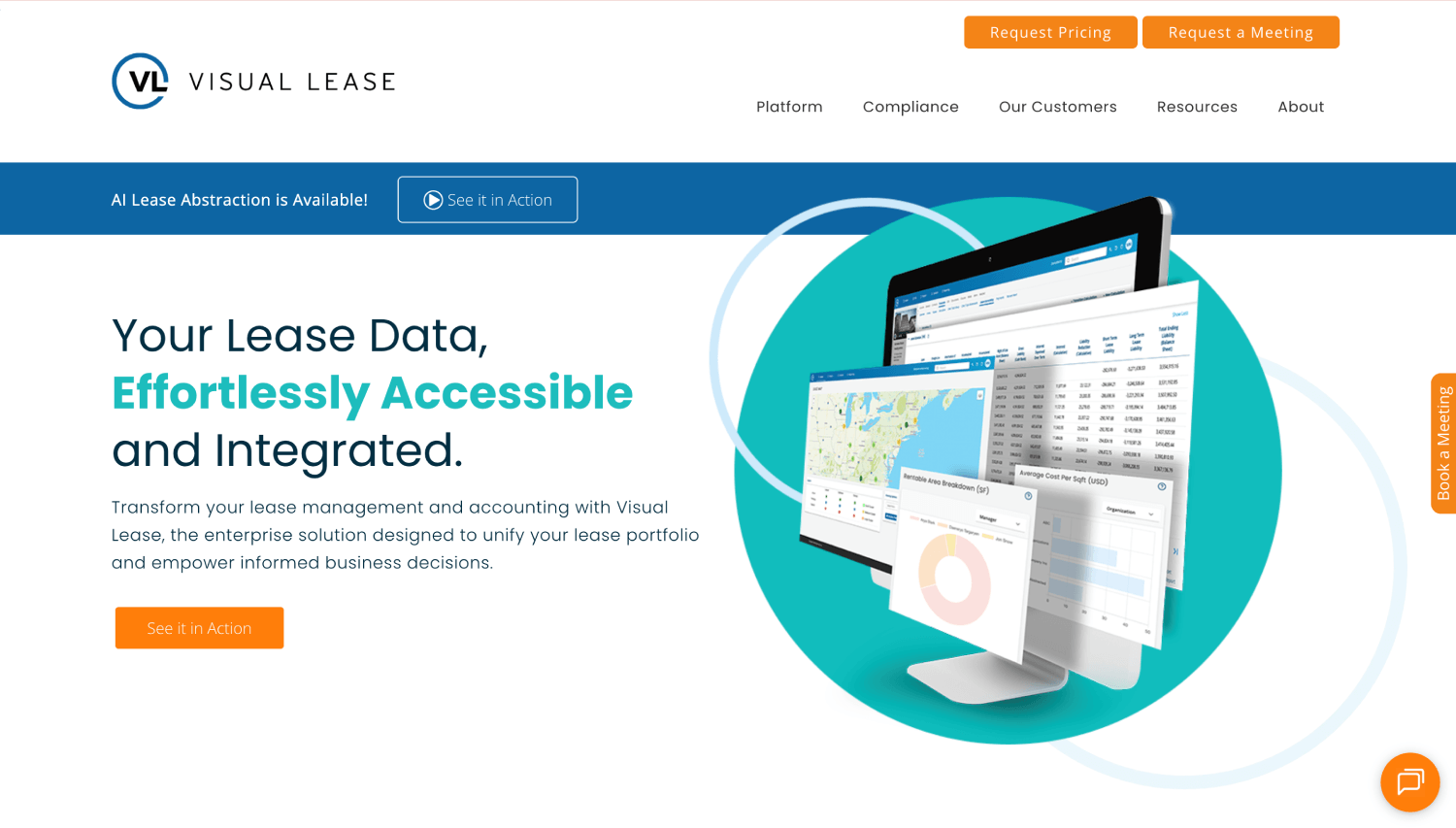
Visual Lease positions itself as a lease-first platform with both ASC 842 and IFRS 16 compliance built into its calculation engine. It supports multi-entity structures by maintaining separate subledgers per legal entity, which means journal entries, amortization schedules, and disclosure packages are all generated at the entity level before any consolidation occurs.
The platform handles equipment leases, real estate leases, and embedded leases within service contracts, which matters for companies that have underestimated their IFRS 16 or ASC 842 scope during implementation. Its reporting module generates the right-of-use asset rollforward, lease liability maturity analysis, and weighted average discount rate disclosures that auditors expect.
ERP connectivity covers SAP, Oracle Cloud, NetSuite, and Workday. The integration posts journal entries in the format each ERP expects, reducing the mapping work during implementation. Visual Lease does not publicly list pricing. As of this writing, pricing is quote-based. Teams should request a proposal with entity count and lease count specified.
LeaseQuery by FinQuery: Who Is It For and What Does It Actually Do?
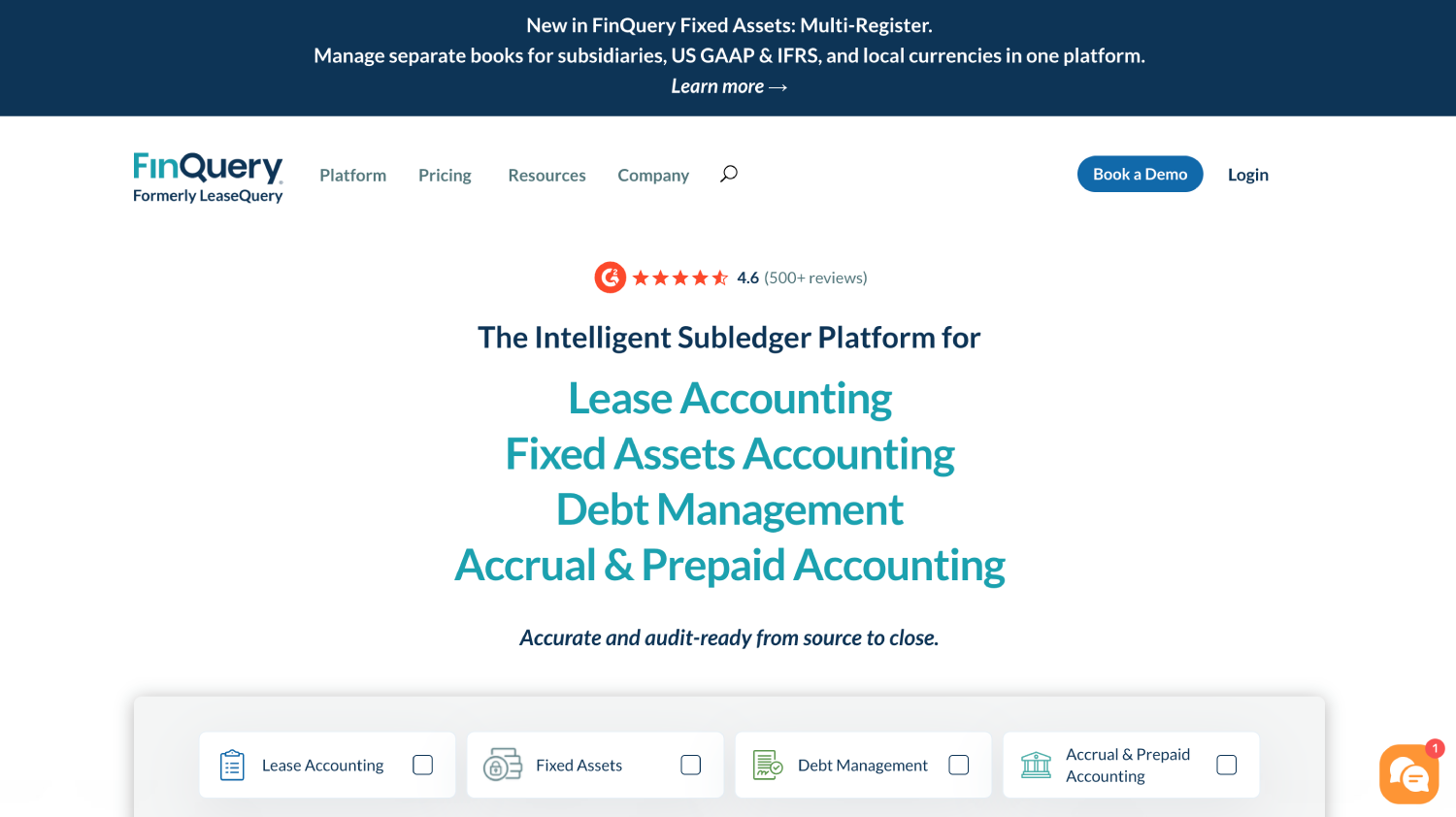
LeaseQuery, now part of FinQuery, is frequently cited by mid-market finance teams as the platform most accountants trust first. That reputation comes from two things: a calculation engine that CPAs audited early in the ASC 842 adoption cycle, and ERP integrations that push journal entries directly into NetSuite, Sage Intacct, QuickBooks Online, Microsoft Dynamics, and SAP without intermediate CSV exports.
For multi-entity structures, LeaseQuery maintains entity-level subledgers and allows each entity to operate under its own reporting standard, so a US subsidiary can run ASC 842 while a UK entity runs IFRS 16 within the same instance. Remeasurement events are logged with reason codes, user stamps, and before-and-after schedules, which satisfies the audit trail requirements most external auditors now require specifically.
The platform handles equipment, real estate, and vehicles. It generates the transition journal entries, the ongoing amortization, and the disclosure note schedules, including the quantitative table requirements under ASC 842-20-50. As of this writing, FinQuery has not disclosed list pricing on its public site. Pricing is quote-based.
Nakisa Lease Administration: Who Is It For and What Does It Actually Do?
Nakisa Lease Administration is built for SAP environments. Its integration with SAP S/4HANA and SAP ECC is not an API connection bolted onto a third-party platform. It runs calculations inside the SAP environment and posts to the SAP general ledger natively, which eliminates the reconciliation gap between the lease subledger and the ERP that many non-native integrations produce.
For global organizations running dozens of legal entities through SAP, this architecture is a meaningful differentiator. The platform also supports IFRS 16 and ASC 842 simultaneously, maintains entity-level subledgers, and handles multi-currency translation consistent with IAS 21. It also supports local GAAP requirements for certain jurisdictions, which is relevant for multinationals where subsidiaries must file under local standards as well as group IFRS.
Nakisa also offers a contract management module and a space management layer, which may add implementation complexity for teams that only need lease accounting. Teams that are not on SAP should evaluate other options first. Nakisa’s Oracle integration exists but is less native than the SAP path. As of this writing, pricing is not publicly listed and is quote-based.
CoStar Real Estate Manager: Who Is It For and What Does It Actually Do?
CoStar Real Estate Manager comes from the CoStar Group, which is primarily known as a commercial real estate data provider. That lineage makes it a strong fit for companies whose lease portfolios are predominantly real estate, particularly those that also use CoStar’s market data for site selection or portfolio benchmarking.
The platform supports ASC 842 and IFRS 16, maintains entity-level subledgers, and integrates with SAP, Oracle, MRI Software, and Yardi. The last two integrations matter because MRI and Yardi are common in real estate-heavy organizations that also run property management alongside lease accounting. For a retail chain or logistics company managing hundreds of real property leases across dozens of entities, that integration set covers more of the existing tech stack than a pure-play lease accounting tool might.
CoStar Real Estate Manager is less commonly chosen for equipment-heavy or technology lease portfolios. Its strength is real estate, and its workflow tools reflect that. As of this writing, pricing is not publicly listed and is quote-based.
ProLease: Who Is It For and What Does It Actually Do?
ProLease covers both real estate and equipment leases within a single platform, which matters for mid-market companies that manage mixed portfolios and do not want separate systems for each asset class. The platform supports ASC 842 and IFRS 16, generates amortization schedules and disclosure packages at the entity level, and integrates with NetSuite, Sage Intacct, QuickBooks, and Microsoft Dynamics.
ProLease includes a critical date management module that flags upcoming lease expirations, renewal options, and rent escalation triggers. For multi-entity teams managing hundreds of leases where missing a renewal window creates an unplanned remeasurement, that functionality reduces operational risk. The platform also includes lease abstraction services as an add-on, which helps teams with legacy paper leases that need to be digitized before compliance work begins.
ProLease is a reasonable choice for companies in the 50 to 500 employee range that run mixed asset portfolios and need mid-market ERP integrations without SAP-level complexity. As of this writing, pricing is quote-based.
Accruent Lx Contracts: Who Is It For and What Does It Actually Do?
Accruent Lx Contracts is built for high-volume, multi-site lessees in retail, restaurant, and healthcare, where a single company might hold thousands of real property leases across hundreds of legal entities with frequent rent escalations, percentage rent clauses, and landlord work reimbursements that complicate the lease liability calculation.
The platform handles both ASC 842 and IFRS 16, maintains entity-level subledgers, and integrates with SAP, Oracle, Microsoft Dynamics, and JD Edwards. The JD Edwards integration is relevant for manufacturing and distribution companies that run older Oracle environments. Accruent’s remeasurement workflow handles the common retail complication of co-tenancy clauses, where a lease term or payment may change based on a co-tenant vacating, triggering a remeasurement under both standards.
Lx Contracts is not the right fit for technology or financial services companies with smaller, cleaner lease portfolios. Its depth comes at implementation cost. Teams with under 100 leases across fewer than ten entities will likely find the platform over-engineered for their needs. As of this writing, pricing is not publicly listed and is quote-based.
EZLease: Who Is It For and What Does It Actually Do?
EZLease occupies a different segment than the other six platforms. It is designed for smaller portfolios, typically under 200 leases, where the organization needs audit-ready ASC 842 and IFRS 16 compliance without the implementation overhead of an enterprise platform. It supports multi-entity setups and generates entity-level amortization schedules and disclosure packages.
ERP integration options include QuickBooks, NetSuite, Sage, and Microsoft Dynamics, with CSV export for ERPs outside that list. The CSV export path means some teams will still handle a manual posting step, which is a trade-off worth acknowledging. For companies that cannot justify the per-entity cost of an enterprise platform but need auditable, standard-compliant output, EZLease provides a credible path.
EZLease is specifically well-suited for private companies transitioning to ASC 842 for the first time, particularly those whose audit firm has accepted the platform’s output format. It is also used by entities that are subsidiaries of larger groups but manage their own lease compliance locally. As of this writing, EZLease does not publicly list pricing, though it has historically offered lower entry points than enterprise platforms.
Illustrative Scenario: What Remeasurement Looks Like Across Entities
To make remeasurement mechanics concrete, consider the following hypothetical. A Series C technology company operates five legal entities: a US parent, a UK subsidiary, a German GmbH, a Singapore entity, and a Canadian subsidiary. The US parent reports under US GAAP. The four subsidiaries report under IFRS for group purposes and local GAAP for statutory filings. The portfolio holds 80 leases across offices and equipment.
In month 14 of their ERP implementation, the UK subsidiary renegotiates its London office lease. The term extends by three years, and the monthly payment increases. Under IFRS 16, this is a lease modification that creates a new lease for the extended term, requiring a remeasurement of the right-of-use asset and lease liability at a revised discount rate. The GBP-denominated liability must then be translated to EUR for group IFRS reporting and to GBP for UK statutory filing, using different exchange rates and different periods.
In a spreadsheet model, that remeasurement ripples through at least four linked tabs, requires manual exchange rate inputs, and produces a journal entry that someone must post to the UK entity’s NetSuite instance and separately to the SAP consolidation environment. In a platform like LeaseQuery or Nakisa, the modification is logged in a workflow, the new schedule is computed automatically, the journal entry is generated in the entity’s functional currency, and the ERP posting happens without manual re-entry. The audit trail is complete before the accountant refreshes the screen.
This type of event is routine for any company that has grown through acquisition or geographic expansion. The point of multi-entity lease accounting software is to make that routine work controlled and auditable rather than fragile.
How Does ERP Integration Depth Differ Between These Platforms?
ERP integration is where these platforms differ most in practice, even when their feature lists look similar. There are three integration patterns in this category:
Native ERP integration
Nakisa runs inside SAP’s architecture. Journal entries are written directly to SAP tables without leaving the SAP environment. This eliminates the reconciliation problem entirely and is the strongest option for SAP shops, but it also means Nakisa’s value proposition collapses outside SAP.
Direct API integration
Visual Lease and LeaseQuery connect to ERP systems via APIs that map lease accounting journal entries to the target ERP’s chart of accounts. This requires a configuration step during implementation, but once mapped, postings are automated. Both platforms support SAP, Oracle, and NetSuite through this method.
Certified connector or CSV export
EZLease and ProLease use pre-built connectors for supported ERPs and fall back to structured CSV export for others. The CSV path is auditable if the import process is documented and controlled, but it introduces a manual step that larger audit teams will scrutinize.
When evaluating integration depth, ask vendors specifically whether the journal entry posting is real-time or batch, whether the ERP connection writes directly to the GL or to a staging table requiring approval, and whether multi-entity postings go to separate ERP company codes or require manual splitting. Those three questions reveal more about implementation risk than any feature comparison sheet.
Finance leaders evaluating ERP-connected accounting tools may also find the accounting integration API comparison on FintechSpecs useful when assessing the middleware layer between lease platforms and their general ledger.
What Should Finance Teams Ask Before Signing a Lease Accounting Contract?
The seven platforms above all meet the minimum bar for multi-entity ASC 842 and IFRS 16 compliance. The selection decision comes down to your specific entity architecture, your ERP stack, and your lease portfolio composition. Before requesting a demo, have answers to these questions ready:
- How many legal entities will the platform need to support, and do any entities report under a local GAAP standard beyond US GAAP or IFRS?
- What is your ERP environment, and does the vendor’s integration write directly to the GL or require a staging step?
- What is the split between real estate leases, equipment leases, and embedded leases in service contracts?
- How frequently do your leases modify, and does the vendor’s remeasurement workflow support your expected volume?
- Does your external audit firm have prior experience with the platform’s disclosure output format?
The last question matters more than most finance teams expect. Audit firms that have reviewed a platform’s disclosure schedules before will ask fewer open-ended questions and move through the lease testing phase faster. Some of the larger platforms will tell you which major accounting firms and mid-market auditors have the most experience reviewing their output.
Teams concerned about broader compliance infrastructure should also review the fintech compliance readiness checklist for a framework that covers accounting standards alongside other regulatory obligations.
Frequently Asked Questions
What is multi-entity lease accounting software?
Multi-entity lease accounting software is a purpose-built platform that maintains a separate lease subledger for each legal entity in a corporate group. It calculates right-of-use assets and lease liabilities under ASC 842 and IFRS 16 at the entity level, handles multi-currency translation, generates entity-specific disclosure packages, and posts journal entries directly into each entity’s ERP general ledger. It is not a financial consolidation tool. It operates before consolidation, at the lease computation layer.
Can one platform handle both ASC 842 and IFRS 16 simultaneously?
All seven platforms profiled here support both ASC 842 and IFRS 16 within a single instance. This matters for multinational companies where the US parent reports under US GAAP while foreign subsidiaries report under IFRS. The calculation engines treat each standard separately, because the two standards differ on topics including variable lease payments, lease term reassessment triggers, and the classification of short-term leases. Confirm with any vendor that their dual-standard support runs at the entity level, not as a report-level toggle applied after a single calculation.
How does lease remeasurement work in multi-entity platforms?
When a lease modification, reassessment event, or index change occurs, the platform triggers a controlled remeasurement workflow. The accountant logs the event, provides the reason code, and the platform computes the revised right-of-use asset and lease liability using the updated inputs and an appropriate discount rate. The before-and-after schedules are locked in the audit trail. The resulting adjustment journal entry is then posted to the relevant entity’s ERP. No figures change without a documented workflow record, which is the primary audit protection the platform provides over spreadsheets.
Which lease accounting platforms integrate natively with SAP?
Nakisa Lease Administration offers the deepest SAP integration, running inside the SAP S/4HANA and SAP ECC environment rather than connecting to it via API. Visual Lease and Accruent Lx Contracts also offer SAP integrations via API-based connectors, which require chart-of-accounts mapping during implementation. LeaseQuery supports SAP through a certified integration. ProLease and EZLease are better suited to NetSuite, Sage, QuickBooks, and Dynamics environments. Teams running SAP as their primary ERP should evaluate Nakisa first.
Is EZLease suitable for large enterprise portfolios?
EZLease is better suited to portfolios under 200 leases across a limited number of entities. It produces audit-ready ASC 842 and IFRS 16 output and supports multi-entity setups, but its ERP integration options are narrower than enterprise platforms, and its workflow capabilities for high-volume remeasurement events are lighter. For companies managing hundreds of leases across dozens of entities with complex modification histories, Visual Lease, LeaseQuery, Nakisa, or Accruent Lx Contracts will provide more appropriate infrastructure.
Do lease accounting platforms handle embedded leases in service contracts?
Yes, most platforms in this list include tools for identifying and tracking embedded leases, which are arrangements where a service contract contains the right to control the use of an identified asset. Visual Lease and LeaseQuery both include embedded lease identification workflows. This is relevant because IFRS 16 and ASC 842 both require lessees to assess whether a contract contains a lease at inception, and many companies discovered embedded leases in IT outsourcing, logistics, and manufacturing agreements during their initial implementation. The platform does not perform the legal analysis, but it maintains the register and calculates the accounting once the determination is made.
What disclosures do these platforms generate for financial statement notes?
Standard disclosure outputs across these platforms include the right-of-use asset rollforward table, lease liability maturity analysis, weighted average remaining lease term and discount rate by asset class, finance and operating lease cost disaggregation, and variable and short-term lease cost disclosures. Under IFRS 16, platforms also generate the reconciliation of lease liabilities required by IFRS 16.53. The specific format and labeling vary by platform, so teams should provide their current disclosure template to prospective vendors during evaluation to confirm the output maps cleanly to their financial statement structure.
The Selection Logic in Plain Terms
If your organization runs on SAP and operates across multiple jurisdictions with complex intercompany structures, Nakisa is the most defensible choice because its native SAP architecture eliminates the subledger-to-ERP reconciliation gap entirely. If you are a mid-market company on NetSuite, Sage, or QuickBooks with a mixed lease portfolio and a team that values accountant-first design, LeaseQuery has the strongest track record with external auditors and the broadest mid-market ERP coverage.
Visual Lease fits well for large lessees with significant real estate portfolios who need Workday integration alongside SAP and Oracle. CoStar Real Estate Manager is the logical choice if your portfolio is predominantly real estate and your tech stack already includes MRI or Yardi. Accruent Lx Contracts is designed for the retail and restaurant segment where high-volume real estate leases with complex rent structures are the norm. ProLease serves mixed portfolios at mid-market scale where both real estate and equipment appear on the same balance sheet.
EZLease earns its place for smaller portfolios where the priority is clean, auditable compliance output at a lower implementation cost. It is a complete solution for the organization that does not need the complexity of the others, not a stepping stone to an enterprise platform.
The common failure mode in this category is selecting a platform based on a demo that showed clean data, then discovering during implementation that the chart-of-accounts mapping, entity configuration, or discount rate methodology requires more professional services time than the license fee suggested. Budget implementation time alongside software cost. For any portfolio with more than five entities or 100 leases, the implementation engagement will be as consequential as the platform itself.
Finance leaders who want a broader view of how compliance tools interact with operational infrastructure may find the tools fintech ops teams actually use and multi-entity expense management platforms useful alongside this evaluation, particularly when scoping the full finance tech stack across entities.