
- Most SaaS companies treat chargebacks as a processor-side problem until dispute volume, fraud rates, or manual evidence work forces a rethink.
- Who owns a chargeback depends on your payment stack: a merchant of record absorbs the liability, a PSP passes it to you, and a payment platform’s answer depends on contract terms.
- Dedicated chargeback management tools SaaS teams actually need become relevant above roughly 50 disputes per month, when evidence workflows start consuming hours your team does not have.
- The tools in this list differ more in workflow automation depth and integration surface than in raw win rate claims, which no vendor can honestly guarantee.
- Pricing varies widely and most vendors do not publish it, so treat any per-case or percentage-of-recovery figure as a starting point for negotiation.
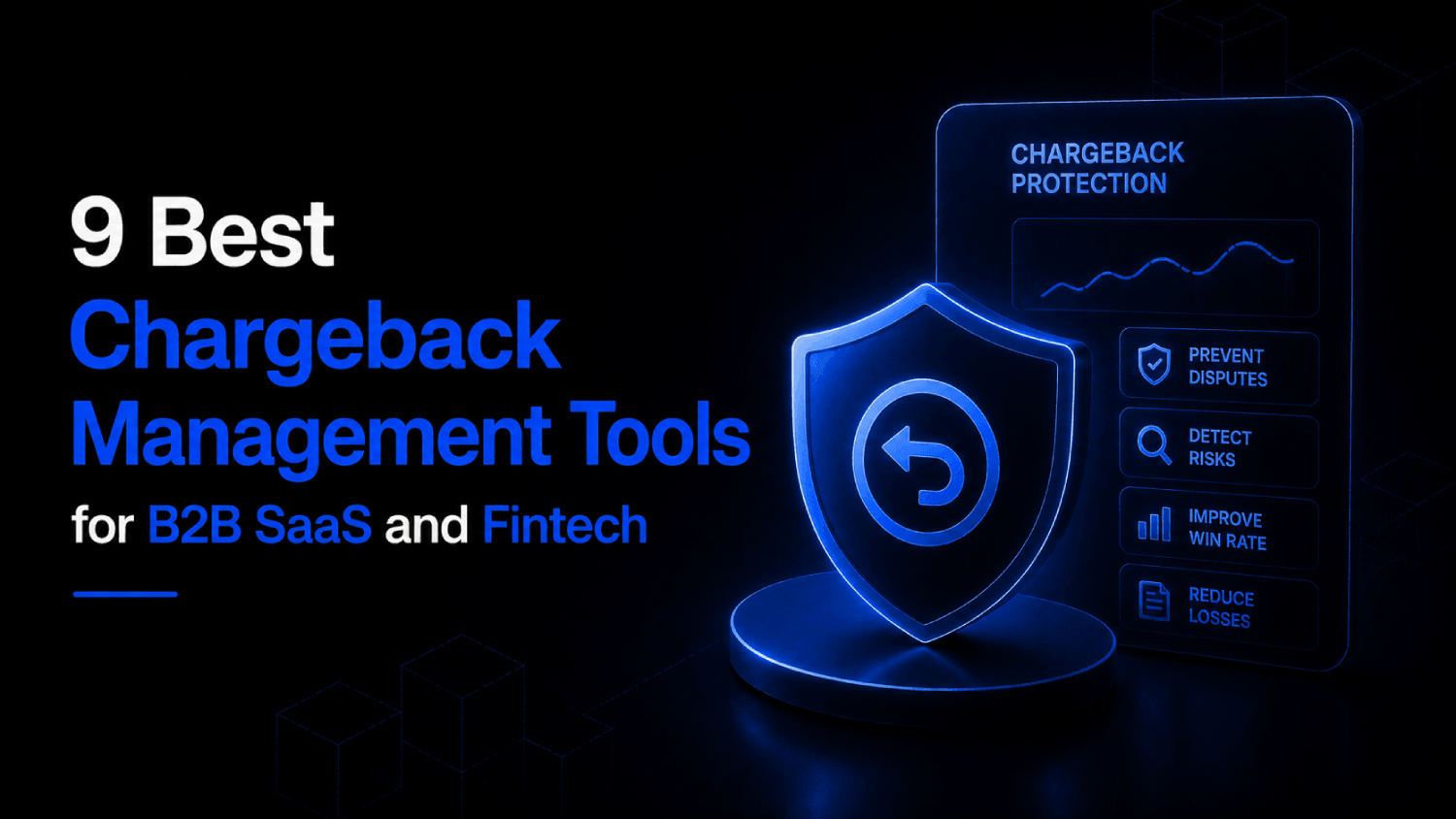
The best chargeback management tools for B2B SaaS and fintech are Chargebacks911, Chargeflow, Justt, Midigator, Kount, Sift, Verifi (Visa), Ethoca (Mastercard), and Chargeback.com. Each targets a different slice of the dispute workflow: some focus on pre-dispute alerts, some on automated evidence submission, and some on full-service managed response. Which one fits depends on your transaction volume, who legally owns your disputes, and whether you need automation or outsourced human review.
Why Your Processor Dashboard Is Not a Chargeback Strategy
Stripe, Braintree, and most PSPs surface dispute notifications and let you submit evidence through their dashboards. That works fine at 10 disputes a month. At 100, the cracks show: evidence must be assembled manually per case, response deadlines are easy to miss, and there is no pattern analysis telling you which SKU or acquisition channel is generating most of the friction.
The deeper issue is liability ownership. A payment processor like Stripe routes the dispute to you and provides the interface, but the chargeback liability sits with your business from the start. A merchant of record like Paddle or Lemon Squeezy absorbs that liability themselves, which means you may never see a chargeback at all. If you are using a PSP directly and processing above a few hundred transactions per day, the processor dashboard is a notification system, not a management system.
What changes with dedicated chargeback management tooling is the operational layer: automated evidence compilation, pre-dispute alerts that let you refund before a dispute is filed, win-rate analytics by reason code, and integrations with your CRM and order management system. That combination is what moves chargebacks from a reactive billing task to a measurable revenue protection function. It also directly affects your chargeback ratio, the metric card networks use to determine whether your account enters a scheme monitoring program, which is the number that should be driving tooling decisions, not anecdotal dispute counts.
Who Actually Owns Your Chargebacks: MoR, PSP, Platform, or Merchant?
Getting this wrong is the most expensive structural mistake in SaaS payment operations. The answer determines whether you need chargeback tooling at all, and if so, what kind.
Merchant of Record (MoR)
When you sell through a merchant of record like Paddle, Lemon Squeezy, or Polar, the MoR is the legal seller of record to the end customer. Chargebacks go to the MoR, not you. You lose visibility into individual disputes, but you also absorb zero financial liability. The trade-off is control: you cannot build your own dispute evidence workflow because the MoR owns that relationship entirely.
Payment Service Provider (PSP)
With a PSP like Stripe, Adyen, or Braintree, disputes are routed to your account. You receive the notification, submit the evidence, and absorb the loss plus the dispute fee if you lose. This is the configuration where dedicated chargeback management tools deliver the most value. Stripe’s built-in dispute tooling is functional but manual; third-party tools automate evidence packaging and add pre-dispute alert coverage. Critically, your chargeback ratio accumulates against your account, and breaching a scheme monitoring threshold, Visa’s standard program triggers at 0.9% of monthly transactions, can result in escalating fees or acquiring bank intervention.
Payment Platform (Marketplace or Embedded Payments)
If you run a B2B platform with embedded payments, the chargeback responsibility often splits: the platform bears the regulatory and scheme liability, but individual sub-merchants generate the disputes. Tools like Stripe Connect allow platforms to push dispute handling to connected accounts, but the platform still carries reputational and scheme-threshold risk if those accounts have high dispute rates.
Direct Merchant (Card-Present or Direct Acquiring)
Companies with direct acquiring relationships own everything: dispute fees, response deadlines, and scheme monitoring thresholds. This configuration benefits most from enterprise chargeback platforms with direct network integrations.
The FintechSpecs Dispute Stack Assessment
Most buyers evaluate chargeback tools by win rate claims. Win rates are nearly impossible to compare across vendors because they depend entirely on your business type, reason code mix, and evidence quality.
A more reliable approach is what we call the Dispute Stack Assessment: a four-question diagnostic developed from reviewing how B2B SaaS and fintech teams actually structure this function. The goal is not to rank tools by feature count but to identify which layer of the dispute problem you actually have, because chargeback prevention, dispute resolution SaaS automation, and managed response each solve different parts of the same workflow failure.
To make this concrete: imagine a 60-person SaaS company on Stripe, processing 3,000 transactions per month in a subscription billing model. They receive roughly 80 disputes per month, split between “subscription canceled” and “unrecognized charge” reason codes. Their ops analyst spends four to five hours weekly assembling evidence. They have never enrolled in a pre-dispute alert network. Running their situation through the Dispute Stack Assessment would surface two clear priority layers: first, pre-dispute alert enrollment through Verifi and Ethoca to stop chargeback ratio accumulation before it reaches the Visa scheme monitoring threshold; second, automation tooling for subscription-coded evidence assembly, where the evidence set is identical across cases. The managed service route (Chargebacks911) would be oversized for their volume and would cost more than the problem. A full fraud scoring platform (Kount, Sift) would be mismatched because their dispute mix is service-related, not fraud-coded. This is the kind of stack-fit reasoning the assessment produces.
- Volume threshold: Are you receiving more than 50 disputes per month? Below that, a PSP dashboard with disciplined manual processes usually suffices. Above it, automation starts paying for itself.
- Evidence complexity: Does a single dispute require pulling data from more than two systems (e.g., your CRM, subscription platform, email logs, and shipping carrier)? If yes, automation saves meaningful time per case.
- Reason code distribution: Are most disputes “item not received” or “subscription canceled”? The reason code mix determines whether you need pre-dispute alerts, compelling evidence workflows, or fraud scoring, and not every tool does all three well.
- Liability model: Do you own the dispute directly, or does a platform or MoR stand between you and the card networks? If someone else owns the liability, your tooling priority shifts from response management to chargeback prevention at the acquisition layer.
9 Best Chargeback Management Tools for B2B SaaS and Fintech
| Tool | Best For | Dispute Ownership Fit | Pricing Model | Standout Feature |
|---|---|---|---|---|
| Chargebacks911 | High-volume merchants, managed service | PSP, direct acquiring | Not publicly listed | Hybrid human + tech dispute management |
| Chargeflow | E-commerce and SaaS on Stripe/PayPal | PSP | Success-based (% of recovered revenue) | AI evidence automation for Stripe disputes |
| Justt | SaaS and subscription businesses | PSP | Success-based | AI chargeback fighter with subscription context |
| Midigator | Mid-market and enterprise SaaS | PSP, direct acquiring | Not publicly listed | Root cause analytics and reason code segmentation |
| Kount (Equifax) | Fraud-heavy transaction environments | PSP, platform | Not publicly listed | Identity-linked fraud signals reduce pre-dispute disputes |
| Sift | Fintech, marketplace, and platform fraud | PSP, platform | Not publicly listed | Real-time fraud signals feeding chargeback prevention |
| Verifi (Visa) | Visa-heavy card portfolios | PSP, direct acquiring | Network pricing, varies | CDRN alert network; direct Visa integration |
| Ethoca (Mastercard) | Mastercard-heavy portfolios | PSP, direct acquiring | Network pricing, varies | Consumer Clarity merchant data enrichment |
| Chargeback.com | Internal team control, SaaS operators | PSP, direct acquiring | Not publicly listed | Full-service dispute resolution SaaS for in-house teams |
1. Chargebacks911
Chargebacks911 is the most widely referenced managed chargeback service for merchants processing at volume. It combines proprietary technology with human dispute analysts, which means your team does not have to build internal expertise to get competitive response quality. The hybrid model matters because card network rules change frequently, and keeping up with Visa’s Compelling Evidence 3.0 updates or Mastercard’s dispute reason code revisions is a full-time job.
For B2B SaaS companies running direct acquiring or high-volume PSP accounts, Chargebacks911 is a strong default because it handles the entire workflow. The trade-off is opacity: you hand off control and get results, but you build less internal institutional knowledge about why your disputes are being won or lost. Teams that want visibility into their chargeback ratio trends by reason code will find that a managed service model obscures exactly the data they need to fix upstream problems.
2. Chargeflow
Chargeflow targets Stripe, PayPal, and Shopify merchants with an AI-driven evidence assembly model. According to Chargeflow’s public materials, it automatically gathers and organizes evidence across connected data sources to handle the dispute response process. The success-based pricing model (a percentage of recovered revenue) removes upfront cost risk but can become expensive if your average disputed transaction value is high.
For early-stage SaaS companies on Stripe that are starting to see subscription cancellation disputes stack up, Chargeflow is often the fastest path to automating what was previously manual evidence work. It connects directly to Stripe’s API, pulls order data, email logs, and usage data, then submits formatted responses before the deadline. No internal disputes analyst required.
3. Justt
Justt positions itself specifically around subscription and SaaS dispute patterns. Its AI model is trained on subscription cancellation and “services not rendered” reason codes, which are the two categories that dominate SaaS chargeback queues. Justt’s public blog has covered how subscription chargebacks erode SaaS MRR, and their tooling reflects that focus.
The success-based pricing model mirrors Chargeflow’s approach. The differentiation is in how deeply Justt maps its evidence logic to subscription billing context, including trial-to-paid conversions, cancellation confirmations, and login activity. For fintech SaaS companies with recurring billing as the core model, that specificity matters. Where Chargeflow is broader in platform coverage, Justt is narrower and deeper in subscription dispute resolution SaaS functionality.
4. Midigator
Midigator is built for teams that want to own the dispute process rather than outsource it. Its root cause analytics layer sits on top of response automation, so finance and risk teams can see which reason codes, product lines, or customer segments are generating the most disputes. That visibility is what separates Midigator from simpler response tools.
Mid-market and enterprise SaaS operators dealing with disputes across multiple processors should look at Midigator’s multi-gateway support. The chargeback ratio reporting by segment is particularly useful for identifying whether a dispute spike is a fraud event, a billing clarity problem, or a product delivery issue, three problems with three different fixes. Pricing is not publicly listed, which means it is structured for accounts with meaningful volume. Small teams evaluating Midigator should expect a sales-assisted process.
5. Kount (Equifax)
Kount, now part of Equifax, approaches chargebacks from the fraud prevention angle. Most chargebacks start as either genuine fraud or friendly fraud, and Kount’s identity decisioning network generates signals before a transaction completes that reduce the probability of a dispute later. It is not purely a chargeback response tool; it is a fraud risk layer that reduces inbound dispute volume by attacking the chargeback prevention problem at its source.
For fintech companies building embedded payments or financial services products, Kount pairs naturally with the transaction monitoring work your risk team is already doing. The Equifax integration gives it access to consumer identity data at a depth that pure chargeback tools cannot match. If your dispute queue is dominated by fraud-coded chargebacks rather than service disputes, start here.
6. Sift
Sift operates in similar territory to Kount but with a stronger foothold in fintech, marketplace, and platform fraud use cases. Its real-time fraud signals feed directly into chargeback prevention by flagging high-risk transactions before they settle, not after a dispute lands. The platform also covers account takeover and payment abuse, which are the two fraud vectors most likely to generate chargebacks in SaaS environments.
For platforms with embedded payments or marketplace dynamics, Sift’s breadth across fraud types is an advantage over single-purpose chargeback tools. It is a higher-complexity integration, and pricing is not publicly listed, but for Series B and later fintech companies where fraud cost is a measurable P&L line, Sift’s signal richness justifies the investment. Fraud prevention and dispute management are more connected than most finance teams realize, and teams evaluating tools here often benefit from reviewing broader fraud detection and risk tooling for fintech startups alongside chargeback-specific options.
7. Verifi (Visa)
Verifi, owned by Visa, runs the Cardholder Dispute Resolution Network (CDRN), which is a pre-dispute alert system. When a Visa cardholder contacts their bank to dispute a charge, Verifi notifies the merchant before the formal dispute is filed. The merchant can then refund the transaction, which stops the chargeback from ever hitting the scheme threshold count.
Pre-dispute alerts are one of the highest-ROI chargeback prevention activities available because a refund carries zero dispute fee and zero impact on your chargeback ratio or scheme monitoring thresholds, while a lost chargeback carries both. Verifi’s value is concentrated on Visa transactions. If your card mix skews Visa-heavy, as it does for most US consumer-facing products, Verifi’s CDRN is often worth running alongside any other tool on this list.
8. Ethoca (Mastercard)
Ethoca, Mastercard’s equivalent to Verifi, operates the Ethoca Alerts network and a separate product called Consumer Clarity, which enriches transaction data shown to cardholders in their banking app. When cardholders can see a transaction’s merchant name, logo, and purchase details clearly, they are less likely to file a dispute out of confusion, which is a significant slice of so-called friendly fraud.
Consumer Clarity addresses a dispute category that most operators underestimate: billing descriptor confusion. If your company name on a bank statement reads as an unfamiliar string rather than a recognizable brand, some customers file disputes simply because they do not recognize the charge. Ethoca’s merchant data enrichment fixes that at the card network level, and it runs passively once configured. For companies processing high Mastercard volume, Ethoca and Verifi together cover pre-dispute alerts across both major networks, effectively the most straightforward chargeback ratio reduction available without touching your product or pricing.
9. Chargeback.com
Chargeback.com is structured as a full-service dispute resolution SaaS platform for internal dispute teams, giving operators direct control over fraud detection, evidence management, and protection workflows rather than delegating to a managed service. According to analysis surfaced in third-party comparisons of chargeback software tools, it focuses on enabling in-house control over the dispute process rather than outsourcing response work.
For SaaS operators that have built a dedicated billing operations or dispute function internally, Chargeback.com provides the tooling infrastructure to support that team without replacing it. The platform fits companies at the point where dispute volume is high enough to justify a full-time analyst but where that analyst needs better data, workflow automation, and analytics than a PSP dashboard provides.
How Do Pre-Dispute Alerts Actually Work in Practice?
Pre-dispute alert networks like Verifi’s CDRN and Ethoca Alerts work through agreements between card issuers and the alert network operator. When a cardholder contacts their bank to complain about a charge, the bank checks whether the merchant is enrolled in the alert network. If they are, the bank sends a notification to the merchant (via the network) instead of immediately filing a formal dispute with the card scheme.
The merchant typically has a short window, often 24 to 72 hours depending on the issuer, to issue a refund. If a refund is confirmed, the dispute is cancelled and never reaches the scheme. The merchant pays an alert fee per case but avoids the dispute fee, the scheme monitoring count, and the chargeback ratio impact. For subscription businesses where a customer genuinely forgot they were paying, this path resolves the situation without punishing the merchant for a benign oversight.
The limitation is coverage: not every issuer participates in every alert network, and coverage varies by geography and card type. Enrolling in both Verifi and Ethoca gives broader coverage but still does not reach 100% of dispute-generating transactions. Pre-dispute alerts are best understood as a chargeback prevention probability reduction tool, not a complete solution.
What Does Chargeback Management Tooling Actually Cost?
Most enterprise chargeback platforms do not publish pricing, which makes direct comparison harder than it should be. The pricing structures that do appear publicly tend to follow one of three models.
- Success-based fees: A percentage of recovered revenue per won dispute. Chargeflow and Justt both use this model. The advantage is zero upfront cost; the disadvantage is that fees scale with transaction value, not dispute count, which can get expensive for high-ACV SaaS products.
- Per-alert fees: Verifi and Ethoca charge per pre-dispute alert processed. Exact figures depend on volume agreements and are negotiated with the network or a reseller.
- Platform subscription plus transaction fees: Some tools charge a base SaaS fee plus a per-case or per-submission fee. This model suits teams with predictable, high dispute volumes where per-case costs become more favorable than percentage fees.
The hidden cost most operators miss is the opportunity cost of internal analyst time. If an ops analyst spends three hours per week assembling evidence for disputes across a PSP dashboard, and that analyst costs $80,000 per year fully loaded, that dispute handling function costs roughly $6,000 annually in labor alone, before any lost disputes. That is the baseline against which any tooling investment should be measured.
Chargeback and fraud costs are also a margin line item that teams often undercount. The hidden costs killing fintech SaaS margins extend well beyond payment processing fees into dispute losses, fraud write-offs, and the internal labor of fighting them.
What Should B2B SaaS Teams Actually Automate First?
Not every dispute workflow is equally worth automating. Evidence assembly for subscription-related chargebacks (reason codes 4853 on Mastercard and 13.5 and 13.6 on Visa) is the highest-value automation target for SaaS companies because the evidence is consistent: billing confirmation emails, terms of service acceptance, login activity, and cancellation request data are the same documents every time. Tools like Chargeflow and Justt are built specifically around this pattern.
Pre-dispute alert enrollment is the second automation priority because it requires zero per-dispute decision-making once configured. You set a refund threshold and the system handles it. The third priority is analytics: understanding your dispute reason code distribution, your win rate by code, and which customer cohorts or acquisition channels generate disproportionate dispute volume. Without that data, you are managing disputes without knowing whether the problem is fraud, billing clarity, product delivery, or customer support gaps. And without chargeback ratio visibility by segment, you cannot tell whether a spike is isolated or systemic until it has already moved your scheme monitoring numbers.
Building this infrastructure thoughtfully fits into a broader fintech scaling checklist. Teams managing payment disputes at scale often find that reaching $10M ARR without breaking operational infrastructure requires formalizing these workflows well before volume makes them unmanageable. The same payment infrastructure decisions that affect dispute ownership also affect your broader payment infrastructure tool selection, and it is worth evaluating them together.
Frequently Asked Questions
What is a chargeback management tool?
A chargeback management tool is software that helps businesses handle payment disputes by automating evidence collection, tracking response deadlines, filing dispute responses with card networks, and providing analytics on dispute patterns. More advanced platforms also include pre-dispute alert integrations that allow merchants to refund transactions before a formal chargeback is filed, reducing scheme monitoring impact and protecting the merchant’s chargeback ratio. They sit on top of, or alongside, a PSP’s native dispute interface.
Does Stripe handle chargebacks automatically?
Stripe notifies merchants of disputes and provides a dashboard to submit evidence, but it does not automatically build or submit evidence on your behalf. Stripe has a feature called Stripe Radar that helps prevent fraud before transactions complete, and it has a Chargeback Protection add-on that reimburses certain dispute losses in exchange for a fee per transaction. Neither replaces dedicated chargeback management tooling for companies with significant dispute volume or complex evidence workflows. According to Stripe’s dispute documentation, merchants must submit evidence within the deadline or the dispute is decided in the cardholder’s favor.
What is the difference between a chargeback and a dispute?
A dispute is the broader term for any customer-initiated challenge to a transaction. A chargeback is a specific mechanism where the card issuer forcibly reverses the transaction and debits the merchant’s account, typically after a dispute is not resolved directly with the merchant. Pre-dispute alerts from networks like Verifi and Ethoca exist specifically to resolve disputes before they become chargebacks. In common usage, the terms are often treated as interchangeable, but the distinction matters operationally because pre-chargeback resolution carries no scheme threshold consequences and does not affect your chargeback ratio.
At what dispute rate should a SaaS company start using dedicated tooling?
Card networks like Visa and Mastercard monitor merchant chargeback ratios and flag accounts that exceed defined thresholds. Visa’s standard monitoring program triggers at a chargeback ratio above 0.9% of monthly transactions. For SaaS companies, dedicated chargeback management tools make operational sense well before that threshold, typically when dispute volume exceeds 50 cases per month or when evidence assembly is consuming more than a few hours of analyst time per week. Below that, a disciplined manual process on a PSP dashboard is usually sufficient.
Can chargeback management tools prevent friendly fraud?
Friendly fraud, where a legitimate customer disputes a charge they actually authorized, is addressable but not fully preventable. Tools like Ethoca’s Consumer Clarity reduce billing descriptor confusion, which eliminates one common trigger. Compelling evidence submission, particularly documentation of product delivery, terms acceptance, and customer communication, increases win rates on friendly fraud disputes. Fraud scoring tools like Kount and Sift identify high-risk customers before transactions complete, reducing the probability that a friendly fraud pattern develops. No tool eliminates it entirely.
How does chargeback tooling fit into a broader fintech compliance stack?
Chargeback management sits at the intersection of payment operations, fraud risk, and regulatory compliance. Card network dispute ratio thresholds are an operational compliance requirement: exceeding scheme monitoring thresholds triggers monitoring programs and can ultimately result in account termination. For fintech companies building payment infrastructure, dispute management tooling should be part of the same operational layer as transaction monitoring and fraud detection, not treated as a separate billing department task. It connects directly to scheme compliance, scheme fees, and acquiring bank relationship health. Teams tracking compliance posture across payment operations will also find relevant framing in the fintech product and compliance readiness checklist.
Do embedded payment platforms need their own chargeback tools?
Platforms with embedded payments face a distinct challenge: sub-merchants generate disputes, but the platform bears the scheme-level consequences if aggregate chargeback ratios spike above scheme monitoring thresholds. Platforms using Stripe Connect or similar architectures should monitor chargeback ratios at both the platform and sub-merchant level. Pre-dispute alert enrollment at the platform level, combined with sub-merchant fraud monitoring, is the standard mitigation approach. Dedicated tooling becomes necessary once the platform has enough sub-merchants that manual monitoring of dispute ratios per account is no longer tractable. Teams evaluating embedded payments infrastructure for this purpose can cross-reference the top embedded payments providers for B2B SaaS platforms against their dispute ownership terms.
The Real Signal That You Need Dedicated Tooling
The clearest signal is not your dispute count. It is when someone on your finance or ops team answers the question “how are we doing on chargebacks this month?” with something like “I’d have to check manually.” At that point, you have already crossed the threshold where a PSP dashboard is sufficient and dedicated analytics and automation would pay for themselves.
The second signal is a reason code you do not understand. If disputes are coming in under a code your team cannot immediately map to a customer behavior pattern or operational failure, your tooling is not giving you enough data to fix the root cause. Every unexplained reason code is a leak you cannot patch because you cannot see it.
Chargeback management is ultimately a data quality problem dressed up as a billing operations problem. The companies that handle it well are not necessarily the ones with the lowest fraud rates. They are the ones that know, precisely and by segment, where their disputes come from, what their chargeback ratio looks like by product line and acquisition channel, and what it costs to fight or prevent each category. That level of visibility requires tooling, not just discipline.