
- Accessing consumer credit data for loan underwriting is a regulated act under the Fair Credit Reporting Act, not just a technical integration. You need a documented permissible purpose before the first API call.
- FCRA compliance for lending startups spans four distinct layers: bureau access agreements, adverse action workflows, data security policies, and vendor oversight. Most early-stage teams only think about the first one.
- The services in this list are not interchangeable. Some handle bureau reseller agreements, some build FCRA-aware decisioning workflows, and some provide legal or compliance consulting. You will likely need more than one category.
- Noncompliance carries both FTC enforcement risk and private right of action. Consumers can sue directly under 15 U.S.C. § 1681n for willful violations, with statutory damages up to $1,000 per violation.
- This article is not legal advice. Consult qualified FCRA counsel before accessing consumer credit data in any lending product.
The best FCRA compliance services for loan underwriting fall into five categories: credit bureau reseller intermediaries (like Experian Partner Solutions, Equifax Developer, and TransUnion TruValidate), compliance software platforms (Securiti, ComplyAdvantage), adverse action workflow tools (Inscribe, Notix, Provenir), FCRA-specialized legal counsel (Hudson Cook, Ballard Spahr), and compliance program infrastructure providers (Ncontracts, Quantivate). Most lending startups need at least one provider from each of the first three categories to meet minimum FCRA obligations.
Why Credit Bureau Access Is a Compliance Event, Not Just an API Integration
Most early-stage lending founders approach credit bureau access the way they approach any third-party API: find the docs, get credentials, start pulling data. That framing misses how the FCRA actually works.
Under 15 U.S.C. § 1681b, a consumer reporting agency can only furnish a consumer report to someone with a permissible purpose. Permissible purposes for lending include credit transactions initiated by the consumer, account review, and employment screening under specific conditions. Pulling a credit report outside those purposes is not a gray area. It is a federal violation, and consumers have a private right of action to sue.
The practical implication: your permissible purpose must be documented, tied to a specific transaction or consumer consent event, and defensible in an audit before you touch bureau data. That documentation requirement is what FCRA compliance services actually help you build.
If you are also building adjacent compliance infrastructure around KYC and identity, the best KYC providers for fintech SaaS cover the identity verification layer that often sits just upstream of your credit pull workflow.
What Does FCRA Compliance Actually Require for a Lending Startup?
The FCRA creates obligations in at least four areas that a lending startup must address before going live.
Permissible Purpose Documentation
You must have a written, auditable basis for every consumer report you access. For direct lenders, this typically means the consumer’s credit application creates the permissible purpose. For platform or embedded lenders, the chain of permissible purpose runs through your lending partner, and you must confirm that chain is contractually intact.
Adverse Action Notices
When you deny credit, offer less favorable terms, or take any adverse action based on a consumer report, the FCRA requires a notice to the consumer. That notice must name the credit reporting agency used, state the consumer’s right to a free report within 60 days, and list the principal reasons for the action. Per the CFPB’s Regulation B, adverse action notices must go out within 30 days of the decision. Missing this deadline is one of the most common FCRA violations in early-stage lending.
Data Security and Retention Policies
Consumer report data cannot be retained indefinitely or used for secondary purposes. Your data handling policies must specify retention periods, access controls, and disposal procedures. The bureaus enforce this through their own end-user license agreements, which typically require periodic security audits.
Vendor Oversight
If you use third-party decisioning tools or credit data intermediaries, the FCRA’s “furnisher” and “user” obligations do not transfer to the vendor. You remain responsible. Your vendor contracts must reflect FCRA-compliant data use terms, and you need documented oversight of how those vendors handle consumer data.
The FintechSpecs FCRA Stack Framework: Four Layers Every Lending Startup Must Cover
Evaluating FCRA compliance services without a structure leads to gaps. The services in this list map to what FintechSpecs calls the FCRA Stack Framework: four layers that together constitute a defensible FCRA compliance program for a lending startup.
Layer 1: Bureau Access. Who gives you permissioned access to Equifax, Experian, and TransUnion data, and under what contractual terms.
Layer 2: Workflow Compliance. How your decisioning system handles adverse action triggers, notice generation, and audit logging.
Layer 3: Program Infrastructure. Policies, procedures, training documentation, and vendor oversight frameworks.
Layer 4: Legal Oversight. FCRA-specialized counsel who can review your permissible purpose documentation, advise on edge cases, and represent you in regulatory inquiries.
No single vendor covers all four layers. The services below are organized by which layer they primarily serve.
One pattern FintechSpecs sees repeatedly in early-stage lending audits: teams that buy their way into Layer 1 (bureau access via a reseller) and treat that as a compliance program. It is not. Bureau access gives you the data. It does not give you the adverse action workflow, the written policies, or the legal review. A regulator examining a lending startup will ask for all four layers of documentation. A plaintiff’s attorney in a class action will subpoena all four. The vendors below each address a specific slice of that exposure , which is why understanding which layer you are missing matters more than finding the “best” single compliance tool.
For a broader view of how compliance costs compound as you scale, The Real Cost of Compliance in FinTech SaaS, Broken Down by Stage covers the full picture.
Layer 1: Bureau Access and Reseller Services
Getting permissioned access to consumer credit data as a startup is not as simple as signing up for an API. The three major bureaus each require you to pass a permissible purpose review, sign an end-user license agreement, and often undergo a site inspection or security certification before they grant production access. Most early-stage companies go through a bureau reseller or intermediary instead.
1. Experian Partner Solutions

Experian Partner Solutions is Experian’s program for third-party platforms that want to resell or embed Experian data in their products. As an intermediary, Experian handles much of the initial credentialing complexity and provides contract templates designed for fintech platforms. This is the most direct path to Experian data for a startup that does not yet have the volume to negotiate a direct bureau agreement.
2. Equifax Developer Program
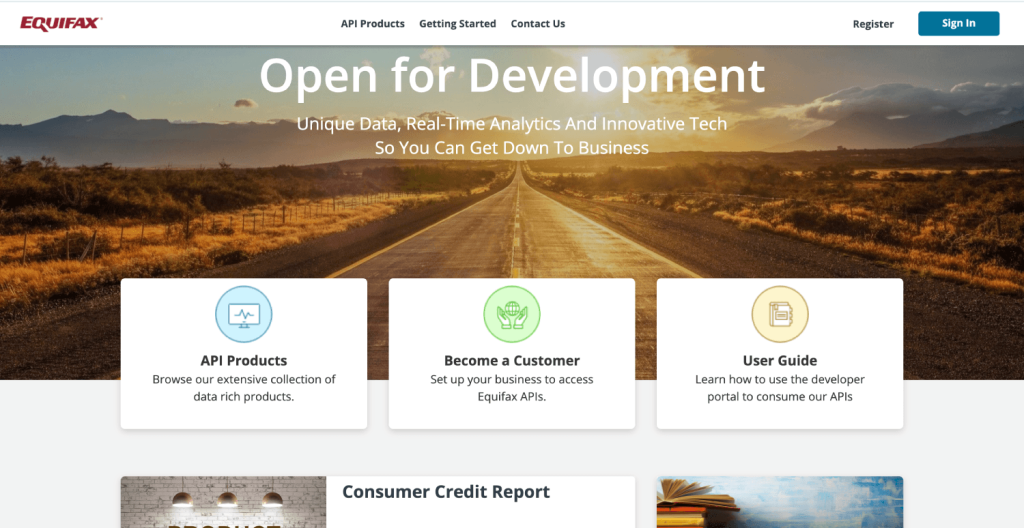
The Equifax Developer Program provides API-level access to Equifax consumer and commercial data products. Equifax requires applicants to document their permissible purpose and sign their standard end-user agreement before production credentials are issued. Equifax also offers a developer sandbox, which lets teams build and test decisioning logic before the credentialing process completes.
3. TransUnion TruValidate and Developer Portal
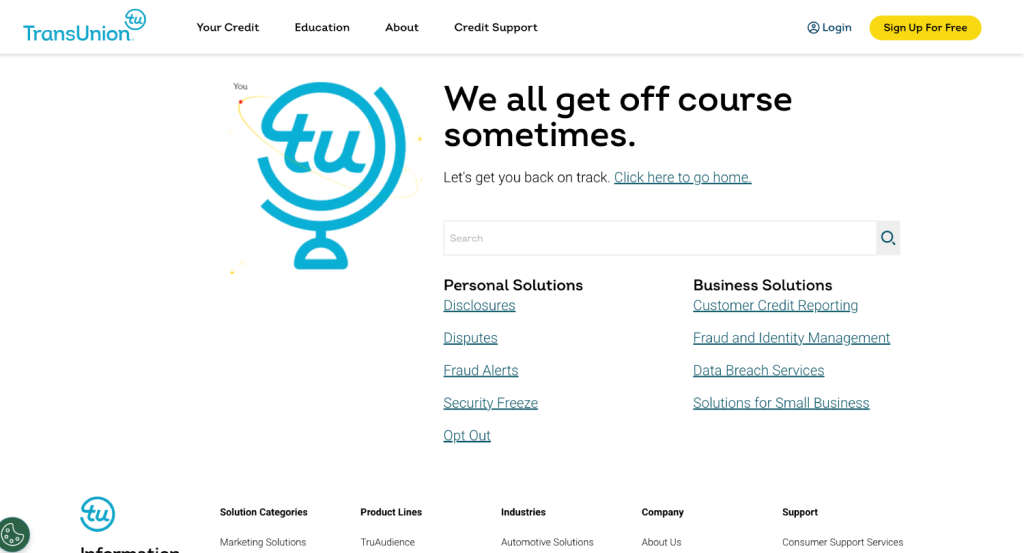
TransUnion TruValidate covers identity, fraud, and credit verification products in a single platform. TransUnion’s developer portal provides API documentation and credential request flows. Like Equifax and Experian, TransUnion requires a formal application and permissible purpose review before production access.
4. Array
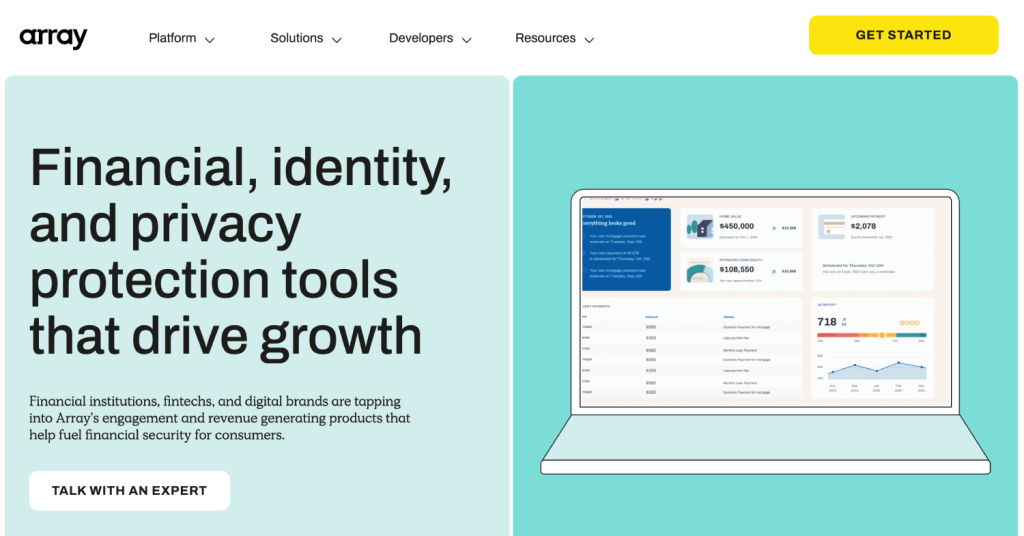
Array is a white-label credit data platform that gives fintechs and consumer-facing apps access to tri-bureau credit data under Array’s own bureau agreements. For lending startups that are not yet ready to negotiate direct bureau contracts, Array acts as a compliant intermediary , effectively renting access to bureau relationships that would otherwise require months of credentialing. Array manages the bureau relationships and the FCRA-required disclosures for embedded credit products, which reduces the compliance surface area for the startup but does not eliminate it entirely. The startup remains the end user under the FCRA and retains its own adverse action and data security obligations. Array’s white-label infrastructure is particularly well-suited to consumer-facing apps that want to add credit monitoring or score display without becoming a bureau-credentialed entity themselves, but direct lenders using Array for underwriting still need their own permissible purpose documentation and adverse action workflows in place.
5. Credit Karma for Business (Intuit)
Worth mentioning in the context of bureau access intermediaries: Credit Karma, now owned by Intuit, operates as a consumer-facing credit reporting intermediary and marketplace. For lending platforms distributing through consumer channels, Credit Karma’s marketplace can serve as a distribution layer where the permissible purpose chain runs through Credit Karma’s existing bureau relationships.
6. Prism Data
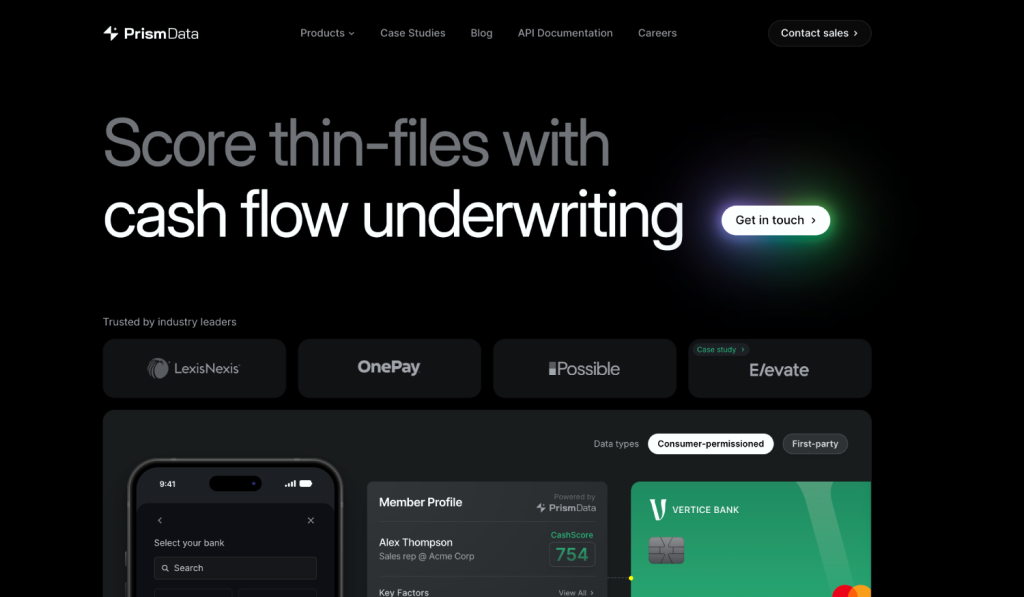
Prism Data focuses specifically on cash flow underwriting as an alternative or supplement to traditional credit bureau data. Its CashScore product analyzes bank transaction data rather than bureau reports, which changes the FCRA picture significantly. Bank transaction data is not a “consumer report” under the FCRA in the same way bureau data is, but as Prism’s own compliance documentation notes, lenders using cash flow data alongside bureau data must still comply with ECOA adverse action disclosure requirements that specify the principal reasons for denial.
Layer 2: Decisioning Workflow and Adverse Action Compliance
Adverse action compliance is where most early-stage lending startups get into trouble. The requirement is not just to send a notice. The notice must be accurate, timely, and linked to the actual reasons the system generated the decision.
7. Provenir
Provenir is an AI-powered decisioning platform designed for lenders. It allows teams to build credit decisioning workflows that incorporate bureau data, alternative data, and custom scoring models. Provenir includes adverse action code generation as part of its decisioning output, which means the workflow can produce FCRA-compliant denial reasons automatically rather than requiring a manual downstream process. This is the kind of architecture-level compliance integration that prevents adverse action errors at scale.
8. Inscribe
Inscribe handles document and income verification with an audit trail built for compliance. The core use case for FCRA purposes is specific: when a lender uses document-based income verification alongside a credit bureau pull, Inscribe creates a structured, timestamped record of which documents were reviewed, what data was extracted, and when that data entered the underwriting decision. That audit trail matters because if a consumer disputes an adverse action, you need to reconstruct exactly which consumer report data , and which non-bureau data , contributed to the decision. Inscribe is not a full loan origination system, and it does not generate adverse action notices on its own, but it fills a gap that many early-stage lenders discover only after their first compliance examination: the missing link between document review and decisioning audit logs.
9. Footprint
Footprint is an identity vault and onboarding infrastructure tool that handles consent collection, data storage, and audit logging for regulated financial products. For FCRA purposes, Footprint’s consent infrastructure documents the consumer’s initiation of a credit transaction, which is the basis for most lending-related permissible purposes. This matters because documenting the permissible purpose event at onboarding protects you if a consumer later disputes whether they authorized the credit pull. Footprint’s architecture stores consent records in a vault that is separate from application data, which creates a cleaner audit trail than consent buried in application database logs. For embedded lending platforms in particular , where the permissible purpose chain runs through a partner , having a vault-level consent record that names the authorizing party, timestamp, and specific product is a meaningful compliance difference versus a checkbox in a terms-of-service flow. Footprint does not replace bureau-specific compliance obligations, but it addresses the consent documentation gap that regulators look for first.
10. Blend
Blend is a mortgage and consumer lending platform that includes FCRA-aware workflow components for application intake, credit pull authorization, and adverse action notice generation. Blend’s platform is built primarily for mid-size to large lenders and banks, but it has been adopted by growth-stage lending startups that want pre-built compliance workflows rather than building their own. The trade-off is that Blend’s platform is less flexible for non-standard lending products.
11. Notix (formerly known in the adverse action notice space)
Several point solutions exist specifically for adverse action notice automation. The compliance requirement is narrow but failure-prone: the notice must go out within 30 days, name the bureau, and list the reasons using the standard codes from Regulation B and FCRA guidelines. Purpose-built tools in this category automate the trigger, template, and delivery, reducing the risk that a loan decision creates an undocumented adverse action.
12. MeridianLink
MeridianLink provides loan origination software with compliance workflows built for consumer lending. Its LoansPQ product includes bureau integrations and adverse action notice generation. MeridianLink is more commonly used by credit unions and community banks, but it is worth evaluating for lending startups that want a single-vendor loan origination stack with FCRA compliance built in rather than assembled from parts.
Layer 3: Compliance Program Infrastructure
Bureau access and adverse action workflows handle the transactional compliance layer. But the FCRA also requires that you maintain a compliance program: written policies, employee training, vendor oversight documentation, and evidence that you have assessed your FCRA obligations. This is what regulators look for in an examination, and it is what plaintiffs’ attorneys request in discovery.
13. Ncontracts
Ncontracts is a compliance management platform used primarily by banks, credit unions, and fintech lenders. It includes policy management, vendor risk management, and exam readiness tools. For a lending startup building its first FCRA compliance program, Ncontracts provides the document management infrastructure to maintain and version your FCRA policies, track employee training completion, and store vendor contracts with FCRA-relevant terms.
14. Quantivate
Quantivate offers governance, risk, and compliance software with modules for regulatory compliance management. Its compliance calendar and obligation tracking features are useful for managing FCRA-specific deadlines and documentation requirements. Quantivate is not FCRA-specific, but its GRC framework applies directly to lending compliance programs.
15. Securiti
Securiti is a data governance and privacy platform that covers data mapping, consent management, and regulatory compliance workflows. For FCRA purposes, Securiti’s data inventory and classification tools help lending startups understand where consumer report data lives in their systems, which is a prerequisite for building FCRA-compliant retention and disposal policies. Securiti publishes a detailed FCRA compliance checklist that is worth reading before structuring your program.
16. ComplyAdvantage
ComplyAdvantage is primarily an AML and financial crime compliance platform, but it is relevant to the broader compliance program that sits around FCRA obligations. For lending startups that are simultaneously managing AML screening, OFAC checks, and credit data compliance, ComplyAdvantage consolidates some of that operational compliance work into a single platform. The credit data compliance component is not its primary focus, but it connects to the broader compliance program infrastructure a lending startup needs.
Layer 4: FCRA Legal Counsel and Consulting
Technology alone does not satisfy the FCRA. You need counsel who can review your permissible purpose documentation, advise on your adverse action notice templates, and assess your vendor agreements for FCRA compliance gaps. The firms below specialize in consumer financial services law, including FCRA practice.
17. Hudson Cook LLP
Hudson Cook is a consumer financial services law firm widely regarded as one of the most specialized practices in the US for lending compliance, including FCRA. Their attorneys advise lenders on permissible purpose analysis, adverse action requirements, and regulatory examination preparation. For a Series A lending startup engaging outside FCRA counsel for the first time, Hudson Cook is a common first call.
18. Ballard Spahr LLP
Ballard Spahr has a substantial consumer financial services practice with specific FCRA experience. The firm publishes the Consumer Finance Monitor blog, which covers CFPB and FTC enforcement actions, including FCRA-related cases. For lending startups, Ballard Spahr is useful both for initial compliance setup and for monitoring enforcement trends that affect how regulators are interpreting FCRA obligations in the current environment.
19. Troutman Pepper Hamilton Sanders
Troutman Pepper (now Troutman Pepper Hamilton Sanders) is another large-firm option with a dedicated consumer financial services regulatory practice. Their FCRA work covers both compliance counseling and litigation defense for lenders facing private consumer actions. For growth-stage lenders expecting volume that increases litigation exposure, having a firm with both counseling and litigation capability matters.
How to Compare FCRA Compliance Services: What Lending Startups Should Evaluate
| Service / Provider | FCRA Stack Layer | Best For | Key Limitation | Pricing Model |
|---|---|---|---|---|
| Experian Partner Solutions | Bureau Access | Startups needing Experian reseller path | Requires credentialing review | Volume-based, not public |
| Equifax Developer Program | Bureau Access | Dev-first teams building decisioning | Production access requires approval | Volume-based, not public |
| TransUnion TruValidate | Bureau Access | Identity + credit combined stack | Slower credentialing for startups | Volume-based, not public |
| Array | Bureau Access (Intermediary) | Startups not ready for direct bureau deals | Less control over bureau relationship | Per-pull + platform fee, not public |
| Prism Data | Bureau Access (Alt Data) | Cash flow underwriting use cases | Not a substitute for bureau compliance | Not publicly disclosed |
| Provenir | Decisioning Workflow | Lenders building complex decisioning | Overkill for simple loan products | Enterprise, not public |
| Inscribe | Decisioning Workflow | Document + income verification audit trail | Not a full LOS | Not publicly disclosed |
| Footprint | Decisioning Workflow | Consent and permissible purpose documentation | Not bureau-specific | Not publicly disclosed |
| Blend | Decisioning Workflow | Mortgage and consumer lending platforms | Less flexible for alternative lending | Enterprise, not public |
| MeridianLink | Decisioning Workflow | Credit union and community bank LOS | Less startup-native | Enterprise, not public |
| Ncontracts | Program Infrastructure | Policy management and vendor oversight | Not FCRA-specific | Not publicly disclosed |
| Quantivate | Program Infrastructure | GRC and compliance obligation tracking | Requires customization for FCRA use | Not publicly disclosed |
| Securiti | Program Infrastructure | Data governance and consumer data mapping | Broader than FCRA; may be oversized | Not publicly disclosed |
| ComplyAdvantage | Program Infrastructure | AML + compliance program combined | FCRA is not its primary focus | Not publicly disclosed |
| Hudson Cook LLP | Legal Oversight | Specialized FCRA counsel, all stages | Law firm rates; not a software solution | Hourly / retainer |
| Ballard Spahr LLP | Legal Oversight | Enforcement monitoring + FCRA counseling | Large firm rates | Hourly / retainer |
| Troutman Pepper | Legal Oversight | Lenders with litigation exposure | Large firm rates | Hourly / retainer |
| Credit Karma (Intuit) | Bureau Access (Distribution) | Consumer lending marketplace distribution | Not an infrastructure tool for lenders | Revenue share |
| Array | Bureau Access (White-label) | White-label credit product embedding | Compliance still rests with the lender | Not publicly disclosed |
What Does a Realistic FCRA Compliance Stack Look Like for a Seed-Stage Lending Startup?
Consider a seed-stage lender building a personal loan product, processing its first 500 applications per month, with a two-person engineering team and no in-house compliance staff. That team needs bureau access, adverse action notices, and basic program documentation before its first live loan.
A practical early stack looks like this: Array or a similar intermediary for bureau access (bypassing the direct bureau credentialing process), Footprint for consent and permissible purpose documentation at onboarding, a purpose-built adverse action notice template reviewed by Hudson Cook, and Ncontracts or a simple policy management tool for written FCRA policies. Total vendor spend at this stage is not publicly disclosed by these providers, but the legal review for initial FCRA documentation is typically a fixed-fee engagement with specialized counsel, not an open-ended retainer.
What this stack does not cover: the team still needs a written data retention and disposal policy, a vendor oversight log documenting each third party that touches consumer report data, and a plan for bureau re-certification when Equifax or Experian conducts their annual security review. Those are operational tasks, not vendor purchases. They fall on the compliance or legal function , which at seed stage usually means outside counsel on retainer.
As volume grows past a few thousand monthly decisions, the adverse action notice process demands automation. That is when Provenir or a comparable decisioning platform becomes worth the enterprise contract. Manual adverse action processes do not scale, and errors at volume create class action exposure under 15 U.S.C. § 1681n. A broken notice workflow at 5,000 decisions per month, running silently for 60 days, can expose a company to six-figure statutory damages before anyone notices. That is not a hypothetical , it matches the factual pattern in several CFPB enforcement actions against small lenders.
For lending startups also managing fraud detection alongside credit data, the coverage of fraud detection and risk tools for fintech startups covers the tools that sit adjacent to your credit decisioning workflow.
What Is the Difference Between FCRA and FACTA for Lenders?
FACTA is the Fair and Accurate Credit Transactions Act, a 2003 amendment to the FCRA. FACTA added new consumer rights, including the right to a free annual credit report from each major bureau, enhanced identity theft protections, and the “Red Flags Rule,” which requires creditors to maintain programs to detect identity theft warning signs. For a lending startup, FACTA’s Red Flags Rule creates an additional compliance obligation: you must have a written identity theft prevention program and train staff on it.
The practical difference is that FCRA covers the core rules for credit report access and use, while FACTA layers on top with specific procedural requirements around identity theft and free disclosure rights. Both apply to any entity that pulls consumer reports for lending decisions.
What Is Permissible Purpose for a Soft Credit Pull?
A soft pull for rate pre-qualification is permissible under the FCRA’s account review and credit transaction provisions, but with a narrower data set. Soft pulls typically return a credit score and limited trade line data rather than a full report. For pre-qualification workflows where the consumer has not yet formally applied, the permissible purpose is usually the consumer’s initiation of the credit transaction or the lender’s firm offer of credit process, governed by 15 U.S.C. § 1681b(c). The firm offer of credit permissible purpose has specific requirements around maintaining the offer to any consumer who qualifies based on the prescreening criteria.
The broader fintech compliance picture, including where FCRA sits within your overall compliance program, is covered in the Fintech Product and Compliance Readiness Checklist.
Frequently Asked Questions About FCRA Compliance Services for Lending
What requires FCRA compliance for a lending startup?
Any company that accesses consumer credit reports from a consumer reporting agency (Equifax, Experian, TransUnion, or any FCRA-covered specialty bureau like ChexSystems or LexisNexis) for a lending purpose must comply with the FCRA. This includes documenting permissible purpose, sending adverse action notices when denying credit, maintaining data security policies for consumer report data, and overseeing any vendors that handle consumer report data on your behalf. The obligation attaches the moment you access consumer report data, not when you reach a certain loan volume.
What is compliance underwriting for fintech lenders?
Compliance underwriting refers to the set of processes that confirm a lender’s credit decisioning workflow meets regulatory requirements, including the FCRA, ECOA, and applicable state lending laws. In practice, this means that every underwriting decision that uses consumer report data must have a documented permissible purpose, generate an adverse action notice if declined, and produce an audit log connecting the data used to the decision made. Compliance underwriting is distinct from credit risk underwriting, though both run through the same workflow in most lending systems.
What is the permissible purpose of ChexSystems for lending?
ChexSystems is a consumer reporting agency that maintains records of bank account application denials and closures. For lending, the permissible purpose to access ChexSystems data is the same as for any consumer report: the consumer must have initiated a credit or deposit account transaction with you, or you must have another documented permissible purpose under 15 U.S.C. § 1681b. ChexSystems data is commonly used in deposit account opening decisions, but lenders offering products linked to bank accounts may also access it under the credit transaction permissible purpose when the consumer has applied.
Can a lending startup use alternative data instead of credit bureau data to avoid FCRA obligations?
Partially. Bank transaction data, payroll data, and rent payment history sourced directly from the consumer or a financial institution may not be “consumer reports” under the FCRA if they are not assembled by a consumer reporting agency. However, the analysis is fact-specific. Data purchased from a company that compiles consumer information and sells it to lenders may meet the FCRA definition of a consumer report even if it does not come from a traditional bureau. Prism Data explicitly notes in its documentation that cash flow underwriting used alongside bureau data still triggers ECOA adverse action obligations. Consult FCRA counsel before treating any alternative data source as outside FCRA scope.
How does vendor oversight work under the FCRA for lending platforms?
The FCRA does not allow a lender to transfer its compliance obligations to a technology vendor. If your decisioning platform generates incorrect adverse action codes, you are the responsible party, not the vendor. Vendor oversight under the FCRA means reviewing vendor contracts for data use restrictions that align with FCRA requirements, conducting periodic due diligence on how vendors handle consumer report data, and maintaining documentation of that oversight. Regulators and plaintiffs’ counsel will ask for this documentation in an examination or litigation discovery.
What is the difference between a consumer reporting agency and a bureau reseller for FCRA purposes?
A consumer reporting agency (CRA) under the FCRA is any entity that assembles or evaluates consumer information for the purpose of furnishing consumer reports. The major bureaus (Equifax, Experian, TransUnion) are CRAs. A reseller is a type of CRA that purchases consumer reports from another CRA and packages them for sale to end users. Resellers have their own FCRA obligations, including maintaining their own permissible purpose records and complying with accuracy and dispute requirements. When you access bureau data through an intermediary like Array, the intermediary is typically a reseller CRA, and you are the “end user” with your own independent FCRA obligations.