
- Most startup founders default to Chase or their accountant’s suggestion. Both choices leave FDIC coverage gaps and forgo yield that founder-built fintech accounts offer by default.
- The accounts on this list are fintech platforms built on partner bank infrastructure, not chartered banks. That distinction matters for how deposits are insured and how integrations work.
- FDIC sweep coverage is the most underrated decision variable. At pre-seed, $250K standard coverage is often fine. Post-seed, with $1M+ sitting in an operating account, it is not.
- Mercury dominates pre-seed and seed. Brex and Rho compete for Series A and beyond. Arc and Relay fill specific gaps. Legacy banks still win on loan relationships and regulated credit.
- The right account depends on three variables: funding stage, monthly burn relative to cash on hand, and how much your team needs accounting and spend management to live in one place.
For most US startups, the best business bank accounts for startups at pre-seed come down to Mercury, which offers free checking, up to $5M in FDIC sweep coverage through its Treasury product, and direct integrations with Stripe, QuickBooks, and Gusto. At Series A and above, Brex and Rho offer tighter spend controls, higher sweep limits, and treasury yield that Mercury does not match. Legacy banks like Chase and First Citizens Bank (which absorbed SVB’s book) remain relevant only when a credit facility or SBA loan is the primary goal.
Why Your Accountant’s Default Recommendation Is Probably Wrong for Your Stage
Accountants recommend Chase Business Complete Checking because it works with every accounting stack and nobody gets fired for it. That logic made sense in 2015. It does not account for what founder-built fintech platforms now offer at zero monthly fee: multi-bank FDIC sweep, ACH same-day transfers, automated bill pay, and API access to your own transaction data.
The deeper issue is that Chase, Wells Fargo, and Bank of America treat a $200K startup deposit the same way they treat a $200K retail checking account. You get standard $250K FDIC coverage, near-zero yield, and a business banker who calls you about a mortgage. The fintech platforms on this list were built around startup operating patterns: irregular payroll timing, high outbound ACH volume, investor wires, and the need to see every transaction in a spreadsheet on demand.
One structural point worth understanding before the list: none of these platforms are chartered banks. Mercury holds deposits at Choice Financial Group and Evolve Bank and Trust. Brex Cash sweeps across a network of partner banks. Rho partners with Webster Bank. The fintech layer handles the product experience; a regulated bank holds the money. That structure is how FDIC sweep programs work and why coverage can extend well beyond $250K per depositor. If you want a deeper look at how this model works financially, The Hidden Economics of Banking-as-a-Service explains the mechanics behind these partner bank programs.
The FintechSpecs Stage-Fit Matrix: Which Account Belongs at Which Funding Level
The right account is not about features. It is about whether the account’s default assumptions match your current operating reality. A pre-seed founder managing $150K in a single account has different risk and workflow needs than a Series B CFO managing $8M across payroll, vendor payments, and a money market sweep.
The framework below, which we call the Stage-Fit Matrix, maps accounts across three dimensions: FDIC coverage ceiling, monthly cash management complexity, and spend management integration depth. Use it as a first filter, then read the individual entries for detail.
| Account | Best Stage | FDIC Coverage | Monthly Fee | Yield on Deposits | Spend Management | Best For |
|---|---|---|---|---|---|---|
| Mercury | Pre-seed to Seed | Up to $5M (Treasury) | $0 | Yes (Treasury) | Cards, basic controls | First operating account, LLCs, solo founders |
| Brex | Seed to Series B+ | Up to $6M | $0 (core); paid tiers available | Yes (Brex Cash) | Deep: policies, approvals, ERP sync | VC-backed teams with a finance function |
| Rho | Seed to Series B | Up to $75M (sweep) | $0 | Yes | AP automation, corporate cards | Ops-heavy teams needing AP workflow |
| Arc | Seed to Series A | Up to $5M | $0 | Yes | Basic | SaaS founders who want non-dilutive financing alongside banking |
| Relay | Pre-seed to Seed | Up to $3M (sweep) | $0 (Pro: $30/mo) | Yes (savings accounts) | Multi-account for Profit First | Bootstrapped founders, service businesses, Profit First users |
| Chase Business Complete Checking | Any | $250K standard | $15 (waivable) | No | None native | Founders who need SBA loans or a credit relationship |
| Bank of America Business Advantage | Any | $250K standard | $16 (waivable) | No | None native | Physical branch access, international wire volume |
| First Citizens Bank | Series A+ | $250K standard | Varies | Limited | None native | VC-backed companies needing venture debt or credit lines |
| Bluevine | Pre-seed to Seed | Up to $3M (sweep) | $0 | Yes (high-yield checking) | Basic | Small teams prioritizing yield over integrations |
| Found | Pre-revenue to early stage | Up to $250K | $0 (Plus: $19.99/mo) | Yes (Plus tier) | Built-in tax tools | Solo founders and single-member LLCs with self-employment tax complexity |
| Novo | Pre-revenue to early stage | $250K standard | $0 | No | Basic (Stripe, PayPal, Square integrations) | Pre-revenue solo founders and side projects needing zero-cost checking |
What Does FDIC Sweep Coverage Actually Mean for a Startup?
Standard FDIC insurance protects $250K per depositor per insured bank. If your startup raises a $500K pre-seed round and parks it all in a Chase checking account, $250K is insured and $250K is not. Most founders do not think about this until they wire everything to payroll and realize the second half had no protection if the bank failed.
FDIC sweep programs solve this by automatically distributing deposits across multiple FDIC-member banks in the background, each holding up to $250K. The depositor sees one account; the back end might involve 20 partner banks. Mercury’s Treasury product advertises up to $5M in coverage this way. Rho advertises up to $75M. Neither figure is a guarantee in a systemic banking crisis, but for the type of single-institution failure risk that materialized in March 2023, sweep programs would have protected depositors at those limits.
The practical takeaway for founders: if you have raised more than $250K and it is sitting in one operating account, check whether your bank uses a sweep program. If it does not, you have uninsured deposits every day between wire receipts and payroll runs.
Mercury vs. Brex for a SaaS Startup: Which One Actually Wins?
Mercury is better for early-stage SaaS teams that want a clean operating account with minimal overhead. Setup takes under 10 minutes, there are no monthly fees, and the product integrations with Stripe, Gusto, and QuickBooks are genuinely useful at the seed stage. The free tier gives you virtual and physical debit cards, ACH transfers, and a bill pay function. Mercury Treasury adds yield and expanded FDIC coverage for cash you are not burning immediately.
Brex wins at the point where your finance function has enough complexity to need spend policy enforcement. Once you have a VP of Finance setting budget limits by department, approving invoices in a workflow, and syncing directly to NetSuite or Sage Intacct, Mercury’s controls feel lightweight. Brex’s spend management layer is the product. The checking account is the foundation beneath it. If you are comparing Brex against Ramp and Airbase for corporate card and expense management, the Ramp vs. Brex vs. Airbase breakdown on FintechSpecs covers that decision in more depth.
The one scenario where neither wins is venture debt. If you are negotiating a credit line or a venture term loan, First Citizens Bank (which absorbed SVB’s book in 2023) and traditional banks like Silicon Valley’s surviving competitors maintain the relationship infrastructure for that. No fintech operating account currently replaces a real credit relationship for debt financing.
Pre-Seed Stage: What Should a New LLC or C-Corp Open First?
At pre-seed, the account decision is simple: open Mercury or Relay. Both are free, both have competent FDIC sweep, and both integrate with the tools a new company needs before it has a full-time finance person. Mercury has a larger developer community, better Stripe integration, and more name recognition with investors who will want to see clean wire records. Relay wins if you are a bootstrapped service business running Profit First , a cash management method that allocates revenue into separate named accounts (envelopes) for specific purposes like taxes, operating expenses, and owner pay , because it lets you open up to 20 checking accounts under one roof to keep those allocations distinct.
For a single-member LLC with self-employment income, Found deserves mention. It handles quarterly estimated tax calculations inside the app and routes a percentage of deposits to a tax savings account automatically. That is genuinely useful for solo founders who are doing their own bookkeeping and are not yet on a payroll service.
What to avoid at pre-seed: Chase Business Complete Checking. The $15 monthly fee is waivable with a $2,000 average daily balance, but the account offers nothing that Mercury does not provide for free. The only reason to open it is if you need to walk into a branch and hand someone a cashier’s check, which almost never happens in a software startup.
Seed and Series A Stage: When Should You Add Treasury or Upgrade Your Account?
The trigger for upgrading your banking setup is not your funding round. It is your cash balance relative to your burn rate. A startup that raised $2M and burns $80K per month has roughly 25 months of runway sitting in its operating account. That is a material amount of uninsured deposit risk if it is all in a single non-sweep account, and it is also a yield opportunity. At a conservative 4% annualized yield on $1.5M in idle cash, the difference between a sweep account paying yield and a non-interest Chase account is roughly $60K per year. That is real money at the seed stage.
Mercury Treasury, Brex Cash, and Rho’s interest-bearing accounts all address this. The yield rates on these products fluctuate with the Fed funds rate, so check current rates directly on each platform’s pricing page rather than relying on any static figure here. What does not change is the structural advantage: you collect yield while maintaining same-day liquidity, which a traditional savings account does not provide.
At Series A, the question becomes whether your operating account’s spend controls match your company’s complexity. If you have five people with company cards, a recurring SaaS bill list, and a monthly close that takes four days, you have outgrown Mercury’s default setup. That is when Brex or Rho’s AP automation becomes worth evaluating. For a fuller picture of the infrastructure stack at this stage, the Fintech SaaS Scale Checklist maps out what needs to be in place before $10M ARR.
Scaling Stage (Series B and Beyond): Does a Fintech Account Still Work?
At Series B, most CFOs are running two accounts: a primary operating account (usually Brex or Rho) and a legacy bank account for credit facilities, wire-heavy vendor relationships, and any banking that requires a chartered institution. The fintech account handles 90% of daily volume because the product experience is better. The legacy bank account exists because the credit relationship requires it.
Rho stands out at this stage for one specific reason: its advertised FDIC sweep coverage of up to $75M is the highest on this list. For a Series B company with $10M to $30M in operating cash, that sweep limit matters. No other account on this list comes close without moving to a formal treasury management product from a custodian bank.
One scenario worth walking through: say a Series B SaaS company holds $18M in its primary operating account. With standard FDIC coverage, $17.75M is uninsured on any given day. A Rho account with full sweep enrollment covers the entire balance. Mercury Treasury covers up to $5M. That $13M gap is not theoretical exposure. It is the kind of risk that finance teams flagged in March 2023 when SVB’s depositors spent 48 hours not knowing what was insured.
The 11 Best Business Bank Accounts for Startups, Reviewed by Fit
1. Mercury
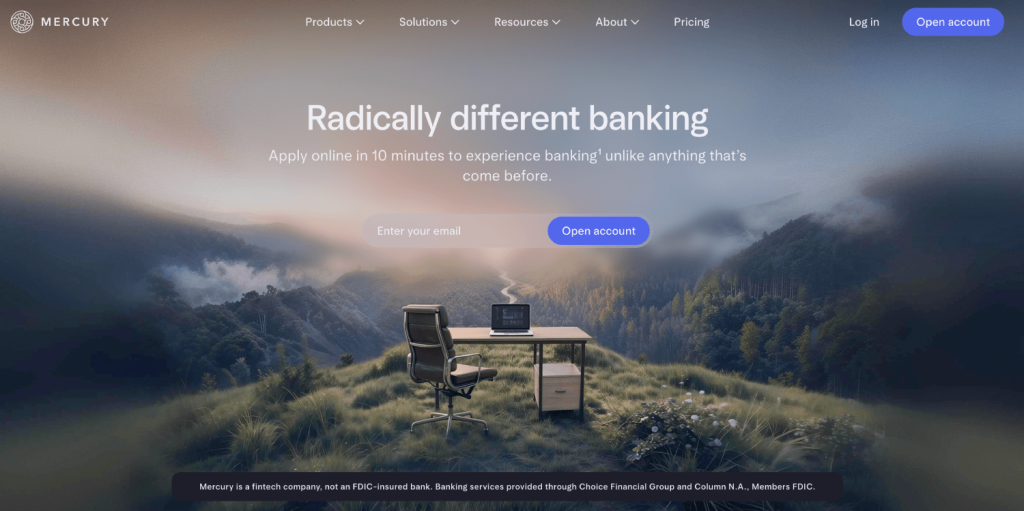
Mercury is the default choice for US startups at pre-seed and seed for a straightforward reason: it was built specifically for this customer and the product reflects that. Free checking, virtual cards, ACH transfers, and a clean API for developers who want to pull transaction data. Mercury Treasury extends coverage to $5M and adds yield. The main limitation is spend management depth. Mercury’s card controls and approval flows are adequate for a 5-person team but not for a 50-person company with a finance department.
2. Brex
Brex began as a corporate card and evolved into an integrated spend management and banking platform. The checking product (Brex Cash) sweeps deposits across partner banks for up to $6M in FDIC coverage and pays yield on idle balances. The real value is in the spend layer: budget policies, real-time transaction visibility by department, ERP integrations (NetSuite, QuickBooks, Xero, Sage Intacct), and reimbursement management. Brex makes more sense at Seed and above, when a founder has stopped approving every expense themselves.
3. Rho
Rho is the strongest option for companies that need AP automation alongside their operating account. The platform handles vendor payments, approval workflows, and corporate cards inside one interface, with deposit sweep advertised up to $75M. Rho partners with Webster Bank, which provides the underlying charter. The product is more complex to set up than Mercury but significantly more powerful for an ops-heavy business paying 50+ vendors monthly.
4. Arc
Arc occupies an unusual position: it combines a business bank account with non-dilutive financing products aimed at SaaS companies. If you are a recurring-revenue business looking for revenue-based financing or a credit facility alongside your operating account, Arc lets you manage both in one place. The banking product itself is competitive but not differentiated from Mercury. The financing access is the reason to consider it.
5. Relay
Relay is built for founders who run Profit First , a cash management approach where every dollar of revenue is allocated at receipt into separate named accounts for specific purposes (operating expenses, taxes, owner pay, profit) , or who want similarly disciplined account separation. You can open up to 20 checking accounts and 2 savings accounts under one login, with each account labeled and tracked separately. Free tier covers the basics; Relay Pro at $30 per month adds AP automation and faster ACH. FDIC sweep covers up to $3M. Best fit: bootstrapped founders and professional service businesses where cash allocation discipline matters more than API integrations.
6. Bluevine
Bluevine offers a high-yield business checking account with no monthly fees and FDIC sweep coverage up to $3M. The yield on the primary checking account is higher than most competitors in the free tier. Bluevine also offers a business line of credit, which makes it useful if you want a single relationship for both operating cash and short-term credit. The spend management tools are minimal.
7. Found
Found targets freelancers and solo founders with an embedded tax management layer. The free account includes automatic tax savings based on income, and Found Plus at $19.99 per month adds higher yield and a bookkeeping dashboard. Standard FDIC coverage at $250K. Not the right choice for a funded startup with employees, but strong for a solo founder running a single-member LLC who wants taxes handled passively.
8. Chase Business Complete Checking
Chase Business Complete Checking has the broadest physical footprint in the US and the deepest integration with SBA loan programs. If you are applying for an SBA 7(a) loan or need a physical branch for cash deposits, Chase is practical. Standard $250K FDIC coverage with no sweep program in the basic tier. Monthly fee of $15, waivable with a qualifying balance or transaction activity. No yield on deposits. Not recommended as a primary operating account unless the credit relationship is the goal.
9. Bank of America Business Advantage Fundamentals
Bank of America Business Advantage Fundamentals covers the same use case as Chase: physical branch access, traditional credit products, and international wire infrastructure. Monthly fee of $16, waivable with minimum balance. No yield, no sweep on standard tiers. Useful if your business operates globally and you need FX services through a full-service bank. Not a startup-first product.
10. First Citizens Bank
First Citizens Bank acquired the deposits and loans of Silicon Valley Bank in March 2023 and continues to serve VC-backed startups under that infrastructure, particularly for venture debt and credit facilities. The operating account itself does not offer the fintech layer that Mercury or Brex provide. The reason to bank here is the credit relationship, not the product experience. Series A and B companies that want venture debt alongside their operating account should have a conversation with First Citizens. The SVB brand is no longer a separate operating entity , it is First Citizens.
11. Novo
Novo is a free business checking account built for freelancers and small businesses, operating on Middlesex Federal Savings. It offers refunded ATM fees, ACH transfers, and integrations with Stripe, PayPal, Square, and Shopify. FDIC insured up to $250K with no sweep program. Novo does not appear in the Stage-Fit Matrix above because its feature set does not differentiate it enough to displace Mercury at pre-seed or Found at solo-founder stage , but for a pre-revenue founder or side project that has not yet incorporated, it gets the job done at zero cost while you figure out what you actually need.
Frequently Asked Questions
What is the best business bank account for a pre-seed startup in the US?
Mercury is the most widely used operating account among US pre-seed startups. It is free, integrates with Stripe, Gusto, and QuickBooks on day one, and offers up to $5M in FDIC sweep coverage through Mercury Treasury. For solo founders running a single-member LLC who need built-in tax management, Found is a reasonable alternative. Neither requires a minimum balance or monthly fee.
Is Mercury or Brex better for a SaaS startup?
Mercury is better at pre-seed and early seed, when banking simplicity matters more than spend controls. Brex is better from Seed onward, when you have multiple people with company cards, a monthly close process, and accounting software that needs real-time sync. Brex’s spend management policies, department-level budget controls, and ERP integrations are where it earns its place over Mercury. If all you need is a checking account with good integrations, Mercury is cheaper and simpler to operate.
Which startup bank account has the best FDIC sweep coverage?
Rho advertises the highest FDIC sweep coverage on this list at up to $75M, making it the strongest option for Series B and later companies holding large operating balances. Mercury Treasury covers up to $5M. Brex covers up to $6M. All three use multi-bank sweep networks to extend coverage beyond the standard $250K per depositor limit. Coverage limits are subject to program terms and change over time, so verify directly on each platform’s website before depositing funds.
Do I need a real bank or is a fintech account fine for my LLC?
A fintech account like Mercury or Relay is fine for an LLC’s day-to-day operating needs: payroll, vendor payments, ACH transfers, and card expenses. These platforms hold deposits at FDIC-member partner banks, so your money is insured through the same federal program as a traditional bank. The main gap is credit products. If your LLC needs a line of credit, SBA loan, or commercial mortgage, you will need a relationship with a chartered bank. For operating cash management, fintech accounts are functionally superior to legacy banks for most startups.
Where should a startup park cash without losing FDIC protection?
The safest structure for a startup with more than $250K in operating cash is a fintech account with an active sweep program. Mercury Treasury, Brex Cash, and Rho all sweep deposits across multiple FDIC-member banks automatically, extending effective coverage to $5M, $6M, and $75M respectively. Beyond those limits, startups use Treasury money market funds or CDARS programs through a custodian bank. For amounts under $5M, Mercury Treasury or Brex Cash covers the full balance with same-day liquidity intact.
What bank do venture-backed startups actually use?
Mercury holds the largest share of early-stage VC-backed startup accounts in the US, largely because it became the default recommendation in Y Combinator and Techstars cohorts around 2019 and has maintained that position. Brex is more common among later-stage VC-backed companies. First Citizens Bank (operating the former SVB infrastructure) retains a significant share of Series A and B companies that maintained relationships before SVB’s 2023 failure. Rho is growing among ops-heavy B2B SaaS teams.
Can a startup use multiple bank accounts at the same time?
Yes, and most Series A companies do. A common structure is a primary fintech account (Mercury or Brex) for day-to-day operations and a secondary legacy bank account for credit facilities or international wire volume. Some finance teams also hold a separate money market account for runway reserves. The risk of multiple accounts is reconciliation complexity, which is why accounting integrations that auto-sync transactions become more important as the number of accounts grows. Understanding the full infrastructure picture is worth reviewing in the context of common fintech infrastructure mistakes that teams make when building out their financial stack.
Is a business bank account required for a single-member LLC?
Legally required in most states: no. Strongly advisable: yes. Commingling personal and business funds in a single-member LLC creates liability exposure, complicates tax filing, and is specifically cited by courts when piercing the corporate veil. Opening a free business account at Mercury, Relay, or Found takes under 15 minutes and immediately establishes the paper trail that protects the LLC structure. There is no practical reason to delay this step after formation.
How to Choose: The FintechSpecs Two-Variable Filter
Every account on this list can be reduced to two variables: how much cash do you hold relative to your FDIC coverage, and how complex is your spend management workflow. If your balance stays below $250K and one person approves all expenses, any free fintech account works. If either variable exceeds those thresholds, the account decision starts to matter financially.
The SVB failure in 2023 made the second variable concrete. Companies that had FDIC-insured deposits recovered immediately. Companies with uninsured deposits spent days uncertain about access to their payroll funds. That experience pushed a significant number of startups from legacy bank accounts into sweep-enabled fintech platforms. The feature that looked like a premium add-on in 2022 became standard practice by 2024.
The broader point is that banking infrastructure compounds. A founder who opens Mercury at pre-seed, activates Treasury at Seed when the balance crosses $500K, and moves to Brex or Rho at Series A when the finance team expands is making three correct decisions in sequence, each appropriate to its stage. Starting with Chase and migrating later is not wrong, but it is slower and costs the yield and coverage gap in the interim. For teams thinking through the full financial infrastructure picture beyond the operating account, the best payment infrastructure tools for SaaS founders covers the next layer of decisions that typically follow banking setup.