
TLDR
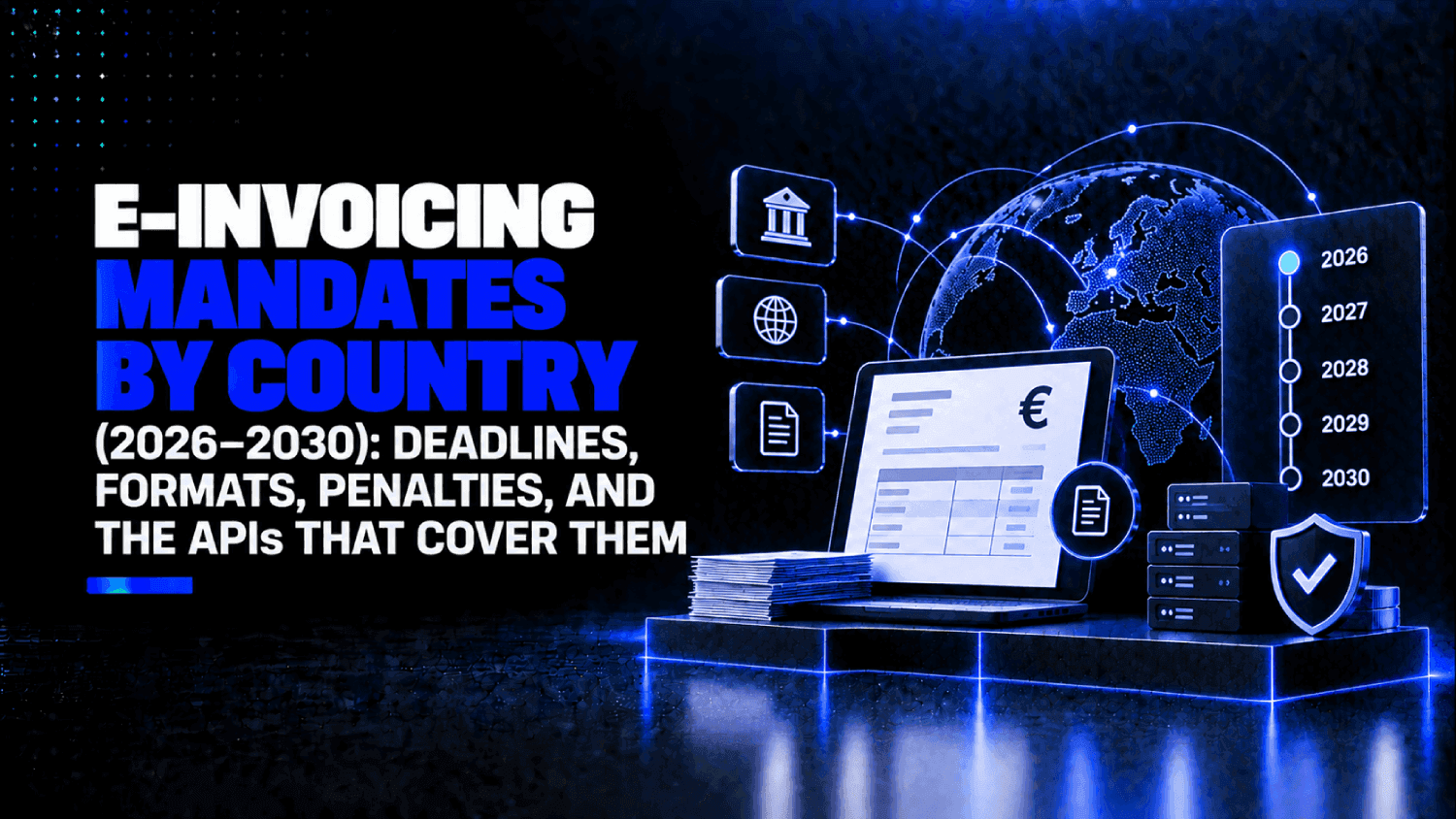
- E-invoicing is now a legal requirement in more and more places, not just a nice upgrade. Belgium (Jan. 1, 2026), Croatia (Jan. 1, 2026), Poland (Feb. 1 and Apr. 1, 2026) and France (Sept. 1, 2026) already require structured B2B e-invoices. Greece (Nov. 2, 2026 for most businesses), Germany (2027–2028), the UAE (2027) and Spain (2027–2028) come next. The EU-wide cross-border regime under ViDA starts July 1, 2030.
- A PDF sent by email does not count as an e-invoice under these rules. The invoice has to be structured data (EN 16931 XML such as Peppol BIS, XRechnung or Factur-X/ZUGFeRD, or a national schema like Poland’s KSeF FA(3)). It must often travel through a specific network (Peppol) or an approved platform (France’s plateformes agréées).
- For a SaaS or fintech team, the real decision is build vs. buy. You can connect country by country (a Peppol access point, the KSeF API, a French PA), or you can buy one e-invoicing compliance API that covers many countries. This guide compares the main options and shows real published pricing for one of them (Storecove: €3,300–€9,900 a year in license fees plus €0.072–€0.324 per document).
- The guide also includes a dated mandate table with sources, a cost calculation you can reuse, and a checklist for deciding which countries need action this quarter.
If you invoice businesses in Europe, the Gulf or India, the old setup of “generate a PDF in your billing tool and email it” is ending country by country. The change is uneven. Each country sets its own dates, revenue thresholds, formats and delivery channels. Some only require you to receive e-invoices at first. Others make you issue them through a government-run or government-approved hub.
This page is a working reference for founders, finance leads and product teams at SaaS and fintech companies. It covers what each major mandate requires and when, the technical routes to compliance, and how the multi-country API providers compare. Every date below links to the regulator or the official legal text.
If you’re choosing a general invoicing or billing API (invoice generation, hosted invoice pages, dunning), start with our 9 Best Invoicing APIs for SaaS Platforms. This page covers the compliance layer that sits underneath: getting a legally valid structured invoice to the buyer, and to the tax authority where required.
E-invoicing mandate tracker: dates, scope and penalties
| Country | Who must comply | Key dates | Format / channel | Penalty or enforcement note | Source |
|---|---|---|---|---|---|
| Belgium | VAT-registered Belgian businesses, domestic B2B | Issue + receive from Jan. 1, 2026. Grace period ended Mar. 31, 2026. Self-billing tolerance ran to June 30, 2026 | Peppol BIS (UBL) over the Peppol network by default | Not having the technical means to issue and receive: €1,500 (1st offense), €3,000 (2nd), €5,000 (later offenses) | Royal Decree of July 8, 2025; FPS Finance FAQ |
| Poland (KSeF 2.0) | All VAT taxpayers | Receive: Feb. 1, 2026. Issue: Feb. 1, 2026 if 2024 sales were above PLN 200M (incl. VAT), Apr. 1, 2026 for everyone else, Jan. 1, 2027 for the smallest (≤ PLN 10,000 gross invoiced a month) | Clearance through the government KSeF system (API or the free Ministry of Finance app) | No administrative KSeF penalties for 2026. Penalties are postponed to the end of 2026 | KSeF scope; Ministry of Finance |
| France | All VAT-liable businesses established in France | Receive: Sept. 1, 2026 (everyone). Issue + e-reporting: Sept. 1, 2026 for large and mid-sized companies, Sept. 1, 2027 for SMEs and micro-businesses | Must go through a registered plateforme agréée (PA), directly or via compatible software connected to one | The tax authority oversees PAs and can impose fines. 136 platforms were listed (108 fully registered, 28 conditionally) | AIFE; impots.gouv.fr; Service-Public |
| Croatia (Fiscalization 2.0) | VAT-registered businesses, domestic B2B | Jan. 1, 2026. Non-VAT entities issue from Jan. 1, 2027 | Structured e-invoice plus fiscalization reporting | Check the Croatian Tax Administration’s guidance | VATupdate briefing |
| Greece | B2B issuers | Large companies from Mar. 2, 2026. All others from Nov. 2, 2026. From Feb. 1, 2027, invoices must go through an approved provider or AADE’s own tools | myDATA-linked e-invoicing | Check AADE’s FAQs | AADE FAQ; EY Greece |
| Germany | Domestic B2B between German businesses | Receive: Jan. 1, 2025 (an email inbox is enough). Issue: Jan. 1, 2027 if prior-year (2026) turnover was above €800,000, Jan. 1, 2028 for everyone else. A VAT reporting system based on e-invoices is expected around July 1, 2030 | EN 16931: XRechnung or ZUGFeRD ≥ 2.0.1 (not the MINIMUM or BASIC-WL profiles). EDI is allowed with the buyer’s agreement. No channel is prescribed | The structured XML is what counts legally. A PDF is an “other invoice” | BMF letter, Oct. 15, 2025; IHK Ulm; BStBK FAQ |
| Spain | Domestic B2B | Oct. 6, 2027 for turnover above €8M. Oct. 6, 2028 for everyone else (per the latest advisor alerts) | Structured e-invoice (“Crea y Crece”). Verifactu is a separate billing-software rule | Verifactu’s further delay still needs to be formally enacted | Grant Thornton Spain; EY Spain alert |
| UAE | VAT businesses, B2B and B2G | Voluntary pilot from July 1, 2026. Revenue ≥ AED 50M: appoint an Accredited Service Provider by Oct. 30, 2026 and go live Jan. 1, 2027. Below AED 50M: appoint by Mar. 31, 2027 and comply from July 1, 2027. Government entities: Oct. 1, 2027 | Peppol-based “5-corner” model through Accredited Service Providers (PINT-AE) | Ministerial Decisions set the scope and timeline | Ministerial Decision No. 244 of 2025 |
| India | GST taxpayers whose aggregate turnover passed ₹5 crore in any year since FY 2017–18 | In force. From Apr. 1, 2025, taxpayers with AATO of ₹10 crore+ must report to the IRP within 30 days of the invoice date, or no IRN is generated | Invoice Registration Portal (IRN + QR code) | An invoice reported late is rejected, so in practice it’s not a valid e-invoice | GSTN advisory |
| EU (ViDA) | Intra-EU cross-border B2B | Member states may mandate domestic e-invoicing from Apr. 14, 2025 without a special derogation. Cross-border e-invoicing plus Digital Reporting Requirements apply from July 1, 2030. National systems must align by Jan. 1, 2035 | EN 16931 by default | Council Directive (EU) 2025/516 | European Commission; EUR-Lex |
The four models hiding inside that table
The table looks like ten different rules, but technically they reduce to four architectures. Most of the integration cost comes from which architecture applies, not from the country itself.
- Format-only (Germany today). You must send EN 16931-compliant structured data, but the law doesn’t say how it travels. Email with an XRechnung attachment is valid. This is the cheapest model to meet.
- Network model (Belgium, the UAE, and much of ViDA’s direction). Invoices travel over Peppol through certified access points (Peppol’s “4-corner” model). The UAE adds a fifth corner that reports to the tax authority. You either run your own certified access point or rent one.
- Clearance model (Poland’s KSeF, India’s IRP). The invoice legally exists only once a government system accepts it and assigns an identifier. Your billing flow has to wait for, or handle, an asynchronous accept or reject response.
- Approved-platform model (France, and Greece from 2027). You must route invoices through a state-registered intermediary, and that intermediary also does e-reporting of transaction and payment data.
Why this matters for SaaS: if your billing system finalizes an invoice and immediately emails a PDF, then clearance and approved-platform models break that flow. In Poland, the invoice isn’t valid until KSeF accepts it. In France, delivery happens through the buyer’s chosen PA, which you look up in the national directory, not through an email address your customer typed into a form.
Build vs. buy: three ways to get compliant
| Route | What you do | Best for | Hidden cost |
|---|---|---|---|
| Free government tools | Key invoices into the government’s own app (for example, Poland’s free KSeF taxpayer app) | Very low volumes, a single country, manual billing | Doesn’t scale. No integration with your billing system, so you double-key every invoice |
| Direct, country by country | Integrate the KSeF API yourself, become or rent a Peppol access point, connect to a French PA | One or two countries with high volume, and an in-house engineering team | You maintain every schema change (KSeF moved from 1.0 to 2.0 and fully switched off 1.0 on Feb. 1, 2026), certificates, and each country’s validation rules |
| Multi-country compliance API | Send one canonical JSON invoice. The vendor converts it to UBL, XRechnung, FA(3) and so on, and routes it to Peppol, KSeF, a PA or the IRP | Three or more countries, or a product roadmap that will add more | License plus per-document fees, plus vendor lock-in on your canonical data model |
A useful rule of thumb: if you invoice businesses in three or more mandated countries, or plan to within 18 months, the multi-country API usually wins on engineering time alone. Below that, a direct Peppol access point plus your billing tool’s native exports is often enough.
E-invoicing compliance API providers compared
These are the multi-country providers SaaS and fintech teams shortlist most often. We’ve only listed facts each vendor or its parent company publishes. Where pricing isn’t public, we say so.
| Provider | Ownership / notes | Coverage claim | Integration model | Public pricing? |
|---|---|---|---|---|
| Storecove | Independent. Peppol and DBNAlliance (US) access point | Peppol network countries plus other e-invoicing networks | REST JSON API. You send one document and Storecove converts and delivers it | Yes. License €3,300–€11,880 a year plus per-document fees (details below) |
| Avalara E-Invoicing and Live Reporting | Part of Avalara’s tax suite | One global API for country-specific e-invoicing and live reporting, including Peppol access in Europe, Australia, New Zealand, Malaysia and Japan | API, with connectors into Avalara’s sales-tax and VAT stack | Quote-based |
| Fonoa | Independent tax-tech company | 100+ countries, according to its API docs | REST: POST /v1/transactions with country code, currency, items, supplier, transaction date and ID | Quote-based |
| Vertex e-Invoicing (ecosio) | Vertex acquired ecosio in Aug. 2024 | Listed countries include Austria, Belgium, Croatia, France, Germany, Greece, the UK and others | API and EDI, integrated with Vertex tax determination | Quote-based |
| ONESOURCE Pagero (Thomson Reuters) | Thomson Reuters acquired a majority stake in Pagero in Jan. 2024 | Global e-invoicing network | Network plus API, integrated with ONESOURCE indirect tax | Quote-based |
Sources: Storecove pricing calculator; Storecove; Vertex press release; Vertex e-Invoicing; Thomson Reuters press release; ONESOURCE Pagero.
For France specifically: check that your provider, or the provider’s French partner, appears on the official list of plateformes agréées. A vendor that only says it is “France-ready” may be offering compatible software that still needs a registered PA behind it.
How to read the market
- Tax-engine suites (Avalara, Vertex, Thomson Reuters) make sense when the same vendor already calculates your VAT or GST. The e-invoice then carries tax data your tax engine produced, which cuts down on reconciliation mismatches. If you’re still choosing a US sales-tax or VAT engine, see Tax Compliance Tools for Stripe SaaS and 12 Best Sales Tax Filing Services for SaaS Companies.
- Network-first specialists (Storecove, Fonoa) suit product teams that want to embed e-invoicing in their own platform. That includes billing tools, accounting software and vertical SaaS that invoice on behalf of their customers. Storecove even publishes an “Integrators” price tier for this case.
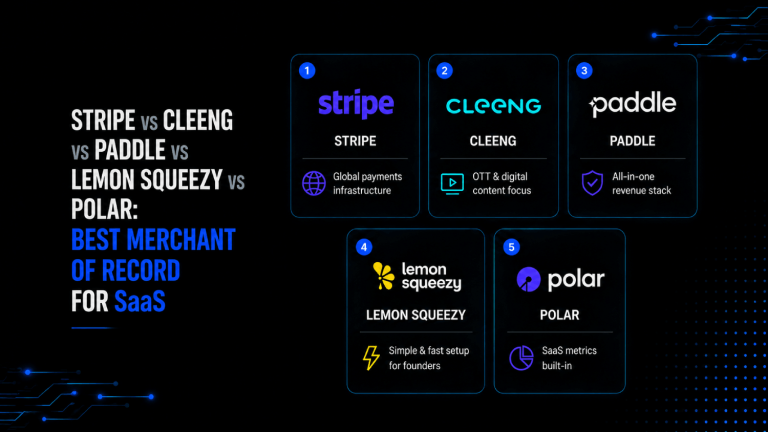
- If you invoice through a merchant of record, the MoR is legally the seller and handles the invoicing obligations for those sales. That’s one more reason some EU-facing SaaS companies choose the MoR model. See Merchant of Record vs. Payment Processor.
What e-invoicing compliance actually costs: worked example
Storecove is the only provider in the table with a full public price list, so we use it here as a benchmark. Its Cloud Accounting and Integrators tiers both list these rates:
| Tier | Annual license | Per document, 0–50k docs | 50k–250k | 250k–1M | Max entities / customers |
|---|---|---|---|---|---|
| Starter | €3,300 | €0.162 | €0.144 | €0.132 | 50 entities (2 customers for Integrators) |
| Growth | €6,600 | €0.120 | €0.096 | €0.084 | 250 entities (5 customers) |
| Ultimate | €9,900 | €0.090 | €0.084 | €0.072 | Unlimited (10 customers) |
The Enterprise tier costs more per document (€0.324 at Starter for 0–50k) but is licensed per legal entity (1 entity on Starter, 5 on Growth, 10 on Ultimate), with licenses of €3,960, €7,800 and €11,880. Add-ons include compliant 10-year archiving (€3,000 per 100k documents a year), Peppol Invoice Response (€1,200 per 100k a year) and a managed Peppol/DBNA certificate (€4,500 a year).
Scenario: a B2B SaaS company issuing 100,000 invoices a year across Belgium, Germany and France on the Growth plan.
- License: €6,600
- Documents, if the bands are charged progressively: 50,000 × €0.120 = €6,000, plus 50,000 × €0.096 = €4,800, so €10,800
- Documents, if the whole volume is charged at the 50k–250k rate: 100,000 × €0.096 = €9,600
- Invoice Response add-on (needed for full compliance in some mandated countries, per Storecove): €1,200
- Total: about €17,400–€18,600 a year, or roughly €0.17–€0.19 per invoice all-in
Storecove’s page doesn’t say whether the bands are charged progressively or on the whole volume, so ask before signing. Either way, the order of magnitude is the useful benchmark. At this volume, compliance costs roughly as much as a mid-level engineer spends in two to three weeks. Building Peppol, KSeF-style clearance and French PA integrations yourself takes far longer than that, and that’s before maintenance.
How to compare a quote-based vendor against that benchmark: ask for (1) the annual platform fee, (2) the per-document price at your volume, separately for sent and received documents, (3) whether inbound documents are billed, (4) archiving, and (5) per-country or per-network surcharges. Then normalize everything to an all-in cost per invoice, as above.
Implementation checklist for SaaS and fintech teams
- Map where your customers are, not where you’re incorporated. Belgian and German rules mostly apply to businesses established in those countries. A Belgian or German customer will still ask for a structured invoice, because they need it for VAT deduction and AP automation.
- Turn on receiving first. Germany (since 2025), Poland (Feb. 2026) and France (Sept. 2026) all require businesses to receive e-invoices before or alongside issuing. Your AP side has to ingest UBL or CII files, not just PDFs. Our payment reconciliation software guide covers tools that match structured invoices to payments.
- Clean up master data. Clearance systems reject invoices with missing buyer VAT IDs, wrong Peppol participant IDs, or line totals that don’t add up to the header. Most failed go-lives trace back to customer records, not code.
- Make finalization asynchronous. For KSeF and the IRP, treat “submitted” and “accepted” as separate invoice states. Only send the customer the accepted invoice and its government ID, such as the KSeF number or the IRN with its QR code.
- Treat the XML as the legal invoice. Under the German rules, the structured part of a hybrid ZUGFeRD file is what counts. If the PDF and the XML disagree, you have a compliance problem.
- Check retention and archiving. Budget for compliant storage of sent and received structured invoices for the statutory period.
- Put 2030 on the roadmap. ViDA’s cross-border Digital Reporting Requirements begin July 1, 2030. If you sell B2B across EU borders, choose a provider whose roadmap explicitly covers ViDA DRR.
For broader compliance tooling such as KYC, AML and regulatory change, see Fintech Compliance Automation Tools. For speeding up month-end once structured invoice data flows in, see 8 Financial Close Software Tools.
FAQ
Is a PDF invoice sent by email still legal in the EU?
For domestic B2B, it depends on the country and the date. In Belgium (since Jan. 1, 2026) and Poland (since Feb. or Apr. 2026, depending on size), a PDF no longer satisfies the obligation. In Germany, PDFs remain allowed through 2026, and through 2027 for businesses with turnover up to €800,000. From 2028 they’re no longer allowed for domestic B2B.
What is Peppol, and do I need my own access point?
Peppol is an international network and set of specifications for exchanging structured business documents through certified access points. You don’t need to become an access point. Most companies rent access through a provider. Running your own requires certification and, with Storecove for example, a managed certificate costs €4,500 a year as an add-on.
Does the EU require e-invoicing for every business by 2030?
Not exactly. ViDA (Directive 2025/516) makes e-invoicing plus digital reporting mandatory for intra-EU cross-border B2B supplies from July 1, 2030. Domestic mandates remain each member state’s choice, though since April 2025 member states can impose them without asking Brussels for a derogation.
Do US companies have an e-invoicing mandate?
There’s no federal B2B e-invoicing mandate in the US. The DBNAlliance network exists for voluntary exchange. US SaaS companies still have to comply wherever their EU, UAE or Indian entities invoice locally, and they increasingly get asked for structured invoices by European customers.
Which country is hardest to integrate?
For most SaaS teams, the clearance and approved-platform countries: Poland, France, India and Greece from 2027. These change your invoice lifecycle, not just your file format. Format-only Germany is the easiest.
How much does an e-invoicing API cost?
Storecove publishes €3,300–€11,880 a year in license fees plus roughly €0.07–€0.32 per document, depending on tier and volume. Avalara, Fonoa, Vertex and Thomson Reuters quote on request. Normalize every quote to an all-in cost per invoice (see the worked example above).