
- Synthetic identity fraud is not the same as stolen identity theft. Fraudsters build entirely new personas by combining real SSNs (often from children or thin-file individuals) with fabricated names and addresses, then age the account for months before busting out.
- Brand recognition is a poor buying signal in this category. The right platform depends on whether you are a lender, a neobank, or a payments company, and how you plan to integrate detection into your onboarding flow.
- The vendors on this list differ most on three axes: graph-based consortium data access, thin-file coverage, and whether synthetic detection is a standalone API or bundled inside a broader identity orchestration layer.
- Pricing across the category is almost entirely quote-based. Any vendor who publishes per-verification rates is the exception, not the rule.
- Use the FintechSpecs SIFT Criteria (Signal Depth, Integration Path, Fit for US Regulatory Context, Thin-File Coverage) to cut your longlist to three vendors before running a proof of concept.
The best synthetic identity fraud detection platforms for US fintechs in 2026 are Socure, SentiLink, Alloy, Sardine, SEON, Emailage (LexisNexis), Experian CrossCore, Equifax Interconnect, Acuant (a HID company), Ekata (Mastercard), and Unit21. Each targets different buyer profiles: SentiLink is the specialist choice for lenders and credit issuers, Socure is strongest for high-volume onboarding with document intelligence, Alloy and Sardine suit fintechs that want fraud and compliance decisioning in one orchestration layer, and SEON fits early-stage teams that need a fast API integration without a long procurement cycle.
What Is Synthetic Identity Fraud and Why Do Generic Identity Tools Miss It?
A synthetic identity is not a stolen identity. It is a constructed one. A fraudster typically pairs a real Social Security Number, often from a child, a recent immigrant, or someone with no credit history, with a fabricated name, date of birth, and address. That combination clears standard SSN validation because the number is technically valid. Then the fraud ring opens a secured card, pays on time for 12 to 24 months, and requests a large credit line increase before going delinquent across every account simultaneously. That final move is called a bust-out.
Standard KYC tools verify that a name and SSN match a record in a bureau database. They were not designed to detect whether the combination has been artificially aged. Catching synthetic identities requires network-level analysis: has this SSN been associated with multiple different names? Does the address velocity look like a ring of manufactured identities? Does the phone number resolve to a freshly registered VoIP number? These are graph signals, not point-in-time lookups.
If you are still evaluating your baseline KYC setup, the KYC provider comparison for fintechs on FintechSpecs covers the foundational layer before adding synthetic-specific detection on top.
How to Score Synthetic Identity Fraud Detection Vendors: The FintechSpecs SIFT Criteria
Most buyer guides in this category rank vendors on feature checkboxes. That rewards marketing copy over actual detection capability. The FintechSpecs SIFT Criteria evaluates vendors on four dimensions that map directly to where synthetic fraud slips through:
- Signal Depth: Does the vendor operate a proprietary consortium network, or are they reselling bureau data? First-party consortium networks built from actual fintech application data catch synthetic patterns that bureau data misses for months or years.
- Integration Path: Is this a standalone REST API, an SDK, or a full decisioning platform? A pre-seed team needs an API. A Series B lender migrating off a bureau-only model needs an orchestration layer with audit trails.
- Fit for US Regulatory Context: Does the vendor support FCRA-permissible use cases? Does it have documented BSA/AML alignment? Can it produce model explainability reports for your compliance team and bank partner?
- Thin-File Coverage: Synthetic identities are specifically engineered to look like thin-file consumers. Does the vendor have alternative data signals, device intelligence, or behavioral analytics that work when bureau data is sparse?
Each vendor below is rated on SIFT from 1 to 5 in the comparison table. The ratings reflect publicly documented capabilities, not marketing claims.
What Are the 11 Best Synthetic Identity Fraud Detection Platforms?
1. SentiLink
SentiLink was built specifically to catch synthetic and first-party identity fraud at credit application. Its core product, Synthetic Scores, was trained on confirmed synthetic fraud cases from its financial institution network rather than on self-reported labels. That distinction matters because bureau-labeled fraud data significantly underrepresents synthetic accounts, which often charge off as first-party defaults rather than fraud write-offs.
SentiLink’s consortium spans a large number of US financial institutions, which means it sees SSN-to-identity combinations across many lenders simultaneously. When a synthetic identity applies at Institution A and again at Institution B six months later with a slightly different name, SentiLink flags the pattern. Bureau tools working in isolation do not. Pricing is not publicly disclosed; prospective buyers should request a demo directly.
Best for: Lenders, credit unions, and card issuers processing consumer credit applications who want a specialist tool rather than a bundled platform.
Watch out for: SentiLink is narrow by design. It does not cover payments fraud, device intelligence, or transaction monitoring. Teams that need a single vendor for the full fraud stack will need to pair it with something else.
2. Socure
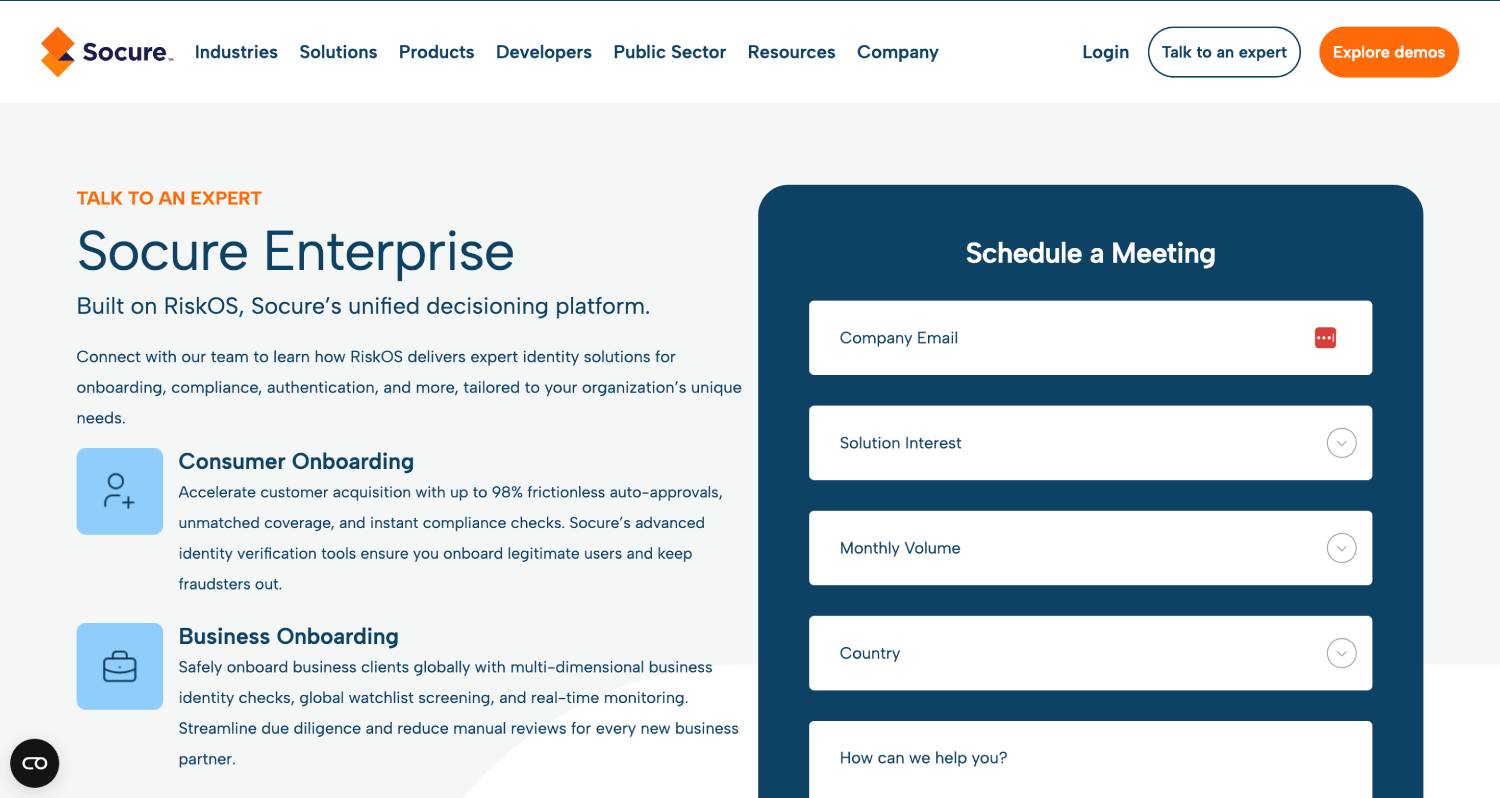
Socure offers synthetic identity detection as part of its Sigma Synthetic product, which it positions alongside its broader ID+ verification suite. The vendor claims real-time detection using a graph network built on identity data from its consortium of financial services companies. Socure’s model ingests document verification signals, digital footprint data, phone and email intelligence, and network linkage data together rather than scoring them separately, which reduces the false-positive rate on thin-file applicants who are legitimate.
Socure has built meaningful scale in the financial services segment and has published case studies with credit unions, challenger banks, and marketplace lenders. Pricing is not publicly available. Integration is REST API with pre-built connectors for Salesforce and several loan origination systems.
Best for: Fintechs running high-volume consumer onboarding who need synthetic detection bundled with document verification and KYC in one API call.
Watch out for: Socure’s full suite is priced for mid-market and enterprise buyers. Early-stage teams with low application volumes may find the commercial structure difficult to justify. See the Socure vs. SentiLink comparison for a side-by-side breakdown of both vendors.
3. Alloy
Alloy is an identity decisioning platform that orchestrates data from more than 190 data sources, including synthetic identity signals from SentiLink, Socure, and bureau data providers, under one rules engine. Rather than building its own consortium detection model, Alloy gives fraud and compliance teams a workflow layer where synthetic fraud checks are one node in a multi-step decisioning tree alongside KYC, AML screening, and document verification.
For fintechs that already work with a bank partner requiring documented decisioning logic, Alloy’s audit trail and case management features carry real operational value. Pricing is quote-based and typically structured around monthly active users or API call volume. Integration complexity is higher than a standalone API but lower than deploying multiple vendors independently.
Best for: Series A to Series C fintechs that need fraud decisioning, compliance, and KYC in a single orchestration layer, particularly those with a sponsor bank requiring explainability. The Alloy vs. Persona comparison covers how these orchestration platforms differ in depth.
Watch out for: Alloy’s synthetic detection is only as good as the underlying data partners you activate. Teams that want a native consortium network rather than an aggregated one should evaluate SentiLink or Socure alongside Alloy.
4. Sardine
Sardine approaches synthetic identity detection from a behavioral intelligence angle. Its platform combines device fingerprinting, behavioral biometrics (typing cadence, mouse movement patterns, copy-paste behavior), and identity graph signals to flag synthetic personas at account creation. Where bureau-first tools struggle with manufactured identities that have clean credit histories, Sardine’s behavioral layer can detect that the device session itself looks scripted or that the application was filled out in a pattern inconsistent with a real user.
Sardine covers synthetic identity fraud at onboarding, account takeover, and payments, which makes it relevant for neobanks and crypto platforms dealing with fraud rings that create synthetic accounts to launder money rather than to bust out on credit. Pricing is not publicly disclosed.
Best for: Neobanks, crypto fintechs, and payment platforms where synthetic identities are created to commit payments fraud or money laundering rather than credit fraud specifically.
Watch out for: Sardine’s behavioral data is richest in web and mobile app contexts. It is less applicable in pure API-to-API application flows where there is no human device session to analyze.
5. SEON
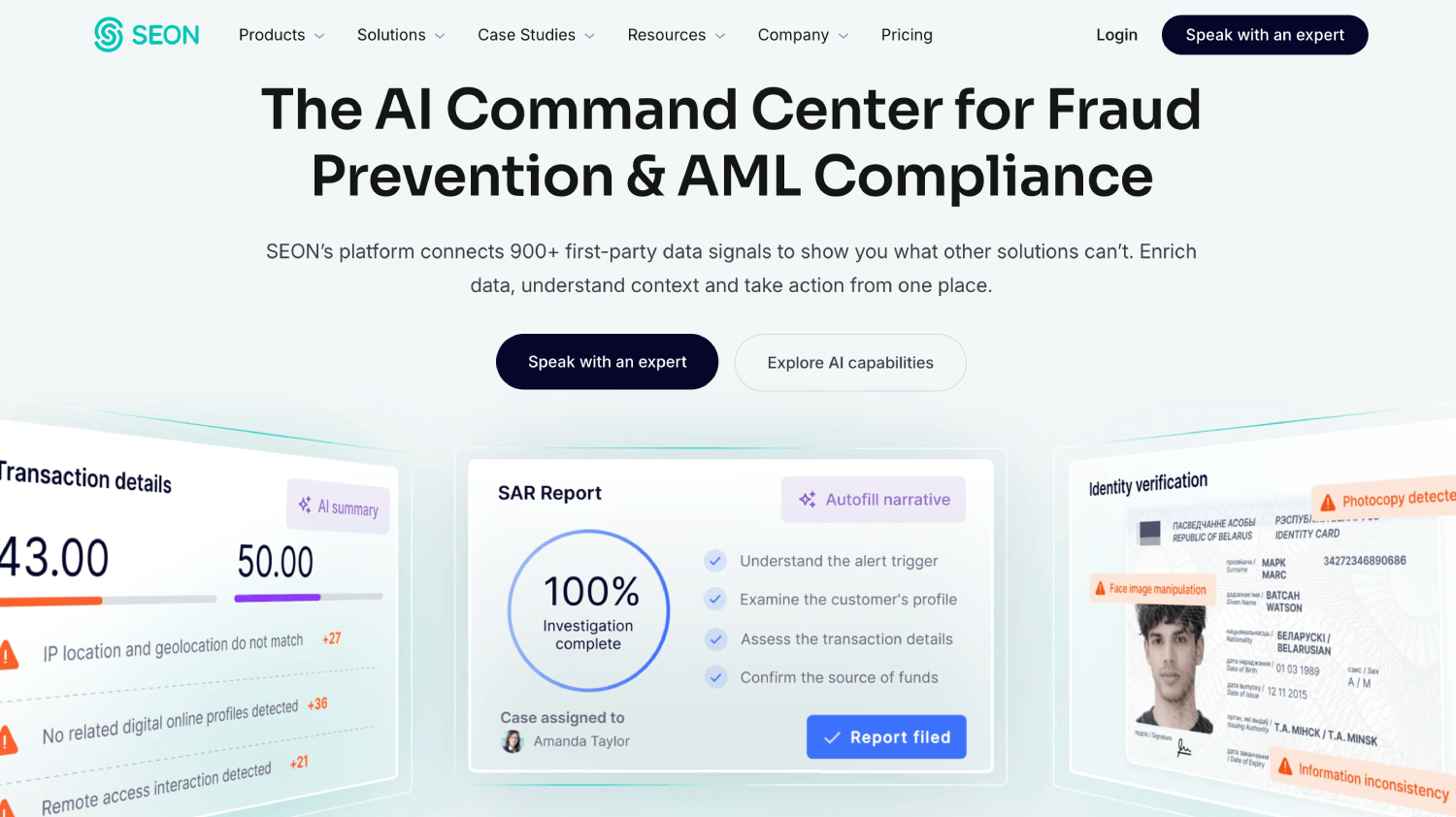
SEON offers a modular fraud detection API that includes synthetic identity signals derived from email intelligence, phone number profiling, social media presence scoring, and device fingerprinting. Its architecture is notable for operating without a mandatory data consortium or large upfront integration, which makes it the most accessible entry point for early-stage fintechs.
SEON publishes transparent API documentation and offers a free tier for low-volume testing according to its public pricing page, which is unusual in a category where almost every other vendor requires a sales call before sharing any pricing information. The trade-off is that SEON’s synthetic detection is built on digital footprint signals rather than on financial application consortium data, which means it catches identity fraud tied to digital persona fabrication more reliably than it catches credit-seasoned synthetic bust-out fraud.
Best for: Seed to Series A fintechs that need a fast, developer-friendly API integration and want synthetic identity screening at account creation without a long procurement cycle.
Watch out for: For lenders where synthetic bust-out on credit is the primary threat, SEON’s signal set is not a substitute for consortium-based SSN analysis from SentiLink or Socure.
6. LexisNexis Risk Solutions (Emailage and ThreatMetrix)

LexisNexis Risk Solutions brings two relevant products to synthetic identity detection: ThreatMetrix, which provides device intelligence and behavioral analytics, and its broader identity graph built on a combination of public records, credit header data, and consortium signals. LexisNexis operates one of the largest identity networks in the US financial services market, which means it has broad SSN-to-identity linkage data accumulated over decades.
The integration path is more complex than API-first competitors, and the commercial structure is enterprise-oriented. For regulated financial institutions with existing LexisNexis relationships, adding synthetic identity modules to an existing contract is typically the path of least friction. Pricing is not publicly disclosed.
Best for: Mid-market and enterprise fintechs with existing LexisNexis contracts, or those already running ThreatMetrix for device intelligence who want to add identity graph-based synthetic scoring without a new vendor.
Watch out for: LexisNexis is not developer-first. Early-stage teams will find the integration timeline and minimum commitment expectations misaligned with their pace.
7. Experian CrossCore
Experian CrossCore is a fraud decisioning platform that connects Experian’s bureau data, device intelligence, and third-party fraud signals through a single API layer. Synthetic identity detection within CrossCore draws on Experian’s SSN velocity data, synthetic identity models built on its credit header database, and linkage analysis across applicant histories.
CrossCore is FCRA-compliant for credit decisioning use cases, which matters for lenders who need synthetic fraud scores to be part of a documented, explainable underwriting process. Pricing is enterprise, quote-based.
Best for: Fintechs with existing Experian bureau relationships, or lenders who need FCRA-compliant synthetic detection integrated with credit decisioning rather than separated from it.
Watch out for: Experian’s consortium data reflects bureau-visible fraud patterns. Synthetic identities that have not yet generated bureau footprints will score lower risk than they deserve.
8. Equifax Interconnect

Equifax Interconnect provides a fraud and identity verification workflow platform powered by Equifax’s identity database, the Work Number employment and income database, and third-party data integrations. Synthetic identity detection uses SSN-to-identity mismatch scoring alongside employment verification signals, since many synthetic identities cannot produce consistent employment data when queried against the Work Number’s employer-contributed records.
Employment data as a synthetic fraud signal is underused in the category. A synthetic identity built on a child’s SSN will have no employment history in any employer-contributed database, which is a strong negative signal when combined with an application claiming income. Equifax’s access to the Work Number makes this cross-signal approach easier to operationalize. Pricing is not publicly disclosed.
Best for: Lenders using income and employment verification in underwriting who want to cross-reference those signals against synthetic identity risk in the same decisioning call.
Watch out for: The Work Number covers roughly 70% of the US workforce based on employer participation, so coverage gaps exist, particularly for gig economy workers and self-employed applicants.
9. Acuant (a HID Global Company)
Acuant focuses on document-based identity verification with synthetic fraud signals derived from document authenticity, facial comparison, and liveness detection. Its AssureID and FaceID products flag synthetic identities where the fraudster has either fabricated supporting documents or used an AI-generated face rather than a real photo.
This is a different threat model than bureau-based synthetic detection. AI-generated face fraud and document fabrication are growing attack vectors in digital onboarding, particularly in states that accept digital ID submissions. Acuant addresses this specific scenario better than most consortium-first vendors. This article does not cover document forensics in depth, as that topic is addressed separately in the fake document detection tools comparison for fintechs.
Best for: Fintechs where the synthetic fraud risk manifests at document submission, not only at SSN or credit data analysis, particularly those onboarding with selfie and ID capture flows.
Watch out for: Acuant does not provide SSN consortium analysis or behavioral biometrics. It is a document layer tool, not a full synthetic identity fraud platform.
10. Ekata (Mastercard)

Ekata, now part of Mastercard, provides identity network data that links phone numbers, email addresses, IP addresses, and physical addresses to identity profiles. Its Pro Insight API gives developers access to identity graph queries that flag synthetic patterns where the combination of identity elements does not resolve to a coherent digital footprint.
Ekata’s network is global, which makes it particularly useful for fintechs onboarding international users or for platforms where synthetic identities may be manufactured outside the US but used domestically. US-specific SSN analysis is not Ekata’s core strength. Pricing is not publicly disclosed, but API documentation is available on the Ekata developer portal.
Best for: Fintech platforms with a meaningful share of international applicants, or those that need identity graph verification as a lightweight API signal alongside a primary synthetic detection tool.
Watch out for: For pure US consumer credit synthetic fraud, Ekata’s signal depth is lower than SentiLink or Socure. It works better as a supplemental signal than as a primary detection layer.
11. Unit21
Unit21 is a fraud and AML operations platform with case management, rules engine, and model management tooling built for risk teams who need to operationalize synthetic identity detection across multiple data sources. Unit21 does not generate its own synthetic identity scores, but it ingests scores from external vendors, flags patterns in transaction and onboarding data, and gives fraud analysts a workflow to investigate and confirm synthetic cases.
For fintechs that already have synthetic detection signals from SentiLink or Socure but lack the operational infrastructure to act on them at scale, Unit21 fills the workflow gap. It is not an alternative to a detection vendor but a layer that makes detection results usable at volume. The Unit21 vs. Alloy comparison goes into detail on how these platforms differ in fraud operations versus identity decisioning use cases.
Best for: Fraud and risk teams at Series B and later fintechs who have synthetic detection vendors in place but need case management, alert triage, and SAR filing workflow on top of raw detection signals.
Watch out for: Unit21 without a detection signal source is like a case management system without cases. Budget for at least one upstream signal provider alongside it.
How Do These Platforms Compare on the FintechSpecs SIFT Criteria?
| Vendor | Signal Depth (1-5) | Integration Path (1-5) | US Regulatory Fit (1-5) | Thin-File Coverage (1-5) | Pricing Transparency | Best Buyer Profile |
|---|---|---|---|---|---|---|
| SentiLink | 5 | 4 | 5 | 5 | Quote only | Lenders and credit issuers |
| Socure | 5 | 4 | 5 | 4 | Quote only | High-volume consumer onboarding |
| Alloy | 4 | 3 | 5 | 4 | Quote only | Fintechs needing orchestration + fraud + compliance |
| Sardine | 4 | 4 | 4 | 4 | Quote only | Neobanks, crypto platforms, payments fraud |
| SEON | 3 | 5 | 3 | 3 | Public (free tier + paid) | Seed to Series A, fast integration |
| LexisNexis Risk | 5 | 2 | 5 | 4 | Quote only | Enterprise with existing LN contracts |
| Experian CrossCore | 4 | 3 | 5 | 3 | Quote only | Lenders needing FCRA-compliant synthetic scoring |
| Equifax Interconnect | 4 | 3 | 5 | 4 | Quote only | Lenders with income verification use cases |
| Acuant (HID) | 3 | 3 | 4 | 2 | Quote only | Document-based onboarding with selfie capture |
| Ekata (Mastercard) | 3 | 4 | 3 | 3 | Quote only | International applicant coverage |
| Unit21 | 2 | 3 | 5 | 2 | Quote only | Fraud ops and case management layer |
Signal Depth scores reflect whether the vendor operates a proprietary consortium network (5) versus reselling or aggregating bureau or third-party data (3 or below). Integration Path scores favor developer-first REST APIs with published documentation (5) over enterprise-only integration engagements (2). Thin-File Coverage scores reflect performance on identities with little or no bureau history, where synthetic fraud is hardest to distinguish from legitimate new-to-credit applicants. No vendor was tested directly by FintechSpecs; scores reflect publicly documented capabilities.
What Is the Right Shortlist by Company Type?
Running every vendor on this list through a proof of concept is not realistic. The following shortlists are based on the SIFT scoring above and the buyer profiles for each company type.
Seed to Series A Fintech (under 50 employees, limited procurement bandwidth)
- SEON as a fast first integration for digital identity signals
- SentiLink if you are specifically a lender or credit product
- Alloy if your bank partner requires a documented decisioning layer
Series B Consumer Lender or Neobank
- SentiLink for credit application synthetic detection
- Sardine for behavioral layer at account creation and transaction monitoring
- Unit21 for fraud operations, case management, and SAR filing
Series B to Series C Regulated Fintech with Bank Partner
- Alloy for orchestration across KYC, synthetic fraud, and AML
- Socure for document and identity verification signals within the Alloy stack
- Equifax Interconnect or LexisNexis Risk if income verification cross-referencing is a priority
Enterprise Fintech or Established Lender
- LexisNexis Risk Solutions or Experian CrossCore for FCRA-compliant bureau-anchored detection
- SentiLink or Socure for specialist synthetic scoring on top
- Unit21 for fraud operations workflow
What Does Synthetic Identity Fraud Cost Fintechs to Ignore?
Consider a hypothetical Series A lender approving 2,000 personal loan applications per month at an average loan size of $8,000. That is $16 million in monthly origination volume. If 1% of approved applications are synthetic accounts that bust out at month 18, a scenario consistent with the bust-out pattern described earlier in this article, the lender absorbs $160,000 in charge-offs from that single cohort, with no collateral and no recovery path once the fraud ring disperses. That figure does not include the operational cost of investigation, SAR filing, or the cost of regulatory scrutiny if synthetic fraud patterns surface in an exam. The 1% figure is illustrative; actual synthetic fraud rates vary by product type, underwriting controls, and the sophistication of the detection layer in place.
The subtler cost is misclassification. Legitimate thin-file borrowers, recent immigrants, and young adults look like potential synthetic identities to bureau-only tools. Declining those applicants has a direct revenue cost and a potential fair lending risk. This is why thin-file coverage sits alongside signal depth in the SIFT Criteria. A tool that catches more synthetic fraud but also declines more real applicants is not necessarily a net win.
Fintechs navigating the fraud-versus-user-experience trade-off in onboarding should read the fraud prevention and user experience trade-off breakdown before locking in a vendor that optimizes only for fraud reduction. The most expensive risk mistakes fintech founders make covers adjacent decision errors that compound this cost.
How Do You Integrate a Synthetic Identity Fraud Detection API Without Breaking Onboarding?
The integration path question is often decided by your existing stack, not by the vendor. If you are running a loan origination system with a pre-built SentiLink integration, adding SentiLink is a configuration task. If you are building a custom onboarding flow on a BaaS provider, you are likely calling a fraud API in parallel with your KYC call and routing the combined response through a rules engine before approving the application.
Three integration patterns appear most frequently among the vendors on this list:
- Standalone risk API: You call the fraud vendor’s API at the point of application submission, receive a risk score and model reason codes, and write decisioning logic yourself. SentiLink, Socure, SEON, and Ekata all support this pattern. It gives you the most control but requires your engineering team to own the decisioning logic and audit trail.
- Orchestration platform: Alloy or Experian CrossCore sits in the middle, calling multiple data sources and returning a composite decision. Your engineering team integrates once; the orchestration platform manages upstream data vendor calls. This reduces integration complexity but introduces a dependency on the orchestration vendor’s uptime and model versioning.
- Risk operations layer: Unit21 or a similar case management tool sits downstream of your decisioning logic, ingesting fraud signals, triggering analyst review queues, and managing SAR filings. This is not a real-time onboarding integration but an operations tool for your fraud team.
For fintechs evaluating their broader risk tool infrastructure, the fraud detection and risk tools overview covers the full stack beyond just synthetic identity.
How Does US Regulatory Context Shape Your Platform Choice?
FCRA compliance is a hard requirement for any vendor whose output influences credit decisions. If you are a lender and your synthetic identity score affects an application approval or denial, that score must meet FCRA adverse action notice requirements, which means the vendor must provide model reason codes in a format that maps to consumer-facing explanations.
SentiLink, Socure, Experian CrossCore, and Equifax Interconnect are all documented as FCRA-compliant for credit use cases based on their published product documentation. SEON, Sardine, and Ekata are not positioned as FCRA-compliant for credit decisioning, which limits their use to non-FCRA contexts: account creation fraud, payments fraud, and fraud scoring that does not directly trigger an adverse action on a credit application.
BSA/AML alignment is a separate consideration. If your sponsor bank requires your fraud controls to be part of your documented BSA compliance program, Alloy and Unit21 are the two vendors on this list explicitly designed for that regulatory integration. The fintech product and compliance readiness checklist breaks down what your bank partner will typically expect before approving your fraud controls as part of your compliance program.
Article Methodology
FintechSpecs evaluated 11 synthetic identity fraud detection vendors using the FintechSpecs SIFT Criteria (Signal Depth, Integration Path, Fit for US Regulatory Context, Thin-File Coverage). Scoring reflects publicly documented product capabilities, published developer documentation, vendor-published case studies, and SERP data current as of the time of research. No vendor was tested directly via live API integration. No vendor paid for inclusion or for a higher score. Sponsored placement is disclosed inline where applicable. Pricing information reflects only what vendors publish on public pricing pages; all other pricing is categorized as quote-only. FCRA compliance designations reflect vendors’ own published statements about permissible use cases and have not been independently verified by legal counsel.
Frequently Asked Questions About Synthetic Identity Fraud Detection
What is the difference between synthetic identity fraud and first-party fraud?
Synthetic identity fraud involves a fabricated or partially fabricated identity, typically using a real SSN paired with a false name and address. First-party fraud involves a real person using their own identity to commit fraud, such as intentionally defaulting on a loan or disputing a legitimate charge. Some synthetic fraud rings blur this line when a real person knowingly provides their SSN to a fraud ring. Detection tools handle these differently: synthetic detection focuses on identity construction signals, while first-party fraud detection focuses on behavioral and payment pattern anomalies after account opening.
Can you detect synthetic identity fraud without bureau data?
Yes, but your coverage will be narrower. Vendors like Sardine and SEON use device intelligence, behavioral biometrics, and digital footprint signals to flag synthetic patterns without requiring bureau access. These signals are effective at catching fraud rings manufacturing digital personas for account creation. They are less reliable at catching credit-seasoned synthetic bust-out fraud, where the synthetic identity has accumulated a real bureau file over months or years. For lenders, bureau-adjacent consortium data from SentiLink or Socure is difficult to replace with digital signals alone.
Which synthetic identity fraud platforms are FCRA-compliant for lending?
SentiLink, Socure, Experian CrossCore, and Equifax Interconnect are documented as FCRA-compliant for credit decisioning use cases, meaning their scores can be used in decisions that trigger adverse action notices. SEON, Sardine, Ekata, and Acuant are not positioned as FCRA-permissible for credit decisions and are better suited to account-creation fraud detection, payments fraud, or supplementary risk signals that do not directly trigger an adverse action. Always verify FCRA permissible use with your legal counsel and the specific vendor before deployment.