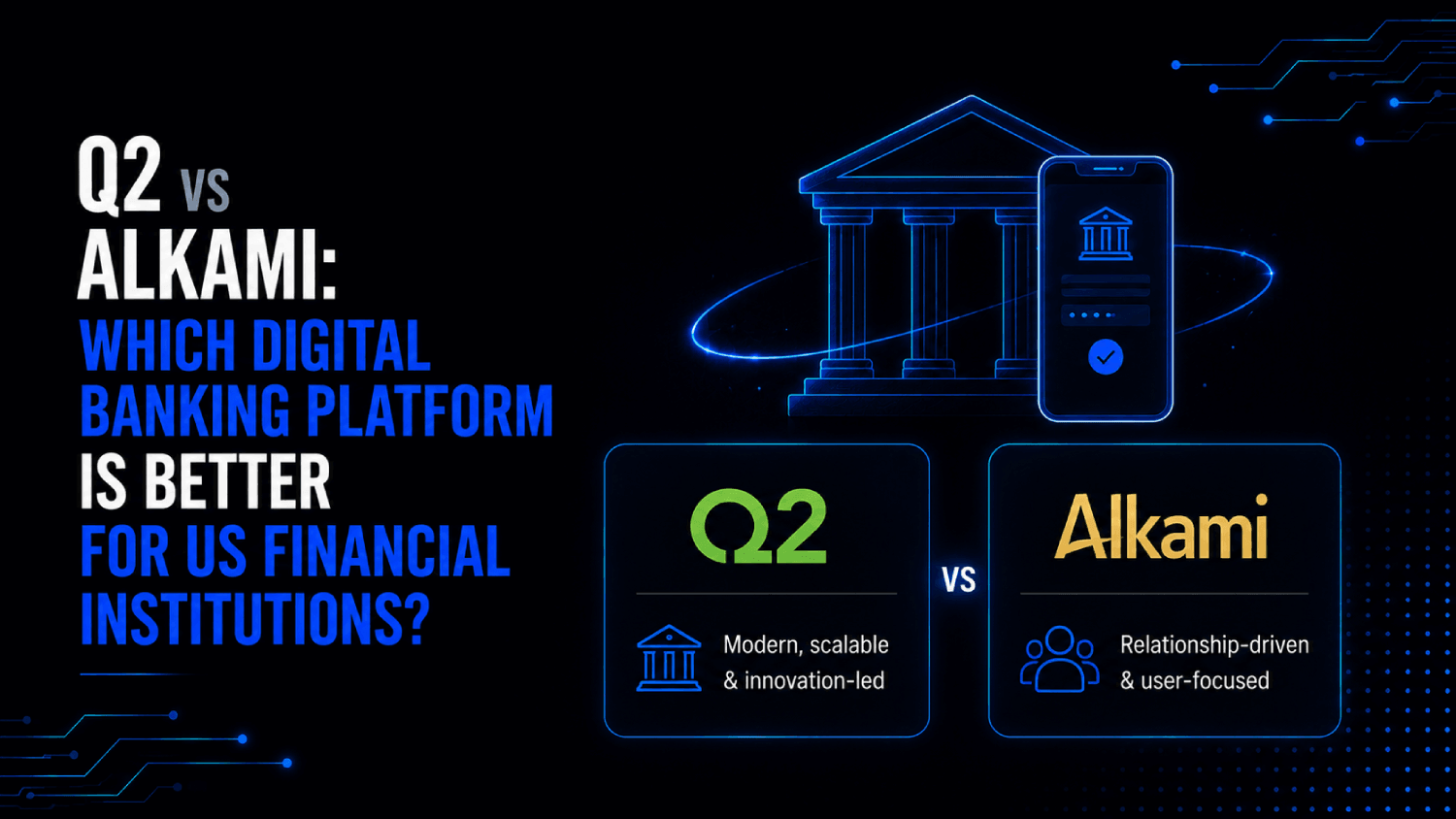

- Q2 is the larger platform by client count and serves a broader mix of banks and credit unions, including larger institutions; Alkami is credit-union-focused and built for digital channel depth rather than breadth.
- Neither vendor publishes list pricing; both require a demo and a contract negotiation, and minimum commitment terms reported by buyers are multi-year.
- Q2’s integration story is anchored on its partner network and SDK-level extensibility; Alkami competes on its Digital Sales and Service module and a tighter core-system integration layer.
- Switching costs are high on both sides because both platforms hold member data, digital onboarding flows, and third-party integration configurations that require migration work to move.
- Choose Q2 if your institution is above $1B in assets, needs enterprise-scale controls, or wants a broad vendor marketplace; choose Alkami if your credit union is growth-focused, prioritizes member experience metrics, and wants a platform built specifically around the credit union operating model.
Q2 and Alkami both sell digital banking platforms to US banks and credit unions, and their marketing pages use nearly identical language about member experience, open APIs, and integrated data. The real difference is in who each vendor built the product for, how each prices and contracts, and where each platform creates lock-in. This article separates those differences across eight dimensions so buyers can move from a two-vendor shortlist to an RFP or demo request with a clear rationale.
Q2 vs Alkami: Quick Verdict and Choose-If Table
Q2 is the stronger fit for larger, multi-charter institutions and banks that need a mature vendor network with documented compliance controls. Alkami is the stronger fit for growth-oriented credit unions that want a platform built around the credit union model and are willing to trade some breadth for deeper member-facing digital capability.
| Dimension | Choose Q2 if… | Choose Alkami if… |
|---|---|---|
| Institution type | Bank or mixed-charter institution | Credit union, specifically |
| Asset size | $500M and above, especially $1B+ | $300M to $5B in assets |
| Product priority | Broad feature set, vendor marketplace | Member growth, digital sales conversion |
| Integration model | SDK-based, many third-party connectors | Tighter core system partnerships, fewer but deeper integrations |
| Compliance ownership | Mature SOC 2 and audit documentation | SOC 2 compliant; compliance tools are embedded in platform |
| Pricing structure | Per-user plus modules; contract-negotiated | Per-registered-user; contract-negotiated |
| Support model | Tiered by contract size; dedicated CSM at enterprise tiers | Named success team; more hands-on at mid-market |
| Switching cost | High; embedded in Q2 partner integrations | High; embedded in Alkami’s core data layer |
What Is Q2 and Who Uses It?
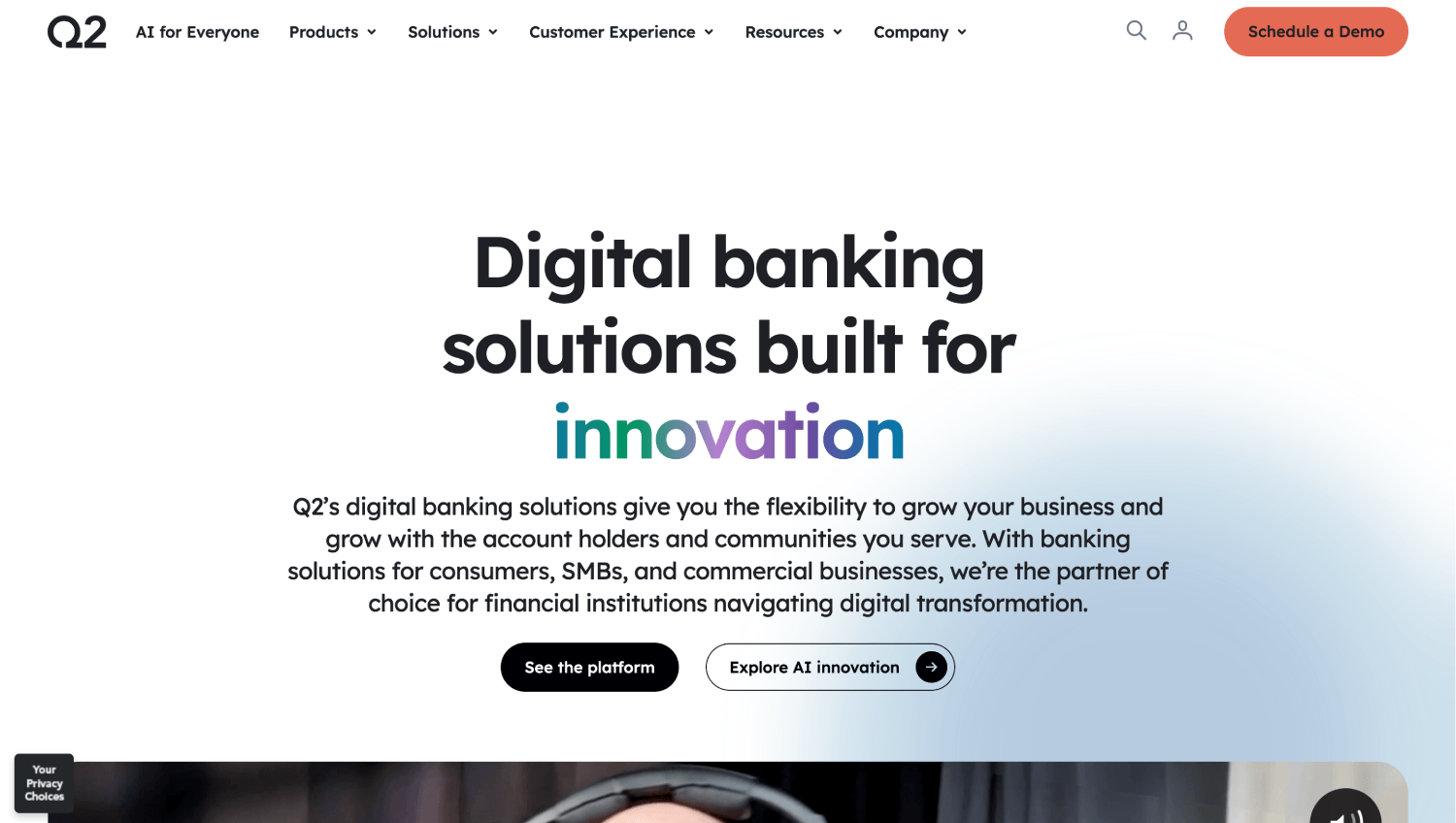
Q2 Holdings is a publicly traded company headquartered in Austin, Texas that provides digital banking software to financial institutions across the US. Its client base spans community banks, credit unions, and regional banks. Q2 does not publicly disclose its market share figure, and any specific percentage cited in third-party analyses should be verified against the original source before relying on it in a procurement context.
Q2’s platform covers retail and commercial digital banking, lending, and a partner network called Q2 Innovation Studio, which lets third-party fintech companies publish services directly into Q2-powered banking apps. That marketplace model is one of Q2’s clearest competitive differentiators: an institution on Q2 can offer its members access to third-party financial tools without building custom integrations for each one.
Q2 also operates a subsidiary called Q2 SMART focused on commercial banking analytics and a separate lending infrastructure product. For institutions that need a single vendor covering retail digital, commercial digital, and lending workflow, Q2 can plausibly be that vendor.
What Is Alkami and Who Uses It?
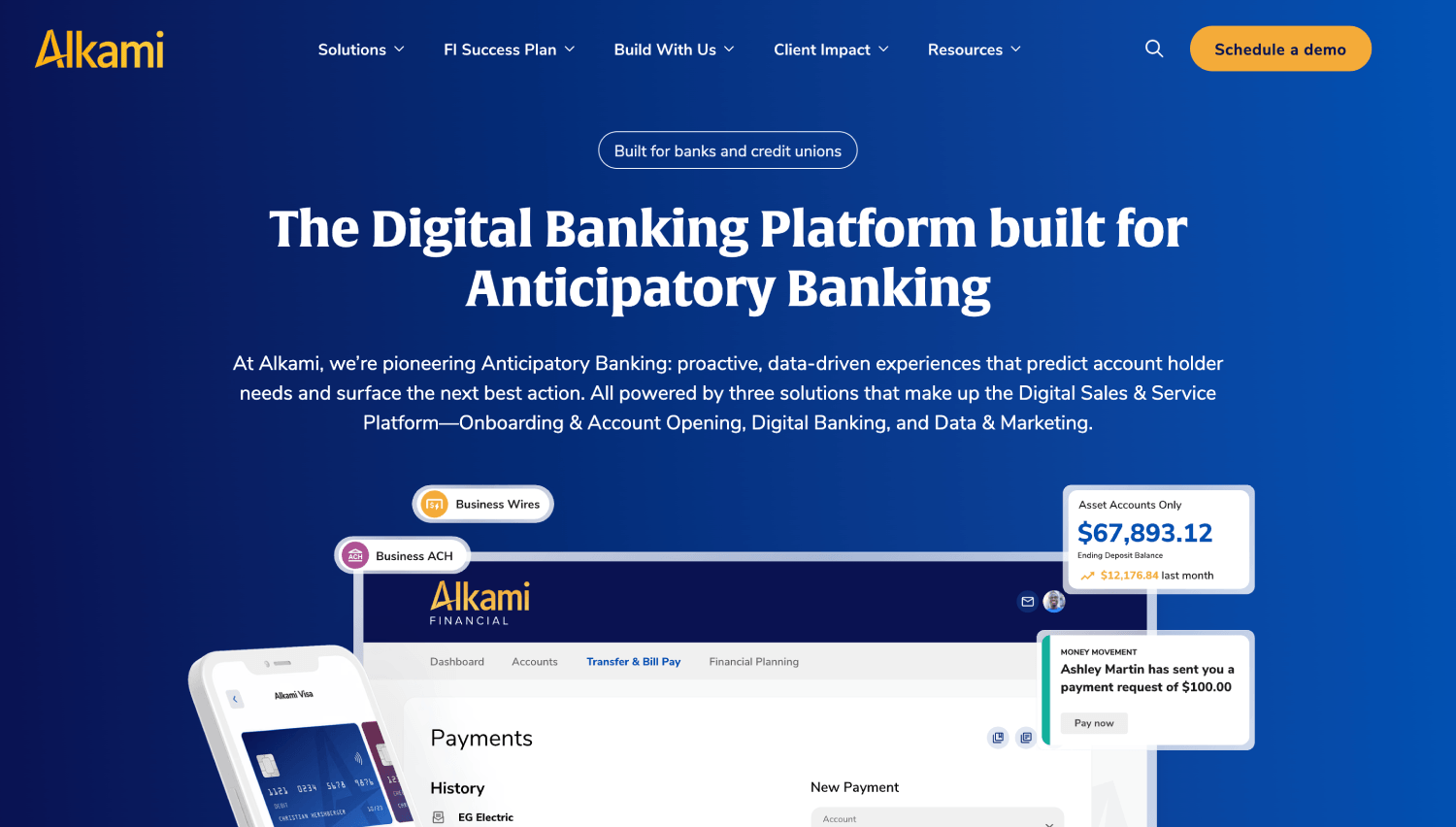
Alkami Technology is also publicly traded, headquartered in Plano, Texas, and built its platform almost entirely around credit unions before expanding to include banks. Alkami does not publicly disclose a precise market share figure; the company’s scale relative to Q2 is better understood through its publicly reported client count and asset-tier concentration in credit unions than through unverified percentage comparisons.
Alkami’s product centers on the Alkami Digital Banking Platform, which includes retail banking, business banking, data and marketing tools, and a module called Digital Sales and Service that is specifically designed to help credit unions grow membership and cross-sell products inside the digital channel. That last piece is where Alkami differentiates most sharply: it treats the digital banking interface as a sales surface, not just a transaction ledger.
Banks and credit unions that use Alkami include several mid-size credit unions in the $500M to $3B asset range. The company does not publicly publish a full client list, but its public case studies feature credit unions prominently.
How Do Q2 and Alkami Compare on Product Depth?
Q2 covers more ground in absolute feature count. Its platform addresses retail banking, commercial banking, lending origination, risk and fraud, and a marketplace of third-party integrations through Q2 Innovation Studio. For a bank or credit union that wants one contract covering all of those areas, Q2’s breadth is real.
Alkami’s product depth is concentrated in the retail and business banking digital channel. Its data and marketing layer, built around member behavioral data, is designed to help institutions identify which members are likely to open a second product and then serve them a targeted offer inside the app. That capability is more developed in Alkami than in Q2’s equivalent marketing tools, based on how each company positions its platform in buyer documentation.
For commercial banking, Q2 is the stronger platform. Its commercial digital banking product has more documented features for treasury management workflows, multi-user entitlements, and payment approvals at the business level. Alkami’s business banking module exists, but commercial banking is not where the product investment has been concentrated.
How Do Q2 and Alkami Handle Core System Integration?
Both platforms need to connect to a core banking system, and that integration is where implementation timelines and long-term flexibility are determined. The major cores in the credit union market include Corelation, Symitar (owned by Jack Henry), CU*BASE, and Fiserv‘s XP2 and DNA. On the bank side, the major cores include Fiserv Signature, FIS IBS, and Jack Henry’s SilverLake.
Alkami lists integration partnerships with Symitar, Corelation, and several other credit-union-specific cores on its public partner pages; buyers should verify the current integration list directly with Alkami during the RFP process, as partner coverage can change. The technical architecture of Alkami’s core connectivity, including whether specific integrations operate via real-time API calls or scheduled data exchange, is not fully detailed in publicly available documentation, and that question is worth raising explicitly in a technical discovery call. For credit unions already on Symitar, the Alkami integration is widely cited as well-established, and the implementation path is generally shorter than it would be on a less common core.
Q2 supports a wider range of cores, including bank cores that Alkami does not prioritize. Its extensibility comes through its SDK and the Q2 Innovation Studio partner framework. But more integration options can mean more integration complexity, and buyers should ask both vendors specifically how many implementations they have completed on the institution’s exact core version before signing.
Implementation timelines for both platforms range from six to eighteen months depending on core complexity, data migration scope, and the number of third-party services being replaced. Neither vendor guarantees a specific go-live date in standard contract language, and delays are common in the market. If your institution is evaluating how to manage a platform migration without disrupting operations, the core banking migration guide at FintechSpecs covers cutover risk in detail.
What Does Q2 vs Alkami Pricing Actually Look Like?
Neither Q2 nor Alkami publishes list pricing. Both use a per-registered-user model as the base unit, with additional fees for module activation, implementation services, and ongoing support tiers. Contract minimums are multi-year; three-year and five-year terms are common based on buyer reports in public procurement disclosures and RFP forums.
Q2’s pricing structure adds module fees on top of the base per-user rate. An institution that wants the full stack, including commercial banking, lending, and Innovation Studio marketplace access, will pay significantly more per user than an institution using only the retail digital banking module. Volume discounts apply at higher user counts, but Q2 does not publish those thresholds.
Alkami’s pricing follows a similar per-registered-user structure. Its Digital Sales and Service module and data analytics tools are typically licensed separately from the core platform fee. Alkami has disclosed in investor materials that its revenue model is predominantly recurring subscription, which aligns with its SaaS pricing approach.
For both vendors, the published contract price is not the total cost. Implementation fees, data migration services, and training add to the first-year spend. Ongoing costs include annual increases tied to user growth and module expansion. Before signing either contract, ask for a fully loaded three-year total cost of ownership figure that includes all professional services and estimated user-growth-based price escalations. The kinds of hidden costs that erode vendor relationships after signing are documented in detail in this FintechSpecs analysis of hidden costs in fintech SaaS.
How Do Q2 and Alkami Handle Compliance and Security?
Both platforms hold SOC 2 Type II certifications. For federally regulated financial institutions, that baseline matters because examiners will ask for it during a vendor management review.
Q2 has been in market longer and has a larger volume of completed regulatory examinations across its client base. Its compliance documentation, including its shared responsibility model and examiner-ready audit artifacts, is more extensive by volume. That does not make Q2 more secure, but it does mean an examiner who has seen a Q2-hosted institution before will recognize the documentation format.
Alkami’s public product pages list risk and compliance-related tools including Positive Pay and ACH reporting, though some of these are delivered as partner solutions rather than natively built features. Buyers evaluating Alkami’s compliance and fraud tooling should ask specifically which capabilities are built into the core platform, which are delivered via third-party integrations, and what the configuration requirements are for each. For a mid-size credit union without a dedicated compliance engineering team, that distinction matters operationally. For institutions building out a broader compliance evaluation, the Fintech Product and Compliance Readiness Checklist is a useful parallel read for structuring the vendor review. See also this FintechSpecs coverage of fraud prevention trade-offs in digital products for context on how platform-level versus integration-level controls affect member-facing experience.
What Are the Support Models for Q2 and Alkami?
Q2’s support structure is tiered by contract size. Smaller institutions typically access support through a shared service desk with defined SLA windows. Larger contracts include a dedicated Customer Success Manager and faster escalation paths. Public reviews from Q2 clients on G2 and Capterra mention response time variability at lower contract tiers as a recurring concern.
Alkami’s support model is more uniform at the mid-market level. Its named success team approach means a credit union in the $500M to $1B asset range still gets a defined point of contact rather than a generic support queue. Public reviews from Alkami clients mention implementation support quality as a consistent positive, though some note that post-launch feature requests take time to reach the product roadmap.
Both vendors offer annual client conferences and user group communities. Alkami’s user community skews heavily toward credit unions, which means peer benchmarking is more directly applicable for credit union buyers.
The FintechSpecs Digital Platform Stress Test: Four Questions Before You Sign
When two platforms look identical on paper, the decision comes down to four specific questions that sales decks rarely answer directly. This framework, developed from the evaluation criteria most commonly cited by digital banking buyers in procurement documentation and public RFPs, is designed to surface the differences that matter after go-live.
Question 1: Who owns the member data if you leave? Ask each vendor for the data portability clause in their standard contract. Both Q2 and Alkami hold member profile data, transaction history linked to the digital channel, and behavioral data from the platform’s analytics layer. The format in which that data is exported, and the fees associated with the export, are negotiable before signing but rarely after.
Question 2: What is the upgrade path when the platform releases a major version? Q2 and Alkami both release platform updates on a scheduled cycle. Ask specifically whether major version upgrades require new implementation fees, whether they are mandatory within a defined window, and what the downtime expectation is during the upgrade. Some clients have reported unplanned downtime during major Q2 releases; ask for a reference client who went through the last major upgrade.
Question 3: How does pricing scale when your user base grows 40% in two years? Run a hypothetical scenario with each vendor. Say your credit union has 50,000 registered digital users today and projects 70,000 in two years. Ask for the contract language that governs the price adjustment at that new user count, and whether you can lock a per-user rate for the full contract term. Both platforms have growth-based pricing escalators that are not always clearly disclosed in initial proposals.
Question 4: Which third-party integrations are native versus pass-through? Q2’s Innovation Studio model means some integrations are published by third parties and may have their own pricing, terms, and support relationships. Alkami’s integrations are more tightly curated but fewer in number. An integration listed in a product demo as “available” may require a separate contract and implementation timeline. Get the full integration inventory in writing before the contract is signed.
Which Platform Has More US Financial Institution Coverage?
Q2 serves a larger number of US financial institutions and covers a broader range of institution types, including community banks that Alkami does not actively target. Its publicly reported client count covers institutions across all 50 states.
Alkami’s coverage is concentrated in credit unions, where it has built a stronger reference base in the $300M to $3B asset tier. For a credit union evaluating a new digital banking platform, Alkami’s peer reference pool is more directly comparable by institution type and operating model.
For banks, Q2 is the only realistic option of the two. Alkami sells to banks but has not built the same depth of bank-specific features or the same volume of bank reference clients. A community bank evaluating both platforms will find more relevant case studies, implementation templates, and peer references in Q2’s network.
How High Are the Switching Costs on Each Platform?
Switching costs for both platforms are high, for the same structural reasons. Both platforms hold the digital onboarding configuration, the member-facing interface customizations, the third-party integration settings, and years of behavioral data tied to the platform’s analytics layer. Moving off either platform requires rebuilding all of that on the new system.
The specific switching cost drivers to quantify before signing include: data migration services (typically billed by the outgoing vendor), integration reconfiguration on the new platform, member re-enrollment if the authentication model changes, and staff retraining. A mid-size credit union with 60,000 digital users should budget for a transition process that spans twelve to twenty-four months, not six.
The framing that switching is easy because “it’s all SaaS” is one of the more expensive misconceptions in enterprise fintech procurement. The infrastructure may be cloud-hosted, but the data dependencies and configuration complexity are equivalent to an on-premise migration. The same dynamic applies across fintech vendor categories, as covered in this analysis of critical mistakes when choosing fintech infrastructure.
Frequently Asked Questions
What is Q2 in banking?
Q2 Holdings is a US-based software company that provides digital banking platforms to banks and credit unions. Its platform covers retail digital banking, commercial banking, lending, and a partner marketplace called Q2 Innovation Studio. Q2 is publicly traded and serves financial institutions across all 50 US states. The company is headquartered in Austin, Texas. It does not publicly disclose a precise market share figure; investors and buyers should reference Q2’s public filings for reported client and revenue metrics.
Is Alkami a real company?
Yes. Alkami Technology is a publicly traded company listed on the Nasdaq under the ticker ALKT. It is headquartered in Plano, Texas, and provides a cloud-based digital banking platform to US banks and credit unions. Alkami was founded in 2009 and went public in 2021. Its platform is used by banks and credit unions primarily in the $300M to $5B asset range.
What banks use Q2 software?
Q2 does not publish a full client list, but its platform is used by community banks, regional banks, and credit unions across the US. Q2’s client base skews toward institutions that need both retail and commercial digital banking under one platform. The company’s public investor filings confirm a broad institutional client base, though specific institution names are not disclosed without the client’s permission.
What is Alkami for credit unions?
Alkami provides credit unions with a cloud-based digital banking platform that covers mobile and online banking, business banking, data analytics, and a Digital Sales and Service module designed to grow membership and cross-sell products inside the digital channel. Alkami lists integration partnerships with major credit union core systems including Symitar and Corelation on its public partner pages. It is specifically designed around the credit union operating model, making it a more targeted fit than broader-market platforms.
What banks use Alkami?
Alkami serves both banks and credit unions, though its product investment and reference client base skew toward credit unions. The company does not publish a full client list. Public case studies and press releases feature credit unions prominently. Banks evaluating Alkami will find fewer bank-specific reference clients compared to Q2, which has a longer history serving community and regional banks alongside credit unions.
How does Q2 vs Alkami pricing compare?
Both Q2 and Alkami use a per-registered-user pricing model with additional fees for modules, implementation, and support tiers. Neither vendor publishes list pricing; both require a negotiated contract. Contract terms are typically multi-year. The fully loaded cost includes implementation services, data migration, and annual price escalators tied to user growth. Buyers should request a three-year total cost of ownership estimate from both vendors before comparing proposals.
What are the integration differences between Q2 and Alkami?
Q2 supports a wider range of core banking systems and offers an SDK-based extensibility model through Q2 Innovation Studio. Alkami lists integration partnerships with credit union cores including Symitar and Corelation on its public partner pages; the depth and technical architecture of those integrations should be verified directly with Alkami during evaluation. Q2’s broader integration catalog comes with more configuration complexity. Alkami’s tighter integration list is generally easier to implement on supported cores but limits flexibility if the institution uses a less common system. Both require institution-specific implementation work regardless of platform.
Which digital banking platform is better for credit unions: Q2 or Alkami?
Alkami is the stronger fit for most credit unions, particularly those in the $300M to $3B asset range that prioritize member growth and digital channel depth. Its Digital Sales and Service module, credit-union-specific core integrations, and peer reference base are more directly applicable to credit union operations than Q2’s broader platform. Q2 is the better choice for credit unions above $1B in assets that also need commercial banking capability or want access to a larger vendor marketplace.
Q2 vs Alkami: How to Make the Final Call
The most durable way to separate these two platforms is to stop comparing feature lists and start comparing operating models. Q2 was built to serve financial institutions broadly, and its product reflects that: wide coverage, a large marketplace, strong commercial banking capability, and a support structure that scales with contract size. Alkami was built to serve credit unions specifically, and its product reflects that too: deeper member-facing tools, tighter credit-union-core integrations, and a growth-oriented positioning that treats the digital channel as a revenue driver rather than a cost center.
For the institutions where the choice is genuinely unclear, the deciding variable is usually commercial banking. If the institution has meaningful business member volume and needs entitlements, payment approvals, and treasury tools at the business banking level, Q2 has built more of that capability. If the institution is primarily retail-focused and wants to drive member product adoption through the digital channel, Alkami’s Digital Sales and Service module does things Q2’s equivalent does not.
Contracts with both vendors are long and expensive to exit. The RFP process should include a live scenario test: give both vendors a real workflow your institution runs today and ask them to demonstrate it without a custom build. The platform that handles your actual operating reality without workarounds is the one worth the multi-year commitment. If you are building a broader vendor evaluation framework, the FintechSpecs fintech vendor evaluation framework covers the full diligence process across contract terms, compliance documentation, and integration risk.