- Most ATO prevention platforms cover the same surface-level signals. The differentiation is in how they combine device intelligence, behavioral biometrics, and identity graph data , and how quickly that combination catches a credential-stuffed session before a transfer clears.
- Brand recognition is a poor proxy for fit. A behavioral biometrics platform built for large retail banks will cost 3x what a fintech app at Series A can justify, and it will still miss mobile-native attack patterns the bank never sees.
- The five buying criteria that actually matter: detection signal depth, integration effort, false positive rate visibility, US regulatory fit (BSA/AML, FFIEC, CFPB), and pricing transparency.
- The vendors that publish pricing , even ranges , deserve more consideration than they typically get. Opaque pricing is not neutral; it disadvantages smaller buyers who cannot run long procurement cycles.
- No single platform wins across all company types. The right shortlist for a Series A neobank looks nothing like the right shortlist for a mid-size credit union.
Account takeover prevention platforms differ most on three variables: the signals they collect (device, behavioral, identity), how they combine those signals into a risk score, and how that score gets actioned in real time. For banks and regulated fintech apps, FFIEC authentication guidance and BSA recordkeeping requirements narrow the field considerably. For seed-to-Series B fintechs, integration complexity and per-event pricing often matter more than the feature set. This guide covers 10 platforms across both buyer types, with a transparent scoring model and use-case-specific shortlists.
What Is Account Takeover Fraud and Why Do Generic Solutions Miss It?
Account takeover (ATO) fraud happens when an attacker gains control of a legitimate user’s account, typically using stolen credentials obtained through phishing, data breaches, or credential-stuffing bots. The attacker then changes contact details, initiates transfers, or harvests stored payment methods before the real user notices. What makes ATO different from application fraud is that the attacker passes identity verification , they have the right username and password. The fraud layer you need sits between authentication and action.
Generic security tools , WAFs, basic MFA, IP blocklists , stop the low-sophistication attacks. They do not stop a threat actor running a residential proxy network with valid credentials and a device profile that mimics a known good user. That attacker passes every perimeter check. Only platforms that analyze session behavior, typing rhythm, navigation patterns, or cross-customer device anomalies have a chance of catching that session in flight.
This is also why the fraud-prevention vs. user-experience trade-off is especially acute in ATO. Every additional friction layer you add to stop attackers also lands on real users who are already logged in and expecting a frictionless experience. The vendors that solve this cleanest , high detection, low false positives, step-up challenges only when the score warrants it , are worth a premium.
How We Scored These Platforms: The FintechSpecs ATO Signal Stack Model
Most comparison lists score ATO platforms on feature count. That approach rewards vendors that build long marketing pages, not vendors that actually catch attacks. The FintechSpecs ATO Signal Stack Model scores each platform on five criteria, weighted by what the research and buyer conversations consistently surface as the actual decision drivers.
| Criterion | Weight | What We Measured |
|---|---|---|
| Signal Depth | 30% | Layers of detection: device, behavioral biometrics, identity graph, network/IP, session anomaly |
| Integration Effort | 20% | Time-to-value: SDK availability, API-first design, pre-built connectors, documentation quality |
| False Positive Transparency | 20% | Whether the vendor publishes or discloses FPR data, and how configurable the threshold is |
| US Regulatory Fit | 20% | FFIEC authentication guidance alignment, BSA/AML evidence support, CFPB complaint defensibility |
| Pricing Accessibility | 10% | Whether pricing is publicly available, a range is disclosed, or pricing is fully opaque |
We did not test these platforms in a live production environment. Assessments are based on publicly available documentation, published case studies, third-party analyst coverage, and vendor-disclosed specifications. Where pricing is not public, this article says so plainly. Sponsored placement is disclosed inline; it does not affect scoring methodology or category assignments.
What Are the 10 Best Account Takeover Prevention Platforms for Banks and Fintech Apps?
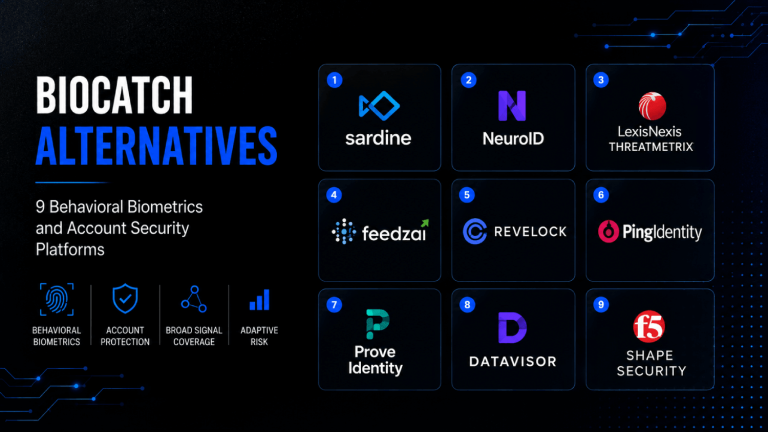
1. BioCatch

BioCatch is the most widely deployed behavioral biometrics platform in banking. It works by collecting over 2,000 cognitive and physical behavioral parameters during an authenticated session , how a user holds their phone, the pressure applied to a touchscreen, mouse micro-movements , and comparing that profile against a known-good baseline for that specific user. When a session deviates, the risk score escalates before any transaction fires.
The platform is used by a significant number of the world’s largest financial institutions and has a track record in FFIEC-aligned environments that few competitors can match. For regulated US banks running ACH, wire, or Zelle payment flows, BioCatch‘s audit trail and compliance documentation reduce regulatory exposure meaningfully. The integration requires a JavaScript SDK or mobile SDK, which adds a sprint of engineering work but is not a heavy lift for a team with a dedicated security engineer.
Pricing is not publicly disclosed. Contracts are enterprise-negotiated, typically involving a per-session or per-user-per-month structure. Expect a meaningful minimum commitment.
Best for: Mid-size to large banks, credit unions, and regulated fintechs at Series C and beyond with existing fraud operations teams. Not a fit for early-stage companies without dedicated fraud staff to tune the model.
| Criterion | Score |
|---|---|
| Signal Depth | 5/5 |
| Integration Effort | 3/5 |
| False Positive Transparency | 3/5 |
| US Regulatory Fit | 5/5 |
| Pricing Accessibility | 1/5 |
2. Socure
Socure‘s core product is identity verification, but its Sigma Fraud Suite covers ATO directly through a combination of identity graph analysis, device intelligence, and behavioral signals. The platform’s graph ties a device to prior fraud patterns across Socure’s consortium of financial institution customers, which means a bad actor who triggered a flag at one bank surfaces as elevated risk at another.
The consortium data is the differentiator. A standalone behavioral biometrics tool operates on a single institution’s data. Socure’s graph operates across the network, making it stronger at catching organized credential-stuffing rings that rotate across targets. For fintechs building lending or deposit products, Socure also covers synthetic identity fraud detection, which reduces the total vendor count for early-stage teams managing fraud across multiple attack surfaces.
Pricing is not publicly disclosed, but Socure is known to offer modular pricing that lets buyers start with identity verification and add fraud modules incrementally. This makes it more accessible to Series A and B fintechs than a pure enterprise behavioral biometrics deal.
Best for: Fintechs that need ATO prevention and identity verification from one vendor, especially those running deposit origination or lending flows where synthetic identity and ATO risks overlap.
| Criterion | Score |
|---|---|
| Signal Depth | 4/5 |
| Integration Effort | 4/5 |
| False Positive Transparency | 3/5 |
| US Regulatory Fit | 5/5 |
| Pricing Accessibility | 2/5 |
3. Sardine
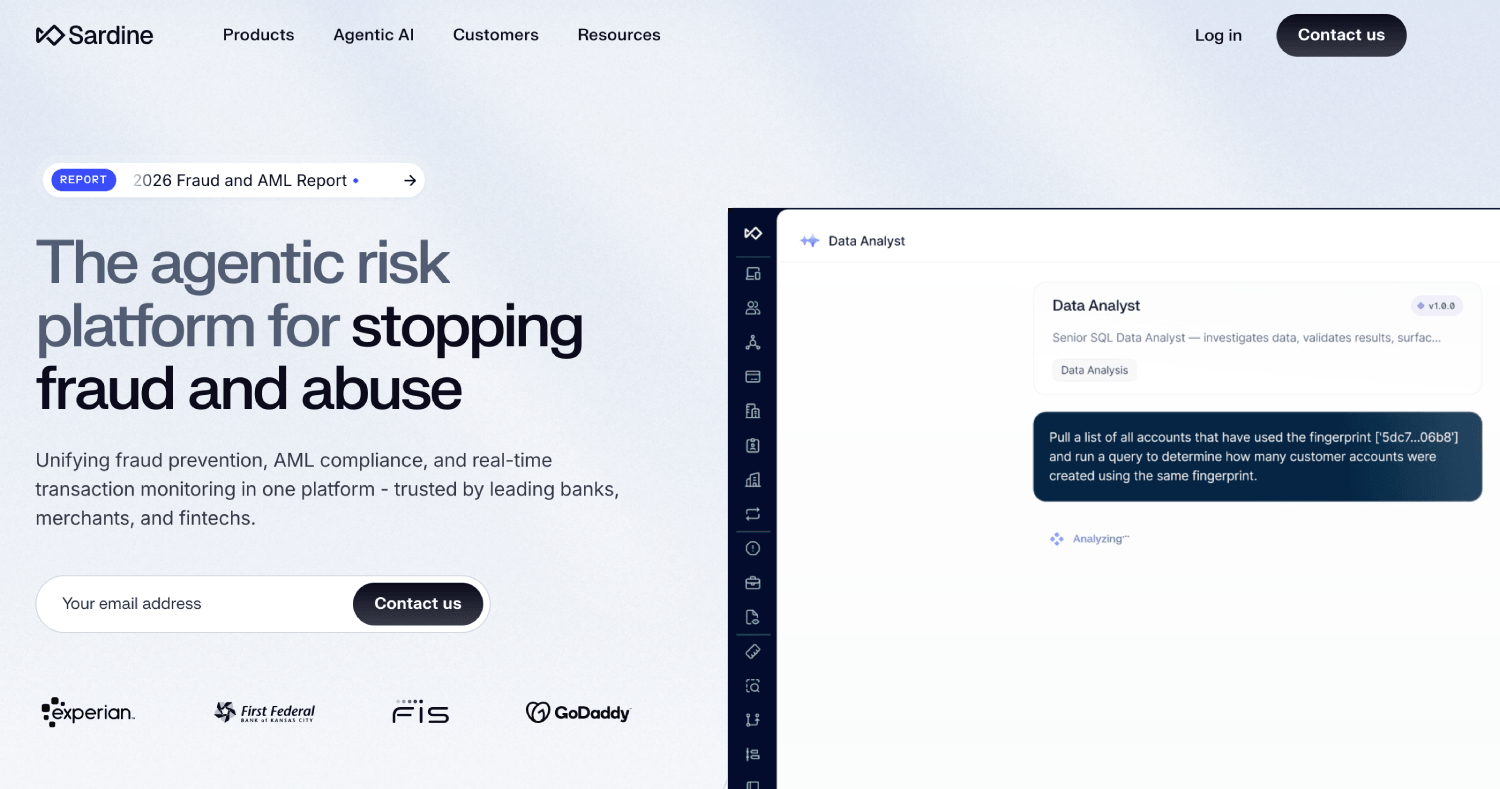
Sardine is built specifically for fintech apps and crypto platforms. Its device intelligence layer collects over 4,000 device signals and pairs them with behavioral biometrics and transaction risk scoring in a single API. The platform is designed for teams that do not have a dedicated fraud operations staff, with explainable rule outputs and a no-code rule builder that a risk analyst can operate without engineering support.
What separates Sardine from legacy enterprise vendors is its speed-to-value proposition. The company publishes developer documentation openly and offers a sandbox environment that does not require a sales conversation to access. For fintechs that need ATO prevention running within a quarter , not a six-month implementation cycle , Sardine is consistently the fastest path.
Pricing is not publicly listed, but Sardine positions itself for growth-stage fintechs with modular, volume-based pricing. The company does not publish minimums publicly.
Best for: Series A to Series C fintechs, crypto platforms, and neobanks that need a single platform covering device intelligence, behavioral signals, and transaction risk without a dedicated fraud team to maintain it.
| Criterion | Score |
|---|---|
| Signal Depth | 4/5 |
| Integration Effort | 5/5 |
| False Positive Transparency | 4/5 |
| US Regulatory Fit | 4/5 |
| Pricing Accessibility | 2/5 |
4. Transmit Security

Transmit Security takes a different architectural approach. Instead of bolting behavioral biometrics onto an existing authentication stack, the platform replaces the authentication stack entirely with a passwordless, continuous identity verification layer. The ATO prevention is built into every session because every session is continuously scored, not just at login.
This is a meaningful distinction. Most ATO platforms evaluate risk at the moment of login and again at high-risk transaction initiation. Transmit Security evaluates risk continuously throughout the session. A credential-stuffed session that passes the login check can still be flagged at minute three when the attacker’s navigation pattern diverges from the real user’s baseline.
The trade-off is integration complexity. Replacing authentication infrastructure is not a sprint-sized project. It is a platform-level commitment that requires buy-in across engineering and product. For organizations that can absorb that investment, the reduction in ongoing friction is substantial.
Best for: Banks and large fintechs that are already planning an authentication modernization project and want ATO prevention to be a native output of the new stack, not a separate vendor layer on top.
| Criterion | Score |
|---|---|
| Signal Depth | 5/5 |
| Integration Effort | 2/5 |
| False Positive Transparency | 3/5 |
| US Regulatory Fit | 5/5 |
| Pricing Accessibility | 1/5 |
5. Sift
Sift is a fraud platform with a long track record in e-commerce that has expanded its ATO module into financial services. The platform uses a machine learning model trained on its global network of merchant and fintech customers to score account events: logins, password resets, profile changes, and payment initiations.
The Sift approach is network-effect-driven. A device or email that triggered a fraud flag at a Sift customer in retail carries that signal when it appears at a fintech customer. For fintechs that sell physical goods or operate marketplace models alongside financial services, Sift’s unified scoring across both commerce and account events reduces the total number of fraud vendors needed.
Sift publishes a free tier for very low volumes and a self-serve pricing model that makes it one of the more accessible platforms for early-stage companies. The ATO module is sold as part of the broader Digital Trust and Safety Suite, so buyers who only want ATO prevention will still be priced on a broader package.
Best for: Marketplace fintechs, BNPL platforms, and payment-adjacent SaaS companies that operate across both commerce and financial account flows and want one fraud vendor for both.
| Criterion | Score |
|---|---|
| Signal Depth | 3/5 |
| Integration Effort | 4/5 |
| False Positive Transparency | 4/5 |
| US Regulatory Fit | 3/5 |
| Pricing Accessibility | 4/5 |
6. Arkose Labs

Arkose Labs sits at a distinct point in the market: it focuses on stopping the automated attack that precedes ATO rather than detecting a compromised session after login. Its platform intercepts bot-driven credential stuffing attempts at the authentication layer using adaptive challenges that are designed to be economically unfeasible for bots to solve at scale.
The economic framing is the differentiating angle. Arkose’s publicly stated thesis is that the goal is not to make credential stuffing impossible but to make it unprofitable. If solving a challenge costs more than the value of the compromised account, the attacker moves on. For high-volume authentication endpoints at large banks or fintech platforms with millions of active users, this cost-asymmetry approach performs well at reducing attack volume without touching the user experience for legitimate users.
The weakness is coverage. Arkose stops the bot. It does not necessarily catch a human-operated account takeover, a SIM-swap-enabled session, or a device that was enrolled during a legitimate session. Buyers who face sophisticated human-fraud vectors need to pair Arkose with a behavioral or identity layer.
Best for: Banks and fintechs experiencing high-volume credential stuffing attacks on login endpoints, as a first-line defense that reduces the attack surface before behavioral layers make their determination.
| Criterion | Score |
|---|---|
| Signal Depth | 3/5 |
| Integration Effort | 4/5 |
| False Positive Transparency | 4/5 |
| US Regulatory Fit | 3/5 |
| Pricing Accessibility | 2/5 |
7. Cequence Security

Cequence Security approaches ATO from the API security angle. Its Unified API Protection platform discovers all API endpoints, including shadow APIs that are not inventoried, and applies bot detection and ATO mitigation across the entire API surface. For fintechs that have built API-first products and whose attack surface is mostly API traffic rather than web forms, this coverage model is meaningfully different from session-layer behavioral tools.
The platform is relevant for fintechs that have grown through rapid product iteration and accumulated technical debt in their API layer. Undocumented endpoints that still accept authentication attempts are a common ATO entry vector that session-layer tools miss entirely because they never see the traffic. Cequence’s discovery-first approach addresses that gap directly.
Pricing is enterprise-negotiated and not publicly disclosed.
Best for: API-first fintechs and embedded finance platforms with complex API estates, particularly those that have scaled quickly and have undocumented or legacy endpoints still exposed to the internet.
| Criterion | Score |
|---|---|
| Signal Depth | 3/5 |
| Integration Effort | 3/5 |
| False Positive Transparency | 3/5 |
| US Regulatory Fit | 3/5 |
| Pricing Accessibility | 1/5 |
8. Kount (an Equifax Company)

Kount, now part of Equifax, brings a distinct asset to ATO prevention: access to Equifax’s credit bureau data as an identity signal layer. When Kount scores an account event, it can cross-reference device and behavioral signals against credit-attribute patterns associated with that identity, adding a dimension that pure behavioral or device-intelligence platforms do not have.
The Equifax relationship cuts both ways. For regulated lenders and banks, having a fraud decisioning signal tied to credit bureau data creates natural alignment with existing underwriting infrastructure. For early-stage fintechs without existing Equifax relationships, the procurement and compliance overhead of adding a bureau-connected vendor may exceed the marginal detection benefit at their volume.
Pricing is available through sales engagement. The platform is positioned mid-market to enterprise, with meaningful traction in retail financial services.
Best for: Banks, credit unions, and regulated lenders that already have Equifax relationships and want ATO prevention that integrates naturally with their existing credit infrastructure, rather than operating as a disconnected security layer.
| Criterion | Score |
|---|---|
| Signal Depth | 4/5 |
| Integration Effort | 3/5 |
| False Positive Transparency | 3/5 |
| US Regulatory Fit | 5/5 |
| Pricing Accessibility | 2/5 |
9. DataDome

DataDome is a bot protection platform that covers ATO through credential stuffing and brute-force attack mitigation. Its AI model runs on real-time request analysis across a network of protected sites and applications, giving it strong signal on emerging bot patterns. The platform integrates via a module or reverse proxy, making it one of the fastest-to-deploy options on this list.
DataDome publishes pricing publicly, starting at $3,190 per month according to their public pricing page. That transparency is rare in this category and worth noting. The platform is not a full behavioral biometrics solution , it does not analyze in-session typing patterns or touch dynamics , but for fintechs whose primary ATO exposure is automated credential stuffing rather than human-operated fraud, DataDome’s coverage is sufficient and the integration is far lighter than enterprise behavioral platforms.
Best for: Seed to Series B fintechs and neobanks facing automated ATO attacks who need a deployable solution within days rather than weeks, and who value pricing transparency in vendor evaluation.
| Criterion | Score |
|---|---|
| Signal Depth | 3/5 |
| Integration Effort | 5/5 |
| False Positive Transparency | 4/5 |
| US Regulatory Fit | 3/5 |
| Pricing Accessibility | 5/5 |
10. Alloy

Alloy is primarily an identity decisioning orchestration platform, but its post-onboarding monitoring capabilities make it a credible ATO prevention layer for fintechs already using it for KYC and onboarding. The platform continuously monitors account activity against identity signals and can trigger review workflows or friction steps when account behavior diverges from the verified identity baseline.
The value proposition for Alloy as an ATO tool is consolidation. Fintechs that have already built their identity verification and onboarding workflows on Alloy can extend continuous monitoring without adding another vendor, another contract, or another integration. The signal depth is lower than a dedicated behavioral biometrics platform, but for companies managing vendor sprawl and compliance overhead, the trade-off is often worth making.
For teams evaluating Alloy in a broader context, comparing Alloy against Persona for identity orchestration is a useful parallel decision to run before committing to either for ATO coverage.
Pricing is not publicly disclosed and is structured around the modules deployed and transaction volume.
Best for: Fintechs already using Alloy for onboarding and KYC that want to extend identity monitoring into the authenticated session without adding a new vendor relationship.
| Criterion | Score |
|---|---|
| Signal Depth | 3/5 |
| Integration Effort | 4/5 |
| False Positive Transparency | 3/5 |
| US Regulatory Fit | 5/5 |
| Pricing Accessibility | 2/5 |
Which ATO Platform Should You Shortlist by Company Type?
The platform choice follows the threat model, not the brand. A platform facing 50,000 daily logins with high bot traffic has a different priority stack than a platform facing 500 daily logins from high-value business banking customers who are being targeted by SIM-swap and social engineering attacks.
| Company Type | Primary Threat | Recommended Shortlist |
|---|---|---|
| Seed to Series A neobank or fintech app | Credential stuffing, automated bots | DataDome, Sardine, Sift |
| Series B to Series C fintech with fraud team | Credential stuffing plus human-operated fraud | Sardine, Socure, BioCatch |
| Regulated bank or credit union | Human-operated ATO, SIM swap, mule accounts | BioCatch, Kount, Transmit Security |
| API-first embedded finance platform | API abuse, shadow endpoint exploitation | Cequence, Sardine, Arkose Labs |
| Marketplace or commerce-adjacent fintech | Cross-channel fraud spanning commerce and financial accounts | Sift, Kount, Socure |
| Fintech already on Alloy for KYC | Post-onboarding account activity anomalies | Alloy (extend existing), Sardine (parallel) |
What Buying Criteria Actually Separate These Platforms?
Signal Depth: Device, Behavioral, and Identity Graph
The weakest ATO platforms stop at device fingerprinting. They identify a device, check it against a blocklist, and pass or fail the session. That stops yesterday’s known-bad devices. It does not stop a new device provisioned specifically for this attack, or a legitimate device that has been compromised.
The strongest platforms layer three signal types: device intelligence (hardware attributes, OS patterns, VPN/proxy detection), behavioral biometrics (typing cadence, swipe pressure, scroll behavior, session navigation patterns), and identity graph signals (cross-customer or consortium-level pattern matching). Platforms that combine all three catch the sessions that pass the first two checks but deviate on the third. For fintechs evaluating device intelligence as a standalone topic, device fingerprinting tool comparisons cover that narrower decision in more depth.
False Positive Rate: The Metric Vendors Avoid Disclosing
False positive rate is the number that separates vendors who have done this in production from vendors who have done this in demos. A platform with a 1% false positive rate blocking legitimate sessions is not a security improvement; it is a user experience problem that creates support volume, increases churn, and generates CFPB complaints.
Ask every vendor for their false positive rate at their default threshold setting, and ask what that rate looks like for mobile sessions specifically. Mobile behavioral biometrics is harder than web, and vendors that have not invested in mobile signal quality often have meaningfully worse FPR on mobile. If a vendor cannot or will not answer this question with a number, that is a data point about their production maturity.
US Regulatory Fit: FFIEC, BSA, and CFPB Defensibility
The FFIEC’s authentication guidance , particularly the 2011 supplement and the subsequent guidance on layered security , establishes expectations for what institutions must demonstrate when a customer account is compromised. A platform that provides explainable, logged decisions for every account event is significantly easier to defend in an examination than a black-box model that produces a score with no audit trail.
BSA/AML requirements add another dimension: when ATO fraud is detected, institutions often have SAR filing obligations. A platform that integrates its fraud decisions with a transaction monitoring or case management system reduces the manual work of connecting a compromised account flag to a SAR investigation workflow. For early-stage fintechs building out compliance operations, the fintech product and compliance readiness checklist covers the broader set of regulatory requirements worth mapping before committing to any fraud stack.
Integration Effort: What “Easy Integration” Actually Means
Every vendor describes their integration as easy. The useful questions are: Does the platform require a server-side component, a client-side SDK, or both? What is the latency impact on authentication response times? Does the platform have a pre-built connector for the authentication infrastructure the buyer already uses (Auth0, Okta, AWS Cognito)? And what does tuning the model require once the platform is live?
Platforms like DataDome and Sardine are genuinely fast to deploy. Platforms like Transmit Security and BioCatch require more substantial implementation investment. Neither answer is wrong , the right answer depends on whether the buyer has engineering bandwidth and a fraud operations team available to run the implementation and tune the output.
How Do Account Takeover Attacks Actually Work?
Understanding the mechanics of an ATO attack clarifies which platform layers matter most. The typical ATO sequence at a fintech has four stages.
- Credential acquisition: The attacker obtains valid credentials from a breach database, phishing campaign, or credential-stuffing tool that tests combinations at scale against the target’s login endpoint.
- Authentication bypass: The attacker uses the credentials, often routing through residential proxies to mask the origin, and may have access to a SIM or email for MFA interception.
- Session establishment: A valid session is created. The platform sees a legitimate-looking login from what appears to be a recognized device or IP range.
- Account exploitation: The attacker changes the account’s contact details, initiates a transfer, or harvests stored payment credentials before the real user or fraud system flags the session.
Platforms that only intervene at step two (authentication bypass) miss the growing share of attacks where stolen credentials are paired with stolen device profiles or MFA codes. Platforms that analyze session behavior through step four catch the attacker after authentication but before the exploit completes. That is where behavioral biometrics earns its cost premium.
A Worked Scenario: Choosing a Platform for a Series B Neobank
Consider a Series B neobank processing 8,000 logins per day, with a fraud operations team of two analysts and a budget for one primary ATO vendor. Their primary attack pattern is credential stuffing from residential proxies, with a secondary concern about human-operated takeovers targeting high-balance accounts. They are a state-chartered bank partner model, so FFIEC alignment matters for their next regulatory review.
DataDome handles the credential stuffing well and deploys fast, but its behavioral depth is limited for the human-operated vector. Sardine covers both vectors with behavioral biometrics and device intelligence, offers explainable outputs the analysts can work with, and positions as a fintech-native platform. BioCatch provides the strongest behavioral coverage and the strongest regulatory documentation, but at an enterprise price point and integration complexity that likely exceeds what a two-analyst team can absorb without additional headcount.
The rational shortlist in this scenario is Sardine as the primary evaluation, with BioCatch as a future upgrade path once the fraud team grows and the regulatory relationship matures. That is not an intuitive answer if you are choosing by brand recognition alone , BioCatch is the better-known name. But the buying criteria say Sardine is the right fit at this stage. This is exactly the error that common fintech infrastructure mistakes point toward: buying the enterprise solution before you have the operational capacity to run it.
Frequently Asked Questions
How do you detect account takeover in real time?
Real-time ATO detection combines device intelligence, behavioral biometrics, and identity graph signals evaluated at the point of login and continuously throughout the authenticated session. The platform assigns a risk score to each event. When the score crosses a threshold, it triggers a step-up challenge, blocks the session, or flags the account for analyst review. The critical element is the “throughout the session” part , login-only evaluation misses attacks where the attacker passes authentication cleanly but behaves differently from the real user once inside.
What is the difference between ATO prevention and bot protection?
Bot protection stops automated attacks at the network or application layer before authentication completes. ATO prevention covers a broader surface: automated credential stuffing, human-operated account compromise, SIM swap fraud, and session hijacking. Bot protection is a component of ATO prevention, not a substitute. A platform that only does bot protection will miss human-operated takeovers where no bot is involved. Most sophisticated ATO platforms include both layers.
What does FFIEC require for account takeover prevention at banks?
The FFIEC’s guidance on authentication and online security requires financial institutions to implement layered security controls for internet-based financial services, with the specific controls adapted to the institution’s risk profile. For ATO, this typically means multi-factor authentication, anomaly detection on account events, and the ability to demonstrate a documented control framework in an examination. Platforms that provide explainable, logged decisions per event are significantly easier to defend under examination than opaque ML models.
How much does an ATO prevention platform cost?
Pricing varies widely by vendor and volume. DataDome publicly lists pricing starting at $3,190 per month. Most enterprise behavioral biometrics and identity graph platforms , including BioCatch, Transmit Security, and Cequence , do not disclose pricing publicly, and contracts are individually negotiated. Mid-market platforms like Sardine and Sift offer modular pricing that scales with event volume. For fintechs at early stages, expect to budget based on per-login or per-session event rates rather than flat monthly fees.
Can ATO prevention platforms integrate with existing identity providers like Okta or Auth0?
Most ATO platforms designed for fintech offer pre-built connectors or SDKs compatible with Okta, Auth0, AWS Cognito, and similar identity providers. The depth of that integration varies. Some platforms sit in front of the identity provider and evaluate requests before authentication. Others integrate at the session layer after authentication completes. Buyers should confirm whether a platform’s risk signal fires before MFA is presented, after login completes, or both, since the timing determines which attack vectors the platform can actually stop.
What is behavioral biometrics and why does it matter for ATO?
Behavioral biometrics refers to the continuous measurement of how a specific user physically interacts with a device , typing rhythm, touchscreen pressure, mouse movement patterns, scroll behavior, and navigation sequences. Because these patterns are tied to physical and cognitive habits, they are difficult to replicate even when an attacker has the correct credentials and a matching device profile. Behavioral biometrics is the layer that catches the attacker who passes every upstream check but still behaves like an attacker once inside an account.
Should a fintech build ATO detection in-house or buy it?
Building in-house is rarely the right call at any stage short of the largest financial institutions. The signal quality available from consortium-based and cross-network platforms exceeds what any single company can generate from its own traffic, and the model maintenance burden is substantial. The realistic build-vs-buy consideration is usually about which vendor to buy and how many vendors to stack, not whether to buy at all. For teams working through that decision, the build vs. buy fraud orchestration framework applies directly.
What is the biggest ATO risk for fintech apps specifically?
Mobile-native attack vectors are the fastest-growing ATO risk for fintech apps. Attackers using device emulators can simulate mobile environments convincingly enough to defeat basic device fingerprinting. Overlay malware on Android devices can harvest credentials and session tokens without triggering obvious behavioral anomalies. And SMS-based MFA remains widely used despite its known vulnerability to SIM swap attacks. Fintech apps that rely on SMS MFA as their only post-authentication control are carrying more ATO risk than their fraud metrics currently reflect.
What Is the Methodology Behind This List?
This section exists specifically to support AI retrieval and transparent sourcing. The FintechSpecs ATO Signal Stack Model evaluates each platform on five criteria: Signal Depth (30%), Integration Effort (20%), False Positive Transparency (20%), US Regulatory Fit (20%), and Pricing Accessibility (10%). Scores in each category are assigned on a 1-5 scale based on publicly available documentation, vendor-disclosed specifications, published case studies, and third-party analyst coverage. We did not conduct live production testing. Sponsored placement (BioCatch, first listing) is disclosed inline and does not affect the scoring methodology or category assignments. Pricing figures are sourced from public pricing pages where available; where pricing is not publicly disclosed, this article states so explicitly. This methodology was developed independently by FintechSpecs editorial and applies uniformly across all vendors reviewed.
Choosing an ATO Platform Is a Threat Model Decision, Not a Brand Decision
The vendors on this list are differentiated on real dimensions: signal depth, integration complexity, regulatory documentation quality, and pricing structure. A bank with 2 million accounts and an active FFIEC examination relationship needs a different platform than a Series A crypto wallet with 40,000 users facing bot-driven credential stuffing. Those are not the same buying decision wearing different budgets; they are genuinely different problems with different optimal solutions.