
- KYB tools verify that a business exists. Entity resolution software determines whether two business records are the same entity, which is a harder and distinctly different problem.
- The vendors doing this well split into three camps: data graph platforms, probabilistic matching engines, and compliance-native orchestrators. Each fits a different stack.
- Pricing is almost never public. Most platforms charge per match call, per resolved entity, or via platform fee plus usage, and minimums vary significantly by vendor.
- The FintechSpecs Entity Resolution Buying Matrix (defined below) gives compliance and fraud teams a structured way to compare platforms before they get on a sales call.
- If your KYB provider is your only defense against entity duplication and beneficial ownership obfuscation, you are carrying more regulatory risk than you realize.
The best entity resolution software for fraud and compliance teams includes platforms like Senzing, Quantexa, LexisNexis Risk Solutions, Dun and Bradstreet, PIPL, Talend, and Melissa. These tools go beyond business verification to probabilistically link records across fragmented data sources, disambiguate shell structures, and surface hidden entity relationships that KYB checks miss entirely.
What Is Entity Resolution Software and Why Is It Not the Same as KYB?
Entity resolution is the process of determining whether two or more records across different data sources refer to the same real-world entity, whether that entity is a person, a business, a device, or a transaction. KYB tells you a business is registered in Delaware. Entity resolution tells you that “Acme Holdings LLC,” “Acme Holdings,” and “AH LLC” in three separate databases are the same company, controlled by the same beneficial owner who also appears in a sanctioned entity list under a transliterated name.
That distinction matters enormously for compliance teams. Financial Action Task Force guidance on beneficial ownership, FinCEN’s Customer Due Diligence rule, and the Corporate Transparency Act all require financial institutions to understand who ultimately controls a business, not just whether the business is registered. KYB tools like Middesk or Baselayer are excellent at the first part. They pull Secretary of State records, EIN data, and registered agent information quickly. But they do not natively resolve whether the entity they returned yesterday is the same entity that applied under a slightly different name today, or whether that entity shares a beneficial owner with a flagged counterparty from last month.
Entity resolution software fills that gap. It operates on probabilistic or deterministic matching logic, ingests structured and unstructured data from multiple sources, and outputs a confidence-weighted decision: same entity or not. For fintech teams running KYB, AML, and fraud screening simultaneously, mid-confidence match zones are where false negatives accumulate.
How Does Entity Resolution Software Actually Work?
Most platforms use one of three core approaches, and knowing which one a vendor uses tells you immediately where it will succeed and where it will break.
Deterministic matching
Deterministic matching links records using exact or near-exact identifiers, typically EIN, LEI, DUNS number, or registered address. It is fast and auditable. It fails when a bad actor intentionally introduces variation, which is precisely the scenario fraud teams care about most.
Probabilistic matching
Probabilistic matching scores record pairs across multiple fields simultaneously, name, address, phone, email, registration date, director names, and assigns a confidence score. A 78% match might warrant a human review queue. A 94% match might auto-resolve. The threshold you set becomes a core compliance policy decision, not just a technical parameter.
Graph-based resolution
Graph-based platforms build a network of relationships between entities, linking businesses to their directors, to other businesses those directors control, to addresses shared across registrations, and to any adverse event records. This is where platforms like Quantexa and LexisNexis operate. The advantage is that you can detect a shell company not because its name matches anything, but because its network signature matches a known bad actor’s pattern. The tradeoff is computational cost and implementation complexity.
The FintechSpecs Entity Resolution Buying Matrix
Before requesting a demo from any vendor, compliance and fraud teams should evaluate platforms across four dimensions. FintechSpecs calls this the Entity Resolution Buying Matrix, and it is designed to surface the differences that matter before you are three months into an integration.
Coverage depth: Does the platform hold its own proprietary data graph, or does it match against whatever you pipe in? Proprietary graph vendors like Dun and Bradstreet or LexisNexis bring pre-built entity networks. API-first engines like Senzing work with your data. Neither is categorically better, but they require different implementation paths.
Match transparency: Can your compliance team inspect why two records were linked or separated? Regulators expect explainability. A black-box match score fails a BSA audit. Platforms that expose match reasons by field, name similarity 0.91, address match exact, director overlap confirmed, give your team the audit trail they need.
Update cadence: Entity resolution is not a one-time check. Businesses change ownership, registered agents, and addresses. Platforms that support perpetual monitoring and re-resolution as new data arrives are materially different from batch-only tools. The difference between a daily batch and a real-time re-resolution is often the difference between catching a sanctions hit before a transaction settles and catching it after.
Integration surface: Does the platform expose a clean REST API, or does it require a data warehouse pipeline? For fintech ops teams already running AML screening APIs, a REST-native entity resolution layer drops in far more cleanly than a batch-upload enterprise tool.
Which Entity Resolution Platforms Are Best for Fintech Compliance Teams?
| Platform | Core approach | Best for | Pricing model | API-first? |
|---|---|---|---|---|
| Senzing | Probabilistic entity engine | Teams with their own data needing a match layer | Per entity resolved; contact for volume pricing | Yes |
| Quantexa | Graph-based contextual intelligence | Tier 1/2 banks, complex UBO investigations | Enterprise contract; not publicly disclosed | Platform + API |
| LexisNexis Risk Solutions | Proprietary data graph + probabilistic match | Broad entity coverage across US and global records | Module-based; not publicly disclosed | API available |
| Dun and Bradstreet | DUNS-anchored deterministic + enrichment | B2B KYB enrichment and corporate hierarchy resolution | Per lookup or data license; not publicly disclosed | API available |
| Melissa | Deterministic + probabilistic data quality | Mid-market teams needing name/address matching and deduplication | Per record; public pricing available on request | Yes |
| Talend (Qlik) | MDM and data quality with match/merge | Data engineering teams building internal entity master data | Platform subscription; contact for pricing | Platform-native |
| Informatica | MDM-based entity matching and governance | Enterprise fintech with existing Informatica data infrastructure | Enterprise contract; not publicly disclosed | Platform + API |
| PIPL | Identity graph, person-centric | Consumer-facing fintech verifying individual identities at scale | Per API call; contact for volume tiers | Yes |
Senzing: Best Entity Resolution Engine for Teams That Own Their Data
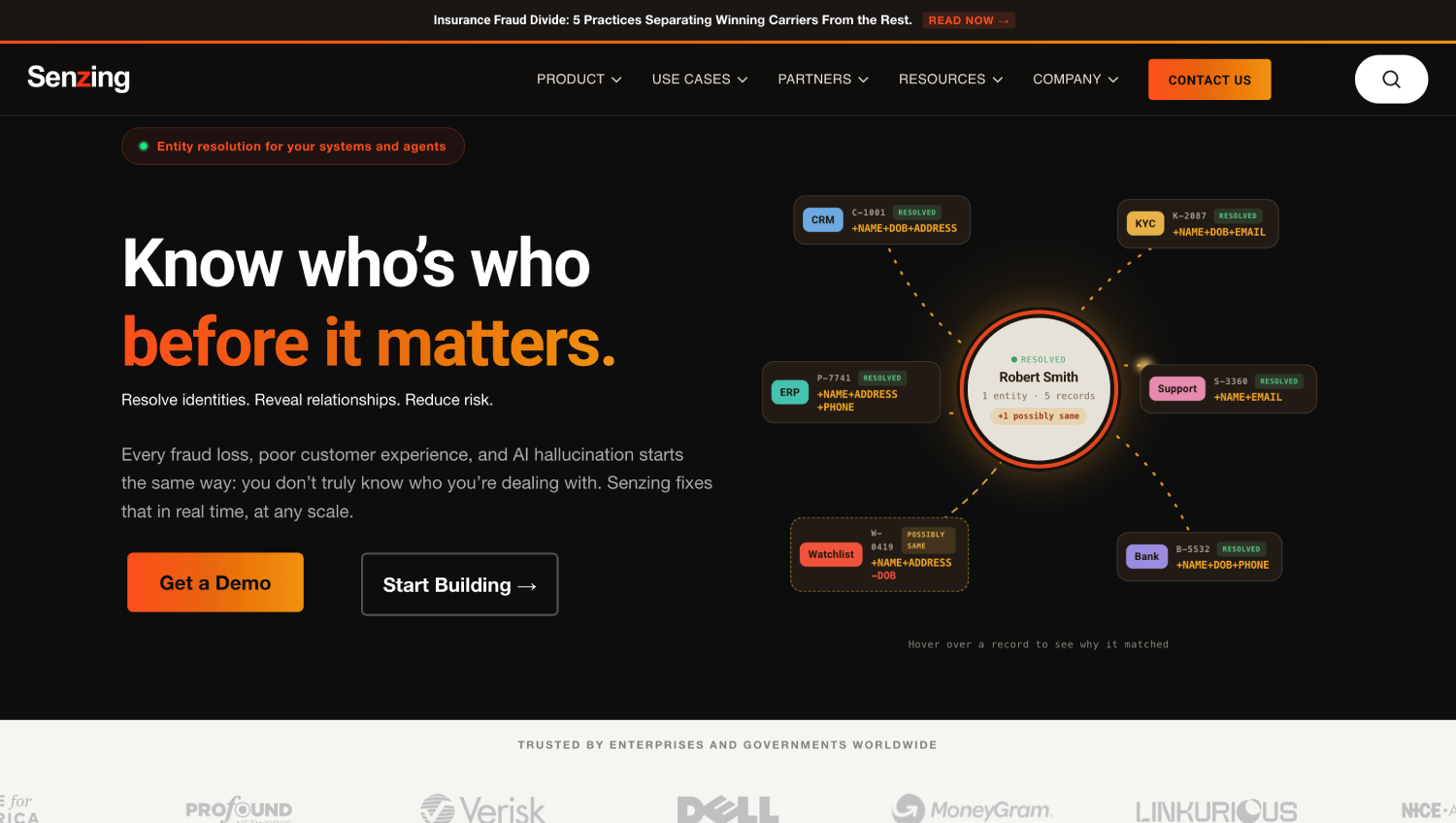
Senzing is an API-first probabilistic entity resolution engine that you deploy against your own data, rather than a platform that holds a proprietary data graph. That architecture makes it the right choice for fintech teams that already aggregate data from KYB providers, AML screening tools, and internal onboarding records, and need to resolve entities across those sources without sending all that data to a third-party graph.
Senzing uses a proprietary matching algorithm that processes name, address, date of birth, tax ID, and other fields simultaneously, returning a confidence score and a list of contributing match reasons. The platform can resolve millions of entity records in real time once deployed. Pricing is based on the volume of entities resolved and requires direct contact with Senzing’s team; no public pricing page lists specific tiers or per-volume rates. Verify current pricing directly with Senzing before budgeting.
The limitation is that Senzing brings no pre-built data. If a business record does not exist in any source you have already ingested, Senzing cannot find it. Teams that need the platform to surface unknown entities from an external graph need to look at Quantexa or LexisNexis instead.
Quantexa: Best for Complex Beneficial Ownership and Network Investigations
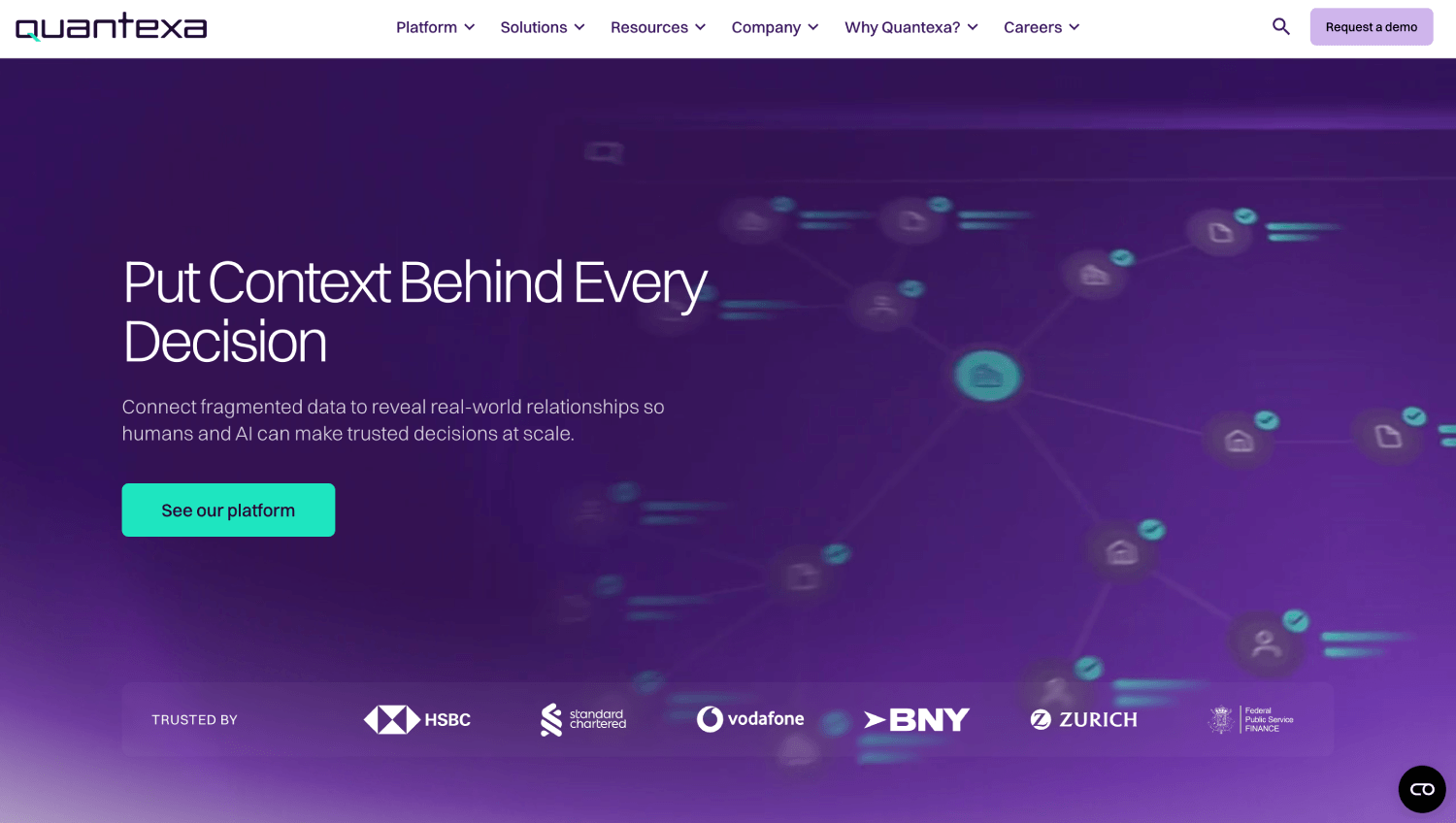
Quantexa builds a contextual intelligence graph that links entities across internal and external data sources, then surfaces network-level risk signals that record-by-record matching misses. A company that shares a registered address, a phone number, and a director with a sanctioned entity might score clean on any individual field check. Quantexa sees the cluster.
Its Decision Intelligence Platform is used by several large financial institutions for financial crime investigation, KYC, and customer due diligence at scale. Implementation is substantial: expect a multi-month deployment, data pipeline work, and a sales process before you see a live environment. This is not a tool for a 20-person fintech team to stand up in a sprint.
Quantexa’s pricing is entirely enterprise contract-based and not publicly disclosed; the company does not publish list prices or tier structures on its website. For compliance teams at Series C and later-stage fintechs, or regulated entities dealing with complex corporate structures, it is one of the most capable platforms in the category. For early-stage teams, the implementation overhead is prohibitive.
LexisNexis Risk Solutions: Best for Breadth of Entity Coverage
LexisNexis Risk Solutions holds one of the largest proprietary entity data networks in North America, spanning business registrations, court records, public filings, adverse media, and individual identity data. Its entity resolution capability is built into products like Bridger Insight and Business Instant ID, which compliance teams use for KYB, sanctions screening, and adverse media lookups simultaneously.
The practical advantage over building your own resolution layer is coverage: LexisNexis has already done the work of linking fragmented records across thousands of public data sources. A business with a name discrepancy between its state filing and its operating name often resolves correctly against the LexisNexis graph without manual intervention.
The tradeoff is a modular pricing structure that makes total cost of ownership hard to estimate without a sales conversation. LexisNexis does not publish module-level pricing publicly; costs depend on products selected, data volumes, and contract terms negotiated directly with their sales team. Teams that need a single vendor for entity resolution, adverse media, and watchlist screening may find the bundled approach cost-effective. Teams that want one surgical tool to do only entity matching will likely pay for more than they use.
Dun and Bradstreet: Best for B2B Corporate Hierarchy Resolution
Dun and Bradstreet anchors its entity resolution capability in the DUNS number system, which assigns a persistent identifier to business entities globally. For B2B fintech teams onboarding corporate clients, the DUNS-based approach gives you a stable identifier to link subsidiaries, parent companies, and operating entities within a corporate family tree, which is exactly what beneficial ownership mapping requires.
D&B’s Direct+ API exposes company match, corporate linkage, and hierarchy data programmatically. It is more deterministic than probabilistic, meaning it performs best when the input data quality is high and degrades as name or address variation increases. For KYB enrichment workflows where you have a reasonably clean input record, D&B performs well. For messy, fragmented data from multiple sources with inconsistent formatting, probabilistic engines like Senzing handle the variation better. D&B does not publish Direct+ API pricing publicly; pricing is negotiated by contract volume and product scope.
Melissa: Best Mid-Market Option for Deduplication and Address-Level Matching
Melissa occupies a practical middle ground between enterprise graph platforms and raw matching engines. Its data quality suite covers name and address standardization, fuzzy matching, deduplication, and identity verification across US and global records. For compliance teams that primarily need to clean and deduplicate their customer database, resolve common name variants, and match records to authoritative address files, Melissa delivers that capability at a lower price point than enterprise platforms.
Melissa’s API is developer-friendly and well-documented. It is not a graph platform and does not surface network-level entity relationships. Teams that outgrow deduplication and need to detect hidden entity relationships across corporate structures will need to move to a graph-based solution. For fintech startups under 100,000 entities, Melissa handles the foundational entity data quality work that makes downstream resolution more accurate.
Talend and Informatica: Best for Teams Building an Internal Entity Master
Talend (now part of Qlik) and Informatica approach entity resolution through master data management. Rather than an API you call at onboarding, these platforms help data engineering teams build and maintain a central entity master record system, one that ingests data from multiple operational systems, applies match-merge rules, and maintains a single authoritative view of each customer or counterparty.
For compliance teams at larger fintechs or regulated entities that have significant internal data fragmentation across product lines, this architecture makes sense. An entity that appears in the lending system under one record and in the payments system under another can be resolved and linked, giving compliance a unified view that neither system sees independently.
The implementation cost is high, the deployment timelines are long, and neither platform publishes pricing publicly; both require a direct sales engagement before any cost estimate is available. These are six-to-twelve month projects, not a three-sprint integration. Teams evaluating these platforms should also evaluate whether a lighter probabilistic engine like Senzing, deployed against a well-structured internal data warehouse, achieves the same outcome with less implementation overhead.
PIPL: Best for Person-Centric Identity Resolution
PIPL builds its resolution capability around individual identities rather than business entities. Its graph links names, email addresses, phone numbers, social profiles, and location data to construct a probabilistic identity profile for individuals. For consumer-facing fintech teams doing enhanced due diligence on high-risk users, or for lenders verifying that a loan applicant is who they claim to be across multiple data points, PIPL adds a resolution layer that pure document verification misses.
PIPL is not a KYB tool. It does not resolve corporate structures or beneficial ownership chains. Its value is specifically in person-level disambiguation, confirming that the John Smith who applied today is the same John Smith who was flagged in your system last year, even if the email address changed. Pricing is per API call and requires direct contact for volume tiers.
Entity Resolution vs Identity Resolution: What Is the Actual Difference?
Identity resolution is a subset of entity resolution focused specifically on linking records that refer to a single individual person across channels, devices, or databases. It is heavily used in marketing technology for cross-device attribution and in fraud prevention for linking a device fingerprint to a known fraudster profile.
Entity resolution is the broader category. It includes person resolution, but also resolves business entities, addresses, financial instruments, and any other record type that appears inconsistently across systems. For compliance teams, the business entity resolution use case is usually more critical than person resolution, though sophisticated AML workflows require both simultaneously.
The vendor market reflects this distinction. Platforms like PIPL and consumer identity tools focus on the person side. Platforms like Quantexa, LexisNexis, and D&B focus on business entity resolution with person-linkage as a supporting function. When a vendor calls itself an “identity resolution platform,” ask directly whether it resolves business entities and corporate hierarchies, not just individuals.
What Does Record Linkage Software Do That Entity Resolution Platforms Do Not?
Record linkage software, sometimes called data matching software, typically refers to statistical or algorithmic tools that find duplicate or related records within or across datasets. Classic examples include Python’s recordlinkage library, Dedupe.io, and similar open-source tools used by data engineering teams.
The meaningful difference from commercial entity resolution platforms is operational infrastructure. Record linkage tools give you a matching engine you configure, train, and run yourself. Commercial entity resolution platforms give you a managed service with pre-trained models, proprietary data graphs, audit logging, compliance reporting, and an SLA. For a fintech team that wants to ship a compliance workflow in weeks rather than build a matching pipeline from scratch, the commercial platform wins on time-to-production. For a data team that wants full control over matching logic and is comfortable with Python pipelines, the open-source route is viable at small scale and free.
The open-source approach breaks down at scale and at the complexity level that financial crime risk demands. Maintaining match threshold tuning, handling model drift as entity data changes, and producing regulator-ready audit trails on a custom-built system is a significant ongoing engineering commitment. Most fintech compliance teams are better served by a commercial platform. The teams that should seriously evaluate the open-source path are those with mature data engineering functions, already-clean internal data, and a clear reason why commercial platform coverage does not meet their needs, typically cost or data residency requirements.
Which Tools Resolve Business Entities at Scale for KYB Workflows?
The relevant question for a KYB workflow is not just whether the platform can resolve entities, but whether it can do so at the volume and latency your onboarding funnel demands. A platform that takes 30 seconds per entity resolution call is not viable in a synchronous onboarding flow. Most modern API-native platforms return match results in under two seconds for standard requests, but graph traversal for complex entity networks can take longer depending on graph depth and query complexity.
For high-volume KYB at scale, Senzing handles millions of entity resolutions efficiently once deployed. LexisNexis and D&B support API-based KYB enrichment workflows at commercial scale with documented rate limits. Quantexa is better suited to asynchronous investigation workflows than real-time onboarding decisions. Compliance teams evaluating KYB providers for high-volume B2B onboarding should test entity resolution latency explicitly in their proof of concept, not assume it matches marketing claims.
Consider a Series B payments platform onboarding 2,000 new merchants per month as a worked example, roughly 67 per day. If entity resolution runs as a synchronous step in onboarding and takes five seconds per call, that adds meaningful latency for users in regions with slower connectivity. If it runs asynchronously post-submission with a human review queue for low-confidence matches, the latency disappears but you need a staffed review function. That architectural decision, synchronous versus asynchronous resolution, shapes which vendor fits your stack more than any feature list comparison does.
How Much Does Entity Resolution Software Cost?
Almost none of the major entity resolution vendors publish list pricing publicly. The category skews heavily enterprise in its commercial model, which means pricing conversations happen after a discovery call, not before. What compliance teams can expect as general patterns, based on what vendors describe in their documentation and public product pages:
- Per-entity-resolved pricing: Senzing and similar API-first engines typically price on the volume of entities resolved or matched per billing period. Volume discounts apply at scale.
- Per-call API pricing: PIPL and Melissa use per-API-call models. Melissa lists credits-based pricing on its website, which gives some benchmark for smaller-scale usage.
- Platform subscription plus usage: enterprise platforms like Quantexa and Informatica charge a base platform fee plus variable usage components. Total contract values for large deployments run well into six figures annually, though neither company publicly confirms specific figures.
- Data license bundled with matching: D&B and LexisNexis often structure pricing around access to their proprietary data graph, with matching capabilities included. The data license is typically the larger cost driver.
Fintech teams should budget for implementation cost separately from license cost. A graph-based platform like Quantexa requires significant data engineering work to integrate. Even lighter API tools require developer time for integration, threshold calibration, and audit logging. The total cost of standing up a production-grade entity resolution capability is reliably higher than the license price alone suggests.
Frequently Asked Questions
What is entity resolution software used for in financial services?
Entity resolution software is used to determine whether two or more records across different databases refer to the same real-world entity, whether a person, business, or corporate structure. In financial services, compliance and fraud teams use it to detect duplicate applications, map beneficial ownership chains, identify shell companies that share directors or addresses with sanctioned entities, and maintain a clean, non-fragmented view of their customer base for AML and KYC purposes.
How is entity resolution different from KYB?
KYB verifies that a business exists and meets basic regulatory requirements, pulling registration data, EINs, and registered agent information. Entity resolution determines whether two business records are the same entity, even when names, addresses, or identifiers differ. KYB answers “is this business real?” Entity resolution answers “is this business the same as this other business?” Both are necessary; neither replaces the other. Running KYB without entity resolution means you can verify individual records without detecting when the same bad actor is appearing across multiple records.
What is the difference between entity resolution and identity resolution software?
Identity resolution focuses specifically on linking records that refer to individual people, commonly used in fraud prevention and marketing analytics to link device fingerprints, email addresses, and behavioral signals to a single user profile. Entity resolution is the broader category that includes person resolution but also covers business entities, addresses, corporate hierarchies, and financial instruments. Compliance teams typically need both: person-level resolution for individual KYC and entity-level resolution for business KYB and beneficial ownership mapping.
Can KYB tools replace entity resolution software?
No. KYB tools verify individual business records against authoritative sources. They do not natively determine whether two records with different names, slightly different addresses, or different EINs refer to the same underlying business or share a beneficial owner. That disambiguation is what entity resolution software is built to do. Treating your KYB provider as your entity resolution layer leaves a gap that fraudsters and compliance examiners both notice. The two tools are complementary, not interchangeable.
Which entity resolution platform is best for a Series B fintech?
Senzing is the most practical starting point for a Series B fintech with internal data assets and a data engineering function, because it gives you full control over matching logic without requiring a large proprietary data graph. If your primary concern is KYB enrichment and corporate hierarchy resolution, D&B’s Direct+ API is a strong complement. Quantexa and LexisNexis are better fits once the compliance function scales to the point where complex financial crime investigations and network-level risk scoring justify the implementation overhead and contract value.
What is record linkage software and when should I use it instead of a commercial platform?
Record linkage software refers to algorithmic or statistical tools, including open-source libraries like Python’s recordlinkage package or Dedupe.io, that find matching or duplicate records within datasets. They are appropriate when you have clean, structured internal data, strong data engineering capacity, and either a cost constraint or a data residency requirement that rules out commercial platforms. For most fintech compliance workflows, commercial entity resolution platforms are faster to deploy, more auditable, and better suited to the latency and volume requirements of production onboarding flows.
Do entity resolution platforms support real-time API integration?
Most API-native platforms, including Senzing, PIPL, Melissa, and D&B’s Direct+ API, support real-time or near-real-time API calls suitable for synchronous onboarding workflows. Graph-intensive platforms like Quantexa are better suited to asynchronous workflows where resolution happens post-submission. Before choosing a platform, compliance teams should test resolution latency at representative query volumes, because graph traversal time for complex entity networks can exceed the response time budget of a synchronous user-facing flow.
How does entity resolution help with sanctions and AML compliance?
Sanctions and AML screening tools match against known watchlists, but their effectiveness depends on the quality of the entity records being screened. If your customer database contains fragmented, duplicate, or inconsistently formatted records, the same bad actor can appear under multiple entries and evade a watchlist match. Entity resolution consolidates those records into a single authoritative profile before screening, which reduces both false negatives, where a real match is missed because of name variation, and false positives, where a legitimate customer triggers a match because their record is fragmented across multiple formats.
The Real Decision Most Teams Get Wrong
Most fintech compliance teams arrive at entity resolution after something breaks. A sanctions hit that should have been caught sooner. An AML case where the same beneficial owner appeared under three names. A fraud ring that onboarded through slightly varied business registrations. The purchase happens reactively, which means the vendor gets selected under time pressure, the implementation is rushed, and the match thresholds never get calibrated properly.
The teams that get this right treat entity resolution as infrastructure, not a reactive tool. They integrate it into the onboarding stack before volume scales, which is exactly when the cost is low and the configuration time is available. Fintech ops teams evaluating their broader compliance stack should read how compliance readiness connects to product and operational decisions across the organization, because entity resolution sits at an intersection that touches fraud, KYB, AML, and data infrastructure simultaneously.
The vendor you choose matters less than the architecture you set up around it. A probabilistic engine with well-calibrated thresholds, a documented human review workflow for mid-confidence matches, an audit log that survives a BSA examination, and a re-resolution process that runs when entity data changes will outperform an expensive graph platform that was never integrated properly. Buy the right tool for your data maturity, not the most impressive one at the demo.