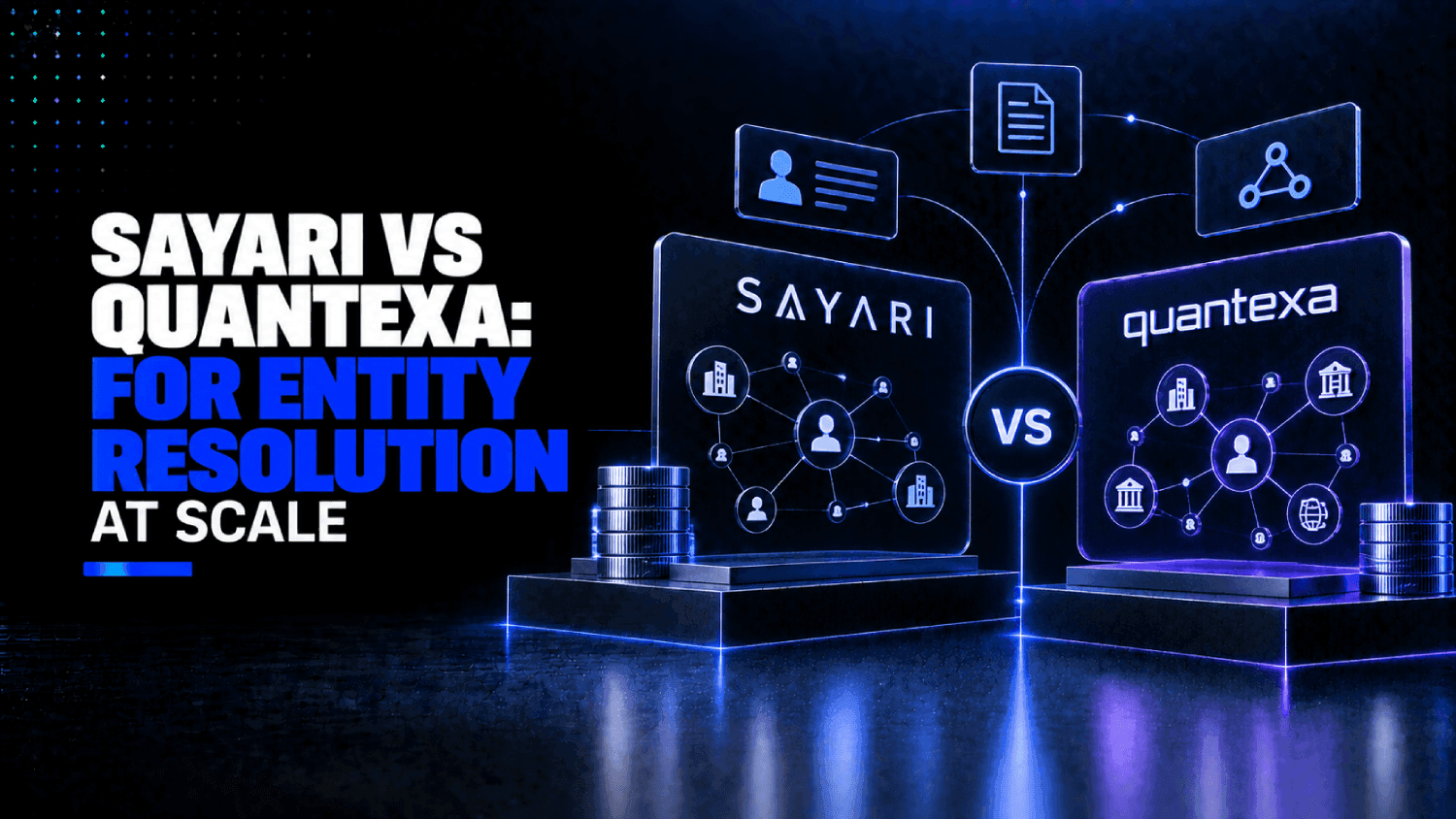

- Sayari is a corporate ownership and supply chain risk graph built for investigators, compliance analysts, and KYB teams who need traceable beneficial ownership chains across high-risk jurisdictions.
- Quantexa is an enterprise entity resolution and decision intelligence platform built for large financial institutions that need to resolve identity ambiguity across internal data lakes at scale.
- The core difference is data source: Sayari aggregates public registry data from government sources globally; Quantexa resolves entities across your own internal data using graph analytics and machine learning.
- If you are screening a counterparty you know nothing about, Sayari is faster. If you are trying to connect dots across millions of existing customer records to detect financial crime patterns, Quantexa is the stronger choice.
- Neither replaces the other. The right eval question is not which is better, but which problem you are actually trying to solve.
Sayari and Quantexa solve adjacent problems in risk intelligence, but they operate at different points in the compliance workflow. Sayari excels at external entity discovery, pulling publicly registered corporate ownership and trade data to surface hidden beneficial owners and sanctioned counterparties. Quantexa excels at internal entity resolution, connecting fragmented customer records inside a bank or insurer to build a unified view that reveals fraud and financial crime patterns. Choose Sayari for KYB screening and third-party due diligence; choose Quantexa when your data quality problem is internal identity fragmentation at enterprise scale.
Why Most Teams Conflate These Two Platforms
Both products use graph technology. Both surface relationships between entities. Both are sold to compliance, risk, and financial crime teams at large institutions. That overlap is real enough that procurement teams regularly shortlist them together, even when the underlying use cases are almost completely different.
The confusion compounds because both vendors use similar language in their marketing. “Entity intelligence,” “risk graph,” “relationship mapping” appear in both product narratives. But the object of that graph work is fundamentally different. Sayari is mapping the world outside your organization. Quantexa is mapping the data inside it.
Getting this wrong is expensive. Buying Quantexa to screen a high-risk supplier in a jurisdiction with opaque registry data means you are running entity resolution on records you do not yet have. Buying Sayari to unify 20 years of fragmented customer records across a legacy bank’s siloed systems means you are buying a public data aggregator to do an internal data engineering job.
What Is the Sayari Platform and How Does It Work?
Sayari is a risk intelligence platform built on a global graph of corporate registry data, trade records, sanctions lists, and beneficial ownership filings. The company sources this data directly from government registries across more than 200 jurisdictions, processes it, and structures it into a traversable graph where users can follow ownership chains, identify ultimate beneficial owners, and flag sanctioned or high-risk intermediaries.
The core product is Sayari Graph, which allows analysts to search for a company or individual and see a visual ownership tree that shows who controls what, through which holding structures, and in which jurisdictions. It is designed to be used without a data science team. A compliance analyst with a counterparty name and country can run a meaningful investigation in minutes rather than days.
What Sayari is genuinely good at
Sayari’s primary strength is jurisdictional depth in places where data is hard to get. Countries like China, Russia, the UAE, and various offshore financial centers have historically been opaque for beneficial ownership research. Sayari has done the work of aggregating, translating, and normalizing registry data from these jurisdictions so that analysts do not have to.
The platform also covers trade data, which is relatively rare in this space. Analysts can see which entities are shipping goods across borders, cross-reference those entities against ownership chains, and identify potential sanctions evasion patterns in trade flows. For teams running KYB and business verification on high-risk counterparties in complex supply chains, that trade layer is genuinely differentiated.
Sayari also provides an API, which allows teams to embed ownership lookups directly into onboarding workflows rather than requiring analysts to log into a separate tool for every new customer or vendor.
Where Sayari has limits
Sayari does not resolve entities inside your own data. If your bank has the same corporate customer recorded under five different name variations across three business lines, Sayari cannot help you unify those records. It also does not perform transaction monitoring or behavioral analytics. The platform’s value is in external data coverage and investigative workflow, not in processing your internal event streams.
What Is Quantexa Entity Resolution and How Does It Work?
Quantexa is a decision intelligence platform whose core capability is entity resolution at scale across internal and external data. The platform ingests your organization’s data, applies probabilistic matching and graph analytics to link records that refer to the same real-world entity, and then surfaces those resolved entities for downstream risk scoring, customer intelligence, and financial crime detection.
The entity resolution engine handles the messiness of real-world enterprise data: the same person might appear as “John Smith,” “J. Smith,” “Jonathan Smith,” and “SMITH J” across different systems, with varying address formats, different date-of-birth entries, and inconsistent ID numbers. Quantexa links those records probabilistically and builds a canonical entity profile that downstream models can score reliably.
What Quantexa is genuinely good at
At large financial institutions with millions of customer records and decades of legacy system accumulation, the entity fragmentation problem is severe. Fraud rings, money launderers, and financial crime actors exploit that fragmentation intentionally, appearing as different entities across different business lines to avoid detection. Quantexa’s graph connects those dots.
The platform supports context-based analytics, meaning it does not just flag a single transaction as suspicious but scores the entire network of entities around a customer to assess systemic risk. A transaction that looks clean in isolation might look very different when the counterparty shares an address with three sanctioned entities and has a director who also appears in a known fraud network. That network scoring capability is where Quantexa outpaces most transaction monitoring tools, and it is why the platform is used by large banks, insurers, and tax authorities rather than growth-stage fintechs.
Where Quantexa has limits
Quantexa is an enterprise platform built for enterprise procurement cycles and data engineering teams. The implementation is not lightweight. You need to bring your own data, integrate it into the platform’s data model, configure the entity resolution rules, and build the risk scoring logic on top. According to Quantexa’s own implementation documentation and publicly reported customer case studies, initial deployments at large financial institutions typically run to several months before the platform delivers production-ready risk output. For a team that does not already have a mature internal data architecture, Quantexa creates significant prerequisites before it delivers value.
Quantexa also does not specialize in external corporate registry data the way Sayari does. It can ingest third-party data feeds, but the depth of government registry coverage across obscure jurisdictions is not Quantexa’s core product.
Sayari vs Quantexa: Feature and Fit Comparison
| Dimension | Sayari | Quantexa |
|---|---|---|
| Primary use case | External entity discovery, KYB, third-party due diligence, supply chain risk | Internal entity resolution, financial crime detection, customer intelligence |
| Data source | Global government registries, trade data, sanctions lists (200+ jurisdictions) | Your own internal data plus configurable external data feeds |
| Target user | Compliance analysts, KYB teams, procurement risk, investigative journalists | Data science teams, financial crime analysts, enterprise risk architects |
| Entity resolution approach | Pre-resolved external graph; you query it | You bring the data; the platform resolves it |
| Implementation complexity | Moderate (UI-first with API available) | High (requires data integration, model configuration, and ongoing tuning) |
| Transaction monitoring | No | Yes, via network analytics and behavioral scoring |
| Graph visualization | Yes, built-in ownership tree visualization | Yes, network graph for entity relationships |
| API access | Yes | Yes |
| Ideal company stage | Series A through enterprise with third-party risk exposure | Large enterprise with substantial internal data and engineering resources |
| Pricing model | Not publicly disclosed; contact sales | Not publicly disclosed; enterprise contract |
How Does Each Platform Handle KYB Specifically?
For Know Your Business verification, Sayari is the more purpose-built tool. An analyst can enter a business name and jurisdiction, pull the registry record, trace the ownership chain to the ultimate beneficial owner, cross-reference that person against sanctions and PEP lists, and check whether any corporate entities in the chain share directors or addresses with flagged entities. That workflow is available through the UI for manual reviews or through the API for automated onboarding pipelines.
Quantexa approaches KYB differently. It is not designed for screening a new counterparty from scratch against external data. Its value in a KYB context is in resolving whether a new applicant matches any existing entity in your internal records, which is relevant for detecting repeat fraud attempts or recognizing a known customer applying through a different legal entity. That is a valuable check, but it is a supplement to external KYB data, not a replacement for it.
Teams running high-volume B2B onboarding, particularly those operating in industries with elevated sanctions exposure, will find Sayari’s external coverage more directly applicable to their KYB workflow. The AML screening API options available to US fintechs generally cover watchlist matching, but beneficial ownership tracing in opaque jurisdictions requires the kind of registry depth Sayari has assembled.
The FintechSpecs Entity Intelligence Stack Test
Before shortlisting either platform, a compliance or risk team should run through four questions. Call it the Entity Intelligence Stack Test.
1. Is the problem external or internal? If you are trying to understand who you are doing business with before you onboard them, the problem is external and Sayari is the candidate. If you are trying to understand whether your existing customer database contains fragmented records of the same bad actor, the problem is internal and Quantexa is the candidate.
2. Do you have the data or do you need it? Quantexa requires you to supply the data it resolves. If you are a growth-stage company without a mature data warehouse, you cannot extract value from Quantexa’s resolution engine because you do not yet have the volume or structure of internal data that makes it work. Sayari does not require you to have anything; it is a query layer on top of a pre-built external graph.
3. What is your analyst-to-volume ratio? Sayari’s UI is designed for analyst workflows, which means it works well when human review is part of the process. Quantexa is built for automated decisioning pipelines where the output of entity resolution feeds directly into risk scoring models without analyst intervention on every record. High-volume, automated use cases favor Quantexa; investigation-heavy, high-stakes use cases favor Sayari.
4. What jurisdiction coverage do you actually need? If your risk exposure is concentrated in FATF-compliant jurisdictions with transparent registries, several tools can handle it. If you are dealing with counterparties in jurisdictions where government registry data is genuinely difficult to access, Sayari’s collection work in those markets is a concrete differentiator that matters at the time of the investigation, not just on a feature checklist.
What Does Sayari vs Quantexa Look Like in Practice?
For example, consider a mid-market trade finance lender evaluating a new borrower incorporated in the British Virgin Islands with operations in China and a supply chain running through a Dubai free zone entity. The compliance team needs to identify the ultimate beneficial owner, check for sanctions exposure, and verify that the trade flows are consistent with the stated business purpose.
In this scenario, Sayari is the right tool. The analyst queries the BVI entity, traces the ownership chain through the platform’s registry data, finds the individual UBO, cross-references that person against PEP and sanctions lists, and cross-checks the Dubai entity’s trade records against the declared cargo. That entire investigation can happen in a single platform session without requiring the lender to have pre-existing internal data on the counterparty.
Now consider a large retail bank that has accumulated 15 years of customer records across five legacy systems, and its financial crime team suspects that a known fraud ring has infiltrated the customer base through multiple synthetic and real identities spread across personal accounts, business accounts, and mortgage applications. The team needs to find all the connected records to understand the full exposure and file accurate Suspicious Activity Reports.
In that scenario, Quantexa is the right tool. The entity resolution engine ingests all five legacy data sources, probabilistically links records that belong to the same real-world individual or entity, and surfaces the network of accounts and relationships connected to the suspected fraud ring. No amount of external registry data solves an internal data fragmentation problem at that scale. This connects directly to why entity resolution for fraud and compliance teams is increasingly a distinct product category from external screening.
Sayari Alternatives and Quantexa Alternatives Worth Knowing
In the external corporate intelligence space where Sayari competes, Refinitiv World-Check and Dow Jones Risk and Compliance are established alternatives with different trade-offs on registry depth versus breadth of entity coverage. Dun and Bradstreet covers corporate relationships broadly but is less focused on high-risk jurisdiction registry depth. OpenSanctions is an open-source alternative for sanctions and PEP data specifically, though without the ownership chain tracing that Sayari provides.
In the enterprise entity resolution space where Quantexa competes, SAS Anti-Money Laundering and NICE Actimize are the traditional incumbents at large financial institutions, with similar implementation weight. Pegasystems and Oracle Financial Services offer comparable graph-based risk decisioning capabilities within their broader financial services platforms.
For growth-stage fintechs that need entity resolution but cannot absorb an enterprise implementation, Alloy and Persona offer identity orchestration with some entity linking capability, though at a different technical depth than Quantexa. The comparison between Alloy and Persona for identity decisioning is relevant context for teams evaluating that tier of the market.
Pricing: What to Expect from Sayari and Quantexa
Neither Sayari nor Quantexa publishes pricing. Both sell through enterprise sales processes with contracts that vary based on user seats, API call volume, data modules accessed, and level of implementation support required.
Sayari’s pricing structure is seat-based for the UI product with a separate API pricing tier for automated screening. The company does not disclose specific figures publicly; teams should request a quote directly through Sayari’s sales process. Based on the product’s positioning and contract structure, growth-stage fintechs should budget for five-figure annual minimums for meaningful access, with larger commitments for high-volume API use.
Quantexa’s contracts are consistently enterprise-tier commitments that include significant professional services components for the initial data integration and model configuration work. This is not a product you can trial with a credit card. Implementation timelines and total cost of ownership for Quantexa are in a different order of magnitude than most API-first compliance tools, which matters for budget planning when teams are doing initial vendor comparisons. The full cost of compliance infrastructure including platform fees, integration time, and ongoing maintenance is often underestimated at this stage of a vendor selection.
Frequently Asked Questions
Is Sayari or Quantexa better for KYB?
Sayari is better for KYB on new or unknown third parties, particularly in high-risk or opaque jurisdictions. It provides ownership chain tracing, UBO identification, and sanctions cross-referencing through a purpose-built investigative interface and API. Quantexa is better for checking whether a new KYB applicant matches a known entity already inside your internal records, which is a useful fraud check but a narrower application. For end-to-end external KYB, Sayari is the more complete answer.
Can Sayari and Quantexa be used together?
Yes, and at large financial institutions this is not uncommon. Sayari handles the external counterparty investigation, providing UBO data and corporate ownership maps. Quantexa handles the internal resolution, ensuring that the identified entities are matched against the bank’s existing customer and transaction records. The two products address different parts of the same risk workflow and do not directly compete for the same data problem within a single organization.
What type of company is Quantexa built for?
Quantexa is built for large financial institutions, insurers, and government agencies that have substantial volumes of internal data spread across multiple systems and need to resolve entity identity across that data at scale. It requires internal data engineering resources, a mature data architecture, and budget for a multi-month implementation. Growth-stage fintechs without those foundations will find it difficult to extract value from the platform in the short term.
Does Sayari cover beneficial ownership in offshore jurisdictions?
Sayari’s primary differentiator is its registry coverage in jurisdictions that are typically difficult for compliance teams to access, including offshore financial centers, free trade zones, and markets with non-English government filings. The depth of that coverage varies by jurisdiction and changes as registries are updated, but Sayari’s team has focused specifically on high-risk jurisdiction coverage as a core product investment.
Is there an API for both Sayari and Quantexa?
Sayari provides an API that allows teams to embed entity lookups, ownership chain queries, and sanctions checks into automated onboarding workflows. Quantexa also provides API access, but the practical reality is that integrating Quantexa requires substantially more data infrastructure work before the API is callable in a meaningful way. Sayari’s API is closer to plug-and-play for a team with a working onboarding pipeline.
How do Sayari and Quantexa handle sanctions screening?
Sayari integrates sanctions and PEP list coverage directly into its ownership graph, so an analyst or automated lookup can flag whether any entity in an ownership chain appears on a sanctions list. This goes beyond simple name matching by catching indirect exposure through related entities. Quantexa can incorporate sanctions data as an external feed into its entity resolution output, but it is not primarily a sanctions screening product. Teams needing dedicated sanctions list matching at volume should also evaluate purpose-built adverse media and PEP screening tools alongside either platform.
What is entity resolution at scale in practice?
Entity resolution at scale means algorithmically determining that two or more data records refer to the same real-world person, company, or asset, across millions or billions of records, with enough accuracy to support automated risk decisions. At enterprise scale, this requires probabilistic matching that tolerates name variations, address formatting differences, and missing fields, as well as graph analytics that surface shared attributes across records that would not be linked by exact matching alone. Quantexa’s resolution engine is one of the more established implementations of this capability in financial services.
Which Platform Should You Choose?
The clearest signal is the direction of your data problem. Sayari answers the question: “Who is this entity I’m about to do business with, and what are their connections?” Quantexa answers the question: “How are the entities already inside my systems connected to each other, and what does that network tell me about risk?” Those are not the same question, and a platform built for one does not answer the other well.
For growth-stage fintechs running B2B onboarding with third-party risk exposure, particularly across complex or opaque ownership structures, Sayari fits the compliance workflow without requiring enterprise data infrastructure. For large institutions trying to extract financial crime signals from years of accumulated internal data, Quantexa’s graph-based resolution engine addresses a problem that no external data feed can solve.
The vendor comparison framing that leads teams astray is treating this as a feature matchup. The more productive frame is asking which data problem is costing you the most today: unknown external counterparties, or unresolved internal records. Answer that honestly, and the platform choice follows directly.