
TLDR
- Most platforms treat W-9 and W-8BEN collection as a year-end task. The IRS treats missing TINs as a withholding obligation from the first payout, not the last.
- Backup withholding kicks in at 24% for US payees without a valid TIN on file. For foreign payees without a W-8BEN, the default withholding rate is 30%.
- The tools in this list differ most on two axes: whether they handle foreign payee forms natively, and whether they plug into payout flows at onboarding rather than at year-end.
- Trolley, Tipalti, and Abound are built for platforms with active payout flows. Track1099, Tax1099, and Zenwork are better suited for businesses filing in bulk after the fact.
- TIN matching against the IRS database is the most commonly skipped step. Every tool here supports it, but only some run it automatically at onboarding.
The best payee tax compliance software for platforms paying contractors or sellers collects W-9s and W-8BENs at onboarding, runs IRS TIN matching before the first payout, and generates 1099s or 1042-S forms automatically at year-end. For US-only domestic payee lists, Track1099, Tax1099, and Zenwork are cost-effective filing tools. For platforms with mixed domestic and international payees, Trolley, Tipalti, and Comply Exchange cover the full form stack including W-8BEN-E, W-8IMY, and 1042-S reporting.
Why Does Tax Form Collection Belong at Payee Onboarding, Not Year-End?
Platforms that defer W-9 collection until November face a specific problem: they have already made payments all year without a valid Taxpayer Identification Number on file. The IRS requires backup withholding at 24% on payments to US payees who have not furnished a TIN. If your payout API releases funds before the tax form is collected, that liability has already accrued.
Foreign payees create a parallel problem. Without a valid W-8BEN or W-8BEN-E, the default FDAP withholding rate is 30% on payments that constitute US-source income. Many platforms pay international sellers or contractors without realizing the payment qualifies as US-source income at all. The W-8 form is what documents the payee’s claim to a reduced treaty rate.
Collecting forms at onboarding solves both problems because the gate sits before money moves. A payee who has not submitted a valid W-9 or W-8 simply cannot receive a payout. That is how the best payee tax compliance software is wired, and it is the first thing to verify when evaluating any tool in this category. For a broader look at how compliance obligations stack up during platform growth, the Fintech Product and Compliance Readiness Checklist covers the stages where tax collection typically gets deprioritized.
What Forms Does Payee Tax Compliance Software Actually Need to Cover?
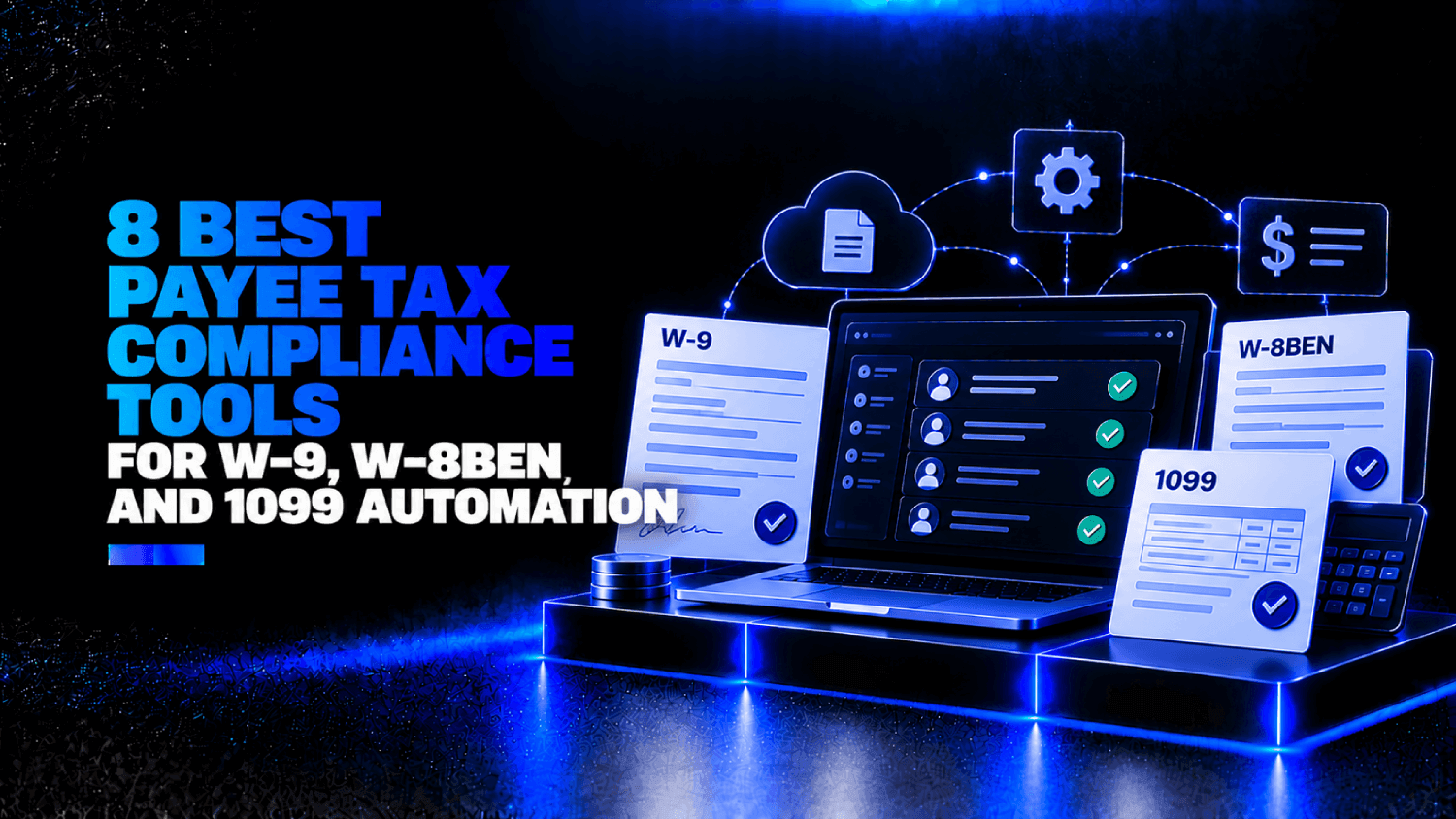
The form set is wider than most platform operators expect. For US payees, W-9 is the baseline. For foreign individuals, W-8BEN applies. For foreign entities, the form is W-8BEN-E. Foreign intermediaries or flow-through entities require W-8IMY. Each form has different data fields, expiration rules, and associated withholding logic.
| Form | Payee Type | Associated Filing | Withholding Default |
|---|---|---|---|
| W-9 | US individuals and entities | 1099-NEC, 1099-MISC, 1099-K | 24% backup withholding if missing |
| W-8BEN | Foreign individuals | 1042-S | 30% FDAP withholding if missing |
| W-8BEN-E | Foreign entities | 1042-S | 30% FDAP withholding if missing |
| W-8IMY | Foreign intermediaries | 1042-S | 30% FDAP withholding if missing |
| W-8ECI | Foreign persons with ECI | 1042-S | 30% FDAP withholding if missing |
The year-end filing obligation changes depending on which forms you collected. A marketplace paying only US freelancers files 1099-NECs. A platform with a global seller base likely owes both 1099s and 1042-S forms. Most pure filing tools handle 1099s well but require a separate workflow or vendor for 1042-S. That is where the gap between a filing tool and a compliance platform becomes expensive.
The FintechSpecs Payee Tax Stack Test: Four Checks Before You Commit
Before reviewing individual vendors, it helps to have a consistent evaluation framework. The following four checks define what separates a tool that prevents a compliance problem from one that just documents it after the fact.
Check 1: Onboarding Gate. Does the tool block payouts to payees who have not submitted a valid tax form? This is a yes or no. If the answer is no, the tool is a filing tool, not a compliance tool.
Check 2: IRS TIN Matching. Does the tool run the payee’s submitted TIN against the IRS database before the first payout? TIN matching catches name-TIN mismatches that would trigger backup withholding. Some tools run it nightly in batch. Others run it at submission. Real-time or same-day matching is meaningfully better.
Check 3: Foreign Form Coverage. Does the tool collect and validate W-8BEN and W-8BEN-E natively, or does it hand off to a manual process? A platform with even 5% international payees needs this covered in the same workflow.
Check 4: Year-End Filing Integration. Can the tool generate and e-file 1099-NEC, 1099-MISC, and 1042-S forms directly, or does it export data for a separate filing tool? The fewer handoffs, the less room for error in the final count.
Which Are the Best Payee Tax Compliance Tools for W-9, W-8BEN, and 1099 Automation?
1. Trolley
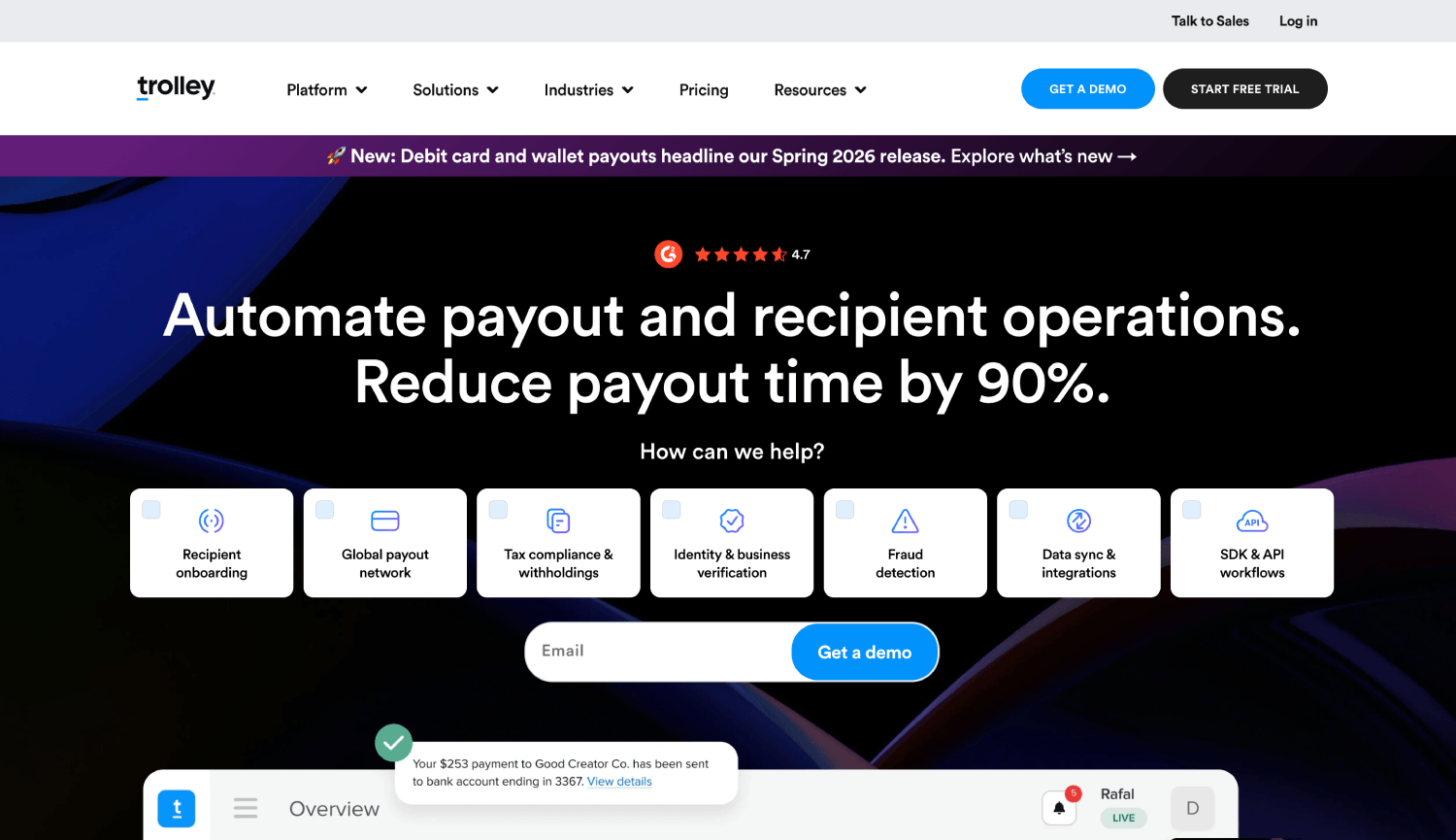
Trolley is built specifically for platforms and marketplaces that pay contractors, creators, and sellers. Its tax compliance module sits inside a full payout infrastructure, which means W-9 and W-8BEN collection happens during payee onboarding before any funds are released. TIN matching runs automatically, and the platform flags mismatches before a payout is triggered.
Trolley covers the full 1099-NEC, 1099-MISC, and 1042-S filing stack, and its international payee coverage is genuine rather than bolted on. The vendor handles withholding calculations for foreign payees and generates 1042-S forms at year-end without requiring a separate workflow. For marketplaces and creator platforms with a global payee base, Trolley is the most operationally complete option in this list. Pricing is not publicly disclosed at a per-form rate; the company uses platform-level pricing based on volume.
2. Tipalti
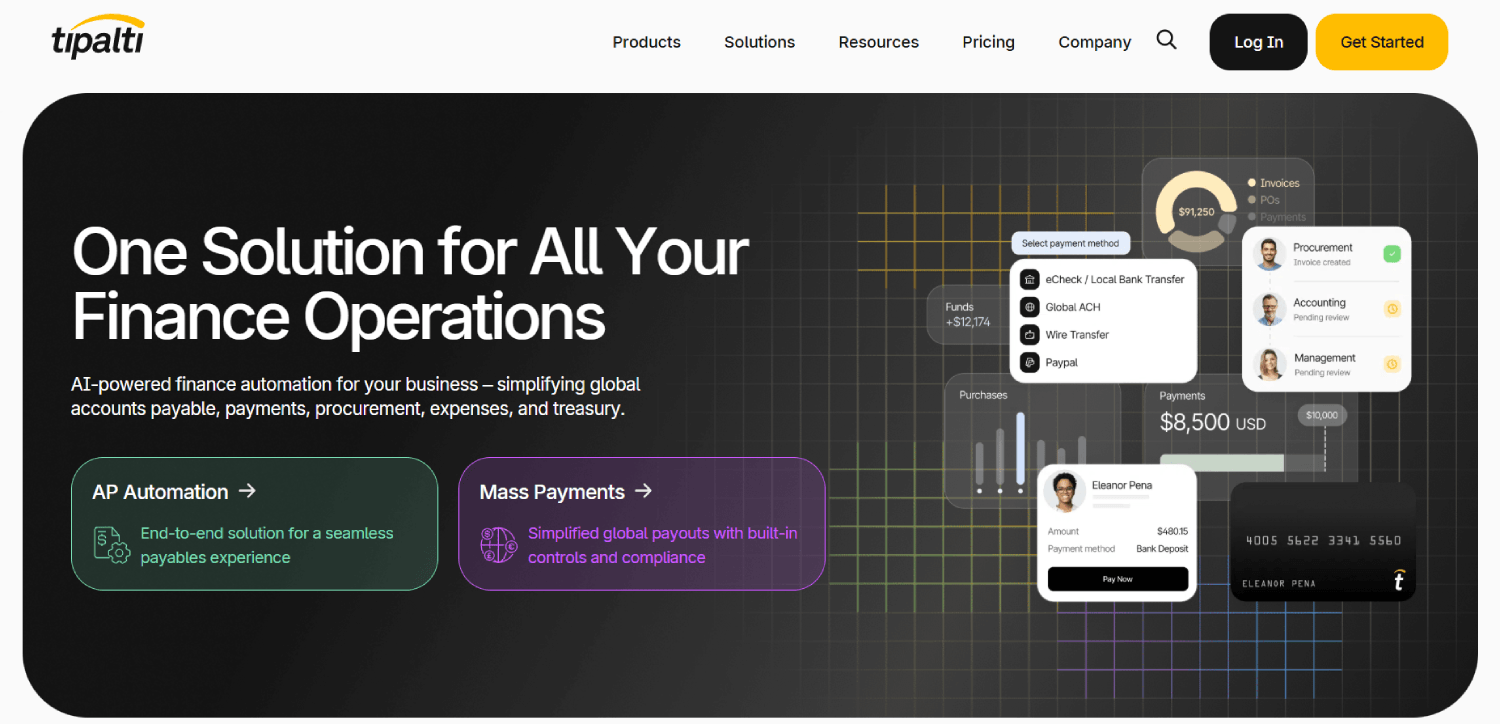
Tipalti positions itself as an accounts payable and mass payout platform with tax compliance built in. The tax module collects W-9 and W-8 forms through a self-service payee portal, validates them, and runs IRS TIN matching. Where Tipalti differentiates is its global payment rail coverage: it supports payouts to over 190 countries across multiple payment methods, and the tax form logic maps to each payee’s country and entity type automatically.
For finance teams at mid-market companies paying international vendors or contractors, Tipalti handles 1099 and 1042-S generation alongside its core AP workflow. The tax compliance piece is not a standalone product. Tipalti pricing is not listed publicly on a per-form basis, and the platform is generally positioned for companies with higher payment volumes. If you are earlier stage, the minimum spend threshold may not fit. The comparison between Tipalti and Bill.com on the Bill.com vs Tipalti AP automation breakdown covers the operational tradeoffs in more detail.
3. Track1099
Track1099 is a dedicated 1099 and W-9 collection and filing tool. It handles W-9 collection via a hosted link or embedded form, runs IRS TIN matching, and e-files 1099-NEC, 1099-MISC, 1099-INT, and other common form types directly with the IRS and states. Pricing as of late 2026 is per-form and per-recipient, making it accessible for smaller platforms that do not need a full payout infrastructure layer.
Track1099 does not cover W-8BEN or 1042-S filing. For US-only payee lists, that is not a problem. For any platform with international payees, that gap requires a second vendor. The platform is a strong choice for operators who want a clean, affordable filing solution without committing to a broader payment infrastructure tool.
4. Tax1099
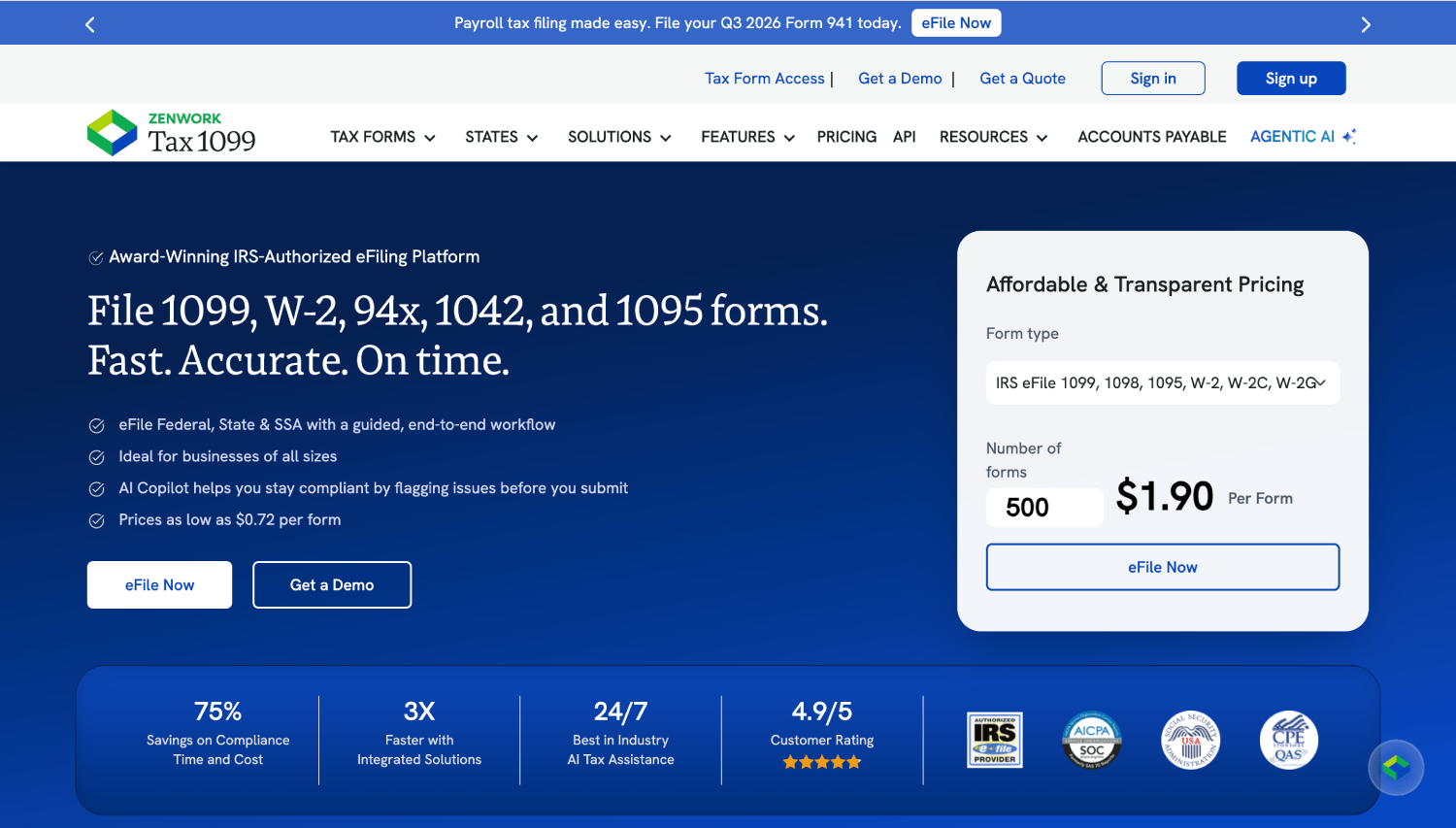
Tax1099 covers a broader form set than most pure filing tools, including 1099-NEC, 1099-MISC, 1099-K, 1099-INT, 1099-DIV, and W-2. It supports e-filing with the IRS and all participating states, and it offers bulk upload via CSV or API. TIN matching is available as a separate add-on rather than included by default, which is a meaningful distinction when comparing tools at the evaluation stage.
Tax1099 added 1099-DA support for digital asset brokers, which puts it ahead of most competitors for platforms in the crypto payments space. Pricing is public and per-form, making cost estimation straightforward before you commit. It does not natively handle W-8BEN collection or 1042-S generation, so international payee workflows require a different tool or a manual bridge.
5. Zenwork (Compliance Cloud)
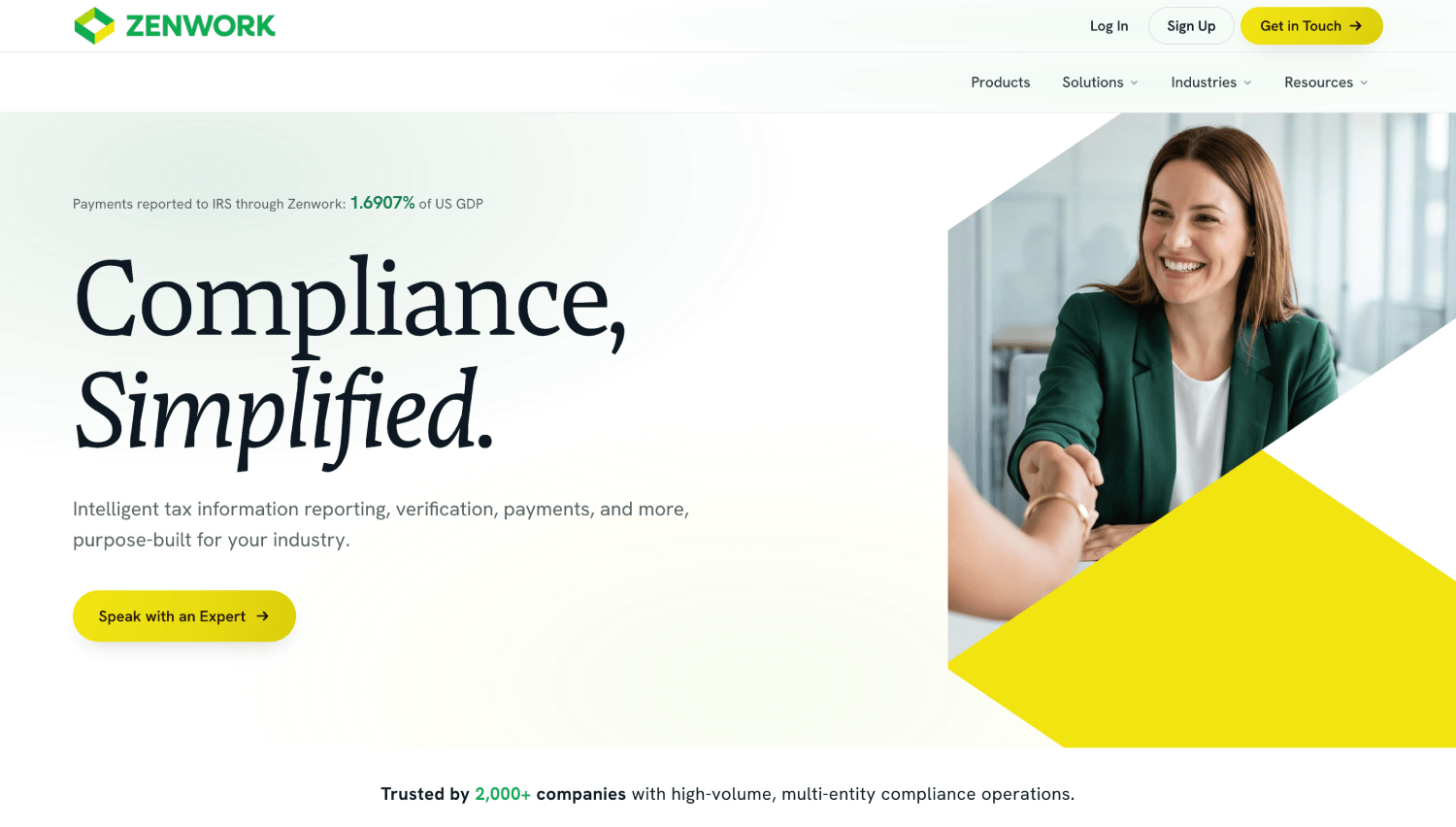
Zenwork operates a compliance platform that covers 1099 filing, W-9 collection, TIN matching, and ACA reporting under one product umbrella. Its API-first design makes it more relevant for platforms and software vendors that want to embed tax compliance into their own product rather than redirect payees to a third-party portal.
The TIN matching module runs against the IRS database and returns results before filing, which helps platforms catch errors at the point of collection rather than at year-end. Zenwork’s form coverage extends to 1099-NEC, 1099-MISC, 1099-K, and related types. Like most tools in the domestic filing category, it does not natively generate 1042-S forms. Pricing is not fully public but is structured around volume tiers.
6. Abound
Abound is an API-first tax infrastructure provider designed specifically for platforms paying gig workers, creators, and contractors. The API handles W-9 collection, TIN matching, income aggregation, and 1099-NEC e-filing. Abound’s design assumption is that the platform integrates the tax collection step directly into its own onboarding UI using Abound’s API, rather than redirecting payees to a separate portal.
That design choice has a practical consequence: Abound suits engineering teams that want to own the payee experience end-to-end. It is less suitable for non-technical finance teams looking for an out-of-the-box portal. Abound covers domestic 1099 workflows cleanly. It does not cover W-8BEN or 1042-S. For platforms building US-focused gig or creator payout products, Abound is one of the strongest API integrations available. Pricing is not publicly listed at a per-API-call rate.
7. Comply Exchange
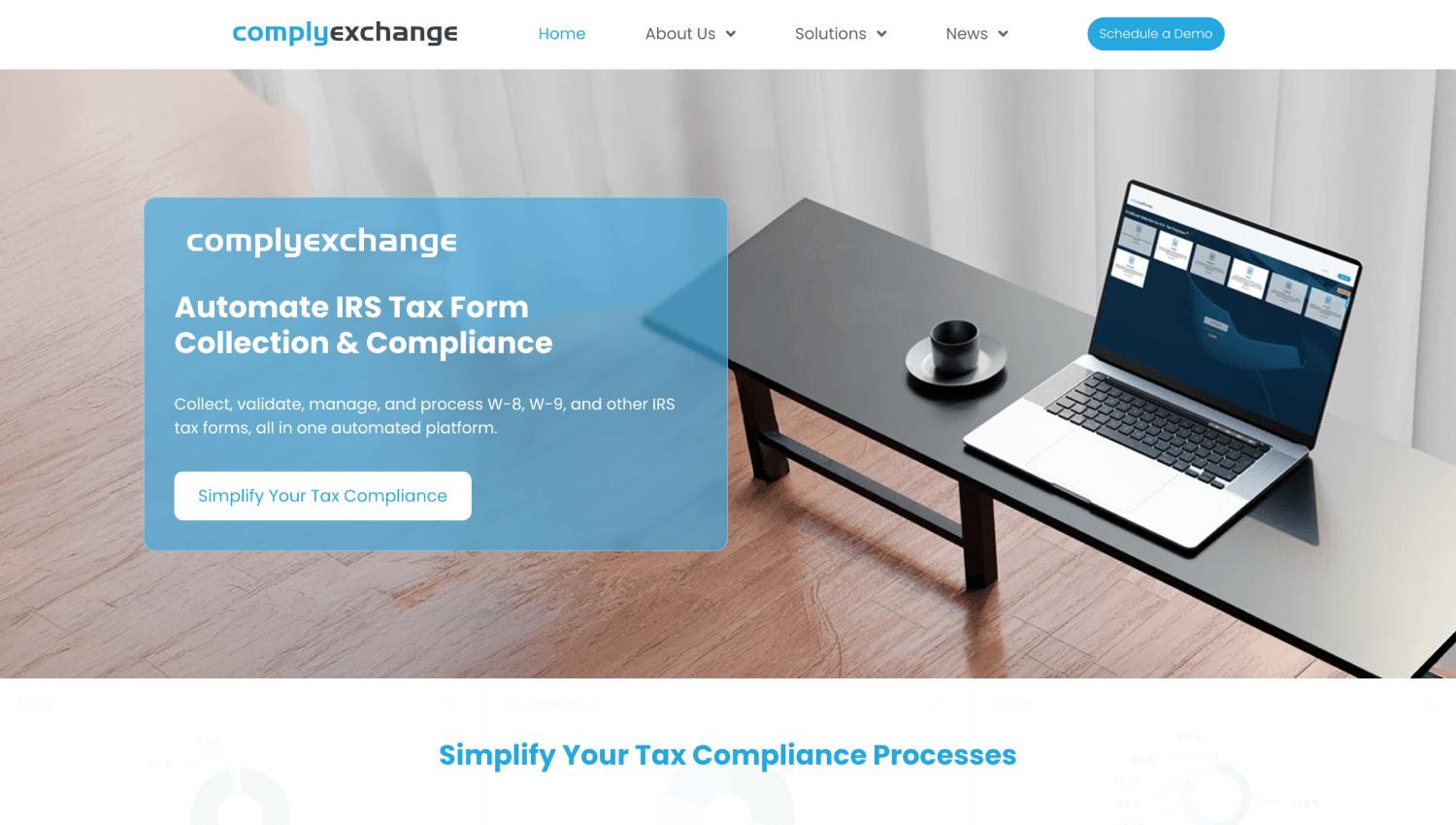
Comply Exchange is purpose-built for withholding tax compliance, specifically the W-8 form family. Where most tools in this list treat foreign payee forms as a secondary capability, Comply Exchange treats them as the primary use case. The platform supports W-8BEN, W-8BEN-E, W-8IMY, W-8ECI, and W-8EXP collection and validation, with treaty rate calculations built into the form logic.
For financial institutions, broker-dealers, and platforms with significant foreign payee populations, Comply Exchange solves a problem that no domestic-only tool addresses. It is not a 1099 filer. It is a W-8 collection and withholding compliance platform, often used alongside a separate 1042-S filing tool. Teams evaluating this tool are typically dealing with FATCA compliance, QI (Qualified Intermediary) obligations, or cross-border payment operations at meaningful scale.
8. Sovos (1099 Pro and Tax Information Reporting)
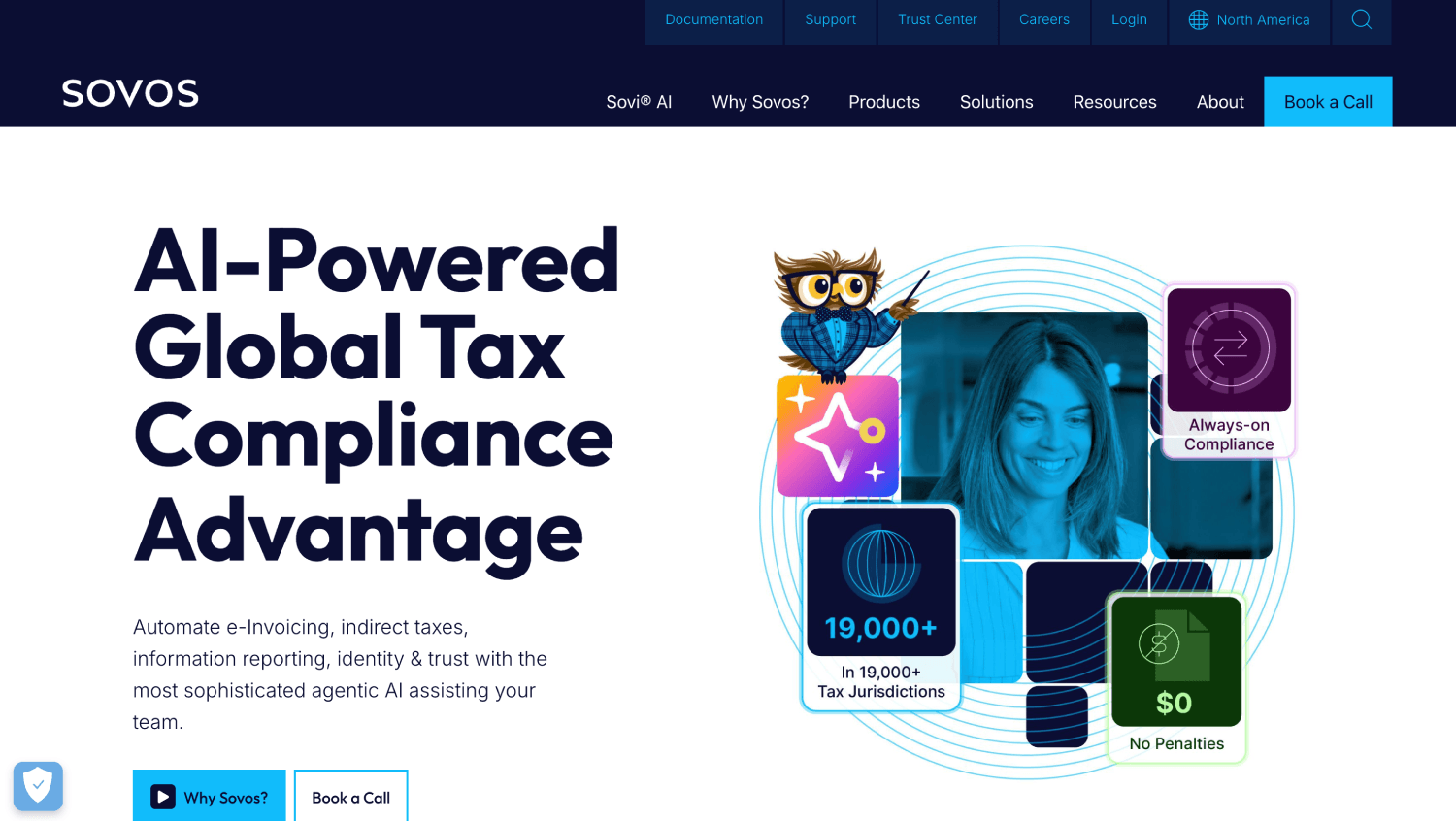
Sovos covers the full tax information reporting stack including 1099, 1042-S, ACA, and state-level reporting. It is an enterprise-positioned platform with implementations typically involving dedicated onboarding and professional services. For high-volume platforms filing hundreds of thousands of forms annually, Sovos offers direct IRS e-file capability, state combined reporting, and a compliance operations layer that smaller tools do not match.
Sovos acquired several smaller 1099 and tax reporting businesses over the past decade, and its form coverage reflects that breadth. The tradeoff is complexity and cost. Sovos is not a fit for a seed-stage marketplace filing a few hundred 1099s. It is built for companies where tax reporting volume has become a compliance operations problem rather than a spreadsheet problem. Pricing is not publicly disclosed and is negotiated at the account level.
How Do These Tools Compare Across the Criteria That Matter?
| Tool | W-9 Collection | W-8BEN / W-8 Series | IRS TIN Matching | 1099 E-Filing | 1042-S Filing | API-First | Best For |
|---|---|---|---|---|---|---|---|
| Trolley | Yes | Yes | Yes (automatic) | Yes | Yes | Yes | Marketplaces, creator platforms |
| Tipalti | Yes | Yes | Yes | Yes | Yes | Partial | Mid-market AP teams, global vendors |
| Track1099 | Yes | No | Yes | Yes | No | Partial | US-only payee lists, SMB platforms |
| Tax1099 | No (form collection separate) | No | Add-on | Yes | No | Yes | Bulk filers, crypto platforms (1099-DA) |
| Zenwork | Yes | No | Yes | Yes | No | Yes | Embedded compliance in SaaS products |
| Abound | Yes (API) | No | Yes | Yes | No | Yes | Gig and creator platforms, US-focused |
| Comply Exchange | No | Yes (primary focus) | Partial | No | Pairs with separate tool | Partial | FIs, broker-dealers, FATCA compliance |
| Sovos | Yes | Yes | Yes | Yes | Yes | Yes (enterprise) | High-volume enterprise filers |
What Does a Realistic Onboarding-Gate Tax Flow Look Like in Practice?
Consider a marketplace that processes payouts to 2,000 US sellers and 400 international sellers annually. Without an onboarding gate, the platform releases payments through Q1 to Q3, then scrambles in October to collect W-9s and W-8BENs before year-end. At that point, some sellers have churned. Some TINs come back as mismatches. A handful of international sellers never submitted a W-8BEN, meaning the platform technically owed 30% withholding on every payment made to them.
With an onboarding gate, the flow inverts. A seller creates an account, gets prompted to submit their tax form before bank details, and cannot receive their first payout until a TIN match returns clean. The platform’s year-end 1099 and 1042-S run pulls from a data set that was validated at the point of each payee’s first payout. The compliance team reconciles the year in hours, not weeks.
That flow is what Trolley, Tipalti, and Abound are designed to support at the infrastructure level. Track1099 and Tax1099 support the year-end filing half of that flow well, but they require the platform to have collected and validated tax forms through a separate process. For platforms evaluating their full payout infrastructure, the payout API and seller onboarding comparison covers how tax collection fits into the broader onboarding architecture.
What Are the 1099 Reporting Thresholds Platforms Actually Owe?
The threshold for 1099-NEC filing is $600 per year to a non-employee US payee. The threshold for 1099-MISC is also $600 for most payment types. The 1099-K threshold has changed multiple times in recent years and applies to platforms that process payments through a payment card or third-party network. Foreign payees receiving US-source income have no minimum threshold for 1042-S reporting: $1 of US-source income triggers the obligation if the payee holds a W-8 form claiming treaty benefits.
The $600 domestic threshold is frequently misapplied. A platform that pays 50 sellers between $400 and $599 each owes no 1099s but still needs W-9s on file to document the exempt status of each payment. The IRS backup withholding obligation does not have a threshold. It applies the moment a US payee refuses or fails to furnish a TIN, regardless of payment size.
How Does W-9 Collection Software Handle the TIN Matching Problem?
IRS TIN matching compares the name and TIN a payee submits against the IRS database. A mismatch means the name on the form does not correspond to the TIN. Common causes include payees submitting their personal Social Security Number under their business name, name changes after marriage or incorporation, and simple transcription errors.
A mismatch does not always mean fraud. But it does mean the platform has a payee it cannot safely 1099 at year-end without risking a CP2100 notice from the IRS, which triggers backup withholding retroactively. Tools that run TIN matching at submission, rather than in a batch before filing, give the platform time to resolve the mismatch before payments accumulate. That timing difference is worth more than it looks on a feature comparison sheet.
Building tax compliance into a product properly connects to broader compliance readiness. The compliance blind spots common in early-stage fintech companies frequently include exactly this gap: platforms that collect payment details at onboarding but defer tax form collection until it becomes urgent.
Does Geographic Coverage Change Which Tool to Pick?
For platforms paying exclusively in the US, geographic coverage is a non-issue. Track1099, Tax1099, Zenwork, and Abound all handle domestic payee tax compliance cleanly. For platforms with international payees, the form set and withholding logic multiply in complexity, and the tool choice narrows considerably.
| Payee Geography | Forms Required | Recommended Tools |
|---|---|---|
| US only (individuals) | W-9, 1099-NEC | Track1099, Abound, Tax1099, Zenwork |
| US only (entities) | W-9, 1099-MISC or 1099-NEC | Track1099, Tax1099, Tipalti |
| Foreign individuals | W-8BEN, 1042-S | Trolley, Tipalti, Comply Exchange + Sovos |
| Foreign entities | W-8BEN-E, W-8IMY, 1042-S | Comply Exchange, Tipalti, Sovos |
| Mixed US and international | All of the above | Trolley, Tipalti, Sovos |
The cross-border dimension also applies to platforms that pay in non-USD currencies. Withholding calculations on FX-converted amounts require the platform to determine the USD equivalent of each payment for 1042-S reporting. Tools like Tipalti and Trolley handle this within their payment infrastructure. Pure filing tools do not. For a full comparison of cross-border payout infrastructure, the cross-border payout API comparison covers how the payment rail layer interacts with the tax reporting layer.
Frequently Asked Questions
What is the difference between a W-9 collection tool and 1099 automation software?
W-9 collection software gathers taxpayer information from payees before payments are made, validates the TIN against the IRS database, and stores the certified form. 1099 automation software uses that stored information to generate and e-file 1099 forms at year-end. Some platforms do both. Others specialize in one half of the workflow. A platform that skips the collection step and uses only a filing tool is working with unvalidated data, which increases the risk of CP2100 notices and backup withholding obligations.
Does 1099 automation software also handle W-8BEN collection?
Most domestic 1099 filing tools do not handle W-8BEN or the broader W-8 form series. Tools built for US freelancer or contractor payrolls typically stop at W-9 collection and 1099-NEC filing. Platforms with foreign payees need a tool that explicitly covers W-8BEN, W-8BEN-E, and 1042-S generation. Trolley, Tipalti, Comply Exchange, and Sovos cover this. Track1099, Tax1099, Zenwork, and Abound focus on US payee workflows.
When does backup withholding apply, and how does payee tax software prevent it?
Backup withholding at 24% applies when a US payee fails to furnish a TIN, furnishes an incorrect TIN, or the IRS notifies the payer that the TIN is incorrect. Payee tax compliance software prevents it by requiring W-9 submission before the first payout, running IRS TIN matching at submission, and blocking payments to payees with unresolved mismatches. Platforms that collect W-9s after payments have been made cannot retroactively avoid the withholding obligation for the period the TIN was missing.
What is IRS TIN matching, and which tools run it automatically?
IRS TIN matching is a pre-filing service that compares a payee’s name and Taxpayer Identification Number against the IRS database to confirm they match. A failed match indicates a data error that will likely trigger a CP2100 notice after year-end filing. Trolley, Tipalti, Track1099, Zenwork, and Abound all support TIN matching. Tax1099 offers it as an add-on. Comply Exchange focuses on W-8 validation rather than domestic TIN matching. The timing of when matching runs, at submission versus in a batch before filing, varies by platform.
Do platforms owe 1042-S forms for international payees, and which tools generate them?
Yes. Any US platform making payments that constitute US-source income to foreign individuals or entities is generally required to file a 1042-S with the IRS and furnish a copy to the payee. The 1042-S reports the income paid, the withholding applied, and the treaty rate claimed on the payee’s W-8 form. Tools that generate 1042-S forms include Trolley, Tipalti, Sovos, and Comply Exchange when paired with a filing tool. Most domestic-only 1099 filers do not generate 1042-S forms.
Is there a minimum payment threshold before a 1099-NEC is required?
The IRS requires a 1099-NEC for payments of $600 or more to a non-employee US payee in a calendar year. Payments below $600 do not require a 1099-NEC, but the platform still needs a W-9 on file to document the exempt status of those payments and to avoid backup withholding if asked to demonstrate compliance. For foreign payees on W-8 forms, the 1042-S filing threshold is $0 for income subject to withholding tax under a treaty claim.
Can I use a separate 1099 filing tool if my payout platform already collects W-9 forms?
Yes, and many platforms do exactly this. If your payout platform, such as Stripe, Trolley, or a custom ACH integration, already collects W-9s and stores validated TIN data, you can export that data to a dedicated filer like Track1099 or Tax1099 for year-end processing. The risk is in the export and import step: mismatched fields, missing records, or formatting errors can create discrepancies between what was paid and what gets filed. A single-platform solution eliminates that handoff risk.
How does vendor tax form management differ from payroll tax compliance?
Vendor tax form management covers non-employee payments: contractors, freelancers, sellers, and service providers who receive 1099s. Payroll tax compliance covers employees on W-2s, which involves withholding, payroll taxes, and FICA contributions. The tools in this article handle vendor and payee tax forms only. For platforms embedding payroll into their product, a separate embedded payroll API handles the employee tax layer. The two workflows share some data infrastructure but use entirely different IRS forms, thresholds, and filing deadlines.
Which Payee Tax Compliance Tool Should You Actually Use?
The most important variable is not which tool has the most integrations. It is where in your payout flow the tax collection step occurs. A tool that collects forms at year-end is a filing tool. A tool that blocks the first payout until a valid form and a clean TIN match are on file is a compliance tool. Both have their place, but only the second one prevents the liability rather than documenting it.
For platforms with any international payee exposure, the shortlist narrows to Trolley, Tipalti, Comply Exchange, or Sovos. For US-only contractor or seller payments under a few thousand payees annually, Track1099 and Abound cover the requirement at much lower cost and complexity. The decision between an embedded API tool and a portal-based tool comes down to whether your engineering team wants to own the collection UX or delegate it. Abound and Zenwork are built for the former. Trolley and Tipalti give you both. The tax compliance piece of vendor onboarding connects directly to the broader 1099 and tax compliance API comparison for platforms paying contractors, which covers the integration details in more depth.
The most expensive decision in this category is not picking the wrong tool. It is spending another year treating tax form collection as a Q4 project while the payout volume and the associated compliance exposure both grow. Whatever tool fits your stack, the time to put it at the front of your onboarding flow is before your payee count makes the remediation painful.