
- Onboarding KYC and ongoing transaction monitoring are separate BSA obligations. Running only the first leaves a compliance gap that bank examiners and FinCEN will find.
- Real-time transaction monitoring requires an event-driven API architecture, not a batch file export. If your vendor sends daily files, it is not real-time monitoring.
- Rules-based systems generate fewer false positives when tuned well, but ML models catch behavioral drift that static thresholds miss. The best platforms combine both.
- Alert triage workflow, not just detection accuracy, is what separates a usable system from an alert-flood that burns out your compliance team.
- The ten vendors below range from API-native tools built for seed-stage fintechs to full AML case management suites serving regulated banks. The right fit depends on transaction volume, your sponsor bank’s requirements, and whether you need built-in SAR filing.
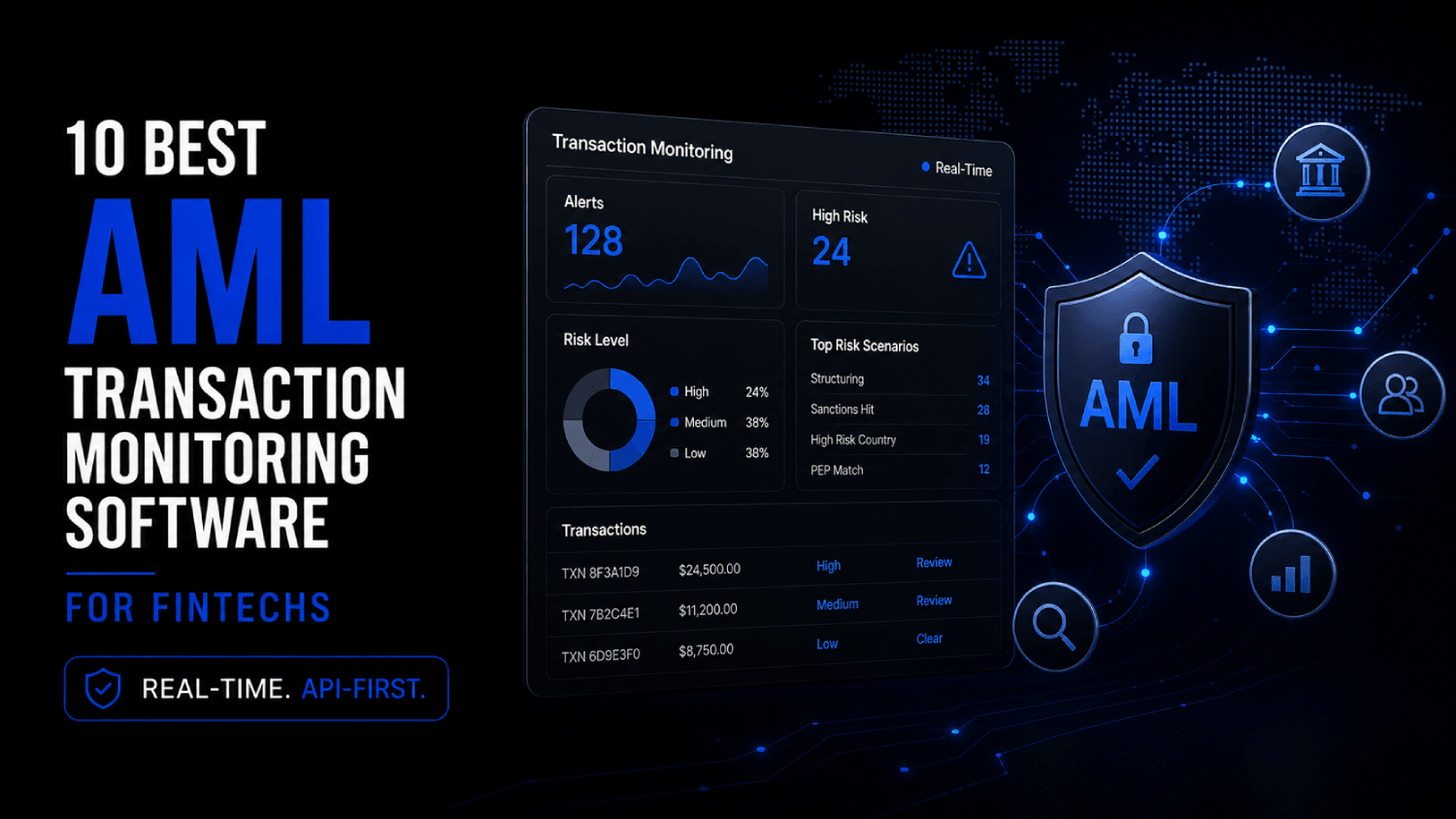
The ten best AML transaction monitoring software platforms for fintechs , evaluated as transaction monitoring software fintech teams actually deploy , are Unit21, Sardine, ComplyAdvantage, Hummingbird, Flagright, Hawk AI, Napier AI, Sumsub, NICE Actimize, and Fenergo. Each covers real-time transaction monitoring and BSA compliance obligations, but they differ on API maturity, case management depth, ML capability, and pricing structure. The right choice depends on your transaction volume, whether you need embedded SAR filing, and how much tuning capacity your compliance team has.
Why Onboarding Screening Does Not Cover Your BSA Monitoring Obligation
Most early-stage fintechs run sanctions and PEP screening at account opening and call it AML compliance. That covers one obligation. The Bank Secrecy Act requires a separate, ongoing monitoring program that watches transaction behavior continuously and files Suspicious Activity Reports when patterns cross defined thresholds.
Onboarding screening answers “who is this customer?” Transaction monitoring answers “what is this customer doing, and does it look like layering, structuring, or mule activity?” These are different data problems with different detection architectures. A KYC vendor does not replace a transaction monitoring system, and your sponsor bank’s compliance team already knows the difference. It is also worth noting that transaction monitoring is categorically distinct from AML screening APIs, which match individual payments against watchlists at execution time , monitoring analyzes behavioral patterns across a customer’s full transaction history over days or weeks. If you are building on a Banking-as-a-Service platform, that sponsor bank will ask about your TMS before you hit any meaningful volume. The FintechSpecs article on best Banking-as-a-Service platforms for fintech startups covers what sponsor banks typically require before approving a program.
The gap matters more now because regulators are increasingly holding fintechs to the same monitoring standards as depository institutions. FinCEN’s 2023 and 2024 enforcement actions have named fintech program managers directly, not just the sponsor banks behind them.
Rules-Based vs. ML-Based Transaction Monitoring: Which Architecture Fits Fintechs?
Rules-based systems fire alerts when a transaction crosses a fixed threshold, say, a cash transaction over $10,000 or three rapid transfers to the same beneficiary within 24 hours. They are transparent, auditable, and easy to explain to examiners. The downside is rigidity. A fraudster who knows your rules can stay just below every threshold indefinitely.
ML-based systems build behavioral profiles for each customer and flag deviations from that baseline. A payment that looks normal for one user looks suspicious for another, and the model adapts as patterns change. The cost is opacity. Explaining to an examiner why the model flagged a specific transaction requires additional documentation that purely rules-based outputs do not need.
Most production fintech deployments use both. Rules catch known typologies and satisfy examiner expectations. ML catches novel patterns and reduces alert volume by filtering out benign deviations that would trigger a static rule. The table below shows how each architecture performs across the dimensions that matter most to a fintech compliance team.
| Dimension | Rules-Based | ML-Based | Hybrid |
|---|---|---|---|
| Alert explainability | High. Rule ID, threshold, triggered value. | Low without explainability layer. | High. Rules fire with ML risk score layered on. |
| False positive rate | High when poorly tuned. | Lower after model training period. | Lowest in class when tuned. |
| Novel typology detection | Poor. Blind to patterns not pre-defined. | Good. Detects behavioral drift. | Good. ML handles gaps in rule coverage. |
| Regulator familiarity | High. Examiners expect rules documentation. | Requires model risk management documentation. | Requires both, but rules anchor the audit. |
| Time to first alert | Immediate after rules configured. | Days to weeks of training data needed. | Rules fire immediately; ML improves over time. |
| Tuning burden | Manual threshold adjustments ongoing. | Model retraining required periodically. | Both, but ML reduces manual threshold work. |
| Best fit | Early-stage, low volume, limited compliance staff. | High-volume, mature compliance team. | Series A and beyond with dedicated risk function. |
How Does the Alert Triage Workflow Actually Work?
Detection is only the first step. What happens after an alert fires determines whether your compliance program is functional or a liability. The FintechSpecs Alert Triage Framework breaks this into four named stages that every transaction monitoring system should support natively. These stages are not a vendor checklist , they are the sequence that determines whether a compliance analyst can close 40 cases a week or 10, and whether an examiner sees a documented program or a folder of spreadsheets.
Stage 1 , Generation: The system fires an alert when a transaction or pattern crosses a rule threshold or an ML risk score. The alert should include the triggering condition, the customer’s full transaction history, and a risk score. Platforms that produce alerts without context force analysts to look up everything manually, which is where alert fatigue compounds.
Stage 2 , Prioritization: Alerts queue by severity. A system without priority scoring dumps every alert into a flat list. At volume, analysts work highest-severity cases first and low-risk alerts age out uninvestigated, which is itself an examiner finding. Good platforms assign risk tiers automatically and let compliance leads reweight scoring criteria without an engineering ticket.
Stage 3 , Investigation: The analyst reviews linked entities, transaction chains, counterparty data, and external watchlist hits inside one interface. Context switching between a TMS and a separate KYC system, a spreadsheet, and a Google search is how cases get resolved incorrectly. Case management quality here separates tier-one platforms from the rest.
Stage 4 , Disposition and Filing: The analyst closes the case (no action), escalates to SAR filing, or flags for enhanced due diligence. Platforms with built-in SAR filing let analysts complete the FinCEN SAR form inside the system and maintain an audit trail. Those without it require manual export and filing, which introduces documentation gaps.
When evaluating any vendor on this list, map each of the four stages against what the platform actually does in a demo. Most vendors demo Stage 1 and Stage 3 well. Stage 2 prioritization logic and Stage 4 SAR workflow design are where the real differences appear. A platform that scores a 9 on detection and a 4 on disposition workflow will cost your compliance team more time than a platform that scores a 7 across all four stages.
What Are the 10 Best Transaction Monitoring Software Platforms for Fintechs?
1. Unit21
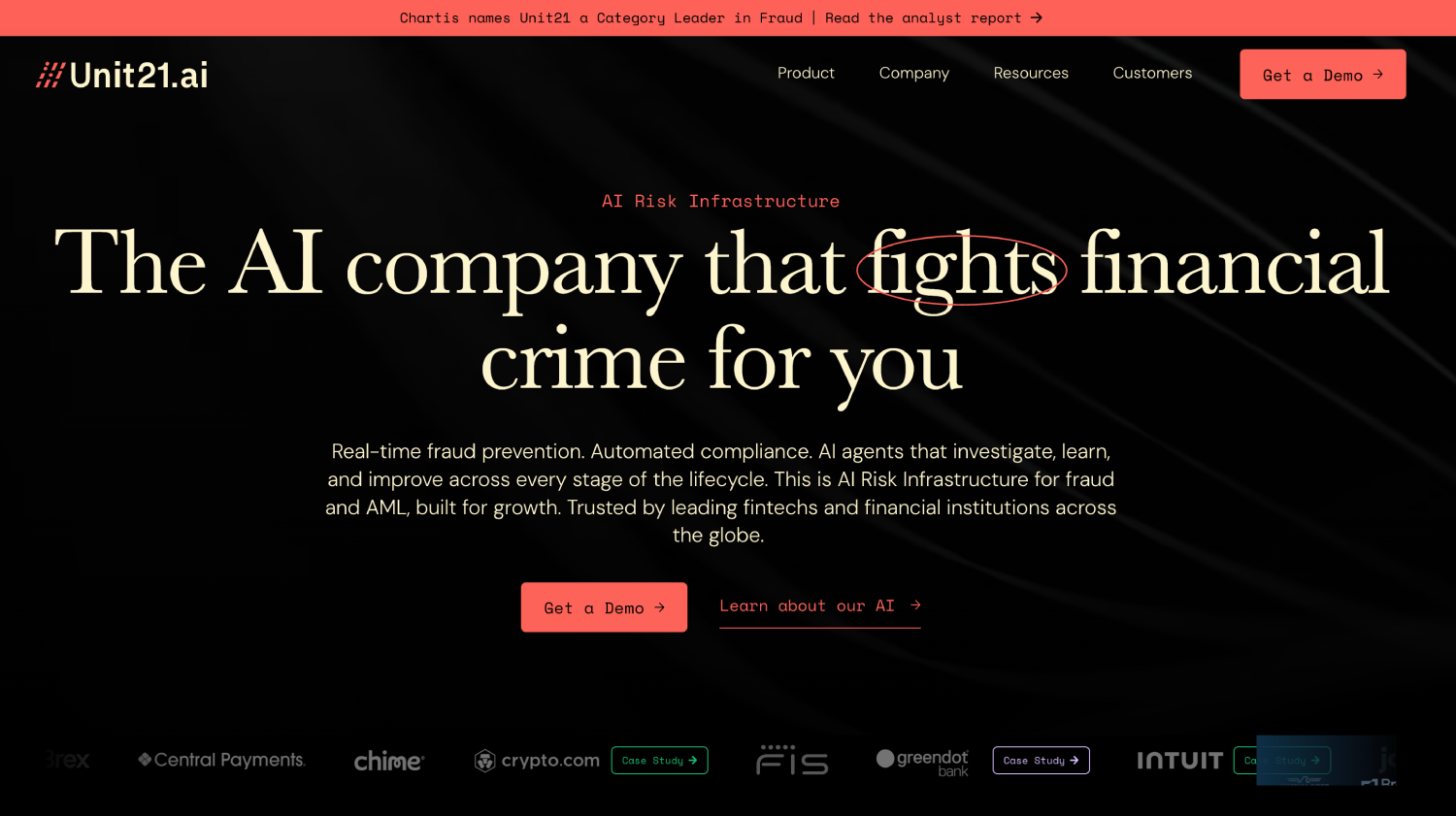
Unit21 is a no-code rules engine and case management platform built specifically for fintechs. Compliance teams configure detection rules through a drag-and-drop interface without writing code, which matters at Series A when you have one compliance analyst and no dedicated engineering support.
Unit21’s case management is among the strongest in this category. The platform links entities, transactions, and prior SAR filings into a single timeline view, and it supports direct SAR filing to FinCEN. Pricing is not publicly disclosed and is negotiated based on transaction volume and feature set.
Best for fintechs that want a compliance team to own the TMS fully, without opening an engineering ticket every time a rule needs updating.
2. Sardine
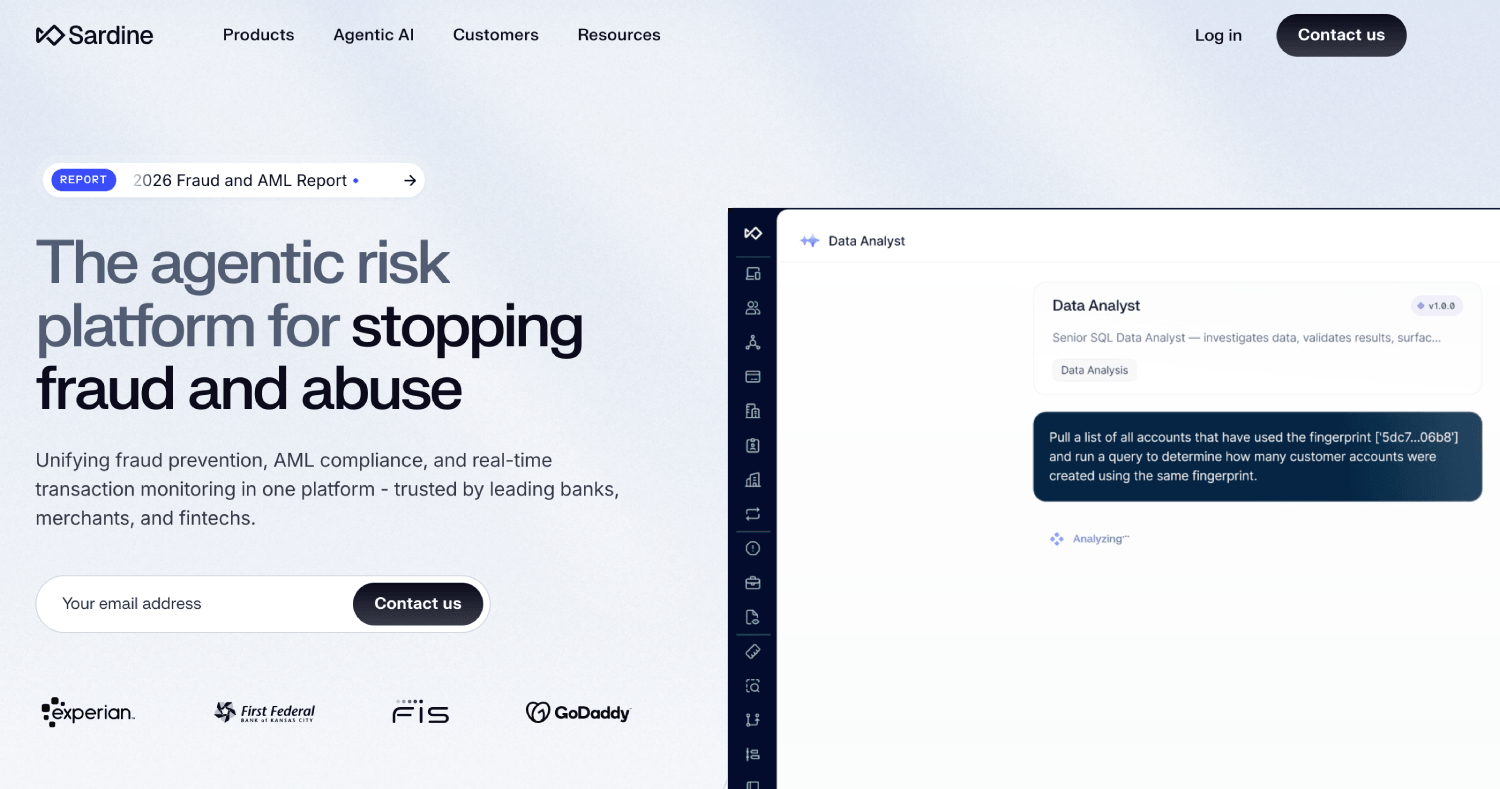
Sardine is a fraud and AML platform that combines device intelligence, behavioral biometrics, and transaction monitoring into a single API. It is unusual in the market because it correlates pre-transaction signals (how a user behaves during login) with post-transaction patterns, which improves signal quality before a suspicious transaction even clears.
For fintechs that also have a fraud detection requirement alongside AML monitoring, Sardine reduces the vendor count. The API is well-documented and webhook-driven, which fits event-driven architectures common at API-first startups. Pricing is not publicly listed.
Best for seed-to-Series B fintechs that want fraud and AML monitoring in one vendor relationship.
3. ComplyAdvantage
ComplyAdvantage combines a proprietary sanctions and adverse media database with transaction monitoring and a case management layer. The data side is the differentiator: the platform updates its watchlist data continuously rather than on a fixed refresh cycle, which reduces the window between a designation event and detection in a live payment flow.
For fintechs that process cross-border payments or serve customers in sanctions-adjacent jurisdictions, the data freshness matters more than it does for domestic-only use cases. ComplyAdvantage also publishes pricing tiers on its site for some products, which is rare in this category and useful during vendor evaluation.
Best for fintechs with cross-border exposure where watchlist data freshness is a material risk variable.
4. Hummingbird

Hummingbird is a case management and SAR filing platform that treats investigation workflow as its core product, with transaction monitoring feeding into it. The design philosophy is that most AML tools are built for detection engineers, not compliance analysts. Hummingbird is built for analysts.
The SAR filing module is the cleanest in this list. Analysts complete the FinCEN SAR form inside the platform, fields pre-populate from case data, and the filing history is stored with the case record. For compliance teams managing SAR volume, that workflow difference compounds weekly. Pricing is not publicly disclosed.
Best for compliance-heavy teams where SAR filing volume and analyst efficiency are the primary constraints, not detection configuration.
5. Flagright
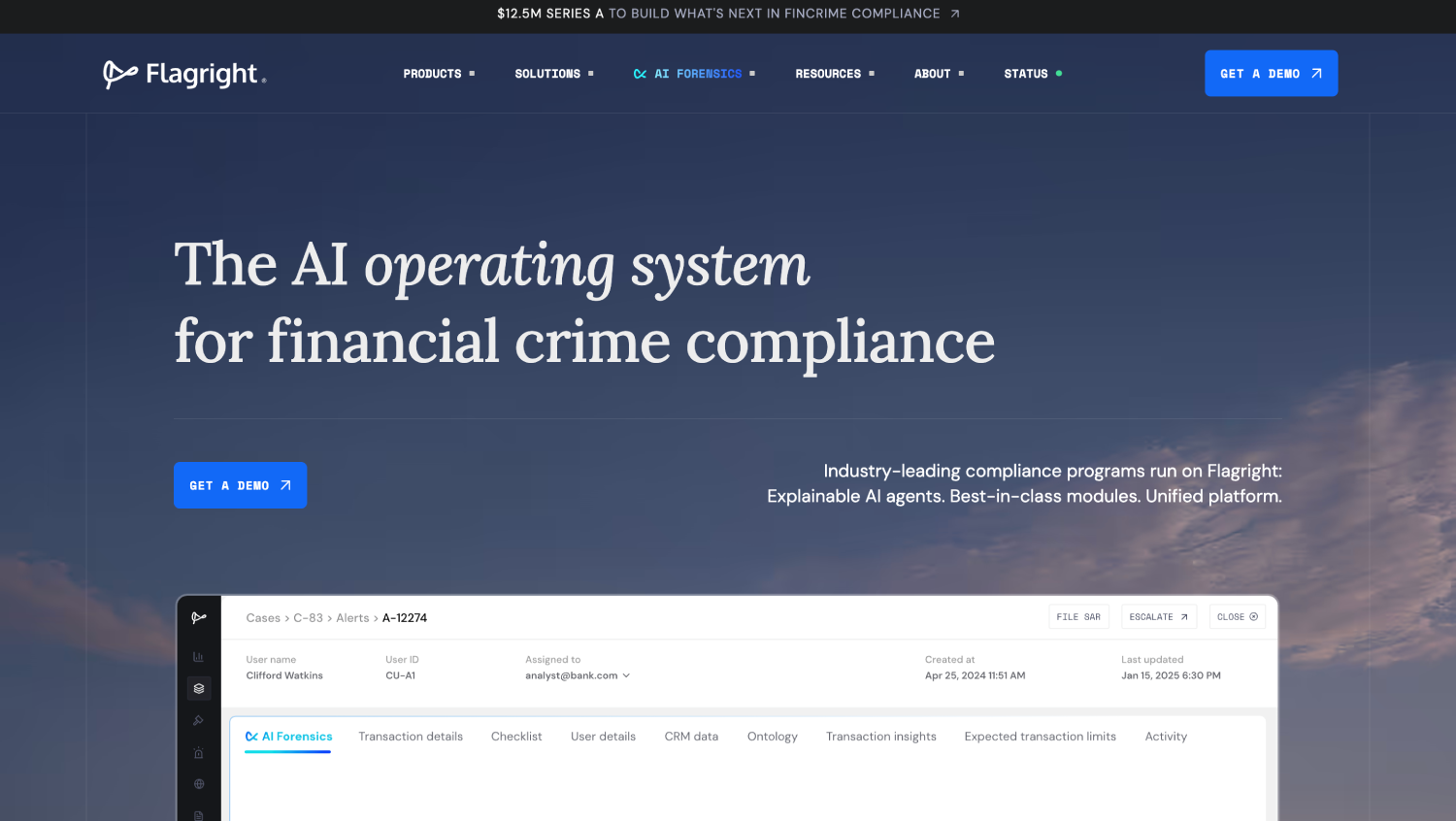
Flagright is an API-native real-time transaction monitoring platform built for fintechs and neobanks. According to Flagright’s public documentation, the platform processes transactions in real time with sub-second latency, which supports payment blocking before settlement rather than post-settlement review.
The API-first architecture means integrations are webhook-driven and the rules engine is configurable via API as well as UI. For engineering-led fintech teams that want to embed monitoring into the payment flow programmatically, the developer experience is stronger than most incumbent platforms. Pricing is not publicly disclosed.
Best for API-first fintechs that need pre-settlement blocking, not just post-transaction alerting.
6. Hawk AI
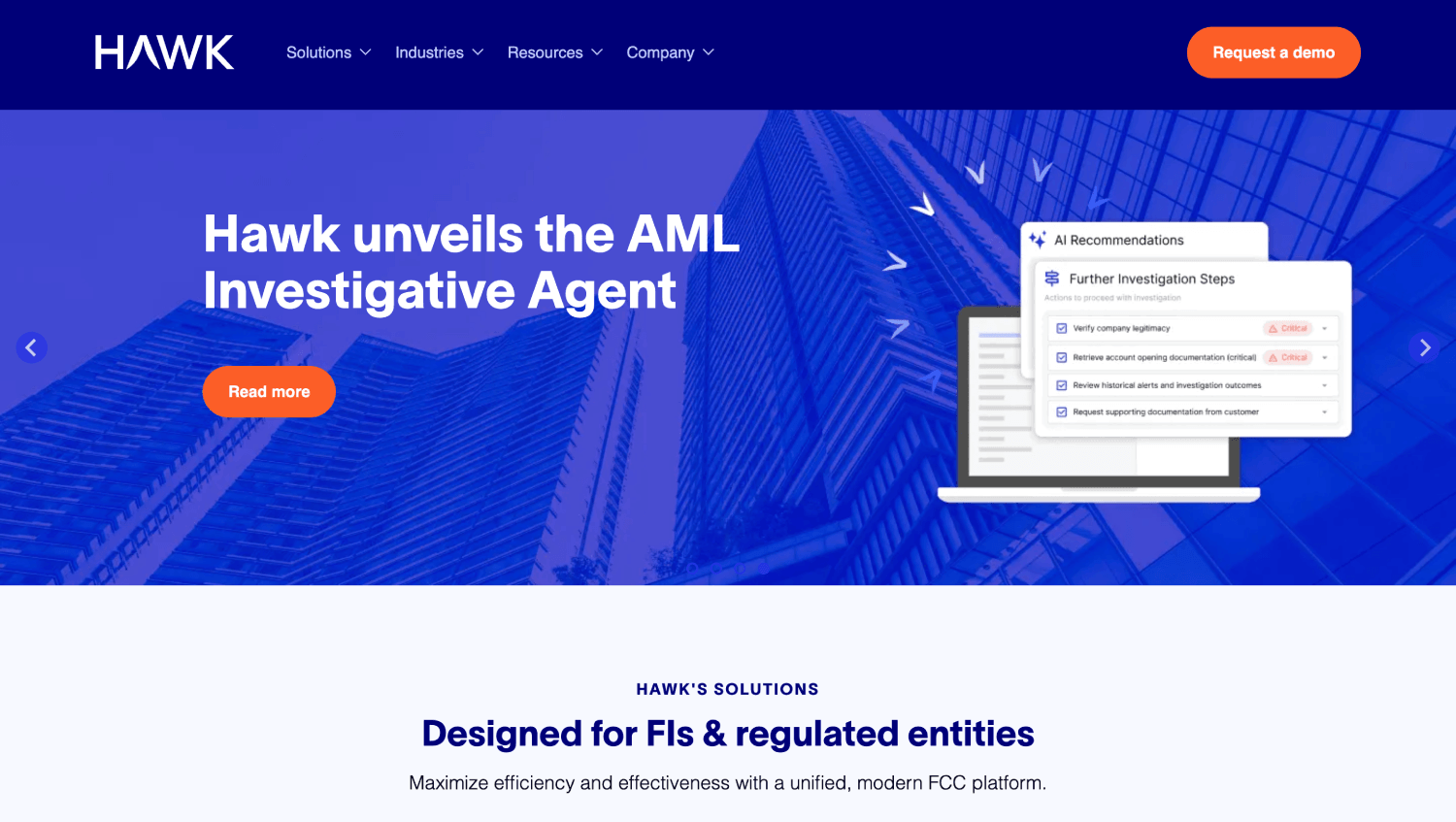
Hawk AI is a hybrid rules and ML platform that targets payment processors and fintechs processing high transaction volumes where false positive management is the main operational cost. The platform’s Explainable AI layer converts ML model outputs into human-readable rationales, which addresses the examiner documentation problem that pure ML platforms create.
Hawk AI’s alert reduction approach is notable: the platform surfaces a risk score alongside each alert that indicates whether it is likely to result in a SAR filing, letting analysts skip low-probability cases faster. Pricing is enterprise and not publicly disclosed.
Best for high-volume fintechs where analyst alert load is a scaling problem and ML explainability is required for regulatory documentation.
7. Napier AI
Napier AI is an AML transaction monitoring and client screening platform used by banks, payment firms, and regulated fintechs. The platform covers transaction monitoring, client risk scoring, and screening in one suite. According to Napier’s public documentation, the platform is designed to integrate with existing core banking and payment systems via API.
Napier positions itself at the more regulated end of the fintech market, including EMIs and payment institutions subject to FCA oversight in addition to US BSA requirements. For US fintechs with international regulatory exposure, that dual-jurisdiction coverage reduces the need for a separate European compliance tool. Pricing is enterprise and not publicly disclosed.
Best for regulated fintechs with both US BSA and international AML obligations.
8. Sumsub
Sumsub is primarily known for KYC verification but offers a transaction monitoring module that integrates directly with its identity verification layer. Sumsub’s public marketing cites a 272% ROI figure attributed to a Forrester Consulting study; the company has not published the full report publicly, so that figure should be treated as a vendor claim pending independent verification. The transaction monitoring module shares customer identity context directly with alert workflows.
The integration between KYC and monitoring reduces the entity resolution problem. When an alert fires, the analyst sees the full KYC record, document verification results, and transaction history in the same interface. For fintechs that already use Sumsub for onboarding, adding monitoring is a lower-friction expansion than introducing a separate TMS vendor. Pricing is not publicly listed.
Best for fintechs already on Sumsub for KYC that want to consolidate vendors rather than add a standalone TMS.
9. NICE Actimize
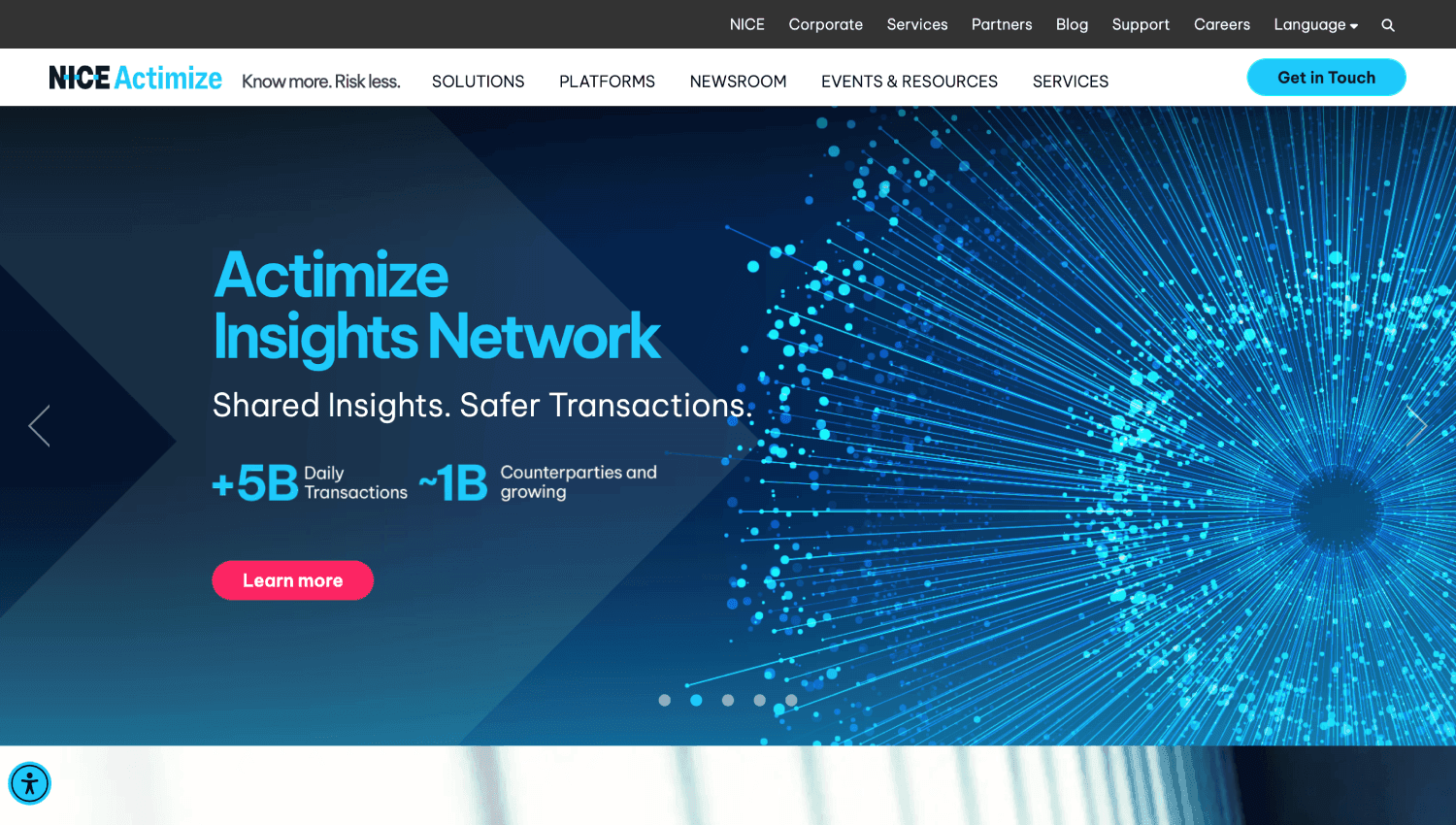
NICE Actimize is an enterprise-grade AML suite used by large banks and financial institutions. For fintechs, it represents the top end of the market in both capability and operational complexity. The platform covers transaction monitoring, SAR filing, customer risk scoring, and sanctions screening in one integrated suite.
The implementation timeline is longer than API-native competitors, and the platform assumes a dedicated compliance operations team. At Series C and beyond, when a fintech’s transaction volume and regulatory scrutiny approach those of a small bank, NICE Actimize becomes a credible option. Pricing is enterprise and not publicly disclosed.
Best for late-stage fintechs approaching bank-equivalent compliance requirements, not for seed or Series A deployments.
10. Fenergo
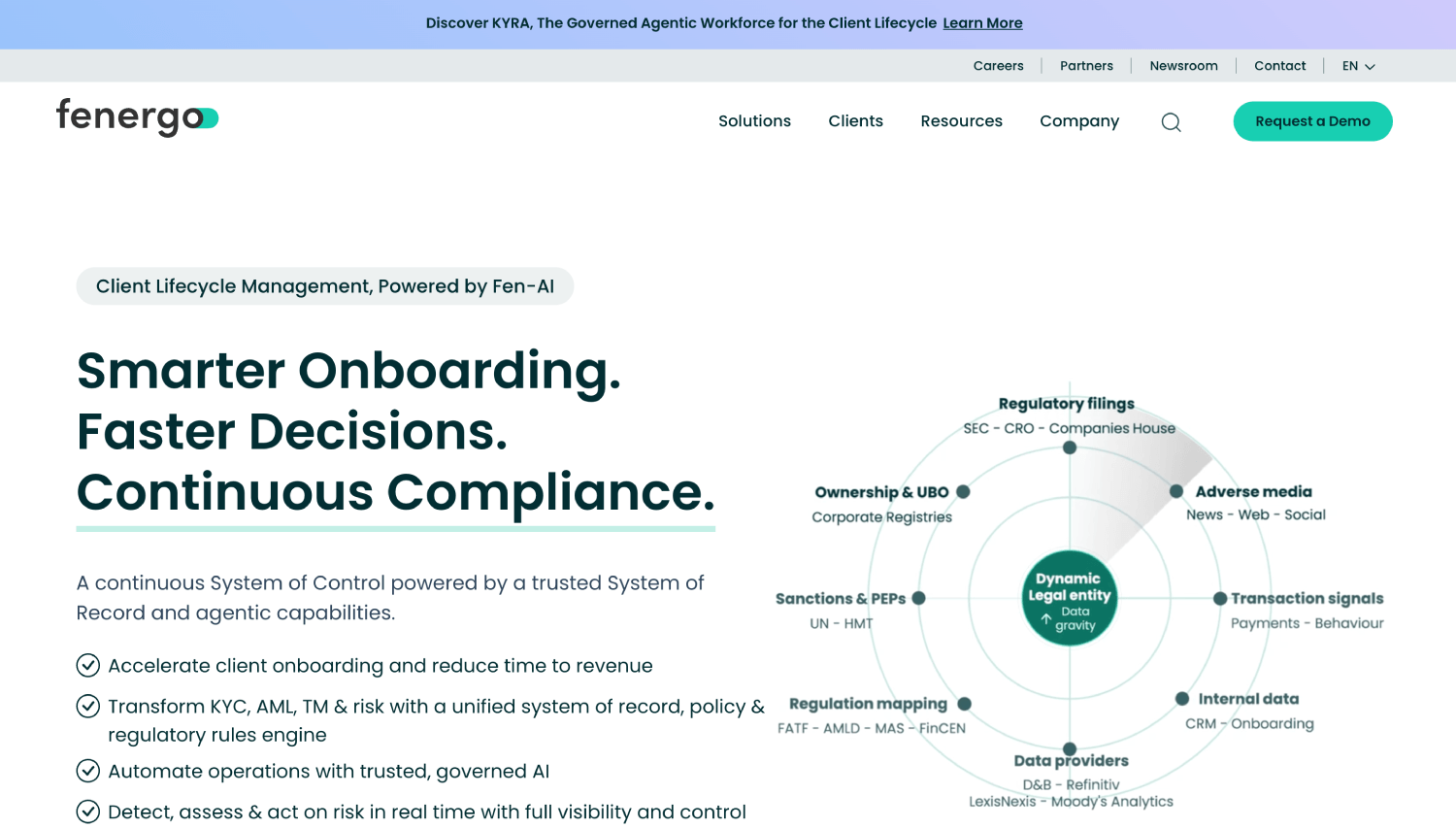
Fenergo is a client lifecycle management platform that includes transaction monitoring as part of a broader AML and KYC workflow suite. According to Fenergo’s public product pages, the transaction monitoring module is designed to detect a wide range of suspicious activity patterns and integrates with Fenergo’s client risk scoring engine.
Fenergo is more common in institutional financial services than in startup fintechs. For fintechs that are building toward a bank charter or acquiring a regulated entity, it provides the kind of end-to-end AML infrastructure that regulators expect from full-service financial institutions. Pricing is enterprise and not publicly disclosed.
Best for fintechs planning institutional-grade compliance infrastructure as part of a charter or acquisition strategy.
Vendor Comparison: AML Transaction Monitoring Software
| Vendor | Detection Type | API-Native | Built-in SAR Filing | Case Management | Best Fit Stage |
|---|---|---|---|---|---|
| Unit21 | Rules + ML | Yes | Yes | Strong | Seed to Series C |
| Sardine | Rules + ML + Behavioral | Yes | No (alerts only) | Moderate | Seed to Series B |
| ComplyAdvantage | Rules + Continuous Data | Yes | Partial | Moderate | Series A to C |
| Hummingbird | Rules-fed case workflow | Yes | Yes (primary feature) | Best in list | Series A to C |
| Flagright | Rules + ML | Yes (primary) | Yes | Moderate | Seed to Series B |
| Hawk AI | Rules + Explainable ML | Yes | No | Moderate | Series B to C |
| Napier AI | Rules + ML | Yes | Partial | Strong | Series A to C (international) |
| Sumsub | Rules + ML | Yes | No | Moderate | Seed to Series B (Sumsub KYC users) |
| NICE Actimize | Rules + ML (enterprise) | Partial | Yes | Enterprise-grade | Series C and beyond |
| Fenergo | Rules + ML | Partial | Yes | Enterprise-grade | Series C and beyond |
What Should a Fintech Look for in a Transaction Monitoring API?
The term “real-time transaction monitoring” is used loosely by vendors. Here is what it actually requires in a production architecture: the payment event must trigger an HTTP webhook or API call to the monitoring system, the system must return a risk decision before the transaction settles, and that decision must be capable of blocking or flagging the payment in the same session. If any step in that chain uses a batch file, it is not real-time monitoring.
When evaluating a transaction monitoring API, four technical requirements separate deployable systems from ones that will create integration debt:
- Webhook-first event ingestion, not file-based polling
- Synchronous or near-synchronous risk scoring with documented p99 latency under 200ms
- Entity resolution that links transactions across accounts, devices, and beneficiaries
- Rule configuration accessible via API, not just UI, so engineering can automate rule deployment
Vendors that score well on all four are Unit21, Sardine, Flagright, and Hawk AI. Fenergo and NICE Actimize are strong operationally but assume a longer implementation cycle before the API is production-ready. For a detailed look at how fintech API infrastructure decisions compound over time, the best fintech APIs for SaaS overview on FintechSpecs covers the evaluation criteria that matter at each stage.
How Much Does AML Transaction Monitoring Software Cost?
Almost none of the vendors in this category publish pricing. The structure is typically a base platform fee plus a per-transaction or per-alert fee, with volume discounts negotiated on contract. A few reference points that are publicly available or commonly disclosed during sales processes:
Flagright has indicated startup pricing tiers on its site historically. ComplyAdvantage lists pricing for some data products. Every other vendor in this list requires a discovery call before a number appears. That opacity is intentional. The same platform costs dramatically different amounts at 10,000 transactions per month versus 10 million.
Pricing varies widely across this category and depends heavily on transaction volume, feature set, and contract length. No vendor in this list publishes a standard rate card for transaction monitoring. Any specific figures circulating in the market , including ranges cited in analyst reports or sales conversations , should be verified directly with each vendor during your evaluation, as they shift with contract negotiation and product packaging. The FintechSpecs article on the real cost of compliance in fintech SaaS by stage provides a more complete breakdown of how compliance infrastructure spending scales relative to ARR. For a broader view of where compliance spend fits within your overall margin structure, see also 15 hidden costs killing your fintech SaaS margins.
What Are BSA Monitoring Requirements for Fintechs?
The Bank Secrecy Act requires financial institutions, including money services businesses and fintech companies operating under bank partner programs, to maintain a written AML program that includes a system for detecting and reporting suspicious transactions. The four pillars are: internal policies and controls, a designated compliance officer, ongoing employee training, and independent testing of the program.
Transaction monitoring is the technical implementation of the first pillar. FinCEN expects the monitoring program to be calibrated to the specific risk profile of the business, which means a crypto exchange and a payroll card issuer should not run identical rule sets. Fintechs that license off-the-shelf rule sets without tuning them to their customer base and transaction types are vulnerable during examinations.
SAR filing thresholds require a report when a transaction involving $5,000 or more is suspected to involve illicit activity and there is no reasonable explanation. The 30-day filing deadline starts when the activity is detected, not when the transaction occurred. Platforms with built-in SAR filing, specifically Unit21, Hummingbird, and Flagright, reduce the documentation burden at this stage considerably. If you want to understand the broader compliance infrastructure decisions fintechs face, the fintech product and compliance readiness checklist covers the full program requirements by stage. For a sharper look at where early-stage teams most commonly fall short, the biggest compliance blind spots in early-stage fintech SaaS is worth reading before your next examiner conversation.
Frequently Asked Questions
What is an example of real-time transaction monitoring?
A payment platform receives a $4,500 ACH transfer from a new account. The transaction data triggers a webhook to the monitoring system. Within 150 milliseconds, the system checks the sender against watchlists, evaluates the amount against the customer’s 90-day behavioral baseline, and returns a risk score. The score exceeds the threshold. The platform holds the transfer for manual review before releasing funds. That sequence, where the decision happens before settlement, is real-time transaction monitoring. A system that runs the same check the following morning against a batch export is not.
How does transaction screening differ from transaction monitoring?
Transaction screening checks individual payments against sanctions lists and PEP databases at the moment of execution. It is a point-in-time check. Transaction monitoring analyzes patterns across a customer’s full transaction history over time to detect behavioral indicators of money laundering, structuring, or mule activity. Screening catches known bad actors. Monitoring catches behavior that looks like financial crime even when the individual is not on a list. Most fintech AML programs need both, but they are separate technical functions and are often handled by different systems or different modules within the same platform.
Can a fintech use the same vendor for KYC and AML transaction monitoring?
Yes, and there are efficiency arguments for consolidation. Sumsub offers both. Alloy connects KYC decisions to downstream monitoring workflows. The trade-off is that purpose-built transaction monitoring platforms like Unit21 or Hummingbird typically have stronger case management and SAR filing than all-in-one vendors. The right answer depends on your compliance team’s capacity and whether analyst workflow quality or vendor simplicity is the higher priority. Many Series B fintechs use separate vendors for KYC and monitoring and connect them via API.
What is the difference between AML case management software and transaction monitoring?
Transaction monitoring generates alerts when suspicious patterns appear. AML case management is where analysts investigate those alerts, link related entities, document their findings, and disposition the case. They are sequential functions. A TMS without case management forces analysts to use spreadsheets or external systems to track investigations, which creates documentation gaps that appear in audits. Hummingbird is built primarily as case management software with monitoring feeding into it. Unit21 offers strong coverage of both in one platform.
What should a fintech include in its AML monitoring program documentation?
FinCEN examiners expect documentation of the rules or models used, the rationale for threshold settings, the alert review process, case disposition records, SAR filings with the underlying case files, and evidence of periodic testing and tuning. Platforms that maintain an audit trail of rule changes, alert dispositions, and SAR submissions inside the system simplify examination preparation significantly. Platforms that require manual documentation outside the system transfer that burden to the compliance team, which typically means documentation is incomplete when an examination arrives.
Do fintechs need real-time monitoring or is batch monitoring sufficient?
It depends on whether the fintech has the ability to hold or block transactions before settlement. If funds clear instantly, batch monitoring can only detect and report after the fact. For platforms with payment holds, real-time monitoring supports pre-settlement intervention. For fintechs processing ACH, where there is a natural clearing window, next-day batch monitoring may satisfy examiner requirements as long as the program is otherwise sound. The trend in regulatory expectation, particularly for crypto and instant payment rails, is toward real-time detection. Building on batch architecture now creates a rebuild later.
What is structuring, and how does transaction monitoring detect it?
Structuring is the practice of breaking up transactions into amounts below the $10,000 CTR reporting threshold to avoid filing. It is a federal crime under the BSA regardless of whether the underlying funds are legitimate. Transaction monitoring detects it by analyzing the pattern of deposits or withdrawals over a rolling time window, typically 7 to 30 days. A customer making seven $1,400 deposits across two weeks to the same account triggers a structuring rule even though no single transaction is suspicious. Static rules catch obvious patterns. ML models catch more sophisticated ones involving multiple accounts or counterparties.
Which transaction monitoring platforms support SAR filing directly?
Unit21, Hummingbird, and Flagright support SAR filing natively within the platform, with filing workflows integrated into case disposition. NICE Actimize and Fenergo also support SAR filing within their enterprise suites. Sardine and Hawk AI generate alerts and support investigation workflows but do not currently offer native SAR filing. For teams using those platforms, SAR filing happens outside the TMS, which requires a documented handoff process to maintain the audit trail. If your compliance team is managing significant SAR volume, the platforms with native filing reduce error risk considerably.
The Decision That Does Not Show Up on a Feature Matrix
Every vendor in this list will demo well. The differences that matter appear six months after deployment, when your alert queue is 400 cases deep, an examiner is asking for documentation of your last 90 days of dispositions, and your compliance analyst is trying to close cases without switching between five systems. That is when case management quality, audit trail completeness, and SAR workflow design become the actual competitive differentiators between these platforms.
For fintechs at seed to Series A, the practical choice is between Sardine or Flagright if you are building an API-first payment product that needs monitoring embedded in the transaction flow, and Unit21 or Hummingbird if you are building a compliance operations function and the analyst workflow is the priority. Those are different problems with different right answers. The best fraud detection and risk tools for fintech startups article on FintechSpecs covers adjacent tooling decisions, including where fraud detection and AML monitoring overlap and where they should be separated.
The mistake worth avoiding is deferring the decision until your sponsor bank asks for it. By that point, you are evaluating vendors under time pressure, negotiating from a weak position, and implementing during a compliance review cycle rather than before one. The fintechs that get this right treat the TMS vendor decision the same way they treat their payment processor decision: as infrastructure that needs to be correct the first time, because replacing it mid-operation is disproportionately expensive. The critical mistakes when choosing fintech infrastructure article on FintechSpecs documents exactly how that mid-operation replacement cost compounds.