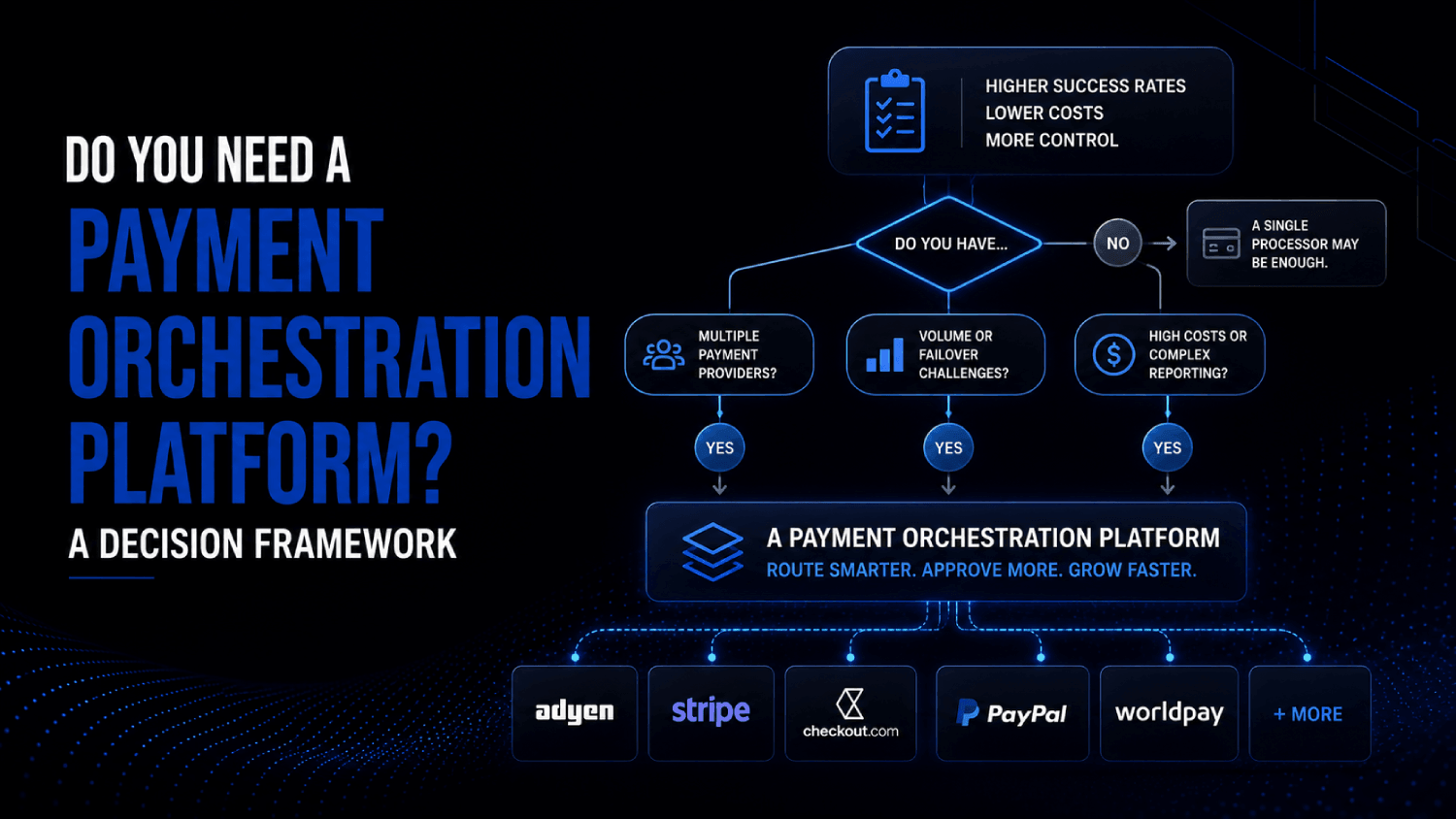

- Most companies that ask “do I need a payment orchestration platform?” already qualify , they just haven’t run the numbers against a clear threshold.
- The four signals that actually matter are: PSP count, monthly processing volume, number of active geographies, and whether a single PSP failure would materially hurt revenue.
- If you are on one PSP, processing under $500K per month, and selling in one country, orchestration adds cost and complexity without a proportional return.
- Above those thresholds, the cost of not orchestrating , failed payments, manual routing, dead-end outages , compounds faster than the platform fee.
- The vendor decision comes after the yes/no decision. Confusing them is the most common mistake.
You need a payment orchestration platform if you are managing more than one payment service provider, processing above $500K per month, operating across multiple countries, or experiencing PSP downtime that causes measurable revenue loss. Below those thresholds, a single PSP like Stripe or Adyen usually covers your needs. Above them, orchestration starts paying for itself through higher authorization rates and reduced single-point-of-failure risk.
Why This Decision Is Harder Than It Looks
Payment orchestration gets framed as enterprise plumbing. The vendors selling it aim at billion-dollar payment volumes. The case studies feature retailers and banks. So when a Series B SaaS founder or a mid-market marketplace operator asks whether they need it, the honest answer rarely finds them quickly.
The problem is that the costs of under-orchestrating are invisible. A failed payment looks like user error. A PSP outage looks like a one-time incident. Low authorization rates in a new market look like low demand. None of those show up in a dashboard as “cost of not having orchestration.” They just quietly shrink revenue.
This guide gives you a concrete threshold test , four variables, each with a specific cutoff , and a decision tree for walking through your own situation. If you already know you need a platform and want vendor comparisons, the 8 best payment orchestration platforms for SaaS companies covers that ranking in detail. This article is for the decision before the vendor list.
What Payment Orchestration Actually Does?
A payment orchestration platform sits between your application and all your PSPs , Stripe, Adyen, Braintree, Checkout.com, regional processors , and decides in real time which PSP to route each transaction through, based on cost, success probability, geographic coverage, or custom rules you set. It also handles fallback routing when a PSP fails, token vaulting across providers, and unified reporting across all of them. What it does not do is process the payment itself. It is a routing and control layer, not a processor.
The FintechSpecs Orchestration Threshold Test
Four variables determine whether orchestration makes economic sense. Each has a binary answer. Score yourself before moving to the decision tree.
| Variable | Below Threshold (Skip Orchestration) | At or Above Threshold (Evaluate Orchestration) |
|---|---|---|
| PSP count | One active PSP | Two or more PSPs in production |
| Monthly processing volume | Under $500K/month | $500K/month or above |
| Active geographies | One country or region | Two or more countries, especially outside US/EU |
| Failover sensitivity | PSP outage is inconvenient but recoverable | One hour of PSP downtime costs $10K+ in lost transactions |
If you score zero or one, orchestration is premature. If you score two or more, you are already absorbing the costs of not having it. If you score three or four, the only open question is how fast to implement.
The $500K/month volume threshold is not arbitrary. Below that level, most single-PSP platforms offer enough configurability, and the annual cost of an orchestration layer , typically a per-transaction fee plus a platform fee , often outweighs the authorization rate gains. Above it, even a 1-2 percentage point improvement in authorization rates on $6M+ annual volume starts to produce material recovery.
What Does the Decision Tree Actually Look Like?
Work through these four questions in order. Stop when you hit a clear answer.
- Are you routing transactions across more than one PSP today? If yes, you are already doing manual orchestration without the tooling. Go to question 2. If no, go to the geographic question.
- Is your monthly volume above $500K? If yes, the transaction-level economics of orchestration (routing optimization, retry logic, cascading fallback) start justifying the platform cost. Go to question 3. If no, stay on a single PSP until volume warrants the overhead.
- Are you processing in more than one country, or do you plan to in the next 12 months? Cross-border routing is where authorization rates diverge most sharply between PSPs. A Brazilian card processed through a US-based PSP will authorize at a materially lower rate than the same card through a local acquirer. If yes, orchestration is likely your path. If no, proceed to question 4.
- Would a single PSP outage cause you to miss SLAs, lose a meaningful percentage of daily GMV, or trigger customer-facing failures? If yes, failover logic alone justifies the evaluation. If no, and you answered no to most of the above, you are not at threshold yet.
Single PSP vs. Orchestration: Where the Trade-Off Actually Lives
The real cost of staying on a single PSP past your threshold is not the PSP’s transaction fee. It is the ceiling you hit on authorization rates, the engineering time spent building manual retry logic, and the revenue lost during outages that cascade with no fallback. The Stripe vs. Adyen decision for B2B SaaS goes deeper on what each PSP does and does not handle natively , but neither platform solves the multi-PSP coordination problem on your behalf.
To illustrate the math: a marketplace processing $1.2M/month across the US and Mexico, running through Stripe only, with a Mexican card authorization rate 12 points below what a local acquirer would achieve, and 30% of volume on Mexican cards. At a blended $100 average order value, that gap works out to roughly $43,200/month in declined revenue (hypothetical: $1.2M × 30% × 12% gap ÷ $100 AOV × $100). An orchestration layer that routes Mexican cards to a regional processor would recover most of that, and the platform cost at that volume is typically well below the recovery figure. Verify the calculation against your own authorization data before treating it as a projection.
That scenario only works if the company has already identified the authorization rate gap. Most haven’t. Authorization rate by card BIN, by issuing country, by PSP, is not the default dashboard view in Stripe or Braintree. It requires deliberate measurement, which is one reason companies under-orchestrate: they do not see the problem until they start looking for it.
Payment Orchestration for SMBs: Is It Ever Worth It Below $500K?
There are two SMB exceptions to the volume threshold.
First, if your average transaction value is high , say, $2,000 or more per transaction , a single failed transaction represents significant lost revenue. Even at $200K/month volume, a 3% authorization failure rate on high-ticket transactions is painful enough to justify orchestration’s fixed costs. The math changes when your order values are high relative to your volume.
Second, if you are building a platform or marketplace where you are managing payments on behalf of other businesses, orchestration is less about your volume and more about your sub-merchants’ aggregate risk. A vertical SaaS product with 200 sub-merchants, each doing $5K/month, has the operational complexity of a $1M/month processor even if individual merchant volumes look small. For that pattern, looking at embedded payments providers built for B2B SaaS platforms alongside orchestration options makes sense, since some providers bundle both capabilities.
Outside those two exceptions, the honest answer for early-stage companies is: stay lean. Adding an orchestration layer at $150K/month is like buying a load balancer before your server is ever stressed. The infrastructure spend arrives before the problem does.
How to Choose a Payment Orchestration Provider Once You Qualify
Assuming the threshold test puts you in the “yes” column, the provider evaluation has five concrete dimensions.
| Dimension | What to Evaluate | Questions to Ask Vendors |
|---|---|---|
| PSP connectivity | Native integrations vs. custom API builds | Which PSPs are live in production, not just “supported”? |
| Routing logic | Rule-based, ML-driven, or both | Can I build custom routing rules without engineering support? |
| Token vault | Cross-PSP tokenization for card-on-file customers | What happens to stored tokens if I leave your platform? |
| Failover speed | Time to reroute after a PSP failure | What is the P99 failover latency in production? |
| Pricing model | Per-transaction fee, platform fee, or both | Does the fee apply to all transactions or only routed ones? |
The token vault question is underweighted in most evaluations. If your platform has recurring billing or card-on-file customers, the tokens stored with your current PSP are not portable by default. An orchestration layer with a cross-PSP vault means you own the customer’s payment credential, not the PSP. That is a meaningful structural shift in how portable your payment stack becomes.
Pricing structure also matters more than the headline rate. Some platforms charge on every transaction that passes through the orchestration layer, even if it goes to a single PSP. Others only charge on transactions they actively route or retry. At high volumes, those two models produce very different monthly invoices. Vendors including Spreedly, Checkout.com’s orchestration layer, and Rapyd each use different pricing structures; request a volume-based quote rather than a per-transaction rate in isolation.
For a full vendor comparison across these dimensions, the 8 best payment orchestration platforms for SaaS companies breaks down the category by use case. The evaluation framework above applies regardless of which vendor list you consult.
What About Fraud and Compliance , Does Orchestration Touch Those?
Orchestration platforms vary significantly on this. Some, like Spreedly, focus narrowly on routing and connectivity. Others bundle fraud decisioning, 3DS2 orchestration, and BIN intelligence directly into the routing logic. The distinction matters because running fraud tools at the orchestration layer , rather than at the PSP layer , gives you consistent rules across all processors, rather than having Stripe’s fraud model apply to some transactions and Adyen’s to others.
If your fraud stack is separate, this is less urgent. But if you are evaluating orchestration at the same time you are evaluating fraud tooling, choosing a platform that handles both at the same layer reduces integration surface. The top fraud orchestration platforms for high-growth fintech teams covers that adjacent decision in detail.
On the compliance side, orchestration does not reduce your PCI DSS scope on its own. Tokenization can, but only if the vault is the scope reduction mechanism and you have implemented it correctly. Assuming orchestration handles compliance automatically is one of the more expensive mistakes in this space.
The Hidden Costs That Tip the Calculation
Engineering time is the most consistently underestimated cost in the single-PSP-vs-orchestration trade-off. Building retry logic, failover handling, and multi-PSP reconciliation in-house is not a one-time project. It requires ongoing maintenance as PSP APIs change, as routing rules need adjustment, and as new markets require new integrations. Companies that have gone through this internally often report that payment infrastructure absorbs engineering cycles that compound into real opportunity cost , a pattern that hidden costs killing fintech SaaS margins documents across several infrastructure categories.
The flip side is also real. Orchestration platforms add a dependency and a failure point. If the orchestration layer goes down, all your PSPs go with it , which is worse than any single PSP outage. Evaluating an orchestration vendor’s own uptime history and SLA structure should be part of the due diligence, not an afterthought.
Frequently Asked Questions
What is the difference between a payment gateway and a payment orchestration platform?
A payment gateway is a single integration point that connects your checkout to one payment processor or acquiring bank. A payment orchestration platform connects to multiple gateways and PSPs simultaneously, routing transactions across them based on rules, performance, or cost. Gateways handle the transaction. Orchestration handles which gateway handles the transaction. Most companies start with a gateway and add orchestration when a single gateway becomes a ceiling rather than a solution.
What is the difference between a payment processor and a payment orchestration platform?
A payment processor moves money , it handles authorization, clearing, and settlement between the cardholder’s bank and the merchant’s bank. A payment orchestration platform does not move money itself. It routes transactions to the best-fit processor, manages failover if a processor fails, and aggregates reporting across all processors. You need at least one processor regardless of whether you add orchestration. They are not substitutes; they operate at different layers of the stack.
At what volume does payment orchestration become worth it for a SaaS company?
$500K/month in processing volume is the practical floor for most use cases. Below that, the platform fee and integration overhead typically outweigh the authorization rate gains. The threshold drops for high average order value products (above $1,500 per transaction) and for platforms managing sub-merchants at aggregate volume. Above $500K/month across multiple geographies or PSPs, the economic case usually closes within the first few months of deployment.
Can a small business use payment orchestration?
Yes, but the economics rarely work until volume or complexity crosses a threshold. For most SMBs on a single PSP, selling in one geography, with average order values under $500, a well-configured Stripe or Square integration outperforms an orchestration layer on total cost. The SMB exception is high-ticket verticals and platform businesses with many sub-merchants, where orchestration’s authorization rate improvements and failover logic produce returns even at lower absolute volumes.
How does payment orchestration improve authorization rates?
By routing each transaction to the PSP most likely to approve it, based on factors like card BIN, issuing country, transaction amount, and real-time PSP performance data. A domestic card issued in Brazil authorizes at a materially higher rate through a local Brazilian acquirer than through a US-based PSP. Orchestration applies that logic automatically at transaction time, rather than relying on a single PSP’s fixed routing rules. The improvement is most pronounced in cross-border transaction flows.
Does payment orchestration eliminate the need for PCI DSS compliance?
No. Orchestration does not automatically reduce your PCI scope. If you use the orchestration platform’s token vault and never handle raw card data yourself, you can reduce scope through tokenization , but that depends on correct implementation. The orchestration layer is still a component in your cardholder data environment and needs to be included in your compliance assessment. Assuming orchestration handles PCI by default is inaccurate and can create audit exposure.
Which payment orchestration providers are best for SaaS companies?
The answer depends on PSP footprint, geographic needs, and whether you need fraud tooling bundled in. Spreedly is well-regarded for breadth of PSP integrations and developer flexibility. Checkout.com’s orchestration layer suits companies already in their payment stack. Rapyd has strong emerging market coverage. For a detailed breakdown by use case, volume tier, and pricing model, the 8 best payment orchestration platforms for SaaS companies on FintechSpecs covers the full category comparison.
What to Do With Your Score
Run the threshold test against your actual numbers, not projections. Companies that justify orchestration based on where they expect to be in 18 months often end up with infrastructure that arrives before the operational complexity does. The threshold exists to prevent that. If you score two or more today, start the vendor evaluation. If you score one or zero, set a calendar reminder to re-run the test when your volume or geography situation changes.
The vendor evaluation itself is a separate exercise with its own due diligence checklist. PSP connectivity, token portability, failover latency, and pricing structure on actual volume , not headline rates , are the four variables that separate a well-fitted platform from one that looks good in a demo. The framework for evaluating any fintech vendor before you sign applies directly to orchestration platform RFPs.
One underappreciated signal: how much of the orchestration value you are already capturing through manual processes. If your engineering team has built retry logic, PSP fallback, or reconciliation tooling in-house, you are already paying for orchestration in engineering hours. The platform just determines whether you keep paying that way or consolidate it into a vendor relationship with predictable cost and dedicated support.