
- Mambu is a capable SaaS core, but its pricing opacity, limited US regulatory depth, and configuration-heavy model create real friction for fintechs scaling past seed stage.
- Thought Machine, Tuum, and 10x Banking sit in the same enterprise tier and compete directly on cloud-native architecture. Engine by Starling and Unit are the strongest alternatives for US-market builders who need faster time-to-product.
- No single Mambu alternative wins across every dimension. The right call depends on three variables: your regulatory jurisdiction, whether you need a ledger or a full core, and how much engineering lift your team can absorb.
- Pricing across all eight alternatives is largely undisclosed and sales-negotiated. Any vendor that gives you a public number before understanding your volume should prompt skepticism, not relief.
- The FintechSpecs Core Selection Matrix below maps each vendor across five dimensions so you can build a shortlist in under ten minutes.
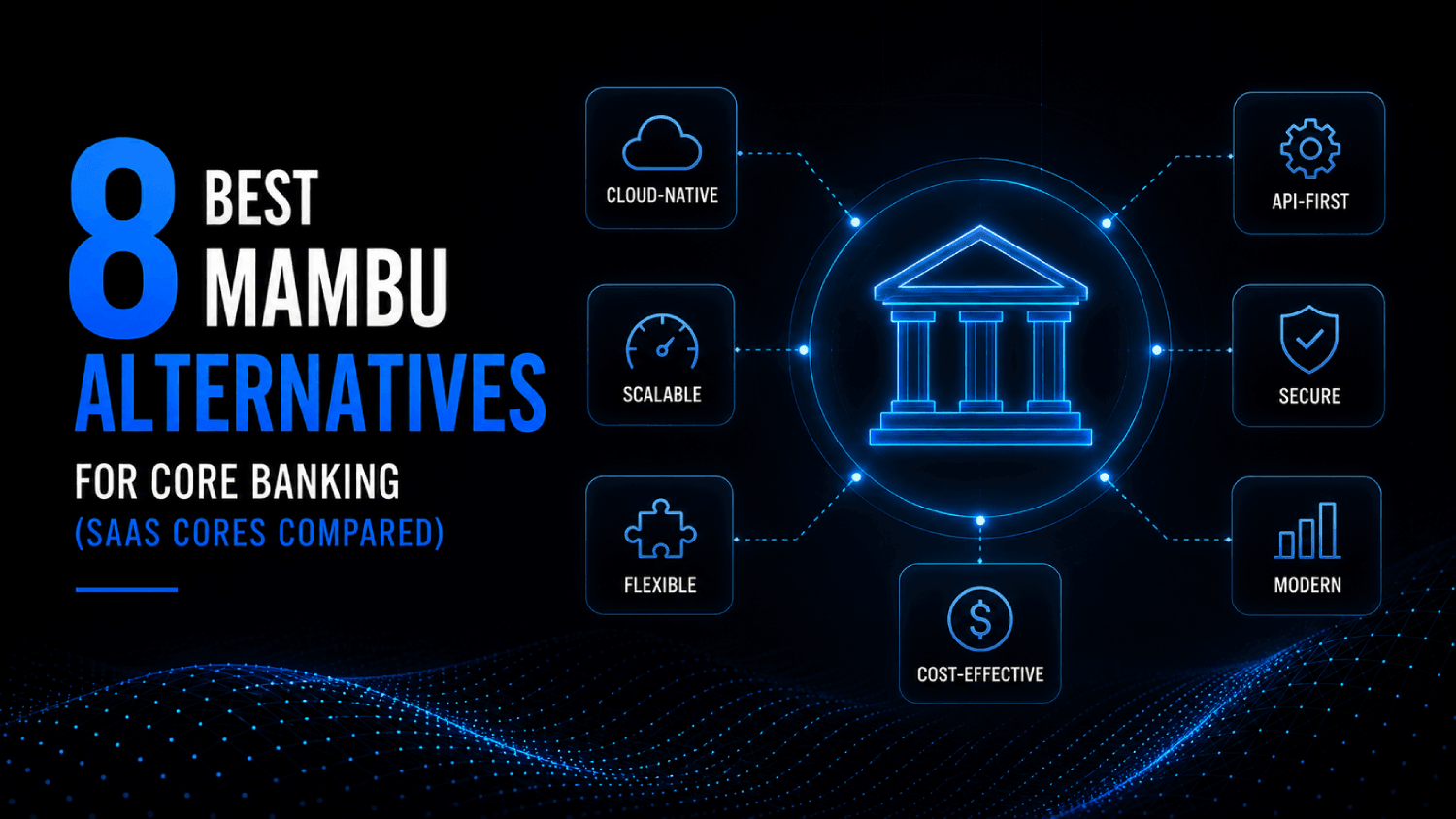
The eight strongest Mambu alternatives for SaaS core banking are Thought Machine, Tuum, 10x Banking, Engine by Starling, Unit, Finflux by M2P, Galileo Financial Technologies, and SolarisBank. Each addresses a different gap in Mambu’s offering: Thought Machine and 10x Banking for pure cloud-native architecture, Tuum for multi-product configurability in Europe, Engine by Starling for regulated UK and US expansion paths, Unit and Galileo for embedded finance in the US market, Finflux for emerging-market and asset-finance use cases, and SolarisBank for full Banking-as-a-Service with a built-in German banking license.
Why Are Fintech Teams Looking Beyond Mambu Right Now?
Mambu built its reputation as the anti-legacy core: API-first, cloud-deployed, fast to configure. That reputation is still largely earned. For a neobank or digital lender launching in Europe, Mambu remains a rational starting point. The friction starts later.
Teams that have run Mambu in production consistently report three complaints. First, the pricing model scales with accounts and transactions in ways that become expensive and hard to forecast above a certain volume. Second, the composable banking model requires significant internal engineering to wire together productized modules into coherent customer flows. Third, Mambu’s US regulatory depth is thinner than its European pedigree, which matters for teams building US lending, deposit, or card products that need OCC or state-charter compatibility baked into the core.
None of this makes Mambu a bad product. It makes it a product with a specific fit profile, and if your product is outside that profile, the alternatives below deserve serious evaluation. Core banking decisions compound over years. Getting this wrong is expensive in ways that don’t show up on a single invoice. For a fuller picture of how infrastructure choices ripple through your margins, see the FintechSpecs analysis of hidden costs that compress fintech SaaS margins before you finalize any shortlist.
How to Evaluate Core Banking Alternatives: The FintechSpecs Core Selection Matrix
Most vendor comparison frameworks treat all evaluation criteria as equal. They are not. The FintechSpecs Core Selection Matrix weights five dimensions by the order in which they typically eliminate candidates during a real procurement cycle.
Tier 1 (eliminators): Jurisdiction readiness and regulatory coverage. If a core cannot support your charter type or jurisdiction, nothing else matters. Tier 2 (differentiators): Architecture model (cloud-native vs. cloud-hosted legacy) and data model flexibility. Tier 3 (tiebreakers): Time-to-first-product, developer experience, and pricing model predictability.
Applying this sequence lets you reduce eight candidates to two or three before you ever get on a sales call. The table below maps each vendor across all five dimensions. Use it as a filter, not a ranking.
| Vendor | Architecture | US Presence / Fit | Primary Use Case | Pricing Model | Best For |
|---|---|---|---|---|---|
| Thought Machine | Cloud-native (Vault Core) | Strong (US office, US bank clients) | Tier 1-2 banks, challenger banks | Enterprise contract, not disclosed | Banks and large fintechs needing maximum product flexibility |
| Tuum | Cloud-native, modular | Moderate (Europe-first, US expanding) | Multi-product banking, lending, cards | Subscription + usage, not disclosed | European fintechs needing a single core across product lines |
| 10x Banking | Cloud-native (SuperCore) | Moderate (UK-origin, growing US) | Tier 1 banks modernizing at scale | Enterprise contract, not disclosed | Large banks replacing core infrastructure |
| Engine by Starling | Cloud-native (Starling’s live stack) | Growing (US market entry active) | Full-service neobank and digital bank | Enterprise contract, not disclosed | Teams that want a proven live-bank stack, not a prototype |
| Unit | API-first BaaS layer | Strong (US-native) | Embedded banking for SaaS companies | Revenue share + platform fee | US SaaS platforms embedding accounts, cards, and payments |
| Finflux by M2P | Cloud-hosted, configurable | Limited (India/Africa-primary) | Lending, asset finance, microfinance | SaaS subscription, not disclosed | Lenders and MFIs in emerging markets |
| Galileo Financial Technologies | API-first processing platform | Very strong (US-native, SoFi subsidiary) | Card issuance, payments, accounts | Per-transaction / volume-based | US fintechs building card and payment-centric products |
| SolarisBank | Banking-as-a-Service platform | Limited (Europe/Germany-primary) | Embedded finance with full BaaS stack | Revenue share + platform fees | European companies needing a licensed BaaS partner |
Thought Machine vs Mambu: Which Cloud-Native Core Wins for Banks?
Thought Machine’s Vault Core is the most technically rigorous alternative to Mambu in the enterprise segment. Where Mambu uses a configuration-layer model, Vault Core uses Smart Contracts written in Python to define every financial product from the data model up. That gives engineering teams fine-grained control over product behavior that Mambu’s module system does not match.
The practical trade-off is implementation time and cost. Vault Core is not a fast path to production. Teams that have deployed it report multi-year implementation timelines for full-scale bank deployments. Mambu is meaningfully faster to get running at smaller scale. If you are a Series A fintech with 18 months of runway and a go-live deadline, Thought Machine is the wrong call. If you are a Tier 2 bank with a 3-year modernization program and requirements that Mambu’s module catalog cannot satisfy, Thought Machine earns serious consideration.
Thought Machine has disclosed clients including JPMorgan Chase, Lloyds Banking Group, and Standard Chartered. That reference list is difficult for any other cloud-native core to match and signals genuine enterprise-grade deployment at scale. Mambu’s client list skews toward challenger banks and digital lenders, which reflects the different complexity ceiling each platform is built for.
What Makes Tuum a Credible Mambu Competitor for Multi-Product Builds?

Tuum’s architecture is designed around one specific problem that Mambu addresses imperfectly: running deposits, lending, and card products on a single core without stitching together separate modules that don’t share a consistent data model. Tuum positions each product line as a native capability rather than an add-on, which reduces the integration surface area for teams that need all three.
Tuum is Estonia-headquartered and has built its strongest reference base in Europe, with particular traction in markets where teams need PSD2 and GDPR-native architecture from day one. Its US presence is developing but not yet at the depth of Galileo or Unit for teams building specifically for US consumers. If your primary market is the EU and you anticipate launching multiple product verticals on a single customer record, Tuum deserves a place on the shortlist ahead of Mambu.
Pricing is not publicly disclosed. Tuum operates on a subscription and usage model with contract terms negotiated directly. This is consistent across almost every platform in this category, which makes benchmarking difficult without going through a full procurement process.
Engine by Starling: Does Licensing a Live Bank’s Core Change the Risk Profile?

Engine by Starling occupies a position no other vendor in this list can claim: it is the actual technology stack that runs Starling Bank, licensed to third-party banks and fintechs. That distinction matters more than it might appear. Mambu, Thought Machine, and Tuum are all platforms built for clients. Engine is a platform that its own builder bet its banking license on.
That creates a different kind of confidence signal. When a vendor uses its own product in a live regulated bank processing real customer deposits and payments at scale, the operational failure modes have already been discovered and addressed. Most competing platforms have never run a live bank’s actual transaction volume under that platform’s production infrastructure.
Engine’s client list includes AMP Bank in Australia and Salt Bank in Romania. Its US market entry is active, though the reference base there is still early. For a digital bank or challenger looking to launch with a technology stack that has proven live-bank provenance, Engine is a more compelling alternative to Mambu than its current name recognition suggests.
Unit and Galileo: The US-First Alternatives Mambu Struggles to Match
For US-market builders, Unit and Galileo solve a problem Mambu does not fully address: the sponsor bank relationship layer. Building a US deposit or card product requires a bank charter or a sponsor bank partnership. Both Unit and Galileo have those relationships embedded in their platform offering in ways that reduce the legal and operational complexity a Mambu customer would need to solve independently.
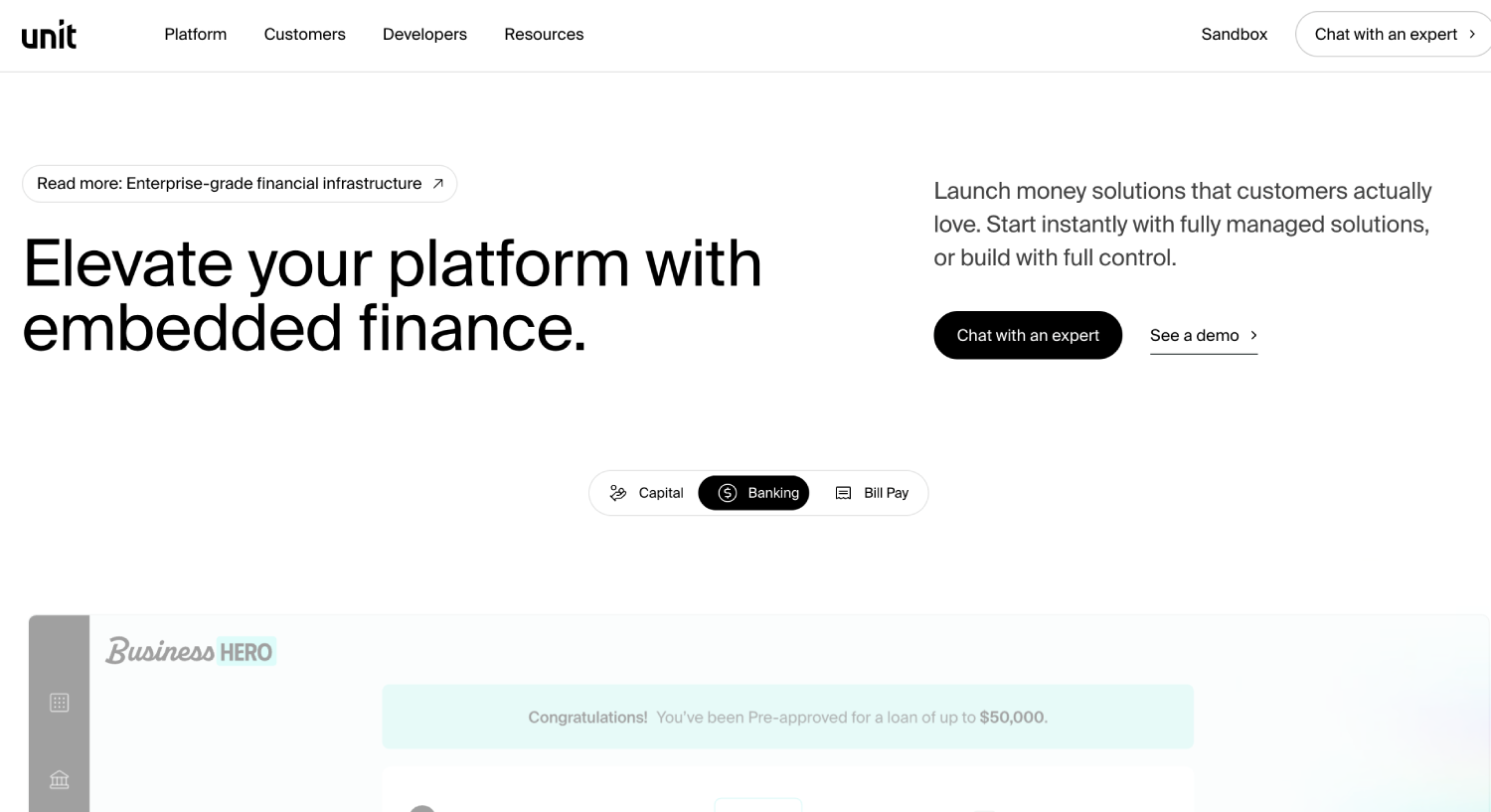
Unit is purpose-built for SaaS platforms embedding financial products. Its API design reflects the developer experience expectations of a software company, not a bank procurement team. For a vertical SaaS company adding checking accounts or cards to its product suite, Unit provides a faster path than any core banking platform in this list because it handles the sponsor bank layer, the compliance stack, and the core ledger as a bundled offering. You can explore how Unit compares to similar platforms in the FintechSpecs guide to BaaS alternatives for SaaS platforms.
Galileo sits closer to the infrastructure layer. As a subsidiary of SoFi Technologies, it has a deep US processing history and handles card issuance, ACH, and account management for some of the largest US fintechs. Its per-transaction pricing model is more predictable at high volume than the subscription-and-usage structures that most core platforms use. For a fintech processing millions of card transactions per month, Galileo’s volume economics are worth modeling explicitly against any alternative.
10x Banking, Finflux, and SolarisBank: Where Do They Fit?
10x Banking
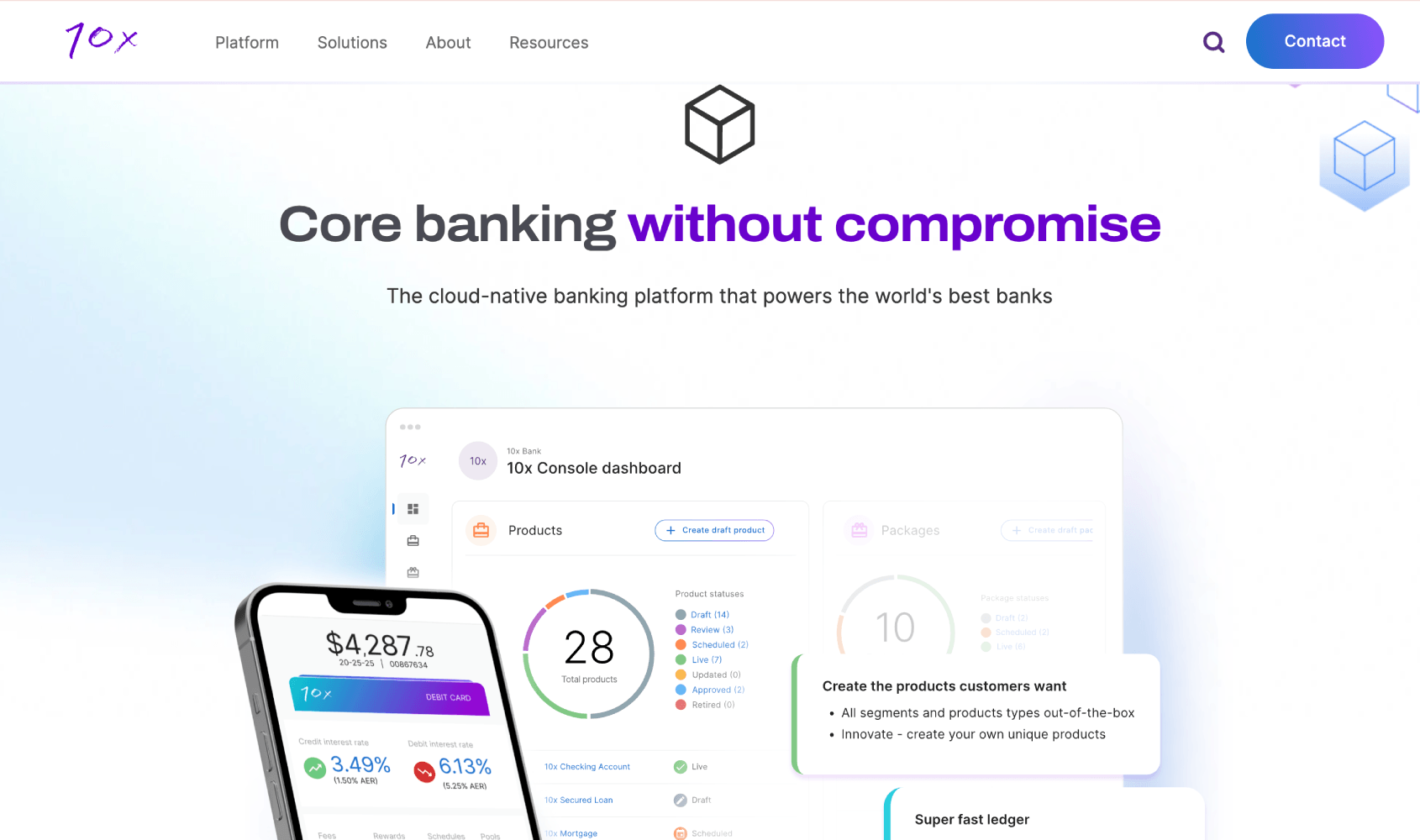
10x Banking’s SuperCore is architecturally closest to Thought Machine: fully cloud-native, built around a universal data model, and aimed at large banks replacing core systems rather than fintechs launching new products. Its primary clients are institutions like Westpac. If you are evaluating Mambu as a bank modernization vehicle rather than a fintech launch platform, 10x belongs on the shortlist. If you are a startup or scale-up, the implementation economics will not work in your favor.
Finflux by M2P
Finflux targets lending, asset finance, and microfinance use cases in emerging markets, primarily India and Africa. It is a strong option for fintechs operating in those geographies and product categories that Mambu’s more bank-centric model does not serve as naturally. For a US or European team, Finflux is rarely the right call, but for a NBFC or MFI looking for a configurable loan management core, it competes directly with Mambu on price and speed of deployment.
SolarisBank
Solarisbank is a German-licensed bank that also operates as a Banking-as-a-Service platform, which makes it a fundamentally different category than a pure core banking vendor. If your use case requires a European banking license without obtaining one yourself, Solarisbank is the only player in this list that offers that. That is a meaningful differentiator for European embedded finance products. For teams that already have or are pursuing their own license, Solarisbank’s offering overlaps more than it differentiates from a pure-core alternative. The FintechSpecs overview of Banking-as-a-Service platforms covers the licensed-BaaS category in more depth.
Deployment and Pricing Model Comparison
| Vendor | Deployment | Pricing Structure | Pricing Transparency | Typical Contract Term |
|---|---|---|---|---|
| Mambu | SaaS (multi-cloud) | Subscription + account/transaction fees | Low (custom quotes) | Multi-year |
| Thought Machine | Cloud-native (GCP, AWS, Azure) | Enterprise contract | Very low | Multi-year |
| Tuum | SaaS, cloud-hosted | Subscription + usage | Low | Multi-year |
| 10x Banking | Cloud-native | Enterprise contract | Very low | Multi-year |
| Engine by Starling | Cloud-native | Enterprise contract | Very low | Multi-year |
| Unit | SaaS API (US) | Revenue share + platform fee | Moderate (some public guidance) | Annual or multi-year |
| Galileo | SaaS API (US) | Per-transaction / volume tiers | Moderate | Volume-based contracts |
| Finflux by M2P | SaaS / cloud-hosted | SaaS subscription | Low | Annual |
| SolarisBank | SaaS (Europe) | Revenue share + platform fees | Low | Multi-year |
One observation worth naming: pricing opacity is universal in this category. Every vendor claims pricing transparency as a differentiator, but none of the enterprise-tier platforms publish a pricing page. Unit and Galileo offer the most accessible entry points and have at least disclosed their pricing model structure publicly, which gives you something to model before the first call. For a detailed breakdown of how hidden costs compound inside fintech infrastructure decisions, the FintechSpecs piece on critical mistakes when choosing fintech infrastructure is useful pre-reading.
A Worked Scenario: Choosing Between Mambu and Its Top Alternatives
Scenario: A US-based fintech at Series B, processing $8 million per month across a combination of lending and deposit accounts, with a 12-month roadmap to add a card product. This team has evaluated Mambu and found three specific constraints: the US sponsor bank integration requires significant custom work, the card module needs third-party processors bolted on, and the account-level pricing model becomes expensive above 500,000 active accounts.
Applying the FintechSpecs Core Selection Matrix: Thought Machine and 10x Banking are eliminated at Tier 1 because the implementation timeline does not fit a 12-month card launch. Engine by Starling clears Tier 1 but is early-stage on US deployment references. Tuum and Finflux are eliminated on US jurisdiction readiness. That leaves Unit and Galileo as the primary candidates, with Unit winning on the bundled compliance and sponsor bank layer for deposit accounts, and Galileo winning if the card-processing volume economics favor per-transaction pricing over a platform fee structure.
The elimination logic above is real even if the company is not. Most teams waste two to three sales cycles on vendors that would have been eliminated in the first five minutes with a structured framework.
What Does “Cloud-Native” Actually Mean for Core Banking, and Why Does It Matter?
The term cloud-native is used loosely enough in core banking marketing to have almost lost meaning. For the purpose of evaluating Mambu alternatives, a precise definition matters. A genuinely cloud-native core was built from scratch to run on cloud infrastructure, uses microservices or API-first architecture, scales horizontally at the component level, and has no legacy mainframe dependency anywhere in its lineage.
Mambu qualifies under this definition. So do Thought Machine, Tuum, 10x Banking, and Engine by Starling. Galileo and Unit are API-first but are processing platforms rather than general-purpose cores. Finflux is cloud-hosted but was not built with cloud-native architecture as its founding constraint. SolarisBank is a hybrid: a licensed bank that has built modern APIs over a more traditional banking infrastructure.
This distinction has direct operational consequences. A cloud-native core can deploy new product configurations without downtime, scales compute independently of storage, and can give individual tenants their own isolated environments within a shared infrastructure. A cloud-hosted legacy system can often do none of these things, regardless of what the marketing says. One direct technical question in the first sales call settles which category a vendor falls into: “Has any part of this codebase migrated from a pre-cloud system, or was it written entirely post-2010?”
Frequently Asked Questions
Is Mambu a core banking system or a banking platform?
Mambu is a cloud-native SaaS core banking platform. It provides a composable banking engine that handles deposit accounts, lending products, and transaction processing through an API-first model. It is not a full Banking-as-a-Service provider with a bundled bank license. Banks and fintechs use Mambu as the system of record for financial products while building adjacent capabilities on top of it through their own integrations or third-party services.
What is the biggest difference between Thought Machine and Mambu?
Thought Machine’s Vault Core uses a Smart Contract model written in Python to define every financial product at the data layer, giving engineering teams more control over product logic than Mambu’s configuration-based approach. In practice, that control comes with higher implementation complexity and longer timelines. Mambu is faster to deploy for standard product types. Thought Machine is better suited to banks that need to build products outside standard templates and have the engineering resources to support a longer implementation cycle.
Which Mambu alternative has the strongest US presence for fintech builders?
Unit and Galileo Financial Technologies are the strongest options for US-market fintech builders. Both are US-native, have established sponsor bank relationships that reduce regulatory complexity for deposit and card products, and have reference clients in the US market. Galileo is deeper on card processing and payment infrastructure. Unit is better suited to SaaS platforms embedding financial products for the first time. Thought Machine also has US clients including JPMorgan Chase, but at an enterprise scale that most fintechs cannot access.
Does Mambu publish pricing, and how do its competitors compare on pricing transparency?
Mambu does not publish pricing on its public website. Pricing is custom-quoted based on account volume, transaction volume, and contract terms. This is consistent with nearly every alternative in the category: Thought Machine, 10x Banking, Tuum, and Engine by Starling also operate on custom enterprise contracts with no public pricing. Unit and Galileo are the exceptions, having publicly described their pricing model structures (revenue share and per-transaction respectively), though specific rates still require a sales conversation to obtain.
Can a Series A or seed-stage fintech realistically deploy an enterprise core like Thought Machine or 10x Banking?
Realistically, no. Enterprise cores like Thought Machine and 10x Banking require multi-year implementation timelines, dedicated engineering resources during integration, and contract minimums that are sized for Tier 1 and Tier 2 banks. A seed or Series A fintech with fewer than 50 engineers and a go-live target inside 18 months would be better served by Unit, Galileo, or a BaaS platform that reduces integration complexity. Mambu itself sits in the middle: faster than Thought Machine, but still requiring significant internal engineering to operate well.
What is the FintechSpecs Core Selection Matrix?
The FintechSpecs Core Selection Matrix is a five-dimension evaluation framework for core banking platform selection, applied in order of elimination priority. Tier 1 criteria (eliminators): jurisdiction readiness and regulatory coverage. Tier 2 criteria (differentiators): architecture model and data model flexibility. Tier 3 criteria (tiebreakers): time-to-first-product, developer experience, and pricing model predictability. Applying these in sequence reduces an eight-vendor shortlist to two or three candidates before a single sales call, saving three to six months of wasted procurement cycles.
Is SolarisBank a core banking alternative or a different category entirely?
SolarisBank operates as a Banking-as-a-Service platform with a German banking license, which makes it a different category from a pure core banking vendor like Mambu. It is a credible alternative for European companies that need a licensed financial infrastructure partner without obtaining their own banking authorization. For teams that already have a charter or are building a core modernization program, SolarisBank’s offering is not a direct substitute. The licensing capability is the differentiator, not the core technology itself.
How does choosing a core banking platform affect compliance obligations?
The core banking platform you choose does not replace your compliance obligations, but it significantly affects how expensive and complex those obligations are to fulfill. A platform with US regulatory-native architecture reduces custom integration work for AML, BSA, and state-licensing requirements. A European-primary platform adds compliance engineering overhead for US deployments. Before finalizing any core selection, your compliance and legal teams should review the platform’s data residency options, audit log architecture, and regulatory reporting capabilities. The FintechSpecs guide to fintech product and compliance readiness covers what to validate before you sign.
Which Mambu Alternative Should Actually Make Your Shortlist?
The honest answer is that Mambu’s reputation as the safe modern-core choice is partially justified and partially a function of incumbency. It was early to the cloud-native core market, built a strong European reference base, and has real production deployments to point to. What it is not is the default best choice for every fintech or bank evaluating a modern core in the current market.
For US-market SaaS platforms embedding financial products, Unit belongs on every shortlist before Mambu. For large banks modernizing core infrastructure with multi-year programs, Thought Machine and 10x Banking are technically superior to Mambu if your product requirements exceed what Mambu’s configuration layer can deliver. For European multi-product fintechs, Tuum and Engine by Starling have closed the gap with Mambu on product capability while offering architectural advantages Mambu cannot match. The FintechSpecs analysis of next-generation core banking platforms covers the broader category in more depth for teams still in early-stage research.
The single most useful thing this evaluation should tell you: the core banking selection decision is primarily a jurisdiction and architecture decision, not a features-and-pricing decision. Eliminate candidates on jurisdiction first. Then eliminate on architecture fit for your product roadmap. Everything after that is negotiation. Any team that starts by comparing module checklists and skips jurisdiction readiness is likely to end up in a re-platforming conversation 24 months later.