
- A credit decisioning platform POC fails most often because of data mapping problems, not API errors. Map every input field before writing a single test case.
- The POC should reproduce your worst-case production scenarios: bureau fallbacks, thin-file applicants, stale data, and rule conflicts. Happy-path testing only proves the demo works.
- Ownership gaps kill post-launch monitoring. Assign a named human to every decisioning component before go-live, not after the first incident.
- A staged rollout with hard exit gates, not a soft launch with vague milestones, is what separates a safe migration from an expensive rollback.
- Post-launch metrics should track approval rate drift, false positive rates, and latency under load, not just system uptime.
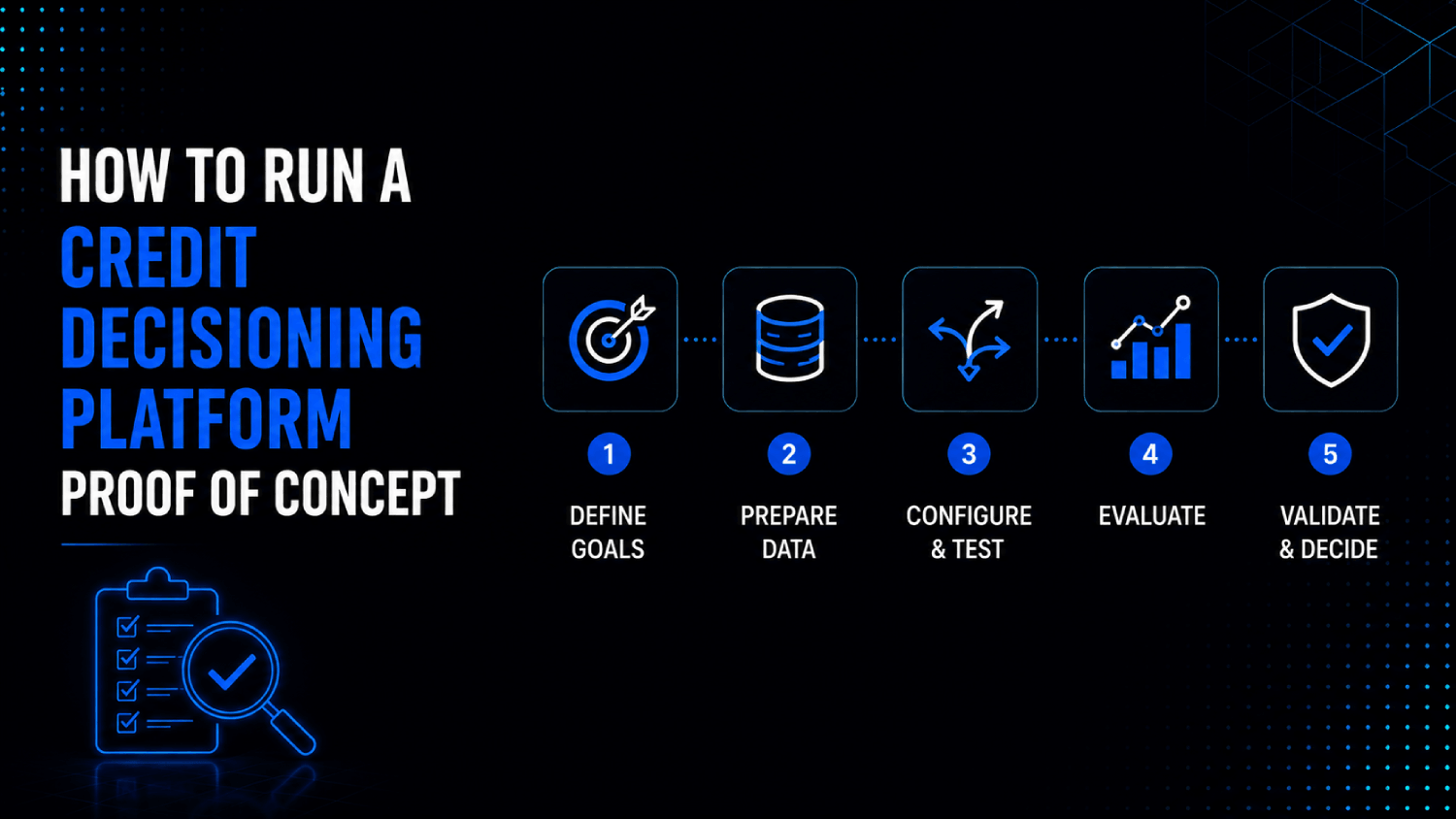
Running a credit decisioning platform proof of concept means deploying a controlled test of your decisioning logic, data connections, rule engine, and fallback controls against a representative slice of real or realistic applicant data, then validating that outcomes match what your policy intends before any production traffic moves. A well-run POC takes four to eight weeks and covers data mapping, test case design, rule validation, failure mode testing, staged rollout gates, and post-launch monitoring setup. Skip any of those stages and you are not running a POC; you are running an uncontrolled migration.
Why Most Credit Decisioning POCs Fail Before They Start
The standard assumption when a vendor is selected is that integration is an engineering task with a defined endpoint. Connect the API, configure the rules, flip the switch. Teams that think this way hit the same wall: the platform works in the demo environment and breaks in production because the data it receives is nothing like the clean, normalized payloads shown during the sales process.
Real applicant data comes in with missing bureau fields, mismatched identifiers between your CRM and the decisioning layer, income figures reported in inconsistent formats, and bureau responses that time out at a rate your load testing never anticipated. None of that is the vendor’s fault. It is a data readiness problem, and no amount of vendor support can resolve it after the fact.
The second failure mode is rule logic that was never formally documented before migration. Teams import their existing credit policy into a new platform and discover mid-POC that the policy in their heads differs from the policy in their legacy code, which differs again from what compliance approved eighteen months ago. A POC forces that reconciliation to happen on a schedule. Running it without that discipline just defers the conflict to a live environment.
What Should a Credit Decisioning POC Actually Prove?
A POC is not a demo. It is a falsification exercise. The goal is to discover every condition under which the platform gives the wrong answer, takes too long, or fails silently, while that failure costs nothing. Four things must be provable at the end of a POC before production traffic is justified.
First, decisioning outcomes must match your intended credit policy for every defined applicant segment. Second, the system must handle data failures gracefully, with documented fallback behavior rather than silent errors. Third, latency must stay within acceptable thresholds under realistic concurrent load. Fourth, the audit trail must satisfy your compliance team’s documentation requirements, including adverse action notice generation if your product is consumer-facing under the Fair Credit Reporting Act.
If your POC does not test all four of those dimensions, you will discover the gaps in production. That is the consistent pattern across migrations for any credit-adjacent product, whether you are building a consumer installment lender, a B2B embedded credit product, or a working capital advance program on top of a vertical SaaS platform. For teams building embedded credit specifically, the top embedded credit API providers each handle POC data requirements differently, and understanding that before you contract matters.
The FintechSpecs POC Readiness Stack: Eight Components That Must Be Validated
This is the framework used in the implementation sections below. Every credit decisioning POC should validate all eight components before any rollout gate is opened. Teams that skip components and plan to “come back to it” rarely do.
- Data mapping: every input field verified end-to-end from source system to decisioning layer
- Rule logic: every credit policy rule formalized, versioned, and confirmed against approved policy documentation
- Bureau and data provider connectivity: primary and fallback connections tested under simulated failure conditions
- Failure mode handling: documented behavior for every named failure scenario
- Test case coverage: approved applicant, declined applicant, edge case, and stress test scenarios all passing
- Audit and adverse action logging: confirmed output for every decision type
- Load and latency testing: performance validated at 1x, 3x, and 10x expected daily volume
- Owner matrix: named human accountable for each component pre-launch
How to Build the Data and Control Checklist Before Touching the Platform
Data mapping is the single phase most teams underinvest in, and it is the phase that determines whether every subsequent step works. Before writing a test case or configuring a rule, every data field that flows into a decision needs to be traced from its source to its destination and verified for format, frequency, and failure behavior.
Input data fields to map and verify
| Data Field | Source System | Format Expected by Platform | Null / Missing Behavior | Verified |
|---|---|---|---|---|
| Applicant identifier (SSN / EIN) | Application form / CRM | Numeric string, no dashes | Hard stop, no decision | |
| Bureau credit score | Experian / Equifax / TransUnion | Integer 300-850 | Route to manual review or use model score | |
| Stated income | Application form | Annual USD integer | Flag for verification, do not auto-approve | |
| Verified income | Argyle / Pinwheel / Plaid Income | Monthly gross, USD decimal | Fall back to stated income with flag | |
| Bank account cash flow | Plaid / MX / Finicity | 30/60/90-day averages, USD | Decision without or flag for manual | |
| Business financials | Ocrolus / Codat / ERP | JSON, normalized revenue and expense | Request resubmission or decline | |
| Identity verification result | Alloy / Socure / Persona | Pass / Fail / Review enum | Block decision until resolved | |
| Fraud signal score | SentiLink / SEON | 0-1000 risk score | If unavailable, apply conservative threshold |
Each row in that table needs a named owner who has physically confirmed the field in a staging environment, not just on a schema document. Schema documents lie. Staging environments show you what the data actually looks like at 2am on a Tuesday when a bureau has a partial outage.
For teams using bank account data as a primary underwriting signal, the differences between Ocrolus and Codat for cash flow underwriting materially affect how you structure this mapping phase, particularly around document parsing reliability and normalization logic.
Control checklist: credit rules engine configuration
Every rule in your credit policy needs to be stated in plain language, translated into platform logic, and confirmed to produce the correct output against a known test case before any other testing begins. Common sources of rule drift include legacy code that was never formally documented, informal exceptions that individual underwriters built into manual processes, and policy updates that were applied to one channel but not another.
| Rule Category | Example Rule | Input Condition | Expected Output | Confirmed in Staging |
|---|---|---|---|---|
| Hard decline | Bureau score below threshold | Score < 580 | Decline, adverse action generated | |
| Hard decline | Recent bankruptcy | Bankruptcy filed within 24 months | Decline, specific reason code | |
| Conditional approval | Thin file / no bureau score | Score not available, cash flow above threshold | Approve at reduced limit with flag | |
| Manual review route | Score in borderline band | Score 580-640 | Route to human review queue | |
| Fraud flag hold | High synthetic identity score | SentiLink score above threshold | Hold for identity review, no decision | |
| Pricing rule | Risk-based rate assignment | Score band A/B/C maps to rate tier | Correct APR or fee in offer |
How to Design Test Cases That Actually Break Things
Most teams design test cases to confirm that the platform works. The more productive framing is to design test cases that are intended to break the platform in every predictable way, then verify that each failure produces the correct behavior. A platform that handles failure cleanly is safer than one that only handles success.
Applicant scenario test cases
At minimum, your POC test suite should include these applicant scenarios, each with a documented expected outcome before testing begins:
- Prime applicant: all data present, score well above threshold, fraud score low. Expected output: auto-approve at standard terms.
- Near-prime applicant: score in borderline band, income verified, no fraud flags. Expected output: manual review route with correct queue assignment.
- Thin-file applicant: no bureau score, 90-day bank data available, stated income present. Expected output: platform follows your alternative data policy, not a silent decline.
- Hard-decline applicant: recent derogatory marks, score below hard cutoff. Expected output: decline with correct adverse action notice and reason codes.
- Fraud-flagged applicant: synthetic identity score above threshold. Expected output: decision held, fraud review queue populated, no offer issued.
- Repeat applicant: previously declined, reapplying within your cooling-off window. Expected output: platform detects prior application and applies correct cooldown policy.
- Applicant with conflicting data: stated income far above verified income. Expected output: defined handling, not arbitrary behavior.
System failure test cases
These are the scenarios most POCs skip and most production incidents trace back to:
- Bureau timeout: primary bureau connection fails to respond within SLA. Does the platform fall back to a secondary bureau, route to manual review, or return an error to the applicant?
- Identity provider outage: KYC/KYB check unavailable. Does the decision hold cleanly or fail silently with a false pass?
- Malformed payload: upstream system sends a field in an unexpected format. Does the platform reject cleanly or attempt to process corrupted data?
- Duplicate application: same applicant identifier submitted twice within thirty seconds. Does the platform deduplicate or create two decisions?
- Concurrent load spike: ten times normal volume for sixty seconds. Does latency degrade gracefully or does the queue back up in ways that affect applicant experience?
Document the expected behavior for every failure scenario before running the test. If you discover the expected behavior during testing, the test is not a POC; it is a requirements discovery session, which is a different and earlier activity.
What Does a Phased POC and Rollout Timeline Look Like?
A realistic timeline for a credit decisioning platform POC and staged rollout at a company processing moderate application volume looks like this. Teams at higher volumes or with more complex rule sets should add time to phases two and three, not compress them.
| Phase | Duration | Key Activities | Exit Gate |
|---|---|---|---|
| Phase 0: Readiness | 1-2 weeks | Data mapping audit, rule documentation, owner matrix assignment, environment setup | All input fields mapped, all rules formally documented, staging environment confirmed |
| Phase 1: POC Build | 2-3 weeks | Data connections in staging, rule engine configuration, test case design | All applicant scenario test cases pass, all failure mode behaviors documented |
| Phase 2: POC Validation | 1-2 weeks | Load testing, adverse action log review, compliance sign-off, audit trail verification | Compliance sign-off received, load test passes at 3x expected volume, audit trail confirmed complete |
| Phase 3: Shadow Mode | 2-4 weeks | Platform runs in parallel with existing system, outputs compared but new platform not authoritative | Outcome agreement rate above defined threshold (typically 98%+) for two consecutive weeks |
| Phase 4: Partial Rollout | 2-4 weeks | 5-10% of live traffic routed to new platform, monitoring active, rollback ready | Approval rate within defined tolerance of baseline, no new adverse action failures, latency SLA met |
| Phase 5: Full Rollout | 1-2 weeks | 100% traffic migration, legacy system retained in standby for 30 days | 30 days stable, no material outcome drift, legacy system decommissioned only after sign-off |
Shadow mode, Phase 3, is the step teams most often want to skip when they are under timeline pressure. It is the single highest-value phase in the entire process. Running the new platform in parallel with the existing system for two to four weeks with no production consequences surfaces rule interpretation differences, data handling discrepancies, and edge cases that no synthetic test suite would have caught. The cost of running shadow mode is a few weeks of infrastructure overhead. The cost of skipping it shows up as unexplained approval rate shifts on day one of full rollout.
Who Owns What: The Owner Matrix
Accountability gaps in credit infrastructure produce the same failure pattern every time. An incident occurs, no one is clearly responsible, the fix takes three times as long as it should, and the post-mortem reveals that ownership was assumed rather than assigned. Assign named owners to every decisioning component before the POC starts, not after the first production incident.
| Component | Primary Owner Role | Secondary Owner Role | Escalation Path |
|---|---|---|---|
| Data pipeline (bureau, income, bank data) | Engineering lead | FinOps / data engineer | CTO or VP Engineering |
| Credit rules engine configuration | Credit risk analyst | VP Risk or Chief Credit Officer | Compliance / Legal |
| Adverse action and audit logging | Compliance manager | Engineering lead | General Counsel |
| Identity and fraud integrations | Risk operations | Engineering lead | VP Risk |
| Load testing and latency monitoring | Engineering lead | DevOps / platform engineering | CTO |
| Rollout gates and rollback decisions | VP Product or COO | VP Risk | CEO for full rollback |
| Post-launch metrics and drift monitoring | Credit risk analyst | FinOps | VP Risk |
Every owner in this matrix needs to explicitly accept their assignment, not be listed on a document they have not read. Run a kickoff meeting where each owner confirms they understand what they are accountable for and what the escalation trigger looks like. This takes forty-five minutes and prevents the three-day incident triage that comes from unclear ownership.
What Are the Named Failure Scenarios and How Should the Platform Handle Each?
Document expected failure behavior before testing. If you are discovering the expected behavior during a failure, the platform is in production before it is ready.
Bureau and data provider failures
A primary bureau connection that times out is the most common production failure for any lender using real-time decisioning. The platform must have a documented policy for every permutation: primary times out and secondary available, both time out, response returns but with missing fields. “Route to manual review” is an acceptable answer, but it must be specified in advance, tested, and staffed accordingly.
Vendors like Taktile, Zest AI, and Upstart Network each handle bureau fallback differently in their platform configurations. Knowing what your vendor’s default behavior is during a bureau outage is not optional information; it is a prerequisite to signing a contract.
Rule conflict failures
When two rules produce conflicting outputs for the same applicant, a rules engine needs a defined conflict resolution hierarchy. The common approaches are priority ordering (the higher-priority rule wins), conservative default (the more restrictive outcome applies), and exception routing (conflict triggers manual review). There is no universally correct answer. There is a correct answer for your policy, and it needs to be documented before the rules go live.
Applicant experience failures
A decision that takes forty-five seconds instead of three seconds in a real-time application flow is a failure, even if the decision is technically correct. Define your latency SLA from the applicant’s perspective, not just the system’s perspective, and test against it at realistic concurrent volume.
What Rollout Gates Should Block Full Deployment?
A rollout gate is a defined, measurable condition that must be true before the next phase of deployment proceeds. “We feel good about it” is not a gate. These are the gates that matter for a credit decisioning platform migration.
Gate 1: Outcome parity in shadow mode
Before any live traffic moves to the new platform, the new platform’s decisions must match the existing system’s decisions on the same applicants at a rate your compliance team has pre-approved. For most programs, 98% or higher agreement on approval/decline outcomes is the right threshold. Discrepancies should be individually reviewed and categorized as intentional policy differences versus bugs.
Gate 2: Adverse action compliance in staging
For any consumer-facing lending product regulated under the Equal Credit Opportunity Act or Fair Credit Reporting Act, the adverse action notice output must be reviewed by compliance before go-live, not after. The specific reason codes generated, the timing of delivery, and the formatting requirements are all regulatorily defined. A platform that generates technically correct decisions but incorrect adverse action notices creates regulatory exposure immediately upon first production decline. Teams building FCRA-regulated products should review the full scope of those obligations, which the FCRA compliance services coverage addresses in detail.
Gate 3: Latency SLA under partial load
During the 5-10% partial rollout phase, response time for the new platform must stay within your defined SLA at that volume level before traffic is increased. A platform that is borderline on latency at 10% of volume will not improve at 100%.
Gate 4: Approval rate tolerance at partial rollout
Approval rate on live traffic should stay within a pre-defined tolerance band of your historical baseline during the partial rollout phase. A 2-3 percentage point shift is worth investigating. A 10-point shift is a gate failure, and the rollout should pause regardless of how confident the team feels about the cause.
What Metrics Should You Track After the Platform Goes Live?
Post-launch monitoring for a credit decisioning platform is not the same as API monitoring. System uptime tells you the platform is responding. These metrics tell you whether it is deciding correctly.
| Metric | What It Measures | Monitoring Frequency | Alert Threshold |
|---|---|---|---|
| Approval rate by segment | Whether decision outcomes match expected policy output by applicant type | Daily | Shift outside 2-3 pp baseline band |
| Adverse action rate | Proportion of applications generating adverse action notices | Daily | Material change from shadow mode baseline |
| Manual review queue volume | Whether borderline routing is working as expected | Daily | Queue volume more than 20% above projected |
| Bureau / data provider timeout rate | Frequency of fallback logic being invoked | Real-time | More than 0.5% of requests triggering fallback |
| P99 decision latency | Worst-case response time experienced by applicants | Real-time | Exceeds SLA for more than 60 seconds |
| Early-term default rate by cohort | Whether approved applicants are performing as the model predicted | Monthly (30/60/90 day cohorts) | Cohort default rate more than 15% above expected |
| False positive fraud flags | Legitimate applicants incorrectly held for fraud review | Weekly | Rate exceeds defined fraud review staffing capacity |
Early-term default rate by cohort is the metric teams set up last and regret most. Approval rate drift is visible within days. Default rate drift only surfaces 30 to 90 days after a policy change or migration, which is exactly long enough for a team to have moved on mentally before the signal appears. Build the cohort tracking dashboard on day one of post-launch monitoring, not when someone asks why defaults are up in month three.
For teams managing risk tooling more broadly, the overlap between credit decisioning monitoring and fraud detection monitoring is worth understanding. The fraud detection and risk tools coverage includes tools that integrate with or complement a credit decisioning layer, particularly for synthetic identity detection and application fraud signals that feed directly into decisioning inputs.
How Do Real Vendors Handle POC Differently?
Vendors handle the POC phase differently in ways that materially affect your rollout risk. These are implementation differences worth asking about explicitly, not features to evaluate on a comparison grid.
Platforms that provide a managed sandbox environment with pre-loaded test applicant profiles (representative of real bureau response structures) cut Phase 1 build time significantly. Taktile offers a no-code rule builder with version control that reduces the gap between credit analyst intent and engineering implementation, which directly addresses one of the most common sources of rule drift during migration. Zest AI is typically deployed with implementation support from its own team, which changes the ownership model compared to self-serve platforms. Teams evaluating Scienaptic or Finastra for enterprise lending programs will find implementation timelines and data integration requirements that differ substantially from API-native platforms built for fintech operators.
The question to ask every vendor in a POC context is: what breaks most often in the first thirty days post-launch for customers in our segment, and how do you handle it? A vendor who answers with specifics has institutional knowledge from real deployments. A vendor who responds with reassurances has not been asked the question before or does not want to answer it.
For teams that have not yet finalized vendor selection, the full evaluation framework for credit decisioning platforms for fintech lenders covers the major platforms in depth. The POC process above assumes you have already made or are finalizing that selection.
What Should the Compliance Team Sign Off On Before Go-Live?
Compliance sign-off is not a box to check at the end of the POC. It is a series of specific confirmations at specific phases. For consumer-facing credit products, the relevant frameworks include ECOA (Regulation B), FCRA, and any state-level lending regulations that apply to your product. For business credit products, the regulatory surface is narrower but not absent.
Compliance should confirm the adverse action notice content and delivery timing in staging before Phase 3. They should review the audit log format to confirm it satisfies examination requirements before Phase 4. They should sign off on the final rule set as consistent with approved credit policy before Phase 5. Any one of those confirmations arriving late will delay rollout regardless of how clean the technical implementation is.
Teams building credit products at early stage, where compliance infrastructure is often thinner, should be especially deliberate here. The fintech product and compliance readiness checklist provides a broader framework for what compliance coverage should look like at different stages of a fintech build.
Frequently Asked Questions
What does PoC mean in banking and credit decisioning?
A proof of concept in credit decisioning is a structured test of a new platform or rule set conducted in a controlled environment before live traffic moves. It covers data connectivity, rule validation, failure mode behavior, adverse action output, and performance under load. A banking POC is distinct from a vendor demo because it uses your actual credit policy and representative applicant data rather than vendor-supplied examples. Its purpose is to discover what breaks before production consequences apply, not to confirm that the platform works under ideal conditions.
How long does a credit decisioning POC take?
A realistic POC for a company at seed to Series B takes four to eight weeks of active work across the five phases described above: readiness, build, validation, shadow mode, and partial rollout. Teams that rush through readiness or skip shadow mode often complete the nominal POC faster but spend more time on post-launch fixes than the skipped phases would have cost. Enterprise lenders with more complex rule sets and more regulatory scrutiny should plan for eight to sixteen weeks including compliance review cycles.
What is shadow mode in a credit decisioning migration?
Shadow mode means running the new decisioning platform in parallel with the existing system, receiving the same applicant data, and producing decisions that are logged and compared, but not acted upon. The existing system remains authoritative for actual credit outcomes during this phase. Shadow mode surfaces decision disagreements between old and new platforms that indicate rule interpretation differences or data handling discrepancies. A two-to-four-week shadow mode period with a defined agreement rate threshold is the most reliable early warning system available before production exposure.
What test cases does a credit rules engine need before go-live?
At minimum: a prime applicant with full data present, a near-prime applicant in a borderline band, a thin-file applicant with no bureau score, a hard-decline applicant with a recent derogatory event, a fraud-flagged applicant, a repeat applicant within a cooling-off window, an applicant with conflicting stated versus verified income, and a bureau timeout scenario. Each test case must have a documented expected output before the test runs. If the expected output is only identified after the test, the test is requirements discovery, which should happen earlier in the process.
What post-launch metrics matter most for a credit decisioning platform?
Approval rate by applicant segment, adverse action rate, manual review queue volume, bureau fallback rate, P99 decision latency, and early-term default rate by monthly cohort. Approval rate and latency are visible immediately. Early-term default rate is only visible at 30, 60, and 90 days post-origination, which is why cohort tracking must be set up before launch rather than reactively. Platform uptime is table stakes; these seven metrics determine whether the platform is deciding correctly, not just responding.
What causes approval rate drift after a decisioning platform migration?
The most common causes are rule interpretation differences between the old and new platforms (identical written policy producing different logic), data normalization inconsistencies in how income or bureau fields are processed, changed fallback behavior that routes more or fewer applications to manual review, and scoring model differences if the new platform uses its own scoring layer in addition to or instead of bureau scores. Shadow mode disagreement analysis before full rollout is the most direct way to identify which of these is present before it affects production outcomes.