- April and Column Tax are the two dedicated embedded tax filing APIs built for fintechs. Every other option on this list serves a narrower slice of the tax data problem.
- The IRS e-file infrastructure is the real moat. Both anchor providers carry IRS Authorized e-file Provider status, which means you do not have to become one yourself.
- Embedded tax filing drives deposit retention during refund season, not just a nice-to-have engagement feature. A refund routed into your account is cash that stays.
- Pricing across this category is not publicly listed. Every vendor on this list requires a direct conversation, and per-return pricing varies by volume and white-label depth.
- The category also includes adjacent APIs for crypto tax, 1099 workflows, and tax data extraction, each solving a different piece of the problem.
The best embedded tax APIs for fintechs are April and Column Tax for full in-app filing, Awaken Tax for crypto gains and cost basis, TaxBandits for 1099 and information return workflows, Plaid for tax transcript and income data extraction, and Accora for white-label tax preparation with CPA review. These providers handle IRS e-file authorization, form generation, and state filings so your product team does not have to build or maintain that infrastructure directly.
Why Fintechs Are Adding Tax Filing Now, Not Later
Tax season is the one moment every year when financially engaged consumers are actively thinking about where their money lives. A neobank or investing app that surfaces a refund estimate, files the return, and captures the refund deposit in the same session has done something no push notification campaign can replicate. The user did not just get a feature. They completed a high-stakes financial task inside your product.
The compliance barrier that kept fintechs away from this is real but solvable. IRS e-file authorization requires an application process, ongoing compliance with Publication 3112, and annual recertification. Building toward that directly takes 12 to 18 months at minimum, and that is before state filing complications. Embedded tax providers already cleared that hurdle. You are renting infrastructure that took years to build.
This article covers consumer and in-app income tax filing APIs only. Merchant sales tax compliance and VAT tools are a separate category with different vendors and different buyer profiles. If your question is about sales tax automation for SaaS, the 15 best tax compliance tools for SaaS companies using Stripe is the right starting point.
How to Read the Embedded Tax API Market Before You Shortlist Anyone
The embedded tax category is genuinely small. The viable full-filing API options number fewer than five. Most fintechs evaluating this space land on a two-provider shortlist quickly. The interesting decisions happen at the margins: which adjacent APIs fill gaps your anchor provider does not cover, and whether your volume justifies white-label depth versus a co-branded experience.
Before evaluating any provider, it helps to run what FintechSpecs calls the Tax API Readiness Screen: four questions that separate fintechs ready to ship an embedded tax feature from those still in infrastructure debt.
- Do you have verified user identity data? Tax filing requires SSN, date of birth, and address. If your KYC flow does not already capture these, you will need to add a data collection step before any filing API can work.
- Can you receive and hold refund deposits? The deposit-retention argument only holds if users have an account to receive the refund into. If you do not offer a deposit account, refund capture requires a partner bank.
- What is your 1099 exposure? If your platform issues payments to gig workers, creators, or investors, you likely already have 1099 obligations. An embedded filing API and a 1099 generation API are different tools solving different problems.
- What tax data does your platform already hold? Interest income, dividend data, and transaction history your platform already has can pre-populate fields and reduce user friction significantly.
Most fintechs that fail at embedded tax integration underestimate the identity data gap. The filing API is rarely the blocker. For a broader view of infrastructure decisions like this one, the best embedded finance APIs for SaaS companies provides useful context on how tax fits alongside banking, lending, and payments infrastructure layers.
What Are the 6 Best Embedded Tax APIs for Fintechs?
1. April , Full In-App Tax Filing for Consumer Fintechs

April is the most visible embedded tax filing API in the US market and the provider most commonly referenced in fintech infrastructure conversations. The platform lets fintechs offer in-app federal and state tax filing under their own brand, with April handling the IRS e-file infrastructure, form logic, and calculation engine behind the scenes.
April’s developer documentation describes access to up to seven years of tax transcript data via their tax transcript API, which means a neobank could surface historical filing data to personalize refund estimates or pre-fill prior-year information. That is a materially different capability than just filing current-year returns. It changes the product from a seasonal feature to a year-round data asset.
The white-label depth is meaningful. Users see your branding throughout the experience, and April’s API handles the compliance plumbing. April publicly positions itself toward neobanks, investing apps, and financial wellness platforms. Pricing is not publicly listed. April requires direct contact for per-return or platform fee structures, and pricing scales with volume and white-label configuration.
Best for: Consumer neobanks and investing apps that want a fully branded in-app filing experience and have verified identity data already in place.
2. Column Tax , Tax Filing Infrastructure With a Direct-Bank Angle

Column Tax is the second anchor provider in this category. Like April, Column Tax offers an embedded tax filing API for consumer platforms, covering federal and state returns under the partner’s brand. Column Tax has positioned itself toward financial platforms that already have banking infrastructure, including deposit accounts and debit products, where the refund deposit capture use case is most direct.
Column Tax’s API approach gives product teams more control over the filing flow than a fully managed white-label experience. That means more engineering lift, but also more flexibility in how the tax experience integrates with account opening, direct deposit switching, or money movement flows. Fintechs that want the tax feature tightly woven into their financial product rather than bolted on as a separate tab tend to find Column Tax’s architecture a better fit.
Pricing is not publicly disclosed. Column Tax engages prospects through direct sales conversations. The company does not publish per-return fees or platform minimums on its public site.
Best for: Fintechs with existing deposit accounts that want deep API integration and control over the filing UX, and can staff the engineering work to build around a more modular API.
3. Awaken Tax , Embedded Crypto Tax API for Investment Platforms

Awaken Tax (also referenced as Awaken Finance in some developer documentation) operates in a narrower slice of the tax problem: crypto cost basis, gains calculations, and finished crypto tax reports embedded directly in your product. According to Awaken’s public product description, the API handles transaction imports, pricing data, and tax calculations, including the specific lot-matching rules that make crypto tax reporting genuinely complex.
For a crypto exchange or a multi-asset investing app that holds crypto alongside equities, this is a different buy than a full income tax filing API. Awaken generates the tax data and reports that a user would then need to either file themselves or pass to a filing tool. It does not submit returns to the IRS. That makes it a complement to April or Column Tax for platforms with significant crypto transaction volume, not a replacement.
Pricing is not publicly listed. Awaken works through direct integration agreements.
Best for: Crypto exchanges, multi-asset investment apps, and Web3 consumer platforms that need accurate cost basis and gains reporting embedded in-product before or alongside a filing workflow.
4. TaxBandits , 1099 and Information Return API for Platforms That Pay Users

TaxBandits solves a different problem than the full filing APIs above. If your platform makes payments to gig workers, independent contractors, creators, or investors, you have IRS information return obligations: 1099-NEC, 1099-K, 1099-DIV, 1099-INT, and related forms. TaxBandits provides an API for generating, distributing, and e-filing those forms at scale.
TaxBandits publicly lists pricing on its website. Per-form rates vary by form type and volume, with bulk pricing available for high-volume filers. The public pricing page details specific rates by form, which is unusual for this category and useful for budget modeling before a sales conversation. Check their public pricing page for current rates, as these are updated periodically.
This is not an embedded tax filing API in the consumer sense. Users of your platform do not file their personal returns through TaxBandits. Rather, your platform files the information returns it is legally required to file, and recipients get the forms they need to complete their own returns. That distinction matters for product roadmap conversations.
Best for: Marketplaces, gig platforms, creator tools, and any fintech that issues payments to individuals and needs to automate 1099 generation and filing at volume.
5. Plaid , Tax Transcript and Income Data Extraction for Pre-Fill and Personalization
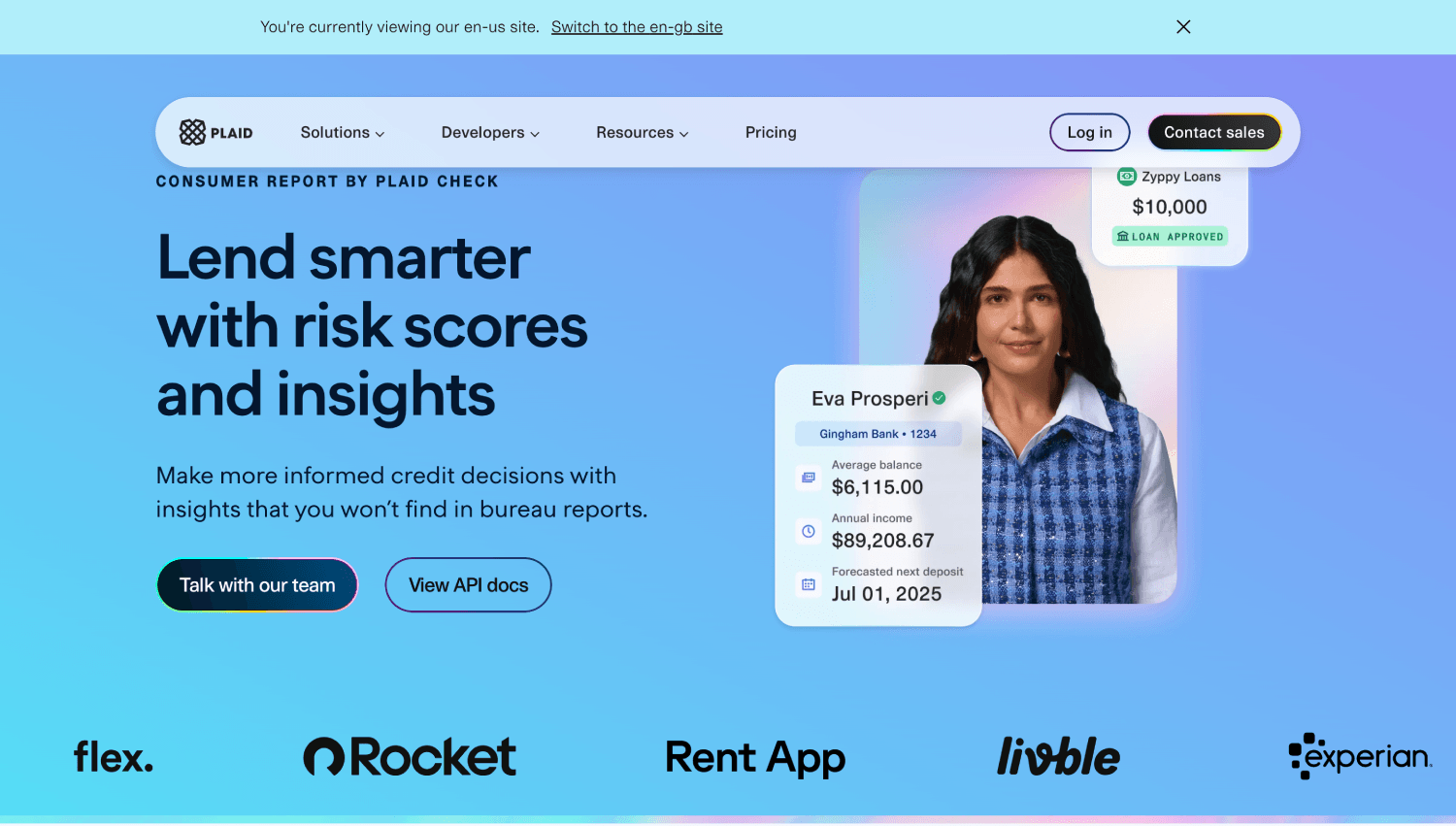
Plaid is not a tax filing API. Its relevance in this list comes from the income verification and tax data layer it provides, specifically IRS tax transcript access through Plaid’s Income product. A fintech building an embedded tax filing feature can use Plaid to pull prior-year AGI, income summary data, and other transcript fields that help pre-populate current-year returns and reduce user input friction.
For fintechs already using Plaid for bank account connectivity and income verification in their lending or onboarding flows, adding the tax transcript data pull is an incremental integration rather than a new vendor relationship. Plaid’s pricing is volume-based and not publicly listed. Existing Plaid customers negotiate transcript access as part of their broader API agreement.
The limitation is that Plaid provides data extraction, not filing. You still need April or Column Tax to submit returns to the IRS. But the data Plaid surfaces can meaningfully improve completion rates on a filing flow by reducing the number of fields users have to enter manually. The Plaid vs MX vs Finicity comparison covers how these open banking APIs differ if you are still deciding on your bank data layer.
Best for: Fintechs already using Plaid for bank data that want to improve filing pre-fill rates without adding a new vendor contract for tax data extraction.
6. Accora , White-Label Tax Preparation With CPA Review Layer
Accora sits between a software API and a managed service. According to Accora’s public product description, embedded tax filing through Accora integrates tax computation, professional CPA review, and government submission directly into a platform’s existing product. The CPA review layer is the differentiator. April and Column Tax offer software-driven filing. Accora adds a human review step, which matters for platforms serving users with more complex returns: self-employment income, rental properties, or multi-state filing situations.
That professional review layer also creates a meaningful compliance buffer for fintechs worried about liability exposure on edge-case returns. If a user’s tax situation falls outside the clean W-2 plus interest income profile that software filing handles well, Accora’s CPA review catches it before submission. The trade-off is throughput. A CPA-reviewed workflow cannot scale to millions of users during the peak two weeks of filing season the way a pure software API can.
Pricing is not publicly disclosed. Accora works through partnership agreements rather than self-serve pricing.
Best for: Fintechs serving users with moderately complex tax situations, or platforms where liability exposure on edge-case returns is a real concern and human review justifies the throughput trade-off.
Embedded Tax API Feature Comparison
| Provider | Full IRS E-File | State Returns | White-Label UX | Crypto Tax | 1099 Filing | CPA Review | Tax Data Extraction |
|---|---|---|---|---|---|---|---|
| April | Yes | Yes | Full | No | No | No | Yes (7-year transcript) |
| Column Tax | Yes | Yes | Full | No | No | No | Limited |
| Awaken Tax | No | No | Partial | Yes (core feature) | No | No | Yes (crypto) |
| TaxBandits | No (info returns only) | Varies by form | API-driven | No | Yes | No | No |
| Plaid | No | No | No | No | No | No | Yes (IRS transcripts) |
| Accora | Yes | Yes | Full | No | No | Yes | No |
What Does Embedded Tax Filing Actually Cost Per Return?
None of the full filing providers in this category publish per-return pricing. April, Column Tax, and Accora all require direct sales conversations. This is standard for infrastructure APIs that price on volume, white-label depth, and partnership structure rather than a flat rate. For budgeting purposes before a vendor call, the useful mental model is to think in three cost layers: platform access fees (sometimes a flat annual or monthly fee for API access), per-return fees (charged when a user actually completes and submits a return), and optional add-on fees for premium features like audit protection or CPA review.
TaxBandits is the exception. Its public pricing page lists specific per-form rates for 1099 filing, making it the only provider in this list where you can build a budget estimate without a sales call. For any platform evaluating the full-filing options, expect the pricing conversation to focus heavily on projected return volume during peak season and whether you intend to charge end users for the filing feature or absorb the cost as a platform expense.
The unit economics argument for absorbing the cost is straightforward. Say a neobank with 200,000 active users gets 20,000 of them to file through the in-app experience. If 60% of those filers receive refunds and elect to deposit into the neobank account, that is 12,000 deposit events that would otherwise go to a competitor’s account. At an average refund that the IRS publicly reports in the thousands of dollars per return, the retained deposit value dwarfs a per-return API fee at any reasonable price point. That calculus is why the deposit-retention framing dominates how April and Column Tax sell to fintech partners.
How Does the IRS E-File Authorization Requirement Affect Your Build?
To submit tax returns electronically to the IRS, a software provider must be an IRS Authorized e-file Provider. The application process involves background checks, security requirements, and ongoing compliance with IRS Publication 3112. Annual renewal is required. Building toward this status directly is not impossible, but it takes time and dedicated compliance headcount.
April and Column Tax both hold IRS Authorized e-file Provider status. When you integrate through their APIs, you submit returns through their e-file authorization, not your own. That is the core infrastructure value these platforms provide. Your product team focuses on the UX layer; they handle the federal compliance relationship.
State filing adds complexity. Each state has its own e-file authorization and submission requirements. The full-filing providers handle state filing as part of their service, but the specific states covered vary. Confirm state coverage with any provider before signing, especially if your user base is concentrated in states with complex filing requirements like California or New York. For fintechs thinking through broader compliance infrastructure, the fintech product and compliance readiness checklist covers the organizational side of these decisions.
April vs Column Tax: Which Embedded Filing API Should You Choose?
Both April and Column Tax solve the same core problem. The differentiation comes down to three factors: how deeply you want to own the UX, how much engineering capacity you have to build around the API, and which provider’s partnership model fits your product timeline.
April’s product positioning and public documentation emphasize the pre-built experience and the seven-year tax transcript API, which suggests a faster time-to-market for teams that want a working filing feature without significant custom UI development. The transcript data layer is also a meaningful differentiator for platforms that want to build personalization features beyond just filing, like refund forecasting or tax-aware savings recommendations.
Column Tax’s more modular API approach gives engineering teams more flexibility to build deeply integrated experiences, at the cost of more build time. For a fintech where tax is a core product feature rather than a seasonal add-on, that control may be worth the additional development investment. For a team evaluating both, it is worth asking each provider for a sandbox environment and spending two weeks building the same core flow against both APIs before making a final decision.
Frequently Asked Questions About Embedded Tax APIs
What is an embedded tax API?
An embedded tax API lets a fintech or SaaS platform offer tax filing, tax data access, or tax form generation inside its own product without building IRS e-file infrastructure from scratch. The API provider handles the compliance layer, including IRS e-file authorization, form logic, and state filing requirements. The platform uses the API to create a branded experience for its users. This is distinct from a white-labeled tax software product, in that the API is composable and integrates with existing product flows rather than launching a separate application.
Does TurboTax have an API for fintech integrations?
Intuit, which owns TurboTax, does not offer a public embedded tax filing API for fintechs to white-label inside their products. TurboTax is a consumer product. April and Column Tax exist specifically to serve the API-first embedded use case that TurboTax does not address. Intuit does offer separate developer APIs for accounting data and QuickBooks integration, but those are not tax filing products for consumer fintechs.
Does the IRS have APIs for tax filing?
The IRS operates an e-file system and offers some data APIs, including the Income Verification Express Service (IVES) for tax transcript access by authorized third parties. However, IRS APIs are not designed for direct consumer-facing product integration. Accessing IRS transcript data through a product requires going through an authorized intermediary, which is what providers like April and Plaid’s Income product offer. Direct IRS API access requires your own IRS Authorized e-file Provider status and significant compliance infrastructure.
What is the difference between a tax filing API and a 1099 API?
A tax filing API allows end users of a fintech platform to file their personal income tax returns (Form 1040 and state equivalents) from within the app. A 1099 API, like TaxBandits, allows the platform itself to generate and submit information returns it is legally required to file with the IRS, such as 1099-NEC for contractor payments or 1099-INT for interest income. These solve different compliance problems. A fintech may need both: a 1099 API to fulfill its own reporting obligations, and a filing API to offer value to users during tax season.
How does embedded tax filing drive deposit retention?
When a user files a return through a fintech app and selects direct deposit for their refund, that refund is deposited into whatever account they designate during filing. A fintech that controls the filing experience controls the refund routing prompt. Users filing inside a neobank app tend to default to depositing into that account, especially if the app pre-fills their account details. Refund deposits in the range of several hundred to several thousand dollars per filer represent meaningful short-term deposit growth that would otherwise flow to the user’s bank or to a filing software provider’s affiliated bank product.
Can a fintech without a deposit account offer embedded tax filing?
Yes, but the deposit-retention value proposition disappears. A fintech without a deposit account can still offer tax filing as an engagement feature, with users directing their refunds to an external bank account. Some platforms use this approach to deepen user engagement during tax season even without capturing the refund deposit. Whether that engagement value alone justifies the integration cost depends on your monetization model and how tax season maps to your retention metrics. Fintechs with deposit accounts get both the engagement and the deposit; those without only get the engagement.
What user data does an embedded tax filing API require?
At minimum, a consumer tax filing integration requires the user’s full legal name, Social Security Number, date of birth, and current address. Most integrations also pull income data from the platform (interest earned, dividends, transaction history) to pre-populate relevant fields. Some providers, including April through its transcript API, can pull prior-year filing data directly from IRS records once the user authorizes access. If your current KYC and onboarding flow does not collect SSN, adding that data collection step is a prerequisite to any tax filing integration, and it introduces its own security and compliance requirements. The best KYC providers for fintech SaaS covers how to structure identity collection if you are still building that layer.
What to Do Before Contacting April or Column Tax
The initial vendor conversation goes significantly faster if you have already answered four questions internally: how many of your active users file a federal return each year (your potential filing cohort), whether you have SSN in your existing user records, whether you have a deposit account to capture refunds, and what your engineering team’s capacity looks like in the six months before your target launch date. Showing up with estimates on those four numbers turns a 45-minute product pitch into a 45-minute scoping conversation.
Ask every provider for a sandbox environment before any contract discussion. The tax filing flow involves a significant number of edge cases: married filing jointly versus separately, users with multiple income sources, state filing requirements for users who moved during the year. You will not discover the gaps in a demo. You discover them in a sandbox when a real engineer is building against real API responses. Most providers in this category offer sandbox access as part of their initial evaluation process. If a provider will not offer sandbox access before a contract, that is worth noting before you proceed. For broader guidance on vendor evaluation, the fintech vendor evaluation framework covers the full diligence process.
The embedded tax category is small enough that both major providers actively compete for fintech partners, which means your position in the pricing conversation is real. Running both providers through a parallel sandbox evaluation, even briefly, gives you the data to negotiate and the product team the hands-on experience to make a confident recommendation. The infrastructure is already built. The decision is purely about which provider’s API design, partnership model, and pricing structure fits your product and your timeline.