
- Ocrolus, Heron Data, and Prism Data are not interchangeable. They represent three distinct underwriting philosophies: document parsing, transaction analytics, and cash flow scoring.
- Ocrolus is built for document-heavy workflows, SBA lending, and lenders who receive PDFs and bank statement images rather than connected account data.
- Heron Data automates submission intake and bank statement scrubbing for SMB funders and brokers, making it a fit for MCA and small business lenders that handle high volumes of emailed or portal submissions.
- Prism Data operates as a cash flow scoring layer, delivering pre-built attributes and scores rather than raw parsed output, which suits lenders who want a decisioning signal without building their own feature engineering.
- Your data input type determines the right vendor before cost ever enters the conversation.
Ocrolus is the right choice for lenders who receive bank statement PDFs and need document parsing with fraud detection. Heron Data fits SMB funders and brokers who need automated submission intake, bank statement scrubbing, and policy-based decisioning at volume. Prism Data serves underwriters who want a finished cash flow score or attribute set rather than raw extracted data, trading customization for speed to decision. All three improve cash flow underwriting, but they solve different parts of the problem.
Why Treating These Three as Statement-Parsing Commodities Gets Lenders in Trouble
The common assumption is that Ocrolus, Heron Data, and Prism Data all do the same job at different price points. That framing leads teams to run a price-per-document RFP and pick the cheapest quote. Then they discover the winning vendor does not actually accept their data inputs, or produces attributes their decisioning model cannot consume.
The three products sit at different points in the underwriting data supply chain. Ocrolus and Heron Data both ingest submitted documents, with different focuses. Prism Data outputs scores. A lender who sends Plaid transaction JSON to Ocrolus is using a document parser where a transaction analytics engine belongs.
Getting this wrong is expensive. Not just in reintegration cost, but in the months spent validating a vendor whose output architecture never matched your model. The framework below treats data input type as the first filter, before features, before pricing.
What Is the FintechSpecs Underwriting Data Layer Test?
The FintechSpecs Underwriting Data Layer Test is a four-question filter that identifies which vendor tier a lender belongs to before any demo or pricing call. It covers input format, output consumption, volume profile, and fraud surface. Run it before shortlisting.
- Input format: Do you receive scanned or PDF bank statements, or do you pull structured transaction data via an API like Plaid or Finicity?
- Output consumption: Do you need raw extracted data to build your own attributes, or do you need pre-built scores you can drop into a decisioning engine?
- Volume and latency profile: Are you processing thousands of documents per day, or hundreds of connected account feeds in near real-time?
- Fraud surface: Is document tampering your primary fraud vector, or is synthetic identity and account manipulation the bigger risk?
If your answers point to PDFs, raw output, high document volume, and document fraud, you are an Ocrolus buyer. High-volume SMB submissions arriving by email, API, or portal, with automated scrubbing and decisioning, points to Heron. Pre-built scores, limited engineering bandwidth, and fast time-to-decisioning points to Prism. The test does not guarantee a perfect fit, but it eliminates the wrong vendor in under five minutes.
Ocrolus: What It Does and Who It Actually Serves
Ocrolus built its product around the reality that most small business and SBA lenders do not receive clean API-connected transaction data. Their applicants upload PDFs, email screenshots, or hand over printed bank statements. Ocrolus converts those documents into structured financial data using a combination of machine learning and human-in-the-loop validation. According to Ocrolus’s published product documentation, that approach delivers 90%-plus accuracy on document parsing.
The platform’s strongest differentiation is document fraud detection. Ocrolus runs checks for altered PDFs, metadata manipulation, and fabricated transaction histories. For SBA lenders and equipment finance shops where document fraud is a live threat, that layer matters more than faster API throughput.
Ocrolus also covers a broader document type range than Heron or Prism. The platform handles bank statements, pay stubs, tax returns, and profit-and-loss statements, which makes it the more natural fit for SBA 7(a) workflows where underwriters pull multiple document types per application. If your underwriting process requires reconciling a bank statement against a tax return against a business P&L, Ocrolus handles that within one platform.
Where Ocrolus Falls Short
Per-document pricing creates predictable cost pressure at volume. A high-volume MCA funder processing thousands of applications per week faces a fundamentally different cost curve than an SBA lender processing fifty per month. Ocrolus does not publish pricing publicly, so cost comparisons require a direct quote. For teams already working with connected bank data rather than uploaded documents, the platform’s core capability is solving a problem they do not have.
Heron Data: What It Does and Who It Actually Serves
Heron Data automates underwriting intake for small business finance. Submissions arrive by email, API, or portal, and Heron classifies and parses bank statements, applications, and tax returns, including stacked PDFs and poor-quality scans. It returns structured data such as revenue, positions, NSFs, and fraud flags. Lender forum discussions on communities including r/fintech and lending-focused operator communities also cite it as a cost-effective alternative to Ocrolus.
The primary use cases are high-volume MCA, term loan, and SBA underwriting, along with broker workflows where deals arrive as document submissions. Heron scrubs and enriches each deal and can auto-decision it against the lender’s credit policy, syncing the outcome into the CRM.
Where Heron Data Falls Short
Pricing is not publicly listed, which makes direct comparison difficult.
Prism Data: What It Does and Who It Actually Serves
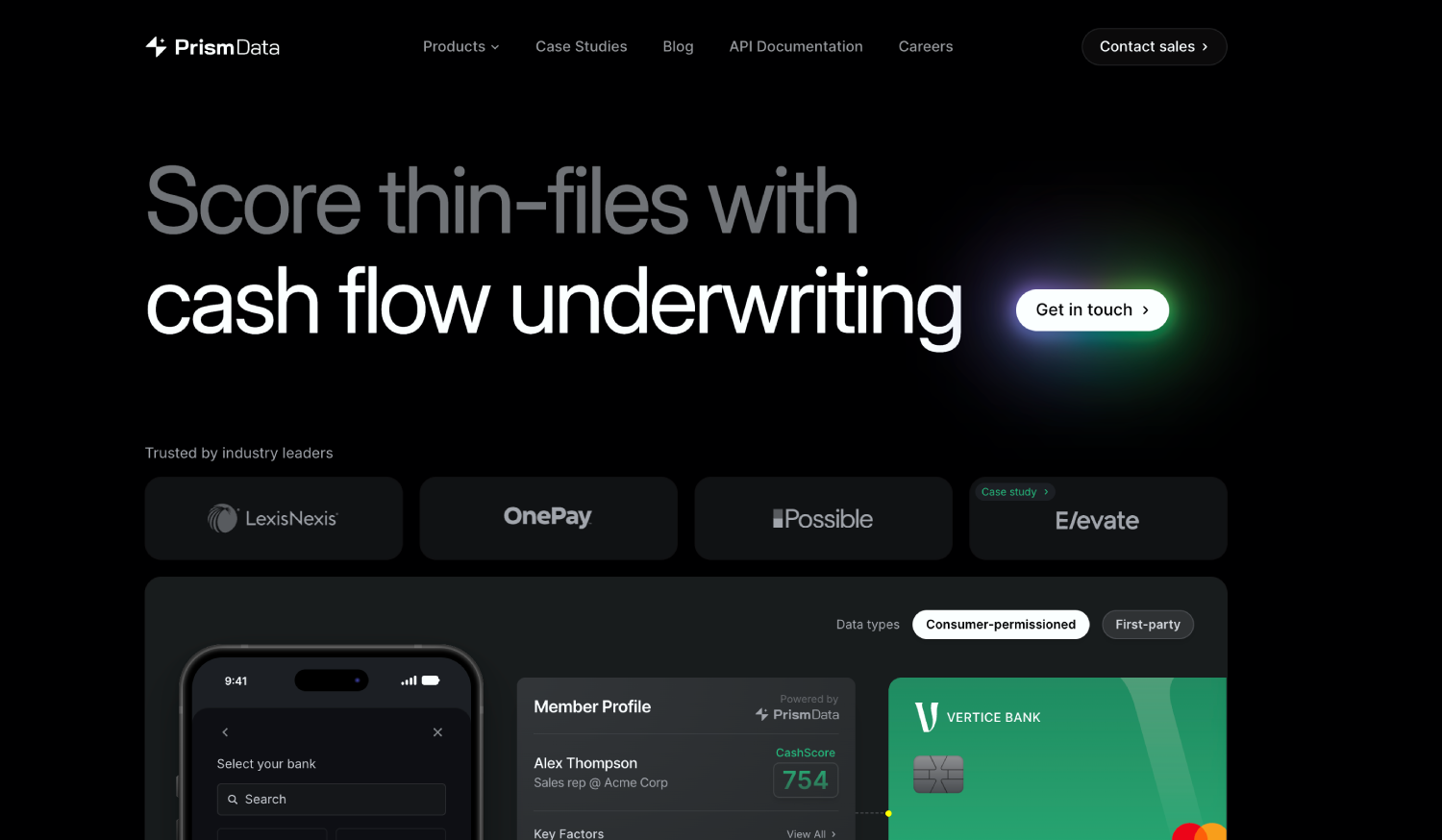
Prism Data operates at a different layer entirely. Instead of raw document parsing or transaction categorization, Prism delivers pre-built cash flow scores and attributes derived from a consortium of consumer cash flow data. The product is closer to a credit bureau alternative than a document processor.
Prism’s value proposition is that it reduces the engineering lift required to move from raw bank data to a usable decisioning signal. A lender using Ocrolus still needs to build feature engineering on top of extracted data. Prism compresses that step by delivering a finished score or attribute set. For lenders without a data science team to build and maintain feature pipelines, that compression is genuinely valuable.
The consortium data model also means Prism can produce signals on consumers who apply but have not connected their accounts or submitted documents. That coverage breadth is something neither Ocrolus nor Heron can match, since both require an active submission to produce output. For consumer lenders and fintechs targeting thin-file borrowers, Prism’s coverage model addresses a different gap entirely.
Where Prism Data Falls Short
Pre-built scores trade transparency for convenience. A lender that needs to explain exactly how a cash flow attribute was derived for a fair lending audit has more work to do with a black-box score than with raw extracted data. Prism also cannot substitute for Ocrolus when the underwriting workflow requires processing physical document submissions. The products are complementary in sophisticated lending stacks, not direct replacements.
Document-Based vs Transaction-Based Underwriting: Which Approach Actually Wins?
The honest answer is that neither approach wins universally. The question is which matches your applicant acquisition model.
Lenders who originate through broker channels, SBA programs, or any workflow where applicants submit physical paperwork are document-based by necessity. Their applicants do not have Plaid-connected accounts at the moment of application. Ocrolus and Heron both serve that workflow. Lenders who acquire applicants digitally, require bank account connection as part of onboarding, and process at scale are transaction-based.
The more interesting tension is between SMB submission automation and pre-scored consumer attributes. Heron automates intake, scrubbing, and decisioning for small business deals. Prism delivers finished scores for consumer lending. A fintech launching a new credit product on a six-week timeline might prefer Prism’s time-to-first-decision speed. Both are legitimate trade-offs. See the vendor comparison for credit decisioning platforms for context on how these inputs fit into broader underwriting stacks.
Head-to-Head Feature Comparison: Ocrolus vs Heron Data vs Prism Data
| Criterion | Ocrolus | Heron Data | Prism Data |
|---|---|---|---|
| Primary data input | Uploaded documents (PDFs, images) | Document submissions by email, API, or portal | Consortium cash flow data (no submission required) |
| Document fraud detection | Yes, core feature | Yes (fraud flags on bank statements) | Not applicable |
| Output format | Structured extracted data and analytics | Structured scrubbed data, credit policy decisions, CRM sync | Pre-built scores and attribute sets |
| Multi-document reconciliation | Yes (bank statements, tax returns, P&L) | Yes (bank statements, applications, tax returns) | Not applicable |
| Applicant connectivity required | No (document upload) | No (document submission) | No (consortium data) |
| Best volume profile | Mid-to-high document volume | High-volume SMB submissions | Any volume, minimal engineering required |
| Feature engineering required post-output | Yes | Not required for policy-based decisioning | Minimal |
| Thin-file coverage | Limited to submitted documents | Limited to submitted documents | Broader via consortium model |
| Parsing accuracy (per vendor documentation) | 90%+ (human-in-the-loop validation) | Not published | Not applicable (score-based output) |
| Public pricing available | No | No | No |
Which Vendor Fits Each Lending Use Case?
| Lending Use Case | Best Fit | Reason |
|---|---|---|
| SBA 7(a) and document-heavy small business lending | Ocrolus | Multi-document reconciliation, document fraud detection, PDF parsing |
| High-volume MCA funding via direct bank feed | Heron Data | Transaction categorization at scale, lower cost per decision on connected accounts |
| Consumer lending with thin-file borrowers | Prism Data | Consortium coverage produces signals without active submission |
| Fintech credit product launching with limited data science bandwidth | Prism Data | Pre-built scores reduce time to first decision without feature engineering |
| Digital-first SMB lender with Plaid integration already in place | Heron Data | Direct feed processing is faster and more cost-effective than document upload workflow |
| Equipment finance or SBA lender needing PDF parsing plus fraud checks | Ocrolus | No competing vendor matches Ocrolus on document fraud detection depth |
| Lender layering cash flow data on top of traditional credit scoring | Prism Data or Heron Data | Depends on whether applicants connect accounts (Heron) or not (Prism) |
How Does Pricing Actually Work Across These Three?
None of the three vendors publish pricing publicly. All three require direct contact for a quote. This is a meaningful friction point for teams trying to build a business case without a sales conversation.
Lender forum discussions on communities including r/fintech and alternative lending operator groups position Heron Data at lower price points than Ocrolus for bank statement processing workflows, particularly for high-volume MCA funders. Verified public pricing figures are not available for any of the three vendors, so any cost comparison at this stage should be treated as directional rather than definitive. Prism Data pricing is structured differently because its product is a scored attribute rather than document processing, so per-document comparisons do not translate cleanly.
The more important pricing consideration is total cost at volume. A lender processing 5,000 applications per month faces a materially different cost structure than one processing 200. Per-document pricing models compound at high volume. The right comparison is not list price per document but cost per funded loan, factoring in the engineering time to build on top of the output. For more on infrastructure cost structures in lending, the analysis of hidden costs killing fintech SaaS margins covers how per-transaction fees compound in unexpected ways.
What About Integration Complexity and Time to Production?
Ocrolus offers a well-documented API with established integrations into several loan origination systems. The platform has a longer market history than Heron or Prism, which means more mature SDK support and a wider library of integration examples from existing customers. For teams building on established LOS platforms, Ocrolus is likely the path with the most available documentation. Evaluating it alongside other cash flow underwriting tools is covered in the Ocrolus alternatives comparison.
Heron Data fits the volume and SMB focus, but it is built around document submissions rather than Plaid feeds, so the lender should confirm with Heron how connected-account data would be ingested.” Then remove “Once volume grows and the team hires a second analyst, they could layer Heron on top for custom feature development.
Prism Data has the lowest integration lift of the three for getting to a first decision signal, because the output is a finished score rather than raw data requiring processing. A team that can make an API call and consume a score can be in production faster than one building attribute pipelines on top of transaction data. That speed advantage disappears once a lender wants to customize which attributes drive the model.
For a structured approach to vendor evaluation before signing any contract, the fintech vendor evaluation framework on FintechSpecs covers the seven checks that matter most.
A Worked Scenario: Which Vendor Fits a Series A SMB Lender?
Consider a Series A lender offering working capital loans to small businesses, processing roughly 800 applications per month. Applicants apply through a digital portal and connect their business bank account via Plaid. The underwriting team has one data analyst and no dedicated data engineering.
Ocrolus is not the right fit here. The applicants are not submitting documents. Document fraud detection is irrelevant when the data comes through a verified account connection. The per-document pricing model maps poorly to a connected-account workflow.
Heron Data fits the data input model and volume. It processes the Plaid transaction feed, returns categorized cash flows, and outputs the attributes the analyst needs. The downside is that the analyst then needs to aggregate those attributes into model-ready features, which takes engineering time the team may not have at full capacity.
Prism Data could accelerate the first model iteration. A pre-built cash flow score gets the lender from application to decision without building attribute pipelines. Once volume grows and the team hires a second analyst, they could layer Heron on top for custom feature development. For lenders evaluating income verification alongside cash flow data, the comparison of income and employment verification APIs for lenders covers tools that complement both Heron and Prism.
Frequently Asked Questions
Is Ocrolus suitable for SBA lending specifically?
Yes. Ocrolus is one of the most widely deployed document parsing platforms in SBA lending workflows. Its ability to process PDFs of bank statements, tax returns, and profit-and-loss statements within a single platform matches the multi-document requirements of SBA 7(a) underwriting. The document fraud detection layer also addresses a common risk in broker-originated SBA pipelines where applicants submit documents rather than connecting accounts directly.
Can Heron Data replace Ocrolus for bank statement analysis?
Yes, for many SMB lenders. Both process uploaded bank statement PDFs. Heron focuses on automated intake, scrubbing, fraud flags, and policy-based decisioning for small business deals, while Ocrolus adds human-in-the-loop validation. The right choice depends on your workflow and volume.
What makes Prism Data different from Ocrolus and Heron Data?
Prism Data is a scoring layer, not a document or transaction processor. Ocrolus and Heron extract and structure data from submitted documents. Prism delivers pre-built cash flow scores and attributes from a consumer data consortium, which means it can produce a signal without requiring the applicant to submit anything. That is a fundamentally different product architecture serving a different part of the underwriting workflow, and the two approaches are often complementary rather than competitive.
Which of these three vendors has the best accuracy for bank statement parsing?
Ocrolus reports 90%-plus accuracy using its human-in-the-loop validation approach. Heron Data does not publish an accuracy figure. The most reliable comparison is a test on your own documents.
Do any of these vendors publish pricing?
None of the three publish pricing publicly. All require direct contact with their sales teams for a quote. Lender forum discussions suggest Heron Data is positioned at lower price points than Ocrolus for comparable bank statement workflows, but verified public figures are not available for any vendor. Prism Data pricing is structured differently because it operates as a score API rather than a per-document processing service.
Can I use more than one of these vendors in the same lending stack?
Yes, and many lenders do. A common architecture runs two vendors as parallel ingestion paths that feed the same pipeline. Prism can sit on top of either as a secondary score signal, particularly useful for thin-file applicants or as a cross-validation layer. The vendors are not mutually exclusive, and the cost of running two in parallel is often justified if your applicant pool includes both submission types.
How do these tools connect to credit decisioning platforms?
All three produce output that feeds into credit decisioning systems, but they require different downstream work. Ocrolus outputs extracted data that needs feature engineering before entering a decisioning model. Heron includes credit policy decisioning and syncs outcomes into the CRM. Prism outputs a finished score that can be ingested directly. For lenders evaluating how these inputs connect to the broader decisioning stack, the overview of credit decisioning platforms for fintech lenders covers the integration layer in detail.
How do Ocrolus and Heron handle document fraud?
Ocrolus targets document-level fraud: altered PDFs, metadata manipulation, photoshopped statement balances, and fabricated transaction histories in uploaded files. Heron also flags fraud on submitted bank statements as part of its scrubbing. Ask both vendors to test against known tampered statements from your own pipeline.
The Core Distinction That Changes the Evaluation
Most lenders approach this comparison with a vendor selection mental model, looking for the product with the highest accuracy and lowest price. The more useful mental model is a supply chain one. Ocrolus is a document ingestion layer. Heron Data is a submission automation and decisioning layer. Prism Data is a score delivery layer. They occupy different positions in the same data pipeline, and the right one for your business is the one that fills the gap you actually have.
A lender who already solved document ingestion with Ocrolus but cannot afford feature engineering staff should be looking at Prism, not comparing Prism to Ocrolus on document parsing criteria.
Start with the FintechSpecs Underwriting Data Layer Test. Answer the four questions about input format, output consumption, volume, and fraud surface. The right vendor becomes obvious before a single demo is scheduled. Lenders who skip that step are selecting tools for workflows that do not match their business, and no amount of feature comparison will fix a fundamental mismatch between what the vendor does and what the lender needs.