
- Purpose-built AI voice agents for banks now resolve routine member inquiries without a live agent, with containment rates that vendors publicly report in the 70 to 85% range for common call types like balance checks, branch hours, and loan status.
- Core system integration is the real differentiator: agents that read and write to FIS, Fiserv, and Jack Henry cores in real time deliver accurate answers; those that rely on nightly data syncs create liability.
- Compliance controls, not NLP quality, are what separate banking-grade voice AI from general-purpose platforms. Look for configurable response guardrails, full call transcription, and audit-ready logging before anything else.
- Credit unions can layer a voice AI agent in front of their existing IVR without replacing it, using SIP trunking or API handoff, which means the deployment risk is lower than most IT teams expect.
- This article covers front-office member services automation. For AI agents handling delinquency outreach and collections, see FintechSpecs’ companion coverage of loan servicing software and collections automation.
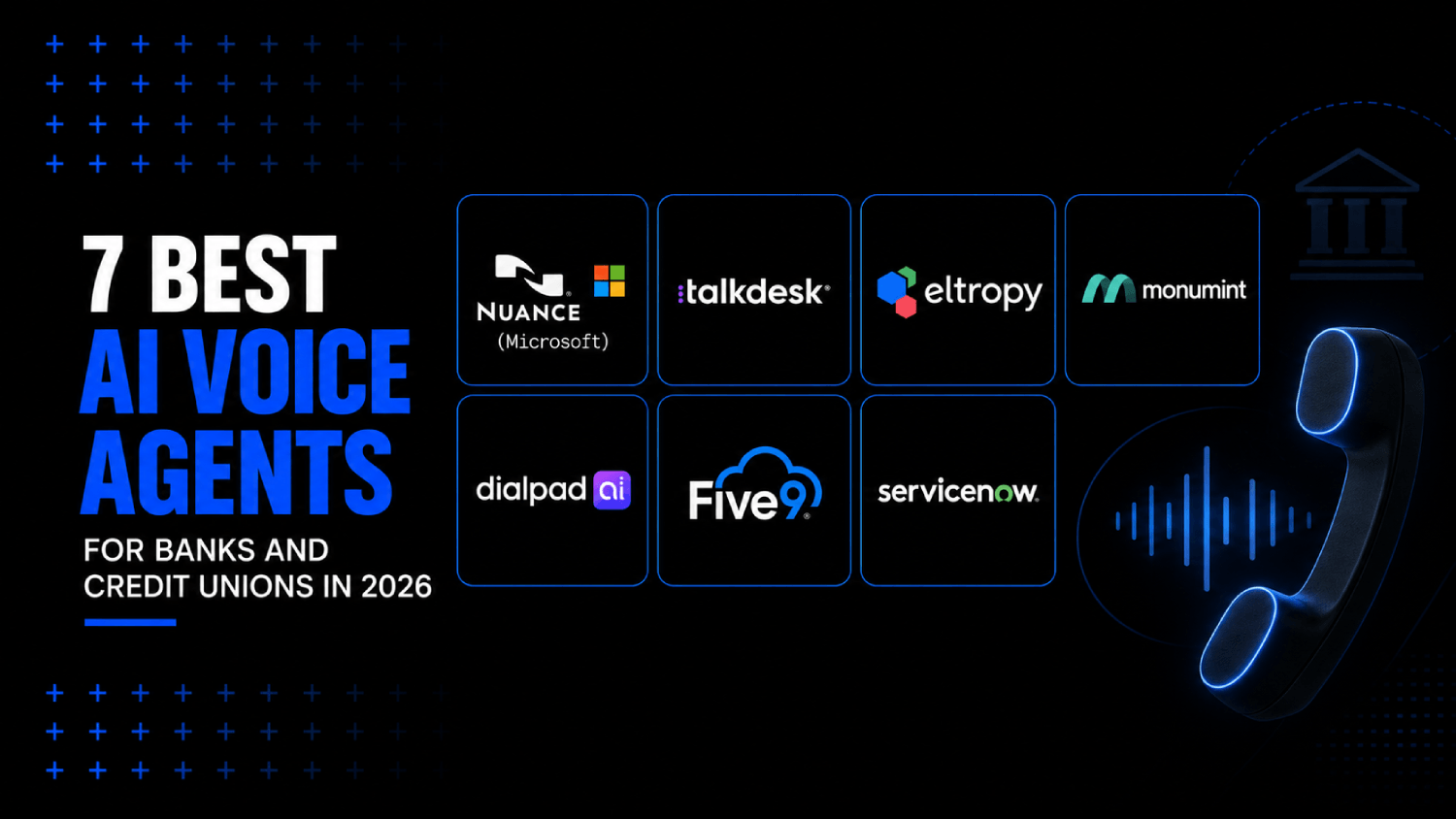
The best AI voice agents for banks and credit unions are purpose-built platforms, not general-purpose chatbots repurposed for financial services. Vendors like Nuance, Talkdesk, and Eltropy offer banking-specific solutions that integrate with FIS, Fiserv, and Jack Henry cores, provide configurable compliance guardrails, and handle routine member service calls, including balance inquiries, payment confirmations, and account status, without live agent involvement. Containment rates for these specific call types regularly reach 70% or higher when the agent has live core access.
Why Most Bank Voice AI Fails Before It Gets to Compliance
The common story at financial institutions goes like this: the IT team buys a general-purpose voice AI, it mispronounces “Roth IRA,” it cannot pull a real-time balance because it connects to a stale data layer, and a member escalates to a supervisor on the second sentence. Compliance sees the transcript and adds voice AI to the prohibited list. The IVR limps on.
That failure mode is not a voice AI problem. It is a procurement problem. General-purpose conversational AI is trained on broad datasets and optimized for intent classification across industries. Banking-grade voice AI is fine-tuned on financial terminology, trained on regulatory constraints, and architected to surface only what it can confirm from an authoritative data source. The difference in member experience is immediate and measurable.
The second failure mode is architecture. A voice agent that reads member account data from a nightly batch file will give a member a balance from yesterday. If that member just made a mortgage payment this morning, the agent is wrong. Wrong data in a regulated context is not an edge case. It is a UDAAP exposure. Every platform on this list is evaluated first on whether it offers live core connectivity, not eventual consistency.
The FintechSpecs Core-Compatibility Stack Test
Before looking at any individual vendor, financial institution buyers should run what FintechSpecs calls the Core-Compatibility Stack Test: four questions that filter out roughly 60% of the market before a single demo is booked.
Live read access: Can the agent query your core in real time, not a cached replica, to answer balance, transaction, or loan status questions? Vendors should be able to name the specific API or middleware they use to connect to your core.
Write-back scope: What transactions can the agent initiate, not just read? Stop payment, address change, and PIN reset are the three most common write-back use cases in member services. If a vendor is read-only, containment rates cap out below what is operationally meaningful.
Handoff fidelity: When the agent transfers to a live agent, does the context, full transcript, intent classification, member ID, and CRM notes, travel with the call? Cold transfers destroy everything the voice AI accomplished.
Audit trail completeness: Is every utterance, every system query, and every decision logged with a timestamp and retrievable for examination? This is not a nice-to-have. It is what your compliance officer will ask for on day one.
Run these four checks against every vendor in an RFP. Any vendor that cannot answer all four with specifics, not marketing language, is not ready for a production banking deployment. For a broader vendor evaluation framework, the FintechSpecs fintech vendor evaluation guide covers contracting, SLA language, and due diligence questions that apply directly to this category.
Which AI Voice Agents Actually Integrate with FIS, Fiserv, and Jack Henry?
Core banking integration is where this market separates into two tiers. The first tier consists of vendors with pre-built connectors to the dominant North American cores. The second tier requires a custom middleware build, which means months of professional services before a single call is deflected.
| Vendor | FIS Integration | Fiserv Integration | Jack Henry Integration | Write-Back Capable | Best For |
|---|---|---|---|---|---|
| Nuance (Microsoft) | Yes, pre-built | Yes, pre-built | Yes, pre-built | Yes | Large banks, complex call centers |
| Talkdesk Financial Services | Yes, via connector | Yes, via connector | Partial | Yes | Mid-size banks with CCaaS needs |
| Eltropy | Yes, native | Yes, native | Yes, native | Yes | Credit unions, community banks |
| Monumint | Disclosed on request | Disclosed on request | Disclosed on request | Disclosed on request | FIs evaluating next-gen voice AI |
| Dialpad AI Contact Center | Via middleware | Via middleware | Via middleware | Limited | Smaller FIs needing basic deflection |
| Five9 Intelligent Virtual Agent | Yes, via connector | Yes, via connector | Yes, via connector | Yes | Banks with existing Five9 CCaaS |
| ServiceNow Virtual Agent (FSI) | Via custom integration | Via custom integration | Via custom integration | Limited | Institutions already on ServiceNow |
Integration depth matters more than integration existence. A connector that only reads account names and balances is not the same as one that can authenticate a caller, retrieve 90-day transaction history, and initiate a stop payment. Ask for a data flow diagram before signing anything.
The 7 Best AI Voice Agents for Banks and Credit Unions
1. Nuance Conversational IVR (Microsoft)

Nuance, now part of Microsoft, is the most deployed voice AI in North American banking by a significant margin. Its Conversational IVR product sits in front of existing IVR infrastructure and adds natural language understanding without requiring a full telephony replacement. Banks that have been on Nuance for years are now migrating to its newer cloud-native components backed by Azure infrastructure.
Nuance’s advantage is breadth. It has pre-built financial services models covering mortgage servicing, retail banking, and credit card operations, plus deep integrations with FIS, Fiserv, and D+H cores built over a decade of banking deployments. The platform supports voice biometric authentication, which matters for credit unions that want to remove the security question friction without adding a separate vendor.
The trade-off is cost and implementation timeline. Nuance is enterprise software priced accordingly. Community banks and credit unions under $1 billion in assets often find the professional services costs alone exceed the economics. Pricing is not publicly disclosed and requires a direct engagement with the Microsoft team. Deployment timelines for full enterprise implementations, based on case study timelines published on Nuance’s and Microsoft’s sites, typically run 6 to 12 months for custom core integrations and voice biometrics configurations.
2. Talkdesk Financial Services Experience Cloud
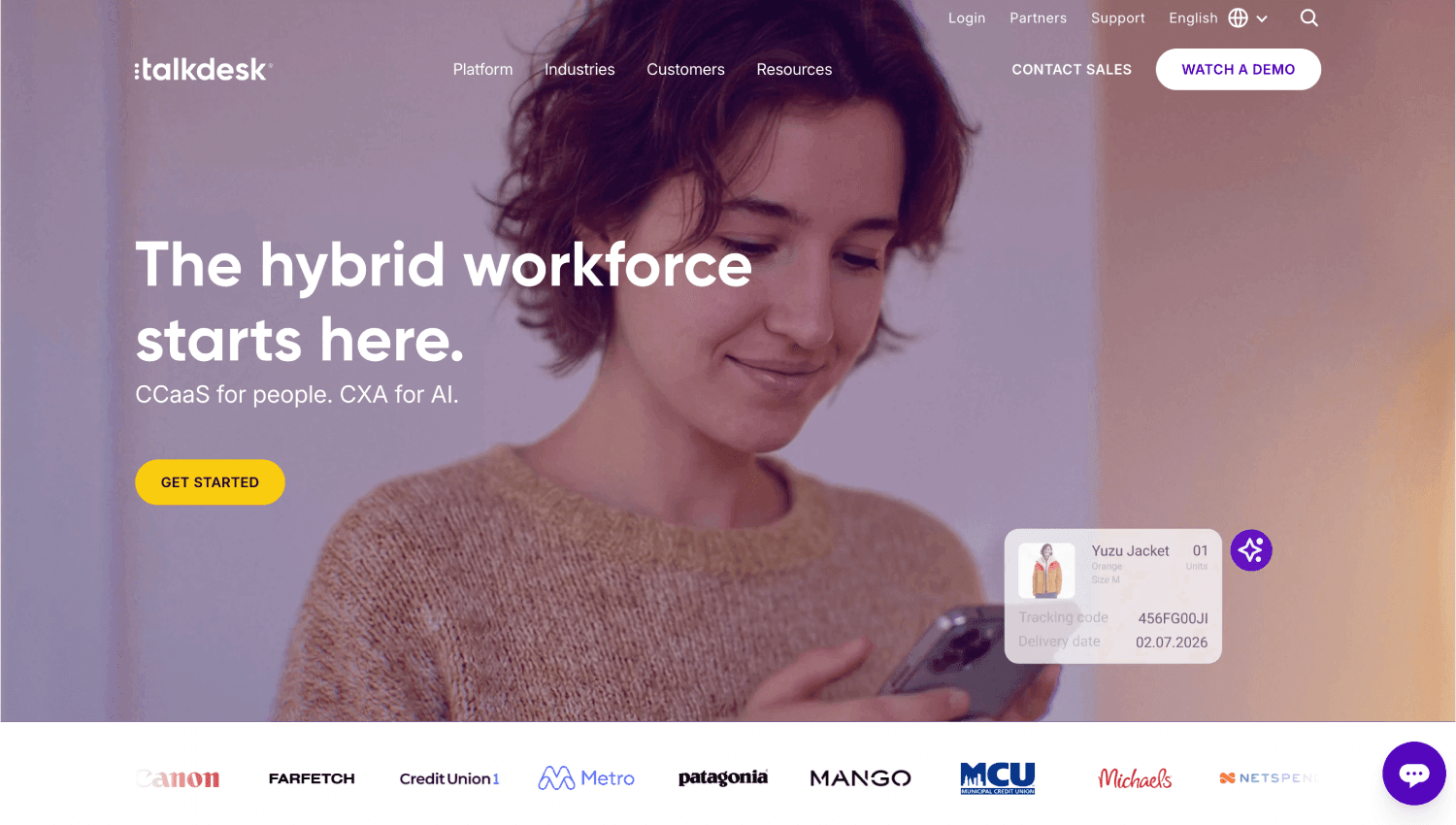
Talkdesk built a dedicated financial services product, not just an industry skin on its general CCaaS platform. The Financial Services Experience Cloud includes a pre-built banking agent that handles account inquiries, transaction disputes, and loan status calls, with integrations to Salesforce Financial Services Cloud, Temenos, and several core banking platforms.
Talkdesk’s containment rates for banking deployments are cited in their published case study library, though the company does not publish a universal benchmark figure. What distinguishes Talkdesk from pure voice AI vendors is that it is also a full contact center platform, which means a bank replacing its CCaaS and adding voice AI does not need two separate procurement processes. The agent handoff experience is native, not bolted on.
The weakness for credit unions specifically is Jack Henry depth. Talkdesk connects to Symitar, Jack Henry’s credit union core, but the integration requires more configuration than its FIS or Fiserv connectors. Credit unions already on Symitar should ask specifically about write-back capabilities before the demo stage. Pricing is contract-based and not publicly listed as of mid-2026.
3. Eltropy Unified Conversations Platform
Eltropy is the most credit-union-native voice AI platform on this list. The company was built from the ground up for community financial institutions, and its client base is almost entirely credit unions and community banks under $10 billion in assets. That specialization shows in the product: Eltropy’s agent handles loan payoff quotes, skip payment requests, and rate inquiries using terminology that credit union members actually use.
Its core integrations cover Symitar, MeridianLink, and several other credit union-specific platforms with native connectors, meaning no middleware build. Eltropy supports member authentication via knowledge-based authentication and, more recently, voice biometrics. The platform also handles SMS, chat, and secure messaging through the same conversation engine, so a member who starts a voice call and then asks to receive a follow-up by text does not require a separate system to handle that request.
Eltropy’s voice AI is not the most capable natural language processor in this list. Its strength is deployment speed, core compatibility, and the fact that its support team understands what a HELOC inquiry actually involves. For credit unions that have failed at generic AI deployments before, that domain specificity is worth more than a marginal improvement in intent accuracy. Pricing is not publicly listed and varies by asset size.
4. Monumint
Monumint sits in a different category from the other platforms here. Where most vendors in this market are contact center companies that added AI, Monumint is an AI-first platform built specifically for member engagement at financial institutions. Its voice agent is designed for conversational depth, not just intent routing, which means it can handle multi-turn conversations about product eligibility, rate comparisons, and account features without falling back to a static menu.
Monumint’s core integration approach and specific connector library are disclosed on request rather than published publicly. FI buyers need a direct conversation to validate compatibility before committing time to a full evaluation, a reasonable ask for an emerging vendor in a regulated space, but it does add a qualification step that established platforms do not require. Buyers should treat the integration question as a first-call agenda item, not something to confirm late in the process.
The platform is worth evaluating for institutions that have found the established players too rigid in how they handle conversation flow. Many banking voice AI systems are still essentially NLU-enhanced IVRs: they understand what the member said but then route to a static decision tree. Monumint’s architecture is designed to maintain conversational context across a call, which changes what is possible for complex member service interactions.
5. Five9 Intelligent Virtual Agent
Five9’s Intelligent Virtual Agent is best evaluated as part of a broader Five9 contact center deployment, not as a standalone voice AI. Banks already using Five9 for their contact center get the voice AI agent as an add-on that integrates natively with their existing agent desktop, routing rules, and reporting infrastructure. For those institutions, it is often the lowest-friction path to voice AI because the telephony layer is already in place.
Five9 has published integrations with FIS, Fiserv, and Jack Henry, and its agent supports real-time data retrieval for account inquiries. The platform also supports HIPAA and PCI-compliant call recording, which matters for institutions handling both healthcare FSA accounts and payment card services. Containment reporting is built into the Five9 analytics suite, which makes it straightforward to track call deflection rates without a separate BI tool.
For banks not already on Five9, evaluating the IVA in isolation from the CCaaS platform creates an awkward architecture. The agent’s full capability requires Five9’s telephony layer. Institutions on Cisco, Avaya, or Genesys looking for a standalone voice AI overlay should evaluate other options first.
6. Dialpad AI Contact Center
Dialpad positions its AI Contact Center product for businesses that want AI assistance without enterprise-scale complexity. For smaller financial institutions, credit unions under $500 million in assets, or banks with limited IT resources, Dialpad offers a faster deployment path than Nuance or Talkdesk at a lower price point.
Dialpad’s real-time transcription and AI coaching features are the strongest in this list for supporting live agents, which is a slightly different use case than autonomous call deflection. If a credit union’s primary goal is to make human agents faster and more accurate rather than to eliminate the human agent entirely, Dialpad’s approach is well-suited to that problem. Its voice AI agent for full call automation is less mature than Eltropy or Nuance for banking-specific workflows.
Core banking integration requires middleware. For a Symitar-based credit union, that typically means working with a third-party connector or building one, which adds cost and time. Dialpad publishes pricing for its contact center products publicly; as of their public pricing page, the AI Contact Center plan starts at $95 per seat per month, making it the most transparently priced option on this list.
7. ServiceNow Virtual Agent (Financial Services)
ServiceNow Virtual Agent belongs on this list specifically for institutions that already run ServiceNow for IT service management or operations workflows. Adding the Virtual Agent for member-facing voice interactions then becomes an extension of an existing platform rather than a net-new vendor relationship. The compliance posture, data governance controls, and audit logging are already configured inside the ServiceNow environment.
The limitation is that ServiceNow is not a banking-native voice AI. Core banking integrations require custom configuration through ServiceNow’s integration hub, and the platform does not offer pre-built connectors for Symitar or the major FIS cores in the same way Eltropy or Nuance does. Institutions that are not already ServiceNow customers should not start here.
ServiceNow’s strength for banking is compliance infrastructure and case management. When a voice interaction surfaces a complex issue that needs human review, follow-up, and documentation, ServiceNow handles that workflow better than most contact center platforms. For institutions where the compliance and operations teams use ServiceNow daily, voice AI that lives inside that environment lowers adoption friction considerably. Pricing is enterprise and not publicly disclosed.
Can a Credit Union Deploy Voice AI Without Replacing Its IVR?
Yes, and this is one of the more important practical points that most vendor comparisons omit. Replacing an IVR is a large, disruptive project. Most credit unions do not need to do it to get the benefits of voice AI.
The standard deployment path is an overlay architecture: the voice AI agent sits in front of the existing IVR via SIP trunking. Calls arrive at the AI agent first. The agent handles everything it can autonomously. Calls that require a live agent, or that the member explicitly requests to escalate, transfer to the IVR or directly to a queue. The IVR itself is untouched. This approach means a credit union can test voice AI containment rates on a subset of call traffic, validate compliance sign-off, and measure member satisfaction before committing to a full IVR retirement.
Eltropy and Nuance both support this overlay deployment pattern explicitly. Talkdesk can also implement it, though the configuration is more involved when the underlying telephony is not Five9 or Talkdesk itself. When evaluating any vendor, ask specifically whether they support overlay deployment without requiring you to port your DID numbers or change your telephony carrier.
What Compliance Controls Should Banking Voice AI Include?
The compliance objection to generative voice AI in banking is legitimate but often aimed at the wrong target. The risk is not that a well-configured banking voice agent will hallucinate loan terms. The risk is that a poorly scoped one will attempt to answer questions it should not, give information that is inconsistent across calls, or fail to produce records when a regulator requests them.
Banking-grade voice AI should include, at minimum, four specific compliance controls. Configurable response scope, meaning the vendor can restrict what topics the agent will engage with at all, so a voice agent deployed for balance inquiries cannot attempt to give investment advice. Full call transcription with retention policies aligned to your institution’s document retention schedule. Pre-escalation disclosures, meaning the agent delivers required regulatory disclosures before initiating certain transaction types. And a hard handoff protocol that routes any call where a member mentions bankruptcy, elder financial abuse, or certain complaint keywords directly to a trained human agent without exception.
Platforms that offer these controls as configurable settings, rather than as custom builds, are meaningfully lower risk to deploy. Eltropy and Nuance both offer these as configurable features. For institutions building their compliance framework from scratch, the FintechSpecs fintech product and compliance readiness checklist covers the documentation and control requirements that apply to member-facing AI systems.
How to Compare Banking Voice Agents by Containment Rate and Real Cost
Vendors universally claim high containment rates. The number is meaningless without a denominator. A vendor who says their agent achieves 80% containment might be measuring only the calls where the agent correctly identified intent, excluding the 30% of calls that fell through to a human immediately. Ask for containment rate calculated as: calls fully resolved by the agent without live agent involvement, divided by total calls offered to the agent.
Consider a specific scenario to make the cost math concrete. Say a credit union receives 12,000 inbound calls per month. Its average fully loaded cost per live agent call, including agent compensation, overhead, and supervisory time, is $8.00. At 70% containment, the agent handles 8,400 calls autonomously. That is a reduction of 8,400 calls from the live agent queue each month. At $8.00 per call, the gross deflection value is $67,200 per month. A voice AI platform that costs $15,000 per month pays back in weeks, not quarters, at that volume.
That math assumes the agent actually contains those calls, not just absorbs them before an inevitable transfer. True containment requires live core access, accurate authentication, and the ability to complete the transaction. Read-only agents without write-back capability contain far fewer calls because members still need a human to execute anything consequential.
What Voice Authentication Options Are Available for Banking Voice AI?
Voice authentication, also called voice biometrics, uses a member’s voiceprint to verify identity passively during a call, without requiring them to answer security questions or enter a PIN. Several platforms on this list support it natively.
Nuance has the most mature voice biometrics offering in this market, built on technology the company developed over two decades. Eltropy has added voice biometric authentication to its platform more recently. For platforms that do not include native voice biometrics, vendors like Nuance Security Suite or ValidSoft can be layered in via API.
Credit unions considering voice authentication should note that passive voice biometrics, where enrollment happens during a normal call without the member taking any explicit action, typically achieve better enrollment rates than active enrollment, where the member must call in for a specific setup process. Most banking deployments now use passive enrollment to build voiceprint databases over time. Compliance teams should confirm that the institution’s member disclosure language covers biometric data collection before any enrollment begins, consistent with state biometric privacy laws including Illinois BIPA and Texas CUBI.
Frequently Asked Questions
What is a realistic containment rate for AI voice agents in banking?
For routine call types, specifically balance inquiries, branch hours, loan status, and payment confirmations, purpose-built banking voice agents with live core access and write-back capability tend to report containment rates between 70% and 85% for those specific call types, figures that align with what vendors including Eltropy and Talkdesk cite in their published case study libraries. Containment rates for complex call types such as mortgage modifications or new account openings are significantly lower, often below 30%, and live agent handoff is the intended outcome for those calls. Vendors should provide containment data segmented by call type, not as a single blended figure.
Can a credit union deploy voice AI without replacing its current IVR?
Yes. The standard approach is an overlay deployment using SIP trunking, where the AI agent sits in front of the existing IVR and handles calls first. Calls that require escalation transfer to the IVR or directly to a live agent queue. The existing IVR infrastructure and phone numbers remain unchanged. Eltropy, Nuance, and Talkdesk all support this architecture. It allows institutions to test voice AI on a subset of call volume before committing to a full IVR replacement.
Which AI voice agents work with Jack Henry Symitar for credit unions?
Eltropy has the deepest native Symitar integration of any platform on this list, built specifically for credit unions. Nuance supports Symitar integration through its broader Jack Henry connector, which has been deployed across multiple credit union clients. Talkdesk connects to Symitar but requires more configuration. Five9 and Dialpad typically require middleware or custom development for Symitar write-back, which adds cost and implementation time.
How do banking voice AI agents handle UDAAP compliance?
Banking-grade voice AI handles UDAAP risk primarily through response scope configuration, meaning the vendor can define which topics the agent will and will not address, and through full call transcription and logging that creates an auditable record of every member interaction. Platforms also include configurable escalation triggers that route calls involving complaints, disputes, or sensitive topics to live agents. Institutions should require that compliance teams review and approve the agent’s response library before go-live, and schedule regular audits of call transcripts against the agent’s stated response scope.
Is generative AI safe to use in a banking voice agent?
Generative AI in banking voice applications is safe when it operates within a constrained response environment, meaning it generates natural-sounding language but only from pre-approved content and confirmed live data. The risk with unconstrained generative AI, where the agent can generate any response, is hallucination of account information or product terms. Banking-grade platforms constrain the generative layer to formatting and conversational phrasing while sourcing all factual content from live core data or approved knowledge bases. Compliance teams should ask vendors specifically how the generative layer is constrained, not whether it is used at all.
What agent handoff features matter most in banking voice AI?
The most important handoff features are full context transfer (transcript, intent classification, member ID, and account data traveling with the call to the receiving agent), screen-pop integration with the agent’s CRM or member service platform, and configurable escalation triggers that hand off before a member becomes frustrated. Cold transfers, where the live agent receives a call with no context about what the member already said, undermine the entire value of the AI interaction. Warm transfers with full context typically improve post-transfer satisfaction scores and reduce average handle time on the live side.
How long does it take to deploy a banking voice AI agent?
Deployment timelines vary significantly by vendor and integration complexity. Eltropy advertises faster deployment for credit unions due to pre-built Symitar integrations, with some deployments completing in 60 to 90 days for core member service call types. Nuance enterprise deployments with custom core integrations and voice biometrics typically run 6 to 12 months based on case study timelines published by Nuance and Microsoft. Overlay deployments, where the voice AI sits in front of an existing IVR rather than replacing it, are consistently faster than full-replacement projects regardless of vendor.
What data does a banking voice AI agent need access to for effective operation?
At minimum, a banking voice AI needs real-time read access to member identity, account balances, transaction history for a defined lookback period, loan status, and branch or contact information. For containment rates above 60%, the agent also needs write-back access to initiate stop payments, process transfers between member accounts, update contact information, and confirm payment scheduling. Authentication data, either a PIN match or biometric verification, must be confirmed before any account data is surfaced. Agents operating on cached or nightly-batch data cannot achieve meaningful containment for balance or transaction inquiries.
How the Established Cores Shape Your Vendor Options
FIS, Fiserv, and Jack Henry collectively power the majority of US financial institutions by account count. Any voice AI vendor without a documented, production-tested connector to at least two of the three is effectively not a viable option for most community banks and credit unions. The connector documentation should include which API endpoints are used, what data fields are accessible in real time versus batch, and whether write-back requires a separate API agreement with the core vendor.
Core vendors themselves are not neutral parties here. FIS and Fiserv both have relationships with specific voice AI vendors that are disclosed in their partner program documentation. That is worth knowing not because it biases the selection, but because using a core-certified partner typically reduces the API negotiation timeline. For institutions evaluating their broader digital banking infrastructure alongside voice AI, the core banking migration guide on FintechSpecs covers the integration architecture questions that come up in both contexts.
Jack Henry’s Symitar core for credit unions has its own API layer that differs architecturally from Jack Henry’s bank-facing cores. Credit unions should confirm that a vendor’s stated Jack Henry integration specifically covers Symitar, not just the commercial bank cores under the Jack Henry umbrella.
The Metrics That Actually Tell You If Voice AI Is Working
Three metrics matter for measuring banking voice AI after deployment. Contained call rate by call type, not blended, because an agent that contains 90% of balance inquiries and 10% of mortgage questions needs different calibration than one that contains 60% of everything. Post-IVR transfer rate, meaning how often members who start with the AI agent still end up with a live agent, and specifically why. And first-contact resolution rate for the contained calls, measuring whether the member’s issue was actually resolved or whether they called back within 48 hours.
Vendors that surface all three metrics in their analytics dashboards, without requiring a custom BI build, are significantly easier to manage after deployment. This is a practical procurement criterion: ask during the demo which of these three you can see on day one and which require configuration. For institutions with more sophisticated analytics needs, the broader question of which fintech compliance and operations tools support ongoing monitoring is covered in FintechSpecs’ fintech ops team tools roundup.
Where Voice AI Fits in the Broader Member Services Stack
Voice AI is one layer in a member service architecture that typically also includes digital banking, secure messaging, chat, and a core banking platform. It does not replace any of those layers. It handles the inbound call volume that those digital channels failed to intercept, because the member either prefers the phone or the digital channel could not answer their question.
The institutions that get the most from voice AI are those that have already reduced avoidable call volume through better digital self-service, because the remaining call volume tends to be higher-complexity and higher-value, and AI containment of even a portion of those calls generates more operational savings than containing a large volume of trivially simple calls. Voice AI deployed on top of a weak digital banking experience will contain balance inquiries while the underlying problem, members who cannot find what they need online, goes unaddressed.
For credit unions in particular, the member service automation question extends beyond the phone channel. Eltropy’s multi-channel approach reflects where the industry is heading: a single conversation engine that handles voice, SMS, and chat with the same underlying member authentication and core integration. Evaluating voice AI in isolation from the broader member communications stack is increasingly the wrong frame. The vendors winning credit union contracts in 2026 are selling unified member engagement platforms where the voice agent is one channel, not a standalone product.