
- Most corporate cash management platforms treat stablecoin yield as a crypto product. The platforms worth using treat it as a treasury function.
- Yield on USDC and USDT varies by protocol and risk profile, current rates should be confirmed directly with each provider, as they track short-duration Treasury yields and change frequently.
- The four failure modes that end treasury stablecoin programs are: commingled counterparty risk, opaque collateral, regulatory ambiguity, and illiquidity at redemption. Every platform below is evaluated against these.
- Finance teams at seed-to-Series C companies are the natural buyers here. Enterprise treasuries with existing MMF relationships have less incentive to move until yields diverge meaningfully from their current benchmarks.
- US stablecoin regulation is actively evolving, with federal legislation under consideration and existing SEC and state-level frameworks already shaping what products are accessible to US corporate treasuries. Platform selection carries compliance implications regardless of where final federal rules land.
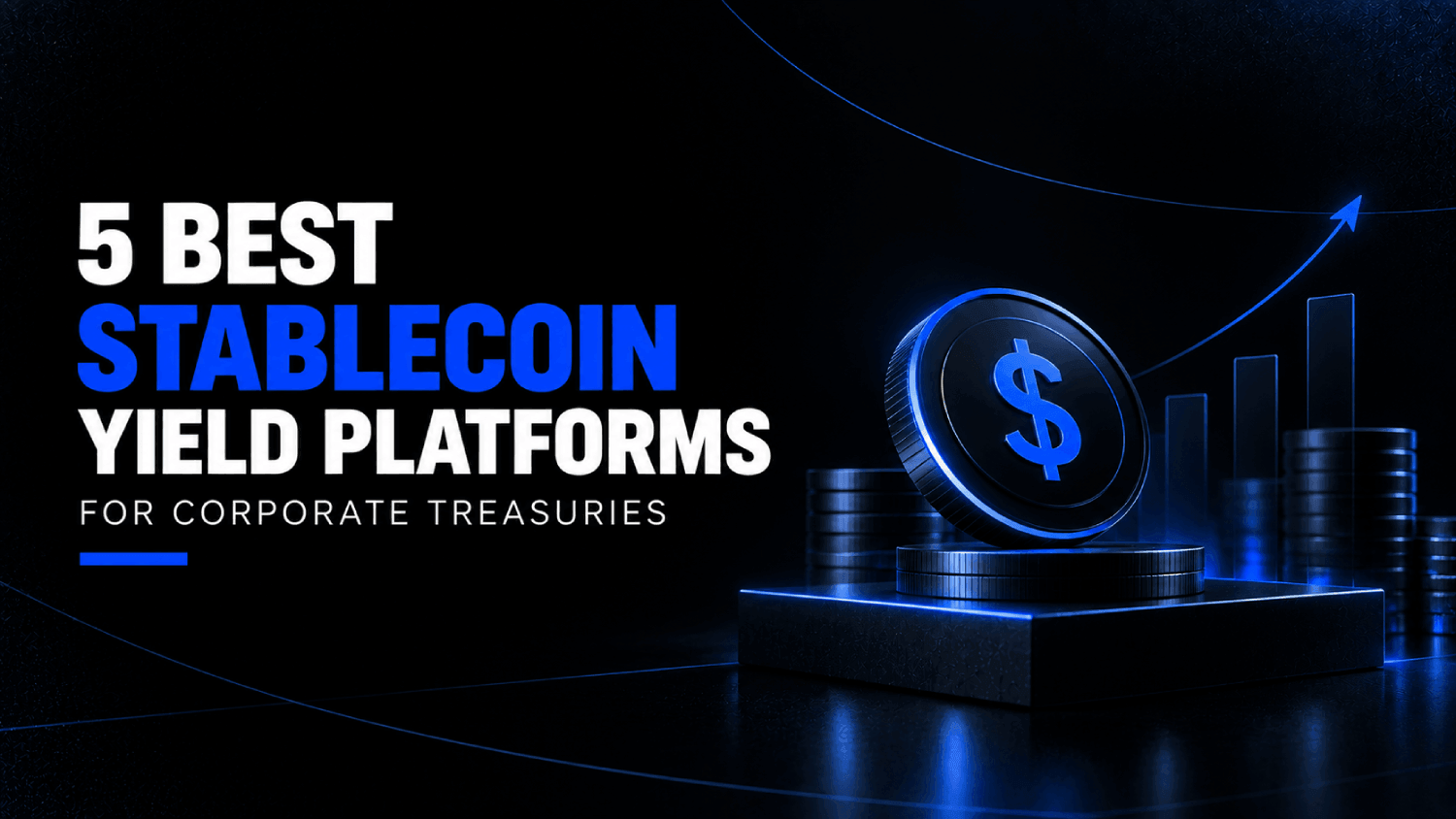
The best stablecoin yield platforms for corporate treasuries, and the best options for teams pursuing stablecoin yield for treasuries specifically, are Ondo Finance, Superstate, Mountain Protocol, Copper, and Agora, each suited to different risk tolerances and operational setups. Ondo and Superstate offer tokenized T-bill exposure that mirrors money market fund logic. Mountain Protocol pays yield directly on its USDM stablecoin. Copper and Agora serve teams that need institutional custody or white-label flexibility alongside the yield. None of these are consumer crypto products.
Why Corporate Treasuries Are Actually Evaluating Stablecoin Yield Now
The case changed in 2024 and 2025 for two reasons that have nothing to do with crypto conviction. First, the federal funds rate stayed elevated long enough for CFOs to care about the difference between 0.1% on a bank sweep account and 4-plus percent on a properly structured stablecoin yield product. Second, the maturation of tokenized government securities products gave legal and structural clarity to what these instruments actually are, which removed the largest objection most general counsels had to touching the category at all.
The objection that remains is structural, not philosophical. Corporate treasuries are not asking whether stablecoin yield for treasuries is real. They are asking whether the platform holding their capital will still be solvent when they need the money back on a Tuesday afternoon. That is a different question, and it is one most crypto-native platforms are not equipped to answer for a finance team with a board-approved treasury policy.
If you are building the internal case for moving a portion of operating reserves into stablecoin yield, the stablecoin treasury management tools guide on FintechSpecs covers the operational layer: how these products connect to your existing banking infrastructure, what the accounting treatment looks like, and which platforms have API-first integrations your finance ops team can actually use.
How to Evaluate a Stablecoin Yield Platform: The FintechSpecs Treasury Stress Test
Most platform comparisons in this category focus on APY. APY is the last thing you should look at. The FintechSpecs Treasury Stress Test is a four-check framework that evaluates platforms on the dimensions that determine whether your capital survives a bad week in crypto markets.
Check 1: Where Is the Yield Coming From?
There are three sources of stablecoin yield: T-bills or short-duration government debt (lowest risk), lending to overcollateralized borrowers on-chain (medium risk), and lending to undercollateralized or uncollateralized counterparties (the failure mode that wiped out Celsius and BlockFi). Any platform that cannot give you a clear, auditable answer to this question in plain English is not a treasury product.
Check 2: What Is the Custody Structure?
User funds should be held in segregated accounts or in on-chain smart contracts where the company cannot touch them for operational purposes. Commingled funds, where your capital sits alongside the platform’s operating capital, create counterparty risk that no yield premium justifies at the treasury level.
Check 3: What Is the Liquidity Profile?
Treasury cash is not investment capital. You may need to move $2 million at 9am on a Monday with no notice. Platforms with lock-up periods, withdrawal queues, or protocol-level redemption delays are not treasury products regardless of their yield. T+0 or T+1 settlement matters more than 50 extra basis points.
Check 4: What Is the Regulatory and Audit Status?
US stablecoin regulation is in active development at the federal level, with existing SEC frameworks and state money transmitter rules already applying to many products in this category. Platforms with monthly third-party attestations from recognized auditors (not self-reported reserve proofs) and clear legal domicile in a regulated jurisdiction score here. Platforms without these fail the check regardless of yield. For a detailed look at the compliance obligations fintech teams should be tracking, the fintech product and compliance readiness checklist is a useful starting point.
Which Stablecoin Yield Platforms Are Actually Built for Treasuries?
1. Ondo Finance

Ondo Finance offers OUSG and USDY, two tokenized products backed by short-duration US government securities and money market funds. USDY is structured as a yield-bearing note with monthly attestations from a third-party accounting firm. The underlying collateral is US Treasuries and bank deposits, which puts the yield source in the lowest-risk bucket of the Treasury Stress Test.
The product that matters most for corporate treasury teams is USDY, which is accessible to non-US persons and to US institutional and accredited investors. Ondo publishes its reserve holdings and yield rates publicly. As of their public documentation, USDY targets yields competitive with short-duration T-bills. The platform integrates with multiple chains including Ethereum and Solana, and Ondo has announced integrations with platforms like Coinbase Prime for custody.
The limitation worth flagging: US retail access remains restricted, and smaller finance teams without existing blockchain infrastructure may find onboarding more involved than a traditional MMF. The fit is strongest for companies already operating with stablecoin infrastructure or those building on Web3 rails.
2. Superstate

Superstate was founded by former Compound Finance leaders and takes the most direct approach to translating traditional fund structure into on-chain form. Its flagship product is a tokenized money market fund registered with the SEC as an investment company, which is a meaningful structural distinction from most competitors.
The SEC registration means Superstate operates under the Investment Company Act of 1940, the same legal framework that governs Fidelity’s money market funds. For a corporate treasury team that needs to show the board a product with identifiable regulatory backstop, that matters. The underlying assets are US government securities and repurchase agreements, consistent with what a traditional institutional MMF would hold.
Pricing is not publicly listed in detail. Superstate operates on a minimum investment basis suited to institutional and near-institutional buyers. Finance teams should contact Superstate directly for current fee and access structure. The on-chain tokenized share gives treasury teams real-time proof of ownership and position, which is an audit advantage over paper-based fund confirmations.
3. Mountain Protocol
Mountain Protocol issues USDM, a yield-bearing stablecoin where the yield is paid by rebasing the token balance daily rather than requiring the holder to stake or lock funds. The underlying collateral is short-duration US Treasury bills, and Mountain Protocol publishes daily attestations from a third-party firm.
The operational advantage over tokenized fund products is simplicity. USDM works like a stablecoin: you hold it in a wallet, the balance goes up each day, and you can transfer it or redeem it like any other ERC-20 token. There is no fund subscription process, no minimum hold period for basic redemption, and no fund administrator standing between you and your capital.
Mountain Protocol is regulated by the Bermuda Monetary Authority. US persons face access restrictions. For non-US treasury operations or for multinational companies managing capital in offshore entities, this is a practical product. For purely US-domiciled corporate treasuries, regulatory counsel review is required before deployment.
4. Copper
Copper approaches the problem differently. Rather than issuing a yield product directly, Copper provides institutional-grade custody and prime brokerage infrastructure that allows treasury teams to access yield strategies while maintaining segregated custody. The ClearLoop system allows trading and staking without assets leaving Copper’s custody environment, which addresses the counterparty risk problem at the architecture level.
The yield-adjacent use case for corporate treasuries is staking on proof-of-stake assets and accessing on-chain yield through Copper’s prime infrastructure, rather than holding a yield-bearing stablecoin directly. This makes Copper more relevant for treasury teams that hold ETH or other digital assets alongside stablecoin positions, and want institutional-grade infrastructure wrapping the whole portfolio.
Copper is regulated in multiple jurisdictions and serves institutional clients including hedge funds and asset managers. Pricing is not public and is structured for institutional minimums. The fit here is companies that want a regulated custodian managing the full digital asset treasury position rather than a standalone yield product.
5. Agora

Agora issues AUSD, a stablecoin designed for use within fintech and payments infrastructure rather than purely as a passive yield vehicle. The collateral structure is US Treasuries and cash equivalents, and Agora’s model is built around partnerships with financial institutions and fintech platforms that want to embed stablecoin functionality into their own products.
For a corporate treasury team, Agora is most relevant if the company is also a fintech platform evaluating whether to integrate stablecoin payments or settlement into its product. The yield on held AUSD is a secondary benefit; the primary value proposition is institutional-grade stablecoin infrastructure with a compliant issuance model. Agora has disclosed a relationship with State Street as custodian for underlying assets, teams should confirm current custody arrangements directly with Agora, as partnership structures can change. The custody pedigree that State Street represents matters to treasury committees when it is in place.
Pricing and access are managed through direct partnership agreements rather than a public self-serve model. Companies evaluating Agora for treasury yield specifically should consider whether the partnership model aligns with their operational needs or whether a more direct product like USDY or Superstate’s fund is a cleaner fit.
How Do These Platforms Compare on the Metrics That Matter?
| Platform | Yield Source | Custody Model | US Person Access | Regulatory Status | Liquidity |
|---|---|---|---|---|---|
| Ondo Finance (USDY) | US Treasuries, MMF | Third-party custodian, on-chain token | Accredited/institutional only | SEC exemptions, third-party attestation | T+1 to T+3 redemption |
| Superstate | US Gov securities, repos | SEC-registered fund structure | Institutional, accredited | SEC Investment Company Act | Fund redemption terms |
| Mountain Protocol (USDM) | Short-duration US T-bills | BMA-regulated issuer, third-party attestation | Restricted (non-US primary) | Bermuda Monetary Authority | Near-instant on-chain transfer |
| Copper | Staking, on-chain strategies | Segregated institutional custody (ClearLoop) | Institutional | Multi-jurisdiction regulated | Strategy-dependent |
| Agora (AUSD) | US Treasuries, cash equivalents | Institutional custodian (confirm current arrangement directly) | Partnership-based | Partnership with regulated custodian | Partnership terms |
Yield figures are deliberately excluded from this table. Rates on all five platforms fluctuate with short-duration Treasury yields and should be confirmed directly with each provider. Any publication quoting a specific APY for these products without a date stamp and source should be treated with skepticism.
What Does the Accounting Treatment Look Like for Corporate Stablecoin Yield?
This is the question finance teams are not asking early enough. How a company accounts for stablecoin yield income affects whether this is a viable treasury strategy under its current audit and reporting obligations.
Tokenized fund shares, like Superstate’s product, are likely to be treated as investments in money market funds for accounting purposes, which means fair value measurement under ASC 820 and disclosure in the financial statements. The accounting is familiar because the underlying legal structure maps to an existing financial instrument category.
Yield-bearing stablecoins like USDY and USDM are harder. The daily rebase mechanic on USDM, for instance, creates a question about whether the daily increment is interest income or an adjustment to the carrying value of a digital asset. The FASB issued ASU 2023-08 in December 2023 requiring fair value measurement for certain crypto assets, but stablecoins held at a $1 peg introduce additional complexity in applying that guidance. Your auditor’s position on how ASU 2023-08 applies to yield-bearing stablecoins matters before you deploy capital, not after.
For teams building compliance infrastructure around digital asset holdings, the fintech product and compliance readiness checklist covers the documentation and control requirements that institutional-grade programs are expected to maintain.
What Should a $5M Treasury Allocation to Stablecoin Yield Actually Look Like?
Consider a Series B SaaS company holding $18 million in operating reserves, with 6 months of runway required to be liquid at all times. The CFO wants to put $5 million to work in a stablecoin yield product without violating the treasury policy that requires capital to be accessible within 48 hours. This is a hypothetical scenario for illustrative purposes.
The allocation that passes the FintechSpecs Treasury Stress Test in this scenario: $3 million in a tokenized T-bill product like USDY or Superstate (T+1 to T+3 redemption, government securities backing, third-party attestation, counterparty risk limited to custodian not platform), and $2 million in a yield-bearing stablecoin like USDM held in a company-controlled wallet (instant liquidity on-chain, daily yield accrual, redemption through regulated issuer). Nothing goes into uncollateralized lending protocols regardless of advertised APY.
The 60/40 split between fund-structure products and direct stablecoin holding is not a fixed rule. It reflects a tradeoff between settlement predictability (better in fund structures) and operational flexibility (better with on-chain stablecoins). A company with slower payment cycles and a more patient treasury posture could weight more toward the fund structure. A company moving large dollar amounts across borders frequently gets more operational value from the on-chain side.
How Does the Evolving Regulatory Environment Affect What Corporate Treasuries Can Hold?
Federal stablecoin legislation in the US remains under active consideration as of this writing. Several bills have advanced through committee, and the direction of travel is toward requiring payment stablecoin issuers to hold 1:1 reserves in high-quality liquid assets and publish regular reserve attestations from registered accounting firms, but no comprehensive federal stablecoin law has been enacted into law at the time of publication. Teams should monitor federal stablecoin compliance developments as the legislative picture clarifies.
In the interim, existing frameworks apply. SEC registration requirements, state money transmitter licenses, and the Bank Secrecy Act already govern many aspects of stablecoin issuance and custody. For treasury teams, the practical implication is that holding stablecoins issued by non-compliant entities, those without verifiable reserves, registered custodians, or applicable regulatory authorization, creates legal and operational exposure that no yield premium compensates for.
The safe harbor in the current environment is holding stablecoins issued by entities with third-party attestations from recognized firms, clear legal domicile in a regulated jurisdiction, and custody arrangements with established financial institutions. Products backed by T-bills with transparent attestation schedules are on the defensible side of this line. Products with unverifiable reserves or offshore-domiciled issuers without regulatory oversight are not.
Non-US treasuries are not exempt from this analysis. Many offshore stablecoin yield products are distributed to US companies through partnerships or platforms that create indirect US regulatory nexus. Legal review is required regardless of where the issuer is domiciled. The real cost of compliance in fintech, broken down by stage, is a useful reference for teams estimating what proper legal review of a stablecoin treasury program actually costs.
Frequently Asked Questions
Is stablecoin yield safe for corporate treasury use?
It depends entirely on the product structure. Tokenized Treasury products and SEC-registered fund structures backed by US government securities carry risk profiles comparable to short-duration bond funds, not crypto speculation. Products that earn yield through uncollateralized lending or opaque DeFi protocols carry materially higher risk. The distinction matters more than any yield differential. Treasury teams should evaluate custody structure, collateral transparency, and redemption liquidity before considering APY.
How much yield can a corporate treasury earn on stablecoins?
Rates on Treasury-backed stablecoin products track closely with short-duration US government securities, which means yields move with the federal funds rate. Platforms do not publish static APYs for this reason, as rates change frequently. Teams should request current rate sheets directly from Ondo Finance, Superstate, and Mountain Protocol, then compare against their current money market fund yields to evaluate whether the operational overhead justifies the switch.
What are the biggest risks of corporate stablecoin yield programs?
The four risks in order of probability and impact: counterparty insolvency (platform fails and commingled funds are frozen), smart contract failure (bug or exploit in on-chain infrastructure drains reserves), liquidity mismatch (yield product has lock-up that conflicts with operating cash needs), and accounting/tax treatment uncertainty (yield recognized incorrectly, triggering audit findings). All four are manageable with proper platform selection and legal review. None are eliminated entirely.
Do US companies face restrictions on stablecoin yield products?
Yes. Most yield-bearing stablecoin products available to non-US persons are unavailable or restricted to accredited investors or qualified institutional buyers in the US. Superstate’s fund structure as a registered investment company is among the cleaner options for US institutional buyers. USDY from Ondo is available to US accredited investors. Mountain Protocol’s USDM explicitly restricts US persons. Any company deploying capital should confirm its eligibility status with each platform before onboarding.
How do stablecoin yield platforms compare to money market funds for corporate treasuries?
Tokenized money market funds like Superstate’s product are structurally equivalent to traditional MMFs, with the added benefit of on-chain settlement and real-time position visibility. Direct yield-bearing stablecoins like USDM offer faster operational settlement and the ability to move capital without fund redemption delays, but with a less familiar regulatory wrapper. Traditional MMFs win on institutional familiarity and audit defensibility. Stablecoin products win on cross-border settlement speed and 24/7 access.
What is the minimum investment for corporate stablecoin yield products?
Minimums vary significantly and are not always published. Superstate targets institutional buyers and minimums are available on request. Ondo’s USDY has lower minimums and is designed for broader institutional access, but exact thresholds require direct confirmation with the platform. Mountain Protocol’s USDM can technically be held in any amount as an on-chain token, though meaningful yield accrual requires meaningful principal. All platforms listed here should be contacted directly for current access requirements.
How do I get board approval to use stablecoin yield products in our treasury policy?
The argument that works with most boards: frame tokenized T-bill products as a technology interface for holding government securities, not as a crypto investment. The underlying assets are identical to what an approved money market fund holds. The additional disclosures needed are around smart contract risk and platform counterparty risk, which can be addressed through platform due diligence documentation, third-party attestation schedules, and insurance coverage confirmation. Document the collateral, the custody structure, and the exit mechanism in the treasury policy update.
Conclusion
The gap between what most finance teams think stablecoin yield is (a crypto product with unacceptable risk) and what the best platforms actually offer (a technology layer over familiar short-duration government securities) is the real opportunity in this category. That gap is closing as platforms like Superstate and Ondo mature, but it has not closed entirely, which means first-mover treasury teams that do the diligence now capture yields that will normalize as adoption increases.
The FintechSpecs Treasury Stress Test is useful precisely because it reorients the evaluation away from APY and toward the four questions that determine whether your capital comes back when you need it. A platform that scores well on yield source, custody structure, liquidity profile, and regulatory status is a treasury product. One that fails on any of those four is not, regardless of how the marketing materials describe it.
The companies best positioned to act on stablecoin yield for treasuries are Series A and B fintech operators who already have some familiarity with blockchain infrastructure and finance teams comfortable with digital asset accounting. For these companies, the operational lift of onboarding a tokenized T-bill product is modest compared to the yield differential over bank sweep accounts. For companies with no prior digital asset exposure, the right starting point is the SEC-registered fund structure from Superstate, which maps to existing treasury policy language without requiring a full policy rewrite.
For broader context on where stablecoin infrastructure fits within the fintech stack, the stablecoin infrastructure providers guide and the fintech infrastructure stack map are useful companion reads.