
- Middesk and Baselayer are not interchangeable. Middesk leads on breadth of US business data coverage; Baselayer leads on risk-layered decisioning for high-risk business categories.
- For onboarding cannabis companies, crypto exchanges, or cross-border marketplaces, Baselayer’s configurable risk rules pull ahead of Middesk’s more compliance-first, bank-oriented workflow.
- Middesk integrates more deeply with existing bank and fintech compliance stacks, including direct connections to Alloy-based workflows, making it the stronger pick for regulated financial institutions.
- Neither platform publishes per-verification pricing publicly. Both are contract-based, and total cost scales heavily with verification volume and the number of data sources activated.
- The decision usually comes down to one question: do you need a clean verification record for a bank examiner, or do you need a configurable risk signal for an underwriter?
Middesk vs Baselayer is ultimately a question of what your KYB output is actually for. Middesk is built for fintech compliance teams and bank partners who need a defensible KYB audit trail. Baselayer is built for risk teams onboarding business types that traditional KYB tooling rejects or misclassifies. For standard US business verification at regulated institutions, Middesk is the more mature choice. For high-risk merchant categories, crypto-adjacent businesses, or platforms that need to customize their own risk logic, Baselayer fits better.
What Problem Does Each Platform Actually Solve?
Both Middesk and Baselayer verify businesses, but they were designed around different failure modes. Middesk was built to solve the problem of manual KYB at banks and fintech lenders, where compliance analysts were spending hours pulling Secretary of State records, verifying EINs, and cross-referencing beneficial ownership by hand. Baselayer was built to solve the problem of KYB tooling that produces a binary pass/fail when what a risk team actually needs is a scored, layered signal.
That origin difference shows up in how each platform structures its output. A Middesk verification returns a structured business identity record: registered agent, formation state, business type, and a summary status that a compliance analyst or an automated decisioning engine can act on. Baselayer returns a risk-scored output that includes signals about the nature of the business, not just whether it exists.
For most regulated fintech onboarding flows, the Middesk output is what a bank examiner expects to see in an audit file. For a payments platform onboarding a new merchant category it has never seen before, the Baselayer output gives the risk team more to work with.
How Does Middesk’s KYB Coverage Work for US Businesses?
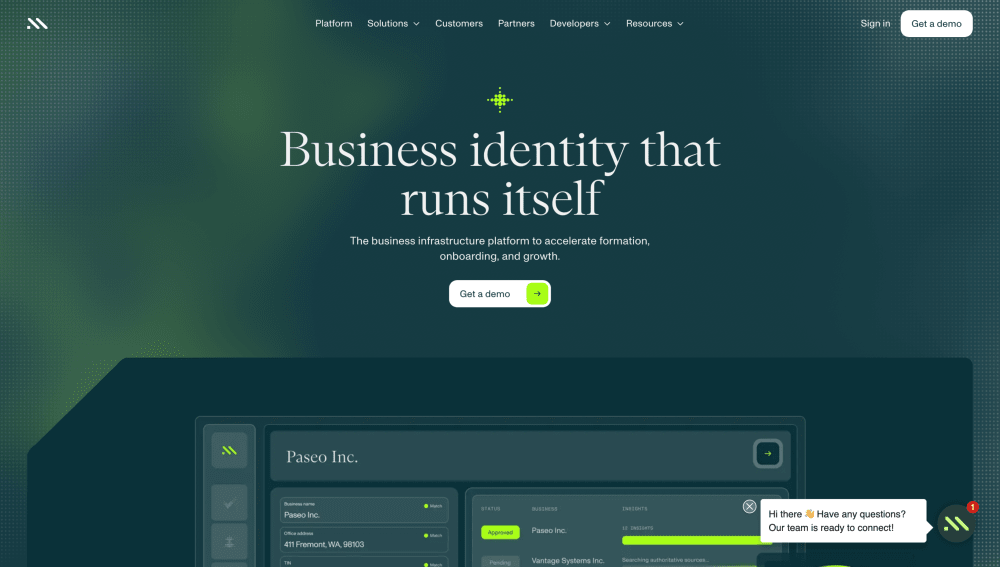
Middesk aggregates data from Secretary of State filings, IRS EIN records, USPS address validation, and a set of watchlist and adverse media sources. Its core product is business verification, which checks that a business legally exists, is in good standing, and matches the information a customer provides during onboarding. It also offers beneficial ownership verification, which maps the individuals behind the business to KYC identity checks.
The coverage depth for US entities is one of Middesk’s clearest strengths. Middesk has built direct pipelines to state-level filing databases across all 50 states, which matters because state business records are notoriously inconsistent in format and update frequency. Pulling that data accurately and fast enough to use in a real-time onboarding flow requires infrastructure that most compliance teams cannot build in-house.
Middesk also produces a continuous monitoring product, which re-checks business standing on an ongoing basis and alerts the customer if a business goes inactive, loses good standing, or triggers a watchlist hit after initial onboarding. This matters for lenders and banking partners who have ongoing BSA/AML obligations after origination, not just at the point of account opening.
How Does Baselayer’s KYB Approach Differ for High-Risk Onboarding?
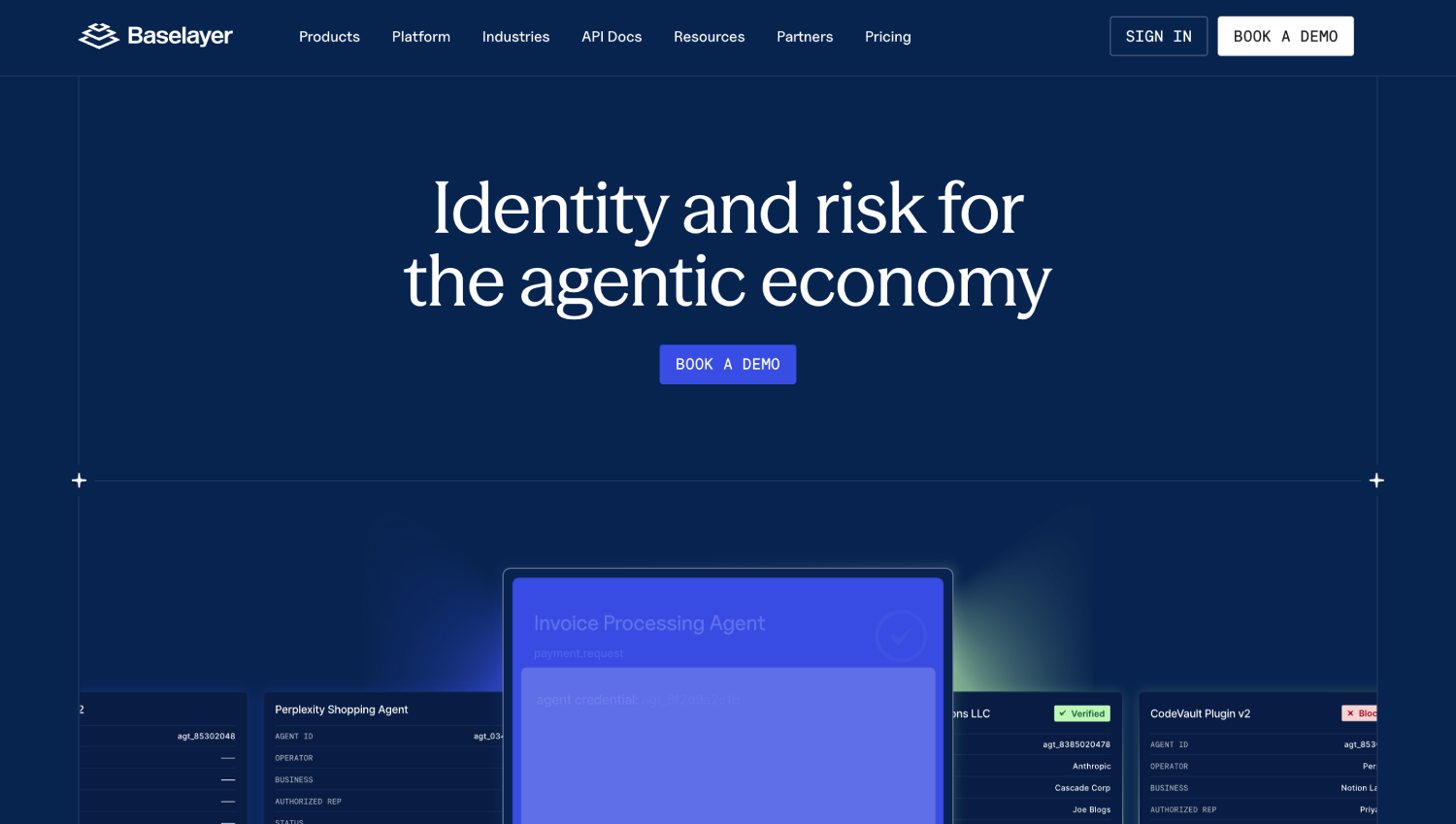
Baselayer covers the same foundational data sources as Middesk, including business registration and EIN validation, but its differentiation is in how it layers risk signals on top of that verification. Rather than returning a clean verified/unverified status, Baselayer’s output is designed to feed risk decisioning engines with scored attributes about a business’s risk profile.
That design is relevant when you are onboarding business categories where existence and registration status are not the only thing that matters. A cannabis dispensary can be fully legally registered in California, pass a standard KYB check, and still be a regulated business category that many payment processors will not touch without additional diligence. A crypto exchange can be a real company with a real EIN and still require category-specific risk signals before a platform decides to onboard it.
Baselayer allows risk teams to build their own decisioning logic on top of its verification signals. That configurability is where it earns its value for non-standard merchant categories. Middesk’s product is optimized for compliance audit readiness; Baselayer’s product is optimized for risk team control.
If your onboarding population is mostly standard US businesses, that configurability is overhead you do not need. If your onboarding population includes merchants your compliance team needs to treat differently, that configurability is the product.
What Is the FintechSpecs KYB Fit Test?
FintechSpecs KYB Fit Test
Choosing between Middesk and Baselayer is not a feature checklist exercise. It is a question of which failure mode your business is most exposed to. Map your situation against these three axes before requesting a demo from either vendor.
Axis 1: Audit Readiness vs. Risk Configurability
If your primary stakeholder for KYB output is a bank examiner, an external auditor, or a sponsor bank compliance team, you need a clean, defensible verification record. Middesk is purpose-built to produce that record. Its output format, data sourcing, and monitoring tools are designed with regulated financial institutions in mind.
If your primary stakeholder is an internal risk team that needs to make nuanced decisions about unfamiliar business categories, you need configurable risk logic. Baselayer is purpose-built for that workflow.
Axis 2: Merchant Category Risk
List the top five business types by volume in your current or projected onboarding pipeline. If they are US-based LLCs, corporations, and sole proprietors in standard industry categories, Middesk’s data coverage is more than sufficient. If more than 20 percent of your pipeline includes businesses in high-risk merchant category codes, cross-border entities, or industries with elevated fraud or regulatory exposure, Baselayer’s risk layering justifies the additional complexity.
Axis 3: Stack Integration
Middesk has documented integrations with Alloy, which is relevant if you are already using Alloy for identity orchestration. That pairing is common at banks and regulated fintech lenders. The Alloy vs. Middesk comparison on FintechSpecs covers that specific architecture decision in detail. Baselayer is API-first but is not designed around that same regulated-institution stack, which matters if your compliance team expects that workflow.
Middesk vs. Baselayer: Feature and Coverage Comparison
| Capability | Middesk | Baselayer |
|---|---|---|
| US business registration verification | Yes, all 50 states | Yes |
| EIN / TIN validation | Yes | Yes |
| Beneficial ownership mapping | Yes | Yes |
| Continuous monitoring | Yes | Not publicly confirmed; verify directly with Baselayer |
| Risk-scored output (beyond pass/fail) | Limited | Core product differentiator |
| Custom risk rule configuration | Limited | Yes |
| High-risk merchant category handling | Standard compliance output | Scored, configurable |
| Alloy integration | Documented | Not documented |
| Bank/sponsor bank use case fit | Strong | Moderate |
| Public pricing | Not published | Not published |
What Does Middesk vs. Baselayer Pricing Actually Look Like?
Neither Middesk nor Baselayer publishes per-verification pricing. Both operate on custom contracts, and pricing structures depend on verification volume, the number of data modules activated, and the type of monitoring included. This is standard for B2B KYB platforms at their scale, but it means any per-unit price you find quoted in a blog post is either outdated or a rough estimate from a sales conversation.
What is known publicly: Middesk structures its pricing around verification products (business verification, beneficial ownership verification) and monitoring tiers. Baselayer similarly bundles its risk-layer features into contract pricing rather than offering a transparent pay-as-you-go model. For teams at the evaluation stage, both vendors will require a demo call before providing a quote.
Volume is the primary lever. A fintech onboarding thousands of businesses per month will negotiate meaningfully different unit economics than one onboarding hundreds. If you are building the cost model for your compliance budget, the real cost of compliance in fintech SaaS is a useful reference for how to frame KYB costs relative to your total compliance spend by stage.
Which KYB Platform Fits High-Risk Merchant Onboarding?
Consider a Series A payments platform onboarding small business merchants across a broad range of categories, including some that process high volumes in industries like firearms accessories, nutraceuticals, or money services businesses. Standard KYB tells you those merchants are real registered companies. It does not tell you how to risk-weight them against each other or how to configure different approval thresholds by category.
That is where Middesk’s output hits its ceiling for high-risk onboarding. A Middesk verification result answers the question “does this business legally exist and match what the applicant told us?” It does not answer “how should we treat this business relative to our risk appetite for this merchant category?” Baselayer’s architecture is designed to feed that second question.
For a regulated bank or a bank-partnered fintech launching deposit accounts or lending products, the Middesk output is exactly what the sponsor bank’s compliance team will ask to see. The audit trail is clean, the data sourcing is traceable, and the monitoring is ongoing. Pairing Middesk with an identity orchestration layer like Alloy handles the broader onboarding workflow. For that use case, Baselayer adds complexity without proportional benefit.
The tension resolves clearly when you map it to the business type being onboarded. Standard US SMBs in common industry categories: Middesk. Complex, elevated-risk, or category-diverse merchant populations where internal risk logic drives the decision: Baselayer. Teams building KYB infrastructure for a mixed population should evaluate whether they need both or whether their risk team can extract enough signal from Middesk’s output with custom internal logic layered on top. Reviewing how other platforms approach KYB provider selection for B2B fintech onboarding gives useful context for where Middesk and Baselayer sit in the broader vendor field.
How Does Each Platform Handle Beneficial Ownership?
Both Middesk and Baselayer support beneficial ownership verification as part of their KYB workflow, which is required under FinCEN’s Customer Due Diligence rule for covered financial institutions. The implementation differs in how the data is collected and how it connects to downstream identity checks on the individuals behind the business.
Middesk handles beneficial ownership by collecting ownership information through its onboarding flow and running that data against identity verification checks, which can be handled by Middesk itself or routed through a connected identity provider. The output is a structured record that maps ownership percentages, control persons, and the identity verification status of each individual.
Baselayer similarly handles beneficial ownership data collection but frames the output within its risk-scoring model. The risk profile of the business entity and the risk signals attached to the individuals behind it can be combined into a single decisioning output, which is more useful for risk teams making nuanced approval decisions than for compliance teams producing audit documentation.
Frequently Asked Questions
Is Middesk or Baselayer better for KYB at a bank-sponsored fintech?
Middesk is the stronger fit for bank-sponsored fintechs. Its data sourcing, audit trail format, and continuous monitoring features are designed with regulated financial institution requirements in mind. Sponsor banks and their compliance teams expect a verification output they can defend to a regulator, and Middesk’s product structure matches that expectation more directly than Baselayer’s risk-scoring approach.
What is the main difference between Middesk and Baselayer for KYB?
Middesk produces a structured, compliance-oriented business verification record optimized for audit readiness and bank examiner review. Baselayer produces a risk-scored output designed for teams that need to configure their own risk logic on top of basic verification signals. Middesk answers “does this business legally exist and match the application?” Baselayer answers “how should we risk-weight this business given its characteristics?”
Does Middesk cover all 50 US states for business registration data?
Yes. Middesk has built data pipelines across all 50 US states for Secretary of State business registration records, which is one of its core infrastructure advantages. State-level business data is inconsistent in format and update cadence across jurisdictions, and Middesk’s coverage depth is a meaningful operational advantage over compliance teams attempting to pull this data manually.
Does Baselayer offer continuous monitoring like Middesk?
Middesk offers a documented continuous monitoring product that re-checks business standing and watchlist status on an ongoing basis after initial verification. Baselayer has not publicly confirmed an equivalent continuous monitoring feature. Teams with ongoing BSA/AML obligations that require post-onboarding monitoring should ask Baselayer about this directly during a sales conversation before making a platform decision.
What does Middesk or Baselayer pricing look like?
Neither Middesk nor Baselayer publishes pricing. Both operate on custom enterprise contracts, and pricing depends on verification volume, activated data modules, and monitoring scope. Expect to go through a sales process with both vendors before receiving a quote. Volume is the primary pricing lever, and both vendors offer different module configurations that affect total cost.
Can Baselayer replace Middesk for standard US business verification?
Baselayer covers the foundational data sources required for standard US business verification, including registration records and EIN validation. For simple compliance-only use cases at regulated institutions, Middesk’s audit trail format and bank-partner integrations make it the more natural choice. Baselayer’s additional risk-scoring layer adds cost and implementation complexity that is unnecessary if your team only needs a clean verification record.
How does KYB fit into a broader fintech compliance stack?
KYB is one component of a broader identity and risk infrastructure. Business verification needs to connect to KYC checks on beneficial owners, AML screening, and ongoing transaction monitoring to form a complete compliance program. Middesk integrates with identity orchestration platforms like Alloy to handle that broader workflow. For a full picture of how these tools connect, the fintech product and compliance readiness checklist covers the full stack by stage.
The Distinction That Actually Drives the Decision
Most teams evaluating Middesk and Baselayer approach the comparison as a feature-matching exercise. They compare data sources, integration options, and pricing tiers, and they end up with two roughly similar-looking lists. That framing misses the real difference. Middesk is a compliance product. Baselayer is a risk product. Those are not the same thing, even when they verify the same businesses.
Compliance products exist to satisfy a regulator or auditor. The output needs to be structured, traceable, and defensible. Risk products exist to inform a decision-maker inside the business. The output needs to be configurable, scored, and useful to someone who does not have a script to follow. If your compliance team is the primary consumer of your KYB output, Middesk fits. If your risk team is the primary consumer, and especially if your merchant population includes categories that require judgment calls rather than binary verification, Baselayer fits.
Teams that need both, which is not an unusual position for a growth-stage payments platform, should think carefully about whether to integrate one platform deeply or run parallel workflows. The common mistakes in choosing fintech infrastructure almost always include over-engineering the vendor stack early or under-specifying the compliance requirements before signing a contract. Pick the platform whose output structure matches the internal consumer of that output, not the one with the longer feature list.