
- Institutional crypto-backed lending is a distinct category from retail crypto loans, with different LTV structures, custody arrangements, and regulatory frameworks that most corporate borrowers overlook.
- The five providers in this list serve entities borrowing against Bitcoin, Ethereum, and other digital assets at minimums that start at $100,000 and scale into nine figures.
- Loan-to-value ratios at origination typically fall in the 50% to 70% range based on market conditions observed across providers, with margin call thresholds that vary significantly between centralized lenders and DeFi-adjacent platforms.
- Custody of collateral is the single most important variable when comparing crypto collateral loan providers at an institutional level, not the interest rate.
- Compliance infrastructure, including AML/KYC depth and jurisdiction-specific licensing, separates lenders that are safe counterparty choices from those that carry regulatory tail risk.
The best crypto-backed loan providers for institutions include Coinbase Institutional, Ledn, Nexo, Anchorage Digital, and Galaxy Digital. Each offers Bitcoin-backed and broader digital asset-collateralized credit lines with institutional-grade custody, AML compliance, and credit facilities that start at six figures. Coinbase and Anchorage carry federal trust charters or banking licenses. Galaxy and Ledn serve high-conviction Bitcoin holders who want fiat liquidity without a taxable sale. This comparison covers the major crypto backed loan providers operating at institutional scale today.
Why Are Institutions Using Crypto-Backed Loans at All?
The core appeal is straightforward: a company or fund holds appreciated digital assets and needs fiat liquidity without triggering a capital gains event. Selling Bitcoin to fund operations or acquisitions is a taxable disposition in the US. Borrowing against it is not. That tax asymmetry, combined with institutions increasingly holding BTC on corporate balance sheets, is what has made institutional crypto lending a real category rather than a retail novelty.
The structure matters as much as the concept. An institutional bitcoin-backed loan typically involves pledging digital assets into a custody arrangement (sometimes the lender’s, sometimes a third-party qualified custodian), receiving fiat or stablecoin credit, and maintaining a loan-to-value ratio below a margin call threshold. If the collateral value drops and LTV exceeds the agreed threshold, the borrower either adds collateral or faces partial liquidation. This is functionally similar to a securities-backed line of credit at a prime brokerage, not a consumer crypto loan from a retail app.
The institutional demand signal is also regulatory. As ETF approvals and clearer SEC and OCC guidance have made digital assets more defensible on corporate and fund balance sheets, CFOs and treasury teams are now asking a question they would not have asked three years ago: “Can we pledge this and stay liquid?”
How Do Institutional Crypto Collateral Loans Actually Work?
The mechanics differ from retail crypto lending in three structural ways: custody, LTV management, and counterparty vetting.
On custody: institutional lenders either hold collateral themselves (usually in cold storage with an institutional-grade setup) or route it to a qualified custodian like BitGo, Coinbase Custody, or Anchorage Digital. Some lenders allow the borrower to choose the custodian, which matters enormously for counterparty risk. If the lender holds collateral on their own books and faces insolvency, the borrower is an unsecured creditor. The Celsius and BlockFi bankruptcies made this risk concrete, not theoretical, in both cases, customers who held assets in accounts rather than segregated custody arrangements became general unsecured creditors, recovering cents on the dollar.
On LTV: based on terms observed across institutional providers, origination LTVs typically sit in the 50% to 70% range. A company pledging $10M in BTC at 50% LTV receives a $5M credit facility. Margin call thresholds are commonly set in the 65% to 75% LTV range, with liquidation triggered above 80% to 85%. These ratios compress during high-volatility periods, and institutional agreements typically negotiate a cure period during which the borrower can post additional collateral before liquidation is executed. That cure window is a key negotiating point and terms differ by lender and facility.
On counterparty vetting: institutional borrowers should treat a crypto lender the way they would treat any credit counterparty. That means reviewing the lender’s capitalization, jurisdiction, licensing status, and how they handle rehypothecation of pledged assets. Several lenders explicitly prohibit rehypothecation; others use collateral to fund their own lending books. This distinction matters for anyone with fiduciary obligations.
If you are building any kind of crypto-native lending infrastructure on top of these relationships, the loan origination and management software space has also matured considerably and is worth evaluating in parallel.
The FintechSpecs Institutional Crypto Lender Evaluation Framework
Most comparisons of crypto collateral lending platforms focus on interest rates. That is the wrong starting point for institutional buyers. The framework below, which we call the CLACK Test, structures evaluation around the five variables that determine whether a lender is a suitable counterparty for a company or fund with fiduciary obligations.
- Custody arrangement: Who holds the collateral, under what legal structure, and is rehypothecation prohibited in writing?
- Licensing and jurisdiction: Does the lender hold a banking license, trust charter, or state-level money transmission licenses in your operating states?
- AML/KYC depth: What is the KYB process, and does the lender have a compliance infrastructure that matches your own regulatory obligations?
- Cure period and liquidation policy: How many hours does the lender give you to post additional collateral before a margin call triggers liquidation?
- Counterparty capital and audit: Is the lender audited by a Big Four or top-tier firm, and do they publicly disclose solvency or reserve attestations?
Running any provider through the CLACK Test before you negotiate rates will eliminate most of the risk surface. A 1% lower interest rate from a lender that fails on custody or liquidation policy is not a deal worth taking.
Which Are the Best Crypto-Backed Loan Providers for Institutions?
The five providers below represent the most credible options for institutional borrowers currently active in this market. They differ significantly on minimum loan size, collateral types accepted, custody model, and the regulatory standing that determines whether they are a viable counterparty for a fund, corporation, or regulated entity. Minimum loan sizes and rehypothecation policies in the table below reflect publicly available disclosures or company-stated terms; borrowers should verify current terms directly with each provider, as these are subject to change.
| Provider | Minimum Loan Size | Collateral Accepted | Custody Model | Licensing | Rehypothecation Policy |
|---|---|---|---|---|---|
| Coinbase Institutional | Not publicly disclosed; institutional focus typically $1M+ | BTC, ETH, and other major assets | Coinbase Custody (qualified custodian) | Federal OCC charter (Coinbase entity) | Not publicly disclosed; request written clarification at term sheet |
| Anchorage Digital | Not publicly disclosed; institutional engagement typically $500K+ | BTC, ETH, and broader digital assets | Anchorage Digital Bank (federally chartered) | National bank charter (OCC-granted) | Federal banking regulations govern client asset handling in chartered accounts; verify specific terms with Anchorage directly |
| Galaxy Digital | Not publicly disclosed; institutional focus typically $1M+ | BTC, ETH, SOL, and others | Third-party or Galaxy custody | Registered investment firm; state licenses | Not publicly disclosed; confirm in writing during negotiation |
| Ledn | $100K+ (per publicly disclosed loan terms) | BTC, USDC | Third-party (Coinbase Custody, BitGo) | Canadian-registered; US state licenses | Prohibited under disclosed B2X loan structure; verify current loan agreement for your facility type |
| Nexo | Retail tier from $100; institutional/enterprise desk for larger facilities | BTC, ETH, and 40+ assets | BitGo, Ledger Vault, and others | Various EU/international licenses; US state licenses vary | Not publicly disclosed; confirm in writing during negotiation |
Coinbase Institutional
Coinbase Institutional is the default starting point for US corporations and funds that are already using Coinbase as a custody or trading venue. The lending program sits within the broader Prime offering and allows clients to borrow against assets held in Coinbase Custody. The practical advantage here is consolidation: collateral never leaves the Coinbase infrastructure, which simplifies legal agreements and operational workflows.
Coinbase’s OCC-regulated entity and publicly traded status give it a counterparty risk profile that most institutional compliance teams can clear without unusual friction. The trade-off is pricing opacity. Coinbase does not publish institutional lending rates, and terms are negotiated based on relationship size and asset mix. Borrowers below a meaningful collateral threshold are generally not the target market.
Anchorage Digital
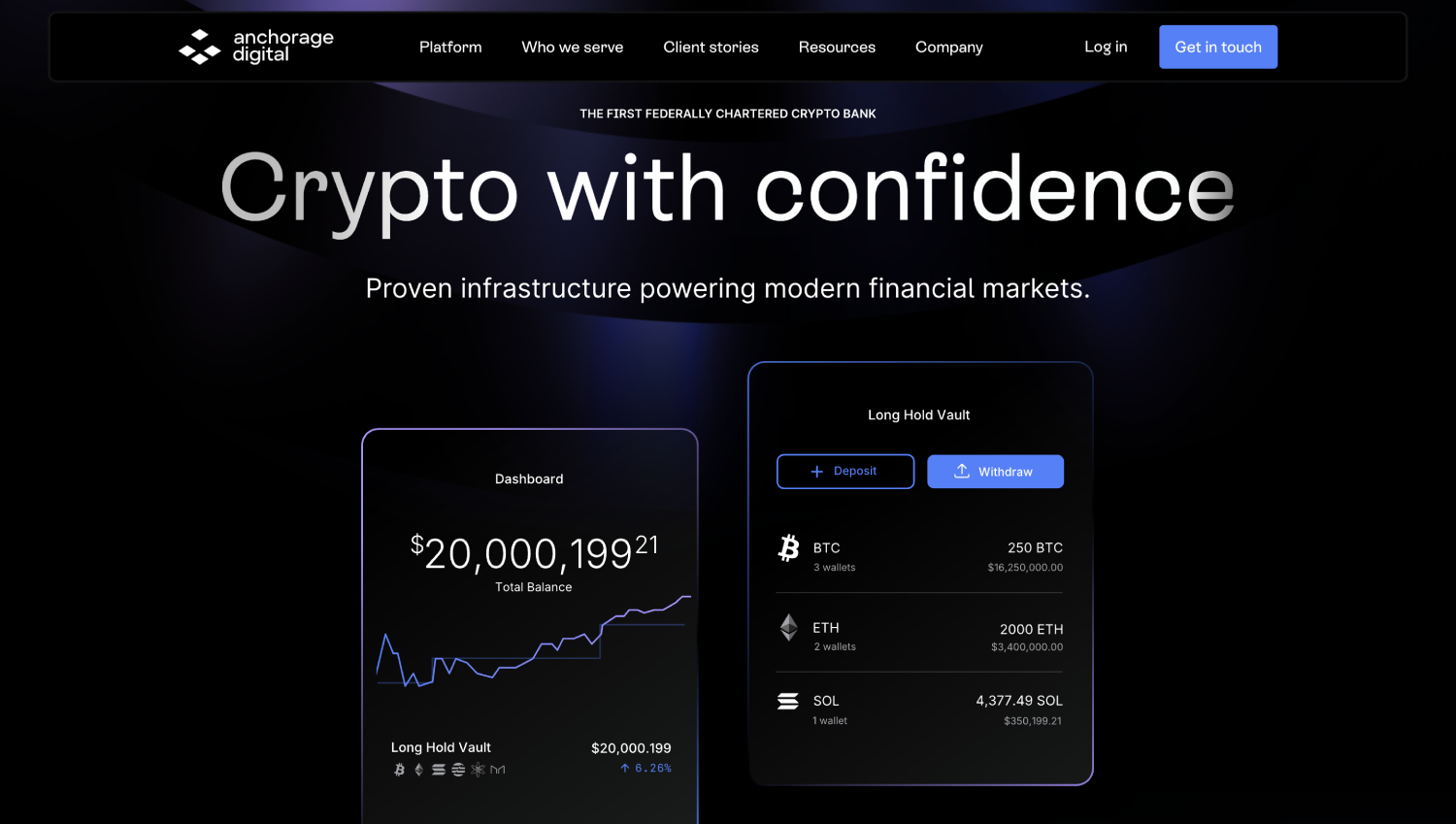
Anchorage Digital holds the only federally chartered digital asset bank in the United States, granted by the OCC. That single fact changes the counterparty risk calculus. Deposits and collateral held within Anchorage Digital Bank operate under federal banking law, not the patchwork of state money transmission licenses that govern most crypto lenders. For institutional borrowers with strict counterparty policies, that charter is often the deciding factor.
Anchorage’s lending product allows clients to borrow against a broad basket of digital assets while collateral remains in the federally chartered custody environment. Interest rates are not publicly disclosed and are structured on a bilateral basis. The firm’s compliance infrastructure runs deep, making it a natural fit for hedge funds, family offices, and corporate treasury teams that need an auditable credit counterparty.
Galaxy Digital

Galaxy Digital operates as an institutional-grade financial services company with a credit and lending desk that handles structured crypto collateral loans at scale. Galaxy serves funds, miners, and corporations that may need structured credit arrangements, including term loans, revolving credit, and OTC-adjacent facilities. The firm accepts a broader range of collateral assets than most lenders, including SOL and other large-cap tokens beyond BTC and ETH.
Galaxy is publicly traded on the Toronto Stock Exchange under GLXY, which provides some financial transparency that private lenders cannot match. The firm’s sales process is relationship-driven rather than self-serve. For sophisticated borrowers who need something beyond a standard BTC-backed line of credit, Galaxy’s structuring capability is a differentiator.
Ledn
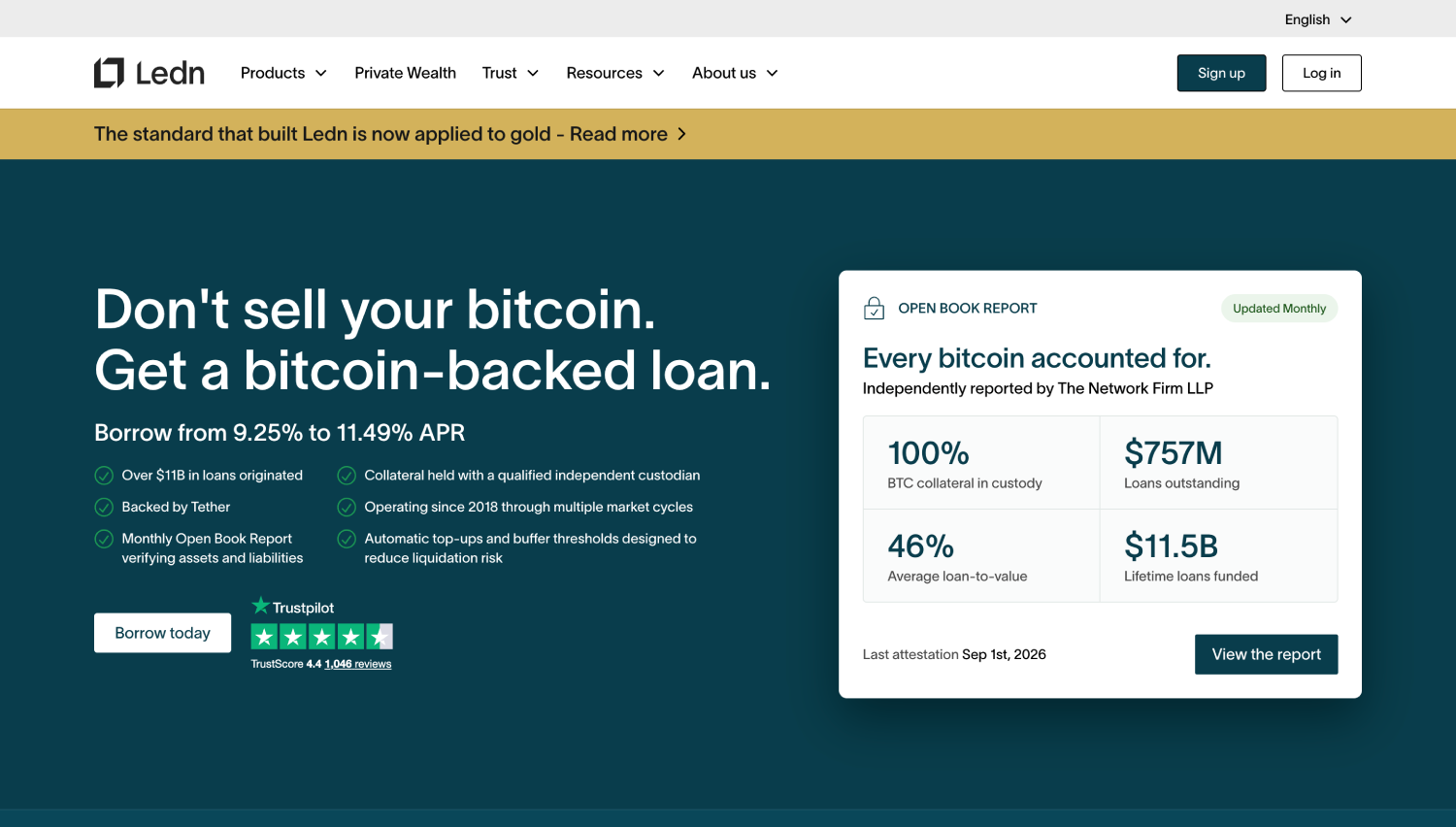
Ledn occupies a specific niche: Bitcoin-maximalist institutions and high-net-worth individuals who want transparency about how their collateral is handled. Ledn’s B2X loan product, which allows borrowers to double their BTC exposure rather than take fiat, is unusual in the institutional lending space and appeals to clients with a specific conviction-based strategy.
For standard institutional crypto collateral loans, Ledn uses Coinbase Custody and BitGo as third-party custodians and prohibits rehypothecation of pledged assets under its disclosed loan agreement structure. This is a meaningful disclosure that most competitors have not made as clearly. Minimum loan sizes for institutional facilities are disclosed starting around $100,000, making Ledn accessible to smaller funds and family offices that are not yet at thresholds Anchorage and Coinbase require. Ledn publishes proof-of-reserves attestations, which adds an additional layer of verifiability.
For a direct comparison of Ledn against Nexo on the borrower experience, FintechSpecs has a detailed analysis of Nexo vs Ledn for CeFi borrowers worth reading before shortlisting either.
Nexo
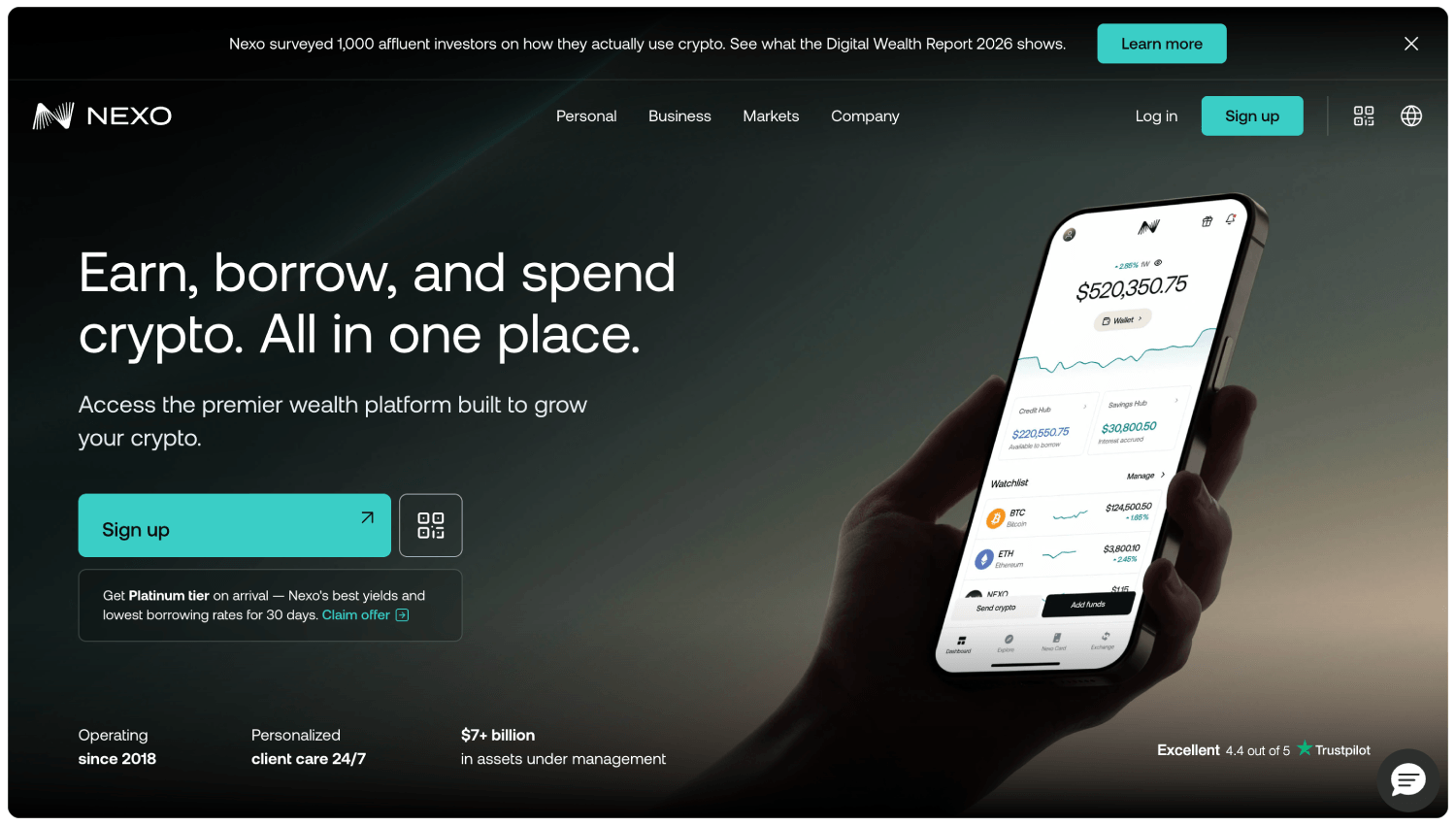
Nexo is the broadest platform in this group by collateral type, accepting over 40 digital assets as collateral against credit lines. The platform has a self-serve institutional tier and a dedicated enterprise desk for larger facilities. Nexo uses third-party custodians including BitGo and Ledger Vault, and the firm has published reserve attestations through third-party accounting firms.
Nexo’s geographic licensing footprint spans multiple European jurisdictions and several US states. For institutions operating across multiple jurisdictions, that breadth matters. The trade-off: Nexo has faced regulatory scrutiny in multiple markets over the past several years, and any borrower conducting counterparty due diligence should review the firm’s current licensing status in their specific jurisdiction before engaging. Interest rates and LTV ratios for institutional accounts are available through the enterprise desk rather than published publicly.
What Collateral Types Do Institutional Crypto Lenders Accept?
Bitcoin is the universal base case. Every provider in this list accepts BTC as collateral, and it typically commands the most favorable LTV ratios because of its liquidity and price discovery depth. Ethereum is accepted by most providers at slightly more conservative LTVs due to its higher volatility relative to BTC over multi-year horizons.
Beyond BTC and ETH, collateral acceptance varies significantly. Galaxy Digital accepts a wider range of large-cap tokens. Nexo accepts over 40 assets but applies progressively lower LTVs to less liquid assets, which can make the effective borrowing power against altcoin collateral substantially lower than the headline ratio suggests. Ledn focuses almost exclusively on BTC and USDC collateral, which keeps their risk model simpler and their borrower agreements cleaner.
Stablecoins as collateral are a distinct use case. Some lenders accept USDC or USDT as collateral for loans denominated in fiat or a different stablecoin, which is less about leverage and more about yield and liquidity optimization. For institutions exploring stablecoin treasury management alongside lending, the best stablecoin yield platforms for corporate treasuries and stablecoin infrastructure providers are adjacent considerations worth reviewing together.
How Do Margin Calls Work in Institutional Crypto Lending?
Margin call mechanics are where institutional crypto lending diverges most sharply from retail. In retail, many platforms auto-liquidate with minimal notice. In institutional agreements, the margin call process is usually negotiated at origination.
A typical negotiated structure: the lender issues a margin call when LTV reaches a defined threshold (say, 70% on a 50% initial LTV facility). The borrower has a cure window to post additional collateral or repay principal to bring LTV back below the threshold. The length of that window is a negotiated term, not a fixed product feature, and borrowers at meaningful scale should push for clarity on this during term sheet discussions. If the cure period expires without action, the lender liquidates enough collateral to restore LTV to a safe level. The speed of that liquidation and the price at which it executes matter enormously during a fast market move.
The 2022 crypto market downturn revealed that some lenders liquidated collateral at unfavorable prices due to thin institutional-grade order book depth at the moment of liquidation. Borrowers who negotiated longer cure windows and pre-defined liquidation venues fared better than those who accepted standard form terms. This is a negotiating point, not a fixed parameter, for any borrower accessing credit at a meaningful scale.
Consider a scenario: a fund pledges $20M in BTC at a 55% LTV for an $11M credit facility. BTC drops 30% in 48 hours, compressing collateral value to $14M and pushing LTV to approximately 78%. The lender issues a margin call. With a 48-hour cure window, the fund can either pledge an additional $4M in BTC or repay $3.2M in principal to restore LTV to 55%. Without that cure window, the lender liquidates $4.3M in BTC at market, potentially into a declining order book.
What Regulatory Considerations Apply to Institutional Crypto Loan Providers?
In the United States, no single federal framework governs crypto-backed lending comprehensively. Lenders operate under a patchwork of state money transmission licenses, state lending licenses, federal banking charters (in Anchorage’s case), and securities regulations depending on the structure of the loan product.
For institutional borrowers, the key compliance question is not just whether the lender is licensed but whether the lending arrangement creates regulatory obligations for the borrower. US corporations borrowing against crypto collateral generally do not face direct securities law implications from the loan itself, but the underlying collateral may be subject to reporting requirements depending on the borrower’s regulatory classification (registered investment advisor, broker-dealer, bank, etc.).
AML and KYC for the borrower is non-trivial. Institutional lenders at this tier conduct full KYB, beneficial ownership verification, and source-of-funds analysis. Borrowers should expect the onboarding process to take two to four weeks for a first facility. For companies that need to assess their broader compliance readiness before entering this process, the fintech product and compliance readiness checklist provides a useful pre-engagement audit structure.
International borrowers face additional complexity. Nexo’s regulatory situation in the EU has evolved through multiple jurisdictional reviews. Galaxy Digital’s Canadian listing adds a layer of Canadian securities law to its counterparty profile. Any non-US institution borrowing through these platforms should engage local counsel to assess the cross-border implications before signing.
Frequently Asked Questions About Institutional Crypto-Backed Loans
What is the minimum loan size for institutional crypto-backed lending?
Minimums vary by provider. Ledn discloses institutional facilities starting around $100,000, though their enterprise desk focuses on larger facilities. Nexo’s retail tier starts lower; institutional engagement scales from there. Anchorage Digital’s institutional engagement typically starts at $500,000. Coinbase Institutional and Galaxy Digital are generally focused on larger facilities. Below $100,000, most institutional-grade platforms redirect borrowers to their retail-equivalent products, which carry different custody and terms structures.
Is the collateral rehypothecated when I take an institutional crypto loan?
It depends on the lender. Ledn prohibits rehypothecation of collateral pledged under their standard loan agreements and discloses this publicly. Anchorage Digital’s federally chartered bank accounts are subject to OCC banking regulations governing client asset handling, borrowers should request written confirmation of how pledged collateral is treated under their specific facility agreement. Coinbase, Galaxy, and Nexo do not publicly disclose comprehensive rehypothecation policies for institutional credit clients, which means borrowers must request written clarification during term sheet negotiation.
What happens to my collateral if the lender becomes insolvent?
This is the central risk that the Celsius and BlockFi bankruptcies made concrete. In both cases, customers who held assets in yield or loan accounts rather than segregated custody arrangements became general unsecured creditors, recovering cents on the dollar. If collateral is held at a third-party qualified custodian (BitGo, Coinbase Custody, Anchorage Digital Bank) under a custody agreement that designates assets as client property, the borrower generally has a stronger claim in insolvency than if assets are held on the lender’s own balance sheet. Borrowers should obtain a legal opinion on custody structure before committing to any significant facility with a non-bank lender.
How long does it take to open an institutional crypto loan facility?
First-time onboarding typically takes two to four weeks. The process includes KYB verification, beneficial ownership documentation, source-of-funds analysis, credit review, legal agreement negotiation, and custody account setup. Borrowers who have existing relationships with the custodian (for example, an existing Coinbase Prime account) can sometimes compress this timeline. Repeat borrowers who are already onboarded can often draw on an existing facility within one to two business days.
Can a registered investment advisor or hedge fund take a crypto-backed loan?
Yes, but the structure requires careful review. RIAs and hedge funds have fiduciary obligations that affect how they can use leverage and pledge client assets. If the assets being pledged are fund assets rather than proprietary capital, the fund’s limited partnership agreement or investment management agreement may constrain or prohibit the transaction. Funds considering institutional crypto lending should have their fund counsel review the loan structure alongside the lender’s legal team before origination.
What LTV ratio should an institutional borrower expect on a Bitcoin-backed loan?
Based on market terms observed across institutional providers, initial LTV ratios for BTC-backed loans typically fall in the 50% to 70% range, with many providers starting in the 55% to 60% zone. These figures reflect commonly observed terms rather than published guarantees from any single lender, and actual ratios are negotiated based on facility size, volatility conditions, and borrower profile. More conservative structures at 40% to 50% LTV offer a larger buffer against margin calls but reduce capital efficiency. Ethereum collateral generally warrants 5 to 10 percentage points lower LTV than BTC due to higher realized volatility. Altcoin collateral, depending on liquidity and market cap, may only support 30% to 40% initial LTV even at institutional-grade lenders.
How is interest calculated on institutional crypto collateral loans?
Most providers offer interest on a term basis (fixed rate for a defined period) or a revolving credit line with a floating rate tied to prevailing market conditions. Rates are not publicly listed by most institutional lenders and are negotiated based on facility size, collateral composition, LTV ratio, and the borrower’s credit profile. Larger facilities and lower LTV ratios generally command better pricing. Some lenders charge origination fees in addition to periodic interest.
Conclusion
Institutional crypto-backed lending is not an extension of the retail crypto loan market. It is a distinct credit category with its own counterparty dynamics, custody structures, and regulatory considerations. The providers that belong in a serious institutional shortlist, Coinbase Institutional, Anchorage Digital, Galaxy Digital, Ledn, and Nexo, differ more on custody model and regulatory standing than on interest rate. Borrowers who optimize for rate first and custody model second are taking the same risk that cost some institutional crypto creditors dearly in 2022.
The CLACK Test provides a structured way to run counterparty evaluation before you reach term sheet negotiation. Custody arrangement, licensing, AML depth, cure period, and counterparty capital are the five variables that determine whether a lender is suitable. If a provider cannot answer all five clearly during initial diligence, that is itself a data point.
For institutions already exploring broader digital asset infrastructure, crypto-backed lending sits naturally alongside custody, stablecoin treasury, and on-chain yield decisions. Those choices interact. A company that holds BTC at Anchorage Digital for custody purposes has a materially faster path to a lending facility than one starting from scratch. The institutions that treat lending, custody, and treasury as a connected infrastructure decision, rather than three separate vendor conversations, are the ones that end up with both better terms and cleaner legal structures.