
TLDR
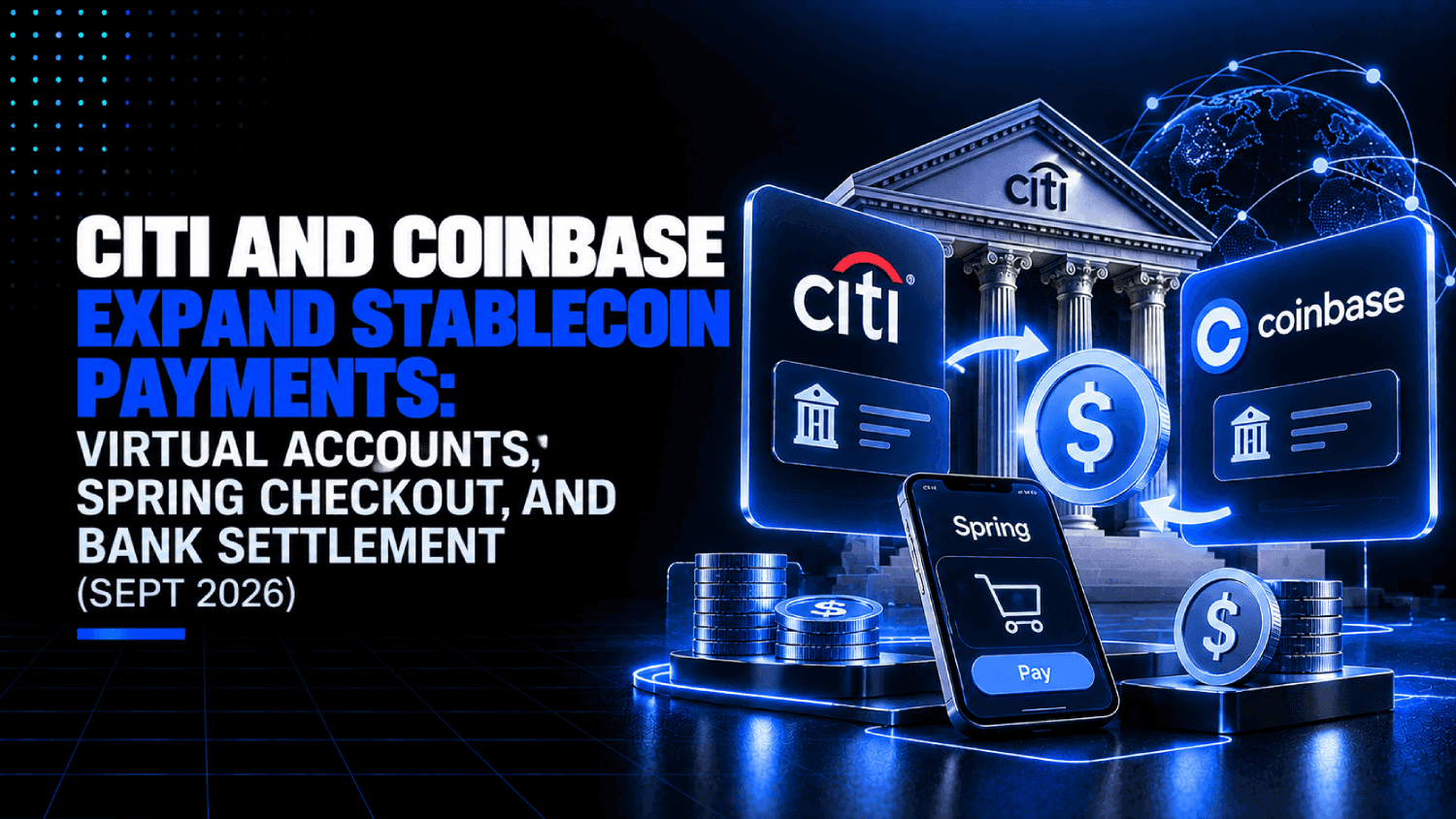
- On Sept. 28, 2026, Citi and Coinbase announced an expanded collaboration connecting fiat and stablecoin payments for corporations and consumers, launching first in the United States.
- Initiative 1: Coinbase Virtual Accounts powered by Citi Services’ Virtual Account Wallet (Banking-as-a-Service). Bank-account-like accept, hold, and pay, with incoming fiat automatically converted into stablecoins. Citi calls this an industry-first.
- Initiative 2: Merchant Stablecoin Acceptance via Spring by Citi + Coinbase Payments. Institutional clients accept stablecoins at checkout; funds auto-convert to fiat; Citi settles as bank of record. Merchants need not hold, custody, or manage digital assets. Framed as serving 150M+ stablecoin holders.
- Context: Citi moves ~$6T daily, banks 90% of top eCommerce and 15 of 20 largest FinTechs, and points to 24/7 USD Clearing plus Citi Token Services. This expands an October 2025 payments collaboration.
- This is a news explainer on bank BaaS + merchant acceptance rails for stablecoin checkout. Distinct from SoFi × Mastercard SoFiUSD settlement, Visa × Reap stablecoin cards, Fed GENIUS rulemaking, and stablecoin yield platform listicles.
Sept. 28, 2026 is another bank-grade stablecoin payments milestone, and it is not a card settlement story. Citi and Coinbase said they are expanding their collaboration so corporate and consumer clients can move between traditional banking rails and blockchain payment rails without building or managing separate infrastructure.
For FintechSpecs operators, the news sits at the intersection of Banking-as-a-Service, merchant checkout acceptance, and fiat↔stablecoin conversion. That is a different buyer question from SoFi × Mastercard (bank-issued stablecoin settlement of a card program), Visa × Reap (stablecoin-linked card issuing across 100+ markets), or best stablecoin yield platforms for corporate treasuries (idle-balance yield rankings). Ask who sponsors the bank account, who converts, who settles, and who never has to custody crypto.
What Citi and Coinbase announced
Per the Sept. 28, 2026 Citi press release, the expansion introduces two core initiatives launching first in the United States:
- Coinbase Virtual Accounts, powered by Citi Services’ Virtual Account Wallet delivered through Citi’s Banking-as-a-Service capabilities.
- Merchant Stablecoin Acceptance through Spring by Citi, with stablecoin acceptance powered by Coinbase Payments, automatic conversion to fiat, and Citi settling as the bank of record.
Citi frames the problem as operational complexity and risk when clients connect traditional banking and securities services with blockchain infrastructure. The stated goal is interoperable payments across traditional and digital instruments without separate systems.
Ashish Bajaj, Head of Services for North America at Citi, said the partnership is “a pivotal step in our ongoing Services strategy to provide optionality for our clients” and that Citi provides “regulated, bank-grade solutions that remove significant hurdles for clients who want to engage in the digital economy.”
Alec Lovett, Head of Infrastructure Product at Coinbase, said clients building on Coinbase “have always needed a fast, compliant bridge between fiat and stablecoins,” and that Citi gives that at scale: bank-account-like functionality with the speed of stablecoins underneath, while Spring clients can move between fiat and digital assets “without ever having to think about which one they’re touching.”
Brett Tejpaul, Head of Coinbase Institutional, called Citi “exactly the kind of regulated banking partner the digital asset economy needs to move from experimentation to everyday commerce,” with bank-grade fiat infrastructure on one side and low-friction stablecoin acceptance for Citi’s institutional clients on the other.
The Block also reported Debopama Sen, Citi’s head of payments, saying the goal is next-generation payments infrastructure that is seamless, interoperable, and operates across traditional and digital instruments and networks.
How the two rails work for operators
One rail is a Coinbase-facing BaaS virtual account with auto fiat-to-stablecoin conversion. The other is a Citi merchant acceptance path where stablecoins become fiat before the merchant has to custody anything.
| Dimension | Coinbase Virtual Accounts (Citi Virtual Account Wallet / BaaS) | Merchant Stablecoin Acceptance (Spring by Citi + Coinbase Payments) |
|---|---|---|
| Primary buyer surface | Coinbase payments customers / businesses building on Coinbase | Citi institutional / merchant clients on Spring |
| Core job | Bank-account-like accept, hold, and pay, with incoming fiat auto-converted to stablecoins | Accept stablecoins at checkout, auto-convert to fiat, settle via Citi as bank of record |
| Who supplies regulated banking infra | Citi Services Virtual Account Wallet (BaaS) | Citi as bank of record on Spring settlement |
| Who supplies digital-asset rail | Coinbase Virtual Accounts product surface | Coinbase Payments powers stablecoin acceptance |
| Custody burden for merchant / client | Account-like balances with conversion into stablecoins (per PR) | Merchants need not hold, custody, or manage digital assets |
| Scale framing in PR | Industry-first auto fiat-to-stablecoin conversion claim | Serve 150M+ stablecoin holders without merchant crypto ops |
| Launch geography | United States first | United States first |
| Operator question | Can my product give bank-like accounts with stablecoin under the hood? | Can I take stablecoin checkout and still receive fiat settlement? |
Citi’s broader context in the same release: ~$6 trillion moved daily, banking relationships with 90% of top eCommerce companies and 15 of the world’s 20 largest FinTechs, plus digital commerce products (Spring by Citi, BaaS) and the newly integrated 24/7 USD Clearing and Citi Token Services path for real-time, round-the-clock cross-border USD payments. Both companies say they will keep collaborating on additional capabilities.
How this differs from SoFi×Mastercard, Visa×Reap, and Fed GENIUS rulemaking
FintechSpecs already covers issuer settlement, card issuing, and policy. Keep the buyer questions separate.
| Dimension | Citi × Coinbase (Sept. 28) | SoFi × Mastercard SoFiUSD | Visa × Reap | Fed GENIUS Act NPRs / policy track |
|---|---|---|---|---|
| Primary job | BaaS virtual accounts • merchant stablecoin acceptance with bank settlement | Live settlement of a bank’s own card volume in SoFiUSD | Issuing infrastructure for stablecoin-linked Visa credit cards across 100+ markets | Federal rulemaking / perimeter for payment stablecoins and related oversight |
| Who is speaking | Citi Services + Coinbase (Virtual Accounts, Spring, Coinbase Payments) | SoFi Bank + Mastercard network settlement | Visa + Reap issuing / settlement partners | Federal agencies via NPR process |
| Stablecoin role | Auto-conversion on Virtual Accounts; checkout tender converted to fiat for merchants | Settlement asset for card-program obligations | Cardholder funding / program treasury + settlement pathways | Regulatory perimeter and compliance clocks |
| Merchant message | Accept stablecoins without holding crypto; Citi settles fiat | Receive settlement in SoFi Bank account; optional cash-out | Partner/issuer launch and settlement optionality | Compliance obligations, not a checkout product |
| Operator question | Who owns the bank account, conversion, and bank-of-record settlement? | Is my card program settling in a bank-issued stablecoin today? | Can partners issue stablecoin-linked Visa cards in my markets? | What rules constrain issuer, custodian, and payment-stablecoin design? |
Keep all of these as separate URLs. Do not merge this into a SoFi settlement explainer, a Visa×Reap card rewrite, a GENIUS Act policy brief, or a stablecoin yield ranking.
How this sits next to FintechSpecs BaaS / stablecoin coverage
Use category posts for BaaS shortlists and yield rankings. Use this post for what Citi and Coinbase put on the record about production fiat↔stablecoin payment rails.
Related FintechSpecs depth (do not cannibalize)
- SoFi × Mastercard SoFiUSD settlement live
- Visa × Reap stablecoin credit cards across 100+ markets
- Best Banking-as-a-Service platforms
- Best BaaS developer experience (banking API platforms)
- Embedded payments providers for B2B SaaS
- J.P. Morgan × Thunes Xpedite Remit cross-border payouts (for outbound corridor contrast, not the same product)
- Best stablecoin yield platforms for corporate treasuries (yield shortlist contrast only)
Operator map for the Citi × Coinbase rails
| Layer | What this announcement mainly moves | What it does not replace |
|---|---|---|
| Bank BaaS / virtual accounts | Regulated Virtual Account Wallet under Coinbase Virtual Accounts | Your choice among Unit, Synctera, Column, Stripe Treasury, and peers on DX shortlists |
| Merchant acceptance | Spring checkout that can take stablecoins via Coinbase Payments | Your acquirer stack, fraud orchestration, and chargeback operating model |
| Conversion and settlement | Auto fiat↔stablecoin conversion with Citi as bank of record on Spring | Treasury policy for when you want to hold stablecoins for yield or liquidity |
| Cross-border USD | Citi’s framing alongside 24/7 USD Clearing and Token Services | Corridor payout networks such as Thunes-style wallet/account reach |
| Market structure | Bank-grade on/off-ramps for a major VASP + merchant acceptance without merchant custody | GENIUS Act / Fed NPR compliance design, or card-network settlement programs |
Risk, controls, and diligence questions
Stablecoin checkout fails on settlement clarity, conversion timing, and who holds the compliance pen, not on whether a press release names BaaS and Spring.
What Citi and Coinbase put on the table
- Regulated banking infrastructure for Coinbase Virtual Accounts
- Automatic fiat-to-stablecoin conversion on Virtual Accounts (Citi’s industry-first claim)
- Merchant stablecoin acceptance without merchant custody or digital-asset ops
- Citi as bank of record on Spring settlement after conversion to fiat
- US-first launch, with more capabilities promised later
What operators should still design for
- Bank of record vs product surface. Ask which legal entity is the deposit-taking or settlement bank for each flow, and what the Coinbase customer vs Spring merchant contracts say about conversion failures.
- Conversion SLAs. Auto-conversion is the product promise. Diligence FX/spread, cutoffs, failed conversion queues, and what the merchant or Virtual Account holder sees when a stablecoin or fiat leg rejects.
- Supported assets and chains. The PR says “stablecoins” without publishing an asset list, chain list, or issuer allowlist. Treat that as a procurement question, not a solved inventory.
- KYC / AML and sanctions ownership. Map who screens the payer, the payee, the wallet, and the merchant. BaaS + VASP + merchant acceptance stacks often split these controls.
- Chargebacks and disputes. Fiat card dispute playbooks do not automatically map to stablecoin checkout. Ask for dispute packets when conversion already happened and the merchant received fiat.
- Geographic and license perimeter. US-first is explicit. Do not assume EU, UK, or APAC merchant coverage from this release alone.
- Yield is not in the Citi PR. If a secondary source discusses affiliate yield or GENIUS Act structural points, treat that as a separate diligence track. This announcement is about payment rails and bank settlement, not a treasury yield product.
- Dependency concentration. Spring + Coinbase Payments + Citi settlement is a powerful bundle. Map exit options if any leg (acceptance, conversion, or bank settlement) has an outage or commercial change.
Who should care, and what to ask
Prioritize a deep read if you:
- Run payments, treasury, or embedded finance at a marketplace, fintech, or B2B SaaS platform evaluating stablecoin checkout
- Own BaaS or virtual-account product strategy and need a bank-grade fiat↔stablecoin bridge
- Advise institutional merchants that want to serve stablecoin holders without standing up custody
- Compare bank-led stablecoin rails against card-network settlement programs and yield-focused treasury stacks
Concrete questions for Citi, Coinbase, counsel, and treasury
- Which stablecoins, chains, and issuers are supported at launch on Virtual Accounts and on Spring acceptance?
- What are conversion spreads, timing SLAs, and failure handling for both rails?
- For Spring merchants: what settlement report, MID mapping, and dispute path exist after auto-conversion to fiat?
- For Coinbase Virtual Accounts: is the Virtual Account Wallet FDIC-insured deposit infrastructure, a payment omnibus, or another structure, and how is that disclosed to end customers?
- Who is the BSA/AML program owner for payer screening on stablecoin checkout?
- How do these rails interact with Citi Token Services and 24/7 USD Clearing for cross-border use cases?
- What is the commercial model (platform fee, conversion spread, BaaS account fees) at production volumes?
- What is the non-US roadmap, and which licenses gate each market?
The take: bank settlement is the product, not the stablecoin logo
The Citi × Coinbase expansion matters because it packages two operator jobs banks and VASPs usually leave fragmented: give businesses bank-like accounts with stablecoins underneath, and let merchants take stablecoins while still getting fiat from a bank of record.
The operator lesson is sharper: stablecoin checkout becomes procurement-ready when conversion, custody avoidance, and bank settlement are explicit, not when a press release only names “crypto payments.”
Treat Sept. 28 as Citi putting BaaS Virtual Account Wallet and Spring acceptance next to Coinbase’s payments stack, expanding the October 2025 collaboration into US-first production framing. Diligence asset coverage, conversion SLAs, AML ownership, and dispute packets before you rewrite your checkout or virtual-account roadmap around the announcement.
For category depth after this news, start with best Banking-as-a-Service platforms and best BaaS developer experience. For adjacent stablecoin payment news, keep SoFi × Mastercard SoFiUSD and Visa × Reap as separate URLs. For treasury yield (a different problem), keep best stablecoin yield platforms for corporate treasuries separate.
FAQ
When did Citi and Coinbase announce the expanded stablecoin payments collaboration?
Sept. 28, 2026, in a Citi press release. The Block also covered the same day.
What are the two initiatives?
Coinbase Virtual Accounts powered by Citi’s Virtual Account Wallet (BaaS), and Merchant Stablecoin Acceptance through Spring by Citi with Coinbase Payments, automatic conversion to fiat, and Citi as bank of record.
Where does it launch first?
The United States, per Citi’s release. Additional capabilities are flagged for the coming months.
Do merchants have to hold stablecoins?
According to Citi, merchants accepting via Spring need not hold, custody, or manage digital assets. Conversion to fiat and bank settlement are part of the design.
How is this different from SoFi × Mastercard SoFiUSD?
SoFi × Mastercard is about live card-program settlement in a bank-issued stablecoin. Citi × Coinbase is about BaaS virtual accounts and merchant checkout acceptance with bank-of-record fiat settlement.
How is this different from Visa × Reap?
Visa × Reap is primarily issuing infrastructure for stablecoin-linked Visa credit cards across 100+ markets. This Citi story is acceptance + virtual accounts + bank settlement, not a 100-market card issuing program.
Does the Citi PR promise a specific stablecoin yield?
No. The official Citi PR does not mention a yield rate. This explainer sticks to payment-rail and settlement facts from the primary release.
How does this relate to FintechSpecs’ BaaS coverage?
Use best Banking-as-a-Service platforms and best BaaS developer experience for vendor shortlists. Use this post for the Sept. 28 Citi × Coinbase product announcement and operator diligence questions.