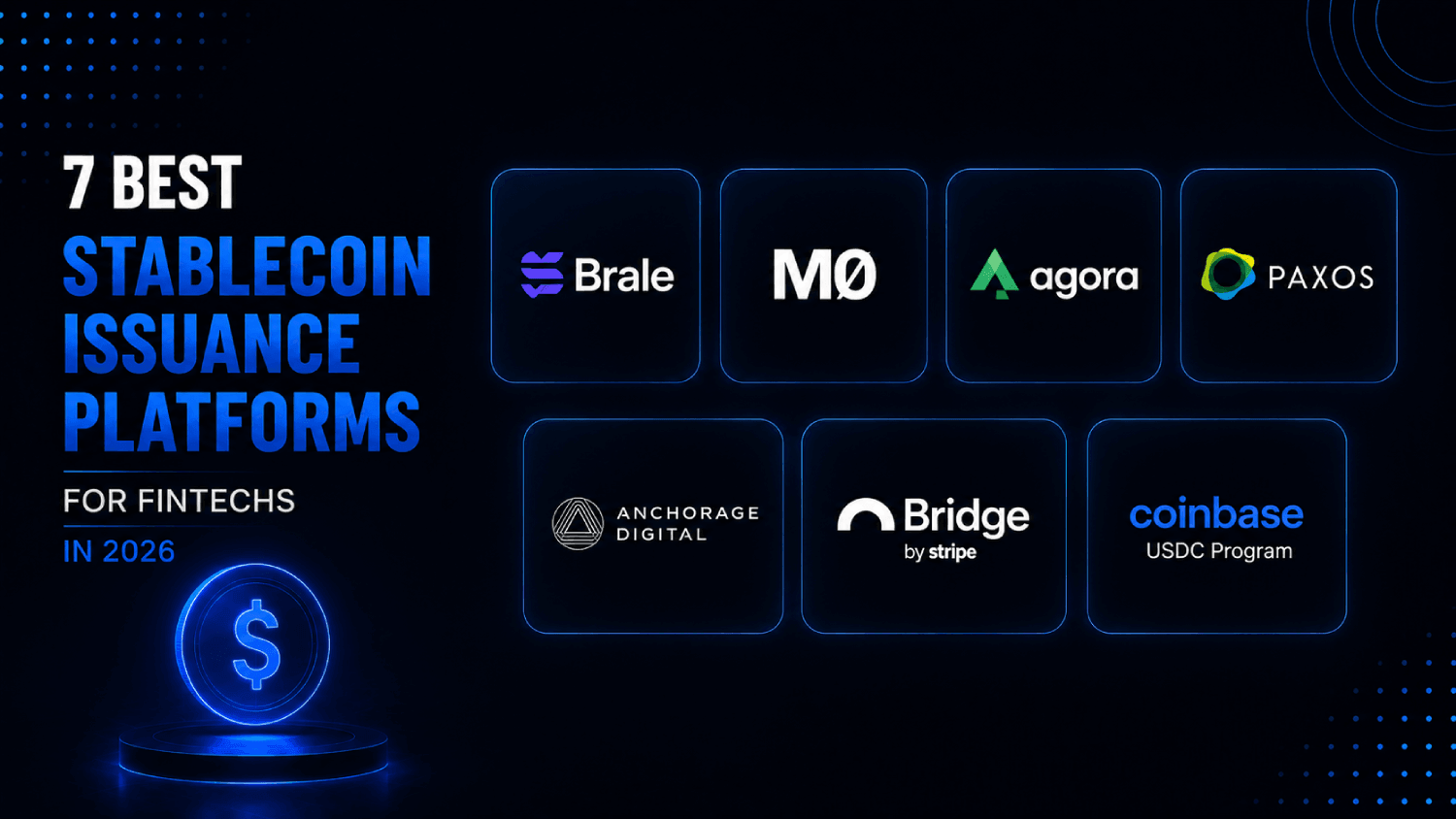

- Stablecoin issuance is no longer a Circle-scale project. Platforms like Brale, M0, Agora, and Paxos let a fintech issue a branded stablecoin without building mint-and-burn infrastructure from scratch.
- The yield on reserves is the business model. A platform that lets you earn on the T-bill or money-market backing turns stablecoin issuance into a revenue line, not a cost center.
- The GENIUS Act, passed in 2025, sets federal issuer requirements for payment stablecoins above $10 billion in circulation, but sub-threshold issuers still face reserve and disclosure obligations that these platforms are designed to absorb.
- The real build-vs-issue trade-off is not technical complexity. It is regulatory licensing. Building your own requires a bank charter or money transmitter licenses in every state you operate. Using an issuance platform means riding the issuer’s existing regulatory posture.
- Choosing a platform locks you into their reserve custodian, their attestation cadence, and their chain support. Those three variables matter more than the minting API itself.
The best stablecoin issuance platforms for fintechs in 2026 are Brale, M0, Agora, Paxos, Anchorage Digital, Bridge Open Issuance, and Coinbase’s USDC-based issuance program. Each uses a different model: some act as the licensed issuer while you front the brand, others give you full programmatic control with your own reserve account. The right choice depends on whether you need yield sharing, multi-chain deployment, tokenized deposit architecture, or a path to your own regulated status.
Why Fintechs Are Issuing Their Own Stablecoins Now
Three things changed at once. First, yield. With short-term rates elevated, the reserve assets backing a dollar-pegged stablecoin generate real income. A platform holding $50 million in T-bills or money-market funds on behalf of a stablecoin issuer produces meaningful float revenue, and several issuance platforms now share a portion of that yield with the fintech brand on top.
Second, the infrastructure matured. Mint-and-burn APIs, programmable reserve management, and multi-chain deployment are now vendor problems, not engineering problems. A fintech can go from signed contract to live stablecoin in weeks rather than years.
Third, the GENIUS Act created a clearer regulatory surface than the patchwork of state guidance that preceded it. A defined federal framework, even an imperfect one, lets legal teams scope the compliance ask. That scoping is what converted “moonshot” into “vendor project” inside finance teams evaluating a branded stablecoin.
If you are already thinking about stablecoin payments as a revenue mechanism, the stablecoin payment APIs comparison on FintechSpecs covers the acceptance side. This article focuses on the issuance side: who mints, who holds reserves, and who takes the regulatory liability.
What Does the GENIUS Act Actually Require from a Stablecoin Issuer?
The Guiding and Establishing National Innovation for US Stablecoins Act created a federal licensing track for payment stablecoin issuers. The law distinguishes between issuers above $10 billion in outstanding supply, who must obtain federal approval through the OCC or a federal banking agency, and smaller issuers, who may operate under state money transmitter frameworks while still meeting federal minimum standards.
Those minimum standards apply regardless of scale. They include 1:1 reserve backing in high-quality liquid assets (cash, insured deposits, Treasury bills with maturities under 93 days, or central bank reserves), monthly public reserve disclosures, annual audits for issuers above a certain threshold, and prohibitions on rehypothecating or lending out reserve assets. The law also mandates redemption at par within defined windows.
For a fintech using an issuance-as-a-service platform, the issuer of record bears most of these obligations. But “using a platform” does not fully insulate you. If your brand name appears on the stablecoin, regulators will examine the commercial agreement between you and the licensed issuer. A compliant platform with clear contractual reserve segregation is the starting point, not the endpoint, of your legal review. The Fintech Product and Compliance Readiness Checklist outlines how to structure that legal review before signing.
The FintechSpecs Issuance Stack Audit: Four Checks Before You Pick a Platform
Most platform comparisons lead with chain support and API documentation. Those matter, but they are not where deals break. After mapping the vendor field, FintechSpecs identified four structural checks that consistently separate the right platform from the wrong one for a given fintech. We call this the Issuance Stack Audit.
Check 1: Who holds the reserves and under what legal structure? Some platforms custody reserves in their own name at a partner bank. Others segregate reserves into a trust or bankruptcy-remote structure in the fintech’s name. The difference matters in a wind-down scenario.
Check 2: What is the yield-sharing model? Platforms vary from zero yield pass-through (they keep the float) to tiered sharing based on outstanding supply. Ask for the exact formula in writing before signing.
Check 3: What chains are supported at launch, and what does adding a chain cost? Some platforms support Ethereum and Solana out of the box. Others require an integration project to add Base or Arbitrum. Multi-chain expansion fees have surprised more than one fintech post-launch.
Check 4: Who is the regulated issuer of record, and what happens to that relationship if your supply crosses a GENIUS Act threshold? A platform designed for sub-$10 billion issuers may not have a clear path for a client that grows past the threshold. Nail this before signing a multi-year contract.
The 7 Best Stablecoin Issuance Platforms for Fintechs
| Platform | Issuer Model | Chain Support | Yield Sharing | Best For |
|---|---|---|---|---|
| Brale | Platform as licensed issuer | Ethereum, Solana, Base, others | Yes, negotiated | Fintechs wanting fastest regulated launch |
| M0 | Tokenized deposit / M^0 protocol | Ethereum-native, EVM chains | Protocol yield distributed | Institutions wanting on-chain reserve transparency |
| Agora | White-label, Agora as issuer | Ethereum, Avalanche, Solana | Revenue share on AUSD | Fintechs wanting a white-labeled dollar product |
| Paxos | Platform-issued or full licensing support | Ethereum, Solana | Negotiated per enterprise deal | Regulated fintechs that may want their own charter |
| Anchorage Digital | Federally chartered bank issuer | Multiple, custody-integrated | Not publicly disclosed | Institutions needing bank-grade custody plus issuance |
| Bridge (Stripe) | Open issuance, Bridge as issuer | Ethereum, Solana, Base | Not publicly disclosed | Fintechs already in the Stripe payments stack |
| Coinbase (USDC Program) | Co-issuance via Centre/Circle partnership | 15+ chains via Circle | Revenue share for qualifying partners | Fintechs wanting broadest chain coverage |
1. Brale
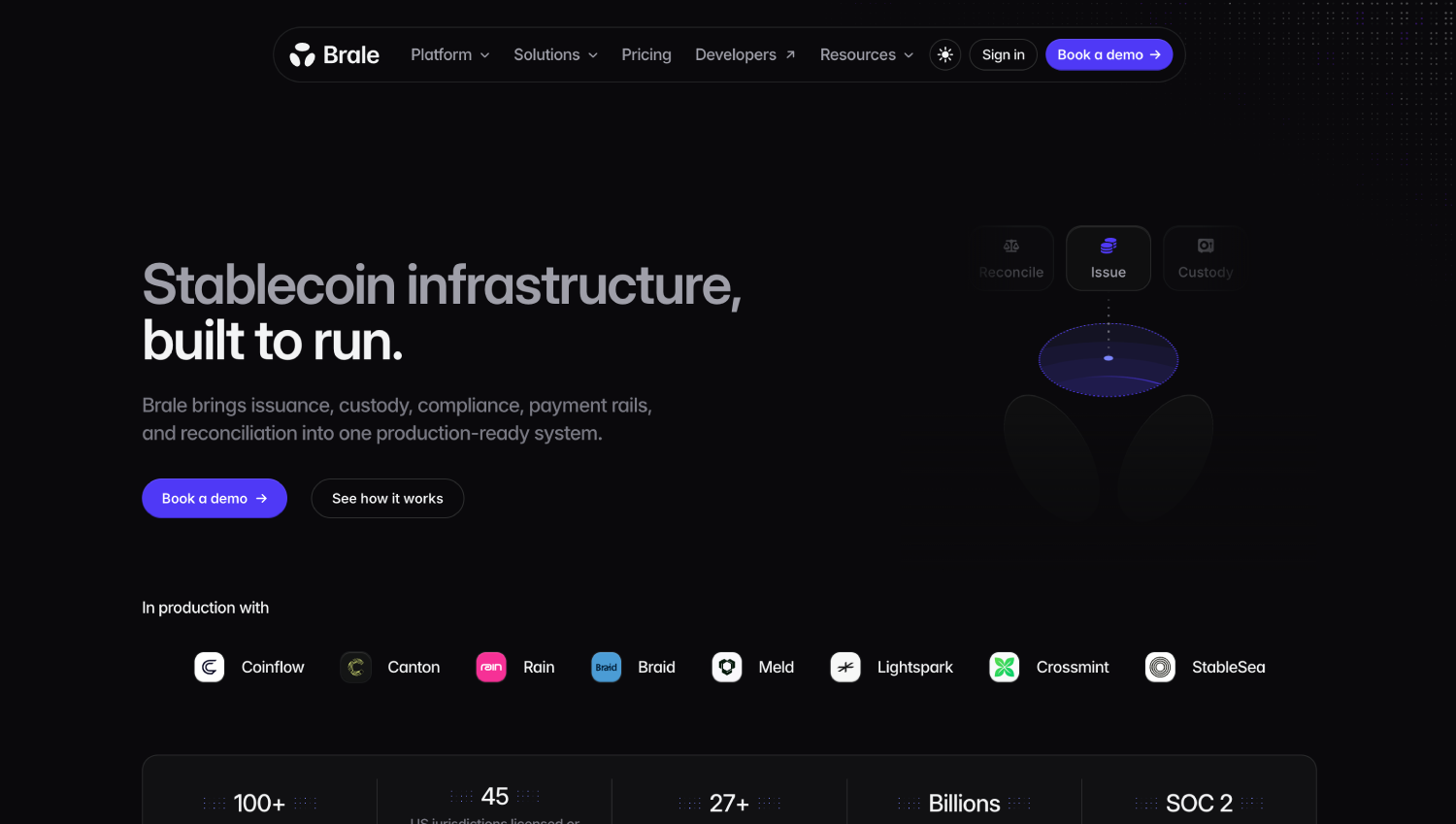
Brale positions itself as the most direct path from “we want a branded stablecoin” to “our stablecoin is live and regulated.” The company acts as the licensed issuer of record while the fintech controls the token name, branding, and redemption experience. Reserve management runs through Brale’s custodial relationships, and the platform handles attestations and regulatory reporting on behalf of the issuer relationship.
The yield-sharing arrangement is negotiated per client and depends on outstanding supply. Brale does not publish a rate schedule publicly. What is documented is multi-chain support across Ethereum, Solana, and Base, with additional chains available on request. For a fintech that wants to be operating within 60-90 days and cannot wait for its own money transmitter license stack, Brale is the most commonly cited first call.
The trade-off is dependency. If Brale’s regulatory posture shifts, the fintech’s product shifts with it. Request a clear contractual mechanism for migrating reserve custody and token contracts if the relationship ends.
2. M0 (M^0)
M0 takes a structurally different approach. Rather than acting as a traditional issuer, M0 is a permissioned on-chain protocol that lets regulated financial institutions mint their own dollar-denominated tokens, called “M,” backed by reserves held at the institutional level. Each institution maintains its own reserve account and publishes on-chain proof of backing.
This architecture appeals to fintechs that want reserve transparency without relying on a centralized issuer’s monthly attestation PDF. The M^0 protocol distributes yield generated by the underlying reserve assets back to token holders and minters according to protocol rules. The limitation is that M0 requires the minting institution to already hold regulatory standing, typically a banking license or equivalent, which raises the entry bar compared to Brale or Agora.
For a Series B or C fintech with an existing bank partnership or a state money transmitter license in multiple jurisdictions, M0 offers the most credible path to genuine institutional-grade tokenized deposit infrastructure. For a seed-stage team, the licensing prerequisite rules it out as a near-term option.
3. Agora

Agora issues its own stablecoin, AUSD, and offers a white-label program where fintechs brand and distribute a stablecoin backed by Agora’s reserves. The commercial model is a revenue share: Agora passes a portion of the yield generated by AUSD reserves back to distribution partners. The company is public about this approach, describing it as turning the stablecoin from a product into a revenue line for the partner.
Agora supports Ethereum, Avalanche, and Solana. The white-label program means the fintech’s customers see the fintech’s brand, but the underlying token is AUSD. For a fintech whose users will not inspect the contract address, that distinction is invisible. For a fintech building wallet-to-wallet interoperability with DeFi protocols or other stablecoin networks, the AUSD dependency creates integration constraints that a natively branded token would not.
Agora’s positioning as a white-labeled stablecoin provider makes it the clearest comparison point for teams evaluating the build-vs-buy question on a short timeline. The revenue share mechanics are the strongest publicly documented yield-sharing model in this category.
4. Paxos

Paxos built USDP and has issued stablecoins for PayPal (PYUSD) and other enterprise clients. The enterprise issuance program lets an established fintech issue a branded stablecoin using Paxos’s New York Department of Financial Services-regulated trust company infrastructure. Reserves are held in cash and U.S. Treasuries, and monthly attestations are published by independent accounting firms.
Paxos is the platform for a fintech that is already large enough to have its own compliance team reviewing the contract and that is seriously evaluating obtaining its own payment stablecoin license under the GENIUS Act in the next two to three years. The platform is not designed for fast self-serve onboarding. Deals are enterprise sales cycles, and pricing is not public. What Paxos offers in return is a regulator relationship that has already been tested under New York’s trust charter, which is arguably the most stringent state-level regime in the US.
If your fintech issues payments at scale and the CEO is willing to have a six-month legal review before launch, Paxos is worth the process. If you need something live in Q3, it is not the right starting point.
5. Anchorage Digital
Anchorage Digital is the first federally chartered crypto bank in the US, and its stablecoin issuance platform sits on top of that infrastructure. The pitch is integrated custody and issuance: a fintech client can hold its reserve assets inside Anchorage’s federally chartered bank, mint tokens against those reserves, and manage the full lifecycle through a single custodial relationship.
This structure removes one of the more awkward compliance gaps in stablecoin issuance, which is the distance between where the reserves live and where the minting logic runs. Anchorage collapses that gap. The trade-off is that Anchorage is built for institutional clients, not early-stage fintechs. The company does not publish pricing publicly, and the sales process reflects that enterprise positioning.
Anchorage makes the most sense for a fintech that already needs institutional custody for other digital assets and wants to add stablecoin issuance to that existing relationship rather than introducing a second vendor. If you are evaluating custody separately, review the Fintech Infrastructure Stack mapping on FintechSpecs for how custody fits alongside issuance and payments layers.
6. Bridge Open Issuance (Stripe)
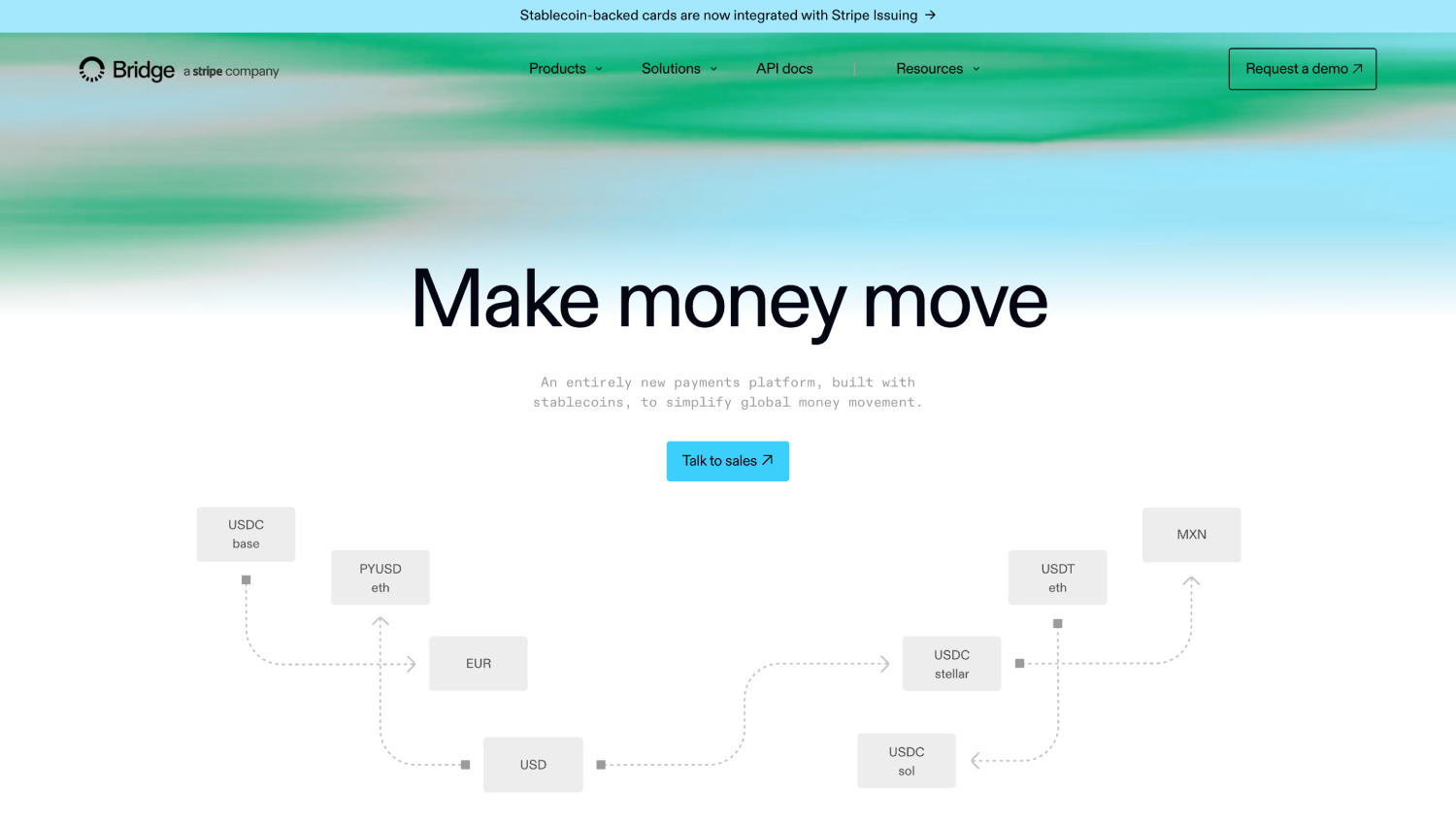
Bridge, acquired by Stripe in late 2024, launched Open Issuance as a platform that lets any business launch and manage a stablecoin. Bridge positions the product as GENIUS-ready, meaning it is being designed to meet federal payment stablecoin requirements as that regulatory framework finalizes. The platform supports Ethereum, Solana, and Base.
Bridge’s advantage is distribution. A fintech already using Stripe for payment processing, or considering Stripe’s stablecoin payment rails, can run issuance and acceptance through the same vendor relationship. That simplicity has real operational value, particularly for teams with small finance and engineering headcounts. The limitation is that Bridge is a newer entrant to the issuance side, and its long-term regulatory posture as a Stripe subsidiary is still settling relative to standalone regulated issuers like Paxos or Anchorage.
For a fintech deeply embedded in the Stripe product suite, Bridge Open Issuance is worth evaluating first. For a fintech that wants its stablecoin infrastructure on a vendor with an independent regulatory track record, it warrants more diligence. The fintech API comparison across payment and infrastructure layers provides useful context for how Bridge sits within a broader stack.
7. Coinbase (USDC Distribution and Co-Issuance Program)
Coinbase co-issues USDC with Circle through the Centre consortium and offers revenue sharing to qualified partners who distribute or hold USDC balances. This is not a white-label stablecoin program in the traditional sense. You are not launching a token called YourCoin. You are distributing USDC and earning a share of the yield on balances held through your platform.
For many fintechs, that distinction is irrelevant. If the business goal is to offer users a dollar-denominated digital asset and generate float revenue, USDC distribution with revenue sharing accomplishes that without any of the regulatory overhead of launching a separate token. USDC runs on over 15 chains, has the deepest DeFi liquidity of any regulated stablecoin, and has a compliance history that regulators have reviewed extensively.
The Coinbase program is the right answer for a fintech that wants the economics of stablecoin issuance without the brand differentiation of a named token. It is the wrong answer for a fintech that needs its own token for technical reasons, such as programmable redemption rules, custom compliance logic embedded in the contract, or a product that requires the token to carry the company’s name in on-chain identifiers.
What Does It Actually Cost to Launch a Stablecoin Through a Platform?
Pricing in this category is almost entirely unpublished. None of the seven platforms above post a fee schedule. What is knowable from public information and the SERP data is the structure of how costs are typically organized.
Most platforms charge some combination of a setup or onboarding fee, a monthly platform fee covering compliance infrastructure and attestations, and a yield split that determines how much of the reserve income flows to the fintech versus the platform. Setup fees for enterprise-grade platforms run from low five figures to six figures depending on the scope of legal and technical work required. Monthly fees vary with the complexity of the compliance program.
The yield economics are worth modeling carefully before you start conversations. Say a fintech launches a branded stablecoin and reaches $20 million in outstanding supply within 12 months. If the platform holds reserves in 90-day T-bills at a 4.5% annualized yield and passes 60% of that yield to the fintech brand, the annualized revenue contribution from float alone would be approximately $540,000 on that supply. That is a rough illustrative calculation, not a vendor quote, and the actual yield and split percentage are negotiated. But it shows why stablecoin issuance has moved from a branding exercise to a finance team conversation. Teams tracking these economics alongside other fintech revenue lines may find the fintech metrics that actually matter framework useful for modeling float against growth targets.
The compliance cost side is the one most teams underestimate. Attestations, legal reviews, ongoing AML and KYC obligations tied to the redemption process, and reserve reconciliation all carry real costs. The real cost of compliance in fintech SaaS article on FintechSpecs breaks down how to budget these by stage.
Should Your Fintech Issue a Stablecoin or Just Use USDC?
For most fintechs under Series B, the answer is to use USDC or another established stablecoin for the first 12 to 18 months. The distribution and liquidity network that Circle has built for USDC represents years of integration work across exchanges, DeFi protocols, and payment rails. A new branded token starts with zero of that infrastructure.
Issuing your own stablecoin makes sense when one or more of the following is true. You need programmable redemption logic that cannot be expressed through a standard USDC transfer. Your users or partners will specifically recognize and prefer your brand in on-chain contexts. You want to capture float revenue on a supply that you expect to reach at least eight figures within 18 months, making the platform costs worthwhile. Or your product roadmap requires the token to function as the settlement unit inside a closed network, such as a marketplace or B2B payment platform.
If none of those conditions apply, using an established stablecoin and earning yield through a distribution partnership is a faster, cheaper, and lower-risk path to the same economic outcome. The decision is fundamentally a product strategy question, not a technical one. Teams that treat it as purely a technical or compliance question often pick the wrong answer in both directions.
How Does Reserve Management Work Across These Platforms?
Reserve management is where the operational complexity concentrates. Every dollar of stablecoin in circulation must be backed by a corresponding reserve asset held somewhere specific, reported somewhere auditable, and redeemable on demand at par.
Platforms handle this in three distinct ways. The first is custodial pooling, where all client reserves are held in a pooled account at a partner bank or custodian, with the platform maintaining internal ledgers showing each client’s share. This is the simplest model operationally but creates counterparty exposure to the platform’s solvency if the legal structure is not carefully designed.
The second is segregated trust accounts, where each client’s reserves are held in a dedicated trust or omnibus account in the client’s name or in trust for the client’s stablecoin holders. This is the model used by NYDFS-regulated issuers and provides stronger bankruptcy-remote protection.
The third is on-chain reserve proof, where reserve composition is published to a blockchain in real time, allowing any market participant to verify backing without relying on a monthly PDF. M0’s protocol model operates closest to this approach. For fintechs issuing to users who are sophisticated enough to verify on-chain attestations, this is a meaningful product differentiator.
Frequently Asked Questions
What is stablecoin issuance as a service?
Stablecoin issuance as a service is a vendor model where a licensed issuer or regulated platform provides the mint-and-burn infrastructure, reserve management, compliance reporting, and regulatory licensing needed to put a branded stablecoin into circulation. The client fintech controls the token name, distribution, and user experience without building or owning the underlying regulatory and custody infrastructure. Platforms like Brale, Agora, and Bridge offer this model.
Which company can issue a stablecoin in the US?
Under the GENIUS Act framework, payment stablecoin issuers must be a federally or state-chartered depository institution, a federally qualified nonbank issuer approved by the OCC, or a state-licensed issuer operating under a regime certified as equivalent to federal standards. Companies currently operating as regulated issuers include Circle, Paxos (through its NYDFS-chartered trust company), Anchorage Digital (through its OCC federal charter), and emerging issuers using state money transmitter licenses. Issuance-as-a-service platforms let fintechs issue tokens under one of these licensed entities’ umbrellas.
How much does it cost to launch a stablecoin through an issuance platform?
None of the major stablecoin issuance platforms publish pricing publicly. Costs typically include a setup fee, a monthly compliance and platform fee, and a yield split on reserve income. Setup can range from low five figures to six figures depending on the regulatory complexity. The yield split is the most economically significant variable: platforms that pass 50-70% of reserve yield to the issuing fintech can turn stablecoin supply into meaningful float revenue, but this is negotiated per deal and not standardized across the market.
What is the GENIUS Act and how does it affect stablecoin issuance?
The GENIUS Act is US federal legislation that creates a licensing framework for payment stablecoin issuers. It requires 1:1 reserve backing in high-quality liquid assets, monthly public reserve disclosures, par redemption, and prohibits lending or rehypothecating reserve assets. Issuers above $10 billion in outstanding supply must obtain federal approval. Below that threshold, state-licensed issuers may operate under certified state regimes. Issuance-as-a-service platforms are designed to help fintechs meet these requirements without obtaining their own charter.
What is a tokenized deposit and how does it differ from a stablecoin?
A tokenized deposit is a blockchain-based representation of a deposit liability at a licensed bank. Unlike a stablecoin issued by a nonbank entity, a tokenized deposit carries the bank’s balance sheet behind it and may be eligible for deposit insurance up to FDIC limits. M0’s protocol operates closer to tokenized deposit infrastructure than traditional stablecoin issuance. The GENIUS Act treats payment stablecoins and tokenized deposits as distinct categories with different regulatory treatment, making the structural choice a legal and compliance decision, not just a product one.
Can a fintech issue its own stablecoin without a banking license?
Yes, through an issuance-as-a-service platform. The licensed issuer of record bears the primary regulatory obligations, while the fintech controls the branded token under a commercial agreement. The fintech typically still needs some form of money services business registration at the state or federal level, depending on its distribution model, and must conduct its own KYC and AML on end users. Full regulatory insulation from the platform’s license status is not guaranteed and should be reviewed with fintech-specialized legal counsel.
What chains do stablecoin issuance platforms support?
Chain support varies by platform. Brale supports Ethereum, Solana, and Base among others. Agora supports Ethereum, Avalanche, and Solana. Bridge supports Ethereum, Solana, and Base. Paxos supports Ethereum and Solana. Anchorage Digital’s chain support is tied to its custody capabilities across multiple networks. M0 is Ethereum-native with EVM chain expansion. USDC through the Coinbase program runs on over 15 chains via Circle’s infrastructure, which is the widest multi-chain coverage in the category.
What Most Evaluations Miss About Stablecoin Issuance Platforms
Teams evaluating these platforms tend to over-index on the developer experience and under-index on the exit clause. Getting a stablecoin live is the easy part. Migrating a live stablecoin with active holders to a different issuance platform, or to your own license, is a compliance and communication project that requires months of lead time and carries real user impact. Before signing, understand specifically what a transition looks like: who controls the token contract, who controls the reserve account, and whether the smart contract is upgradeable by the fintech or only by the platform.
The yield-sharing conversation should happen before legal review, not after. Platforms that negotiate yield share at the term sheet stage will sometimes offer materially better terms to a fintech that comes in with volume projections and a specific launch timeline. Treating yield share as a minor commercial detail, something to settle in redlines, is how teams leave money on the table.
The category is moving fast enough that a vendor who was the obvious choice six months ago may have since been acquired, pivoted, or had a regulatory action change its posture. The GENIUS Act is still being implemented, and platform-level interpretations of its requirements are actively being tested. Treat any issuance partnership as a monitored vendor relationship from day one, not a set-and-forget infrastructure decision. For teams thinking through how to structure that ongoing vendor oversight, the vendor risk management tools comparison on FintechSpecs covers the monitoring layer in detail.