
- Standard KYB checks verify that a business exists and is licensed. They do not reliably surface who actually controls it, which is what UBO screening does.
- The Corporate Transparency Act now requires most US companies to report beneficial owners to FinCEN, creating a new data layer that dedicated UBO tools tap into.
- The five tools in this list split into two categories: data-heavy platforms that run deep corporate graph traversal, and API-first tools that embed ownership checks inside an existing onboarding flow.
- Pricing across dedicated UBO screening vendors is not publicly disclosed. Expect negotiated contracts, with volume tiers based on verification count or API calls.
- The sharpest risk at onboarding is not a fake identity. It is a real identity that conceals a sanctioned controller behind three shell layers.
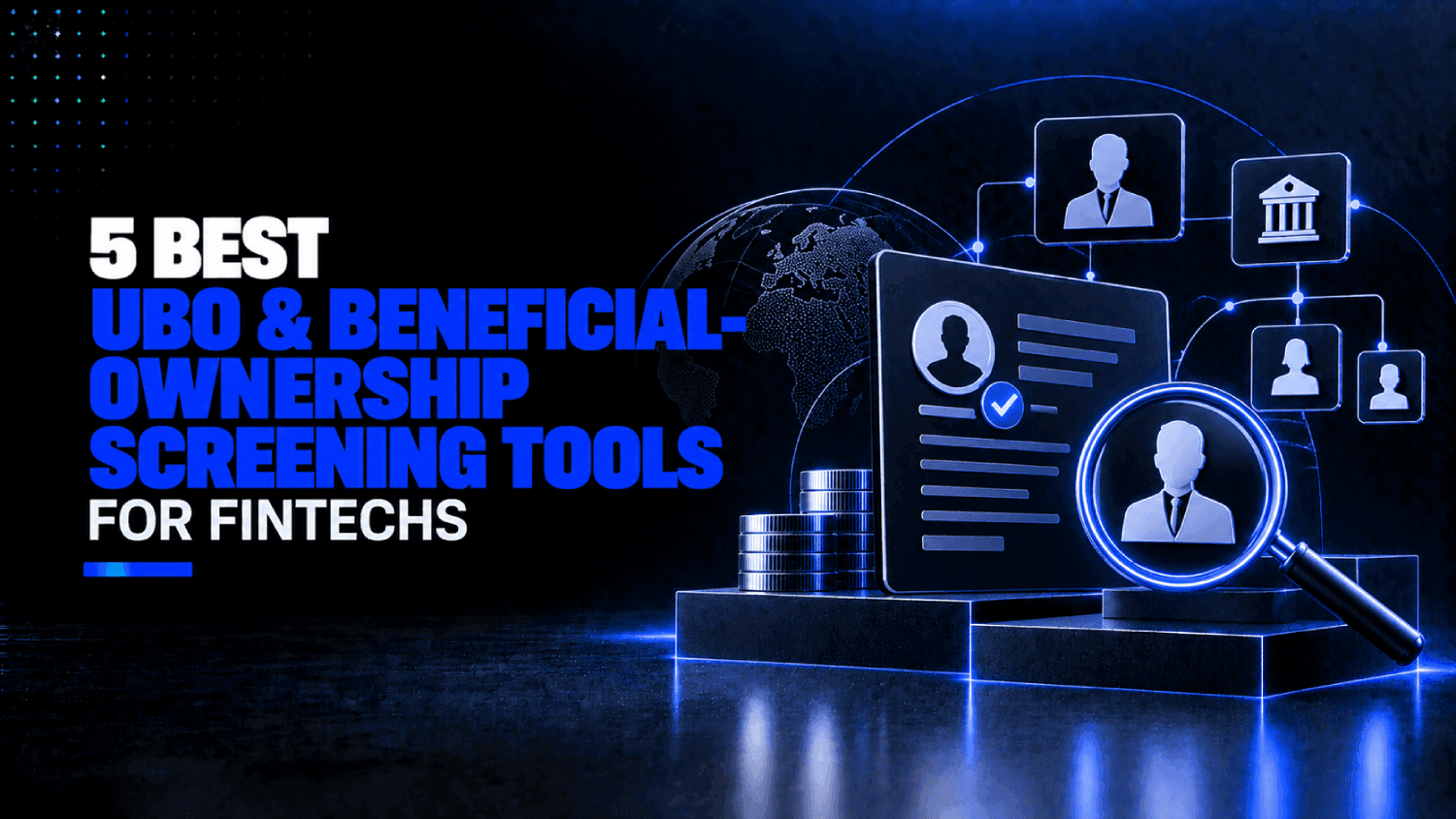
The best UBO screening tools for fintechs in 2026 are Moody’s (Orbis), Dun and Bradstreet, Comply Advantage, Middesk, and Alloy. Each approaches beneficial ownership differently: Moody’s and D&B lead on corporate graph depth, ComplyAdvantage adds real-time watchlist matching on top of ownership data, and Middesk and Alloy integrate UBO discovery directly inside the KYB onboarding workflow so compliance teams do not need to run separate lookup steps.
Why UBO Screening Is Not the Same as KYB
Most founders who have implemented KYB providers for B2B onboarding assume ownership verification came with the package. It usually did not. Standard KYB confirms that a legal entity is registered, active, and not on a sanctions list. It stops at the entity level.
Ultimate Beneficial Owner (UBO) screening goes further: it traces the ownership chain from the entity back to the natural persons who hold a controlling stake, typically defined as 25% or more direct or indirect ownership under FinCEN’s Customer Due Diligence rule. A two-layer holding structure is enough to break most KYB checks entirely.
The distinction matters because shell company risk sits precisely in that gap. An operating company can clear KYB cleanly, while the person who controls it through an intermediate holding vehicle is on OFAC’s SDN list. That is not a theoretical edge case. It is the pattern regulators flag in most B2B fraud enforcement actions.
What Did the Corporate Transparency Act Change?
The Corporate Transparency Act, which went into effect for most US entities in 2024, required reporting companies to disclose beneficial owners to FinCEN’s Beneficial Ownership Information (BOI) registry. The registry is not fully public, but law enforcement and authorized financial institutions can access it under specified conditions. The practical effect for fintechs is that BOI data creates a new ground-truth layer that dedicated UBO tools are beginning to incorporate alongside commercial corporate registries and proprietary ownership databases.
For compliance teams, the CTA created a secondary obligation beyond just screening: any customer that is a US reporting company should itself have filed BOI data, which means a missing or inconsistent filing becomes its own risk signal at onboarding. Good UBO screening tools flag that inconsistency, not just the ownership chain itself.
The FintechSpecs UBO Stack Test: Four Checks That Separate Real Tools from Retrofits
Most compliance vendors now claim UBO coverage. Few deliver it at the depth that matters. Before evaluating any vendor, run what we call the FintechSpecs UBO Stack Test on their product. It has four parts.
- Graph depth. How many ownership layers does the tool traverse before it stops? A tool that resolves two layers catches most straightforward structures. A tool that goes four or five layers catches the ones that end up in regulatory actions. Ask the vendor for their maximum traversal depth on a live company with a known complex structure.
- Data currency. Corporate ownership changes. A tool that refreshes its underlying registry data quarterly is materially different from one that updates weekly or in near real-time. Ask the vendor their update frequency by jurisdiction.
- Watchlist integration. Ownership data and sanctions/PEP screening must be applied at the person level, not just the entity level. A tool that surfaces a UBO name but does not immediately cross-reference that name against OFAC, UN, EU, and PEP lists is half a solution.
- Workflow fit. Is UBO data returned via API in a format your onboarding system can ingest programmatically? Or does it require a compliance analyst to log into a separate portal? The answer determines whether you can automate a decision or are adding a manual review queue.
No vendor aces all four in every jurisdiction. The trade-offs are real and worth understanding before you sign a contract.
Which UBO Screening Tools Should Fintechs Consider?
Moody’s Orbis
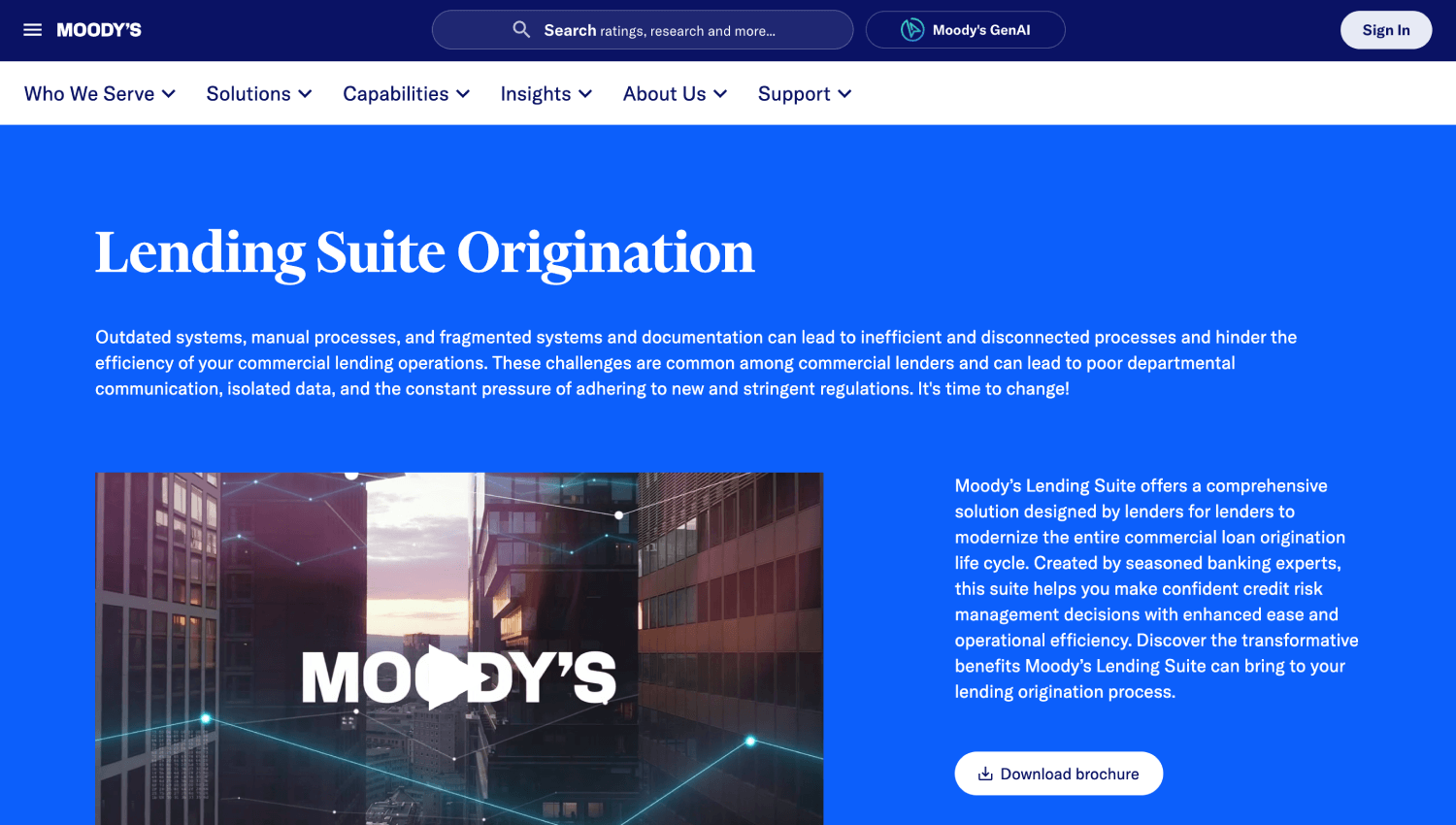
Moody’s Orbis is the most data-dense corporate ownership database available commercially. It covers hundreds of millions of companies globally and traces ownership structures across jurisdictions, including opaque ones in offshore centers. For a fintech with institutional or cross-border B2B customers, Orbis is frequently the gold standard because its corporate graph goes deeper and covers more jurisdictions than any single-country registry can.
The product is not built primarily for API-first fintechs. It is a data product that requires integration work or is consumed via bulk data agreements. Moody’s also offers KYC-specific products layered on top of Orbis, including screening workflows that combine ownership data with adverse media and sanctions checks. Pricing is negotiated and not publicly listed.
Orbis is best for fintechs onboarding large enterprises, financial institutions, or any customer base where counterparty structures are genuinely complex. It is overkill for a SMB lending platform where customers are sole proprietors or simple LLCs.
Dun and Bradstreet (D&B)
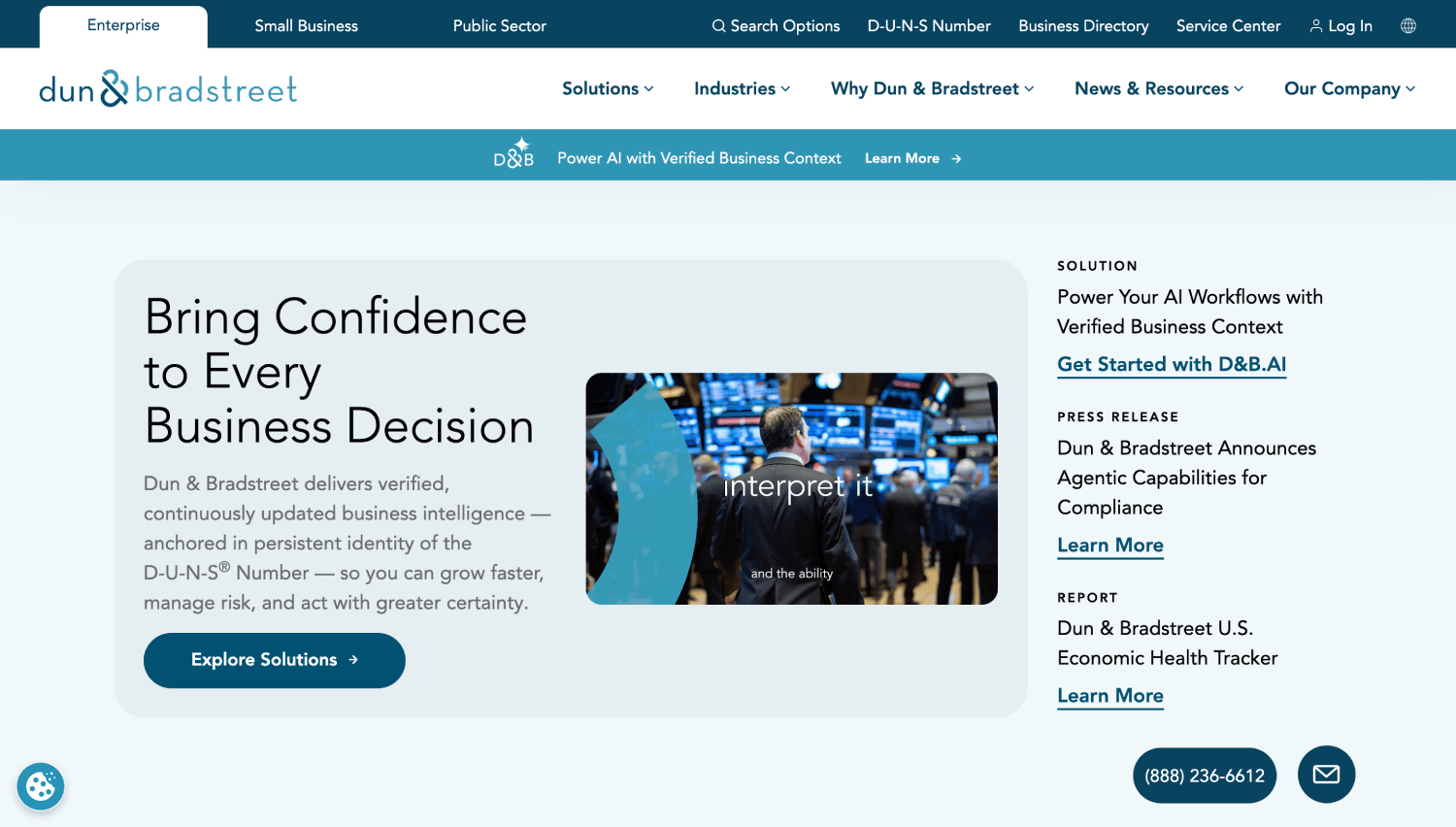
Dun and Bradstreet approaches beneficial ownership through its global commercial database and its Beneficial Ownership product, which maps corporate hierarchies and surfaces UBOs against its proprietary D-U-N-S numbering system. D&B has deep US coverage and reasonable global depth, though it is thinner than Orbis in some offshore jurisdictions.
D&B’s advantage is its integration footprint: many fintech risk and onboarding platforms already connect to D&B for business verification, which means adding UBO data can be an incremental query rather than a new vendor relationship. For a fintech already running D&B for entity verification, this is the lowest-friction path to adding ownership checks. Pricing is not publicly listed and is structured around API volume or data licensing agreements.
ComplyAdvantage
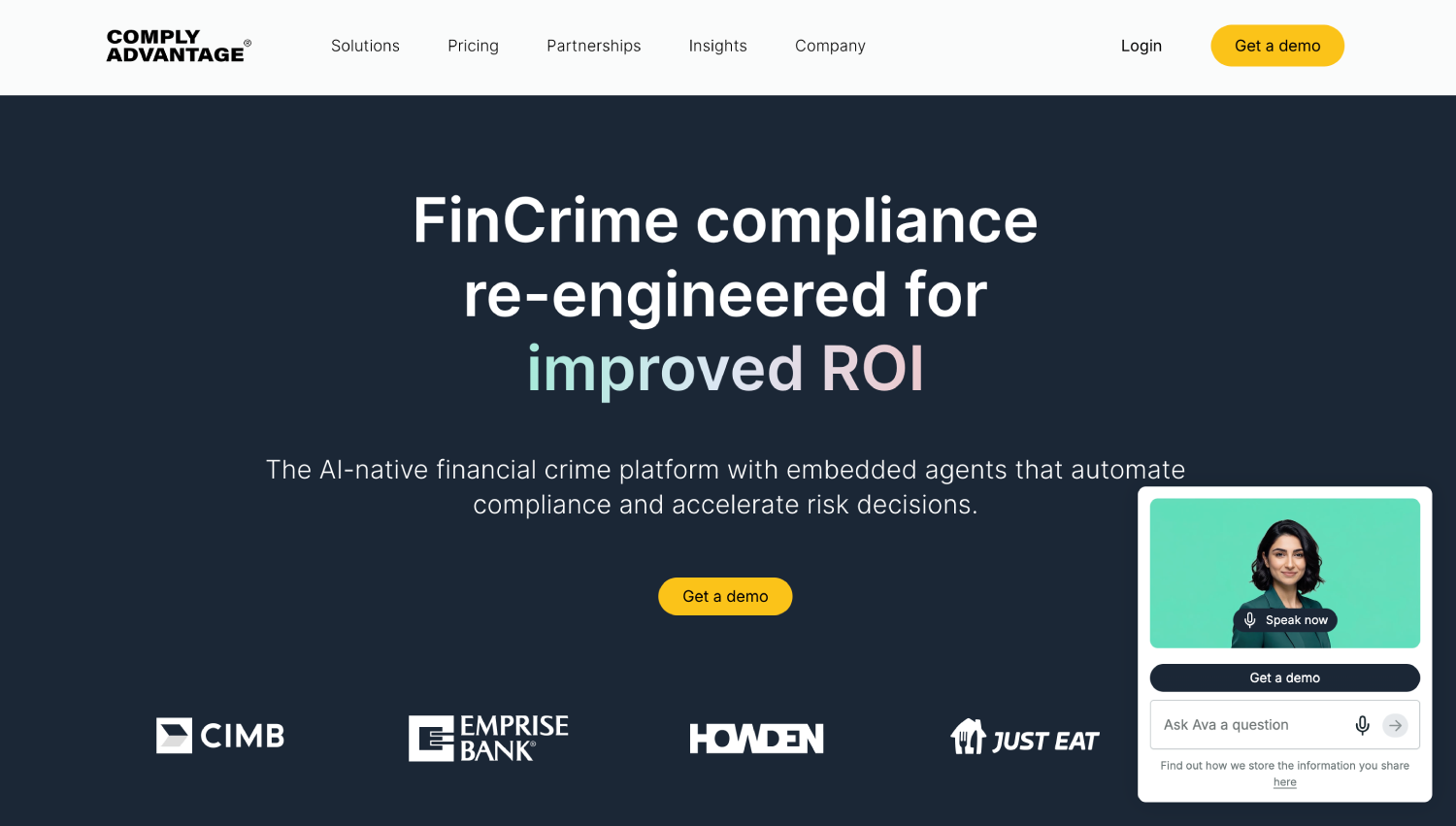
ComplyAdvantage is built as an AML screening platform first, and its UBO functionality sits inside that context. After ownership is resolved, each identified person is immediately screened against ComplyAdvantage’s proprietary database of sanctioned individuals, politically exposed persons, and adverse media signals. The key differentiator is data freshness: ComplyAdvantage uses machine learning to continuously update its screening database, which matters when the risk profile of a UBO changes between your initial onboarding check and an ongoing monitoring cycle.
For fintechs that need both ownership discovery and watchlist screening in a single API call rather than two separate vendor integrations, ComplyAdvantage is the most compact solution. It is not the deepest corporate graph tool available, but for SMB to mid-market customer bases the coverage is sufficient and the watchlist integration is genuinely good. Pricing is not publicly disclosed and requires a demo and quote. Our separate roundup of AML screening APIs for US fintechs covers ComplyAdvantage’s standalone AML capabilities in more depth.
Middesk
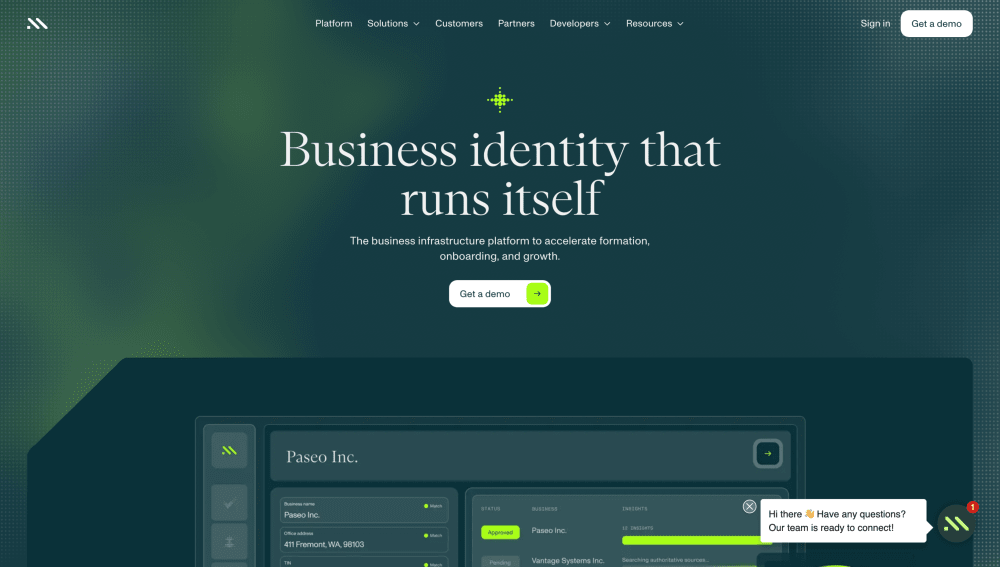
Middesk is one of the few vendors that was built specifically for the US business verification workflow, and it added beneficial ownership data as a core product layer rather than a bolt-on. Middesk pulls from Secretary of State filings, IRS data, and other US registries to surface ownership information and returns it as structured JSON in its API response. The Corporate Transparency Act data layer is being incorporated as FinCEN access expands.
Middesk is strong for fintechs with a US-centric SMB customer base: platforms running KYB for merchant onboarding, business banking, or SMB lending. Its API is clean and the documentation is well-maintained. It is not the right tool if a material percentage of your customers have international holding structures, because its non-US registry coverage is limited compared to Orbis or D&B. Pricing is not listed publicly.
Alloy
Alloy is an identity decisioning platform that orchestrates multiple data sources, including beneficial ownership checks, inside a single decisioning engine. Rather than giving you raw ownership data, Alloy applies rules and models to ownership and identity signals together, producing a decision or a risk score that your compliance team acts on. This is meaningfully different from a data API: Alloy is building the decision layer, not just the data layer.
For growth-stage fintechs that do not yet have a dedicated compliance engineering team to build decisioning logic from raw data, Alloy’s workflow approach reduces the time between data and decision. The trade-off is that you are relying on Alloy’s orchestration layer rather than owning the logic yourself, which can create constraints as your risk model matures. Our detailed breakdown of the Alloy vs Middesk comparison for KYB covers the workflow differences directly.
How Do These Tools Compare on the Dimensions That Matter?
| Tool | Primary Use Case | Corporate Graph Depth | Watchlist Integration | API-First | Best Fit |
|---|---|---|---|---|---|
| Moody’s Orbis | Deep corporate intelligence | Very High (global, multi-layer) | Via Moody’s KYC suite | Partial (data product) | Enterprise, cross-border B2B |
| Dun and Bradstreet | Business verification + UBO | High (US-strong, global coverage) | Via separate D&B products | Yes | Fintechs already using D&B for KYB |
| ComplyAdvantage | AML + UBO screening | Moderate (SMB to mid-market) | Native, real-time | Yes | Fintechs wanting screening in one call |
| Middesk | US business verification | Moderate (US-focused) | Partial (partner integrations) | Yes | US SMB onboarding, lending, banking |
| Alloy | Identity decisioning orchestration | Depends on connected data sources | Native orchestration | Yes | Teams that want decisions, not raw data |
How Should a Fintech Approach UBO Screening at Onboarding?
The ownership check should not wait until after an identity check passes. Running them sequentially means a team invests time verifying a representative’s identity before discovering the entity is controlled by a sanctioned person. Structure the onboarding flow to collect entity information first, trigger the UBO lookup in parallel with the business verification check, and hold any positive identity verification from going to “approved” status until the ownership chain is resolved and cleared.
Consider a Series A neobank onboarding small business customers. Say the platform processes 500 business applications per month. If 3% have ownership structures involving a non-US intermediate holding entity, that is 15 cases per month where a US registry-only check will return incomplete data. A tool with global registry coverage catches those 15. A tool that only queries domestic sources creates a systematic gap that a regulator will find before a fraud team does.
Ongoing monitoring is the second thing most teams underweight. Ownership structures change after onboarding. A controller who was clean at signup can be added to OFAC’s SDN list six months later. Perpetual KYB and continuous ownership monitoring require a different product configuration than a one-time onboarding check. Our coverage of perpetual KYB and ongoing monitoring platforms goes into that configuration in detail.
What Does UBO Screening Cost?
None of the five tools in this roundup publish pricing on their websites as of July 2025. All operate on negotiated contracts. Pricing structures across the category typically follow one of three models: per-verification fees (a fixed cost each time an ownership chain is resolved), API call volume tiers (a rate that decreases as monthly volume increases), or flat platform fees plus a per-query rate above a baseline.
The total cost of compliance in fintech is rarely just the vendor fee. Factor in the engineering time to integrate the ownership API into your onboarding flow, the compliance analyst time to review flagged cases, and the ongoing cost of monitoring alerts. Our breakdown of the real cost of compliance in fintech SaaS by stage gives a structured way to model that total.
Frequently Asked Questions About UBO Screening Tools
What is a UBO screening tool and how does it differ from a KYC tool?
A UBO screening tool identifies the natural persons who ultimately own or control a legal entity, typically tracing through corporate layers to find anyone with 25% or more indirect ownership. A KYC tool verifies the identity of a specific individual. The two functions address different questions: KYC asks “is this person who they say they are,” while UBO screening asks “who actually controls this business.” A full onboarding flow needs both, but they are separate checks drawing on different data sources.
Does the Corporate Transparency Act replace the need for a dedicated UBO screening vendor?
No. The FinCEN Beneficial Ownership Information registry created by the Corporate Transparency Act is not publicly accessible to most fintechs directly. Financial institutions can access it under specific authorized purposes, but the data coverage is limited to US reporting companies and requires a separate access process. Commercial UBO tools aggregate registry data from dozens of global jurisdictions, including offshore centers that no government registry covers, which is where shell company risk is most concentrated.
How many layers of ownership does a fintech need to trace?
FinCEN’s Customer Due Diligence rule sets 25% indirect ownership as the threshold for identifying a UBO, but it does not specify a maximum number of layers to traverse. In practice, regulators expect you to trace ownership to the level a reasonably diligent institution would reach. Two to three layers covers most US SMB structures. Four or more layers becomes necessary for international counterparties, private equity-backed entities, and any structure involving offshore holding vehicles.
Can a fintech use its existing KYB vendor for UBO screening, or does it need a separate tool?
Some KYB vendors include beneficial ownership data in their API responses, and for simple structures on US entities, that may be sufficient. The gap appears with complex or international ownership structures, where a specialist tool like Moody’s Orbis or Dun and Bradstreet provides materially deeper data. The right answer depends on your customer base. A US-only SMB lender with simple entity structures can likely stay within a capable KYB vendor. A cross-border payments platform with corporate customers in multiple jurisdictions needs dedicated UBO depth.
What is the difference between a PEP check and a UBO check?
A PEP (Politically Exposed Person) check screens an individual against a database of government officials, their family members, and close associates. A UBO check resolves the ownership chain of a legal entity to surface who those individuals are. PEP screening is applied to a person. UBO screening tells you which persons to apply PEP screening to. Running a PEP check without first running a UBO check means you may be screening only the person who signed the application, not the person who controls the entity behind it.
How often should beneficial ownership data be re-verified after onboarding?
The appropriate frequency depends on your customer’s risk tier. High-risk customers with complex structures or cross-border exposure warrant annual re-verification at minimum, with ongoing monitoring alerts between cycles. Standard-risk customers are typically re-verified every two to three years, with monitoring triggered by specific events such as a change in beneficial ownership filing or a new watchlist match. Most modern UBO tools support event-driven monitoring, which is more efficient than fixed-cycle reviews for large portfolios.
The Real Trade-Off in UBO Tool Selection
Every fintech in this space eventually faces the same fork: buy data depth or buy workflow integration. Moody’s Orbis and Dun and Bradstreet give you the deepest, most globally comprehensive ownership data commercially available, but they require your team to build the workflow around them. ComplyAdvantage, Middesk, and Alloy give you tighter onboarding integration but make trade-offs on raw data depth in specific jurisdictions.
The choice is driven by your customer geography and entity complexity, not by your preference for API elegance. If your onboarding volume is mostly US-based LLCs and corporations, a workflow-integrated tool like Middesk or Alloy is the right call. If you are onboarding entities with international holding structures, no amount of workflow polish compensates for a shallow corporate graph.
What this category gets wrong, broadly, is treating UBO screening as a compliance checkbox rather than a risk signal. The ownership data a good tool returns is not just documentation for an audit. It is the clearest window into who your customer actually is, and it should feed risk scoring, ongoing monitoring, and relationship-level decisions throughout the customer lifecycle, not just at the moment of onboarding approval.