
TLDR
- Generic chargeback tools are built around SaaS and ecommerce dispute rates. High-risk MCCs operate at 3x to 5x that volume, with card network thresholds that can cost you your processing account.
- Representment automation matters more than prevention-only tools at high dispute volumes. Manually building evidence packages at scale is not operationally viable.
- Win rate is the metric that drives ROI. A tool recovering 40% of disputed revenue is categorically better than one that prevents some disputes but abandons the rest.
- Verifi and Ethoca sit inside the Visa and Mastercard networks. That network access is not something third-party tools can replicate independently.
- The right tool depends on your MCC, processor relationship, and monthly dispute volume. One platform does not fit all configurations.
For high-risk merchants, the eight most defensible high risk chargeback management tools are Chargeflow, Justt, Kount, Verifi, Ethoca, Midigator, Disputifier, and Chargebacks911. Each addresses different parts of the dispute lifecycle: prevention, alerting, representment, or network-level resolution. Merchants at high-risk MCCs should prioritize tools with automated evidence compilation and network-level alert integrations, since manual processes break down above a few hundred disputes per month.
Why High-Risk MCC Merchants Have a Different Chargeback Problem
Most chargeback articles assume you are running a SaaS subscription or a Shopify store. High-risk merchants in categories like nutraceuticals, travel, adult content, firearms accessories, credit repair, CBD, or online gaming face dispute rates that would trigger account termination at a standard processor. Card networks define a merchant as in the Visa Dispute Monitoring Program when their dispute-to-transaction ratio exceeds 0.9%, and in the High Dispute Program above 1.5%. For nutraceuticals or trial-offer merchants, clearing 2% to 4% dispute rates is a daily operational reality, not an anomaly.
The downstream consequences are categorically worse. A high-risk merchant terminated by a processor gets added to the MATCH list, which effectively bars them from card acceptance for five years. That makes chargeback management an existential concern, not a margin optimization exercise. Tools built for low-risk merchants often assume a 0.3% baseline and optimize around it. High-risk merchants need platforms that assume volume, build representment workflows around it, and integrate directly with Visa’s Order Insight and Mastercard’s Consumer Clarity programs.
The FintechSpecs Dispute Stack Audit: Four Checks Before You Buy Anything
Before comparing platforms, audit your current dispute configuration against what we call the FintechSpecs Dispute Stack Audit. It isolates where your operation actually bleeds and prevents buying a prevention tool when your real gap is representment, or vice versa.
Check 1: Dispute origin split. Pull 90 days of chargebacks and classify each by reason code. If more than 40% are 10.4 (Visa fraud) or 4853 (Mastercard quality/services), your problem is pre-dispute prevention. If most are 13.1 or 12.1 (not as described), your problem is post-dispute representment, because customers received the product and disputed anyway.
Check 2: Alert coverage gap. Check whether your processor is enrolled in Verifi’s Order Insight or Ethoca Alerts for Merchants. If not, you are missing pre-dispute notifications that give you a refund window before a transaction ever becomes a chargeback. Many high-risk merchants do not know their acquiring bank has not enrolled them.
Check 3: Representment win rate by reason code. Most merchants who track chargebacks at all track total count, not win rate by code. A 30% blended win rate may hide a 60% win rate on 13.1 disputes and a 5% win rate on 10.4 fraud claims. You cannot improve what you are not measuring at this granularity.
Check 4: Time-to-respond performance. Visa allows 30 days to respond to most chargebacks. Mastercard allows 45. Merchants building evidence packages manually frequently miss response deadlines, compressing recoverable revenue to zero on those disputes. Automation reduces that failure rate substantially.
Which High-Risk MCCs Face the Highest Chargeback Exposure?
| MCC / Merchant Type | Typical Dispute Rate Range | Primary Reason Codes | Biggest Tool Need |
|---|---|---|---|
| Nutraceuticals / Supplements | 2% to 5% | Visa 13.1, 13.3; MC 4853 | Pre-dispute alerts + representment |
| Online Travel (OTA, vacation rental) | 1% to 3% | Visa 13.1; MC 4853, 4855 | Compelling evidence packages |
| Adult content / Digital subscriptions | 1.5% to 4% | Visa 10.4; MC 4863 | Fraud prevention + 3DS enrollment |
| Credit repair / Debt settlement | 2% to 6% | Visa 13.1; MC 4853 | Documentation automation |
| Online gaming / Gambling | 1% to 3% | Visa 10.4; MC 4863 | Velocity monitoring + alerts |
| Firearms accessories | 0.8% to 2% | Visa 13.1; MC 4853 | Representment + MATCH prevention |
| CBD / Cannabinoids | 1.5% to 4% | Visa 13.1; MC 4853 | Dispute response + processor stability |
8 Leading Chargeback Management Tools for High-Risk Merchants
1. Chargeflow
Chargeflow operates on a pure success-fee model, taking a percentage of recovered revenue with no monthly flat fee, as of their public pricing page (last reviewed July 2025). For high-risk merchants who cannot predict dispute volume month to month, that model aligns cost directly with performance. The platform automates the full representment process using transaction data, fulfillment records, and communication logs to build evidence packages without human intervention.
Chargeflow integrates directly with Shopify, Stripe, PayPal, and WooCommerce. For high-risk merchants on non-standard processors, the integration story gets thinner. If your acquiring bank is not one of their natively supported processors, you will need to evaluate whether API-based evidence submission works in your stack. Chargeflow also covers Visa Compelling Evidence 3.0 requirements, which matters for high-volume merchants trying to meet the new evidence standards Visa introduced to reduce first-party misuse.
Best for: High-risk merchants on Shopify or Stripe who want zero upfront cost and are comfortable with a percentage-of-recovery fee structure.
2. Justt
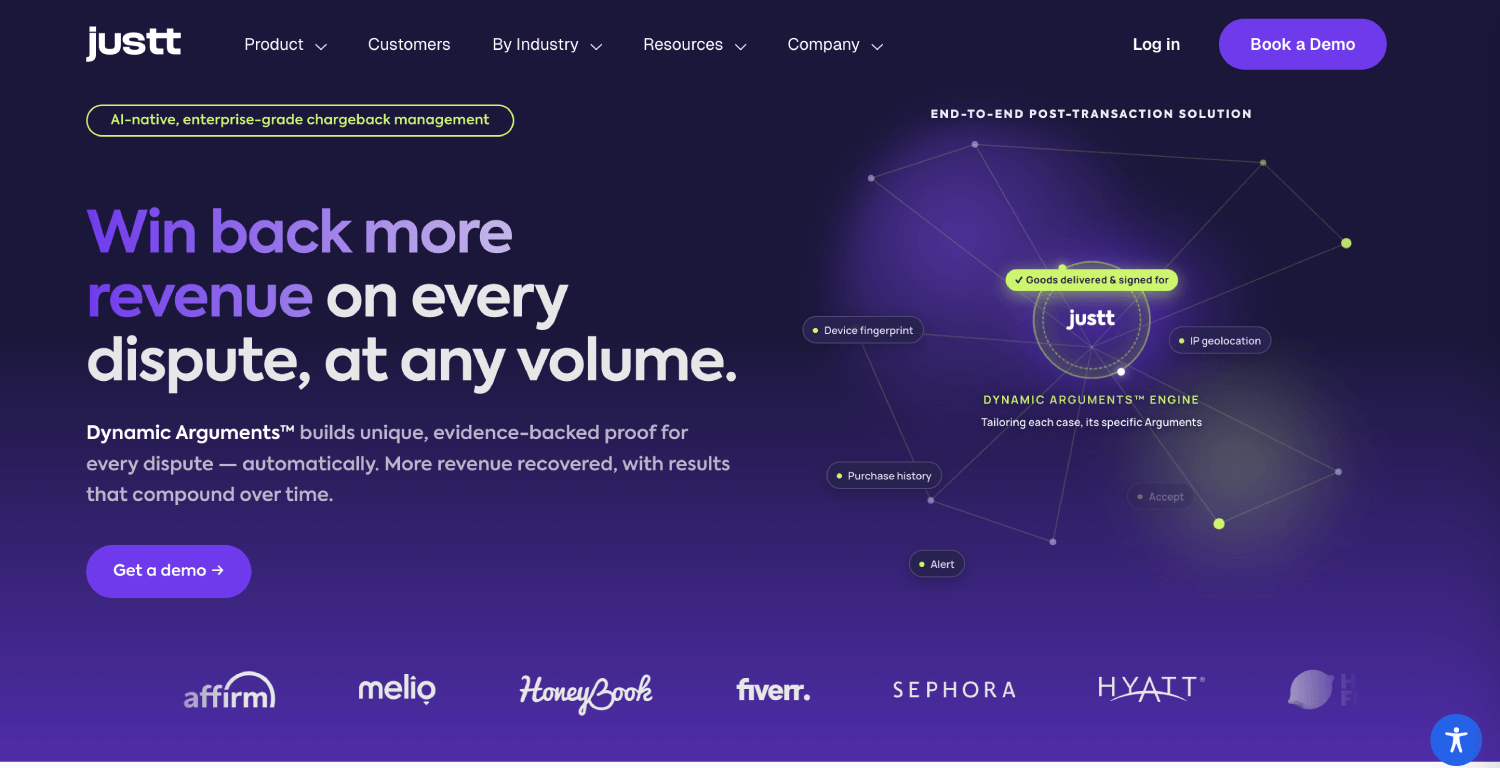
Justt positions around AI-driven representment with a focus on win rate rather than dispute prevention. The platform builds individualized chargeback responses using machine learning trained on dispute outcomes, adjusting evidence strategy by reason code, card network, and issuer bank. That issuer-level tuning is relevant for high-risk merchants because issuers in certain categories (travel, supplements) apply subjective criteria that vary by bank.
Justt also uses a success-fee model, which the company does not publicly break out as a specific percentage. Merchants should request rate details directly. The platform supports Visa and Mastercard disputes and integrates with major payment processors. For merchants dealing primarily with 10.4 fraud codes, Justt’s AI-tuned evidence strategy may outperform static template-based tools, because the response to a fraud claim at Chase Visa requires different framing than the same code at a regional issuer.
Best for: High-volume merchants who have already tried static representment templates and are leaving win rate on the table because their responses are not issuer-differentiated.
3. Kount (Equifax)

Kount, now part of Equifax, operates primarily as a fraud prevention and identity decisioning platform rather than a dispute management tool. It belongs on this list for high-risk merchants because a significant share of their chargebacks originate from fraud rather than customer dissatisfaction, and Kount’s device intelligence and behavioral analytics reduce fraud-originated disputes before they become chargebacks at all.
Kount assigns a risk score (the Omniscore) to each transaction using device fingerprinting, velocity checks, and network data from its merchant consortium. High-risk merchants benefit from the consortium data because Kount has coverage across categories including travel, digital goods, and subscription commerce. Pricing is not publicly disclosed; Kount quotes enterprise contracts based on transaction volume. For merchants whose fraud-originated chargeback rate exceeds 40% of total disputes, Kount’s prevention-first approach recovers more revenue than any representment tool can.
Best for: High-risk merchants where the primary dispute driver is fraud rather than customer complaints, particularly those processing above $1M per month where enterprise pricing becomes defensible. You can compare this approach to other platforms in the fraud detection and risk tools comparison covering the broader fintech risk category.
4. Verifi (Visa)
Verifi is owned by Visa and operates two products that high-risk merchants need to understand separately: Order Insight and the Rapid Dispute Resolution (RDR) system. Order Insight lets issuers retrieve transaction details before a dispute is filed, often resolving the inquiry at the cardholder level without a formal chargeback. RDR goes further, allowing merchants to set automatic refund rules for specific dispute types, converting potential chargebacks into refunds that do not count against your dispute ratio.
The distinction between preventing a chargeback and receiving a refund matters at high-risk MCCs. A refund does not affect your Visa Dispute Monitoring Program standing. A chargeback does. For merchants running above 0.9% dispute rates, RDR is not optional infrastructure. It is a ratio management tool. Verifi pricing is not publicly listed; access is typically arranged through your acquiring bank or directly through Verifi’s sales team. Our chargeback alert services comparison covers RDR and CDRN enrollment in more detail.
Best for: Any high-risk merchant processing on Visa rails who is approaching or exceeding Visa’s dispute monitoring thresholds. This is network infrastructure, not a discretionary tool.
5. Ethoca (Mastercard)

Ethoca is the Mastercard-owned equivalent of Verifi. Its two primary products are Ethoca Alerts, which notify merchants of disputes before they are formally filed and give a window to issue a refund, and Ethoca Consumer Clarity, which delivers transaction details to issuers to reduce confusion-driven disputes. The network position is the point. Ethoca sits between Mastercard issuers and merchants, receiving dispute signals that no third-party tool can intercept independently.
Merchants processing primarily on Mastercard rails should treat Ethoca as foundational, not optional. Alert fees are charged per transaction notification and vary by acquiring bank arrangement. High-risk merchants who operate across both networks need both Verifi and Ethoca running simultaneously. Running only one leaves significant pre-dispute interception coverage on the table.
Best for: Mastercard-heavy processors, or any high-risk merchant who wants complete pre-dispute alert coverage across both major card networks.
6. Midigator

Midigator focuses on data-driven chargeback management with reporting depth that most pure-automation tools lack. The platform provides root cause analysis at the transaction level, tracking which SKUs, marketing channels, or customer segments are generating the most disputes. For high-risk merchants running multiple offer types or product lines, that attribution data determines whether a chargeback problem is a fraud problem, a product problem, or a billing clarity problem. Those require completely different fixes.
Midigator also automates representment workflows, but its differentiation is the analytics layer. Merchants who know their dispute rate but not their dispute source cannot fix the underlying issue. Midigator pricing is not publicly disclosed. The platform integrates with over 50 payment processors, which gives it broader compatibility than tools tied to specific acquiring relationships.
Best for: High-risk merchants who have brought dispute volume down through other means and now need to understand exactly what is still driving disputes at the segment level.
7. Disputifier
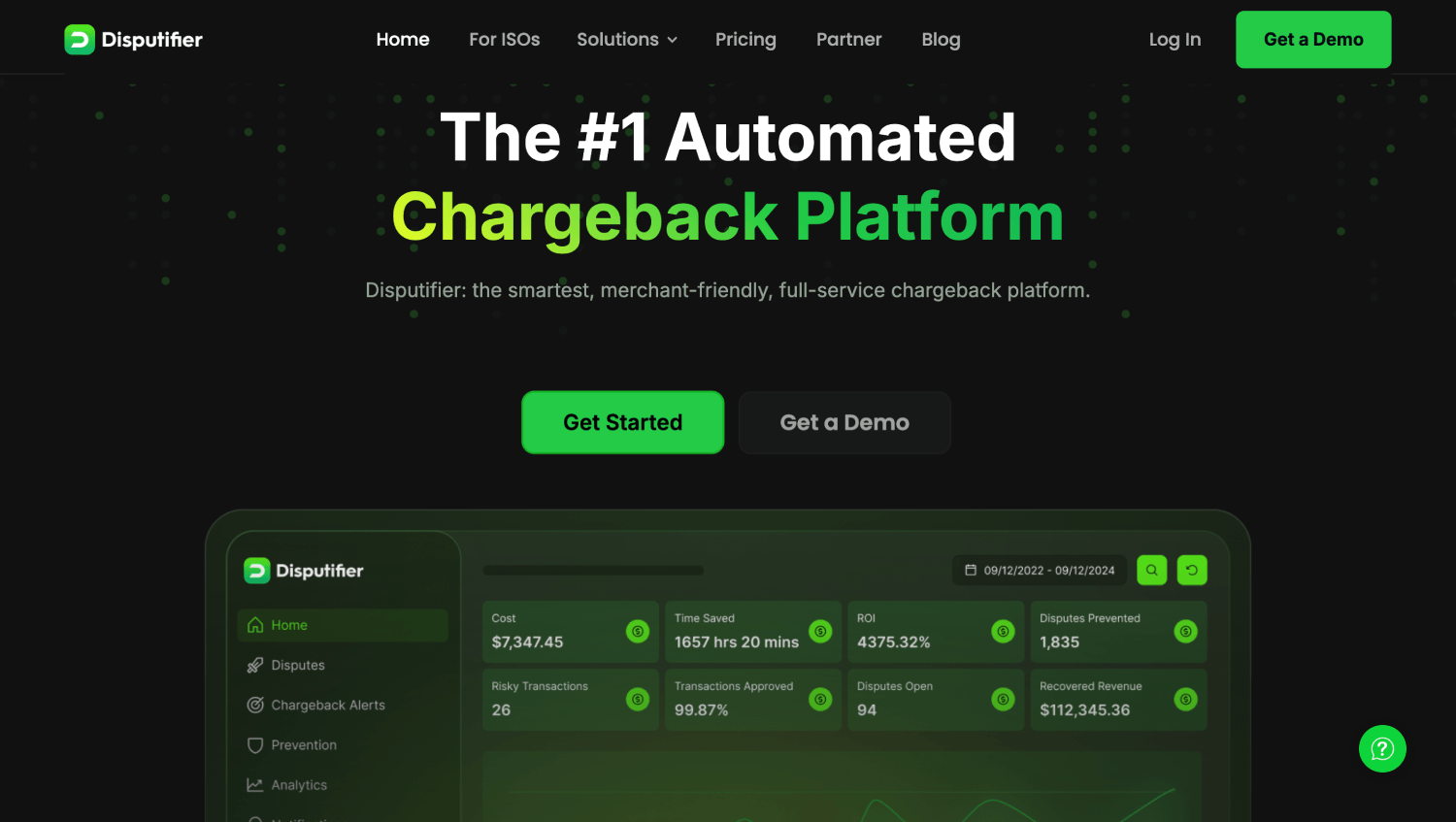
Disputifier offers chargeback prevention and automated representment with a transparent pricing structure that includes a free plan for low-volume merchants and paid tiers based on dispute count, as of their public pricing page (last reviewed July 2025). That accessibility makes it relevant for smaller high-risk merchants who cannot justify enterprise contract minimums. The platform integrates with Shopify, Stripe, and PayPal and includes Ethoca and Verifi alert subscriptions within its service.
The bundled alert access is the key differentiator versus rolling your own multi-vendor alert stack. For a merchant processing 50 to 300 disputes per month, paying separately for Verifi, Ethoca, and a representment tool creates administrative complexity and duplicated data pipelines. Disputifier consolidates those into one interface. Representment quality for complex high-risk disputes may not match the AI-tuned approaches of Justt, but for merchants at lower dispute volumes, that gap rarely matters in practice.
Best for: Smaller high-risk merchants (under 300 disputes per month) who need Verifi and Ethoca alert access plus automated representment without enterprise contract overhead.
8. Chargebacks911
Chargebacks911 is one of the oldest dedicated chargeback management firms and has deep experience specifically in high-risk verticals, including travel, nutraceuticals, and digital goods. The platform blends automated representment with analyst oversight, which matters for complex dispute types where automated evidence packages consistently lose. High-risk merchants frequently face disputes with nuanced reason codes where issuer behavior is inconsistent, and human review of the evidence package before submission increases win rates in those edge cases.
Chargebacks911 also offers Intelligent Source Detection, which attempts to identify whether a chargeback originated from friendly fraud (a real customer disputing a legitimate charge) versus true fraud. That classification affects both the representment strategy and the upstream prevention recommendation. Pricing is not publicly listed. The platform supports all major card networks and integrates with a wide range of processors. For high-risk merchants dealing with a high percentage of friendly fraud, the hybrid automation-plus-analyst model often outperforms pure automation.
Best for: High-risk merchants in complex verticals (travel, continuity billing, digital subscriptions) where automated-only representment produces inconsistent win rates and human review of evidence packages adds measurable ROI. The broader chargeback management tool comparison covers Chargebacks911 in a general B2B context for further comparison.
How Do Win Rates Actually Compare Across High-Risk Dispute Types?
Win rate comparison across platforms is complicated by the fact that every vendor defines “win rate” differently. Some count a pre-dispute refund through RDR as a win. Others count only representments where the issuer ruled in the merchant’s favor. Before accepting any vendor’s stated win rate, ask specifically: does this number include pre-dispute resolutions, or only formal dispute representments?
| Tool | Primary Mechanism | Best MCC Fit | Pricing Model | Network Alert Access | Human Oversight Option |
|---|---|---|---|---|---|
| Chargeflow | Automated representment | Nutraceuticals, digital goods | Success fee | Via integrations | No |
| Justt | AI-tuned representment | High-volume, multi-issuer | Success fee | Via integrations | No |
| Kount | Fraud prevention | Digital goods, travel | Enterprise contract | No (prevention only) | Configurable rules |
| Verifi | Pre-dispute resolution (Visa) | All Visa-processing high-risk | Bank-arranged | Yes (Visa native) | N/A |
| Ethoca | Pre-dispute resolution (MC) | All MC-processing high-risk | Per-alert fee | Yes (MC native) | N/A |
| Midigator | Analytics + representment | Multi-product, continuity | Not disclosed | Yes | Yes |
| Disputifier | Prevention + representment | SMB high-risk | Tiered / per dispute | Bundled | No |
| Chargebacks911 | Hybrid auto + analyst | Travel, nutraceuticals, subscriptions | Not disclosed | Yes | Yes |
What Does a High-Risk Chargeback Stack Actually Cost Per Month?
For example, consider a nutraceutical merchant processing $800,000 per month with a 2.5% dispute rate, generating roughly 200 chargebacks. On a success-fee model at 25% of recovered revenue, with an average transaction value of $80 and a 50% representment win rate, that merchant recovers roughly $8,000 per month in disputed revenue. At a 25% success fee, the tool costs $2,000 per month. No upfront investment, directly correlated to performance.
The same merchant adding Verifi RDR enrollment through their acquiring bank might convert 30% of potential chargebacks to refunds, dropping their monthly dispute count from 200 to 140. That change alone moves them from 2.5% to 1.75% dispute rate, pulling them out of Visa’s High Dispute Program and reducing the risk of processor termination. The RDR fee varies by acquiring bank arrangement, but the cost of staying in the High Dispute Program (including additional fees Visa charges for monitored merchants) typically exceeds the enrollment cost significantly.
Running both Verifi and Ethoca alongside an automated representment tool is not redundant spending for high-risk merchants. It is the minimum viable stack. Prevention without representment abandons contested revenue. Representment without pre-dispute alerts lets avoidable chargebacks accumulate. The stack works as a system, not a single product decision. Understanding how these costs fit into your broader payment infrastructure is worth mapping against your full payment margin picture, especially if chargeback fees are currently hiding inside processor statements.
How Do You Reduce Chargeback Rates at High-Risk MCCs Beyond the Tool Layer?
Tool selection is the middle of the problem, not the beginning. The highest-impact chargeback reduction for high-risk merchants comes from billing descriptor clarity, cancellation accessibility, and trial billing transparency. When a customer cannot identify a charge on their statement, they call their bank instead of the merchant. In continuity billing categories, unrecognized descriptors are a primary driver of disputes , not genuine fraud or product dissatisfaction.
3D Secure 2.0 enrollment shifts fraud liability to the issuing bank for authenticated transactions. High-risk merchants who have not implemented 3DS2 on card-not-present transactions are absorbing fraud liability they could transfer. The tradeoff is conversion rate impact, particularly on mobile. But for merchants already in dispute monitoring programs, liability shift outweighs friction costs. Your payment infrastructure provider should support 3DS2 configuration. If it does not, that is a separate conversation about whether your current processor fits a high-risk operation, which connects to broader questions about payment infrastructure selection for merchants with complex risk profiles.
Frequently Asked Questions
What is the difference between chargeback prevention and chargeback representment for high-risk merchants?
Prevention tools stop disputes from becoming chargebacks, typically by issuing refunds when an alert is received from Verifi or Ethoca, or by authenticating transactions via 3D Secure to shift fraud liability. Representment is the process of contesting a chargeback after it has been filed by submitting evidence to the card network. High-risk merchants need both: prevention reduces dispute ratio exposure, while representment recovers revenue from disputes that reach the formal stage. Running only one category of tool leaves significant money and ratio risk unaddressed.
How does the Visa Dispute Monitoring Program affect high-risk merchants specifically?
Visa’s Dispute Monitoring Program places merchants under heightened scrutiny when their dispute-to-transaction ratio exceeds 0.9%. Merchants above 1.5% enter the High Dispute Program, which carries additional monthly fees and requires a remediation plan submitted to Visa through the acquiring bank. If dispute rates remain elevated over an extended review period, Visa can direct the acquiring bank to terminate the processing relationship. For high-risk MCCs, even brief spikes above the 1.5% threshold create termination risk, making real-time dispute ratio monitoring a baseline operational requirement, not an optional reporting feature.
Can automated representment tools handle all high-risk dispute reason codes?
No. Automated representment works best on reason codes with clear documentation requirements, such as proof of delivery (Visa 13.1) or service not canceled (Visa 13.2). Fraud codes like Visa 10.4 have a much lower representment success rate because the issuer has already sided with the cardholder on a fraud claim, and overturning that requires compelling transactional evidence that automated tools may not reliably compile for complex or high-value transactions. For fraud-coded disputes, prevention via 3DS authentication or pre-dispute alerts is more effective than post-dispute representment.
Do high-risk merchants need both Verifi and Ethoca, or is one sufficient?
Both are needed for merchants processing significant volume on both Visa and Mastercard. Verifi provides pre-dispute alert and resolution coverage for Visa transactions; Ethoca covers Mastercard. The two networks do not share alert infrastructure, so coverage on one network does not extend to the other. Merchants whose transaction mix is heavily weighted toward one network can prioritize accordingly, but a dual-network operation running only one alert service will miss all pre-dispute notifications from the uncovered network, forfeiting the opportunity to convert those disputes into refunds before they affect the dispute ratio.
What win rate should a high-risk merchant expect from automated representment?
Representment win rates for high-risk merchants vary substantially by reason code, MCC, and tool quality. For customer-dispute codes (Visa 13.1, Mastercard 4853) with strong documentation, win rates in the 30% to 55% range are realistic with quality automated tools. Fraud codes (Visa 10.4) are harder to contest and typically see lower win rates. Any vendor quoting a blended win rate above 60% for a high-risk portfolio deserves detailed questioning about how they define a win and whether pre-dispute resolutions are included in that calculation.
How does MATCH list placement relate to chargeback management?
The Member Alert to Control High-Risk Merchants list is maintained by Mastercard and contains merchants whose processing relationships were terminated for excessive chargebacks, fraud, or other violations. A merchant added to MATCH is effectively unable to obtain a new merchant account with any Mastercard-participating acquirer for five years. Chargeback management is a MATCH prevention strategy. Keeping dispute rates below network thresholds, maintaining clean representment records, and responding to processor remediation requests promptly all reduce MATCH placement risk. Once placed on MATCH, no chargeback tool can remove the listing.
Which Tool Should You Actually Start With?
If your dispute rate already exceeds 1.5% and you are not enrolled in Verifi RDR, start there. No representment tool will recover revenue faster than stopping the ratio from climbing further. Ratio management is the firewall. Once RDR is live, layer in Ethoca Alerts for Mastercard coverage. At that point, your unresolved disputes are the ones worth fighting with an automated representment tool.
Merchants below 1.5% with steady dispute volume have more flexibility. A success-fee representment tool like Chargeflow or Justt costs nothing when disputes are manageable, returns revenue from every won case, and does not require an enterprise contract. Merchants with analytical needs, multiple product lines, or unusually complex dispute mixes should evaluate Midigator or Chargebacks911, where the data layer or human oversight justifies a more involved engagement.
The one position worth holding regardless of tool choice: measure win rate by reason code, not blended. A 35% blended rate may obscure a 5% win rate on your most common reason code. That gap is the actual performance problem, and no vendor dashboard will surface it unless you ask for the disaggregated view. The merchants who manage chargebacks effectively at high-risk MCCs are the ones who treat dispute data as operational intelligence, not just a cost to minimize.