
TLDR
- E-invoicing mandates in Germany, France, Belgium, Romania, and Poland now apply to any company issuing invoices to customers in those countries, not just locally registered businesses.
- A dedicated e-invoicing compliance API handles format validation, digital signature requirements, tax authority submission, and Peppol network routing in one integration rather than building country by country.
- Avalara, Sovos, and Pagero cover the widest country footprints for enterprise teams; Storecove and B2Brouter offer cleaner developer experiences for mid-market SaaS products.
- The critical differentiator is not format support but mandate update velocity: how fast a provider pushes schema changes when a tax authority rewrites its technical specs.
- Pricing across this category is almost entirely custom or undisclosed; budget conversations need to start at the volume and country level, not the feature level.
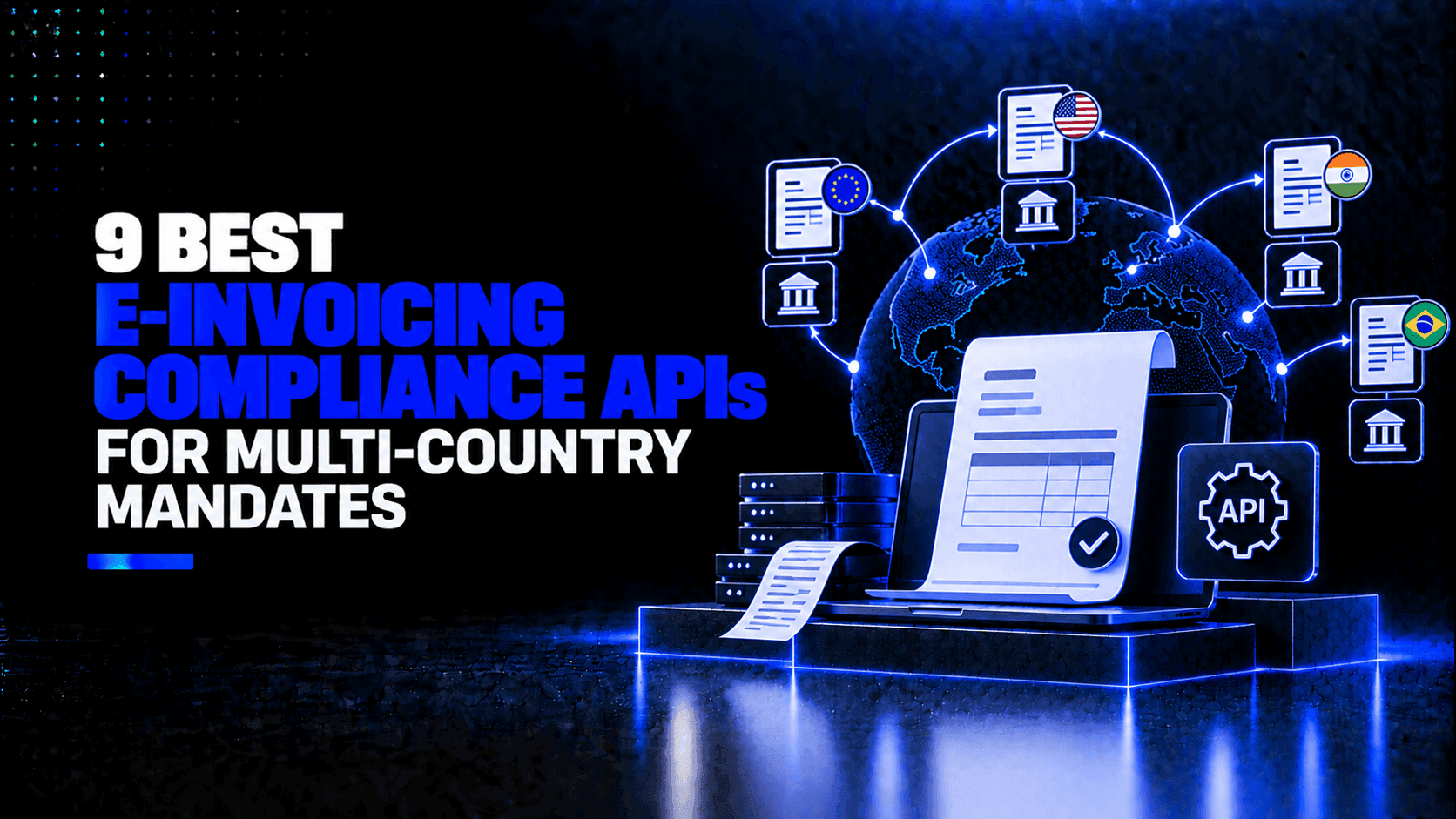
The best e-invoicing compliance APIs for multi-country mandates are Avalara, Sovos, Pagero, Storecove, Complyance, B2Brouter, Tungsten Automation, Basware, and Tickstar. Each connects to the Peppol network and supports structured invoice formats like UBL, CII, and FatturaPA. The right choice depends on how many countries you invoice into, whether you need direct tax authority submission or Peppol-only routing, and how much your team can absorb in integration complexity versus managed service overhead.
Why US SaaS Companies Can No Longer Treat E-Invoicing as a European Problem
Germany’s B2B e-invoicing mandate takes effect in stages starting January 2025, with full enforcement for all company sizes phased through 2028. France’s B2B mandate, originally delayed, is now scheduled in waves through 2026 and beyond. Belgium, Romania, and Poland have all passed or are actively enforcing similar requirements. A US-headquartered SaaS company invoicing a German GmbH customer must issue a structured electronic invoice that complies with the XRechnung or ZUGFeRD format, or risk rejection and potential penalties on the buyer’s side.
This is not a theoretical compliance edge case. If your billing system sends a PDF invoice to a German business customer, that customer may not be able to claim input VAT on it under new rules, which creates a real commercial friction point that accelerates churn. The invoice format is no longer just an accounting preference; it is a legal condition of the transaction.
For a deeper look at how these mandate deadlines stack up country by country, the e-invoicing mandates by country tracker on FintechSpecs covers enforcement dates, penalties, and format requirements across Europe and beyond through 2030.
What Does an E-Invoicing Compliance API Actually Do?
The category name covers several distinct technical functions that are worth separating before evaluating vendors. Most teams conflate invoice generation with compliance, but they are different problems. Invoice generation APIs (Invoice Ninja, Invoiced, Stripe Invoicing) create and send invoices. Compliance APIs validate that those invoices conform to a jurisdiction’s technical schema, apply the required digital signature, route the document to the correct tax authority clearance endpoint or Peppol access point, and return an archived, auditable copy.
The core functions break down as follows. Schema validation confirms that a structured XML document meets a country’s exact field requirements, because a missing buyer VAT number in a German XRechnung is not a minor formatting issue but a rejection trigger. Digital signing applies qualified electronic signatures where mandated, such as Italy’s FatturaPA system. Tax authority submission routes the invoice to a government clearing platform, as Mexico’s CFDI system and Italy’s SDI system require before the invoice is legally valid. Peppol network routing delivers invoices through the four-corner model to buyers registered on the global Peppol network. Finally, archiving and audit trail management stores signed, time-stamped copies for the retention periods each country mandates, often seven to ten years.
Not every vendor does all of these. Some specialize in Peppol routing only. Others focus on clearance-model countries where government systems are involved. Understanding which functions you need before shortlisting vendors saves weeks of scoping calls.
The FintechSpecs Mandate Coverage Stress Test: Four Questions Before You Sign Any E-Invoicing API Contract
Before evaluating individual vendors, teams should run what this publication calls the Mandate Coverage Stress Test, a four-question filter that cuts through feature lists and goes straight to the compliance risk. First: does the vendor support all countries on your current invoice roster, not just the ones you plan to expand into? Second: how does the vendor push schema updates when a tax authority changes its technical specifications mid-year? Third: does the vendor maintain direct connections to tax authority clearance systems, or do they rely on a third-party intermediary that adds a failure point? Fourth: what is the vendor’s documented process when a country adds a new mandate you are not currently contracted for?
The fourth question trips up most buyers. A vendor covering Germany and France today may not have Belgium or Romania in its standard tier. When you add those countries, you could be looking at a separate contract, a different integration endpoint, or a 90-day implementation wait. That lag is a compliance gap.
Which Countries Have Active or Imminent B2B E-Invoicing Mandates?
Italy is the most mature market, with its SDI clearance system having been mandatory for domestic B2B transactions since 2019. France is rolling out its mandate in phases, with large companies required to receive structured invoices as of a date tied to the Chorus Pro platform evolution. Germany introduced mandatory structured invoice reception in January 2025 for businesses with revenues above specified thresholds, with sending obligations phasing in. Poland’s KSeF (Krajowy System e-Faktur) system has been piloted and its mandatory phase is in progress. Romania’s RO e-Factura system became mandatory for B2G and then B2B. Belgium’s phased mandate affects companies transacting within the Belgian VAT system.
Outside Europe, Malaysia’s MyInvois system launched mandatory e-invoicing for large companies and is extending to smaller businesses. Saudi Arabia’s ZATCA Fatoora system operates in two phases, with Phase 2 (generation and integration) rolling out by company revenue tier. Mexico’s CFDI system is already mature and mandatory. Each of these uses different formats, different submission endpoints, and different archiving rules. No single self-built integration handles all of them cleanly.
Country Coverage Matrix: Which APIs Cover Which Mandates
| Provider | Italy (SDI) | Germany (XRechnung) | France | Poland (KSeF) | Romania | Belgium | Mexico (CFDI) | Saudi (ZATCA) | Malaysia | Peppol |
|---|---|---|---|---|---|---|---|---|---|---|
| Avalara | Yes | Yes | Yes | Yes | Yes | Yes | Yes | Yes | Partial | Yes |
| Sovos | Yes | Yes | Yes | Yes | Yes | Yes | Yes | Yes | Yes | Yes |
| Pagero | Yes | Yes | Yes | Yes | Yes | Yes | Yes | Yes | Yes | Yes |
| Storecove | Yes | Yes | Yes | Yes | Yes | Yes | No | No | No | Yes |
| Complyance | Yes | Yes | Yes | Yes | Yes | Yes | No | Yes | Partial | Yes |
| B2Brouter | Yes | Yes | Yes | Yes | Yes | Yes | Yes | No | No | Yes |
| Tungsten Automation | Yes | Yes | Yes | Yes | Yes | Yes | Yes | Yes | Partial | Yes |
| Basware | Yes | Yes | Yes | Yes | Yes | Yes | No | No | No | Yes |
| Tickstar | Yes | Yes | Yes | Yes | No | Yes | No | No | No | Yes |
Note: Coverage status reflects publicly documented capabilities as of the time of publication. “Partial” indicates the vendor has announced support or is in beta for that jurisdiction. Verify directly with vendors before contracting, as mandates and vendor certifications change frequently.
The 9 Best E-Invoicing Compliance APIs Reviewed
1. Avalara e-Invoicing
Avalara’s e-invoicing product is built on top of its existing tax compliance platform, which means teams already using Avalara for sales tax or VAT calculation get a more natural integration path than competitors offer. The API supports both clearance-model countries (where the invoice must pass through a government system before delivery) and post-audit countries (where structured formats are required but sent directly to buyers). Avalara maintains direct connections to Italy’s SDI, Mexico’s SAT for CFDI, and France’s Chorus Pro, among others.
The strongest argument for Avalara in a multi-country scenario is the unified API layer. Rather than calling different endpoints per country, the Avalara e-invoicing API accepts a normalized invoice payload and handles the country-specific transformation, signing, and routing internally. Pricing is not publicly disclosed on Avalara’s site; enterprise contracts are negotiated based on transaction volume and country footprint.
The weakness is implementation complexity. Avalara’s platform is broad, and the e-invoicing product requires meaningful configuration for each jurisdiction. Teams without a dedicated tax technology resource will feel that overhead. It is better suited to companies already inside the Avalara platform than to greenfield API integrations.
2. Sovos
Sovos has built its entire business around tax compliance and government reporting, which makes its e-invoicing product more deeply specialized than general-purpose platforms that added the feature later. Sovos maintains what it calls a “Continuous Transaction Control” (CTC) network, covering clearance and reporting obligations across over 70 countries. For teams invoicing into Latin America (Brazil, Mexico, Chile, Colombia, Peru) alongside Europe, Sovos is the most complete single-vendor option in this list.
The API architecture is REST-based and designed for high transaction volumes. Sovos routes invoices to the correct government endpoint, receives clearance confirmations, and returns the approved invoice document with attached authorization codes where required. For Poland’s KSeF system, Sovos handles the session-based authentication flow that the Polish tax authority requires, which is a non-trivial integration challenge that many smaller vendors have not yet solved cleanly.
Sovos pricing is enterprise-only and not publicly listed. The product targets mid-market and enterprise buyers; the sales process reflects that. Teams under $50M in revenue should expect a longer evaluation cycle than with lighter alternatives like Storecove or B2Brouter.
3. Pagero
Pagero, now part of Thomson Reuters following an acquisition completed in 2024, operates a global business network connecting buyers and suppliers across more than 100 countries. Its e-invoicing compliance product combines Peppol access point services with direct government submission capabilities. The Thomson Reuters acquisition brought additional resources to the compliance update engine, which matters when a country like Romania or Malaysia revises its technical specifications on short notice.
Pagero’s network model is the key architectural differentiator. When a buyer and supplier are both connected to the Pagero network, invoice delivery and compliance handling happen within the network rather than requiring point-to-point API connections. For procurement teams and larger finance departments, this network effect has real value. For pure API integrations where a SaaS platform is submitting invoices programmatically on behalf of customers, the REST API path is available but the implementation is more oriented toward ERP integration than developer-first tooling.
Pricing is not disclosed publicly. Pagero suits companies with complex AP and AR automation needs across multiple countries rather than developer teams looking for a lightweight API call.
4. Storecove
Storecove has built the clearest developer experience in this category. Its API documentation is public, well-structured, and includes sandbox environments with real format validation responses. The product focuses on the Peppol network and European mandates rather than trying to cover Latin America and Asia simultaneously, which makes its coverage narrower but its implementation path significantly faster.
The core workflow is straightforward: submit a JSON invoice payload via the REST API, and Storecove handles conversion to the target country’s required XML format (UBL 2.1, CII, XRechnung, or FatturaPA), signs the document, routes it through the appropriate Peppol access point or direct government submission channel, and returns status updates. For European-focused SaaS companies, this covers the most urgent mandate deadlines without requiring an enterprise contract or a professional services engagement.
Storecove publishes tiered per-document pricing on its pricing page, with higher volume unlocking lower per-unit rates. Verify current volume thresholds and rates directly, as tiers are updated periodically. The lack of CFDI (Mexico) and ZATCA (Saudi Arabia) support is the primary limitation for companies with global mandates beyond Europe.
5. Complyance
Complyance is a newer entrant built specifically for the API-first SaaS use case. Its product architecture is designed for platforms that need to issue compliant invoices on behalf of their customers rather than for in-house finance teams managing their own AP/AR. This makes it relevant for billing platforms, ERP vendors, and vertical SaaS companies that want to add e-invoicing compliance as a feature layer without rebuilding their invoice generation pipeline.
The product covers European mandates including Germany, France, Italy, Belgium, Romania, and Poland, plus Saudi Arabia’s ZATCA requirements. The API accepts standard invoice data and returns compliant documents along with submission receipts. Complyance emphasizes real-time mandate update propagation, pushing schema changes to all customers automatically rather than requiring customers to update their own integrations when specifications change.
Pricing is not publicly disclosed. Given its positioning, Complyance is worth evaluating for SaaS companies that plan to make compliance a product feature rather than an internal operation; the cost model will likely reflect that platform-layer use case.
6. B2Brouter
B2Brouter occupies the mid-market developer space alongside Storecove, with particular strength in Spain and Spanish-speaking European markets. Its API covers Peppol routing across Europe, Italy’s SDI, and the Spanish Facturae format, plus several Latin American CFDI-adjacent systems. For SaaS companies with customer concentrations in Spain, France, or Italy, B2Brouter’s coverage maps well to real invoice traffic patterns.
The REST API is documented publicly and supports multiple input formats, allowing teams to submit standard UBL, their own JSON structure, or even PDF invoices for conversion and compliance processing. The PDF-to-structured conversion feature is particularly useful during a transition period when some customers still send PDF purchase orders that need to be matched against outbound structured invoices.
B2Brouter offers a free entry tier for low-volume testing alongside paid tiers based on invoice volume, making it accessible for smaller companies that want to test real mandate compliance before committing to an enterprise contract. Current volume thresholds and per-document rates are listed on the B2Brouter pricing page and should be verified directly, as tiers are subject to change.
7. Tungsten Automation
Tungsten Automation (formerly Kofax) brings a legacy document processing heritage to e-invoicing compliance. Its platform handles both inbound invoice capture and outbound compliance routing, which is relevant for companies that need to process supplier invoices alongside issuing their own. The product covers major European mandates, Mexico’s CFDI, and Saudi Arabia’s ZATCA, with a global clearance network that has been built over more than a decade.
The Tungsten platform is more oriented toward enterprise procurement and AP automation than developer-first API consumption. Companies that have existing Tungsten or Kofax deployments for document automation will find the e-invoicing compliance module a natural extension. Pure API integrations are possible but require more setup than Storecove or B2Brouter. The trade-off is depth of audit and archiving functionality, which Tungsten handles more completely than lighter API-first alternatives.
Pricing is enterprise-only and not publicly disclosed.
8. Basware
Basware is primarily an AP automation and procurement network company that has added e-invoicing compliance as a component of its broader platform. Its global supplier network is one of the largest in the procurement space, which means buyers on the Basware network can receive compliant invoices from suppliers using Basware’s access point without additional integration on the buyer side.
For SaaS companies, the relevance of Basware depends on whether enterprise procurement customers are already in the Basware network. If a significant portion of your B2B customer base uses Basware for AP, connecting as a supplier via Basware’s API simplifies your invoice delivery path considerably. Outside that specific scenario, Basware is a less obvious choice than API-first alternatives. Coverage spans major European mandates and Peppol; Latin American and Asian mandates are less comprehensively supported.
Pricing is not publicly disclosed and requires direct sales engagement.
9. Tickstar
Tickstar, whose current ownership should be confirmed directly with the company as corporate structures in this space have shifted, operates as a Peppol-certified access point with a developer-accessible API. It focuses squarely on European Peppol routing and selected national mandate support, without attempting to cover the full global clearance market. Germany, France, Belgium, Italy, and several Nordic markets are well-supported; Romania and Eastern European mandates beyond Poland are less comprehensive.
The Tickstar API is designed for software vendors and ERP partners who want to embed Peppol connectivity into their own products. If your primary compliance requirement is Peppol network delivery rather than government clearance system submission, Tickstar’s specialized focus means a leaner integration surface. For Italy’s SDI clearance or France’s government submission flows, verify current support status before contracting, as clearance-model coverage is narrower than Peppol-routing coverage.
Pricing is available through direct inquiry; Tickstar does not publish a standard rate card.
How to Match an API to Your Specific Mandate Stack
The shortlisting process should start with a spreadsheet of every country where you currently issue invoices plus every country you expect to invoice within 24 months. Map each country against two columns: whether it requires Peppol network delivery, and whether it requires government clearance before delivery. Italy, Mexico, Saudi Arabia, and Malaysia are clearance-model countries. Germany, Belgium, and the Netherlands are primarily Peppol-delivery countries with structured format requirements. France operates a hybrid as its mandate matures.
If your mandate stack is Europe-only and Peppol-centric, Storecove and B2Brouter are the fastest paths to compliance without enterprise-scale investment. If you have clearance-model countries in the mix, particularly Mexico, Saudi Arabia, or Italy at scale, Sovos or Avalara’s deeper government network connections become worth the heavier implementation cost. If you are a platform business issuing invoices on behalf of customers rather than managing your own AR, Complyance’s platform-layer architecture is the most purpose-built option in the list.
For teams evaluating broader compliance tooling, the Fintech Product and Compliance Readiness Checklist covers the wider infrastructure decisions around compliance API selection, including how e-invoicing fits into a company’s overall regulatory architecture.
What Does Peppol Integration Actually Require?
Peppol (Pan-European Public Procurement Online) is a set of technical standards for structured electronic document exchange, not a single platform. The four-corner model works as follows: the sender’s access point (corner 1) sends the invoice to a Peppol-registered access point (corner 2), which routes through the network to the buyer’s access point (corner 3), which delivers to the buyer’s system (corner 4). A Peppol API provider sits at corner 2/3, maintaining the certified access point that the network requires.
To use a Peppol API, your application needs to provide the buyer’s Peppol ID (an identifier registered in the Peppol directory), submit the invoice in a valid Peppol BIS Billing 3.0 format (which maps to UBL 2.1 or UN/CEFACT CII), and handle the async confirmation that delivery was accepted. The complexity for most SaaS teams is not the API call itself but populating accurate Peppol IDs for buyers, many of whom do not know their own Peppol registration status.
Storecove and Tickstar both provide lookup utilities to check whether a given VAT number or company identifier has a Peppol registration, which reduces the operational overhead of managing buyer registration status. This feature is more important than it sounds: sending a compliant invoice to the wrong Peppol endpoint or failing to detect that a buyer is not yet registered can cause delivery failures that look like technical errors but are actually directory lookup problems.
Illustrative Scenario: A Series B SaaS Company Adding German and French Compliance
Consider a US-based B2B SaaS company at $15M ARR, invoicing 200 enterprise customers in Germany and 80 in France. Their current billing stack uses Stripe for payment processing and generates PDF invoices via a custom internal tool. Starting in 2025, German customers receiving those PDFs may flag them as non-compliant, creating friction in accounts payable approvals and potential delays in payment.
The engineering team has two months to add structured invoice output. They need XRechnung-compliant XML for German public sector and many large enterprise buyers, ZUGFeRD (hybrid PDF/XML) as an interim format for German buyers not yet on Peppol, and UBL 2.1 via Peppol for French buyers as France’s mandate matures. Storecove’s API handles all three formats from a single JSON invoice payload, requires no enterprise sales cycle to access, and can be tested in sandbox against real German tax authority validation schemas. The estimated integration time for a team with REST API experience is one to three weeks, not three months.
When that same company adds Mexico (CFDI mandatory) and Saudi Arabia (ZATCA Phase 2) to its expansion roadmap, the Storecove gap becomes apparent and a migration to Sovos or Avalara’s broader global clearance network becomes worth the additional implementation investment. Planning for that transition before it is urgent, by selecting a provider with migration documentation and standard data formats, avoids a forced switch under a compliance deadline.
How Does E-Invoicing Compliance Intersect with Tax Calculation?
E-invoicing compliance and tax calculation are related but not the same problem. Compliance APIs validate and route the invoice document. Tax calculation APIs (Avalara AvaTax, Vertex, TaxJar) determine the correct VAT or GST amount before the invoice is generated. Some providers, notably Avalara, offer both in an integrated platform. Others are pure compliance routers that expect the tax amount to already be correct in the submitted invoice.
If your invoice contains an incorrect VAT amount and you submit it through a clearance-model system like Italy’s SDI, the system may accept the document while your customer’s tax filing reflects an error. The compliance API did its job; the tax calculation upstream of it did not. These are separate failure modes requiring separate vendor evaluation. For teams already using Avalara for VAT calculation, the Avalara e-invoicing module closes that gap natively. For teams using other tax engines, the invoice pipeline needs to validate tax amounts before they hit the compliance API submission step.
The intersection of tax compliance and invoice infrastructure is also where merchant of record arrangements create complexity, since the MoR assumes tax liability. For SaaS companies evaluating whether to use a MoR versus handling compliance directly, the merchant of record comparison for B2B SaaS covers when that trade-off makes financial sense.
Frequently Asked Questions
What is a Peppol access point and do I need one?
A Peppol access point is a certified intermediary that connects your invoicing system to the Peppol network, the global standard for structured B2B invoice exchange used across Europe, Singapore, Australia, and other markets. You need one if you invoice buyers who require Peppol delivery, which includes most government entities and increasingly large private sector buyers in Germany, France, Belgium, and the Netherlands. You do not need to build or certify your own access point; using a Peppol API provider like Storecove, Tickstar, or Pagero gives you certified access point connectivity without operating the infrastructure yourself.
Can a single e-invoicing compliance API cover all major global mandates?
No single API covers every global mandate today without gaps. Sovos and Pagero come closest for enterprise use cases, covering Europe, Latin America, and several Asia-Pacific markets in a single integration. However, mandates in countries like Malaysia, Kenya, and India are recent enough that some providers are still in implementation phases. Teams with mandates across more than five countries should request a written coverage confirmation for each specific jurisdiction before signing a contract, rather than relying on marketing-page claims.
How long does it take to integrate an e-invoicing compliance API?
Integration timelines vary significantly by provider and internal stack complexity. Developer-first APIs like Storecove and B2Brouter support integrations in one to three weeks for teams with REST API experience. Enterprise platforms like Sovos or Avalara typically involve a professional services onboarding engagement that runs four to twelve weeks depending on ERP system connections, custom field mapping, and the number of countries being configured. Factor in sandbox testing time against real jurisdiction validation schemas before going live.
What is the difference between clearance-model and post-audit e-invoicing?
In a clearance model, the invoice must pass through a government tax authority system for approval before it is legally valid and can be delivered to the buyer. Italy’s SDI, Mexico’s CFDI, and Saudi Arabia’s ZATCA all use clearance models. In a post-audit model, the invoice is issued directly between buyer and seller in a structured format, and the tax authority retains the right to audit those records later. Germany’s XRechnung and most Peppol-based mandates are post-audit. Clearance models require API providers to maintain direct, real-time connections to government systems, which is a significantly harder technical requirement than Peppol routing.
Does e-invoicing compliance apply to SaaS subscriptions or only physical goods?
Mandates apply to B2B invoices for any taxable transaction, including software subscriptions, professional services, and digital goods, not just physical goods. A German business customer receiving a monthly SaaS subscription invoice needs that invoice in XRechnung or ZUGFeRD format to process it correctly through their AP systems under the German mandate. PDF invoices, even valid ones, do not satisfy structured format requirements in clearance-model countries. If your SaaS product bills enterprise customers in Germany, France, Italy, or Poland, the mandates apply.
What happens if I miss an e-invoicing mandate deadline?
Consequences vary by country and mandate type. In clearance-model countries like Italy, a non-compliant invoice is not legally recognized, meaning the transaction has no valid tax documentation, which can affect both your revenue recognition and your customer’s input VAT claim. In post-audit countries, penalties are typically financial and applied during tax audits. In Germany, buyers are increasingly rejecting non-structured invoices through their AP systems rather than waiting for regulatory enforcement, making the commercial impact arrive before the legal penalty does. The risk is not just regulatory; it is the practical disruption to invoice approval and payment cycles.
Can I use my existing invoicing tool alongside an e-invoicing compliance API?
Yes, and this is the most common architecture. An existing invoicing tool (Stripe Billing, Chargebee, Zuora, or a custom billing system) generates the invoice data. The e-invoicing compliance API receives that data, transforms it into the required structured format, handles signing and submission, and returns a compliant document. The two systems stay separate. The compliance API sits between your billing system and your customer’s AP system, handling the jurisdiction-specific requirements without requiring you to replace your billing infrastructure. For a review of invoicing generation APIs that pair well with this architecture, see the invoicing APIs for SaaS platforms comparison.