
TLDR
- Persona is a full identity orchestration platform that handles KYB as one workflow layer among many; Middesk is a purpose-built business verification platform with deeper US registry and Secretary of State data coverage.
- For banks and credit unions running BSA/AML-compliant commercial onboarding, Middesk’s direct state filing integrations and NAICS code verification make it the faster path to a defensible audit trail.
- Persona wins when the institution needs a single platform to cover both consumer KYC and business KYB within one decision engine, or when the case mix includes complex document collection and beneficial ownership workflows.
- Pricing for both platforms is custom and not publicly disclosed; Middesk publishes a limited self-serve tier, but bank-grade deployments at either vendor require a negotiated contract.
- The FintechSpecs KYB Fit Matrix below maps nine bank-specific criteria to each platform so compliance and product teams can identify the gap before a demo.
For banks and credit unions evaluating KYB platforms, Middesk is the stronger default for US entity verification because its direct Secretary of State integrations and tax ID matching produce a more complete registry-based audit trail. Persona is the better fit when the institution needs one platform to orchestrate both KYC and KYB decisions, or when beneficial ownership document collection is central to the workflow. The right choice depends on whether the institution’s primary gap is data depth or workflow flexibility.
Why Banks Keep Landing on the Wrong Comparison Page for This Decision
The search query “persona vs middesk for KYB at banks” sends most readers to comparisons built for fintech SaaS onboarding, not chartered financial institutions. That matters because the compliance bar at a bank or credit union is structurally different: BSA/AML obligations, FinCEN beneficial ownership rules, FFIEC examination expectations, and core system integration requirements create a shortlist of criteria that generic fintech onboarding articles rarely address.
The other common misread is treating Persona as purely a consumer identity tool. Persona’s platform covers business verification, but it does so as a configurable workflow layer rather than as a registry-first data product. That architectural difference, not feature count, determines which platform fits a given institution’s compliance posture.
This article maps both platforms against the specific criteria bank and credit union compliance teams use when evaluating KYB infrastructure, using the FintechSpecs KYB Fit Matrix as a structured frame.
What Does Each Platform Actually Do?
Persona: Identity Orchestration with KYB as a Workflow
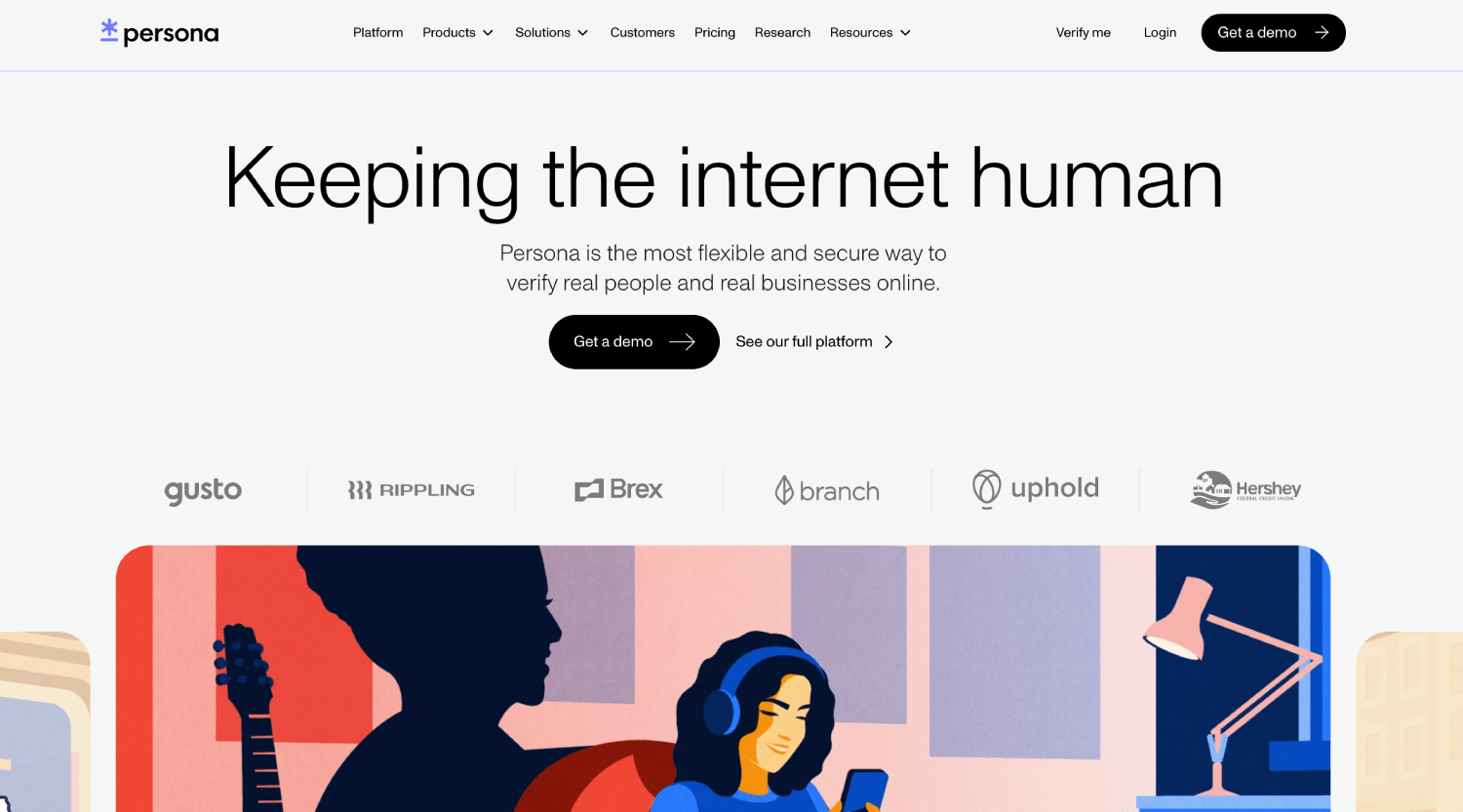
Persona is an identity platform that lets institutions build verification workflows combining document checks, database lookups, biometric verification, and decisioning logic in a single no-code or API-driven environment. KYB in Persona is constructed from components: business name and address verification, EIN lookup, UBO collection, and document upload flows can be assembled and sequenced through its workflow builder.
That configurability is genuinely useful. A bank that needs to run consumer KYC and business KYB through the same onboarding experience, with shared case management and a unified audit log, can do that in Persona without stitching together two separate vendors. The tradeoff is that Persona does not own its business data sources. It pulls from third-party data providers and surfaces them through its orchestration layer, which means the registry depth depends on which data partners are connected at the time of a given lookup.
Middesk: Registry-First Business Verification
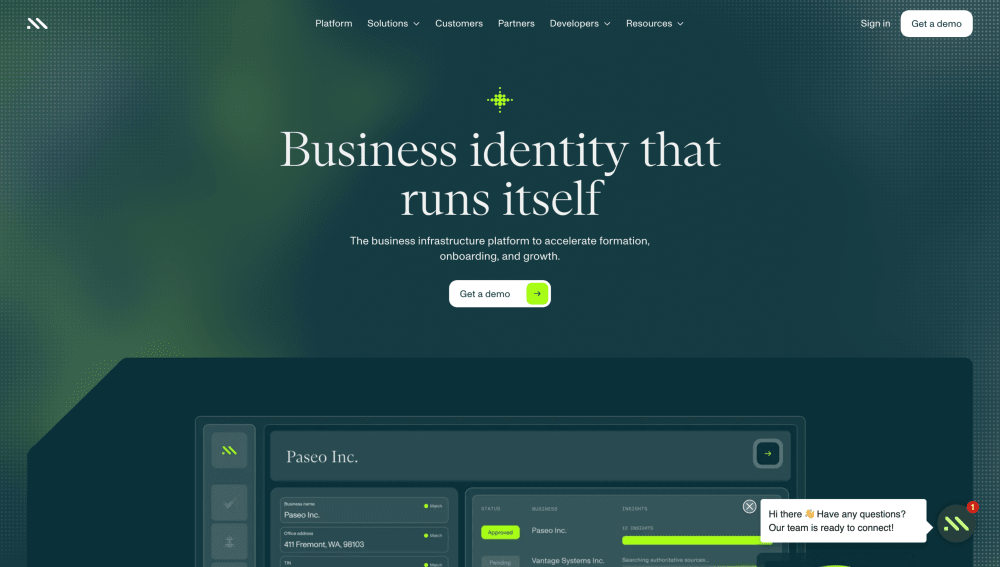
Middesk was built specifically for business verification. Its core product pulls directly from Secretary of State filings, UCC records, USPS address validation, tax ID matching, and business credit data to produce a structured business identity report. For a bank underwriting a commercial deposit account or a credit union onboarding a small business member, that registry-first approach means the verification output is grounded in official government records rather than inferred from aggregated data.
Middesk also covers NAICS code classification, lien searches, and ongoing monitoring for business status changes, which are components that matter for periodic review requirements under BSA. Its Middesk Agent product uses AI-assisted document review to handle cases where automated checks return incomplete registry matches, adding a human-in-the-loop layer that compliance teams at regulated institutions typically require for exception handling.
How Do Persona and Middesk Handle US Business Registry Data?
This is the most consequential difference for bank compliance teams. Middesk has built direct integrations with Secretary of State databases across all 50 states, which means entity status, registered agent, formation date, and officer information come from primary source records. When an examiner reviews a BSA/AML file and asks where the business data originated, “Secretary of State filing” is a materially stronger answer than “third-party aggregator.”
Persona’s business verification draws on data providers but does not publish the specific registry sources it connects to in the same way Middesk does. For institutions where the provenance of business data is a first-order compliance question, that difference in transparency matters. It is not that Persona’s data is unreliable; it is that Middesk makes the audit chain clearer by design.
One area where Persona has an edge: foreign entity verification. Banks onboarding businesses incorporated outside the US run into the limits of any US-registry-focused product quickly. Persona’s document-centric workflow handles foreign certificate of incorporation collection and manual review more naturally than Middesk’s structured data approach, which is optimized for domestic entities.
What Does Persona KYB Cover for Bank-Grade Workflows?
Persona’s KYB workflow capability is broader than most compliance teams expect from a platform they associate with consumer identity. Through its workflow builder, institutions can configure:
- Business name, address, and EIN verification against US data sources
- Beneficial ownership collection with configurable ownership threshold logic (aligned to FinCEN’s 25% rule)
- Document upload and automated extraction for articles of incorporation, operating agreements, and formation documents
- KYC sub-flows for each beneficial owner, run within the same case
- Adverse media and watchlist screening via integrated third-party providers
- Manual review queues with annotated audit trails
Where Persona’s KYB falls short of Middesk for bank use cases is in ongoing monitoring. Persona’s strength is onboarding-time verification. Continuous monitoring for business status changes, address updates, or new UCC filings is not a core Persona capability in the same way it is for Middesk. Banks with periodic review requirements under their BSA program need to account for that gap, typically by supplementing Persona with a separate monitoring data feed or by relying on Middesk’s monitoring product.
The FintechSpecs KYB Fit Matrix for Banks and Credit Unions
The following matrix applies nine criteria that compliance officers, BSA officers, and product teams at chartered institutions use when shortlisting KYB vendors. Each criterion is scored directionally, not as a hard score, because deployment context changes the outcome. Use this as a first-pass filter before a vendor demo, not as a final decision framework.
| Criterion | Persona | Middesk | Why It Matters for Banks |
|---|---|---|---|
| US Secretary of State registry access | Via third-party data partners | Direct integrations, all 50 states | Primary source data is stronger in examination settings |
| Beneficial ownership collection (FinCEN CDD rule) | Configurable UBO workflows with KYC sub-flows | Structured UBO data with document upload support | FinCEN requires identification and verification of each UBO |
| Combined KYC plus KYB in one platform | Yes, core strength | Partial (KYB-focused; KYC via integrations) | Reduces vendor count and unifies audit trail |
| Ongoing business monitoring | Limited | Yes, including status changes and lien alerts | Required for periodic review under BSA programs |
| NAICS code classification | Not a core output | Yes | Used in risk-tiering and SAR filing workflows |
| Foreign entity verification | Strong (document-centric) | US-optimized; limited international coverage | Relevant for institutions with cross-border commercial members |
| No-code workflow customization | Extensive | Moderate | Reduces engineering lift for compliance-driven workflow changes |
| Audit trail and examiner reporting | Unified across KYC and KYB | Business-specific, detailed registry trail | Both formats satisfy FFIEC documentation expectations |
| AI-assisted document review | Yes (document extraction) | Yes (Middesk Agent) | Reduces manual review queue for exception cases |
How Does Middesk for Banks Differ from Its Fintech Deployment?
Middesk deploys differently at banks than at fintech lenders or neobanks, and the difference is worth naming. Fintech deployers typically integrate Middesk via API into a merchant or borrower onboarding flow, where speed is the dominant variable. The acceptable time-to-decision is measured in seconds or minutes.
Banks and credit unions usually have more complex onboarding trees. A commercial deposit account might trigger a standard Middesk business lookup, but the same lookup for a trust or a professional association might require a different data path. Middesk’s structured report format handles the standard entity types well. For complex structures, including holding companies with multiple operating subsidiaries or nonprofits with unusual governance documents, the AI-assisted Middesk Agent review layer is where most of the bank-specific work happens.
Core system integration is the other bank-specific variable. Most Middesk fintech deployments connect to a modern loan origination system or a neobank’s internal platform. Banks running Fiserv, FIS, or Jack Henry cores need either a middleware layer or a custom integration. Middesk does not publish a certified core banking connector list, so integration scoping is a pre-contract conversation. For context on how the broader fintech infrastructure stack layers together for chartered institutions, the Fintech Infrastructure Stack map covers where KYB sits relative to core banking, onboarding, and AML monitoring layers.
Persona vs Middesk Pricing: What Banks Should Expect
Neither Persona nor Middesk publishes pricing for bank-grade enterprise deployments. As of their public documentation, Middesk offers a self-serve tier with per-report pricing for standard business verifications, but the company does not publicly disclose the per-report rate for enterprise contracts. Persona’s pricing is entirely custom and requires a sales engagement.
The cost structure at both vendors follows a similar pattern for bank deployments: a platform or access fee, per-verification charges that vary by product module used, and potentially a minimum annual commitment. Banks that run low verification volumes but require high audit trail fidelity may find Middesk’s per-report model more predictable. Banks running high-volume commercial onboarding campaigns, where a single relationship triggers dozens of sub-entity verifications, should model total cost across the full verification tree rather than on a single business entity basis.
For institutions that have already scoped a broader identity budget, the KYC cost per verification benchmarks on FintechSpecs provide a useful frame for calibrating what the KYB line item should represent as a share of total onboarding cost.
Which Platform Fits KYB for Credit Unions Specifically?
Credit unions face a KYB challenge that differs from banks in one important way: their business member base tends to skew heavily toward small and micro businesses, sole proprietors, and informal structures that may not have clean Secretary of State filings or established business credit profiles. Middesk’s registry-first approach can return thin results for these entities, producing indeterminate verification outcomes that then require manual escalation.
Persona’s document-centric workflow handles the thin-file business case better. A sole proprietor who brings in a DBA certificate and a utility bill can move through a Persona-configured flow more gracefully than through a Middesk lookup that returns no match. For credit unions with a large share of small business members, that failure-mode difference is worth pressure-testing in a proof of concept before committing to either platform.
That said, credit unions with NCUA examination obligations still need a clear audit trail for the businesses they do verify. Middesk’s structured report format, with its named data sources and entity status outputs, satisfies that requirement more directly than a Persona workflow output that may be harder for an examiner to parse if the documentation is not organized carefully at implementation time.
What Are the Real Integration Differences Between Persona and Middesk?
Persona’s API is designed around flexible workflow construction. Product and engineering teams can define the verification steps, branch logic, and fallback paths through Persona’s dashboard, then expose the resulting flow via a hosted link or an embedded SDK. For institutions that want to move quickly without heavy engineering investment, that model reduces time to a working integration. The tradeoff is that complex decisioning logic, like risk-tiering a business based on NAICS code or jurisdiction of formation, needs to be built into the workflow configuration rather than returned as a native data field.
Middesk’s API returns a structured business report with explicit data fields for entity status, registered agent, formation state, and risk indicators. Downstream decisioning in the bank’s loan origination or account opening system can key off those fields directly. That makes Middesk easier to integrate into rule-based decisioning engines that compliance teams have already built. The limitation is that Middesk gives less flexibility in the verification sequence itself. The product verifies the business; how the institution presents that process to the applicant is handled externally.
For institutions evaluating how KYB fits into a broader compliance automation architecture, the compliance automation tools overview covers the adjacent products that typically sit alongside a KYB platform in a bank’s tech stack.
Alloy as a Third Option Worth Naming
Any bank-grade KYB evaluation that starts with Persona versus Middesk should at least scope Alloy as a third option. Alloy occupies similar territory to Persona in that it is a decisioning orchestration platform that covers both KYC and KYB, but it has built deeper relationships with banks and credit unions specifically and carries a longer track record in regulated institution deployments. The FintechSpecs comparison of Alloy versus Middesk covers that match-up in detail. Some institutions end up using Middesk’s data inside Alloy’s decisioning layer, which is a supported integration pattern and worth asking both vendors about during scoping.
Frequently Asked Questions
Is Persona a KYB platform or a KYC platform?
Persona is an identity orchestration platform that covers both KYC and KYB as configurable workflow components. It is not exclusively either. Banks can build business verification workflows in Persona, including EIN lookup, UBO collection, and document review, but the platform’s data depth for US business registry checks depends on the third-party sources connected to the workflow rather than on Persona-owned registry integrations. Teams that need a purpose-built KYB data product rather than a workflow orchestrator typically find Middesk a better fit for that specific function.
Does Middesk cover all 50 US states for Secretary of State data?
According to Middesk’s public product documentation, the platform covers business verification across all 50 states using Secretary of State records. Coverage completeness and data freshness vary by state, since some states update their databases less frequently than others. Delaware, Wyoming, and Nevada entities are generally fast to verify given the volume of filings those states process. Less common formations in smaller states, or entities with recent name changes, may return slower or less complete results and require the Middesk Agent review layer to resolve.
What is FinCEN’s beneficial ownership rule and how do Persona and Middesk handle it?
FinCEN’s Customer Due Diligence rule requires covered financial institutions to identify and verify the identity of beneficial owners who own 25% or more of a legal entity, plus one individual who controls the entity. Both Persona and Middesk support beneficial ownership collection workflows. Persona handles this through configurable UBO forms with embedded KYC verification sub-flows for each owner. Middesk collects UBO data as part of its business report and supports document upload for ownership verification. Neither platform eliminates the institution’s obligation to maintain the underlying records and review them periodically.
Can a bank use Middesk for ongoing business monitoring after onboarding?
Yes. Middesk offers ongoing monitoring as a distinct product that alerts institutions to changes in business status, registered agent updates, new UCC filings, or other material changes to a verified entity’s profile. This capability is relevant for banks with BSA periodic review requirements, where the institution must demonstrate that business relationships are reviewed at a frequency proportional to their risk rating. Persona does not offer equivalent ongoing monitoring as a core product feature, which means institutions that choose Persona for onboarding typically need a separate solution for post-onboarding surveillance.
How long does a Middesk business verification take?
Middesk’s automated verification for standard US entities typically returns results within seconds to a few minutes via API, depending on state database response times and entity complexity. Cases that fall outside the automated match criteria route to the Middesk Agent review layer, which involves AI-assisted document analysis and can take longer depending on queue volume and document quality. Middesk does not publicly publish average review times for Agent-handled cases. Banks should ask for SLA commitments on exception cases during contract negotiations.
Which platform is easier to implement for a small bank or credit union with limited engineering resources?
Persona’s no-code workflow builder gives compliance and operations teams the ability to configure and adjust verification flows without engineering involvement after the initial API integration. That makes it operationally lighter once deployed, assuming the initial integration is scoped correctly. Middesk’s integration is more straightforward on the API side for teams that simply need to call a verification endpoint and parse the result, but workflow adjustments require API-level changes. For institutions with minimal internal engineering capacity, Persona’s post-launch flexibility is a practical advantage worth weighting.
Does Persona or Middesk integrate with core banking platforms like Fiserv or Jack Henry?
Neither Persona nor Middesk publishes a list of certified integrations with major core banking platforms as of their current public documentation. Both vendors support REST API integrations that can be connected to core banking workflows through middleware or custom development. Institutions evaluating either platform should include core integration scoping as a required pre-contract step, and should ask specifically whether the vendor has completed integrations with their specific core version before signing. A middleware layer from a vendor that already connects to both the KYB platform and the core system is often the fastest path to production for community banks and credit unions.
Middesk Wins on Data Depth. Persona Wins on Workflow Scope.
The framing that Persona is an identity tool and therefore unsuitable for bank KYB is wrong, but it points at a real distinction. Persona handles KYB as a workflow configuration problem. Middesk treats KYB as a data product problem. Banks that have already solved their workflow orchestration layer and need better underlying business data should look at Middesk first. Banks that need to unify consumer KYC, business KYB, and beneficial ownership verification into one auditable system, without building that architecture themselves, are more likely to get there faster with Persona.
For credit unions with a thin-file small business membership base, Persona’s document-centric fallback handling is a practical advantage over Middesk’s registry-first approach. For commercial banks running higher-volume entity verification with examiner scrutiny on data provenance, Middesk’s Secretary of State sourcing is harder to argue against in an FFIEC examination setting.
The most important question to bring to a demo is not which platform has more features. It is: when my verification returns an indeterminate result, what happens next, how long does it take, and who at my institution is responsible for resolving it? The answer to that question, tested against real case volume, is what separates a KYB platform that works in a sales deck from one that holds up in production at a regulated institution. For teams that want to pressure-test the broader vendor evaluation process before committing, the fintech vendor evaluation framework on FintechSpecs covers the pre-contract questions that tend to surface the real differences.