
TLDR
- Most merchants assume accepting USDC means holding crypto, managing wallets, and navigating volatile conversions. Modern stablecoin payment gateways eliminate all three.
- The best gateways in this category accept USDC at checkout and settle USD directly to your business bank account, often within 24 hours, sometimes same-day.
- Transaction fees across the leading providers range from 0.5% to 1.5% per transaction as of October 2026, which typically undercuts card interchange on international orders.
- Settlement speed, fiat conversion behavior, supported chains, and KYB requirements differ significantly across providers. Picking the wrong one adds friction you cannot undo without re-integrating.
- This list covers merchant-facing gateways only. If you are building a platform or API product, the comparison you want is stablecoin payment APIs for fintech platforms.
The ten gateways below accept USDC at checkout and settle fiat to a business bank account. Stripe, Coinbase Commerce, BitPay, Triple-A, Crossmint, Shift4, NOWPayments, MoonPay Business, Coingate, and Wert cover the major use cases, from ecommerce and digital goods to enterprise invoicing and Web3 checkout. Fees, settlement speeds, supported chains, and fiat conversion options vary by provider. The table in this article shows each dimension side by side.
Why Are Merchants Looking at Stablecoin Payments Right Now?
Card interchange on international orders runs 2.9% or higher, plus currency conversion fees that can push total cost past 4%. USDC transactions on Ethereum, Solana, or Base settle peer-to-peer with no card network in the middle. For merchants with a high share of international customers, the fee gap is real and recurring.
Chargebacks are also absent from stablecoin transactions. Blockchain payments are final. A merchant who sells digital goods or services, where chargeback fraud is common, gets a structural advantage by accepting USDC alongside cards. That is not a minor operational improvement. It changes the risk math on entire product categories.
Regulatory clarity is catching up. The GENIUS Act, now moving through US implementation, sets federal standards for payment stablecoins. Circle’s USDC already holds reserves in short-duration Treasuries and cash equivalents. The compliance story for accepting USDC is materially cleaner in 2026 than it was in 2022, and gateways have built KYB and AML workflows around it.
What Should Merchants Evaluate Before Choosing a Stablecoin Gateway?
Most gateway comparisons focus on transaction fees and stop there. That misses four decisions that shape your actual operating experience. FintechSpecs uses a four-point framework we call the Stablecoin Settlement Stress Test to evaluate merchant-facing gateways. Here is how it works.
Leg 1: Conversion Behavior
Does the gateway auto-convert USDC to USD at the moment of payment, or does it hold stablecoins in a custodial wallet until you manually withdraw? Auto-conversion means you never touch crypto. Custodial holding means you have a crypto balance sheet item, which triggers accounting and tax treatment you may not want.
Leg 2: Settlement Speed
Same-day settlement, next-business-day settlement, and T+2 settlement have different cash flow implications. A high-volume merchant running tight working capital needs to know exactly when USD hits their bank, not just that it “typically” arrives quickly.
Leg 3: Supported Chains
USDC exists on Ethereum, Solana, Base, Polygon, Avalanche, and other chains. Gas fees on Ethereum mainnet make small transactions expensive for the payer. A gateway that only supports Ethereum USDC is less competitive for sub-$50 transactions than one that supports Solana or Base, where fees are fractions of a cent.
Leg 4: KYB Depth
Most serious gateways require business verification before allowing fiat withdrawals. The question is how deep it goes and how long it takes. A gateway that requires extensive documentation and takes weeks to verify is not viable for a merchant who needs to go live in days. Knowing the onboarding timeline before you integrate avoids a very expensive surprise.
The 10 Best Stablecoin Payment Gateways for Accepting USDC
1. Stripe (Stablecoin Payments via Stripe Crypto)
Stripe added native USDC acceptance through its crypto payments product, supporting USDC on Ethereum, Solana, and Polygon. Merchants receive USD to their Stripe balance after automatic conversion, which means zero crypto exposure. Pricing is 1.5% per transaction, per Stripe’s public pricing page as of October 2026. Settlement follows Stripe’s standard payout schedule, which for most US merchants is T+2.
The integration path is the shortest on this list if you already run Stripe for card payments. You enable the crypto payment method in your dashboard and add a USDC option to your existing checkout. No separate account, no new reconciliation workflow. For any merchant already on Stripe’s infrastructure, this is the lowest-friction stablecoin option available.
The trade-off is that Stripe’s crypto product is less feature-rich than dedicated crypto gateways. There is no NFT checkout, no multi-chain wallet detection, and no crypto payout option if you want to keep USDC rather than convert. Stripe is the right answer for merchants who want stablecoin checkout added to an existing Stripe stack with minimal operational change.
2. Coinbase Commerce
Coinbase Commerce is a non-custodial gateway, meaning USDC payments go directly to a wallet you control rather than through Coinbase’s custody. There are no transaction fees charged by Coinbase Commerce on USDC payments as of October 2026, per the Coinbase Commerce documentation. The cost of using it comes from network gas fees, which the payer bears.
The non-custodial model is a meaningful difference. Merchants who want direct on-chain ownership of USDC before deciding whether to convert prefer this architecture. Converting USDC to USD requires a separate step, either through Coinbase’s exchange, a bank integration, or a third-party off-ramp. That extra step adds friction, but it also gives you optionality.
Coinbase Commerce supports USDC on multiple chains including Ethereum, Polygon, and Base. The Base chain support is particularly relevant because Circle and Coinbase co-founded Base, gas fees are very low, and settlement finality is fast. For merchants in the crypto-native space or those with customers already holding USDC on Base, Coinbase Commerce is the natural first look.
3. BitPay
BitPay has operated as a crypto payment gateway since 2011, longer than any other provider on this list. It supports USDC alongside Bitcoin, Ethereum, and several other assets. BitPay converts received USDC to USD and deposits fiat directly to the merchant’s bank account. The transaction fee is 1% per transaction, per BitPay’s public pricing page as of October 2026.
BitPay’s settlement to bank is its strongest feature for merchants who do not want to think about crypto at all. You accept USDC, you get dollars in your checking account. The process is operationally closer to accepting a card payment than it is to managing crypto. BitPay also provides invoicing tools, a hosted checkout page, and plugins for WooCommerce, Magento, and Shopify.
The weakness is that BitPay’s product has not evolved as quickly as newer competitors. Chain support is narrower than Stripe or Coinbase Commerce, and the user interface for merchants is dated relative to more recent entrants. For high-volume merchants who prioritize proven reliability over modern UX, BitPay is a reasonable choice. For merchants who need multi-chain support or modern API design, look elsewhere.
4. Triple-A
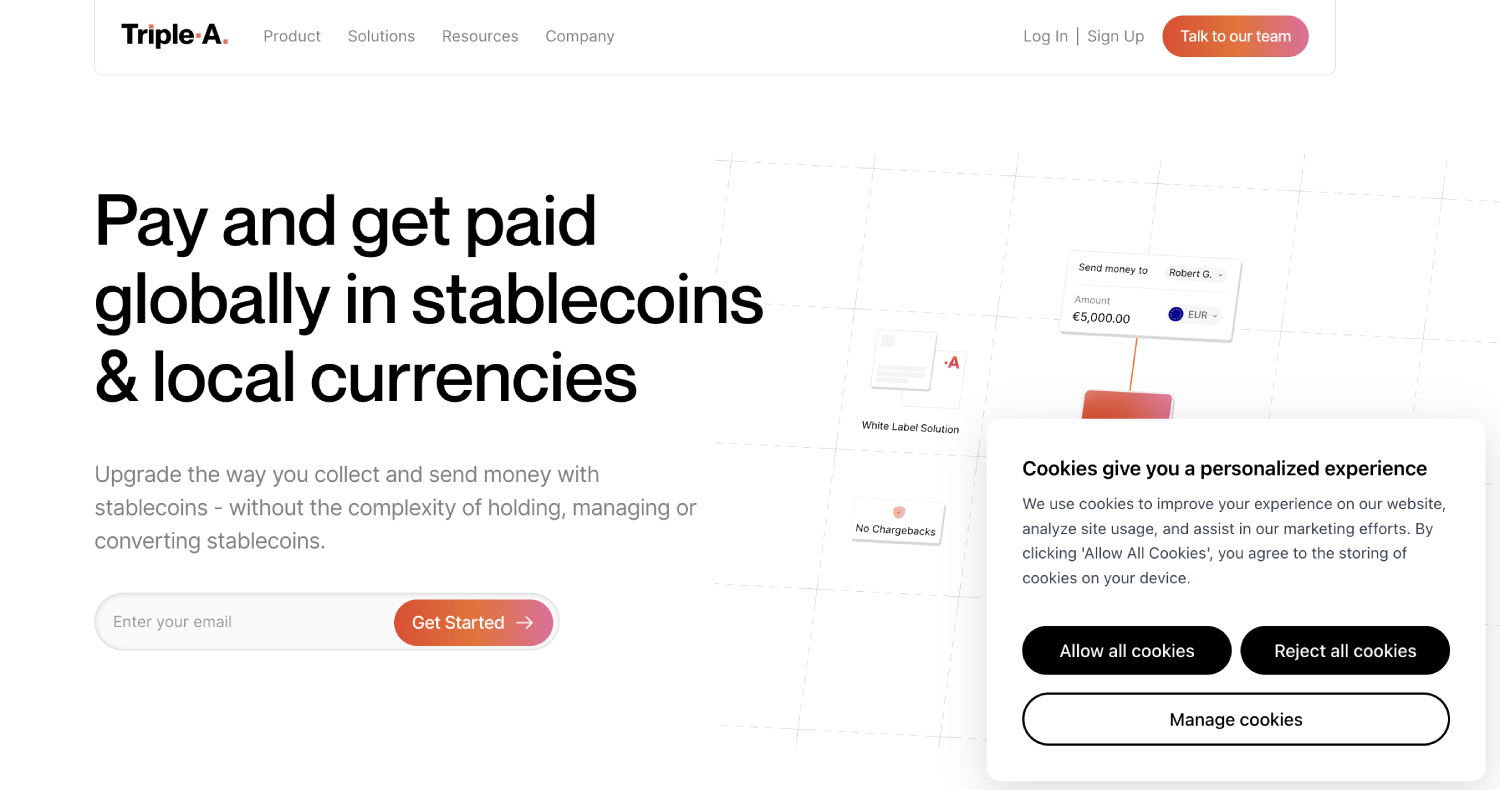
Triple-A is a Singapore-based gateway with regulatory licenses in Singapore and Europe, specifically built for business use cases. It supports USDC and converts to local fiat currencies, making it one of the stronger options for merchants with customers outside North America. Triple-A handles the conversion and settlement in the merchant’s local currency, which simplifies cross-border accounting considerably.
Triple-A operates under a Payment Services license from the Monetary Authority of Singapore and has e-money institution authorization in the EU. That regulatory coverage matters if your customer base is in Southeast Asia or Europe, where acceptance of crypto-derived payments requires a licensed intermediary in some jurisdictions. Triple-A fills that gap that US-centric gateways do not address.
Pricing is not publicly listed on Triple-A’s website as of October 2026; the company requires a business inquiry to get fee terms, which suggests volume-based negotiation is the norm. That is fine for a mid-market merchant processing significant volume, but it makes initial evaluation harder for smaller merchants. If your transaction volume is low, the lack of a self-serve pricing tier is a real barrier to getting started quickly.
5. Crossmint
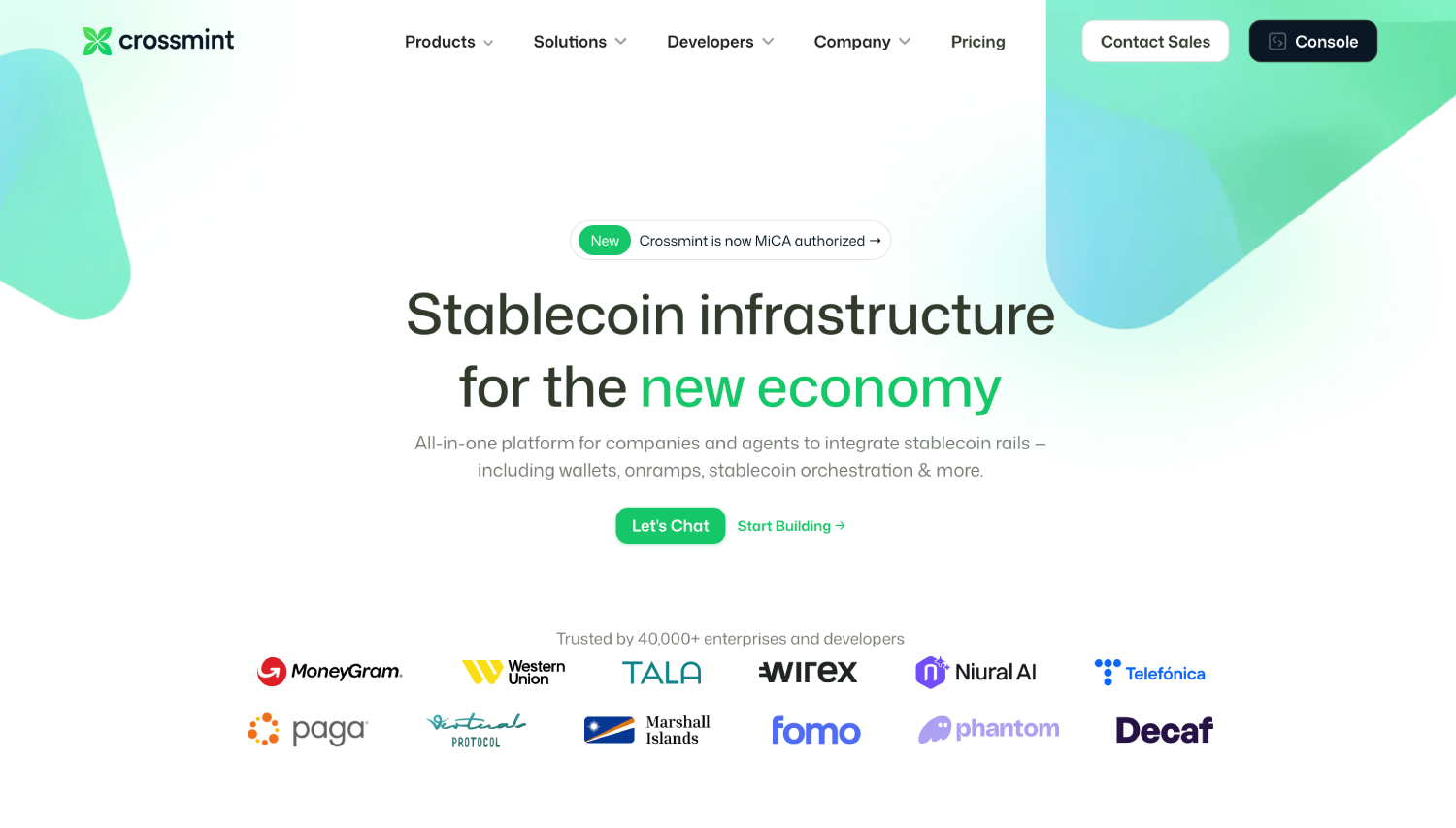
Crossmint is primarily known for NFT checkout and digital goods, but its payment infrastructure supports USDC checkout for any digital product. It supports credit card payments, USDC, and other stablecoins, and it abstracts wallet complexity from the buyer side, which is meaningful when your customer base does not have a crypto wallet but you want to offer USDC pricing.
The buyer experience is the differentiated feature. Crossmint allows buyers to pay with a credit card and receive the underlying digital asset or product without ever managing a wallet address. For merchants selling digital collectibles, tokenized goods, or Web3-adjacent products, this removes the single biggest checkout conversion killer in the category.
Crossmint does not publish transaction fees on its public pricing page as of October 2026; pricing is available on request. For purely fiat-settling merchants who want USDC as a payment option and nothing else, Crossmint is overbuilt. The platform’s strengths are in NFT-adjacent commerce. If that is not your product, the added complexity of Crossmint’s architecture does not pay off. If it is your product, there is genuinely no closer competitor.
6. Shift4

Shift4 is an enterprise payments company that added crypto acceptance through its gateway, supporting USDC among other digital currencies. It converts crypto to USD at point of sale and settles fiat directly to the merchant. Shift4’s primary market is hospitality, retail, and large-format merchants, and its crypto offering is designed to fit within that existing infrastructure.
For a large enterprise merchant that already runs Shift4 for card acquiring, adding USDC acceptance is a configuration change rather than a new vendor relationship. That operational simplicity is the main argument for Shift4 in this context. The gateway is not crypto-first, and its feature depth in the stablecoin space is lighter than dedicated providers.
Shift4 does not publish crypto-specific transaction fees separately from its enterprise pricing as of October 2026. Fee structures for enterprise clients are negotiated. Merchants who are not already on Shift4’s platform and are evaluating stablecoin-specific needs would likely find a better starting point with BitPay or Stripe.
7. NOWPayments
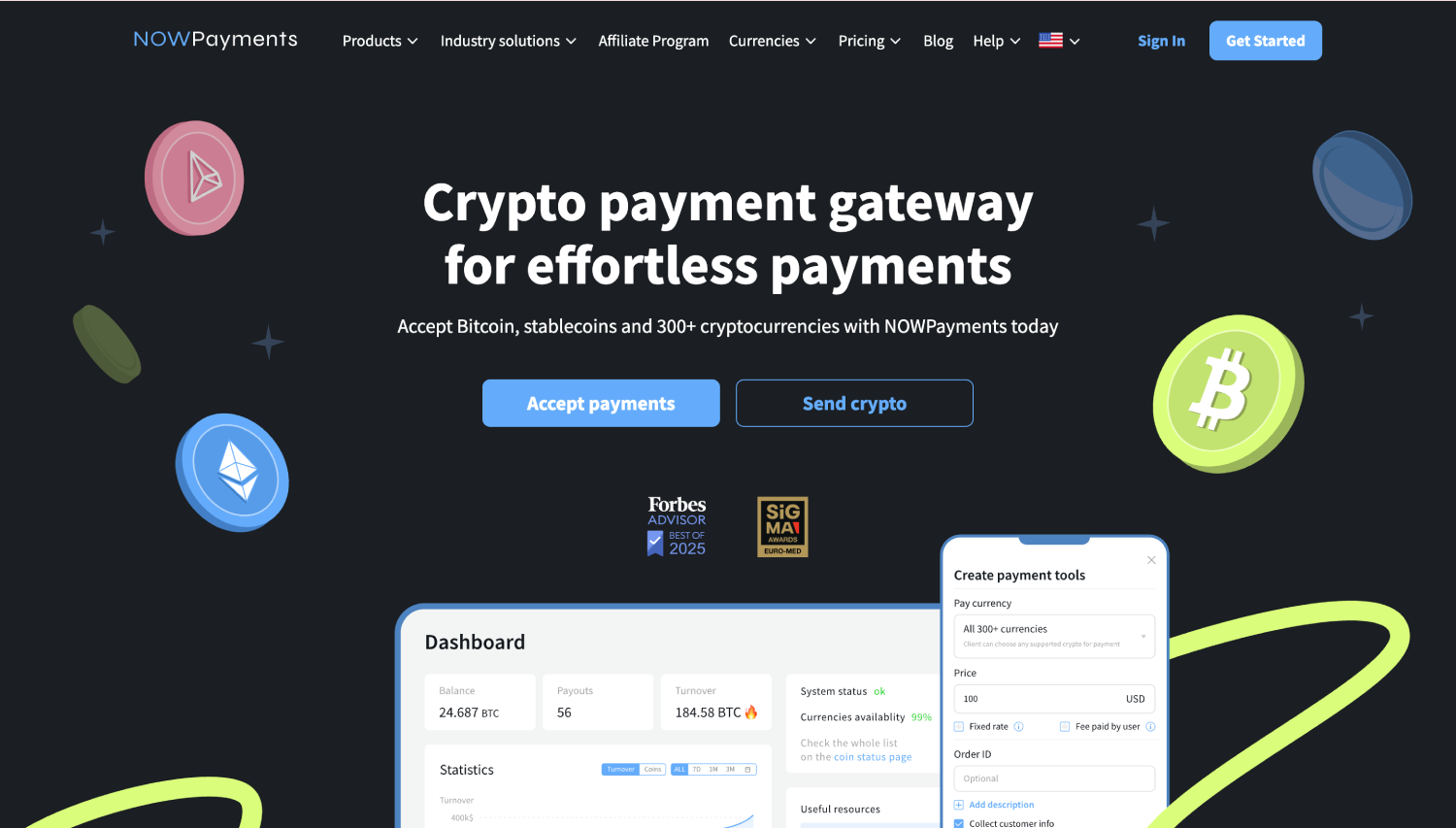
NOWPayments supports over 300 cryptocurrencies including USDC on multiple chains. It offers both a custodial and non-custodial mode, automatic conversion to stablecoins or fiat, and a self-serve onboarding flow that can have merchants live in under an hour. The transaction fee is 0.5% per transaction, per the NOWPayments public pricing page as of October 2026, the lowest published rate on this list.
The 0.5% fee matters at scale. A merchant processing $100,000 per month in USDC payments saves $1,000 per month compared to a 1.5% gateway, which is $12,000 per year. That is real margin. NOWPayments achieves the lower rate partly because its fiat settlement infrastructure is less developed than enterprise-grade competitors. Bank withdrawal options depend on jurisdiction, and speed of settlement to a US bank account is slower than Stripe or BitPay in most configurations.
NOWPayments is best suited for digital product merchants, donation pages, and ecommerce stores with crypto-native audiences. The self-serve setup, wide coin support, and low fees make it competitive for that segment. Merchants who need fast, guaranteed USD settlement to a US business checking account should prioritize providers with more developed banking relationships.
8. MoonPay Business
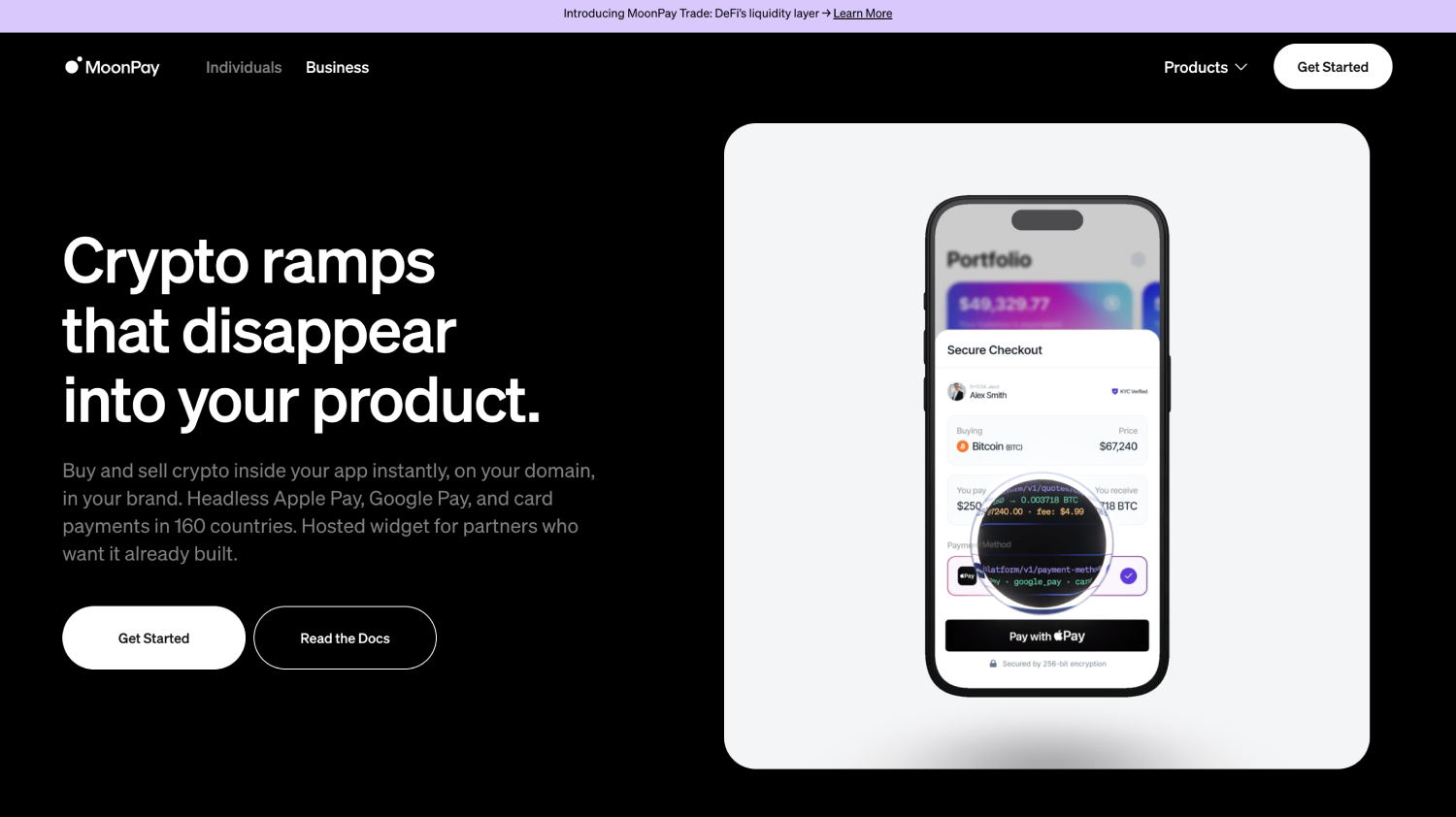
MoonPay Business offers merchant payment acceptance for USDC and other stablecoins, built on MoonPay’s existing on/off-ramp infrastructure. Merchants can accept USDC from customers and receive fiat settlement. MoonPay operates under money transmission licenses across multiple US states and has regulatory coverage in Europe under e-money institution frameworks.
The licensed infrastructure is MoonPay’s primary credential for merchants who need a compliant payment partner. If your business operates in regulated industries or you have legal or compliance requirements that make your gateway provider’s licensing status relevant, MoonPay’s license coverage is one of the more documented on this list. The company publishes its license status on its website.
MoonPay Business does not publish merchant pricing on its public website as of October 2026; merchants should contact the sales team for fee structures. The product is newer to the merchant acceptance side of the market compared to MoonPay’s consumer on-ramp, and the merchant feature set is still developing relative to dedicated gateways like BitPay or NOWPayments.
9. CoinGate
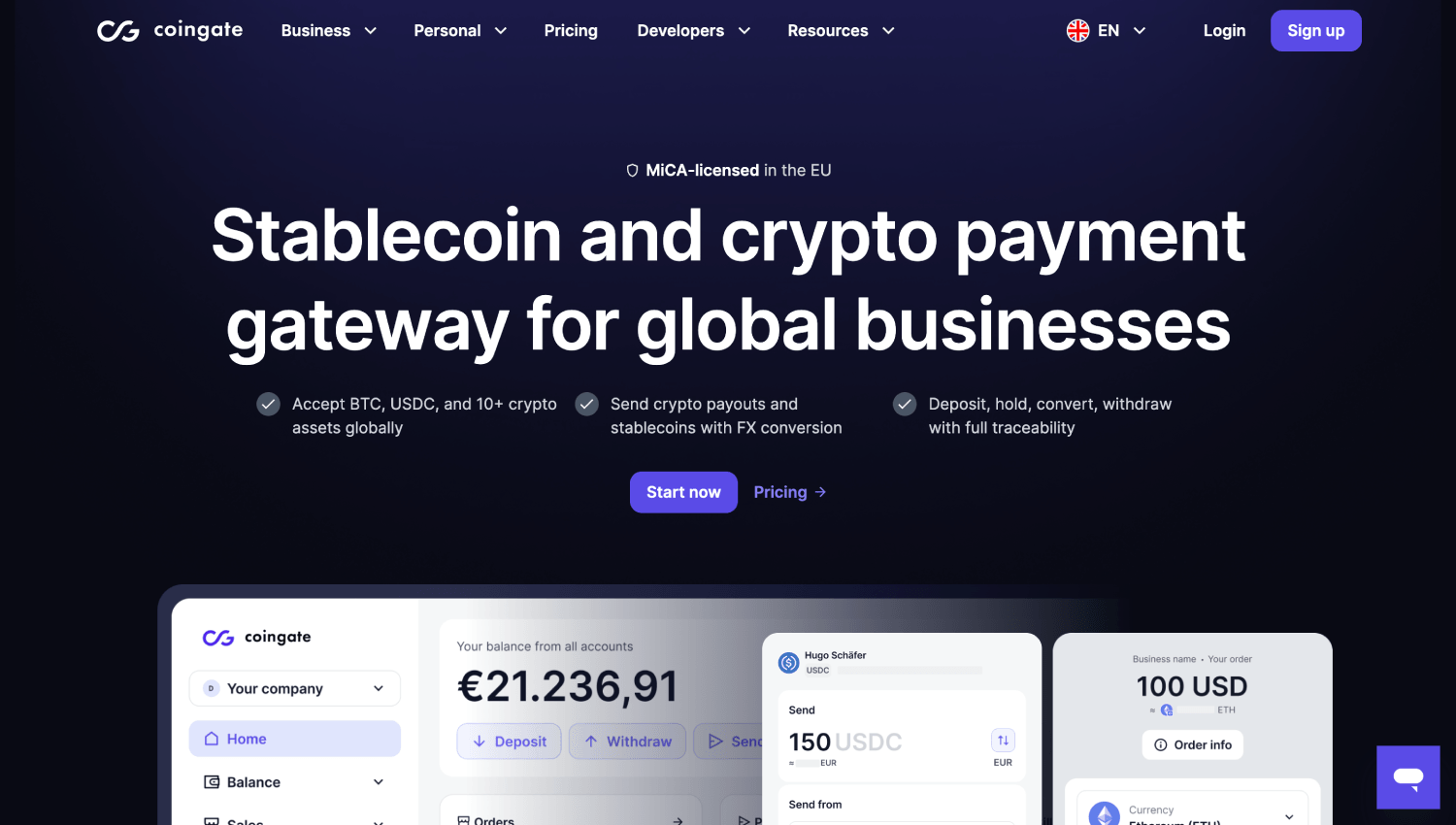
CoinGate is a Lithuania-based crypto payment gateway, licensed as a virtual asset service provider in the EU. It supports USDC and converts to EUR or USD for fiat settlement. The transaction fee is 1% per transaction, per CoinGate’s public pricing page as of October 2026. Settlement to a bank account typically takes one to two business days after conversion.
CoinGate’s strongest use case is European merchants who want USDC alongside a full suite of crypto payment options and need a licensed EU provider. Its Shopify and WooCommerce plugins are well-maintained, and the hosted payment page requires minimal technical integration. For a European ecommerce merchant, CoinGate is one of the cleaner starting points in this category.
For US merchants, CoinGate’s settlement path involves currency conversion from USD to EUR and back, which adds a step and potential FX cost. US-headquartered merchants with domestic customer bases are better served by Stripe, BitPay, or NOWPayments, all of which have cleaner USD-to-USD settlement paths.
10. Wert
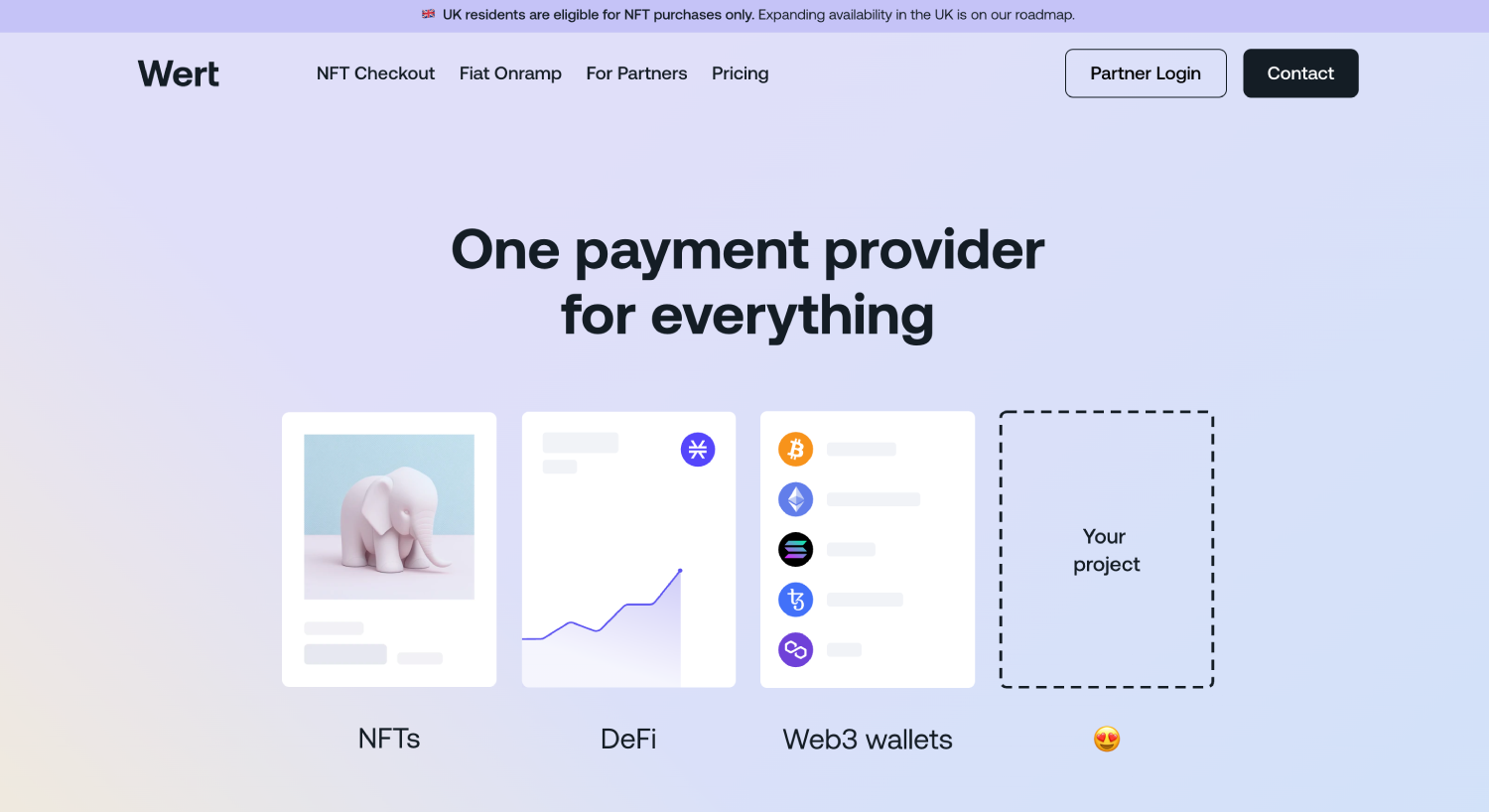
Wert is a checkout provider that allows buyers to purchase with credit cards, debit cards, or USDC and receive digital goods, NFTs, or stablecoins on the other side. Like Crossmint, it is primarily designed for Web3 and digital goods commerce. It abstracts wallet management from buyers entirely, which is the core value proposition.
Wert’s differentiation from Crossmint is in its geographic coverage and card network partnerships. The company has built out credit card acceptance in markets where Crossmint has less penetration, making it relevant for digital goods merchants with European and emerging market audiences. Fiat settlement options depend on the merchant’s jurisdiction and are handled through Wert’s licensed partners.
Wert does not publish pricing on its public website as of October 2026. Wert is a strong candidate for any merchant building a Web3-adjacent product where the buyer experience matters as much as the settlement mechanics. For a traditional ecommerce merchant adding USDC as a payment method, the product’s feature set is more than you need.
Side-by-Side Comparison: Fees, Settlement, and Chain Support
| Gateway | Transaction Fee (Oct 2026) | Fiat Settlement | Settlement Speed | Key Chains | Best For |
|---|---|---|---|---|---|
| Stripe | 1.5% | Yes, auto-convert | T+2 (standard) | Ethereum, Solana, Polygon | Existing Stripe merchants |
| Coinbase Commerce | 0% (network fees apply) | Manual (off-ramp required) | Depends on off-ramp | Ethereum, Polygon, Base | Crypto-native merchants |
| BitPay | 1% | Yes, direct to bank | Next business day | Ethereum, Polygon | Proven reliability, legacy integrations |
| Triple-A | Not publicly listed | Yes, multi-currency | Varies by region | Multiple | Cross-border, EU/SEA merchants |
| Crossmint | Not publicly listed | Yes | Varies | Multiple | NFT and digital goods commerce |
| Shift4 | Negotiated | Yes, to existing Shift4 account | Standard Shift4 schedule | Multiple | Enterprise merchants already on Shift4 |
| NOWPayments | 0.5% | Yes (jurisdiction-dependent) | Varies | Ethereum, Solana, Polygon, BSC | Low-fee, crypto-first stores |
| MoonPay Business | Not publicly listed | Yes | Varies | Multiple | Compliance-sensitive merchants |
| CoinGate | 1% | Yes, EUR/USD | 1-2 business days | Ethereum, Polygon | EU ecommerce merchants |
| Wert | Not publicly listed | Yes (via licensed partners) | Varies by region | Multiple | Web3 checkout, card+crypto buyers |
How Does Fiat Settlement Actually Work When You Accept USDC?
The technical process has three steps, and most merchants only understand the first one. A customer sends USDC from their wallet to the gateway’s payment address. The gateway confirms receipt on-chain, typically within seconds on Solana or Base, or one to two minutes on Ethereum with sufficient block confirmations. The gateway then converts USDC to USD at the spot rate and queues a fiat transfer to the merchant’s bank account.
The conversion happens at the rate USDC trades against USD at the moment of payment. Because USDC is pegged to the dollar, that rate is almost always within a fraction of a cent of $1.00. Merchants do not experience meaningful slippage the way they would accepting Bitcoin or Ether. This is the structural advantage of stablecoins over volatile crypto for merchant acceptance.
The bank transfer step is where providers differ most. Stripe uses its existing Stripe payout infrastructure, which processes billions of dollars per year. The USDC settlement path is new, but the downstream payout infrastructure is not. BitPay sends ACH or wire depending on the merchant’s setup, with next-business-day timing in most cases. NOWPayments’ fiat withdrawal timing depends heavily on jurisdiction and which banking partners are active in a given region. Merchants processing meaningful volume should test this step in a live environment before committing to a primary gateway. If you are evaluating whether the stablecoin route actually reduces your payment infrastructure costs, the payment infrastructure cost breakdown for SaaS founders is a useful comparison frame.
What Does Accepting Stablecoins Online Actually Cost Compared to Cards?
Consider a merchant processing $50,000 per month in international orders. On Stripe card payments, the combined rate for international Visa or Mastercard transactions with currency conversion , which Stripe breaks out as a base processing fee plus a cross-border fee plus a currency conversion fee on its public pricing page , reaches roughly 3.9% in a typical scenario. That is $1,950 per month in processing cost. Merchants should verify the exact combination of fees applicable to their account and customer mix directly with Stripe, since the total depends on card type, country of issuance, and whether currency conversion applies.
The same volume through Stripe’s USDC gateway at 1.5% costs $750 per month. Through BitPay at 1%, it costs $500 per month. Through NOWPayments at 0.5%, it costs $250 per month. The annual difference between card processing at the high end of the international rate range and the cheapest published stablecoin rate on this list is $20,400 per year at $50,000 monthly volume. That is before accounting for chargeback costs, which disappear entirely on stablecoin transactions.
The catch is conversion friction. A merchant’s international customers need to hold USDC to pay with it. Adoption rate among buyers who are not crypto-native remains low. Most merchants who add USDC checkout report it as an additive option, not a replacement for cards. The fee savings apply only to the portion of customers who actually pay with USDC. That percentage varies by product category, audience, and how prominently the option is presented at checkout.
Which Stablecoin Gateway Settles Fiat to a US Bank Account Most Reliably?
Stripe and BitPay are the clearest answers for US merchants who need predictable USD settlement to a business checking account. Stripe’s infrastructure is built on top of its existing Stripe Financial connections and payout system, which processes billions of dollars per year. The USDC settlement path is new, but the downstream payout infrastructure is not. BitPay has over a decade of operating history specifically in crypto-to-bank settlement, and its next-business-day ACH to US banks is well-documented.
NOWPayments is competitive on fees but less predictable on US bank settlement timing, particularly for smaller merchants. CoinGate is best suited for EU merchants settling in EUR. Triple-A and MoonPay Business are strong on compliance documentation and multi-jurisdiction coverage, but their US bank settlement paths involve more complexity and less transparency in their public documentation. For merchants who need rock-solid USD settlement first, then want to optimize on fees, the decision order is: confirm settlement to your bank account works, then negotiate rate.
This is also where the stablecoin-to-bank off-ramp providers comparison becomes relevant. Some merchants use a gateway for USDC acceptance and a separate off-ramp for conversion and settlement, particularly if they want to hold USDC for treasury purposes before converting.
Do You Need a Separate License to Accept USDC as a Merchant?
In the United States, a merchant accepting USDC as payment for goods or services and immediately converting to USD through a licensed gateway does not typically need a money transmitter license. The gateway holds the license. This is the same structure as a merchant using Stripe for card acceptance without needing a card acquiring license. The licensing burden sits with the intermediary, not the end merchant.
The distinction changes if a merchant accepts USDC and holds it in a wallet under their control without immediately converting. Holding crypto and subsequently converting creates a different regulatory analysis that may implicate money transmission in some states. Merchants who want to hold USDC for treasury or yield purposes before settling should get a legal opinion specific to their state of operation. The stablecoin licensing framework for platforms covers which licenses your infrastructure providers need and how that affects your own compliance posture.
Outside the US, regulatory requirements vary significantly. Triple-A and CoinGate hold licenses in Singapore and the EU respectively. MoonPay holds licenses across multiple jurisdictions. If your merchant business operates in markets with specific virtual asset service provider registration requirements, your gateway must be licensed in those markets. Using an unlicensed gateway in a regulated jurisdiction is a compliance problem for the gateway, but it can also expose the merchant in some frameworks.
Frequently Asked Questions
Can I accept USDC payments without holding any crypto?
Yes. Stripe, BitPay, and NOWPayments all offer automatic conversion of USDC to USD at the point of payment. The merchant receives dollars in their bank account. The only party handling crypto in this flow is the gateway. You do not need a crypto wallet, a private key, or any cryptocurrency accounting treatment on your balance sheet.
How fast does USDC settlement reach my bank account?
Settlement speed depends on the gateway. BitPay typically delivers USD to a US bank account by the next business day via ACH. Stripe follows its standard T+2 payout schedule. NOWPayments’ timing varies by jurisdiction. Triple-A and MoonPay Business do not publish specific settlement windows publicly as of October 2026. Always confirm settlement timing with the provider before going live.
What chains should my stablecoin gateway support?
At minimum, Ethereum and one low-fee chain such as Solana, Base, or Polygon. Ethereum has the largest USDC holder base but high gas fees make it expensive for transactions under $100. Solana and Base have gas fees of fractions of a cent. A gateway that supports only Ethereum mainnet is functionally excluding buyers who hold USDC on cheaper chains, which is an increasing share of the market.
Is accepting USDC actually cheaper than accepting credit cards?
For international transactions, yes, in most cases. Card interchange plus cross-border fees on international Visa or Mastercard transactions typically runs 3% to 4% on Stripe as of October 2026, based on Stripe’s published fee components. USDC gateways charge 0.5% to 1.5% with no currency conversion fee. For domestic US transactions, the fee difference narrows. The savings are most pronounced on high-value, cross-border, or digital goods orders where chargeback risk on cards is also elevated.
Do stablecoin payments have chargebacks?
No. Blockchain transactions are irreversible by design. Once a buyer sends USDC and the gateway confirms the transaction, the payment is final. There is no chargeback mechanism. This eliminates a significant operational cost for merchants in high-chargeback categories such as digital goods, software, and subscription products. Dispute resolution for customer service issues must be handled through refunds, which the merchant initiates voluntarily.
Which stablecoin gateway is best for a Shopify store?
BitPay and CoinGate both offer maintained Shopify plugins as of October 2026. NOWPayments also has a Shopify integration. Coinbase Commerce supports Shopify through its official plugin. For a Shopify merchant who already uses Stripe for card payments, Stripe’s USDC option is the simplest addition since it sits within the same Stripe payment methods dashboard. For non-Stripe Shopify stores, BitPay’s Shopify integration and 1% fee structure is the most straightforward starting point.
How do I account for USDC payments in my bookkeeping?
For gateways that auto-convert USDC to USD at payment, the accounting treatment is functionally identical to receiving a wire transfer. You record revenue in USD at the dollar amount received. Because USDC holds its $1 peg at conversion, there is typically no foreign exchange gain or loss to record. For merchants who hold USDC before converting, the accounting is more complex and may require tracking the value at receipt and at conversion as separate events. Consult your accountant before choosing a non-converting gateway.
What is the minimum volume required to use these gateways?
Stripe, Coinbase Commerce, NOWPayments, BitPay, and CoinGate all have self-serve onboarding with no minimum volume requirement as of October 2026. Triple-A, Shift4, and MoonPay Business target higher-volume merchants and typically require a sales conversation before granting full access. Wert and Crossmint are also more enterprise-oriented in their go-to-market, though both offer developer access for testing.
How to Think About This Decision Before You Integrate
The right gateway is almost always determined by your existing payment stack before it is determined by crypto-specific features. A merchant on Stripe adds Stripe’s USDC option and keeps one reconciliation workflow. A merchant on Shopify without Stripe picks BitPay or NOWPayments and adds a plugin. A merchant building a Web3 product picks Crossmint or Wert for the buyer experience. The decision tree is shorter than most listicles make it appear.
What genuinely complicates the decision is the fiat settlement question, and that question deserves more scrutiny than the fee table. A 0.5% gateway that takes five days to settle to your US bank account is worse for cash flow than a 1.5% gateway that settles next business day, depending on your working capital situation. Fee comparisons are meaningful only when settlement mechanics are held equal. The hidden cost analysis for payment stacks applies here: the published rate is rarely the total cost of accepting a payment method.
One thing most merchants underweight: buyer adoption. Adding USDC checkout is a five-hour engineering task. Getting your customers to actually use it is a go-to-market problem. The merchants who report meaningful USDC payment volume are those who actively communicate it to their customer base, particularly to international buyers who pay conversion fees on card transactions and benefit from stablecoin checkout as much as the merchant does. The gateway is infrastructure. Adoption is a commercial decision that happens before you pick a provider.