
TLDR
- USDC and USDT are not the same product. According to Circle’s public disclosures, USDC holds reserves in US Treasuries and cash equivalents attested monthly by Deloitte; Tether publishes quarterly attestations via BDO Italia with a reserve composition that includes secured loans and other assets beyond Treasuries and cash.
- PYUSD runs on Ethereum and Solana with PayPal’s distribution network behind it, making it useful for consumer-facing corridors but thin on institutional liquidity outside those chains.
- RLUSD is Ripple’s dollar stablecoin, issued on XRP Ledger and Ethereum, with a reserve structure attested monthly per Ripple’s public disclosures and a primary use case in cross-border wholesale settlement.
- For most B2B payment corridors, the deciding variables are not the peg itself but reserve quality, chain availability, on/off-ramp depth, and regulatory status under emerging US law.
- The GENIUS Act, signed into law in 2026, created a federal licensing framework for payment stablecoins. How each issuer responds to that framework is now a live compliance variable, not a theoretical one.
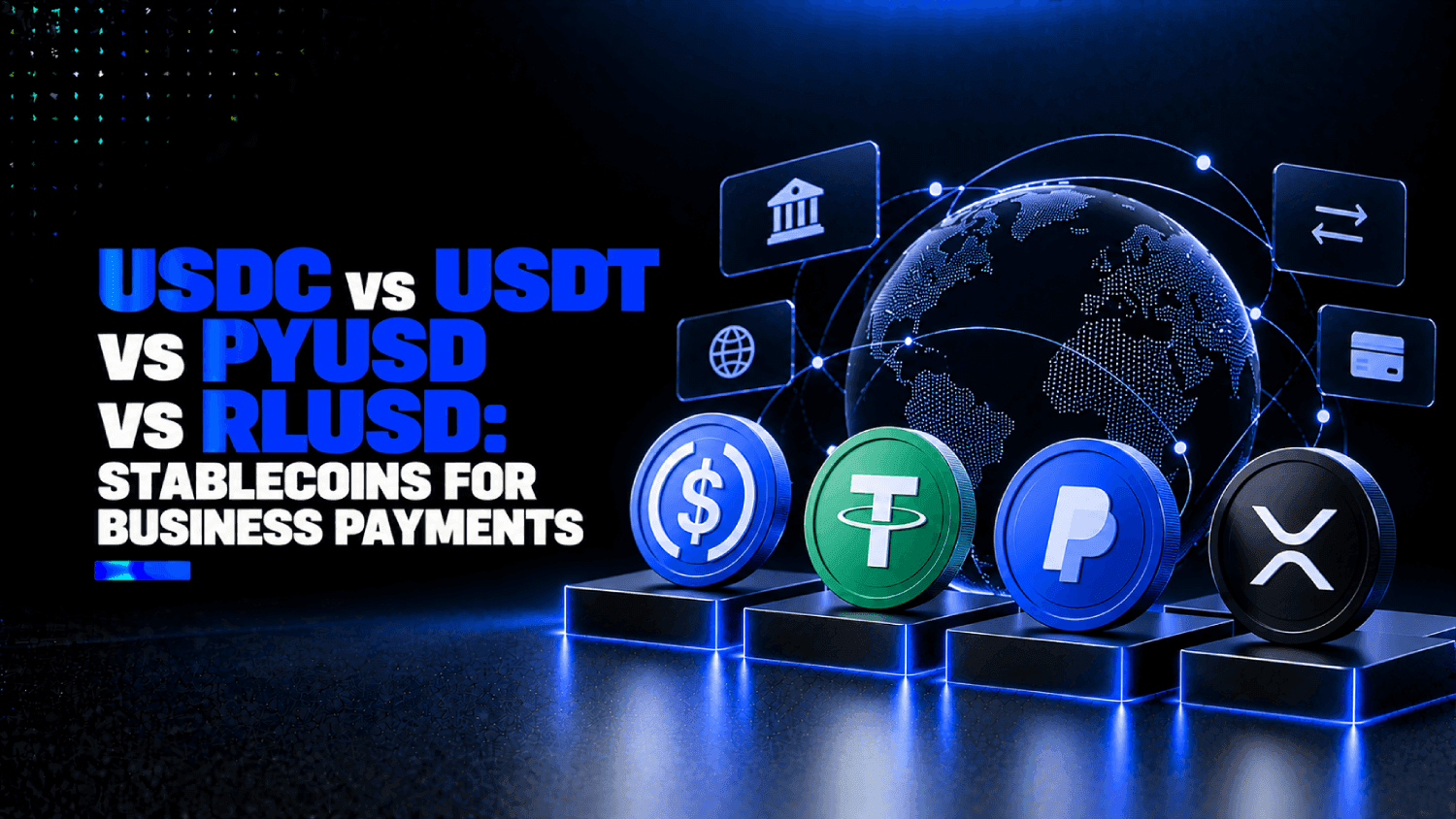
For businesses choosing a settlement stablecoin , and weighing USDC vs USDT for business payments in particular , USDC is the strongest default for US-regulated corridors due to its monthly reserve attestations, native CCTP bridging across 15+ chains, and Circle’s active pursuit of GENIUS Act compliance. USDT leads on global liquidity and exchange depth, making it better for corridors where fiat on/off-ramps are thin. PYUSD fits PayPal-native merchant flows. RLUSD is purpose-built for XRP Ledger cross-border settlement and is the youngest of the four with the thinnest secondary liquidity.
Why “Dollar Stablecoin” Is Not a Single Asset Class
Every dollar stablecoin promises a 1:1 peg to the US dollar. That promise is where the similarities end. What backs the peg, who holds it, which blockchains carry it, and what regulatory regime governs redemption all vary enough to produce materially different counterparty risk and operational cost profiles for a business treasury.
Think of it this way: a US Treasury bill and a money market fund that holds commercial paper are both “dollar assets,” but your CFO treats them differently on the balance sheet. The same logic applies here. Reserve composition, attestation frequency, issuer jurisdiction, and chain liquidity are the four variables that actually determine cost and risk. Chain support alone can add or eliminate a 20 to 80 basis point bridging fee per payment leg, depending on whether the counterparty is on the same network.
The GENIUS Act, signed into law in 2026, added a fifth variable: regulatory status. Payment stablecoin issuers now face federal licensing requirements covering reserve composition, redemption rights, and audit obligations. How each of the four issuers sits relative to that framework is no longer academic , it affects which coins a bank counterparty or institutional partner will touch. FintechSpecs has published a GENIUS Act compliance checklist for fintech startups that walks through the issuer requirements in detail, and a separate piece covering the Fed’s proposed rules under the GENIUS Act that were open for public comment in September 2026.
Reserve and Regulation: How USDC, USDT, PYUSD, and RLUSD Actually Differ
The table below maps the verifiable public facts on each stablecoin’s reserve structure, audit cadence, issuer, primary chains, and regulatory posture. Numbers without a public source are omitted.
| Stablecoin | Issuer | Reserve Composition (public disclosures) | Audit/Attestation | Primary Chains | GENIUS Act Status (as of Oct 2026) |
|---|---|---|---|---|---|
| USDC | Circle | Short-duration US Treasuries and cash equivalents held in segregated accounts, per Circle’s monthly reserve reports | Monthly attestations by Deloitte, per Circle’s public disclosures | Ethereum, Solana, Base, Arbitrum, Polygon, Avalanche, and 10+ others via CCTP | Circle publicly pursuing federal payment stablecoin license; engaged with GENIUS Act rulemaking per company statements |
| USDT | Tether | US Treasuries, cash and cash equivalents, secured loans, other assets per Tether’s quarterly reserve reports | Quarterly attestations by BDO Italia, per Tether’s public disclosures | Ethereum, Tron, Solana, Avalanche, Polygon, and others | Tether is not a US entity; compliance path under GENIUS Act publicly unresolved as of Oct 2026 |
| PYUSD | PayPal / Paxos Trust | US Treasuries, cash equivalents, and similar assets held via Paxos, per Paxos monthly reserve reports | Monthly attestations by Withum, per Paxos public disclosures | Ethereum, Solana | Paxos is a New York-chartered limited trust company; active engagement with federal framework per company statements |
| RLUSD | Ripple | US dollar deposits, short-term US Treasuries, and cash equivalents, per Ripple’s public disclosures | Monthly attestations by a Big Four firm, per Ripple’s public disclosures | XRP Ledger, Ethereum | Ripple pursuing US regulatory alignment post-SEC settlement; GENIUS Act posture evolving per company statements |
The gap that matters most for a US business: Tether is incorporated in the British Virgin Islands, and its compliance path under the GENIUS Act is publicly unresolved. That is not a disqualifier for corridors where USDT liquidity is irreplaceable, but it is a counterparty risk that belongs in your vendor due diligence. Circle, Paxos, and Ripple are all US-domiciled or US-regulated in some form, which makes their compliance trajectories more legible to a US compliance team. For a structured way to evaluate any of these vendors before committing, the fintech vendor evaluation framework covers the due diligence questions worth asking.
What Does the USDC vs USDT Liquidity Gap Actually Mean for Business Payments?
USDT has consistently held the largest market cap among dollar stablecoins and dominates trading volume on exchanges globally. That depth matters in practice: when a business needs to convert USDT to local fiat in a corridor like Southeast Asia or Latin America, the on/off-ramp infrastructure is often deeper and faster than for USDC, because exchange inventory on those rails skews toward USDT.
USDC has a different advantage: native programmability and multi-chain reach via Circle’s Cross-Chain Transfer Protocol (CCTP). A company settling on Base can burn and mint USDC on Ethereum without a bridge contract holding wrapped tokens. That removes a smart contract risk layer that exists in most cross-chain USDT transfers, which rely on third-party bridges. For a fintech building payment rails rather than trading, CCTP is a structural advantage, not a marketing claim.
For businesses reading our roundup of stablecoin payment APIs for fintech platforms, this distinction shows up at the infrastructure layer. APIs built on CCTP can settle finality in minutes without custody of bridged assets. USDT cross-chain moves typically go through intermediaries that add a settlement lag and a fee.
PYUSD vs USDC: Which One Works for B2B Commerce?
PYUSD’s structural advantage is distribution, not reserves. PayPal has hundreds of millions of consumer accounts and a merchant network that spans most of ecommerce. For a business that already collects payments through PayPal Checkout or Braintree, receiving or disbursing PYUSD within that network carries near-zero friction. The off-ramp is the PayPal balance itself, which fiat-settled merchants already use.
Outside that network, PYUSD’s liquidity thins quickly. It launched on Solana in 2024 to gain DeFi depth, and volume has grown, but it remains a distant third behind USDC and USDT in Solana DEX liquidity. For a B2B company routing supplier payments or cross-border contractor payouts, PYUSD’s effective corridor coverage is narrower than USDC unless both sides of the transaction are PayPal-native.
The reserve structure is solid. Paxos Trust, which issues PYUSD under a New York banking charter, holds reserves in the same category as USDC: short-term Treasuries and cash equivalents, with monthly attestations per Paxos’s public disclosures. The risk profile on the reserve side is comparable to USDC. The gap is liquidity breadth, not reserve quality.
RLUSD vs USDC: Is Ripple’s Stablecoin Ready for Enterprise Settlement?
RLUSD launched publicly in late 2024 after receiving NYDFS approval, per Ripple’s public announcements. Its primary design target is cross-border wholesale settlement on the XRP Ledger, where Ripple’s payments network already moves institutional volume. For a company already using RippleNet or ODL (On-Demand Liquidity) infrastructure, RLUSD is a natural complement. It settles on the XRP Ledger in 3 to 5 seconds at transaction costs that are fractions of a cent, which matters at scale.
The constraint is secondary market depth. RLUSD is the newest of the four and carries the thinnest liquidity outside the Ripple network. If a counterparty needs to exit RLUSD to fiat quickly outside of Ripple’s own network, the exchange infrastructure is sparser than USDC or USDT. That is a structural limitation of being newer, not a flaw in the reserve design. According to Ripple’s public disclosures, the coin’s reserves mirror USDC’s quality tier and are attested monthly by a Big Four firm.
For Ripple’s target buyer , a bank or payments company running cross-border settlement through XRP Ledger , RLUSD is purpose-fit. For a Series B SaaS company looking for a general-purpose stablecoin for accounts payable or contractor payouts, RLUSD is not the right starting point.
The FintechSpecs Settlement Corridor Matrix: Matching Stablecoins to Use Cases
The framework below, which we call the Settlement Corridor Matrix, maps each stablecoin to the business payment context where it outperforms the alternatives on a combination of liquidity, chain fit, regulatory posture, and on/off-ramp depth. Use it as a first filter, not a final decision.
| Business Payment Context | Best Stablecoin | Runner-Up | Why |
|---|---|---|---|
| US-to-US B2B settlement on Ethereum or Base | USDC | PYUSD | CCTP native bridging, regulated issuer, deep DEX liquidity on Base |
| Cross-border payouts to Southeast Asia, LatAm, Africa | USDT | USDC | Tron-based USDT dominates local off-ramp infrastructure in these corridors |
| PayPal merchant network payouts | PYUSD | USDC | Native settlement inside PayPal’s network; no external bridge needed |
| Wholesale/institutional cross-border via RippleNet | RLUSD | USDC | XRP Ledger settlement speed and Ripple ODL integration |
| DeFi treasury yield or on-chain lending | USDC | USDT | Deeper Aave/Compound integration, CCTP composability, stronger audit history |
| Solana-native B2B payments | USDC | PYUSD | USDC has deeper Solana DEX liquidity and broader wallet support |
| High-volume emerging market corridors (Tron) | USDT | USDC | USDT on Tron carries the majority of stablecoin transfer volume on that chain |
What Does GENIUS Act Compliance Actually Change for a B2B Buyer?
The GENIUS Act, signed into law in 2026, classifies payment stablecoins as a distinct regulated category. Issuers above a certain market cap threshold must hold a federal payment stablecoin issuer license, maintain reserves in approved assets (essentially US Treasuries, insured deposits, and equivalents), and redeem on demand at par. That is largely what Circle already does, per its public reserve reports. It is a structural challenge for Tether, whose non-US domicile and reserve complexity sit outside the framework as currently drafted.
For a US business, the practical implication is counterparty risk in the banking layer. If your sponsor bank or BaaS provider restricts which stablecoins it will custody or convert, GENIUS Act compliance status becomes a vendor selection variable, not just a legal curiosity. Banks that have started building stablecoin infrastructure licensing frameworks into their vendor requirements are already filtering on this. A business buying a stablecoin settlement solution today should ask their infrastructure provider which coins they support and why.
The Fed’s proposed implementing rules under the GENIUS Act were open for public comment in September 2026, introducing additional capital and liquidity requirements on top of reserve composition rules , as covered in detail here. That rulemaking is live, which means the compliance posture of each issuer will continue to shift. Checking current status rather than relying on cached analysis is worth the ten minutes it takes.
A Worked Scenario: $2M/Month in Cross-Border Contractor Payouts
Consider a US-based platform paying 800 contractors per month across Southeast Asia and Latin America, moving $2 million total. The platform routes through an infrastructure provider that supports both USDC and USDT. Here is how the corridor math plays out:
If the platform chooses USDC on Ethereum, most recipients in Southeast Asia need to convert USDC to local fiat through a regional exchange. Liquidity on those exchanges for USDC is thinner than USDT, meaning the spread at conversion may run wider than the USDT equivalent. Exchange liquidity data on specific corridor spreads is not publicly standardized, so the precise basis-point difference will vary by exchange and corridor , worth requesting directly from any infrastructure provider before committing to a routing decision. On a $2 million monthly flow, even a 30 to 50 basis point spread differential compounds quickly into a meaningful friction cost that the contractor absorbs or the platform funds. If the platform switches to Solana USDC, settlement fees drop to under a cent per transaction, but the same fiat conversion liquidity problem applies regionally.
If the platform routes USDT on Tron, the fiat conversion infrastructure in Bangkok, Manila, or Bogota is deeper, spreads are tighter, and recipients are more likely to have wallets that accept it natively. The tradeoff is the issuer’s regulatory posture and the platform’s own compliance team’s comfort with Tether’s attestation cadence. For a platform with a risk-tolerant treasury policy and an emerging market payout focus, USDT on Tron often wins on total cost. For a platform with US institutional investors or bank partners scrutinizing balance sheet composition, USDC with a slightly higher corridor cost is the defensible choice. Platforms exploring this infrastructure layer should review the leading stablecoin payout platforms for contractor payments to compare how providers abstract this routing decision. The cross-border payout API comparison is also worth reading before choosing a routing provider, since fiat corridor depth varies significantly by vendor.
Which Infrastructure Providers Support All Four Stablecoins?
Most stablecoin infrastructure providers that serve fintechs and B2B platforms support USDC as a baseline and add USDT support for emerging market corridors. PYUSD and RLUSD support is more selective. Coinbase Prime and Circle Mint offer deep USDC integration with institutional-grade custody and CCTP access (feature sets as of October 2026; verify current chain and stablecoin support directly). Bridge (now part of Stripe) and BVNK support multi-stablecoin routing with fiat on/off-ramp infrastructure across multiple corridors (as of October 2026). Zero Hash supports USDC, USDT, and PYUSD with a white-label settlement API that B2B SaaS platforms embed directly (as of October 2026; confirm current stablecoin coverage with the provider).
RLUSD support outside of Ripple’s own network is early. Most third-party infrastructure providers have not added RLUSD routing as of October 2026, which limits its utility for a platform that wants a single API to handle multiple stablecoins. Teams evaluating stablecoin infrastructure providers should verify RLUSD support explicitly, because most provider documentation still lists it as “coming soon” or does not list it at all. The BVNK vs Bridge vs Conduit infrastructure comparison covers how these providers differ on multi-stablecoin routing in more detail.
Frequently Asked Questions
Which stablecoin is safest for a US business to hold on its balance sheet?
USDC carries the strongest case for a US business balance sheet. According to Circle’s public reserve reports, it holds reserves in short-duration US Treasuries and cash equivalents in segregated accounts, with monthly attestations by Deloitte. Circle is actively pursuing a federal payment stablecoin license under the GENIUS Act per company statements. PYUSD through Paxos is comparable on reserve quality, per Paxos’s public disclosures. USDT’s reserve complexity and non-US issuer status create more questions for a US CFO reviewing counterparty risk. RLUSD’s reserves are clean per Ripple’s public disclosures, but the coin is new and liquidity is thin.
Does USDT actually hold enough reserves to redeem at par?
Tether publishes quarterly attestations by BDO Italia showing reserves that exceed outstanding USDT, per Tether’s public disclosures. Those attestations confirm the reserve exists but are not a full audit of internal controls or the quality of every reserve asset. Tether’s reserve composition has historically included secured loans and other assets beyond Treasuries and cash, which creates a more complex risk profile than USDC or PYUSD. No major redemption failure has occurred, but the attestation cadence and reserve complexity are legitimate due diligence considerations.
Is PYUSD vs USDC a meaningful distinction for a SaaS company?
For a SaaS company that does not have PayPal deeply embedded in its payment stack, PYUSD offers little practical advantage over USDC. Both have clean reserve structures and monthly attestations per their respective issuers’ public disclosures. USDC runs on more chains, has deeper DeFi liquidity, and broader exchange support. PYUSD is worth prioritizing only if your payment flow is PayPal-native, where settlement stays inside the PayPal network and avoids external on/off-ramp friction entirely.
What is RLUSD and is it ready for enterprise use?
RLUSD is Ripple’s US dollar stablecoin, which launched publicly in late 2024 with NYDFS approval per Ripple’s public announcements. It runs on the XRP Ledger and Ethereum, with reserves in US dollar deposits and short-term Treasuries attested monthly per Ripple’s disclosures. It is purpose-built for Ripple’s cross-border settlement infrastructure. As of October 2026, it is ready for enterprise use within the Ripple network. Outside of RippleNet and XRP Ledger, secondary liquidity is thin and third-party infrastructure support is limited. Companies not already on Ripple’s rails have limited reason to start with RLUSD.
How does chain choice affect stablecoin payment costs?
Chain choice is often the largest variable in stablecoin payment cost. Ethereum mainnet gas fees can run $2 to $20 or more per transaction during congestion periods, which makes it impractical for sub-$500 payments. Solana and Tron transaction fees run under a cent. Base (an Ethereum L2) runs 1 to 5 cents per transaction in most conditions. USDC on Solana or Base is meaningfully cheaper to move than USDC on Ethereum mainnet for high-frequency, lower-value business payments. USDT on Tron is similarly cheap and is the dominant chain for USDT volume globally.
Do I need a money transmitter license to use stablecoins for business payments?
Whether a business needs a money transmitter license depends on whether it is transmitting funds on behalf of others, not on whether it uses stablecoins as the settlement asset. A business paying its own contractors or suppliers in stablecoins from its own treasury is not typically acting as a money transmitter. A platform that holds user funds and routes payments on their behalf likely is. Infrastructure providers like Bridge, BVNK, and Zero Hash hold the relevant licenses so their business customers do not need to. Consult legal counsel for your specific structure. The state-by-state money transmitter license cost breakdown is a useful reference for understanding the licensing geography.
How does the GENIUS Act change which stablecoin I should use?
The GENIUS Act creates a federal payment stablecoin issuer license requiring US-domiciled issuers, approved reserve assets, and on-demand redemption at par. Circle is actively pursuing compliance per company statements. Paxos already operates under a New York charter consistent with the framework’s requirements per its public disclosures. Tether, as a non-US issuer, does not have a clear GENIUS Act compliance path as of October 2026. If your bank counterparties or institutional investors require GENIUS Act-compliant stablecoins, USDC and PYUSD are the defensible choices. For corridors where USDT is operationally necessary, document the business rationale and monitor the rulemaking actively. The GENIUS Act compliance checklist is a useful starting point for that documentation.
Which stablecoin has the best support across the most blockchains?
USDC leads on multi-chain support. As of October 2026, Circle’s Cross-Chain Transfer Protocol (CCTP) supports native burn-and-mint transfers on Ethereum, Solana, Base, Arbitrum, Optimism, Polygon, Avalanche, and several other chains without relying on third-party bridge contracts, per Circle’s public documentation. USDT runs on more total chains by count, including Tron, but cross-chain USDT moves typically go through third-party bridges that carry smart contract risk. For a business building on multiple chains or expecting to expand chain support over time, USDC’s CCTP architecture provides a more predictable infrastructure foundation.
Conclusion
The core mental model for stablecoin selection at the business level is a two-step filter. First: which corridors do you actually need to settle in, and where does the counterparty liquidity live on those corridors? That narrows the field faster than any reserve analysis. USDT wins on corridor breadth. USDC wins on chain flexibility and regulatory legibility. PYUSD wins inside PayPal. RLUSD wins inside Ripple.
Second: what is your compliance team’s risk tolerance for issuer posture under the GENIUS Act? That question is no longer theoretical. If you have bank partners or institutional LPs that will ask which stablecoins sit on your balance sheet, USDC and PYUSD are the answers that will not trigger follow-up questions. USDT requires a documented rationale. The infrastructure layer matters too: as you evaluate providers, ask specifically which stablecoins they support, which chains they route on natively, and whether their GENIUS Act compliance path is documented. That conversation will surface the real constraints faster than any feature comparison matrix.
The businesses that will get this wrong are the ones that pick a stablecoin based on brand familiarity and then discover their infrastructure provider’s corridor coverage does not match their payment geography. Picking the coin first and the infrastructure second is the wrong order of operations. The infrastructure provider’s supported corridors, chains, and regulatory posture should set the constraint. The stablecoin selection follows from that. Teams building this out for the first time will find the stablecoin payment infrastructure RFP framework useful for structuring that vendor conversation before signing anything.