
TLDR
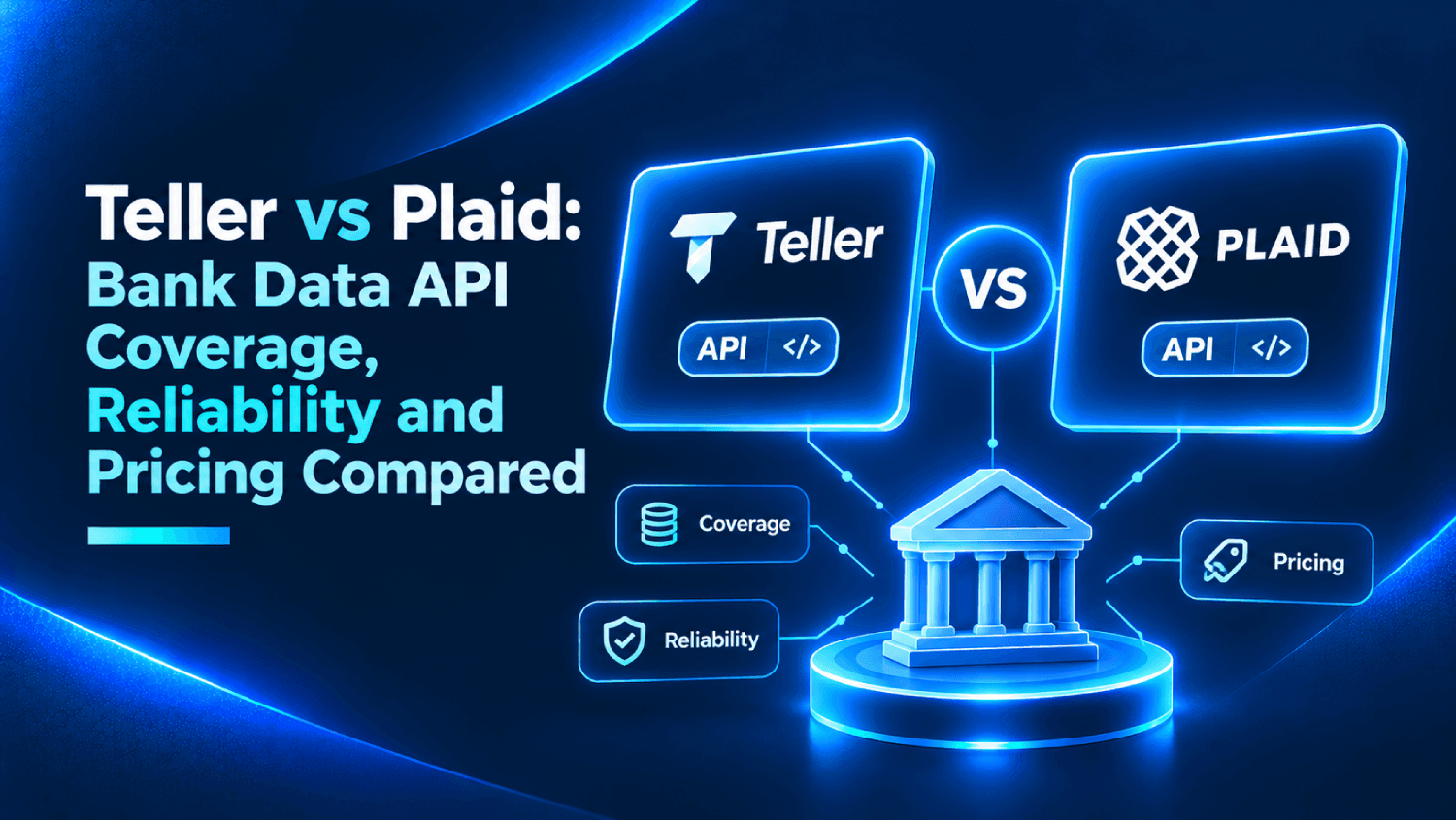
- Plaid connects to more US banks by volume, but Teller uses direct core banking connections at a subset of institutions, which produces cleaner, more reliable data where it works.
- Teller’s pricing structure is simpler and cheaper at low-to-mid volume; Plaid’s pricing is negotiated at scale and often carries per-product fees that compound quickly.
- If your app needs real-time balance checks or transaction data for accounts at major US banks, Teller’s direct connections are worth serious consideration.
- Plaid wins on breadth: it covers far more institutions and has the richer product suite for identity verification, income, and assets.
- The right answer depends almost entirely on your institution coverage needs and whether you want API simplicity or product depth.
Teller is the stronger technical choice for developers who need reliable, real-time transaction and balance data at the major US banks it covers directly. Plaid covers more institutions and offers a broader product set including income verification and identity, making it the default for apps that need maximum coverage or non-transaction data products. At lower volumes, Teller is cheaper. At scale, pricing for both is negotiated.
Why Plaid’s Default Status Deserves a Second Look
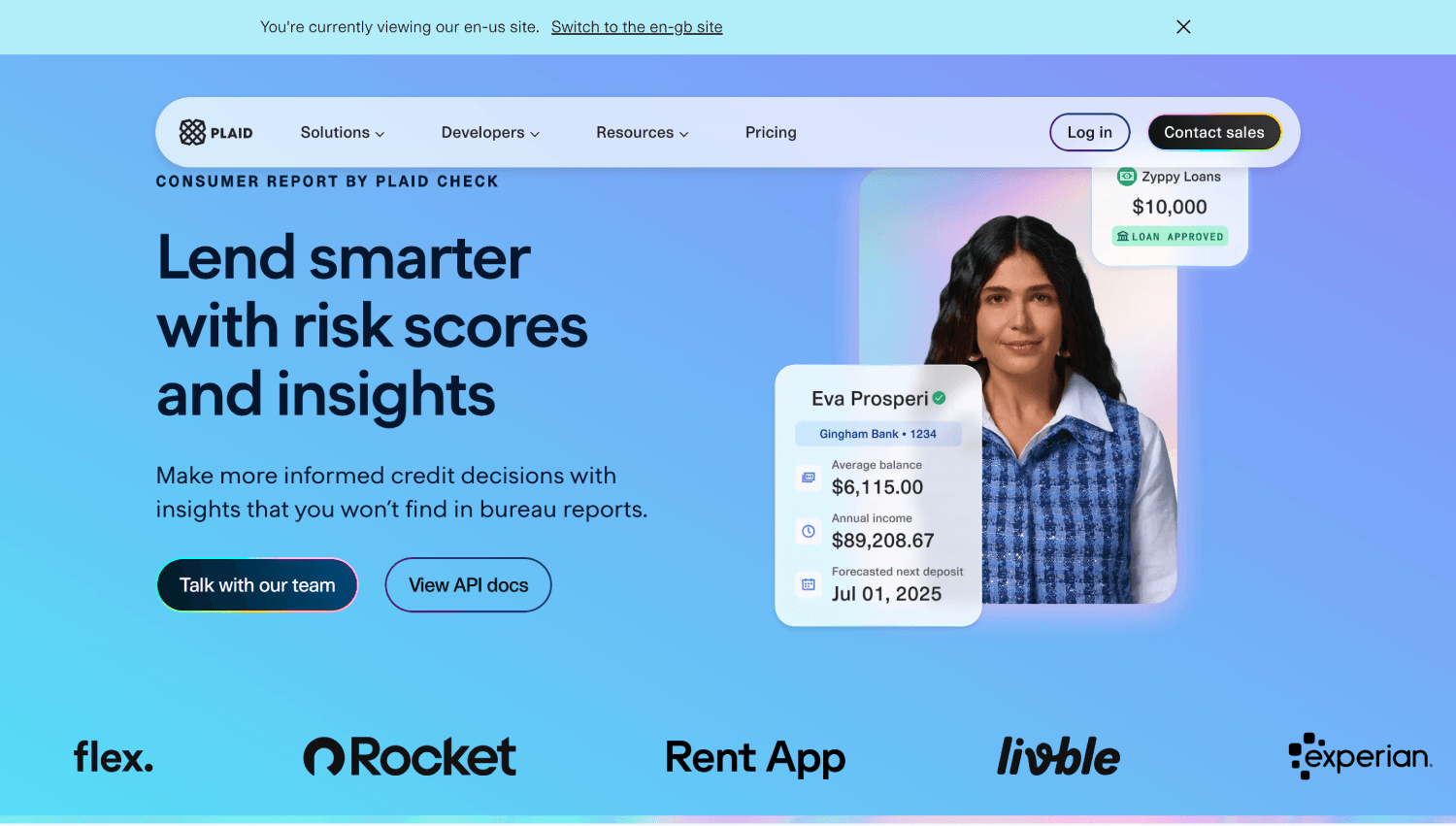
Most developers evaluating bank data APIs start with Plaid because it is the name they already know. That familiarity is earned: Plaid built the category, has connected tens of millions of consumer accounts, and covers thousands of US institutions. For many apps, it is simply the correct choice.
But the reason developers end up on Reddit threads about Teller is usually the same: data quality problems. Plaid’s broad coverage comes largely from its network of connections built through screen scraping and OAuth, and the reliability of those connections varies. When a bank updates its login flow or enforces a new session token policy, Plaid connections at that institution can break, sometimes for days. That is not a hypothetical. It shows up repeatedly in developer forums and in support queues.
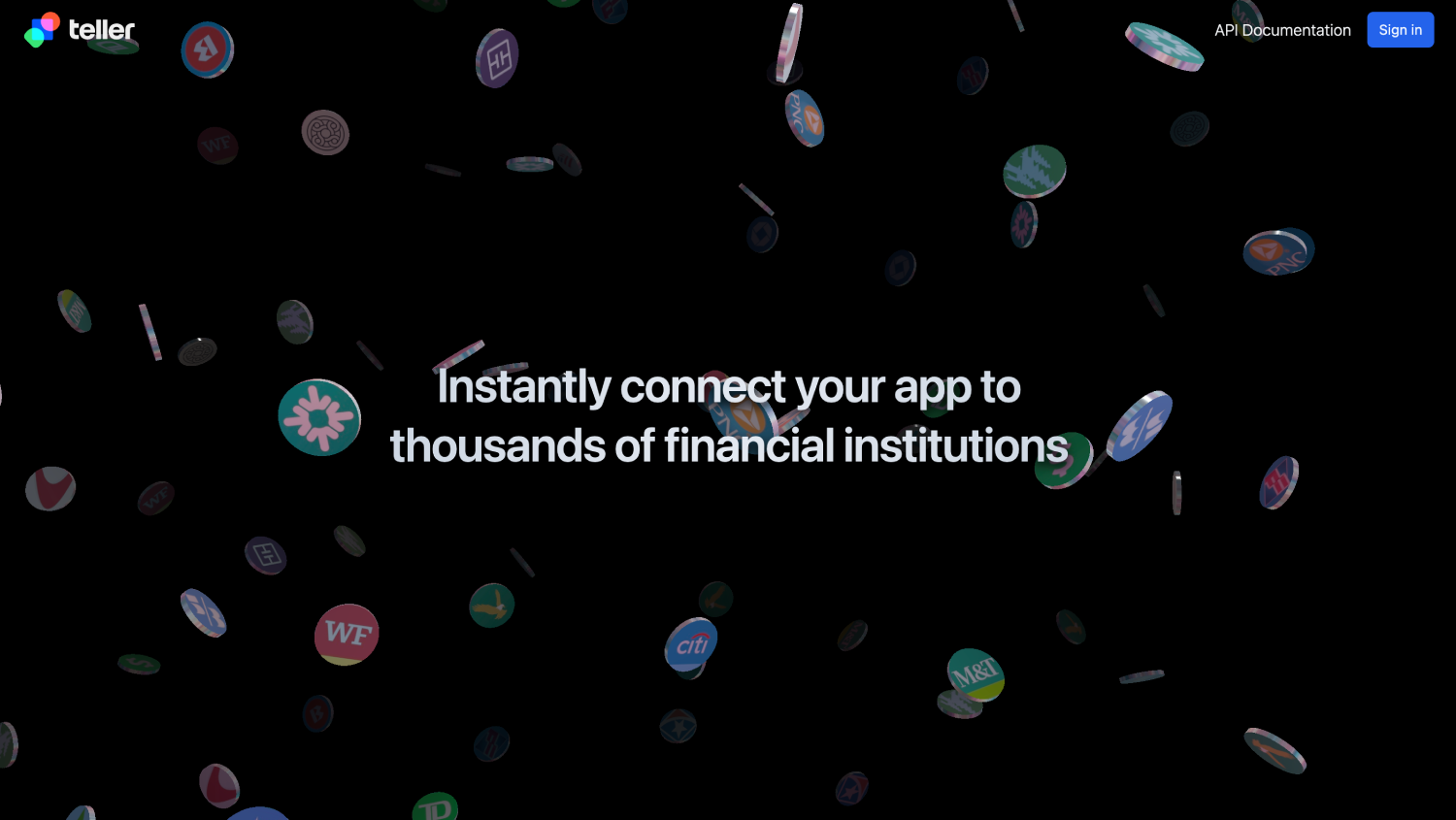
Teller took a different architectural bet. Rather than connect to every institution through every available method, Teller built direct integrations with a smaller number of large banks by integrating with their core banking systems. The result is a narrower coverage footprint but, within that footprint, connections that do not break when a bank changes its consumer-facing login page.
How Do Teller and Plaid Actually Connect to Banks?
This is the most important technical distinction in the comparison, and most write-ups skim over it.
Teller’s Direct Bank Connections
Teller’s homepage states that it connects directly to bank cores at the institutions it supports. When a user authenticates through Teller, that authentication talks to the bank’s internal infrastructure rather than simulating a consumer login. The practical consequence, if that architecture holds as described: Teller does not depend on screen scraping, so layout changes or multi-factor authentication changes on a bank’s website should not affect Teller’s data feed. However, Teller’s official pricing page does not confirm ledger-direct balance delivery as a differentiating feature, and the available source material does not describe Teller’s architectural approach to balance data freshness in enough technical detail to verify specific claims about data latency. Developers evaluating this should ask Teller directly about balance freshness guarantees for their target institutions before building on that assumption.
Plaid’s Multi-Method Connectivity
Plaid uses a mix of OAuth integrations, where banks have officially partnered with Plaid to allow token-based access, and legacy screen scraping for institutions that have not. Its OAuth coverage has expanded significantly as open banking regulation and bilateral agreements have grown. For the largest US banks, Plaid now uses OAuth with Chase, Bank of America, Wells Fargo, and others. But for the long tail of smaller banks, credit unions, and regional institutions, screen scraping remains in the mix. Plaid covers thousands of US institutions, the company does not publish a specific institution count on its public pricing page, so claims about an exact total cannot be independently verified against that source, which Teller cannot match.
What This Means for Connection Reliability
At the specific institutions where Teller operates, its direct connections are designed to produce higher data consistency than scrape-based connections at the same institutions. That is the real argument for Teller. At the thousands of institutions Teller does not cover, Plaid has no competition in this comparison at all because Teller simply does not support them.
Which US Banks Does Teller Actually Support?
Teller’s coverage list includes major US banks such as Chase, Bank of America, Wells Fargo, Citi, US Bank, Capital One, and several others. The company does not publish a complete list publicly with real-time accuracy, so checking Teller’s developer documentation before committing to a build is worth doing. If your users are primarily at the top ten US banks by deposit volume, Teller likely covers them. If a meaningful portion of your users bank at credit unions, community banks, or regional institutions, Teller will leave gaps that Plaid fills.
This institution gap question is the fastest way to filter the decision. Build a rough distribution of where your users actually bank. If 85 to 90 percent are at the major institutions Teller supports, the reliability benefit is real. If that number is closer to 60 percent, you are either building a fallback Plaid integration anyway or leaving a significant user segment stranded.
Teller vs Plaid Pricing: What You Actually Pay
Both companies negotiate pricing at scale, so published rates are most relevant for early-stage products. Here is what is publicly known.
Teller Pricing
Teller’s public pricing page lists a free tier for development use, then a production tier with per-endpoint pricing. According to Teller’s official pricing page, the Production tier is priced as follows: Verify costs $1.50 per account, Balance costs $0.10 per API call, Transactions costs $0.30 per enrollment per month, and Identity costs $1.75 per API call. There is no flat rate of $1 per enrolled account per month, the total cost depends on which endpoints you call and at what volume. That per-endpoint structure still offers more predictability than Plaid’s multi-product fee layering, but it requires modeling your actual API call patterns before projecting costs accurately.
Plaid Pricing
Plaid’s pricing is product-specific and compounds. Plaid charges per API call or per linked item depending on the product. Its Transactions product, Auth product, Identity product, and Income product each carry separate pricing. Plaid does not publish full pricing publicly; developers are directed to contact sales for production rates above a free-tier limit. The free tier allows a limited number of Items, with paid plans structured around volume and product mix. According to terms shared in developer forums such as r/fintech, per-Item monthly fees range from under $1 to several dollars depending on products enabled, negotiated volume, and contract terms, though these figures are unverified and vary by account.
The Per-Product Cost Problem With Plaid
Say a lending app needs three Plaid products: Transactions, Auth, and Income. Each carries its own fee. At 10,000 active users, that multiplication becomes material fast. Teller’s per-endpoint model is structurally simpler to forecast once you know your call patterns. For a CFO building a fintech unit economics model, Teller’s pricing structure is easier to pressure-test than Plaid’s multi-product stack. Plaid’s pricing requires more assumptions. The hidden infrastructure costs in multi-product API bundles are a common margin leak that shows up late.
| Dimension | Teller | Plaid |
|---|---|---|
| Pricing model | Per endpoint/per call (see teller.io/pricing for current rates) | Per Item/month, per product, negotiated |
| Public pricing | Yes (endpoint-based; Transactions $0.30/enrollment/mo, Balance $0.10/call, etc.) | Partial; full pricing requires sales contact |
| Free tier | Yes (development only) | Yes (limited Items) |
| Multi-product fees | Endpoint-based; each call type priced separately | Yes (each product priced separately) |
| Enterprise pricing | Negotiated | Negotiated |
| Predictability | High (once call volume is modeled) | Moderate (depends on product mix) |
Which API Has Better Developer Experience?
Teller’s API surface is intentionally narrow. The developer documentation covers a limited number of endpoints because the product does fewer things. For a developer who needs transactions and balances, that narrowness is a feature: the integration is fast, the response schemas are consistent, and there is less surface area to get wrong. Developers who have worked with both APIs frequently describe Teller as cleaner to integrate at the cost of doing less.
Plaid’s developer experience has improved substantially from its earlier reputation for complexity. The Plaid Link component handles the user-facing authentication flow and abstracts most of the edge cases around different bank login flows. Its sandbox environment is comprehensive and well-documented. The tradeoff is that Plaid’s API surface is significantly larger, and teams integrating multiple products need to understand how those products interact, particularly around webhook handling and item refresh logic.
For a team building a new product and evaluating speed to integration, Teller is the faster path if coverage works. For a team that needs income verification alongside transaction data, Plaid is the only realistic choice in this comparison because Teller does not offer a comparable income product. For teams building full-stack fintech APIs across multiple data types, that product gap matters.
What Does Each API Actually Return?
| Product / Data Type | Teller | Plaid |
|---|---|---|
| Account balance | Yes (Balance endpoint, $0.10/call per teller.io/pricing) | Yes (varies by institution) |
| Transaction history | Yes (Transactions endpoint, $0.30/enrollment/mo) | Yes |
| Account and routing numbers | Yes (Verify endpoint, $1.50/account) | Yes (Auth product) |
| Identity verification | Limited (Identity endpoint, $1.75/call) | Yes (Identity product) |
| Income verification | No | Yes (Income product) |
| Investments / brokerage data | No | Yes (Investments product) |
| Liabilities / loan data | No | Yes (Liabilities product) |
| Asset reports | No | Yes (Assets product) |
| Instant micro-deposit verification | No | Yes |
| Webhook support | Yes | Yes |
The data product gap is wide. Plaid has built a full open banking data layer. Teller has built a very good version of one piece of that layer: account connectivity and transaction data. If your use case touches income verification, asset reporting, or investment account data, Teller is not in the running for now.
The FintechSpecs Coverage Stress Test: Four Questions Before You Choose
Rather than evaluating Teller and Plaid on abstract feature lists, run your decision through four specific checks. We call this the Coverage Stress Test.
1. Institution match rate: What percentage of your target users bank at institutions Teller directly supports? If you can answer this question with actual data from a user survey or existing account data, you can skip the theoretical comparison entirely and get a real number. Below 70 percent institution match, Teller requires a Plaid fallback or leaves users stranded.
2. Product completeness: Does your product require any data type beyond transactions, balances, and account numbers? If yes, Teller cannot serve that need today. Income verification for lenders, liability data for personal finance apps, and asset reporting for advisory tools all require Plaid or an alternative provider like MX or Finicity.
3. Volume economics: At your projected connected account count, which pricing model produces lower total cost? For a product at 2,000 active connected accounts using only transactions and balances, Teller’s per-endpoint pricing (Transactions at $0.30 per enrollment per month, Balance at $0.10 per API call, per teller.io/pricing) is modelable if you know your call volume. Plaid at equivalent volume requires a quote. Build both scenarios before signing.
4. Data freshness requirement: Does your product make decisions based on current balance data? For ACH payment authorization, cash advance underwriting, or overdraft risk scoring, stale balance data creates real financial risk. Teller’s direct connections are designed to give you current balances at the banks it supports, though you should confirm freshness guarantees with Teller directly for your target institutions. Plaid’s balance freshness varies by institution and connection method.
Who Should Choose Teller?
The clearest Teller use case is a neobank, cash advance product, or earned wage access app that serves users primarily at major US banks, needs current balance data for underwriting, and wants pricing it can model against actual API call patterns. The direct connection advantage matters most when a stale balance triggers a failed transaction or a declined advance that should have been approved. That is a user experience failure with a dollar cost attached.
Early-stage teams with tight engineering bandwidth also benefit from Teller’s simpler API surface. Getting a proof of concept running with Teller is faster than navigating Plaid’s full product suite when you only need two or three data points. Speed to integration has real value when you are trying to validate whether bank connectivity even solves your problem.
Teller is also worth evaluating for products where the target user demographic skews toward customers at big banks. A product designed for employees at large US corporations, or for users who self-select as customers of Chase or Bank of America, has a higher institution match rate by design. That demographic filter changes the math materially. For teams building in that space, the fintech niche selection itself shapes which connectivity provider wins.
Who Should Choose Plaid?
Plaid is the right default for any product that needs to support the full spectrum of US bank accounts without knowing in advance where users bank. Consumer personal finance apps, general-purpose budgeting tools, and financial aggregators cannot afford to leave credit union members or community bank customers without service. Plaid’s breadth of coverage handles that problem.
Plaid is also the only realistic choice in this comparison for products that need income verification, asset reports, or investment account data. Those products exist and are well-tested. Building a lending product that qualifies borrowers using bank-sourced income data means Plaid or Finicity, not Teller. For products evaluating full open banking API coverage across data types, the wider Plaid alternatives list is worth reviewing alongside this comparison.
Plaid also has a significantly longer track record in regulated environments. Its data handling agreements, compliance documentation, and existing bank data-sharing agreements matter for fintech teams going through licensing or institutional partnerships. If your compliance team asks about FCRA coverage or data retention policies, Plaid has established answers. Teller’s documentation in this area is thinner.
Can You Use Both Teller and Plaid Together?
Yes, and some teams do exactly this. The pattern: use Teller as the primary connection for accounts at major banks where its direct connection produces better data quality, and fall back to Plaid for institutions Teller does not cover. The integration complexity doubles, and you are paying for two vendors, but for products where data freshness matters and coverage cannot be compromised, it is a defensible architecture.
The more common reality is that most teams pick one and accept the tradeoff. Running dual bank data vendors adds engineering overhead, complicates webhook handling, and creates a support surface for diagnosing connection failures across two systems. That overhead makes sense for a funded team at scale. It rarely makes sense at seed.
Teller vs Plaid: A Decision Matrix
| Use Case | Better Choice | Reason |
|---|---|---|
| Cash advance / earned wage access | Teller | Direct core connection designed for current balance data; reduces declined advances |
| Personal finance / budgeting app | Plaid | Broad institution coverage across all account types |
| Lending with income verification | Plaid | Teller has no income product |
| ACH authorization with current balance check | Teller (if coverage works) | Direct core balance more reliable than refreshed cache |
| Investment or brokerage account aggregation | Plaid | Teller does not cover investment accounts |
| Low-volume startup, predictable cost model | Teller | Per-endpoint pricing (e.g. $0.30/enrollment/mo for Transactions) is modelable once call volume is known |
| High-volume product, negotiated pricing | Negotiate with both | Both offer enterprise pricing; Plaid’s product depth may justify premium |
| Credit union or community bank coverage | Plaid | Teller does not cover this segment |
Frequently Asked Questions
Is Teller a legitimate Plaid competitor or a niche alternative?
Teller is a legitimate competitor for specific use cases, particularly current balance and transaction data at major US banks. It is not a full Plaid replacement. Plaid covers more institutions, offers more data products, and has a longer compliance track record. Teller wins on connection reliability and pricing structure within its coverage footprint, which makes it the right primary choice for some products and a useful fallback component for others. Teams looking at the broader market for Plaid alternatives will find Teller as one of the more credible technical options.
How does Teller vs Plaid pricing compare at 5,000 connected accounts?
According to Teller’s official pricing page, cost at 5,000 active connected accounts depends on which endpoints you call and how often: Transactions is priced at $0.30 per enrollment per month, Balance at $0.10 per API call, and Verify at $1.50 per account. There is no flat per-account rate, so the total bill depends on your actual API call pattern. A product calling the Transactions endpoint only would pay $1,500 per month at 5,000 enrollments; adding frequent Balance checks would increase that figure based on call volume. Plaid does not publish equivalent production pricing publicly; teams need to contact Plaid’s sales team for a quote at that volume. According to terms shared in developer forums such as r/fintech, Plaid’s per-Item monthly cost can vary significantly based on products enabled and negotiated contract terms. Teller is the more modelable option at this volume, though Plaid’s negotiated rates at scale can close the gap.
Does Teller work for credit unions and community banks?
Teller’s coverage focuses on major US banks and does not extend broadly to credit unions or community banks. If a material portion of your user base holds accounts at non-major institutions, Teller will produce connection failures for those users. For coverage across the full spectrum of US financial institutions, Plaid remains the only real option in this comparison. The coverage gap is Teller’s most significant limitation and the primary reason many teams default to Plaid despite its higher complexity and less predictable pricing.
Is Teller faster to integrate than Plaid?
Generally yes, for simple transaction and balance use cases. Teller’s API surface is narrower, its documentation is concise, and there are fewer products to understand before going live. Plaid’s Link component handles the user authentication flow cleanly, but Plaid’s full product suite introduces complexity around webhooks, item management, and product-specific schemas that takes time to get right. A developer focused purely on retrieving transactions and balances can typically reach a working Teller integration faster. That speed advantage matters less once a team needs Plaid’s additional data products.
How does Teller handle open banking compliance under Section 1033?
Section 1033 of the Dodd-Frank Act, now being implemented through CFPB rulemaking, requires financial institutions to provide consumer-permissioned data access. Plaid has been deeply involved in the policy development process and has existing data-sharing agreements with major banks that align with this framework. Teller’s direct bank connections operate under agreements with the banks it supports, but Teller’s public compliance documentation is less extensive than Plaid’s. Teams building regulated fintech products should evaluate Section 1033 compliance requirements carefully and ask both vendors directly about their regulatory positioning before making a commitment.
What do developers say about Teller vs Plaid on Reddit and forums?
Developer sentiment on forums like Reddit’s r/fintech tends to converge on a few themes: Teller is praised for clean data, reliable connections at the banks it supports, and straightforward pricing. Plaid receives mixed feedback, with strong appreciation for its coverage and product depth alongside persistent complaints about connection breaks, webhook reliability, and customer support responsiveness at non-enterprise tiers. The developers most likely to recommend Teller are those who have experienced Plaid outages or data freshness issues and whose user base fits Teller’s coverage. Developers building consumer products with broad demographic reach tend to stay on Plaid despite the friction.
The Realistic Picture for a Founding Team
The practical reality for most seed-stage fintech teams is that Plaid is the safer default because its coverage means fewer user-facing failures during early testing, when you do not yet know the institutional distribution of your users. The cost at low volume is manageable, and discovering a data quality problem with Teller at institutions it partially supports is a worse outcome than paying slightly more for Plaid’s breadth.
The case for starting with Teller is strongest when the founding team already knows its users bank at major institutions, needs current balance data as a core product mechanic, and values pricing clarity over product depth. A cash advance product serving gig workers who direct-deposit into Chase, Bank of America, or Wells Fargo is an example where Teller’s architectural advantage is not theoretical. It affects approval rates, false declines, and unit economics directly.
At growth stage, the conversation changes. If Plaid’s connection reliability is producing measurable user churn during link re-authentication, or if multi-product pricing is compressing margins in ways that show up in the board deck, Teller becomes worth evaluating seriously as either a replacement or a parallel track. For teams evaluating infrastructure decisions at scale, the common fintech infrastructure mistakes around vendor lock-in and cost modeling are worth working through before any long-term contract negotiation.