
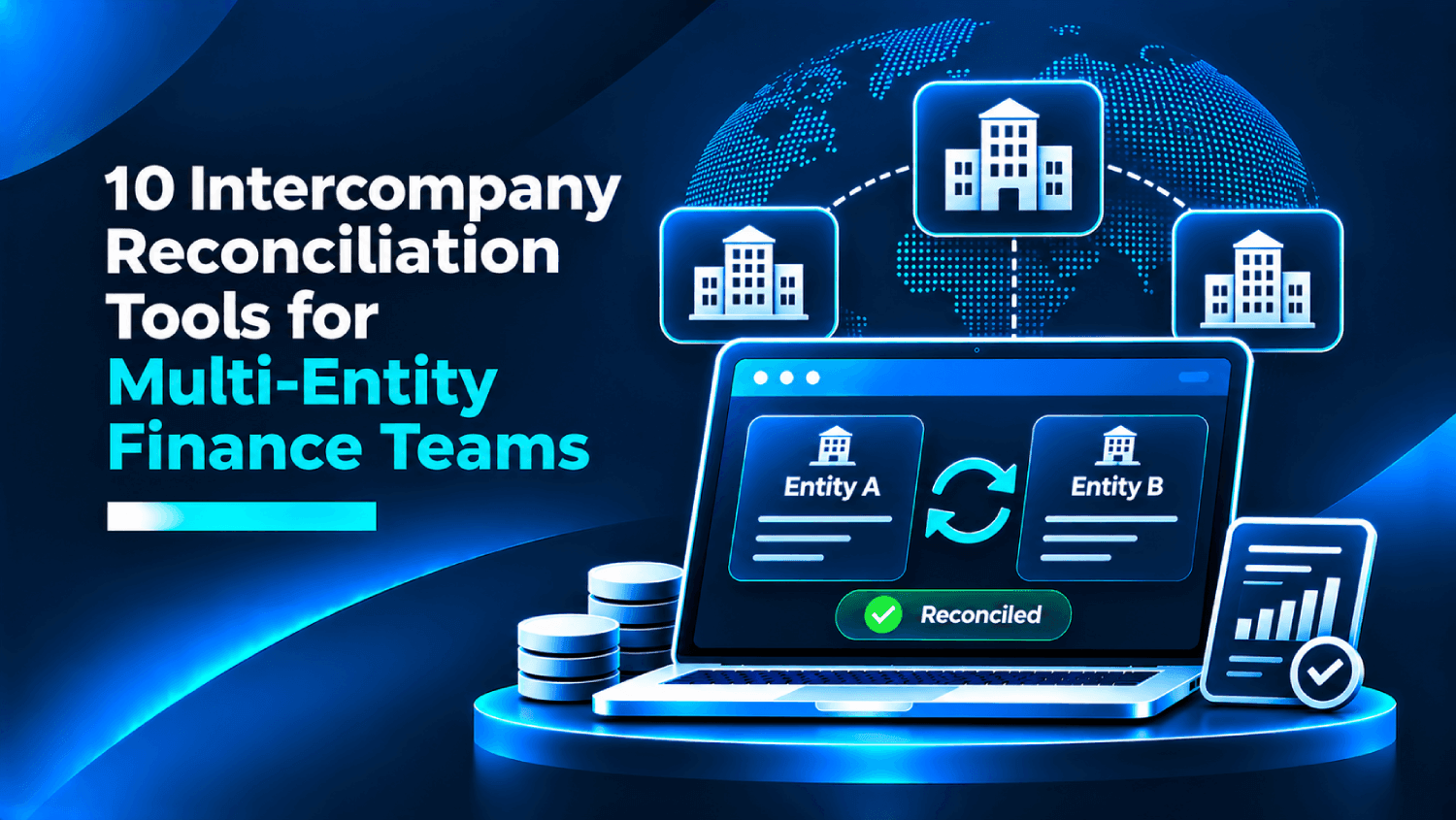

TLDR
- Standard account reconciliation tools match transactions to ledger entries. Intercompany reconciliation is a different problem: matching a payable in one entity against a receivable in another, then resolving disagreements before the books can close.
- The gap between “automated rec” and “intercompany rec” is counterparty matching logic, exception ownership, and elimination workflows. Generic tools handle the first; dedicated intercompany software handles all three.
- Most multi-entity finance teams discover this gap at close, when a subsidiary’s intercompany balance does not agree with its counterpart and no one knows who owns the dispute.
- The 10 tools below are evaluated specifically on entity-to-entity balance matching, exception handling, and audit trail depth. Netting and cash settlement are outside this scope.
The best intercompany reconciliation software for most mid-market multi-entity teams is BlackLine Intercompany Hub, ReconArt, or Prophix One, depending on ERP depth, entity count, and whether close workflow or balance matching is the primary bottleneck. BlackLine leads on audit and elimination workflow. ReconArt leads on configurable matching logic. Prophix One leads when FP&A and intercompany rec need to live in the same platform.
Why Do Multi-Entity Finance Teams Need Dedicated Intercompany Reconciliation Software?
A standard account rec tool confirms that a bank statement entry matches a GL posting. Intercompany reconciliation requires something harder: confirming that Entity A’s $450,000 intercompany receivable from Entity B maps to exactly $450,000 on Entity B’s books, flagging the $12,000 discrepancy in one invoice, assigning that exception to the right controller, and generating an audit trail that holds up under a consolidation review or audit.
The workflow has three distinct stages that generic tools do not cover as a unit. First, counterparty matching: pulling balances from two or more entities and comparing them line by line. Second, exception handling: surfacing disagreements, assigning ownership, and tracking resolution. Third, elimination preparation: producing the offset entries that disappear intercompany balances in consolidated financials.
Finance teams running more than four legal entities on separate ERP instances frequently find that close takes two to three extra days just on intercompany. Spreadsheet-based workflows compound the problem because there is no single source of truth, version control is manual, and audit documentation requires reassembling email threads. If you are evaluating the broader financial close stack, the financial close and month-end automation tools overview on FintechSpecs covers how intercompany rec fits into the full close sequence.
The FintechSpecs Intercompany Matching Rubric: How These 10 Tools Were Scored
To make this list genuinely useful for shortlisting decisions, each tool was evaluated against what we call the FintechSpecs Three-Gate Model for intercompany reconciliation software:
Gate 1: Counterparty Matching. Does the tool match entity-to-entity balances automatically, across multiple ERPs if needed, with configurable tolerance rules?
Gate 2: Exception Workflow. Does it assign unmatched items to named owners, track resolution, and prevent close sign-off until exceptions are cleared or approved for carry-forward?
Gate 3: Elimination Readiness. Does it produce or prepare intercompany elimination entries in a form that feeds the consolidation layer, with a time-stamped audit trail?
Tools that clear all three gates are strong fits. Tools that clear two are worth considering with a workaround. Tools that clear one belong in a different category entirely.
Which 10 Intercompany Reconciliation Software Platforms Should Finance Teams Evaluate?
| Tool | Counterparty Matching | Exception Handling | Elimination Workflow | Best For |
|---|---|---|---|---|
| BlackLine Intercompany Hub | Automated, multi-ERP | Workflow with dispute ownership | Native elimination support | Large enterprise, SAP/Oracle shops |
| ReconArt | Configurable matching rules | Exception queues, escalation | Audit-ready exports | Mid-market, complex matching logic |
| Prophix One | Entity-to-entity balance matching | Workflow and commentary | Consolidation-integrated | Teams combining FP&A and close |
| Trintech Cadency | Automated IC matching | Certifications and dispute tracking | Elimination entry prep | Heavily regulated, multi-country |
| Workiva | Linked data across entities | Workflow tasks and comments | Reporting-layer eliminations | SEC filers, disclosure teams |
| SAP Intercompany | Native ERP matching | Dispute management module | Fully automated eliminations | All-SAP environments |
| Oracle ARCS | Automated balance matching | Certifications and risk scoring | Consolidation data push | Oracle ERP shops |
| Adra by Trintech | Rule-based IC matching | Exception lists, approval chains | Close-ready documentation | Mid-market NetSuite/Dynamics users |
| FloQast | Checklist-driven IC tasks | Preparer/reviewer workflow | ERP-dependent | Accounting teams on NetSuite or QBO |
| Numeric | AI-assisted flux and matching | Variance commentary workflow | ERP-push eliminations | Series B-D companies, lean close teams |
BlackLine Intercompany Hub: Who Is It Actually Built For?

BlackLine’s Intercompany Hub is the most purpose-built intercompany reconciliation product on this list. It handles counterparty matching across multiple ERP instances, routes disputes to named controllers on both sides of a transaction, and feeds the consolidation layer with elimination-ready data.
The core workflow starts with automated balance collection across entities, then applies tolerance-based matching rules to clear clean pairs. Items outside tolerance enter a dispute queue where both the originating and counterpart entity controllers can annotate, attach documentation, and agree on a resolution. BlackLine prevents period close sign-off until all open exceptions are either resolved or formally approved for carry-forward, which satisfies audit requirements without manual follow-up.
The honest limitation is implementation cost and timeline. BlackLine targets enterprise customers with SAP, Oracle, or large Microsoft Dynamics footprints. Mid-market teams with two or three entities on QuickBooks or NetSuite will find the platform sized above their actual problem. Pricing is not publicly listed; BlackLine quotes on a custom basis. For teams that have already evaluated the broader BlackLine platform, the BlackLine vs FloQast financial close comparison covers where the two platforms diverge on close workflow philosophy.
ReconArt: What Makes It the Strongest Fit for Complex Matching Logic?
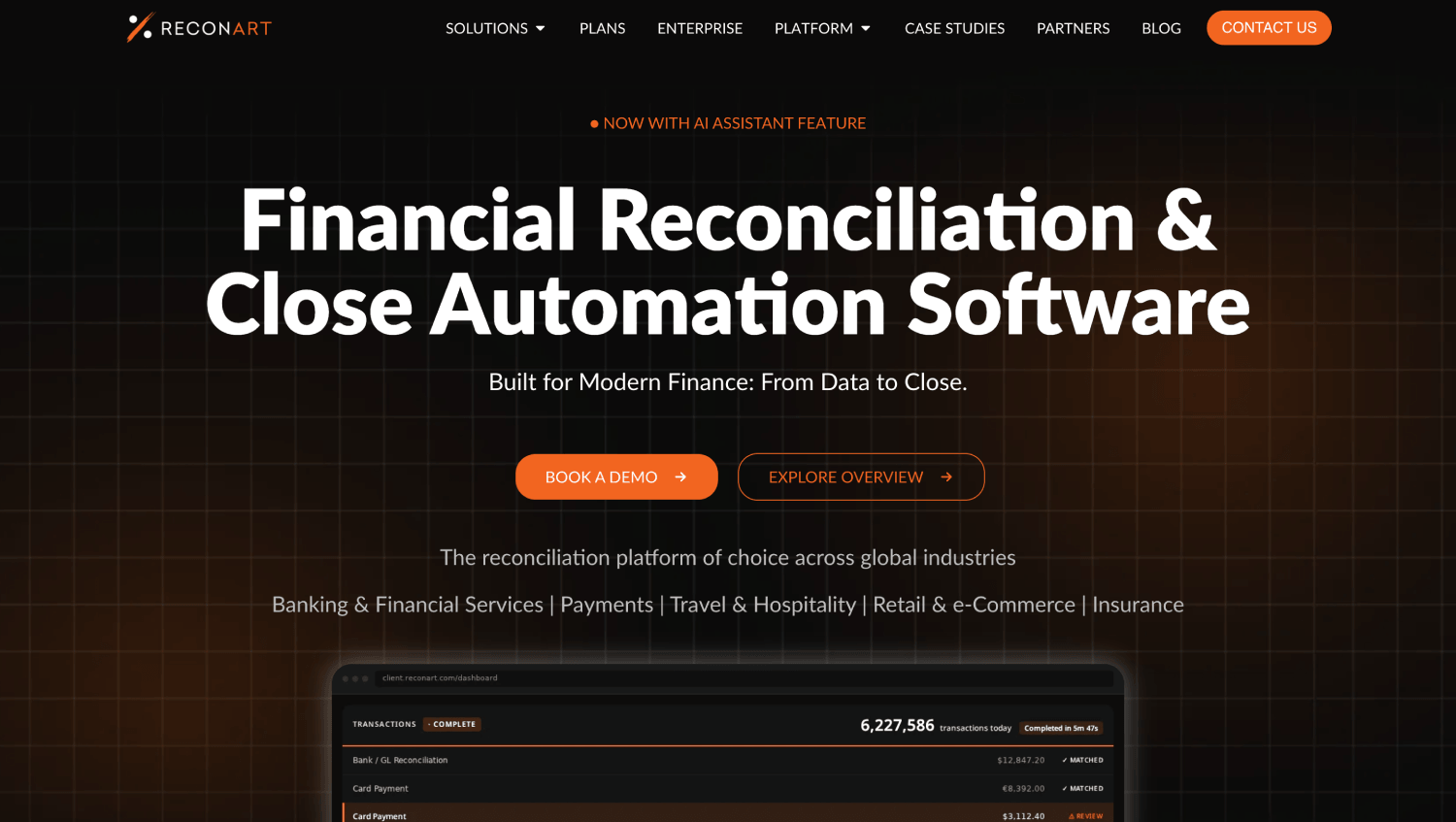
ReconArt is a dedicated reconciliation platform that handles intercompany balance matching as one of several rec types, alongside bank rec, balance sheet rec, and transaction matching. For multi-entity teams where the intercompany matching rules are non-standard (different currencies, partial billing cycles, deferred revenue splits across subsidiaries), ReconArt’s configuration depth is a genuine advantage.
The platform lets finance teams define matching rules at a granular level: match by invoice number, by amount with a percentage tolerance, by date range, or by custom field. Exceptions surface in a managed queue with assignable ownership. The audit trail records every match decision, manual override, and resolution note with a timestamp and user ID, which is what auditors and internal controls teams want to see.
ReconArt does not publish pricing publicly. Prospective customers go through a demo-and-quote process. It supports multiple ERP integrations and is used by financial services firms, shared services centers, and multi-subsidiary manufacturers. For teams that have looked at AutoRek and want a direct comparison, FintechSpecs has a ReconArt vs AutoRek reconciliation platform breakdown that covers the key differences in data model and exception workflow.
Prophix One: When Does an FP&A Platform Win a Reconciliation Decision?
Prophix One combines financial planning, consolidation, and close workflow in a single platform. For multi-entity teams where the intercompany reconciliation problem is inseparable from the consolidation problem (eliminations need to flow directly into consolidated financials), Prophix One removes a data handoff that otherwise requires a manual export-import step.
The intercompany module matches entity-level balances, flags disagreements, and ties resolution back into the consolidation model so elimination entries reflect the most current agreed-upon balances. Controllers on each entity side can add commentary and approve their balance within the same workflow. Because Prophix One also handles the consolidation layer, eliminations post directly without a separate journal entry process in the ERP.
The trade-off is that Prophix One is a broader platform purchase. If you only need intercompany rec and have no appetite for changing your FP&A or budgeting tool, the platform’s value proposition is harder to justify. Prophix does not publish per-entity or module pricing publicly; pricing is available on request.
Trintech Cadency: Where Does It Outperform Competitors?

Trintech Cadency is an enterprise financial close platform with a dedicated intercompany reconciliation module. It performs best in multi-country, multi-currency environments where regulatory requirements add compliance checkpoints to the close workflow. Cadency applies certification-style controls: each entity certifier signs off on their side of an intercompany balance before the period closes, creating a documented chain of accountability.
The exception-handling workflow in Cadency supports escalation paths. If an entity controller does not resolve an exception within a defined window, the system escalates to a designated approver, which is useful in organizations where ownership of intercompany disputes is politically complex. Cadency also integrates with major ERPs including SAP, Oracle, and Workday.
Cadency is built for large and mid-large enterprises. Implementation is a project, not a configuration, and Trintech typically involves implementation partners for enterprise deployments. Pricing is not publicly listed.
Adra by Trintech: Is It the Right Choice for Mid-Market Teams?

Adra by Trintech is Trintech’s mid-market product, sold separately from Cadency. It covers account reconciliation, task management, and intercompany matching at a scope and price point calibrated for teams running 5 to 50 legal entities without a dedicated close management team.
Adra’s intercompany workflow is rule-based: define matching criteria, let the system auto-match clean pairs, and push exceptions to an assignable task list. The approval chain is simpler than Cadency’s but sufficient for most mid-market audit requirements. Adra integrates with NetSuite, Microsoft Dynamics 365, and Sage Intacct, which covers the ERP stack most growth-stage companies sit on.
For finance teams evaluating Adra, the main question is whether the exception workflow is granular enough. Adra handles the standard case well but lacks some of the advanced escalation and risk-scoring features in Cadency. Pricing is available through Trintech’s sales process.
Workiva: Why Do SEC Filers Choose It for Intercompany Rec?
Workiva is primarily known as a connected reporting and disclosure platform, but its workflow capabilities make it a viable intercompany reconciliation environment for public companies and large private companies preparing for audit or public filing. The platform links data across entities in a shared workspace, so changes to one entity’s intercompany balance flow through to consolidated schedules automatically.
The intercompany workflow in Workiva is task-based: preparers complete their entity’s balance, reviewers sign off, and the audit trail captures every change with user, timestamp, and comment. The platform does not have a dedicated intercompany matching engine the way BlackLine or ReconArt does, so it works best when entity controllers are already in agreement and the main need is documented sign-off and reporting integration.
Workiva pricing is not publicly disclosed and is enterprise-tier. The platform is a natural fit for teams already using it for SEC filings or board reporting who want to extend the same controlled workflow to close activities.
SAP Intercompany and Oracle ARCS: When Does Native ERP Win?
Both SAP’s intercompany functionality and Oracle Account Reconciliation Cloud Service (ARCS) are strong choices when the entire entity footprint runs on a single vendor’s ERP stack. The case for them is data fidelity: no extraction, no transformation, no integration layer introducing timing differences.
SAP’s intercompany module within S/4HANA handles automated posting, matching, and elimination in a unified data model. Oracle ARCS applies risk-based certifications, automated balance comparison, and a close checklist that includes intercompany rec as a first-class close step. ARCS can also pull from non-Oracle ERPs through connectors, though the matching logic is richer for Oracle-native data.
The honest trade-off: both are expensive at implementation and license cost, and neither makes economic sense unless the organization is already committed to that ERP vendor. Mixed-ERP environments almost always need a third-party intercompany tool.
FloQast: What Is the Right Way to Use It for Intercompany?

FloQast is a close management platform, not a matching engine. It handles intercompany reconciliation through a structured checklist workflow: assign the intercompany rec task to a preparer, attach the supporting schedule, route to a reviewer, and check it off. The audit trail is clean and the UI is fast, which is why accounting teams on NetSuite and QuickBooks Online adopt it quickly.
What FloQast does not do is automate the entity-to-entity balance comparison. The preparer still needs to pull both sides of the balance, compare them manually or in a connected spreadsheet, and document the result. FloQast manages the workflow around that process, not the matching itself. For teams where the intercompany universe is small (under 10 entity pairs) and the balances are relatively stable month to month, this is often enough. For teams with high transaction volume and frequent timing differences, it is not.
Numeric: Does AI-Assisted Rec Work for Multi-Entity Close?
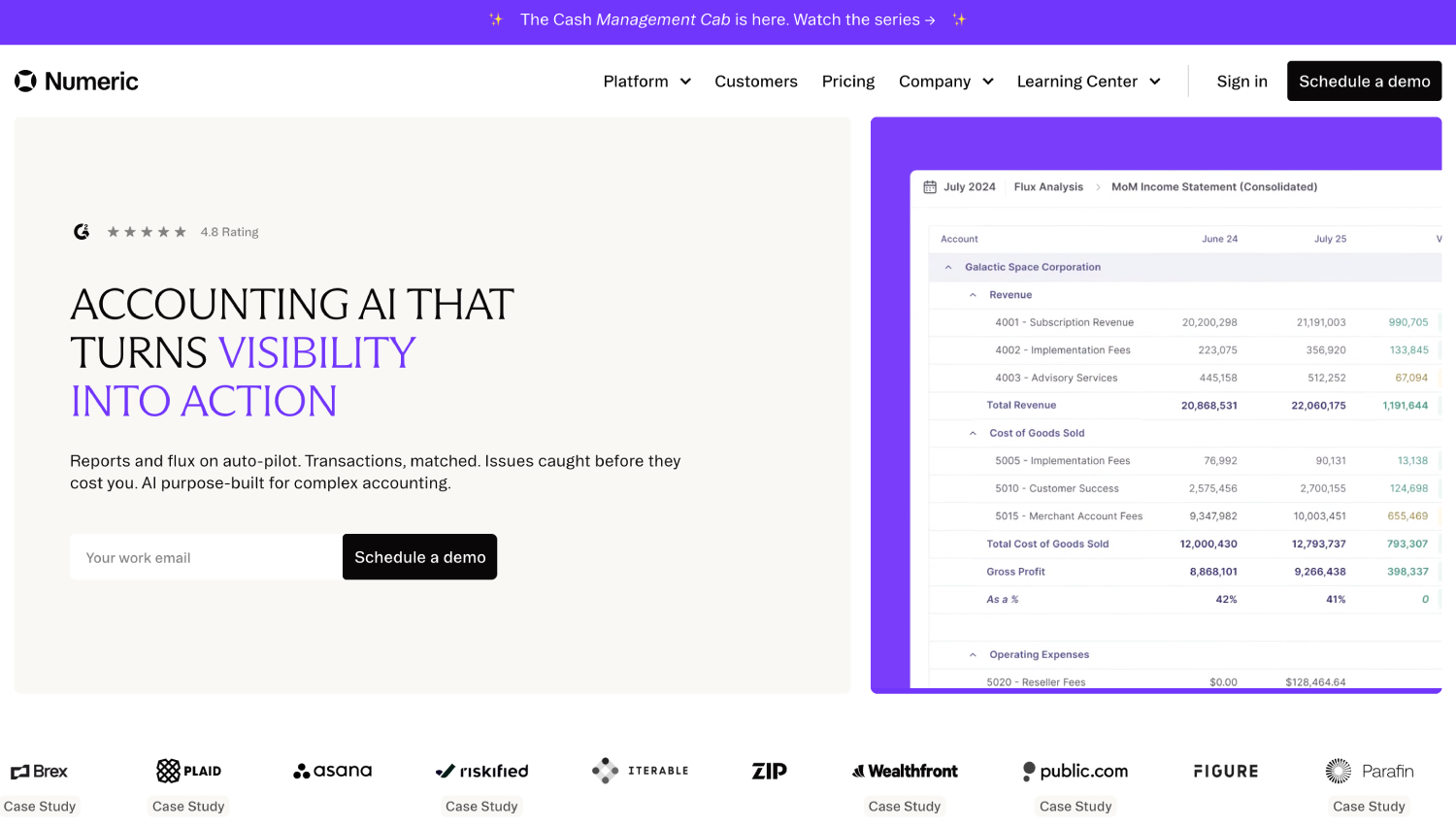
Numeric is a newer financial close platform targeting Series B to Series D companies that want faster close without an enterprise-tier implementation. Its AI-assisted flux analysis flags unexpected variance between entities, and its task workflow handles preparer-reviewer-approver sign-off.
The intercompany capability in Numeric is more workflow and variance flagging than deep entity-to-entity matching. For companies with moderate intercompany complexity, usually fewer than 20 entity pairs and no multi-currency disagreements, Numeric handles the documentation and sign-off side well. Teams with complex matching requirements will find the matching logic less configurable than ReconArt or BlackLine.
Numeric’s pricing is not publicly listed. It positions itself as faster to implement than enterprise alternatives, targeting companies that have outgrown spreadsheets but are not ready for a BlackLine or Cadency implementation. If your team is also evaluating FloQast at this stage, the HighRadius vs Workiva vs Numeric financial close comparison provides relevant context on where Numeric sits in the market.
What Are the Real Differences Between These Tools in Practice?
The clearest way to understand the product differences is to walk through a specific scenario. Say a holding company has eight subsidiaries across four countries, running a mix of SAP (three entities), NetSuite (three entities), and Dynamics 365 (two entities). Every period close, the intercompany matrix generates roughly 60 entity pairs, of which about 15 typically show disagreements above a $1,000 tolerance.
In a spreadsheet workflow, a central controller exports balances from each system, assembles the matrix in Excel, identifies the 15 exceptions, emails the relevant controllers, waits for responses, and then manually updates the master file. This takes two to three days and produces an audit trail that is an email thread and a saved Excel file.
In BlackLine Intercompany Hub, the same 60 pairs are matched automatically. The 15 exceptions are routed to the named controller on each side of the transaction within the platform. Each party annotates their position, attaches supporting documents, and agrees on a resolution. The system holds the period close open until all 15 are resolved or formally approved for carry-forward. Total elapsed time for the matching and exception workflow is typically measured in hours, not days. The audit trail is a system-generated log. This is what intercompany reconciliation software is supposed to do.
How Do These Tools Handle Multi-Currency Intercompany Balances?
Multi-currency matching is where the gap between enterprise and mid-market tools is widest. BlackLine, Cadency, Oracle ARCS, and SAP all handle foreign currency translation at the matching layer, so a EUR-denominated payable in a French subsidiary matches against the USD-denominated receivable in the US parent at the agreed exchange rate, with the FX translation difference surfaced as a named variance rather than an unresolved exception.
ReconArt supports multi-currency matching through configurable rules; finance teams define the translation methodology and the tool applies it. Adra handles multi-currency at the entity level but requires that FX rates be loaded before matching runs. FloQast and Numeric rely on the ERP to have already translated balances before they enter the close workflow, so the matching accuracy depends on consistent ERP configuration across entities.
For multi-entity companies that also manage multi-currency treasury positions, the multi-entity expense management platforms comparison covers how spend management tools handle entity-level currency differently from reconciliation tools.
What Should Finance Teams Ask Before Signing an Intercompany Rec Software Contract?
Four questions separate a good vendor conversation from a bad one. First: does the tool match at the transaction level or only at the period-end balance level? Transaction-level matching finds the specific invoice driving a $12,000 discrepancy. Balance-level matching tells you there is a $12,000 discrepancy but not why. Second: how does the tool handle entities on different ERPs? Ask for a live demo with two different data sources, not a single-ERP demo.
Third: what happens to an exception if neither controller resolves it by close? If the tool has no escalation path or no ability to hold the period close open, it is a workflow tool, not an intercompany control. Fourth: what does the elimination output look like, and where does it go? If the answer is “a report you download and manually journal,” the elimination workflow is not automated in any meaningful sense.
Frequently Asked Questions: Intercompany Reconciliation Software
What is intercompany reconciliation software?
Intercompany reconciliation software matches reciprocal balances between legal entities within a corporate group, identifies discrepancies, routes exceptions to the responsible controllers on each side of the transaction, and produces documentation for consolidation eliminations. It is distinct from general account reconciliation software, which matches transactions to a single entity’s ledger without the counterparty matching layer.
How is intercompany reconciliation different from intercompany netting?
Intercompany reconciliation confirms that the recorded balance between two entities agrees on both sides of the books before the period closes. Intercompany netting is a cash settlement process that offsets what entities owe each other and settles the net position in a single payment. The two processes are related but separate: reconciliation is an accounting control; netting is a treasury cash management function. This article covers reconciliation only.
Can NetSuite or SAP handle intercompany reconciliation natively?
SAP S/4HANA has native intercompany matching and elimination functionality for entities running on the same SAP instance. NetSuite supports intercompany transactions and eliminations within a single NetSuite account for entities on the same instance, but match logic and exception handling across separate ERP instances or subsidiary accounts typically require a dedicated intercompany rec tool or a consolidation platform overlay. Mixed-ERP environments almost always need a third-party solution.
How many legal entities do you need before intercompany reconciliation software is worth it?
There is no universal threshold, but most finance teams report that the break-even point for dedicated software is around four to six active intercompany relationships with regular transaction volume. Below that, a structured spreadsheet template with version control and email workflow is often sufficient. Above it, the manual coordination cost and audit documentation burden typically exceed the software cost within the first two or three close cycles.
What is the difference between intercompany reconciliation software and consolidation software?
Intercompany reconciliation software resolves disagreements between entity pairs before the period closes. Consolidation software takes agreed-upon entity financials, applies elimination entries to remove intercompany balances and transactions, and produces consolidated financial statements. The two are sequential: reconciliation must complete before consolidation can produce accurate consolidated numbers. Some platforms, including Prophix One and Oracle ARCS, combine both functions.
How long does intercompany reconciliation typically take with and without dedicated software?
Without dedicated software, finance teams running 10 or more entity pairs commonly report two to four additional close days consumed by intercompany matching, exception follow-up, and documentation. With dedicated software, the same process typically completes in hours rather than days, with the elapsed time driven primarily by how quickly entity controllers respond to exception notifications rather than by manual data assembly.
Does intercompany reconciliation software produce elimination journal entries automatically?
The answer varies by product. BlackLine, SAP, Oracle ARCS, and Prophix One produce elimination-ready data that feeds directly into the consolidation layer. ReconArt and Trintech Cadency produce audit-ready documentation that supports elimination entries, though the journal posting step may be in the ERP or consolidation tool rather than the rec platform. FloQast and Numeric manage the workflow around eliminations but do not generate elimination entries themselves.
The Practical Shortlist Decision
The choice between these tools comes down to two variables: ERP homogeneity and entity count. If all entities run on SAP S/4HANA, the native intercompany functionality is hard to beat on data fidelity. If all entities run on Oracle, ARCS is the same argument. The moment you have two or more ERPs in the entity footprint, a third-party tool becomes the cleaner answer, and BlackLine or ReconArt are the two strongest options at that layer.
Mid-market teams on NetSuite or Dynamics 365 with 5 to 25 entities and moderate intercompany volume should look seriously at Adra by Trintech or Prophix One before defaulting to BlackLine. The implementation overhead and commercial terms of enterprise platforms frequently make them the wrong choice for companies at that scale, regardless of product quality. FloQast and Numeric are legitimate choices for teams where close workflow management is the main gap, with the understanding that they do not solve the matching problem independently.
The core insight that most account rec tool evaluations miss: counterparty matching, dispute ownership, and elimination readiness are not features you add to a general rec platform. They are architecture decisions that the platform either makes or does not. Evaluating a tool on those three gates, before the demo even begins, is what separates a good shortlist from one that generates regret at close. For teams building the broader finance and compliance infrastructure around this close workflow, the financial consolidation software guide covers how the consolidation layer connects to what intercompany rec software produces.







9 Best AI Month-End Close Tools for Accounting Teams