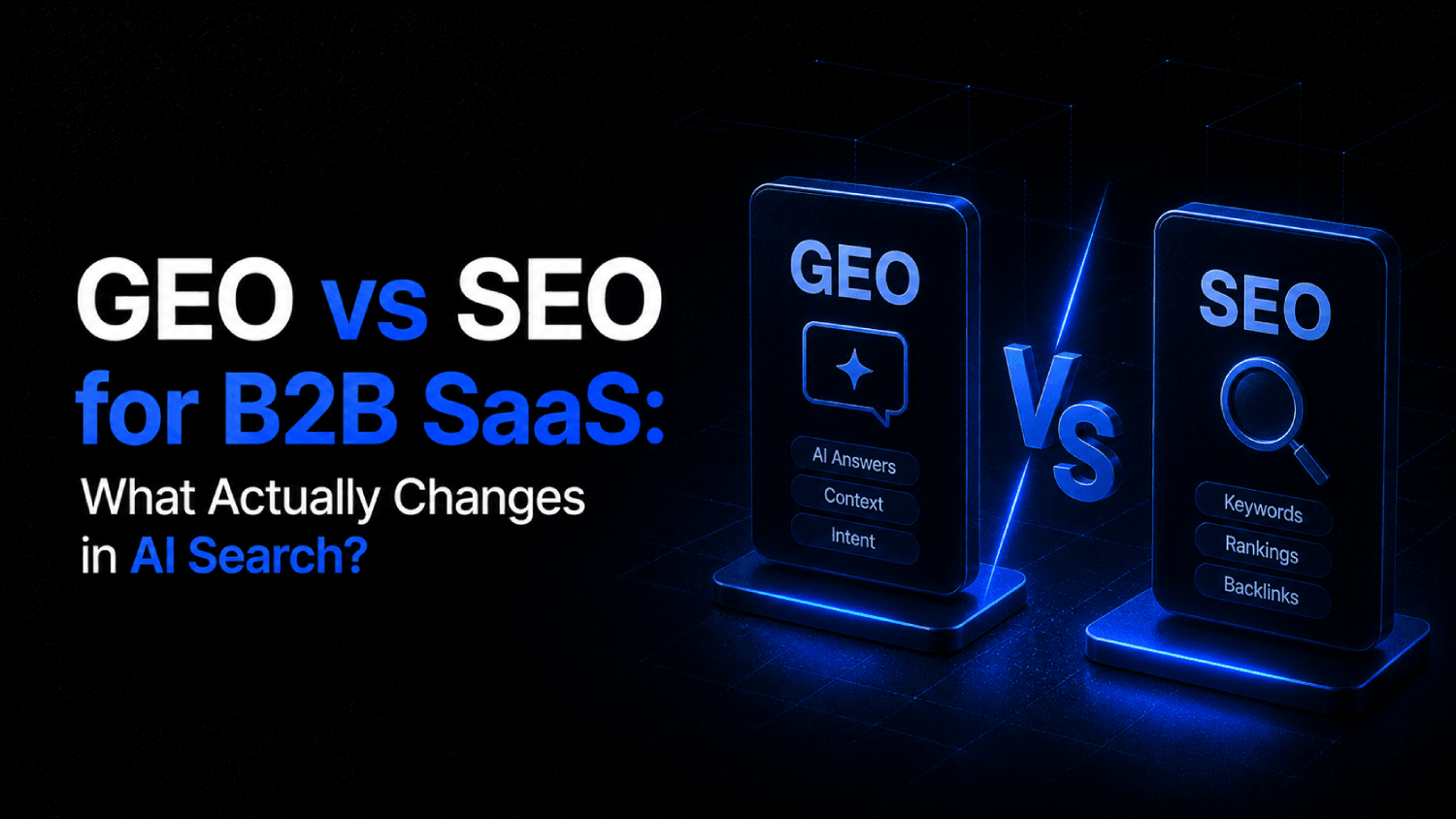

- GEO and SEO share foundational content principles, but they optimize for different outputs: SEO targets a ranked URL in a results page, GEO targets a cited sentence inside an AI-generated answer.
- For B2B SaaS, the research process increasingly starts in ChatGPT, Perplexity, or Google’s AI Overview, not a ten-blue-links results page. That changes what “visibility” means.
- The ranking signals differ: SEO rewards backlinks and on-page authority, GEO rewards factual density, named entities, and cross-platform brand mentions that LLMs can verify.
- Measurement is the hardest part of GEO. There is no position one. Success looks like citation frequency in AI-generated answers, not keyword rank.
- Neither discipline replaces the other. SEO drives recoverable, measurable traffic. GEO drives influence in the zero-click, AI-mediated research phase where B2B buying decisions actually begin.
GEO vs SEO for B2B SaaS comes down to a specific structural difference: SEO gets your pages ranked in traditional search results, while GEO gets your brand cited inside AI-generated answers from tools like ChatGPT, Perplexity, and Google’s AI Overview. For B2B SaaS companies, both matter. SEO captures buyers who click through to compare options; GEO shapes what AI models say about your category before those buyers ever open a new tab.
Why B2B SaaS Teams Are Asking About GEO Now
The question keeps surfacing in growth and marketing channels: is generative engine optimization a real discipline, or is it SEO repackaged for a new news cycle? The skepticism is fair. The industry has a history of rebranding old tactics with new acronyms.
The reason GEO deserves a separate framework comes down to where B2B buyers now start their research. A product evaluation that used to begin with a Google search increasingly begins with a prompt in ChatGPT or Perplexity. The buyer asks “what are the best payment infrastructure tools for early-stage SaaS” and gets a synthesized paragraph naming three or four vendors. Your SEO rank on page two of Google is irrelevant to that answer. Whether an LLM has encountered enough credible, consistent information about your product to include it is what matters.
That is a structurally different problem from ranking a page.
What Is the Core Difference Between GEO and SEO?
SEO is built around the indexed web: crawlers read your pages, assess authority through links and signals, and rank your URLs for specific queries. The output is a position in a results page. A user clicks, traffic flows, and you can measure almost everything.
Generative engine optimization is built around how large language models absorb and reproduce information. LLMs are trained on broad corpora of text and then updated with retrieval-augmented systems. When someone asks ChatGPT a question about B2B SaaS tools, the model synthesizes an answer from patterns in its training data and, in retrieval-augmented setups like Perplexity, from live web sources. Your goal in GEO is to be a reliable, consistent signal in both.
The practical implication: in SEO, you optimize a page. In GEO, you optimize a brand’s entire information footprint, including documentation, third-party mentions, review platforms like G2 and Capterra, press coverage, and structured data that LLMs can parse and trust.
GEO vs SEO: The Full Comparison
| Dimension | Traditional SEO | GEO (Generative Engine Optimization) |
|---|---|---|
| Primary objective | Rank pages in search engine results pages (SERPs) | Appear as a cited, trusted source in AI-generated answers |
| Optimization target | A URL and its on-page signals | A brand’s full information footprint across the web |
| Key ranking signals | Backlinks, E-E-A-T, technical health, page speed, structured data | Entity recognition, factual density, cross-platform consistency, citation authority |
| Content format | Long-form blog posts, landing pages, pillar pages optimized for keyword clusters | Structured, extractable content: clear definitions, comparison tables, FAQ schema, named entities |
| Primary distribution channel | Google Search, Bing, DuckDuckGo | ChatGPT, Perplexity, Google AI Overviews, Claude, Gemini |
| Measurement | Keyword rank, organic sessions, CTR, impressions via Google Search Console | Citation frequency in AI answers, brand mention audits, LLM query sampling |
| Output for the user | A list of ranked URLs to click through | A synthesized answer that may or may not name your brand |
| Feedback loop speed | Weeks to months for rank changes to appear | Variable and opaque; base LLM retraining cycles are not publicly disclosed by OpenAI, Google, or Anthropic, while retrieval-augmented tools like Perplexity refresh more frequently but do not publish source-weighting details |
| Playbook maturity | Over two decades of documented best practices | Actively developing; as one industry observer has noted, GEO is barely 18 months into active practice |
How LLM SEO Differs From Traditional SEO in Practice
The term “LLM SEO” describes the narrower practice of optimizing specifically for large language model retrieval, as distinct from the broader GEO umbrella that includes AI Overviews and answer engines. The mechanical differences matter for B2B SaaS teams deciding where to spend effort.
In traditional SEO, a page on your domain earns authority. In LLM SEO, a concept about your brand earns authority. If 40 credible sources describe your fraud detection tool as “real-time, developer-first, and built for fintech compliance,” that pattern of consistent description is what gets reproduced in an LLM answer, regardless of whether those sources link back to you or not.
This is why Schema.org structured data, public documentation, and third-party review profiles have new importance in a GEO context. They create parseable, named-entity-rich text that LLMs can absorb as factual ground truth. A well-structured G2 profile describing your product’s category, integrations, and customer segments is GEO content, even though it lives off your domain.
What LLMs Actually Look For
LLMs weight information that is specific, attributable, and consistent. Vague brand descriptions (“a leading platform for modern teams”) carry no weight because they carry no information. Specific claims (“supports ACH, SEPA, and same-day wire with sub-second transaction APIs”) give a model something concrete to reproduce.
Named entities matter. A product that is consistently described alongside specific integrations, named standards, and real customer types will appear in AI answers about those contexts. A product described only in marketing abstractions will not.
What Actually Changes for B2B SaaS Specifically?
The B2B SaaS buying cycle is long, multi-stakeholder, and research-heavy. A CFO evaluating payment infrastructure may spend two weeks gathering input before touching a vendor’s website. That research phase now runs partly through AI tools, and GEO is what determines whether your product gets named during it.
The asymmetry is significant. A competitor with weaker traditional SEO rankings but a strong GEO presence can show up in the AI-mediated shortlisting phase. By the time a buyer reaches Google and types your competitor’s name directly, the preference has often already been shaped. This pattern is especially pronounced in fintech and SaaS categories where buyers are comfortable using AI tools for technical due diligence. For a closer look at how B2B SaaS distribution works at scale, the go-to-market strategies that work for fintech SaaS article covers how channel choices compound over time.
The Zero-Click Research Problem
In traditional SEO, a zero-click search is a loss: the user got their answer from a featured snippet and never visited your site. In AI search, the entire interaction may be zero-click by design. A buyer using Perplexity to compare API-based banking infrastructure tools might get a full comparison paragraph, never click through, and carry that information into an internal Slack thread or a vendor evaluation doc. Your presence in that paragraph is worth more than your rank on page two of Google for a query they never typed.
This is not a hypothetical shift. According to reporting by Search Engine Journal, AI Overview appearances in Google are already changing click behavior for informational queries, with users spending more time reading the AI answer and less time clicking through to source pages.
Where GEO and SEO Still Share the Same Foundation
The overlap is real and worth stating plainly. Good SEO content is good GEO content, with some additions. Clear structure, accurate facts, strong definitions, and genuine expertise serve both goals. A page that ranks well because it answers a question completely and specifically is also a page an LLM is likely to cite.
The shared foundations include: factual accuracy, clear topic focus, named entities and specifics over vague claims, and content that answers real questions rather than performing keyword density. Technical health still matters for GEO because LLMs use crawled pages as retrieval sources. A page that is inaccessible to Googlebot is likely also inaccessible to Perplexity’s crawler.
Where SEO and GEO diverge is in what they add on top of that foundation. SEO adds link building, rank tracking, and page-level authority signals. GEO adds off-domain information consistency, entity schema, review platform optimization, and measurement via AI answer sampling rather than rank tracking.
Is GEO Just SEO Rebranded?
No, and the distinction is not cosmetic. SEO determines whether your content can be found and ranked by search engine crawlers. GEO determines whether your brand is represented accurately, consistently, and favorably inside AI-generated answers. As noted in LinkedIn’s fintech and SaaS analysis of these trends, GEO is not a replacement for SEO.
The distinction that matters for resource allocation: SEO is largely page-level work. You write a page, optimize it, build links to it, and track its rank. GEO is brand-level work. You audit what AI models currently say about your product, identify the sources they are drawing from, and build or improve the information in those sources. That is a different workflow, involving different teams and different success metrics.
For fintech SaaS companies with limited content bandwidth, both matter but at different stages. Early-stage companies get more return from SEO because it drives trackable organic traffic. Post-product-market-fit companies with active sales cycles get increasing return from GEO because their buyers are researching in AI tools, not just Google. If you are also tracking which metrics actually reflect business health versus vanity signals, the fintech metrics that actually matter beyond vanity growth analysis is worth reading alongside this one.
How to Measure GEO When There Is No Rank to Track
Measurement is where GEO gets genuinely hard. Traditional SEO has a clear scorecard: keyword position, organic sessions, CTR. GEO has no equivalent of Google Search Console for AI-generated answers, at least not yet.
The current practical approaches include manual prompt sampling (querying ChatGPT, Perplexity, and Google’s AI Overview with the same questions your buyers ask, then recording whether and how your brand appears), brand mention monitoring across the platforms that LLMs crawl, and tools like Semrush and Brandwatch, which are beginning to build AI citation monitoring features alongside their existing brand tracking capabilities.
The feedback loop is also opaque. Traditional SEO changes are measurable within weeks. Base LLM retraining cycles are not publicly disclosed by OpenAI, Google, or Anthropic; retrieval-augmented systems like Perplexity update more frequently, but their weighting of sources is not transparent. This is the honest limitation of GEO right now: you are building for a system you cannot fully observe.
Agencies that specialize in AI visibility for fintech are starting to build proprietary tracking methodologies. The best GEO agencies for fintech SaaS ranking covers who is doing this work and how they report results.
What B2B SaaS Teams Should Actually Do Differently
The tactical changes are specific, not abstract. Content teams need to write for extractability: clear definitions, comparison tables, FAQ sections with structured markup, and named entities in every piece. A blog post that opens with three paragraphs of context before defining the product is invisible to LLMs looking for clean, citable answers.
Product and marketing teams need to treat off-domain content as GEO infrastructure. G2 and Capterra profiles, documentation on developer portals, press releases on accessible URLs, and thought leadership on platforms LLMs crawl all contribute to the information pattern the model assembles about your brand.
Founders evaluating infrastructure categories should note that category description matters as much as product description. If your payments product gets categorized as a “payment processor” by every AI answer when you compete more directly with merchant of record platforms, that is a GEO problem, not an SEO problem. Fixing it requires updating the language used in every credible external source, not rewriting your homepage title tag. The merchant of record comparison for B2B SaaS is an example of the kind of clearly categorized, named-entity-rich content that performs well in both SEO and GEO contexts.
Schema Markup Has New Importance
In traditional SEO, schema markup (structured data using Schema.org vocabulary) improved rich snippet eligibility. In GEO, it does something more direct: it gives LLMs parseable, labeled information about your product, organization, and content type. FAQPage, HowTo, Product, and Organization schema are not just ranking signals anymore. They are machine-readable signals that AI crawlers use to classify and trust your content.
Documentation and Technical Content Are GEO Assets
For B2B SaaS, API documentation and technical guides indexed on accessible URLs are among the highest-quality GEO content that exists. They are specific, factual, structured, and loaded with named entities. A developer searching in Perplexity for “how to handle webhook retries in [your product]” is exactly the kind of named-entity query that retrieval-augmented AI answers well. If your docs are behind a login or hosted on a platform that blocks crawlers, you are losing GEO coverage you have already paid to create. The best fintech APIs for SaaS roundup demonstrates how technically specific, named-entity-rich content gets retrieved in AI answers about infrastructure categories.
Frequently Asked Questions
1. What is the difference between LLM SEO and GEO SEO?
LLM SEO refers specifically to optimizing content so that large language models like GPT-4, Claude, or Gemini include your brand in their training-derived answers. GEO (generative engine optimization) is the broader discipline that includes LLM SEO but also covers retrieval-augmented answer engines like Perplexity and Google’s AI Overviews. In practice, both require the same core tactics: factual specificity, named entities, structured content, and consistent cross-platform information. LLM SEO is one layer inside the GEO framework.
2. Is SEO dead or just evolving in the AI search era?
SEO is not dead. Google still processes billions of traditional queries, and organic search still drives measurable traffic for B2B SaaS companies. What is changing is the share of research that happens inside AI tools before a buyer ever opens a search engine. For informational and comparison queries, which are exactly the queries that B2B buyers use during vendor evaluation, AI-generated answers are capturing an increasing portion of attention. SEO remains important for capturing demand; GEO becomes important for shaping it earlier in the process.
3. How do I know if an AI tool is citing my brand?
The most reliable method right now is manual query sampling: ask ChatGPT, Perplexity, Google AI Overview, and Claude the questions your buyers ask, then record whether your brand appears and in what context. Tools like Semrush and Brandwatch are building more systematic AI citation monitoring into their platforms. There is no equivalent of Google Search Console for AI citation tracking yet, though several companies are working on it. Establishing a regular sampling cadence is more valuable than waiting for automated tooling.
4. Does building backlinks still matter for GEO?
Backlinks still matter for SEO, which feeds into GEO. A page that has strong backlinks tends to rank well in traditional search, which means it is more likely to be in the crawled corpus that retrieval-augmented systems like Perplexity pull from. Beyond that direct relationship, the off-domain credibility that backlinks signal correlates with the kind of third-party coverage that LLMs use as authority signals. Build backlinks for SEO, and the GEO benefit follows. Do not abandon link building because GEO is newer.
5. What content format works best for both SEO and GEO?
Content that is structured, specific, and extractable performs well in both channels. Comparison tables, FAQ sections with schema markup, numbered process steps, and definitions with named entities are the formats that search engines can feature-snippet and LLMs can cite. Long-form narrative that buries its main points in paragraphs five through twelve performs worse in GEO even if it ranks adequately in traditional SEO. Writing for extractability does not require shorter content; it requires clearer structure and earlier placement of key claims.
6. How much of my content budget should shift to GEO?
The right allocation depends on your sales cycle stage. Early-stage B2B SaaS companies with limited organic traffic should invest the majority of content resources in traditional SEO to build a traffic foundation. Companies past product-market fit with active enterprise sales cycles should begin parallel GEO work: optimizing review profiles, improving documentation accessibility, adding structured data, and running regular AI citation audits. The content itself overlaps heavily, so the incremental cost of adding GEO practices to an existing SEO program is lower than it appears.
7. Can a small B2B SaaS team handle GEO without an agency?
Yes, for the foundational work. Schema markup, FAQ content with structured answers, G2 and Capterra profile updates, and accessible documentation are all in-house tasks. The harder parts, specifically systematic AI citation monitoring and entity optimization across dozens of off-domain sources, scale better with specialist support. A team that is already executing solid SEO can adopt GEO fundamentals incrementally without a full agency retainer. The lift increases if your brand is currently misrepresented or absent in AI answers about your category.
8. What is the biggest mistake B2B SaaS companies make with GEO?
Treating GEO as purely an on-domain content exercise. The most common mistake is publishing more blog posts in a GEO-friendly format while ignoring the off-domain information sources that LLMs actually trust most: review platforms, third-party publications, accessible developer documentation, and press coverage on indexed URLs. LLMs do not weight your own website more highly than independent corroboration of your claims. A brand that is well-described on credible third-party platforms will outperform a brand with better on-domain content but no external information footprint.
The Practical Framework for B2B SaaS Teams Going Forward
The clearest mental model is this: SEO gets you found when a buyer is actively searching. GEO gets you named when a buyer is researching without you knowing. Both phases of the research and buying process matter, but the AI-mediated research phase is earlier, less visible to vendors, and increasingly decisive in B2B SaaS categories where multiple vendors solve the same problem.
The content investment required for GEO is not separate from your existing SEO work. It is additive. The same articles, docs, and comparison pages that earn search traffic also earn AI citations, provided they are structured for extractability, loaded with named entities, and consistent with how your product is described across every indexed source. The gap between “solid SEO content” and “GEO-ready content” is mostly a formatting and specificity gap, not a topic gap.
What GEO adds to the B2B SaaS growth equation is influence over the part of the buying decision that happens before a vendor ever knows a prospect exists. As that phase grows longer and more AI-mediated, the compounding advantage of a strong GEO presence becomes harder to close for competitors who start late. The fintech and SaaS companies that treat information quality as infrastructure, not marketing, are the ones building durable AI visibility.