
- Transaction monitoring is not an enterprise-only problem. Any fintech handling payments, transfers, or stored value is a BSA/AML target the moment it moves real money.
- Most early-stage teams wait until their sponsor bank or regulator raises the issue. By then, retroactive SAR filing and manual review burn weeks of engineering and compliance time.
- Startup-friendly tools like Unit21, Sardine, and Hummingbird cost far less than legacy platforms and deploy in days, not quarters.
- The real decision is not which tool has the most rules. It is which tool fits your current transaction volume, your team’s compliance maturity, and your likely audit surface.
- SAR filing workflows, case management, and audit trails are non-negotiable requirements. Tools that lack them are fraud detection tools, not AML-compliant transaction monitoring systems.
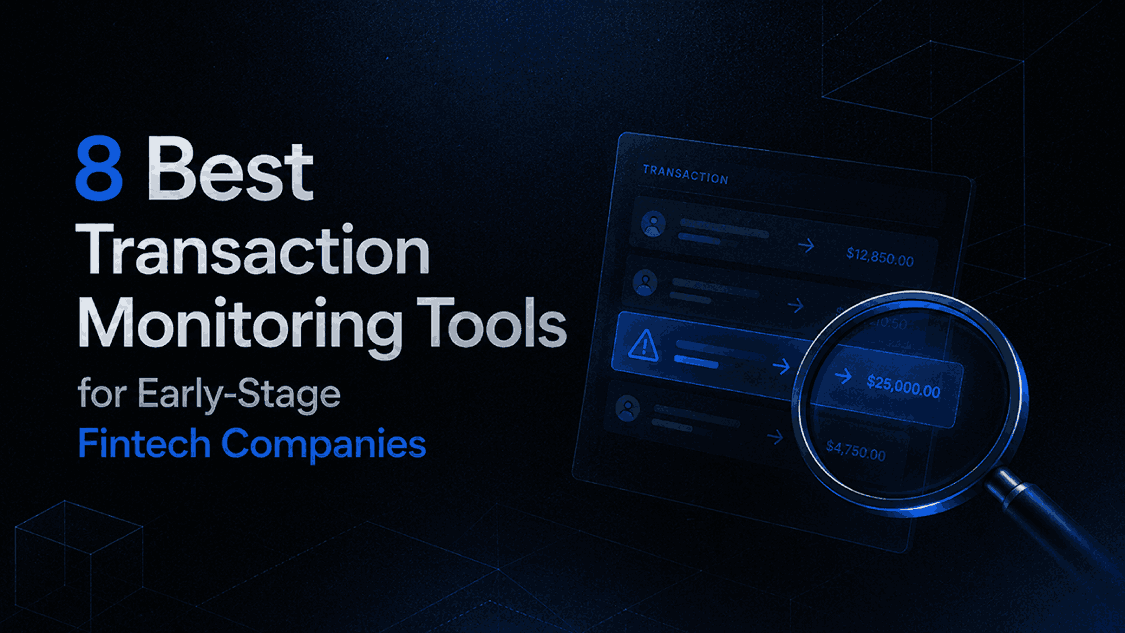
The eight transaction monitoring tools for fintech best suited to early-stage companies are Unit21, Sardine, Hummingbird, Featurespace, ComplyAdvantage, Hawk AI, ThetaRay, and Napier AI. Startup-friendly picks include Unit21, Sardine, and Hummingbird, which offer API-first deployment, lower minimums, and built-in case management. Enterprise-grade platforms like ThetaRay and Featurespace require more integration lift but handle complex typologies at scale.
Why Early-Stage Fintechs Can’t Postpone Transaction Monitoring
The common assumption is that transaction monitoring is something you bolt on after Series B, once a compliance officer is on staff and volumes justify the cost. That assumption is wrong, and it has ended companies.
Under the Bank Secrecy Act, any business that qualifies as a money services business (MSB) has AML program obligations from day one. That includes fintechs operating under sponsor bank arrangements, neobanks, payment facilitators, and platforms that move funds on behalf of users. A common compliance blind spot for early-stage teams is assuming their sponsor bank or payment processor covers this obligation. It does not. The sponsor bank monitors for its own exposure. You are responsible for yours.
Practically, what this means: if a user runs a structuring scheme through your platform and you have no monitoring in place, you face regulatory action not because the scheme succeeded but because you had no controls at all. Regulators treat the absence of a system as more serious than a system that fired on the wrong threshold.
What Separates AML Transaction Monitoring from Basic Fraud Detection
Transaction monitoring in the AML sense means continuously analyzing financial transactions against rule sets and behavioral baselines to identify patterns that may indicate money laundering, terrorist financing, or other financial crimes, then generating alerts that a compliance analyst reviews and, if warranted, escalates to a Suspicious Activity Report (SAR).
Fraud detection tools, by contrast, focus on protecting the business and the user from real-time theft. They block bad transactions. They do not produce the audit trail, case management workflow, or SAR-filing infrastructure that a Bank Secrecy Act compliance program requires.
This distinction matters because several popular fraud tools get positioned as “AML-capable.” Some are. Most are not. Before you buy, confirm the tool produces: time-stamped alert queues, analyst case management with disposition notes, SAR filing support or export, and a complete audit log that can survive regulatory examination. If any of those four are missing, the tool is a fraud tool, not a compliant monitoring system. You can read more about the overlap and tension between these goals in this breakdown of fraud prevention and user experience trade-offs for fintech products.
The FintechSpecs Monitoring Readiness Threshold
Rather than picking a tool by brand recognition, the right starting point is understanding where your company sits across four dimensions. We call this the FintechSpecs Monitoring Readiness Threshold: a simple internal check before any vendor evaluation.
- Volume floor. Are you processing more than 500 transactions per month? Below that, manual review is defensible with documented policies. Above it, manual review is a regulatory liability.
- Money movement type. Are you moving funds (ACH, wire, card push, stored value) rather than just collecting payments? Money movement triggers MSB classification and BSA obligations in most states.
- User base opacity. Do you have business customers, international users, or high-value individual accounts? These categories carry elevated typology risk and require more sophisticated rule sets than a domestic consumer product.
- Sponsor bank expectations. Has your sponsor bank or acquiring bank asked about your AML program in writing? If yes, you are already on the clock.
If you clear two or more of these, you need a dedicated transaction monitoring system now, not at the next funding round.
8 Best Transaction Monitoring Tools for Fintech Startups
| Tool | Best For | Deployment Model | SAR Workflow | Startup-Friendly |
|---|---|---|---|---|
| Unit21 | Seed to Series B fintechs | API + no-code rules | Yes, built-in | Yes |
| Sardine | Payment and crypto platforms | API-first | Partial (alert triage) | Yes |
| Hummingbird | Compliance-first teams | SaaS + API | Yes, native SAR filing | Yes |
| Featurespace | Mid-market to enterprise | On-premise or cloud | Yes | No |
| ComplyAdvantage | AML screening + monitoring combo | API-first | Alert queue, partial SAR | Moderate |
| Hawk AI | Banks and fintechs scaling fast | Cloud SaaS | Yes | Moderate |
| ThetaRay | Cross-border payment platforms | Cloud AI | Yes | No |
| Napier AI | Regulated firms, complex typologies | Cloud or on-premise | Yes | No |
1. Unit21
Unit21 is the clearest startup recommendation on this list. It was built specifically for fintech and financial services companies that need AML-grade monitoring without a legacy compliance stack. The no-code rule builder means a compliance analyst, not an engineer, can write and adjust detection logic. That matters when your engineering team has two sprints allocated to the integration and zero bandwidth for ongoing rule maintenance.
Unit21 covers the full workflow: transaction monitoring, case management, SAR filing, and audit logs. The platform also handles fraud cases in the same interface, which reduces tool sprawl at early stages. Pricing is not publicly listed, but the company positions itself for seed-through-growth-stage fintechs, and multiple operators report getting started without enterprise minimums. The no-code rules environment is genuinely differentiated compared to anything else on this list at the same price tier.
One caveat: Unit21’s rule library is strong for standard typologies (structuring, velocity anomalies, layering) but if your platform involves unusual financial flows like embedded credit or multi-party settlement, expect to spend time configuring custom rules before go-live.
2. Sardine
Sardine sits at the intersection of fraud prevention and AML monitoring, which makes it genuinely useful for payments and crypto-adjacent platforms where the threat model blends both. Device intelligence, behavioral biometrics, and transaction risk scoring feed into a unified risk signal that compliance teams can use for alert triage.
Where Sardine stands apart from pure fraud tools is its support for AML-specific typologies and its ability to ingest data from multiple transaction sources, which is valuable if your platform routes payments across several rails. The alert management and case management capabilities are present, though Sardine’s SAR filing support is more limited than Unit21’s or Hummingbird’s. If your SAR volume is expected to be high or your compliance team needs a turnkey filing workflow, Sardine works best as a monitoring and detection layer paired with a dedicated case management tool.
Pricing is not publicly disclosed. Sardine targets fintechs processing meaningful volume, so very early pre-revenue companies may find it premature.
3. Hummingbird
Hummingbird takes a different angle than most tools on this list. Its core product is compliance workflow and case management, with transaction monitoring built around it rather than the reverse. The result is a platform that compliance analysts genuinely prefer to use, because investigations move faster and SAR drafting is integrated directly into the case interface.
Hummingbird offers native FinCEN SAR filing, which is rare at this price tier. For a startup that expects to file SARs regularly, the time savings are meaningful. A compliance analyst who previously managed SARs in spreadsheets and PDF exports can cut that process down dramatically. Hummingbird also has pre-built integrations with several popular fintech data sources, reducing the initial engineering lift.
The trade-off: Hummingbird’s rule engine for detection is less configurable out of the box than Unit21’s. If you need highly custom detection logic, you will either need to invest in configuration time or accept the default typology library. For most early-stage teams, the defaults are sufficient and the workflow advantage outweighs the detection flexibility gap.
4. Featurespace
Featurespace is an adaptive behavioral analytics platform used by banks and larger financial institutions. Its ARIC Risk Hub uses machine learning to model individual customer behavior and flag anomalies, which produces fewer false positives than static rule-based systems at scale. That is its primary value proposition.
For early-stage fintechs, Featurespace is almost certainly the wrong starting point. The integration complexity, pricing structure, and implementation timeline are calibrated for organizations with dedicated compliance and data engineering teams. If your company is approaching Series C with significant transaction volume and a growing compliance function, Featurespace becomes worth evaluating. Before that, the overhead outweighs the benefit.
5. ComplyAdvantage
ComplyAdvantage is primarily known as an AML data and screening provider covering sanctions, PEPs, and adverse media. Its transaction monitoring module sits on top of that data infrastructure, which creates a genuine advantage: screening and monitoring share the same underlying data, so a sanctioned entity flagged in onboarding also triggers alerts in ongoing monitoring without manual cross-referencing.
For fintechs that need both KYC/AML screening and transaction monitoring in one vendor, ComplyAdvantage offers a consolidated option. The monitoring module’s case management is functional but lighter than Hummingbird’s, and SAR filing support varies by configuration. Pricing has a public starting point but scales with transaction volume and the number of screening checks. It is accessible to growth-stage companies, less so to seed-stage teams with minimal volume.
ComplyAdvantage pairs naturally with companies already using it for AML screening, where the incremental cost of adding transaction monitoring is lower than switching to a separate vendor.
6. Hawk AI
Hawk AI positions itself as a modern AML platform for banks and fintechs that have outgrown basic rule engines. Its explainable AI layer is notable: when the system flags a transaction, it generates a plain-language explanation of why, which makes analyst review faster and documentation more defensible in an examination.
Hawk AI’s sweet spot is companies that have already deployed basic monitoring and are hitting false positive rates that overwhelm their compliance team. The AI layer reduces alert noise, which is the primary complaint with rule-based systems at scale. For a company processing tens of thousands of transactions per month with a small compliance team, that reduction translates directly into fewer analyst hours and faster SAR decisions.
Pricing is enterprise-negotiated and not publicly disclosed. Implementation is more involved than Unit21 or Hummingbird, making Hawk AI a stronger fit for Series A and beyond than for seed-stage companies.
7. ThetaRay
ThetaRay is built for cross-border payment monitoring, which makes it relevant to a specific subset of fintechs. If your platform processes international transfers, remittances, or correspondent banking flows, standard rule-based typologies often fail to catch schemes that span jurisdictions and currencies. ThetaRay’s AI platform was designed specifically for this problem.
It is not a startup tool. The platform targets banks, payment processors, and fintechs with complex cross-border exposure and the compliance infrastructure to support it. For a domestic neobank or a US-only payroll platform, ThetaRay is over-engineered and likely over-priced. For a global remittance platform or an embedded finance provider with international exposure, it covers typologies that simpler tools miss entirely.
8. Napier AI
Napier AI describes its platform as a “Compliance AI” system that covers transaction monitoring, client screening, and risk scoring in an integrated workflow. Its strength is handling complex regulatory environments, particularly for firms operating across multiple jurisdictions with different AML reporting obligations.
According to Napier AI’s published positioning, the platform is designed for regulated financial services firms that need auditability across the full compliance lifecycle, not just transaction flagging. That depth makes it valuable for a fintech anticipating significant regulatory scrutiny, such as a company applying for a banking charter or a broker-dealer adding payment services. For most seed-to-Series A fintechs, the compliance complexity the platform is designed to handle does not yet exist.
How to Evaluate These Tools Against Your Actual Risk Profile
Vendor sales decks will all claim real-time monitoring, AI-powered detection, and low false positive rates. The claims are largely untestable before a contract. What you can test and verify before signing:
- Rule transparency. Can your compliance analyst see and modify the rules that generate alerts, without engineering involvement? If not, you are dependent on the vendor every time your risk profile changes.
- Alert-to-SAR workflow. Walk through a complete investigation flow in a demo environment. How many clicks from an alert to a drafted SAR? Where does the audit trail live?
- False positive rate on your data. If the vendor won’t run a backtest against a sample of your actual transaction data, that is a signal. Any serious platform will do this as part of the sales process.
- Sponsor bank acceptance. If you operate under a sponsor bank, verify that the bank will accept the tool’s output as meeting your contractual AML obligations. Some banks have approved vendor lists. Check before you sign.
This due diligence connects directly to avoiding the most expensive risk mistakes fintech founders make, which often stem from buying infrastructure that looks compliant but fails during examination.
What Does Transaction Monitoring Cost for an Early-Stage Fintech?
Pricing across this category is largely opaque. Almost none of these vendors publish public pricing pages with specific figures. What the market structure looks like in practice:
Startup-tier tools (Unit21, Hummingbird, Sardine) generally price on a combination of monthly transaction volume and platform fee. None of these companies publicly confirms specific entry-point figures, and contract terms vary by volume tier and negotiation. Growth-stage pricing scales with volume. Enterprise platforms (Featurespace, ThetaRay, Napier AI) are negotiated contracts with implementation fees that can run into six figures for deployment alone.
For context, consider a hypothetical Series A fintech processing roughly $5 million per month in ACH transfers across 20,000 transactions. At that volume, a startup-tier tool is likely the right fit on both price and feature depth. The compliance cost of monitoring at that stage is almost certainly lower than the cost of a single regulatory enforcement action or a sponsor bank relationship termination. This is one of the hidden costs in fintech SaaS margins that founders underestimate until they are staring at a remediation bill.
SAR Filing and Workflow Caveats You Should Know Before Buying
Suspicious Activity Report filing is a federal obligation with specific format requirements set by FinCEN. Not all transaction monitoring tools handle SAR filing the same way, and the gaps matter.
Some tools produce an alert and a case file but require you to manually complete and submit the SAR through FinCEN’s BSA E-Filing System. Others, like Hummingbird, pre-populate the SAR fields from the case data and submit through an integrated filing workflow. The difference in analyst time per SAR is material. Based on practitioner accounts from compliance teams that have run both workflows, a pre-populated SAR requiring review and sign-off typically takes 20 to 30 minutes. Building a SAR from scratch in the FinCEN portal from a raw alert export routinely takes two hours or more, before quality review.
The other workflow caveat: SAR filing deadlines are 30 days from detection for standard SARs (or 60 days if you cannot identify a subject). Your monitoring system’s case management needs to surface deadline tracking. If it does not, you will miss filings, and missed SAR deadlines are a primary finding in AML examinations.
When Should a Fintech Actually Start Evaluating These Tools?
The right answer is earlier than most founders expect. If you are building a product that will move money, the ideal time to evaluate monitoring tools is during the infrastructure buildout phase, before you go live with real transactions. This is not about spending money before you have volume. It is about not architecting a transaction pipeline that is difficult to instrument later.
Several BaaS platforms, including the ones covered in the best Banking-as-a-Service platforms comparison, have native monitoring hooks or preferred vendor relationships that reduce the integration cost substantially if you decide early. Waiting until you have a compliance problem to start the evaluation means you will be implementing under pressure, which increases both cost and the likelihood of a gap in coverage.
If you are pre-launch and evaluating your full compliance readiness, the fintech product and compliance readiness checklist provides a structured view of where transaction monitoring fits within the broader program, including KYC, KYB, and sanctions screening dependencies.
Frequently Asked Questions
What is transaction monitoring in AML?
AML transaction monitoring is the continuous analysis of financial transactions against rules, behavioral baselines, and known typologies to identify patterns that may indicate money laundering, terrorist financing, or other financial crimes. When the system flags a transaction or account, a compliance analyst reviews the alert, documents findings, and files a Suspicious Activity Report with FinCEN if the activity meets the reporting threshold. It is a mandatory component of a Bank Secrecy Act compliance program for any regulated financial institution or money services business.
Is AML the same as transaction monitoring?
AML (anti-money laundering) is the broader compliance program, and transaction monitoring is one component of it. A full AML program includes customer due diligence, KYC, sanctions screening, ongoing monitoring, SAR filing, and a written compliance policy. Transaction monitoring specifically refers to the automated surveillance of transaction activity. You can have an AML program without sophisticated transaction monitoring software, but at any meaningful transaction volume, manual monitoring cannot meet the program’s requirements.
What is the difference between KYC and transaction monitoring?
KYC (Know Your Customer) is a point-in-time identity verification and risk assessment done when a customer onboards. Transaction monitoring is ongoing surveillance of that customer’s activity after they are active on the platform. KYC establishes who the customer is and their expected behavior. Transaction monitoring checks whether their actual behavior matches that expectation. The two are complementary. A customer who passes KYC can still trigger SAR-worthy behavior months later, which is exactly what ongoing monitoring is designed to catch.
What is payment monitoring?
Payment monitoring generally refers to the real-time or near-real-time surveillance of payment transactions for fraud, errors, or policy violations. In a compliance context, it overlaps with AML transaction monitoring. In an operational context, it can also mean monitoring for failed transactions, settlement delays, or authorization declines. For fintechs, both meanings apply. The compliance-grade version requires audit trails and SAR filing capability. Operational payment monitoring tools, like those used by payment infrastructure teams, serve a different purpose and do not satisfy AML obligations on their own.
Can fraud detection tools replace transaction monitoring for AML?
No. Fraud detection tools are designed to stop bad transactions in real time, not to identify patterns across accounts and time periods that suggest money laundering. They also lack the case management, audit trail, and SAR filing infrastructure that AML regulations require. Some platforms, like Sardine, bridge both, but even in those cases you need to verify that the AML workflow meets regulatory requirements. Conflating fraud detection with AML monitoring is one of the most common compliance mistakes at early-stage fintechs.
Do startups operating under a sponsor bank need their own transaction monitoring?
Yes. A sponsor bank monitors transactions for its own regulatory exposure, but the fintech operating under the bank’s charter is independently responsible for its AML program. Most sponsor bank agreements contractually require the fintech to maintain its own monitoring controls. The bank’s oversight does not transfer that obligation. Fintech companies that assume their sponsor bank covers this have been caught in enforcement actions where regulators held both parties accountable for program gaps.
What is structuring and why does it matter for monitoring rules?
Structuring is the practice of breaking up transactions to stay below the $10,000 cash reporting threshold, a federal crime under the Bank Secrecy Act. It is one of the most common typologies a transaction monitoring system must detect. Standard monitoring rules flag patterns like multiple transactions just below $10,000 from the same account within a short window, or rapid fund movement across accounts that suggests layering. Any AML transaction monitoring system you deploy should include structuring detection in its default rule set.
How long does it take to deploy a transaction monitoring tool?
Startup-friendly tools like Unit21 and Hummingbird can reach operational status in two to four weeks for teams with clean transaction data and an available engineering resource. Enterprise platforms can take three to six months or longer, depending on integration complexity and the number of data sources. The integration timeline is often underestimated because the bottleneck is not the API connection but the data normalization work required to make your transaction schema match the platform’s expected format. Build that into your implementation timeline before signing.
How to Choose Without Overthinking It
For most seed-to-Series A fintechs, the decision narrows quickly. If you need native SAR filing and a compliance-first workflow, Hummingbird is the strongest option. If you need a more flexible rule engine with broader fraud-AML coverage, Unit21 wins. If your product is payment-forward or crypto-adjacent, Sardine’s behavioral intelligence layer adds genuine value that the others do not replicate. Everything else on this list is either for companies at a later stage or with specific cross-border or jurisdictional complexity.
The mistake to avoid is buying an enterprise platform because it signals seriousness to investors or regulators. Regulators are not impressed by vendor logos. They look at whether your program is documented, whether your rules are tuned to your actual risk profile, and whether your analysts are working alerts in a defensible way. A lightweight tool used correctly passes examination. An expensive platform configured poorly does not.
Transaction monitoring is infrastructure, not a trophy. Pick the tool that matches your current stage, build your program around it, and plan to upgrade as your volume and complexity grow. The cost of getting this wrong is not the monitoring software budget. It is the sponsor bank contract, the regulatory relationship, and the time your team loses to remediation that could have gone to growth.