
- Chargebee, Recurly, and Maxio are not interchangeable. Each one is built around a different billing philosophy, and picking the wrong one costs real engineering time to undo.
- Maxio (formerly SaaSOptics and Chargify) handles usage-based and hybrid metered billing better out of the box than either competitor, and carries stronger native revenue recognition for ASC 606 compliance.
- Chargebee is the most flexible of the three for complex go-to-market motion, CPQ, and multi-currency. It is best suited for Series A to Series C companies with varied pricing models.
- Recurly wins on reliability and dunning for high-volume, clean recurring plans. It is the right choice when your pricing model is simple and your churn prevention workflow needs to be airtight.
- Stripe Billing is enough until it is not. The tipping point is usually when your finance team needs a real audit trail, automated revenue recognition, or deferred revenue schedules independent of your payment processor.
For fintech SaaS companies comparing Chargebee vs Recurly vs Maxio: Maxio is the strongest fit for usage-based and hybrid billing with native ASC 606 revenue recognition. Chargebee is best for companies with complex pricing, CPQ workflows, or multi-currency needs across multiple markets. Recurly is the most reliable option for high-volume, flat-rate recurring billing with sophisticated dunning. All three outperform Stripe Billing once a company needs deferred revenue tracking, audit trails, or finance-grade reporting independent of the payment layer.
Why Billing Platform Choice Matters More for Fintech SaaS Than Regular SaaS
Most SaaS companies treat billing as plumbing. Fintech SaaS cannot afford to. When your product touches money movement, lending, embedded payments, or regulatory-grade reporting, your billing layer is also your compliance layer, your audit evidence, and often your investor’s first look at revenue quality during due diligence.
The specific pressure points are usage-based pricing, ASC 606 compliance, and tax handling across jurisdictions. A fintech SaaS company charging per API call, per transaction volume, or on a hybrid seat-plus-usage model generates billing complexity that flat-rate subscription tools handle badly. Revenue recognition for multi-element arrangements under ASC 606 requires performance obligation tracking that Stripe Billing does not do natively. And state-level sales tax on SaaS, plus VAT for any international customers, requires integrations that vary significantly across platforms.
These are not edge cases. They are the normal operating conditions for any fintech SaaS company past the earliest stage. The decision between Chargebee, Recurly, and Maxio is really a decision about which of those three pressure points matters most to your business right now, and which you expect to hit next. If you are still finalizing your pricing model, the top pricing models in fintech SaaS are worth reviewing before you lock into a billing platform.
What Was Maxio Called Before, and Why Does It Matter?
Maxio is the product of a 2022 merger between SaaSOptics (a revenue recognition and financial operations tool) and Chargify (a usage and metered billing platform). The combined entity rebranded as Maxio. This history explains the product’s actual strengths: it handles the billing side from Chargify’s lineage and the finance-side reporting from SaaSOptics.
That merger is operationally meaningful. Chargebee and Recurly are billing-first platforms that added financial reporting over time. Maxio started with two distinct codebases and merged them, which means the revenue recognition module is genuinely deep rather than bolted on. For a fintech SaaS company where the CFO cares about deferred revenue schedules, contract modifications, and multi-element arrangement accounting, that matters in practice.
How Do Chargebee, Recurly, and Maxio Compare on Core Features?
| Feature | Chargebee | Recurly | Maxio |
|---|---|---|---|
| Usage-based billing | Supported, requires configuration | Supported, best for clean plans | Native, from Chargify lineage |
| Hybrid billing (seat + usage) | Strong, flexible models | Moderate | Strong, built-in |
| ASC 606 revenue recognition | Available (higher tiers) | Basic | Native, from SaaSOptics lineage |
| CPQ (configure, price, quote) | Yes, integrated CPQ module | No native CPQ | Limited |
| Dunning and churn recovery | Good | Industry-leading | Adequate |
| Multi-currency support | Strong | Good | Moderate |
| Tax compliance integrations | Avalara, TaxJar | Avalara, Vertex | Avalara |
| Audit trail / compliance reporting | Good | Good | Strong |
| Native analytics and MRR reporting | Strong | Strong | Strong (with SaaSOptics depth) |
| Contract and subscription amendments | Strong | Moderate | Strong |
| API quality (developer experience) | Good | Good | Moderate |
What Is Chargebee Best For in Fintech SaaS Billing?
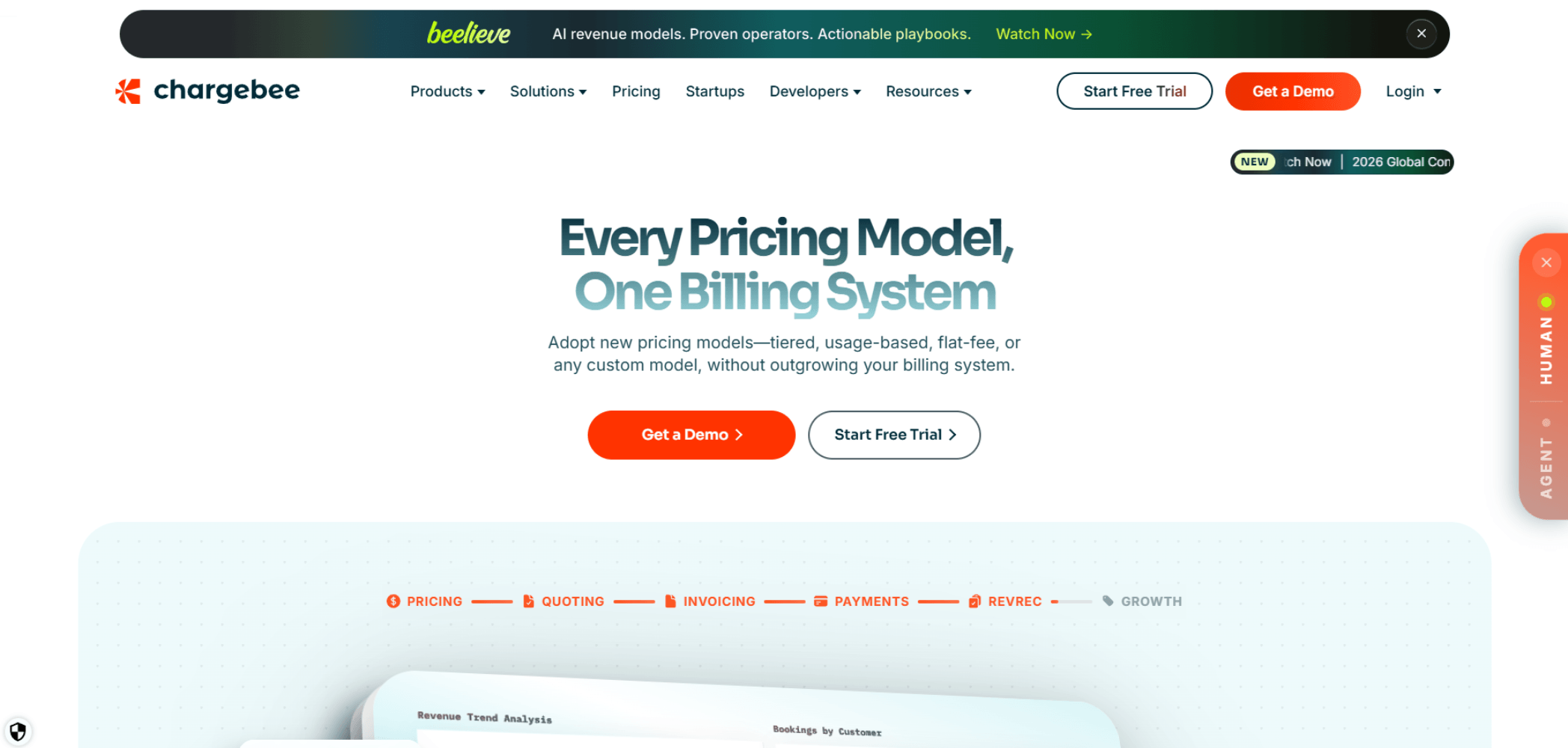
Chargebee is the most go-to-market-flexible platform of the three. If your fintech product has a sales-assisted motion, charges different tiers to different customer segments, and needs the ability to quote, negotiate, and convert contracts in-app, Chargebee’s CPQ module and subscription lifecycle management are genuinely useful. According to Baremetrics’ comparison, Chargebee is one of the more trusted automation tools in subscription management for companies with complex revenue models.
Multi-currency and multi-entity billing are where Chargebee separates from Maxio most clearly. If you are selling into Europe or LATAM alongside US markets, or if you have multiple legal entities billing under one platform, Chargebee handles the complexity without requiring significant custom development. Revenue recognition is available, but it sits at higher pricing tiers, so smaller teams may find they are paying for features they cannot yet access.
One real limitation: a Reddit thread in the SaaS community noted that Chargebee does not offer significantly more functionality than Stripe for basic subscription use cases. That criticism is fair for simple flat-rate products, but misses the point for fintech companies that need CPQ integration, contract amendments, and multi-element billing. Chargebee’s value shows up at the margins of complexity, not at the center of a simple subscription model.
What Is Recurly Best For in Subscription Billing Ops?
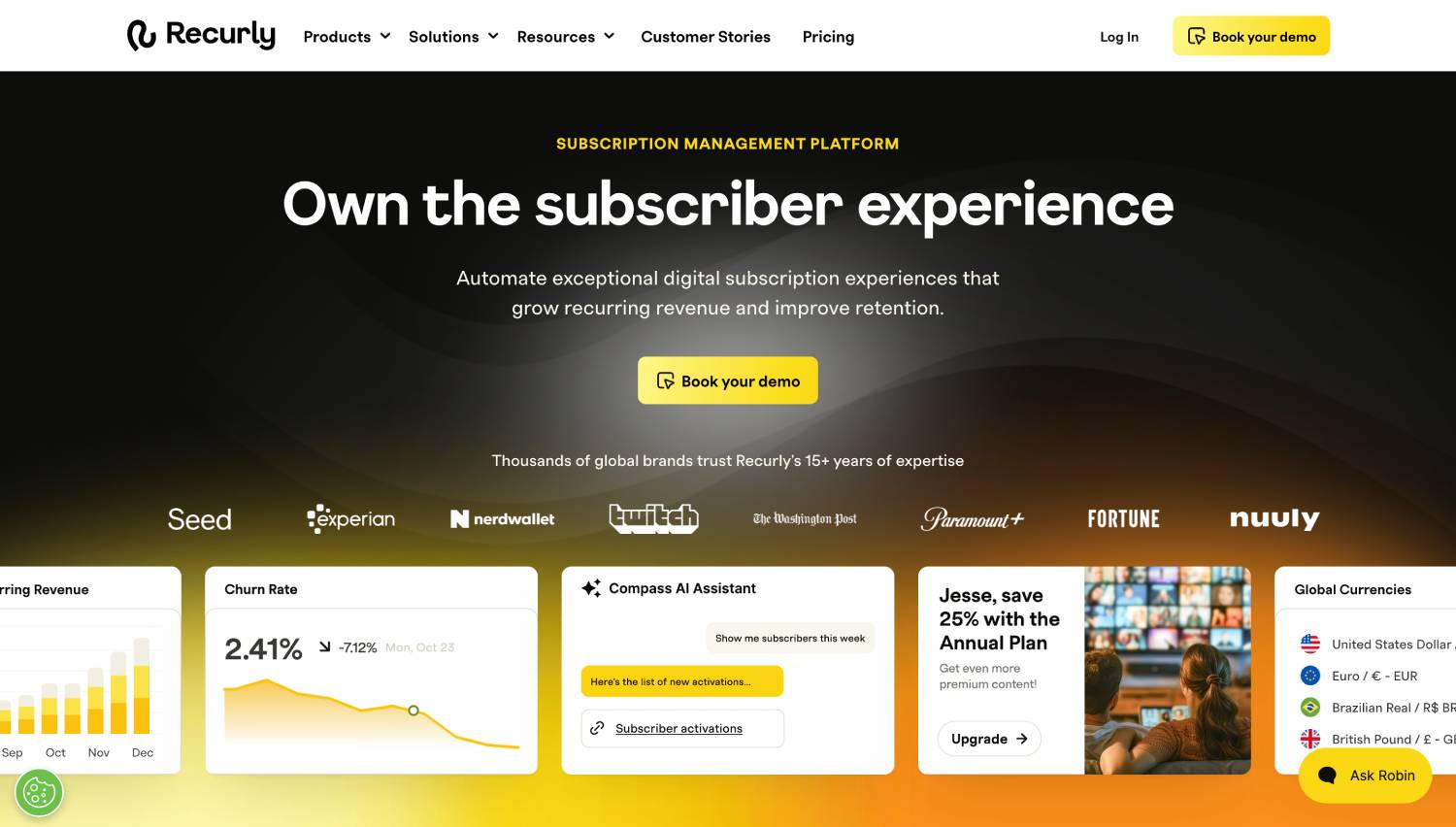
Recurly has the strongest dunning and failed payment recovery logic of the three platforms. For a fintech SaaS company with high subscriber volume and a recurring-first model, that matters more than it sounds. Dunning logic that recovers 10-15% of failed payments does not just reduce churn. It directly improves net revenue retention, which affects your valuation multiple at the next funding round.
Recurly is also the most stable platform for high-volume, predictable billing. If your pricing is clean, your plans are standardized, and your primary billing challenge is operational reliability rather than pricing model complexity, Recurly reduces engineering overhead. Vertex integration for enterprise-grade tax compliance gives Recurly an edge for mid-market fintech companies with complex tax obligations across states or entities.
Where Recurly falls short is in CPQ, contract-based billing, and deep usage metering. A Schematic comparison found that Chargebee offers broader support for complex billing models, including CPQ flows and finance-led workflows. Recurly is better when the billing model is already decided and the job is execution, not modeling.
What Is Maxio Best For in Usage-Based Fintech Billing?
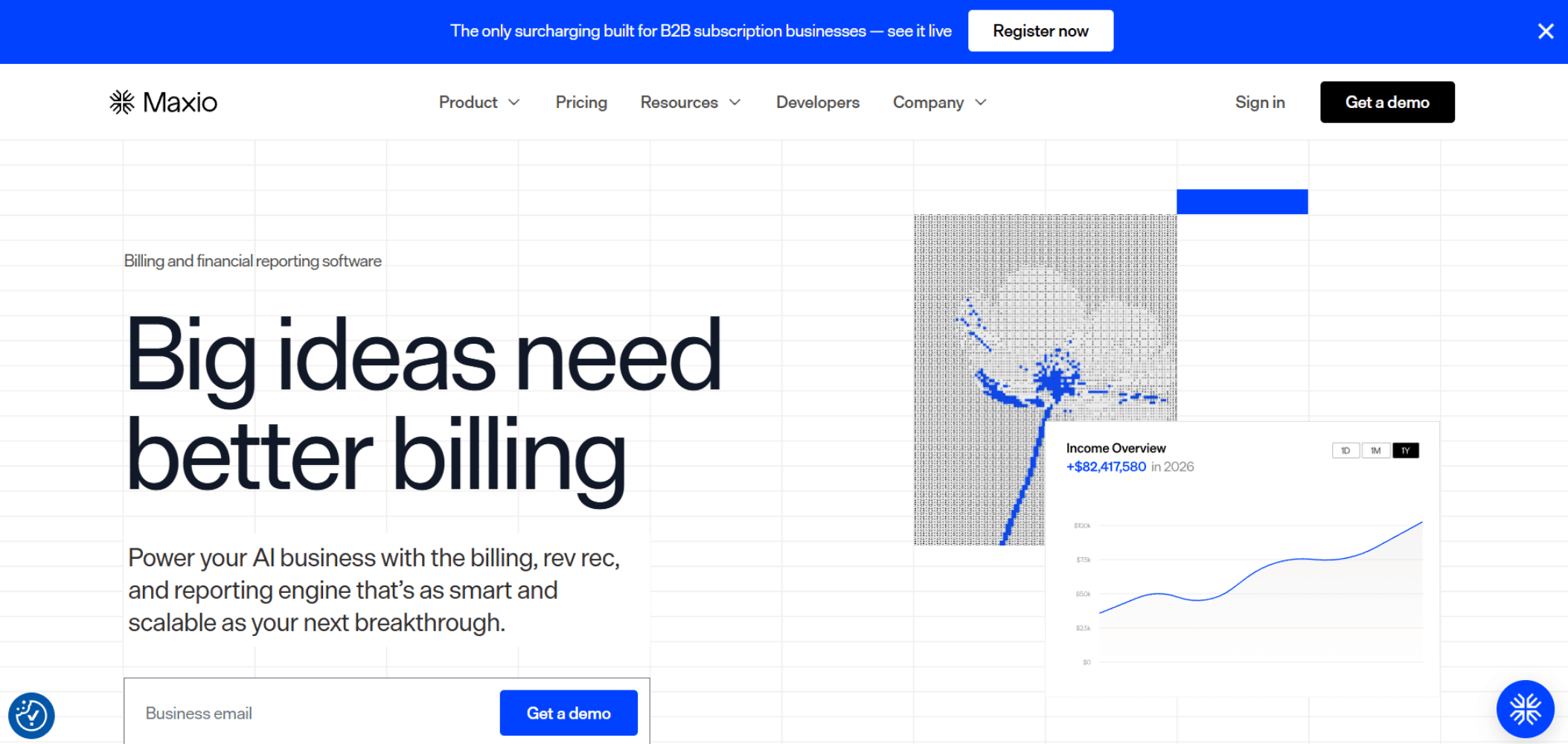
Maxio’s core advantage is the combination of metered usage billing and finance-grade revenue recognition in one product. For a fintech SaaS company charging per transaction, per API call, per connected account, or on any hybrid of usage and base fee, Maxio handles those scenarios more natively than Chargebee or Recurly. The Chargify side of the product was built specifically around metered billing, and that design intent is visible in the feature depth.
The SaaSOptics side handles what happens after billing: deferred revenue, multi-element arrangement accounting, and the reporting a CFO needs when preparing for an audit or a Series B. According to Maxio’s own feature documentation, the platform includes native revenue and expense reporting, basic revenue recognition, and end-of-period balance reporting. Those are not marketing claims. They are specific accounting outputs that eliminate hours of manual spreadsheet work per month-end close.
Maxio’s limitation is API quality and developer experience. Compared to Chargebee or Recurly, Maxio’s API documentation is less developer-friendly, and teams doing heavy integration work report more friction. If your engineering team needs to build deeply against the billing API, Chargebee is a faster start.
The FintechSpecs Billing Ops Fit Matrix: Which Platform Fits Your Stage?
Feature tables tell you what each platform does. They do not tell you which one fits where you are right now. The FintechSpecs Billing Ops Fit Matrix maps platform capability to the specific operational moment a fintech SaaS company is actually in, because a Series A company stress-testing pricing models has different requirements than a Series B company grinding down involuntary churn. Most generic comparisons collapse these distinctions. This one does not.
What makes this framing useful for fintech SaaS specifically is that the compliance and reporting requirements shift as sharply as the billing complexity. A company moving from flat-rate to usage-based pricing is not just adding a feature, it is changing what its finance team needs to produce at month-end close. The matrix accounts for both dimensions simultaneously.
| Stage / Situation | Best Fit | Why |
|---|---|---|
| Pre-seed to seed, simple flat pricing | Stripe Billing | Engineering overhead is not justified yet |
| Series A, testing multiple pricing models | Chargebee | Flexible enough to change pricing without replatforming |
| Series A/B, usage or metered billing is core | Maxio | Native metering + revenue recognition saves months of custom work |
| Series B+, high-volume recurring, churn is the main problem | Recurly | Best dunning, reliable at scale, clean plan structures |
| Mid-market, sales-assisted motion with enterprise deals | Chargebee | CPQ and contract amendment workflows match sales complexity |
| CFO needs ASC 606 audit-ready reporting | Maxio | SaaSOptics lineage makes this native, not an add-on |
| Multi-currency, multi-entity, multi-market | Chargebee | Strongest localization and entity management of the three |
When Is Stripe Billing Enough for Fintech SaaS?
Stripe Billing is a real option, not a consolation prize, for early-stage fintech SaaS. If your pricing is flat-rate or tiered, you are still iterating on the model, and your team does not have a finance function that requires standalone revenue recognition, Stripe Billing avoids the integration overhead of a full subscription billing platform. Stripe’s payment infrastructure, fraud tooling, and billing all live in one dashboard. That simplicity has genuine value when you have seven engineers and zero time.
The tipping point comes when two things happen simultaneously: your pricing model becomes usage-linked, and your CFO or auditor asks for deferred revenue schedules or ASC 606 documentation. At that point, Stripe Billing cannot produce those outputs without custom engineering work, and the cost of that work typically exceeds the cost of migrating to Chargebee or Maxio. The companies that stay too long on Stripe Billing usually discover this when preparing for a Series B audit or when a customer asks for a revenue recognition-compliant contract amendment. For a broader view of how Stripe compares on the payment processing side specifically, the Stripe vs Adyen comparison for B2B SaaS covers that dimension in detail.
A secondary signal: if your sales team is quoting custom contracts with ramps, credits, or multi-year terms, Stripe Billing starts requiring workarounds. That is not a failure of Stripe; it was not designed for that use case. Chargebee was.
How Do Pricing Models Compare Across Chargebee, Recurly, and Maxio?
None of the three platforms publish fully transparent pricing for all tiers. As of their public pricing pages, Chargebee offers a free tier for early-stage companies processing under a certain revenue threshold, with paid plans starting based on revenue volume. Recurly and Maxio both operate on custom pricing models with no publicly listed per-tier rates at the time of writing. All three require a sales conversation for enterprise plans, and pricing varies significantly based on billing volume, number of subscribers, and features included.
What is worth knowing about the cost structure is that all three platforms take fees in one of two ways: a flat monthly platform fee, a percentage of billing volume processed, or a combination of both. For fintech SaaS companies processing significant volume, percentage-of-revenue pricing can become a meaningful cost center. That cost is worth modeling explicitly before signing a contract. For context on how hidden platform costs accumulate across the billing stack, the full breakdown of hidden costs affecting fintech SaaS margins is directly relevant to this calculation.
How Do These Platforms Handle Tax Compliance for SaaS?
Tax compliance is not a feature you want to audit during an IRS inquiry. All three platforms integrate with third-party tax engines. Chargebee integrates with both Avalara and TaxJar. Recurly works with Avalara and Vertex. Maxio integrates with Avalara. The practical difference is that Vertex, available through Recurly, handles more complex enterprise tax scenarios across multiple jurisdictions than TaxJar, which is optimized for simpler US sales tax use cases.
For fintech SaaS companies selling to enterprise customers in multiple states or internationally, the choice of tax engine matters almost as much as the billing platform itself. Running Recurly with Vertex is a defensible choice for a mid-market fintech selling to regulated enterprise clients. Chargebee with Avalara covers most use cases for companies still primarily in the US market. If tax compliance across your billing stack is a significant concern, the tax compliance tools for SaaS companies covers the broader tooling options.
What Integrations Should Fintech SaaS Teams Evaluate?
The integrations that matter most for fintech SaaS billing ops fall into four categories: accounting and ERP (QuickBooks, NetSuite, Sage Intacct), CRM (Salesforce, HubSpot), payment processors (Stripe, Braintree, Adyen), and tax engines (covered above). All three platforms have strong Salesforce and Stripe integrations. Where they differ is on ERP depth.
Maxio, through its SaaSOptics side, has historically had strong NetSuite and Sage Intacct integrations, which are common in finance-forward fintech companies. Chargebee’s NetSuite integration is functional but has required more configuration work in practice. Recurly’s ERP integrations are adequate for most use cases. If your company is running Sage Intacct as your accounting system, Maxio is the path of least resistance. For the broader infrastructure decision, the most common fintech infrastructure mistakes includes billing platform mismatches as a recurring failure pattern.
Frequently Asked Questions
What is the difference between Chargebee and Maxio for usage-based billing?
Chargebee supports usage-based billing but requires more configuration to set up metered models correctly. Maxio handles metered and hybrid billing natively, because the Chargify product it was built from was designed specifically for usage billing. For a fintech SaaS company where usage metering is the core billing model rather than an edge case, Maxio reduces engineering setup time meaningfully. Chargebee is a stronger choice when usage billing is one of several models the company supports simultaneously.
Does Recurly handle revenue recognition for fintech SaaS?
Recurly offers basic revenue reporting but does not match Maxio’s ASC 606 capabilities or the depth of the SaaSOptics-derived recognition engine. For fintech SaaS companies that need to allocate revenue across performance obligations, track deferred revenue on multi-year contracts, and produce audit-ready schedules, Recurly requires more external tooling to fill the gap. Companies with a dedicated finance team and a revenue recognition-specific tool in their stack can make Recurly work, but it is not the default path for ASC 606 compliance.
Is Chargebee a good fit for fintech companies with enterprise sales motions?
Chargebee is the best fit of the three for sales-assisted enterprise motions. Its CPQ module handles configure-price-quote workflows, contract amendments, multi-year deal structures, and ramp pricing in ways that Recurly and Maxio do not support natively. For a fintech SaaS company with an AE team closing six-figure annual contracts, Chargebee’s enterprise billing features reduce manual contract management work and create cleaner handoffs between sales and finance.
When should a fintech SaaS company migrate away from Stripe Billing?
Two conditions reliably signal that migration is overdue: the finance team is spending more than a day per month reconciling revenue in spreadsheets outside of Stripe, and the company needs deferred revenue schedules or ASC 606 documentation for an audit or fundraising round. A second signal is a pricing model change from flat-rate to usage-based or hybrid. At that point, the custom engineering required to make Stripe Billing produce finance-grade outputs exceeds the cost of migrating to a dedicated platform like Chargebee or Maxio.
What is the old name for Maxio?
Maxio was formed in 2022 through the merger of two separate companies: SaaSOptics (a financial operations and revenue recognition platform for B2B SaaS) and Chargify (a usage-based and subscription billing platform). The combined entity rebranded as Maxio. Both original products had been operating independently for over a decade before the merger. Understanding this history explains why Maxio has stronger out-of-the-box revenue recognition than billing-first competitors that added finance features later.
How do Chargebee, Recurly, and Maxio compare on dunning and failed payment recovery?
Recurly has the most developed dunning and failed payment recovery capabilities of the three, including smart retry logic, customizable email sequences, and account updater integrations that automatically refresh expired card data. Chargebee’s dunning is solid and configurable. Maxio’s dunning is functional but less sophisticated than the other two. For high-volume B2C-adjacent fintech SaaS where involuntary churn from payment failures is a top-three metric, Recurly’s recovery tooling is a concrete operational advantage.
Can these platforms handle multi-entity or multi-currency billing for fintech companies?
Chargebee is the strongest of the three for multi-entity and multi-currency billing. It supports billing across multiple legal entities, handles multiple currencies in a single account, and has localization features relevant to European and LATAM markets. Recurly handles multi-currency well for mid-sized operations. Maxio is adequate for US-centric companies but requires more configuration for multi-entity structures. For a fintech SaaS company with ambitions to expand internationally, the billing platform’s currency and entity handling should be a first-order evaluation criterion.
What compliance and audit trail features do these billing platforms offer?
All three platforms maintain audit trails for subscription changes, billing events, and payment history. Maxio’s audit trail is the most detailed for finance-side events, given its SaaSOptics lineage of serving companies during due diligence. Chargebee produces strong audit logs and compliance documentation suitable for SOC 2 evidence packages. Recurly’s audit trail is reliable for billing events. For fintech SaaS companies that are SOC 2 Type II certified or preparing for it, all three platforms are defensible, but Maxio’s finance audit depth is specifically relevant for revenue recognition audits. Compliance readiness across the full product stack is covered in the fintech product and compliance readiness checklist.
The Real Decision Is About Where Complexity Lives
Chargebee, Recurly, and Maxio are all competent billing platforms. The error is treating them as interchangeable and choosing based on pricing or a feature checklist. Each one was built with a different primary user in mind: Chargebee for growth-stage companies with complex go-to-market motion, Recurly for operators who need reliability and churn recovery at scale, and Maxio for finance-forward teams where revenue recognition is as important as billing itself.
For fintech SaaS specifically, the finance layer is not optional. Billing platforms that cannot produce ASC 606-compliant outputs, that require manual spreadsheet work to close the books, or that cannot handle usage-metered pricing natively will become technical debt before your Series B. A platform’s dashboard quality is not the right evaluation criterion. Which platform handles the complexity that your pricing model and your finance team will actually create, that is the question worth answering.
Pick the platform that matches your billing complexity today and the compliance requirements you will face in twelve months. Most fintech SaaS companies overweight pricing and underweight audit trail quality when they make this decision. Those priorities tend to reverse quickly once a CFO joins or an investor asks for a revenue recognition schedule. For a closer look at how billing platform costs compound alongside other infrastructure decisions, why most fintech SaaS margins are worse than founders think covers the full picture.