
TLDR
- Most US-built KYB tools pull from American registries and assume foreign entity data works the same way. It does not.
- Registry coverage is the deciding factor for international KYB, not feature lists. A provider that cannot reach Companies House or the German Handelsregister cannot verify those entities, full stop.
- AML and KYB requirements differ significantly across the EU, UK, and APAC. The EU’s Anti-Money Laundering Directives, the UK’s PSRs, and Singapore’s MAS rules all impose different beneficial ownership disclosure standards.
- The eight providers below were selected by country coverage depth, registry source quality, and fit for specific onboarding contexts, not by who has the best marketing.
- For most cross-border fintechs, no single vendor covers every jurisdiction adequately. The right answer is often a primary provider plus a fallback for edge markets.
The best global KYB providers for verifying non-US companies are Trulioo, Kyckr, GBG, Sumsub, Moody’s (Kompany), Topograph, Signzy, and ComplyAdvantage. Each connects to different national registries and sanctions databases, so the right choice depends on which countries your business customers are incorporated in. Trulioo offers the broadest single-vendor coverage across 200-plus markets. Kyckr and Moody’s Kompany lead on primary-source registry depth in the EU and UK. Signzy is the strongest option for South and Southeast Asian verification.
Why Your US KYB Vendor Cannot Handle International Business Verification
US-focused KYB platforms like Middesk and Baselayer are built around Secretary of State filings, IRS EINs, and domestic credit bureau data. Those data sources do not exist in Germany, the Netherlands, or Singapore. When a US platform tries to verify a UK Ltd or a German GmbH, it typically falls back on third-party data aggregators rather than primary registry pulls, which means lower confidence scores, more manual reviews, and more false positives.
The structural problem is that European registries are sovereign, fragmented, and often require local-language API connections. Companies House in the UK operates differently from the Kamer van Koophandel in the Netherlands, which operates differently from the Registro Mercantile in Spain. A provider that claims to cover “Europe” may connect to three of those registries directly and pull the rest from secondary sources of varying quality.
For teams building cross-border onboarding flows, this matters operationally. Secondary-source data introduces a lag, often 24 to 72 hours, and may not reflect recent changes like director resignations or dormancy status. For a lending or payments platform onboarding a French SAS or an Irish limited company, that lag is a compliance exposure. The KYB requirements and business verification checklist for fintechs covers what you need to gather at the entity level before any registry check even starts.
How AML and KYB Requirements Vary Across Europe
The EU’s AML framework is set at the directive level but implemented by each member state, which creates real variation. The Sixth Anti-Money Laundering Directive (6AMLD) standardized predicate offenses across member states, but UBO disclosure thresholds and verification timelines still differ by country. Germany requires disclosure of beneficial owners holding 25% or more. France applies the same threshold but also mandates ongoing monitoring updates in its RNCS registry. The Netherlands’ UBO register is public. Ireland’s is not.
The UK, post-Brexit, operates under its own regime through the Economic Crime and Transparency Act 2023, which created the Register of Overseas Entities. Verifying a UK company now requires checking Companies House plus, for real estate-holding entities, that secondary register. Most global KYB vendors do not yet pull from the Register of Overseas Entities natively.
In APAC, variation is even sharper. Singapore’s MAS requires that financial institutions verify entities through the Accounting and Corporate Regulatory Authority (ACRA). India’s MCA21 system is the correct primary source for Indian companies, but access requires a licensed local partner in many cases. For fintechs expanding into these markets, picking a global KYB provider based on EU coverage alone leaves large gaps. Checking how KYB providers handle cross-border business verification across these regimes is a necessary pre-procurement step.
The FintechSpecs Registry Depth Test: How to Evaluate Any Global KYB Provider
Before reviewing specific vendors, it helps to have a consistent framework. The FintechSpecs Registry Depth Test evaluates global KYB providers across four dimensions, in order of importance:
- Primary source vs. secondary source: Does the vendor pull directly from the official national registry via API, or do they aggregate from a data reseller? Primary-source connections produce more current data and carry more weight in compliance audits.
- Coverage density: How many of the registries in your target markets does the vendor cover natively? A claim of “200 countries” often means primary coverage in 40 and secondary or manual coverage elsewhere.
- UBO extraction: Can the vendor return beneficial ownership data as a structured field, or does it deliver raw document images that require manual extraction?
- Ongoing monitoring: Does the vendor alert you when registry data changes after initial verification, or is the check a one-time snapshot?
Run every vendor on this shortlist through those four checks against your specific target markets. A provider that scores well in Western Europe may score poorly on Southeast Asia. No single vendor currently passes all four checks in every region.
8 Best Global KYB Providers for Verifying Non-US Companies
1. Trulioo
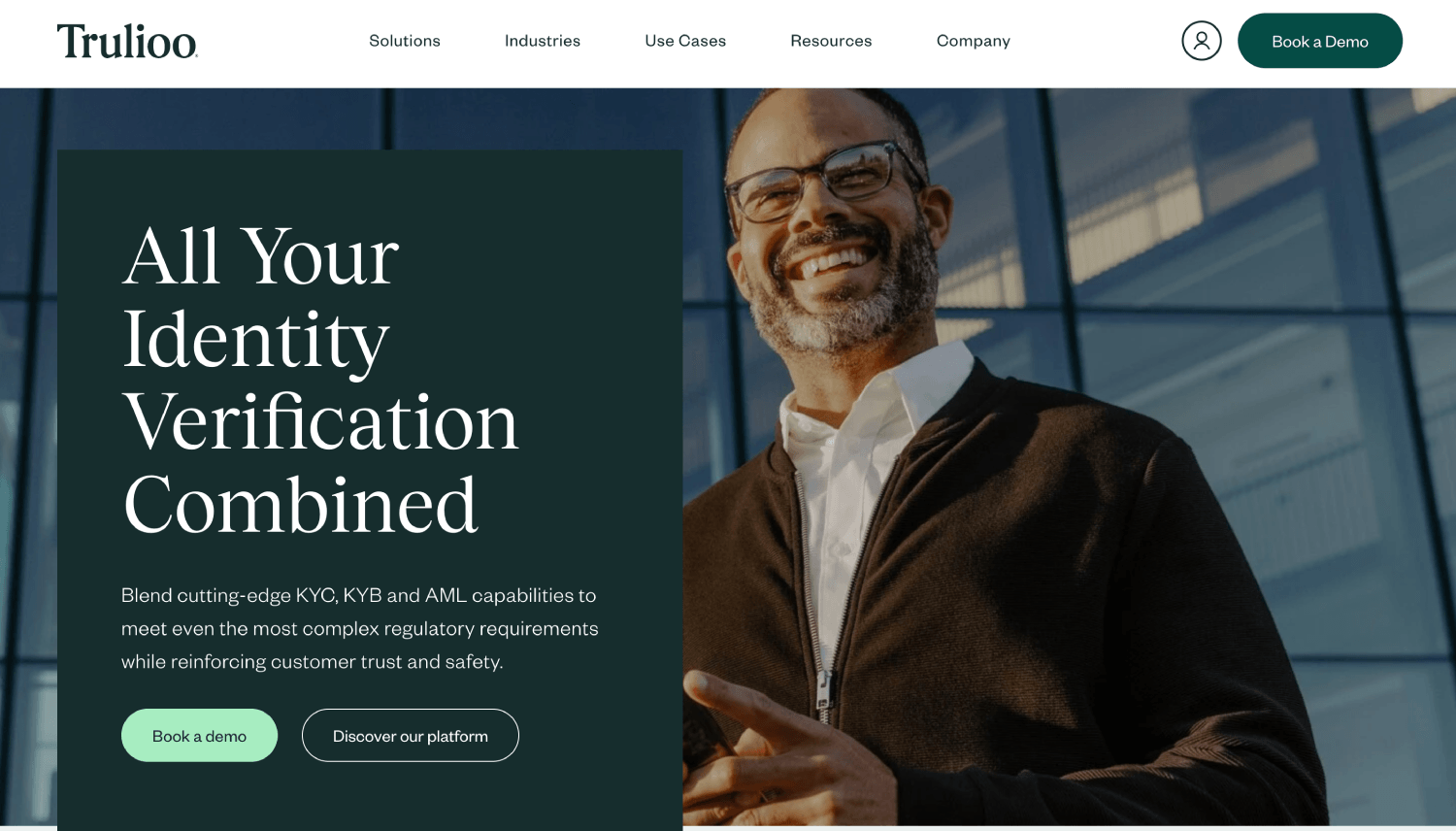
Trulioo is the broadest-coverage option for global KYB, with documented business verification coverage across more than 200 markets. The platform connects to a wide range of data sources globally, including direct registry integrations in the EU, UK, Canada, and Australia. Trulioo’s GlobalGateway product handles both KYC and KYB in a single API, which reduces integration overhead for companies that need both individual and entity verification.
The trade-off is depth versus breadth. In heavily regulated markets like Germany or France, Trulioo pulls from primary registries and delivers UBO data as structured fields. In smaller or less-developed markets, coverage can fall back to secondary sources or commercial data aggregators. For most cross-border fintechs at Series A and beyond, Trulioo is the default starting point because it reduces the number of vendor relationships needed. Pricing is not publicly disclosed and requires a sales engagement.
Trulioo fits best when your company customer base spans 10-plus jurisdictions and you need a single integration to cover the majority of them. It is less optimal when you need deep, primary-source EU registry coverage with structured UBO extraction at high verification volume, where Kyckr or Moody’s Kompany often outperform it. The Trulioo vs Sumsub comparison for KYB and KYC onboarding covers both vendors in depth if that is your core decision.
2. Kyckr
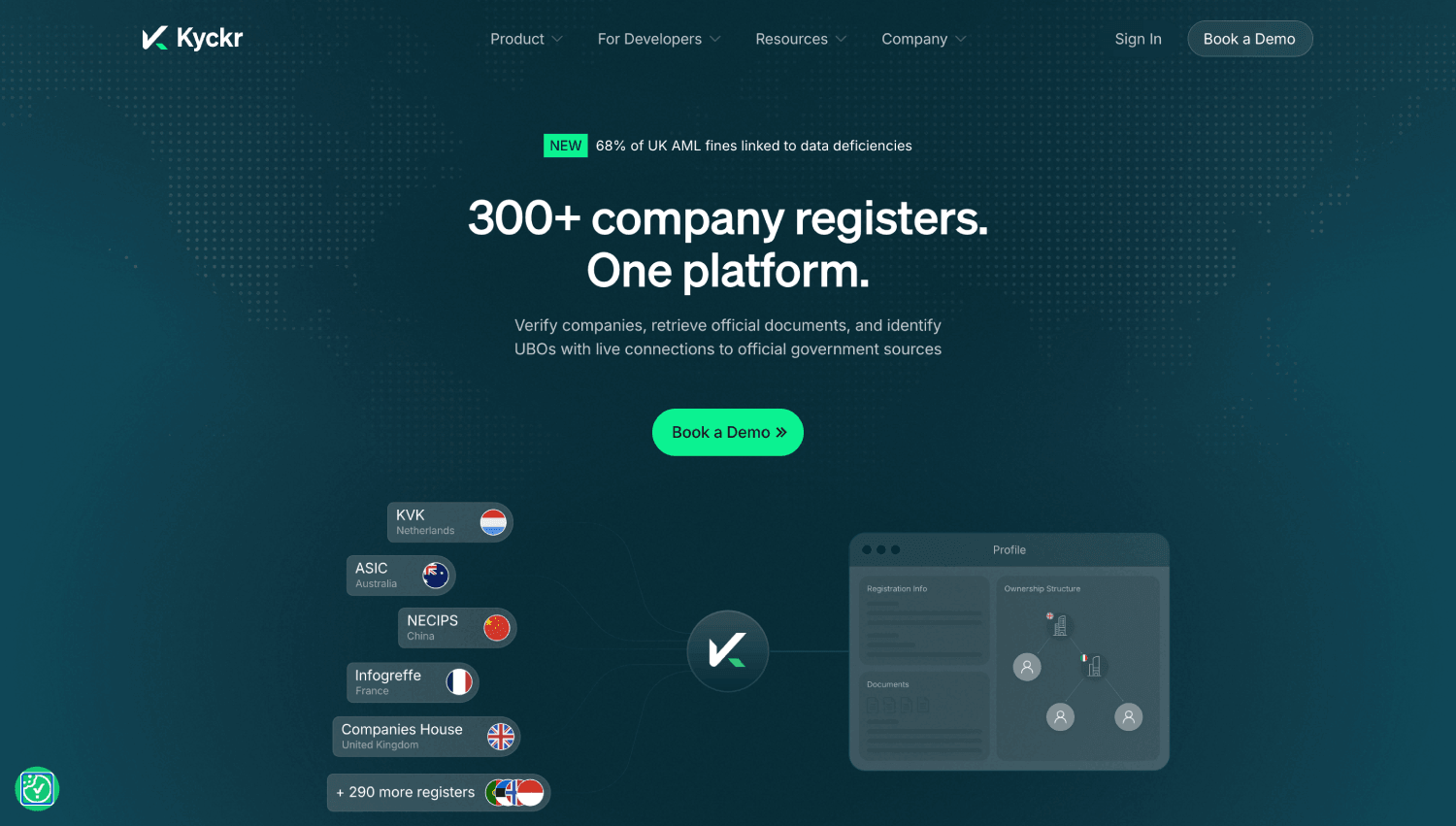
Kyckr is built entirely around primary-source corporate registry data. The company connects directly to official registries in more than 120 countries and does not resell aggregated commercial data. For EU and UK entity verification, that distinction matters enormously. When a compliance auditor asks for the provenance of your entity data, a Kyckr-sourced record pointing to Companies House or the KvK is defensible in a way that a third-party aggregated record is not.
Kyckr’s strength is registry depth. It pulls director lists, shareholder structures, financial filings, and status changes directly from the source authority. UBO data is returned as structured fields where the registry supports it, and the platform supports ongoing monitoring that alerts customers when registry data changes. The coverage in Western and Central Europe is among the strongest available from any single vendor focused on primary-source connections.
Kyckr is a focused tool, not a full compliance stack. It does not offer document verification or sanctions screening natively, so it typically sits inside a broader orchestration layer. Teams that want a modular setup with strong primary-source registry data should evaluate Kyckr first for EU and UK coverage. Pricing is custom; a demo is required.
3. GBG
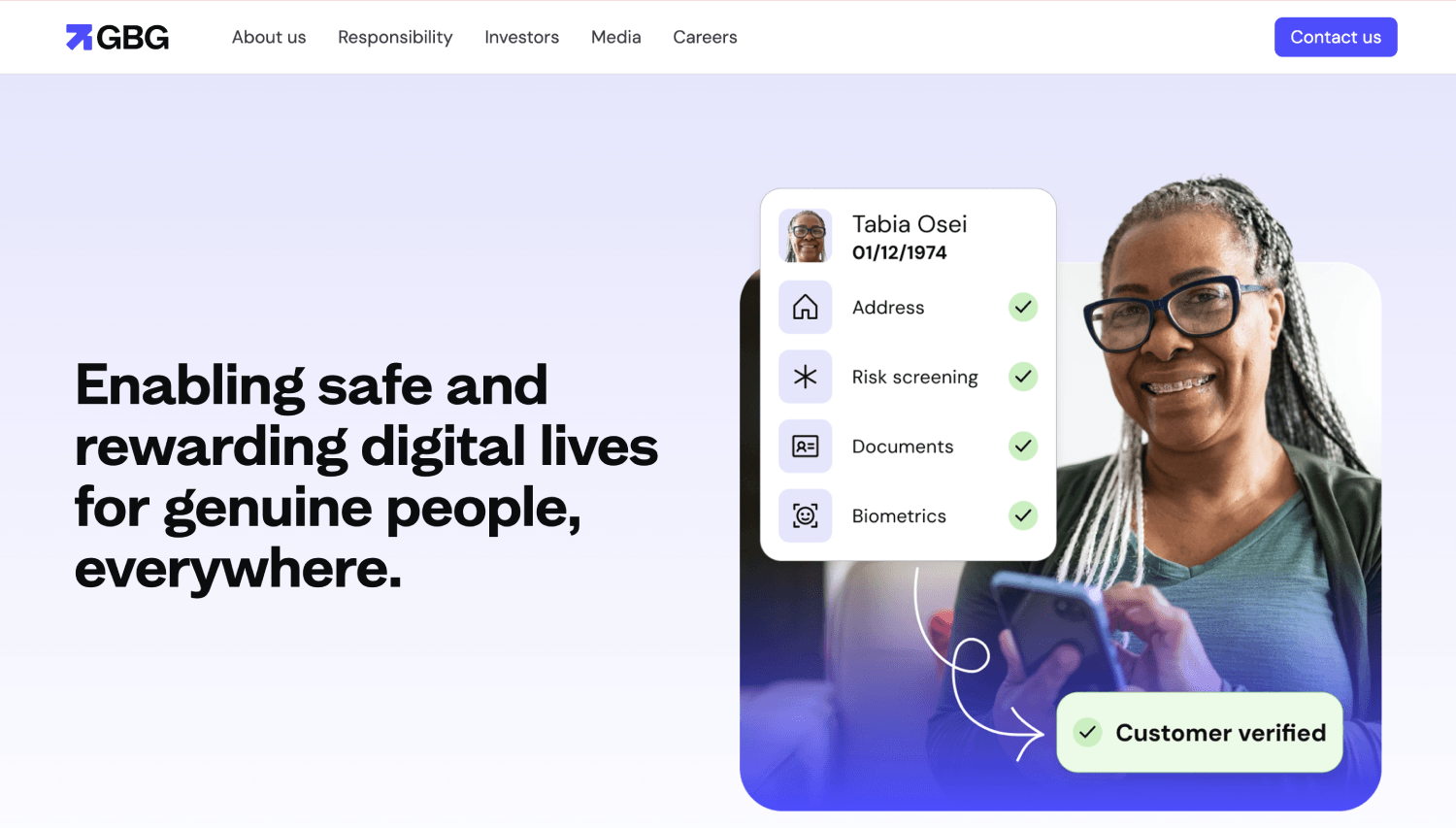
GBG (GB Group) is a UK-headquartered identity data company with particularly strong coverage across the UK, Europe, Australia, and Southeast Asia. The company operates its own proprietary data assets in some markets and connects to national registries in others, which gives it a hybrid coverage model. For companies expanding into markets like Malaysia, Singapore, or Australia, GBG often outperforms US-headquartered vendors that treat those jurisdictions as secondary markets.
GBG’s KYB product is part of a broader identity verification and fraud prevention platform. That integration can be an advantage if you need to run individual director KYC alongside entity verification, since both checks share the same API contract. It is a mild disadvantage if you only need entity verification and the broader platform adds cost and complexity you do not need.
GBG suits larger fintechs and financial institutions that are building compliance operations for the UK and APAC simultaneously. For a US company primarily onboarding EU entities, it is a strong contender but not the default first call. Pricing is not publicly listed.
4. Sumsub
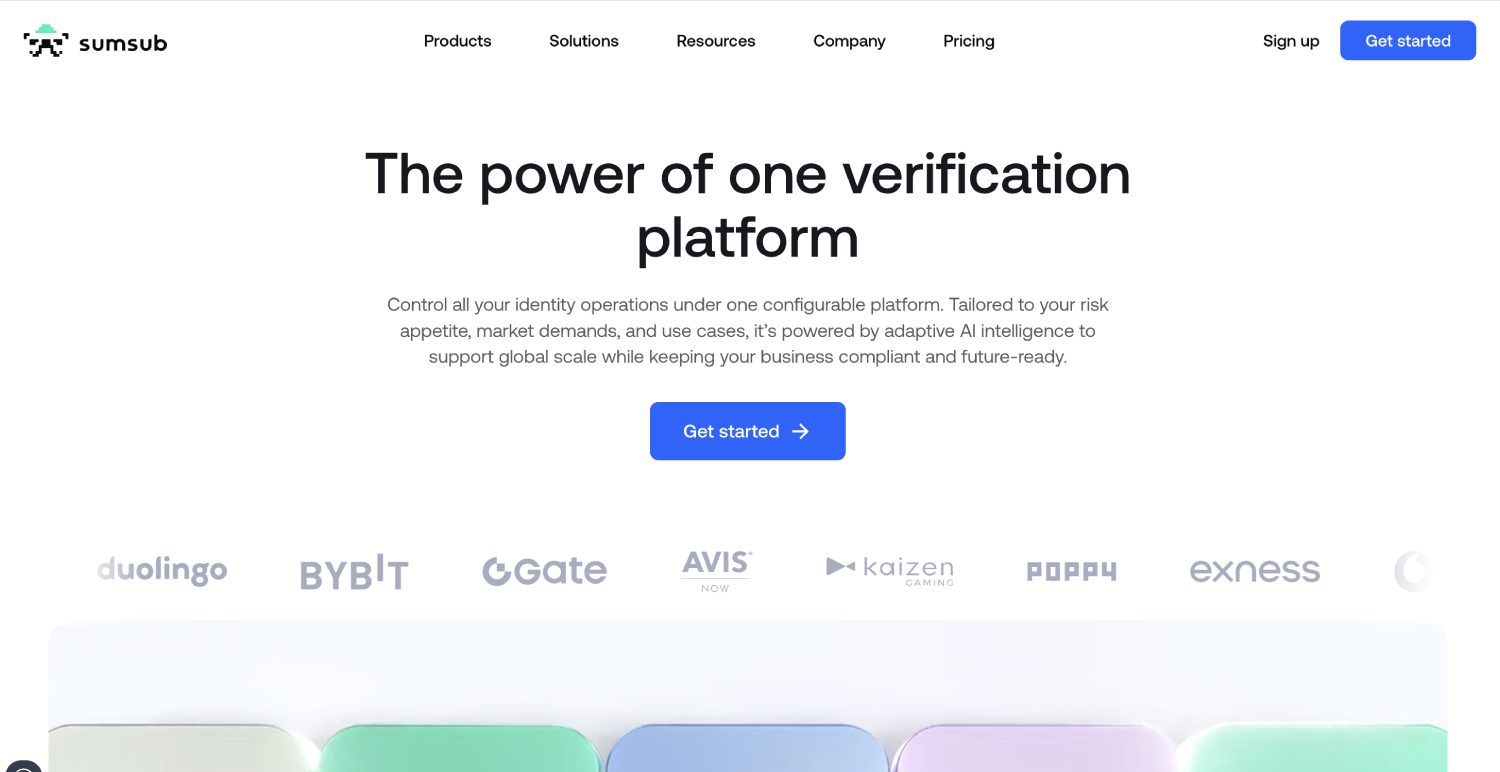
Sumsub positions itself as a full-cycle verification platform covering KYC, KYB, AML screening, and transaction monitoring. Its KYB product pulls from business registries in over 200 countries and integrates directly with registries across the EU, UK, and a wide range of emerging markets. What makes Sumsub notable for international KYB is its UBO verification workflow, which chains individual KYC checks to the entity verification in a single orchestrated flow.
For fintechs that need to verify a company and then verify each beneficial owner’s identity in the same onboarding session, Sumsub’s integrated workflow reduces friction versus stitching together a registry tool and a separate KYC provider. The platform’s no-code workflow builder lets compliance teams adjust verification steps by country without engineering involvement, which is genuinely useful when regulatory requirements differ across markets.
Sumsub’s pricing is volume-based and not publicly disclosed per verification on their website. The platform is a strong fit for growth-stage fintechs onboarding international business customers who also require individual director checks at scale. It competes most directly with Trulioo when the buyer wants a combined KYC and KYB vendor.
5. Moody’s (Kompany)
Moody’s acquired Kompany in 2023 and integrated its real-time registry access into the broader Moody’s analytics and risk data platform. Kompany was purpose-built for primary-source corporate registry access in Europe, with direct connections to registries in the EU, UK, Norway, Switzerland, and beyond. Post-acquisition, that registry infrastructure now sits inside a platform that also includes credit risk scoring, watchlist screening, and adverse media monitoring.
The Kompany registry layer remains among the strongest options for primary-source EU data. Real-time pulls from Companies House, the Handelsregister, the KvK, and other European registries mean verification data is current at the moment of the check, not days old. For compliance teams that need to defend their onboarding process to a regulator, that provenance trail is a meaningful advantage.
The main consideration is that Moody’s is an enterprise sales motion. Pricing reflects that. Mid-market fintechs under 500 employees may find the contract minimums challenging, and the broader Moody’s platform features that are bundled in may not be needed at that stage. For Series C-plus companies with European regulatory exposure, Moody’s Kompany is the strongest primary-source option on this list.
6. Topograph
Topograph is a newer entrant in the global business verification space, built specifically for the KYB use case rather than evolved from a broader identity or credit data platform. The product focuses on structured data extraction from registries, with an emphasis on UBO mapping and corporate structure visualization. For complex entities with multi-layer ownership, Topograph’s graph-based output is easier to work with operationally than a flat registry extract.
Topograph covers a growing set of European and APAC registries. The company’s approach prioritizes real-time primary-source data over breadth of country coverage, which means it is not the right vendor if you need to verify companies in 50-plus jurisdictions today. It is a strong fit for compliance teams that regularly deal with complex corporate structures in specific high-priority markets and need structured, audit-ready output.
Pricing and coverage specifics are available through a direct engagement with the company. Topograph is worth a proof-of-concept evaluation for any team running manual UBO extraction from raw registry documents today. The structured output alone can materially reduce analyst time on complex cases.
7. Signzy
Signzy is the strongest option for KYB verification in South Asia and Southeast Asia. The company is India-headquartered and connects natively to India’s MCA21 corporate registry, the GST database, and a range of other official Indian data sources that most Western KYB vendors cannot reach through primary connections. For companies onboarding Indian entities, that direct integration is the difference between a primary-source check and a manual document review.
Signzy’s coverage extends beyond India to other APAC markets, and the platform includes document verification and KYC for individual directors. The onboarding workflow is designed for the regulatory requirements of the region, including India’s Aadhaar-based identity verification, which is specific enough that most global vendors do not support it natively.
For a US or European fintech expanding into India, Signzy makes more sense as a regional specialist than as a primary global KYB vendor. A practical architecture for cross-border teams is a broad-coverage provider like Trulioo for most markets, with Signzy added specifically for India and APAC where primary-source accuracy matters most. Pricing is custom and requires a direct conversation.
8. ComplyAdvantage
ComplyAdvantage approaches global KYB from the AML side rather than the registry access side. The platform leads with sanctions screening, PEP (politically exposed person) lists, adverse media monitoring, and watchlist checks, and layers entity verification on top of that. For companies where the compliance priority is AML risk rather than corporate structure verification, ComplyAdvantage’s data model is better aligned.
The platform’s global coverage on sanctions and watchlist data is comprehensive, pulling from OFAC, UN, EU, UK, and dozens of national lists. Its adverse media monitoring covers publications in multiple languages, which is relevant for verifying entities in markets where English-language media coverage is limited. For EU-incorporated companies verifying counterparties in high-risk jurisdictions, this combination of AML and entity data is useful in a single tool.
ComplyAdvantage is not the primary-source registry leader on this list. For deep corporate structure verification in Europe, Kyckr or Moody’s Kompany outperform it. ComplyAdvantage earns its place here because many cross-border onboarding workflows need both registry data and AML screening, and running both through one vendor simplifies compliance reporting. For teams already evaluating AML screening APIs, ComplyAdvantage warrants comparison against dedicated registry tools rather than being treated as a separate category.
Country Coverage Matrix: Which Provider Covers Which Markets
| Provider | UK | Germany | France | Netherlands | India | Singapore | Australia | Canada |
|---|---|---|---|---|---|---|---|---|
| Trulioo | Primary | Primary | Primary | Primary | Secondary | Primary | Primary | Primary |
| Kyckr | Primary | Primary | Primary | Primary | Limited | Primary | Primary | Primary |
| GBG | Primary | Primary | Primary | Primary | Secondary | Primary | Primary | Secondary |
| Sumsub | Primary | Primary | Primary | Primary | Secondary | Primary | Primary | Primary |
| Moody’s (Kompany) | Primary | Primary | Primary | Primary | Limited | Limited | Secondary | Secondary |
| Topograph | Primary | Primary | Primary | Primary | Limited | Limited | Limited | Limited |
| Signzy | Limited | Limited | Limited | Limited | Primary | Primary | Limited | Limited |
| ComplyAdvantage | Secondary | Secondary | Secondary | Secondary | Secondary | Secondary | Secondary | Secondary |
Note: “Primary” means a direct connection to the official national registry. “Secondary” means coverage via a data aggregator or commercial data partner. “Limited” means partial coverage or significant gaps that require manual review for many entity types. Coverage designations are drawn from each provider’s public product documentation and website materials; buyers should confirm specifics directly with each vendor for their target jurisdictions.
Which Provider Fits Which Buyer?
| Buyer Profile | Best Fit | Why |
|---|---|---|
| Cross-border fintech, 10+ jurisdictions | Trulioo | Broadest single-vendor coverage, one API integration |
| EU-focused platform, audit-grade requirements | Kyckr or Moody’s (Kompany) | Primary-source EU registries, structured UBO output |
| UK + APAC expansion | GBG | Strong in both regions from a single vendor |
| Combined KYC and KYB in one flow | Sumsub | Chained entity and director verification in one session |
| Complex ownership structures, EU | Topograph | Graph-based UBO mapping, structured audit output |
| India and South Asia primary markets | Signzy | Native MCA21 and Aadhaar integration |
| AML-first, high-risk counterparty screening | ComplyAdvantage | Comprehensive sanctions, PEP, and adverse media data |
| Enterprise risk platform, Series C+ | Moody’s (Kompany) | Registry depth plus credit risk and analytical layers |
What Should You Ask a Global KYB Vendor Before You Sign?
Most KYB RFP processes treat international coverage as a checkbox. The more useful questions go deeper. For each target market, ask the vendor to specify whether their connection to that country’s registry is a direct API integration, a licensed data reseller relationship, or a manual document retrieval service. Those three options carry meaningfully different data freshness, audit defensibility, and failure mode profiles.
Ask specifically about what happens when a registry is unavailable. National registries have maintenance windows and outage events. A vendor with a direct integration fails gracefully and can report back that the registry was unreachable. A vendor relying on a cached secondary dataset may return stale data without flagging it as such.
For ongoing monitoring, ask how long it takes for a registry change to surface as an alert in the platform. Some vendors run nightly batch jobs. Others offer near-real-time monitoring for high-priority entities. For payments and lending platforms with ongoing counterparty risk exposure, that latency difference is material. Teams evaluating broader perpetual KYB and ongoing monitoring platforms should run those questions in parallel with the initial onboarding verification evaluation.
Frequently Asked Questions
What is international KYB and how does it differ from US KYB?
International KYB is the process of verifying the legal existence, ownership structure, and compliance standing of a business entity incorporated outside the United States. Unlike US KYB, which draws on centralized sources like Secretary of State filings and IRS EIN databases, international KYB requires connecting to dozens of distinct national registries, each with different data formats, languages, access requirements, and update frequencies. The core verification logic is similar, but the data infrastructure is significantly more complex.
How do AML and KYB requirements vary across Europe?
EU member states share a common AML directive framework, including the requirement to identify beneficial owners above a 25% ownership threshold, but implementation varies. Germany, France, and the Netherlands all maintain UBO registers, but public access levels differ. The UK, now outside the EU, operates under its own Economic Crime and Transparency Act regime. Verification timelines, document requirements, and ongoing monitoring obligations also differ by country and by the risk classification of the customer. No single rulebook covers all of Europe.
Can a US-only KYB provider verify UK or EU companies?
Some US-focused KYB vendors offer international coverage through data aggregator partnerships, but that coverage is usually secondary-source rather than primary-source. Secondary-source data for UK or EU entities may be 24 to 72 hours stale, may not reflect recent director changes or dormancy filings, and may not satisfy a regulator’s expectation that verification data comes from the official registry. For audit-grade international verification, a provider with direct registry integrations in the relevant countries is required.
What is a primary-source KYB registry connection?
A primary-source connection means the KYB provider pulls data directly from the official national registry, such as Companies House in the UK or the Handelsregister in Germany, via a real-time API or licensed direct access arrangement. The alternative is a secondary-source connection, where the provider retrieves data from a commercial aggregator that repackages registry data. Primary-source connections are faster, more current, and more defensible in compliance audits because the data chain leads directly back to the government authority.
Do KYB requirements differ for UK companies after Brexit?
Yes. UK companies are no longer subject to EU AML directives and are now governed by UK domestic legislation, including the Proceeds of Crime Act, the Money Laundering Regulations 2017 (as amended), and more recently the Economic Crime and Transparency Act 2023. That last piece of legislation introduced the Register of Overseas Entities, which applies to foreign entities owning UK property. Verifying a UK company now involves checking Companies House and, for relevant entities, that secondary register. Most global KYB vendors have not yet integrated the Register of Overseas Entities as a live data source.
How do you verify KYB for companies in India or Southeast Asia?
Verification in India requires access to the Ministry of Corporate Affairs’ MCA21 system, which holds corporate filings for all registered Indian entities. Access typically requires a licensed local integration partner. Singapore entities are verifiable through ACRA, which has a developer-accessible API. For Malaysia and Indonesia, registry data is less consistently available via API, and some verification steps may involve document-based review. Signzy is the strongest vendor for India specifically. GBG covers Singapore and Malaysia more thoroughly than most Western competitors. For detailed considerations, the UBO verification providers for fintechs overview addresses APAC ownership disclosure requirements directly.
What is UBO verification and why does it matter for international KYB?
UBO stands for ultimate beneficial owner, the natural person or persons who ultimately own or control a business entity. AML regulations in the EU, UK, and most other regulated jurisdictions require that financial institutions identify and verify UBOs above a defined ownership threshold, typically 25%. For international KYB, UBO verification is more complex than domestic checks because ownership structures may span multiple jurisdictions, and beneficial ownership registers in some countries are not publicly accessible. Providers that return UBO data as structured fields rather than raw document images significantly reduce the manual work required from compliance analysts.
Is one global KYB provider sufficient, or do most companies need multiple vendors?
For most fintechs serving 20 or fewer jurisdictions, a primary vendor like Trulioo or Sumsub will cover the majority of verifications adequately. The gap cases, India, certain African markets, niche APAC jurisdictions, are where a secondary specialist like Signzy adds value. For companies with serious regulatory exposure in specific EU markets, layering a primary-source specialist like Kyckr or Moody’s Kompany on top of a broad-coverage provider gives both depth and breadth. The architecture that fails is relying on a single US-built KYB vendor and assuming it handles international markets correctly. The best KYB providers for B2B fintech onboarding covers the US-specific landscape for comparison.
What the Right Global KYB Decision Actually Comes Down To
Country coverage is not a marketing claim to skim over. It is the most consequential variable in global KYB selection, and it hides behind vague language like “200 markets” in almost every vendor’s materials. The difference between primary-source and secondary-source coverage in a specific country can determine whether your onboarding data holds up in a regulatory examination. That distinction never appears in a comparison slide.
The second variable most teams underweight is UBO extraction. Verifying that a company exists is table stakes. Building a defensible ownership map for a Dutch BV with three holding layers across two jurisdictions is the actual compliance problem. Providers that return structured UBO fields versus raw document images create a night-and-day difference in analyst time and audit readiness. For complex entity structures, that is worth paying more per verification.
The practical path forward for most cross-border fintechs is to map their top ten jurisdictions by verification volume, run the FintechSpecs Registry Depth Test against two or three shortlisted vendors for each of those markets, and treat any jurisdiction where the primary vendor scores “secondary” or “limited” as a gap requiring a specialist or a manual review process. That exercise takes a day. Discovering the gap after a compliance audit takes much longer.