
- Bill.com suits domestic-heavy payables teams at companies under roughly 200 employees, where fast setup and QuickBooks or Xero sync matter more than multi-currency complexity.
- Tipalti is purpose-built for companies sending payments across borders, handling tax form collection, currency conversion, and regulatory compliance inside a single workflow.
- The pricing gap is real but often misread: Bill.com’s lower sticker price can expand once you factor in wire fees, FX markup, and the manual compliance work Tipalti automates.
- Tax handling is the sharpest differentiator. Tipalti collects W-9s, W-8s, and 1099/1042-S forms from payees directly. Bill.com does not.
- If your payables are primarily US domestic, Bill.com is not a compromise. If you pay contractors or vendors in more than five countries, you will outgrow it.
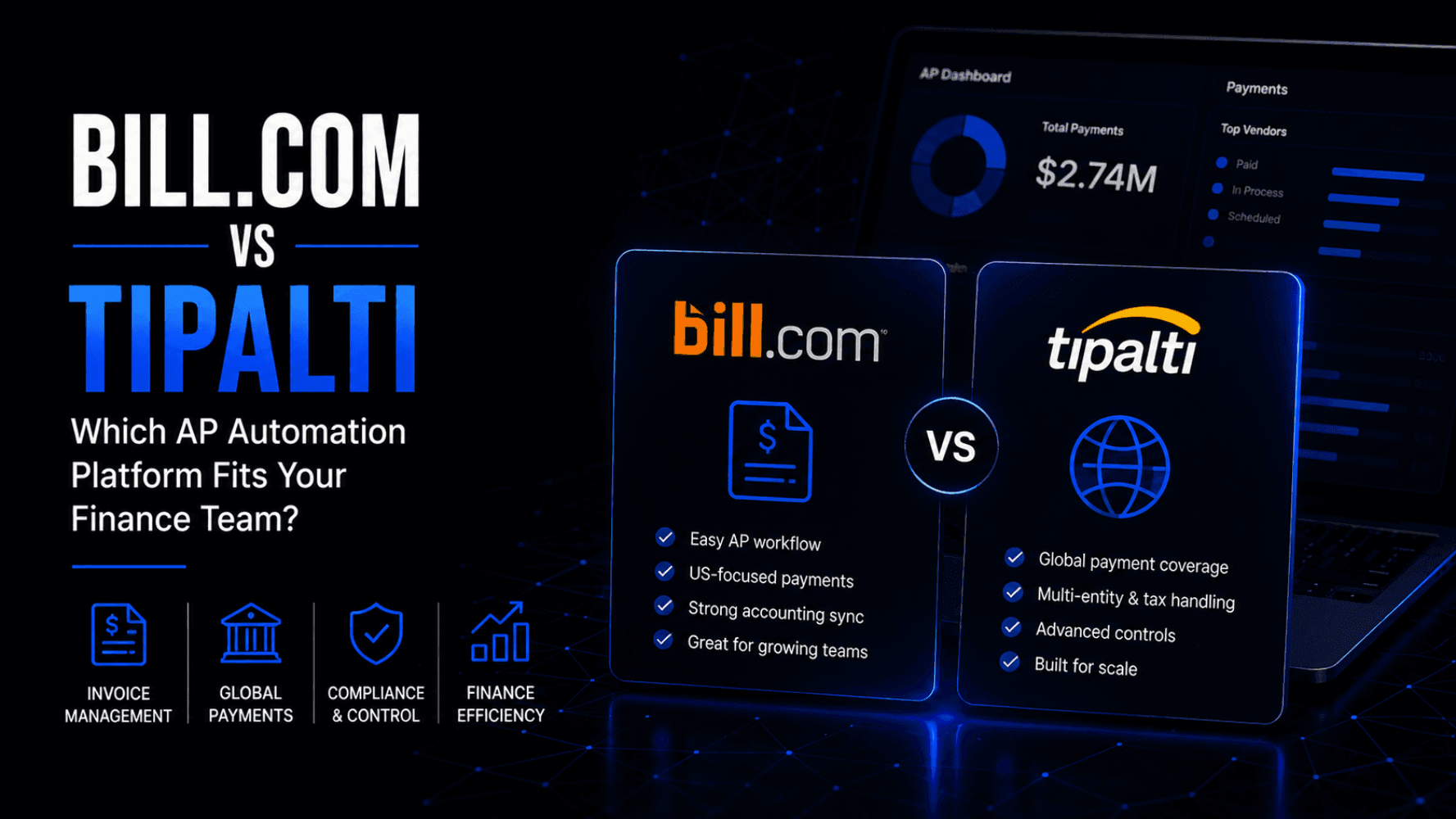
Bill.com fits small-to-mid-size companies with mostly domestic vendor payments, offering quick deployment and strong accounting integrations. Tipalti is the better choice for companies managing cross-border payables at scale, particularly when tax compliance, multi-currency payouts, and global contractor payments are central to the workflow. The price difference between them narrows significantly once transaction fees and manual compliance overhead are counted.
Why This Choice Comes Down to More Than Price
Most finance teams comparing these two platforms are looking at subscription cost first. That instinct leads to the wrong decision in many cases, because the real cost of an AP platform includes what it does not handle.
Bill.com and Tipalti share a surface-level pitch: automate invoice approval, route payments, sync with your general ledger. Past that, they serve different operational realities. One was built for the US SMB market and added international capabilities later. The other was built from day one around the complexity of paying hundreds of global payees while staying compliant with tax regulations in multiple jurisdictions.
The framework that clarifies this decision quickly is what FintechSpecs calls the AP Maturity Stack: four layers of payables complexity that scale with company size and geographic reach. Layer one is domestic payment routing. Layer two is multi-entity approval workflows. Layer three is cross-border payment execution in local currencies. Layer four is end-to-end tax compliance, including payee onboarding and regulatory filing. Bill.com handles layers one and two well. Tipalti handles all four.
What Does Bill.com Actually Do Well?
Bill.com, now marketed as BILL, is genuinely good at domestic AP for companies where the finance team is small and the priority is getting invoices approved and paid without building a complex system. Setup is fast, the interface is approachable, and the integrations with QuickBooks, Xero, Sage Intacct, and NetSuite are mature.
For a 50-person company with 20 to 30 active vendors, mostly US-based, Bill.com replaces a spreadsheet-and-email workflow without requiring a dedicated implementation. Approval chains are configurable. The mobile app works. ACH and check payments are handled natively.
International payments are available through Bill.com, but the coverage and method depth are limited compared to Tipalti. According to comparison data from Ramp’s published review of both platforms, Tipalti supports payments to 200-plus countries in 120 local currencies via ACH, eCheck, PayPal, wire transfer, and prepaid debit. Bill.com’s international reach is narrower and primarily relies on wire transfer. That distinction matters for companies paying freelancers or vendors in Southeast Asia, Eastern Europe, or Latin America, where wire transfers carry higher fees and longer settlement times than local payment rails.
Where Does Tipalti’s Global and Tax Depth Justify the Higher Price?
Tipalti’s pricing is not publicly disclosed at a flat rate, as the company sells through a sales-led process with custom quotes. Bill.com’s pricing, per its public pricing page, starts at $45 per user per month for the Essentials plan, scaling through Team and Corporate tiers, with additional per-transaction fees on top of the base subscription.
The price gap between the two platforms looks significant in a spreadsheet comparison. It narrows when you account for what Tipalti replaces on its own.
To illustrate: consider a hypothetical Series B SaaS company paying 150 contractors across 30 countries monthly. Without Tipalti, that finance team is manually chasing W-8BEN forms, running FX conversions through their bank at rates with 2-to-3 percent spreads, filing 1042-S forms at year end, and handling payee disputes in email. Tipalti collects tax forms directly from payees during onboarding, validates them, stores them, and uses them to generate 1099 and 1042-S filings. That workflow, built manually, can consume a full-time AP coordinator 15 to 20 hours per month at that payment volume, plus the error risk of manual tax form management.
Tipalti also runs payee identity verification during onboarding, which reduces fraudulent payment requests before they reach the approval queue. For teams evaluating vendor risk management alongside AP automation, our breakdown of vendor risk management tools for fintech startups covers where that validation layer fits in a broader risk stack.
How Do the Two Platforms Handle Tax Compliance Differently?
This is the sharpest functional gap, and it is worth being specific.
Bill.com does not collect W-9 or W-8 forms from payees on your behalf, and it does not generate 1099 or 1042-S filings. Those tasks remain with your finance team or your accountant. For a company paying a handful of US contractors, that is manageable. For a company with global payees, it is a meaningful manual burden with real regulatory exposure.
Tipalti collects tax forms directly from payees as part of the payee onboarding portal. Payees enter their own information, Tipalti validates it, and the platform uses that data to prepare year-end tax filings. The company reports that its system handles OFAC and other regulatory screening of payees as part of the same workflow.
For finance teams worried about year-end filing accuracy, this is not a minor convenience feature. Errors on 1042-S filings carry IRS penalties. Having the platform maintain a validated record of payee tax status throughout the year, rather than scrambling to collect forms in December, changes the risk profile of the entire payables function. If your company is also working through broader compliance obligations, the fintech product and compliance readiness checklist on FintechSpecs gives a useful framework for identifying where AP compliance fits into the larger picture.
Bill.com vs Tipalti: Feature and Fit Comparison
| Capability | Bill.com | Tipalti |
|---|---|---|
| Domestic ACH and check payments | Yes, native | Yes, native |
| International payment countries | Limited, primarily wire | 200-plus countries |
| Local currency payouts | Limited | 120 currencies |
| Payment methods (international) | Primarily wire transfer | ACH, eCheck, PayPal, wire, prepaid debit |
| W-9/W-8 collection from payees | No | Yes, via payee portal |
| 1099/1042-S filing preparation | No | Yes |
| OFAC and sanctions screening | No native feature | Yes, built in |
| Payee self-service onboarding portal | Limited | Yes, full portal |
| ERP integrations (QuickBooks, Xero, NetSuite) | Strong | Strong |
| Multi-entity support | Available at higher tiers | Yes |
| Implementation complexity | Low to medium | Medium to high |
| Pricing transparency | Public tiered pricing | Custom quote required |
| Best fit | US SMB to lower mid-market | Mid-market with global payables |
How Much Do Bill.com and Tipalti Cost?
Bill.com publishes its pricing. Per the public pricing page, the Essentials plan runs $45 per user per month, the Team plan is $55 per user per month, and the Corporate plan is $79 per user per month. Each tier adds capabilities: the Team plan includes custom approval policies, and the Corporate plan adds custom user roles and multi-subsidiary access. Per-transaction fees for ACH and international wires are charged on top of the base subscription.
Tipalti does not publish pricing. The company positions itself for mid-market and enterprise buyers and sells through a sales process. Independent reviews suggest annual contract values that are meaningfully higher than Bill.com’s sticker price, though the actual cost depends on payment volume, number of payees, and modules selected. If you are evaluating Tipalti, expect to negotiate and ask specifically about per-payment fees on international transactions alongside the platform fee.
One cost comparison that often goes unexamined: FX markup. Banks and payment platforms that route international wires apply a spread to the exchange rate, often between 1 and 3 percent per transaction. Tipalti’s use of local payment rails in 120 currencies means many international payments settle at rates closer to interbank, not wire-plus-markup. For a company sending $500,000 per month to international contractors, that spread difference can exceed the Tipalti platform fee. Finance teams comparing total cost of ownership should run those numbers explicitly, not just compare subscription prices.
If managing multi-currency payments is part of a broader international operations build-out, the Airwallex vs Wise comparison on FintechSpecs covers how multi-currency account options interact with AP platforms like these.
Which AP Platform Scales Better for Mid-Market Companies?
Scaling here means two things: growing payment volume and growing geographic complexity. They are not the same problem.
Bill.com handles volume growth reasonably well within domestic AP. A company going from 30 vendors to 150 vendors, all US-based, will not hit structural limits on Bill.com. Approval workflows can be expanded, user seats added, and accounting sync stays reliable through that growth.
Geographic complexity is different. Adding vendors in Brazil, Germany, or the Philippines means dealing with different payment rails, different tax treaty implications, and different currency volatility profiles. Bill.com was not designed around that problem. Tipalti was. The platform’s payee onboarding handles country-specific banking field requirements, so a contractor in the Philippines enters their correct local bank details in the portal rather than your AP team researching Philippine banking formats manually.
For companies at Series A or Series B, the decision often lands here: if international payables are already 20 percent or more of payment volume, Tipalti’s implementation overhead is worth it. If international payments are occasional and under 10 percent of total payable spend, Bill.com handles the core workflow and you can use a wire transfer add-on or a secondary tool for exceptions.
Teams evaluating the broader AP automation market should also look at our ranked list of accounts payable automation tools, which covers eight platforms including alternatives to both Bill.com and Tipalti.
Two Verdicts by Company Size
Under 150 Employees, Primarily Domestic Payables: Bill.com
Bill.com is the right choice if your vendor list is mostly US-based, your finance team is lean, and fast deployment matters more than deep international infrastructure. The integrations with QuickBooks and Xero are polished, the approval workflow is intuitive without a long implementation, and the per-user pricing is predictable.
The honest caveat: do not expect Bill.com to handle tax compliance for international contractors. If you have more than a handful of non-US payees, plan to manage W-8 forms and 1042-S filings outside the platform.
150-Plus Employees or 20-Plus Countries in Payables: Tipalti
Tipalti earns its cost at this scale because the alternative is headcount. A company paying 100 global contractors monthly without Tipalti is running a spreadsheet-driven tax compliance operation that carries real IRS penalty exposure and consumes AP coordinator hours that compound every quarter. Tipalti’s payee portal, tax form validation, sanctions screening, and local currency payouts are not features you can replicate cheaply with add-ons.
The honest caveat: Tipalti’s implementation takes longer than Bill.com’s. Expect a more involved onboarding process, and factor that into your go-live timeline. It is not a self-serve product.
Frequently Asked Questions
Is Bill.com good enough for paying international contractors?
For occasional international payments in small volume, yes. Bill.com supports international wires, but primarily through that single method. If you pay contractors in many countries regularly, the lack of local payment rails means higher fees per transaction and longer settlement times compared to Tipalti. Companies with more than ten or fifteen active international contractors tend to find the gaps in currency coverage and payment method variety become operationally significant over time.
Does Tipalti handle 1099 and 1042-S tax filing?
Yes. Tipalti collects W-9 and W-8 tax forms from payees during onboarding through its self-service portal, validates the data, and uses it to prepare 1099 and 1042-S filings at year end. This is one of the sharpest functional differences between the two platforms. Bill.com does not offer this capability natively, leaving tax form collection and year-end filing preparation as manual tasks for the finance team.
What is the real price difference between Bill.com and Tipalti?
Bill.com’s public pricing starts at $45 per user per month, with per-transaction fees added on top. Tipalti does not publish pricing and requires a sales conversation. The platform fee gap is real, but it narrows when you include FX markup on international wires via Bill.com, the cost of manual tax compliance that Tipalti automates, and any additional tools needed to fill Bill.com’s international capability gaps. Total cost of ownership comparisons favor Tipalti for high-volume international payables operations.
Which platform has better ERP integrations?
Both platforms integrate with QuickBooks, Xero, Sage Intacct, and NetSuite. Bill.com’s integrations with QuickBooks and Xero are particularly well-regarded for small and mid-size deployments, with fast sync and minimal configuration. Tipalti’s ERP integrations are similarly strong but are designed around more complex multi-entity setups. If you are on a mainstream SMB accounting platform, neither platform gives you a decisive advantage there.
Can I use Bill.com for a company with multiple subsidiaries?
Multi-entity support is available on Bill.com’s Corporate and higher plans. For companies with two or three domestic subsidiaries, it is functional. For companies with international subsidiaries in multiple currency jurisdictions, Tipalti’s multi-entity architecture is more mature and better suited to intercompany payment flows across borders.
How long does Tipalti take to implement?
Tipalti’s implementation timeline varies based on ERP complexity, number of payees, and how many countries are in scope. It is not a self-serve setup. Most mid-market implementations involve a dedicated implementation manager and a rollout measured in weeks, not days. Bill.com, by contrast, can be production-ready for a small team in a few days. If your go-live timeline is tight, that difference is worth weighing alongside feature fit.
Is Tipalti only for enterprise companies?
Tipalti markets itself to mid-market and enterprise buyers, but the functional fit is really about payables complexity, not pure headcount. A 60-person company running a contractor-heavy model with payees in 20 countries has more need for Tipalti than a 300-person company with a fully domestic vendor list. Payables geography and tax compliance burden are the better indicators than employee count.
Are there AP automation platforms between Bill.com and Tipalti in scope?
Yes. Stampli positions itself as an alternative to both, with AI-driven invoice processing and a focus on AP collaboration. Airbase (now part of Brex) covers AP within a broader spend management context. For teams that find Bill.com too limited but Tipalti too complex for their current scale, those alternatives are worth evaluating. The best accounts payable automation tools comparison on FintechSpecs reviews the broader field.
The Deciding Line
The instinct to pick the cheaper tool is not wrong. It is just incomplete. Bill.com is genuinely the right answer for a finance team that is mostly paying US vendors, wants fast deployment, and does not need a payee tax compliance layer. At that scale and geography, paying for Tipalti’s infrastructure is buying capacity you will not use.
The calculation flips when cross-border payables are a core function. Paying contractors in 15 countries is not a volume problem. It is a compliance problem, a currency problem, and a fraud exposure problem, all at once. Tipalti was designed around that specific set of pressures, and the features that justify its price are not the easy ones to see in a demo. They are the ones you feel in Q4 when tax forms are due and your payee list has 200 entries from eight countries.
For finance leaders also thinking about the outbound payment infrastructure beneath AP automation, the best outbound payment and payout APIs for B2B SaaS covers the layer below these platforms, which matters if you are also building programmatic payment capabilities alongside your AP workflow.