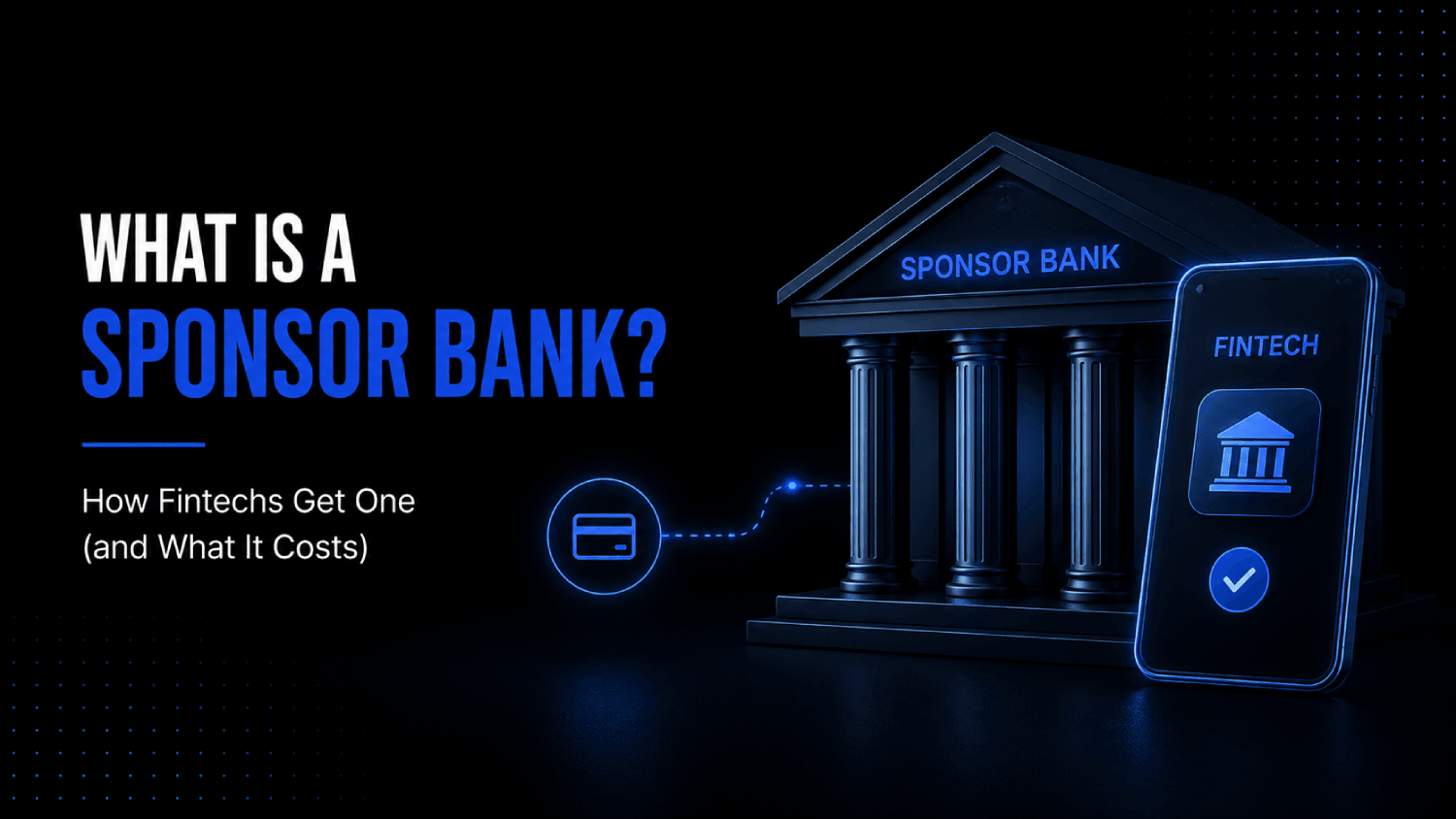

- A sponsor bank is a federally or state-chartered bank that holds the regulatory licenses your fintech product legally requires to offer deposit accounts, issue cards, or move money.
- Every BaaS platform you have heard of (Unit, Synctera, Treasury Prime) sits on top of a sponsor bank. The platform is middleware; the bank is the legal entity.
- Getting a sponsor bank directly takes 6 to 18 months and requires a compliance program the bank’s examiners will audit. Going through a BaaS intermediary compresses that to weeks but limits your negotiating position.
- The bank bears regulatory liability for your program. That dynamic explains every requirement they impose on you, and why consent orders against sponsor banks have shut down fintech programs mid-flight.
- BIN sponsorship is a specific sub-type: the relationship that lets a non-bank issue Visa or Mastercard cards by borrowing a bank’s network membership.
A sponsor bank is a chartered bank that partners with a fintech company to provide the regulatory infrastructure required to offer financial products. The bank holds the licenses, maintains FDIC insurance or network membership, and bears regulatory accountability for the program. The fintech operates the product experience. Without a sponsor bank, a non-bank company cannot legally accept deposits, issue payment cards, or originate loans in most US states.
What Is a Sponsor Bank, Exactly?
Most founders hit this wall at the same moment: they have a product that moves money, and their attorney tells them they need a banking partner. The term “sponsor bank” surfaces and almost immediately gets conflated with a BaaS vendor, a card processor, or an acquiring bank. These are different things.
A sponsor bank is a state- or federally chartered bank that extends its regulatory licenses to a fintech program it does not fully own. The bank is regulated by the OCC, FDIC, Federal Reserve, or a state banking department. Your fintech, which holds no bank charter, operates under the bank’s regulatory umbrella by contractual agreement. That agreement is what makes your product legally operable.
The scope is broad. Sponsor banks cover deposit accounts (checking, savings, stored value), card issuance under Visa or Mastercard network rules, ACH origination, wire transfers, and in some cases lending. Each product type involves a separate regulatory permission the bank grants. A single sponsor bank may cover several product lines, or you may need separate banking partners for different capabilities.
How Does a Sponsor Bank Actually Work?
The mechanics are cleaner than the terminology. When a user opens an account through a fintech app, the underlying account sits at the sponsor bank. The FDIC insurance label your app shows refers to coverage at that bank, not at your company. When a card is issued, the card’s BIN (Bank Identification Number) belongs to the sponsor bank, which is a registered member of Visa or Mastercard. You are licensed to use that BIN under what the industry calls a BIN sponsorship arrangement.
The fintech handles onboarding UX, KYC collection, transaction logic, customer support, and product decisions. The bank handles regulatory reporting, funds custody, and network compliance. The contract between them assigns responsibility for every compliance function and specifies who monitors what. In practice, the bank’s compliance team audits the fintech’s BSA/AML program, reviews its KYC procedures, and can terminate the program if the fintech falls out of compliance.
This is the dynamic that tripped up a number of programs after the OCC and FDIC issued guidance tightening third-party risk management. As Cross River Bank noted publicly, sponsor banks now bear direct regulatory consequences for their fintech partners’ failures, not just contractual ones. That accountability shift is why sponsor bank requirements tightened considerably between 2022 and 2024.
Sponsor Bank vs BaaS Platform: What Is the Actual Difference?
This is the belief most fintech founders carry into early planning and need to correct before signing anything. A Banking-as-a-Service (BaaS) platform is a technology intermediary. A sponsor bank is a regulated financial institution. They are not interchangeable.
When you contract with Unit, Synctera, or Treasury Prime, you are contracting with a software company that abstracts the bank relationship into APIs. But underneath that API layer, there is always a chartered bank holding the deposits and the licenses. Unit’s banking partners have included Blue Ridge Bank and others. Synctera’s model connects fintechs with a curated network of community banks. Treasury Prime has operated with partners including Grasshopper Bank and others.
| Dimension | Sponsor Bank (Direct) | BaaS Platform (Intermediary) |
|---|---|---|
| Legal relationship | Fintech contracts directly with the bank | Fintech contracts with software layer; bank relationship is indirect |
| Time to launch | 6 to 18 months typical | Weeks to a few months |
| Compliance ownership | Fintech must build own BSA/AML program | Platform provides compliance tooling; bank still audits |
| Economics | Negotiated directly; interchange split favorable at scale | Platform takes a margin; less favorable unit economics |
| Portability | Harder to switch banks once embedded | Some platforms allow bank switching without product rebuild |
| Risk concentration | Single bank failure or consent order can pause your program | Some platforms offer multi-bank redundancy |
For a fintech at seed stage, a BaaS platform is almost always the faster path. The compliance infrastructure, API tooling, and pre-negotiated bank relationships are worth the margin hit. For a company processing significant volume, the economics often justify a direct sponsor bank relationship, though the compliance overhead rises proportionally. Our breakdown of the hidden economics of Banking-as-a-Service covers what the platform margins actually look like at different volume bands.
What Is BIN Sponsorship and How Does It Differ from a Full Sponsor Bank Relationship?
BIN sponsorship is a narrower arrangement than full sponsor bank coverage. A BIN (Bank Identification Number) is the first six to eight digits of a payment card. Visa and Mastercard require that every BIN issued on their networks belong to a principal member, which must be a licensed bank. A fintech that wants to issue Visa debit or credit cards cannot hold its own BIN without a bank charter. BIN sponsorship is the contractual arrangement by which a sponsor bank shares its BIN range with a fintech program.
The distinction matters operationally. A BIN sponsorship is specifically about card issuance and network membership. A full sponsor bank relationship may also cover deposit accounts, ACH origination, wire transfers, and lending. Many fintechs have a BIN sponsor for cards and either the same or a different bank for deposit or ACH capabilities. As Stripe’s public resources on BIN sponsorship explain, the sponsor bank is responsible to the card network for all transactions processed under its BIN, which is why banks scrutinize card program risk as carefully as deposit risk.
Marqeta, Lithic, and Stripe Issuing all operate as card issuing platforms that sit between your fintech and the underlying BIN sponsor. They handle the card network integrations and provide APIs for card controls, but the BIN on the card belongs to a bank in their network. For a direct comparison of those platforms, the Marqeta vs Lithic vs Stripe Issuing breakdown covers how the sponsor bank relationships differ across them.
What Do Fintechs Actually Need to Get a Sponsor Bank?
Banks evaluate fintech program applicants the way a sophisticated investor evaluates a deal: they are assessing whether your upside (deposits, fee income, float) outweighs the regulatory and reputational risk you bring. The bar has risen sharply since regulators began issuing consent orders against banks whose fintech programs had inadequate oversight.
The core requirements across most sponsor bank programs:
- A documented BSA/AML program with a designated compliance officer
- KYC procedures the bank’s examiners will approve, including identity verification, sanctions screening, and PEP checks
- A written business plan and financial projections the bank can present to its board
- Proof of adequate capitalization or investor backing
- A clear articulation of your customer base, transaction types, and expected volume
- Technology security documentation, including SOC 2 or equivalent
- A dedicated compliance team (or contracted compliance firm) for ongoing monitoring
Community banks with active fintech programs, such as Column, Evolve Bank and Trust, Pathward, and Sunrise Banks, each have different risk appetites and program requirements. A crypto-adjacent fintech, a high-risk merchant facilitator, and a payroll startup will land at very different banks. Matching your program profile to a bank’s existing risk appetite is as important as the application itself. The guide to evaluating sponsor bank programs covers specific programs by use case.
How Long Does the Sponsor Bank Approval Process Take?
Timeline is where most founders underestimate the process. The sequence below reflects what a typical direct sponsor bank engagement looks like. BaaS-mediated relationships compress some stages but rarely eliminate them entirely.
| Stage | What Happens | Typical Duration |
|---|---|---|
| Initial outreach and fit screening | Bank assesses program type, volume, and risk profile | 2 to 6 weeks |
| Term sheet / letter of intent | Preliminary commercial terms; not binding | 2 to 4 weeks after screening |
| Due diligence | Bank reviews BSA/AML program, KYC docs, financials, tech stack | 6 to 12 weeks |
| Board and compliance approval | Bank’s internal approval chain; compliance committee must sign off | 4 to 8 weeks |
| Contract negotiation | Legal review of program agreement, compliance schedules, SLAs | 4 to 8 weeks |
| Technical integration | API connections, account structures, card program setup | 4 to 12 weeks |
| Soft launch and monitoring period | Bank monitors transactions before full scale | 4 to 8 weeks |
Total direct timeline: 6 to 18 months, with 9 to 12 months being common for programs that are well-prepared. BaaS platforms can collapse the due diligence and integration stages significantly because the bank has already approved the platform’s compliance framework. Your company still goes through a program-level review, but you are not starting from zero.
What Does Sponsor Bank Compliance Actually Require of the Fintech?
The compliance burden does not sit entirely with the bank. Regulatory guidance, particularly the FDIC’s 2024 proposed rule on brokered deposits and the OCC’s third-party risk management guidance, makes clear that fintechs operating under a sponsor bank’s umbrella are treated as the bank’s third-party service providers. The bank is accountable to regulators. The fintech is accountable to the bank.
In practice, this means the fintech must maintain its own BSA/AML program that mirrors the bank’s standards. That includes transaction monitoring, SAR (Suspicious Activity Report) filing procedures, OFAC sanctions screening for every customer and transaction, customer risk scoring, and periodic program reviews. Many early-stage fintechs outsource this to compliance-as-a-service firms. The bank will audit the program annually at minimum, and more frequently if your transaction patterns raise flags.
Platforms like Synctera provide compliance tooling that integrates with sponsor bank audit requirements. But tooling is not the same as a program. The fintech’s leadership must own the compliance function. If you want to understand the full cost structure before it surprises you, the real cost of compliance in fintech SaaS by stage breaks down what you should budget.
What Does a Sponsor Bank Cost?
Sponsor banks are not free infrastructure. Their economics vary considerably by program type, volume, and whether you are going direct or through a BaaS platform. Precise figures are not publicly disclosed by most banks, but the general structure is consistent across the market.
| Cost Component | Typical Range or Structure | Notes |
|---|---|---|
| Program setup fee | $0 to $100,000+ | Some banks waive this for strong programs; BaaS platforms often charge onboarding fees instead |
| Monthly minimum | $5,000 to $50,000/month | Protects the bank against low-volume programs; applies even if you process less |
| Interchange revenue share | Bank retains 10% to 40% of interchange | Higher volume shifts more to the fintech; terms are negotiated |
| Float / deposit spread | Bank earns spread on deposits held | In high-rate environments, this is significant; some programs share float with the fintech |
| Per-account or per-transaction fees | Varies by program and bank | Common for BaaS intermediary models |
| Compliance audit costs | Borne by fintech; $20,000 to $150,000/year | Includes internal staff or outsourced compliance firm costs |
These figures are general market ranges. No sponsor bank publishes a standard rate card. Negotiating position improves with volume, a clean compliance history, and a program profile the bank finds strategically attractive. The analysis of why fintech SaaS margins are worse than founders expect includes a section on banking relationship costs that is worth reading before entering negotiations.
The FintechSpecs Program Fit Test: Four Questions Before Approaching Any Sponsor Bank
Sponsor bank rejections waste months. Banks turn down fintech programs not because the business is bad, but because the program profile does not match the bank’s existing risk framework. Running this diagnostic before outreach saves significant time.
- Risk category match: Does your customer base resemble categories the bank already sponsors? A bank that runs payroll programs has examiners who understand payroll risk. A bank that has never done crypto will not build that expertise for your program.
- Volume floor clearance: Can you realistically clear the bank’s minimum fee thresholds within 12 months? Banks will model your projections. If the math shows you burning through minimums for two years, they may pass.
- Compliance program maturity: Do you have a BSA officer, a written AML policy, and a KYC procedure the bank’s compliance team will recognize as adequate? Showing up with “we’ll figure it out post-approval” is a rejection.
- Strategic value beyond fees: Can you articulate why the bank should want your deposits or your customer relationship specifically? Banks that actively pursue fintech programs often have strategic goals, deposit targets, or CRA considerations your program could address.
If you cannot answer all four confidently, a BaaS intermediary is the right starting point while you build toward a direct relationship. Rushing a direct approach with an underprepared program creates a market reputation problem: banks talk to each other, and a rejected program at one institution becomes harder to place at others.
To make this concrete: consider a seed-stage expense management startup targeting SMBs. They want to issue debit cards and hold float on a stored-value account. Their monthly projected volume is $2M. A direct sponsor bank relationship almost certainly fails the volume floor test , most banks set monthly minimums that assume $10M or more in throughput before the economics work in their favor. The compliance program maturity test also fails without a BSA officer on staff. The right sequence is a BaaS platform like one of the BaaS providers built for exactly this profile, with a direct bank relationship revisited once monthly volume exceeds $20M and the compliance team is in place. Approaching a sponsor bank at $2M monthly volume and pre-BSA infrastructure is how founders lose six months and damage their market reputation simultaneously.
What Happens When a Sponsor Bank Exits a Program?
This is the risk that the industry learned about the hard way when several community banks received consent orders between 2022 and 2024. When a sponsor bank exits a fintech program, whether voluntarily or under regulatory pressure, the fintech’s product goes down. Accounts may be frozen pending migration. Cards stop authorizing. ACH transfers fail.
The fintechs affected by Synapse Financial Technologies’ collapse in 2024 are the clearest illustration. Synapse was a BaaS middleware provider, not a bank, but its failure exposed how fragile the ledger reconciliation between fintech programs and sponsor banks can be when the intermediary is the point of failure. End users were locked out of funds for months. Regulators pointed to inadequate record-keeping at every layer of the stack.
Program continuity risk is why some BaaS platforms have shifted toward multi-bank models, where your program has contractual relationships with more than one sponsor bank. Synctera and Treasury Prime have both moved in this direction. For fintechs evaluating the state of the market, the state of Banking-as-a-Service in 2026 covers the consolidation and what it means for program stability.
Frequently Asked Questions
What do you mean by sponsor bank?
A sponsor bank is a state or federally chartered bank that contractually allows a non-bank fintech company to offer financial products using the bank’s regulatory licenses. The bank holds FDIC insurance, network memberships with Visa or Mastercard, and the regulatory permissions required to accept deposits, issue cards, and move money. The fintech operates the product under the bank’s umbrella and must meet the bank’s compliance standards as a contractual condition of the partnership.
How does a sponsor bank work in a fintech program?
The sponsor bank holds customer deposits in accounts it owns, issues cards under its BIN registered with Visa or Mastercard, and handles regulatory reporting obligations. The fintech company provides the product interface, handles customer onboarding, and operates the KYC and AML program the bank has approved. The bank audits the fintech’s compliance program regularly and can terminate the partnership if the fintech fails to meet agreed standards. Economically, the bank earns float on deposits and a share of interchange revenue.
What is BIN sponsorship and how does it differ from a full sponsor bank relationship?
BIN sponsorship is specifically about card issuance. A BIN (Bank Identification Number) must belong to a bank that is a principal member of Visa or Mastercard. A fintech without a bank charter cannot hold its own BIN, so it borrows a sponsor bank’s BIN to issue cards. A full sponsor bank relationship is broader and covers deposits, ACH origination, wire transfers, and potentially lending, in addition to card issuance. Some fintechs have separate BIN sponsors and deposit institutions.
What are the compliance requirements for working with a sponsor bank?
Fintechs must maintain a documented BSA/AML program with a designated compliance officer, written KYC procedures covering identity verification and sanctions screening, transaction monitoring with SAR filing capabilities, and ongoing OFAC screening for every customer and transaction. The sponsor bank will audit the fintech’s compliance program at least annually. Fintechs are treated as the bank’s third-party service providers under OCC and FDIC guidance, meaning the bank bears regulatory liability for compliance failures at the fintech level.
What is the difference between a sponsor bank and a BaaS platform?
A BaaS platform is a technology intermediary that provides APIs, compliance tooling, and pre-negotiated access to sponsor bank relationships. The sponsor bank is the regulated institution that holds the licenses, deposits, and network memberships. BaaS platforms like Unit, Synctera, and Treasury Prime sit between your fintech and the bank, compressing the time to launch from months or years to weeks. The trade-off is that the platform takes a margin on transactions and limits your direct negotiating position with the underlying bank.
How long does it take to get a sponsor bank?
A direct sponsor bank relationship typically takes 6 to 18 months from first outreach to program launch. The process includes fit screening, due diligence on your compliance program, bank board approval, contract negotiation, technical integration, and a monitored soft launch period. Going through a BaaS intermediary can compress this to weeks or a few months because the bank has already approved the platform’s compliance framework, though your program still goes through a review.
What are the risks of BIN sponsorship for a fintech?
The primary risks are program termination and regulatory change. If the sponsor bank exits a program, whether because of a consent order, a strategic decision, or financial difficulty, the fintech’s cards stop authorizing. Visa and Mastercard may also change rules governing sponsored programs with limited notice, and compliance with those changes is the fintech’s contractual responsibility. Concentration in a single sponsor bank amplifies this risk. Some fintechs mitigate it by working with platforms that maintain relationships with multiple banks.
Do fintechs need a sponsor bank to accept payments or just to issue cards?
Fintechs need a sponsor bank for any regulated financial product: deposit accounts, card issuance, ACH origination, wire transfers, or lending. Accepting payments as a merchant does not require a sponsor bank if you are using a third-party payment processor, but if you are holding customer funds, issuing stored value, or moving money on behalf of users, a licensed bank must be in the chain. The specific regulatory requirement depends on the product and the states in which you operate.
The Structure Most Founders Misread
The core misunderstanding about sponsor banks is a framing error, not an information gap. Founders treat the BaaS platform as the banking relationship because the platform is what they interact with daily. The APIs, the dashboards, the compliance alerts: all of it comes from the platform. But the legal and regulatory weight sits one layer down, at the bank. That distinction determines your compliance obligations, your concentration risk, and your economics at scale.
Choosing between a direct sponsor bank and a BaaS intermediary is not a question of which is better in the abstract. It is a question of where your program is today. At seed stage with no compliance infrastructure, a BaaS platform is the only realistic path. At Series B with $50M in monthly volume and a compliance team, the economics and the risk management often justify direct. The programs listed in the sponsor bank program comparison for fintech startups are worth evaluating with that lens, not as a single ranked list.
The regulatory environment has made sponsor banks more selective, not less. Banks that ran permissive programs before 2022 are now conducting deeper due diligence, adding compliance covenants, and in some cases exiting categories entirely. That is not a temporary condition. It reflects a structural recalibration between regulators and the institutions that underwrite fintech. Building your program on that reality, rather than on assumptions about how accessible bank partnerships used to be, is what separates founders who launch on time from those who get stuck at the bank-partnership wall for a year.
For founders still mapping the broader infrastructure decisions that surround a sponsor bank relationship , ledger tools, KYC providers, transaction monitoring , the fintech infrastructure stack overview and the fintech product and compliance readiness checklist are useful working documents before you approach any bank.