
- Recurly’s percentage-of-revenue pricing model costs significantly more than flat-fee alternatives once you cross $500K MRR, making a platform switch financially justified at that threshold.
- Chargebee is the most direct swap for teams already in Recurly, with near-identical data models and a documented migration path. Zuora is the right move if you are heading upmarket and need contract-centric billing.
- Usage-based billing is Recurly’s sharpest weakness. Orb and Metronome are built specifically for metered and hybrid pricing models where Recurly requires workarounds.
- Migration difficulty varies widely: Chargebee and Stripe Billing rank lowest, Zuora and Salesforce Revenue Cloud rank highest. The table below encodes this as a 1-5 scale.
- ProfitWell (now Paddle) is no longer a standalone analytics tool. Teams looking for a ProfitWell alternative should evaluate ChartMogul or Baremetrics depending on their data ownership requirements.
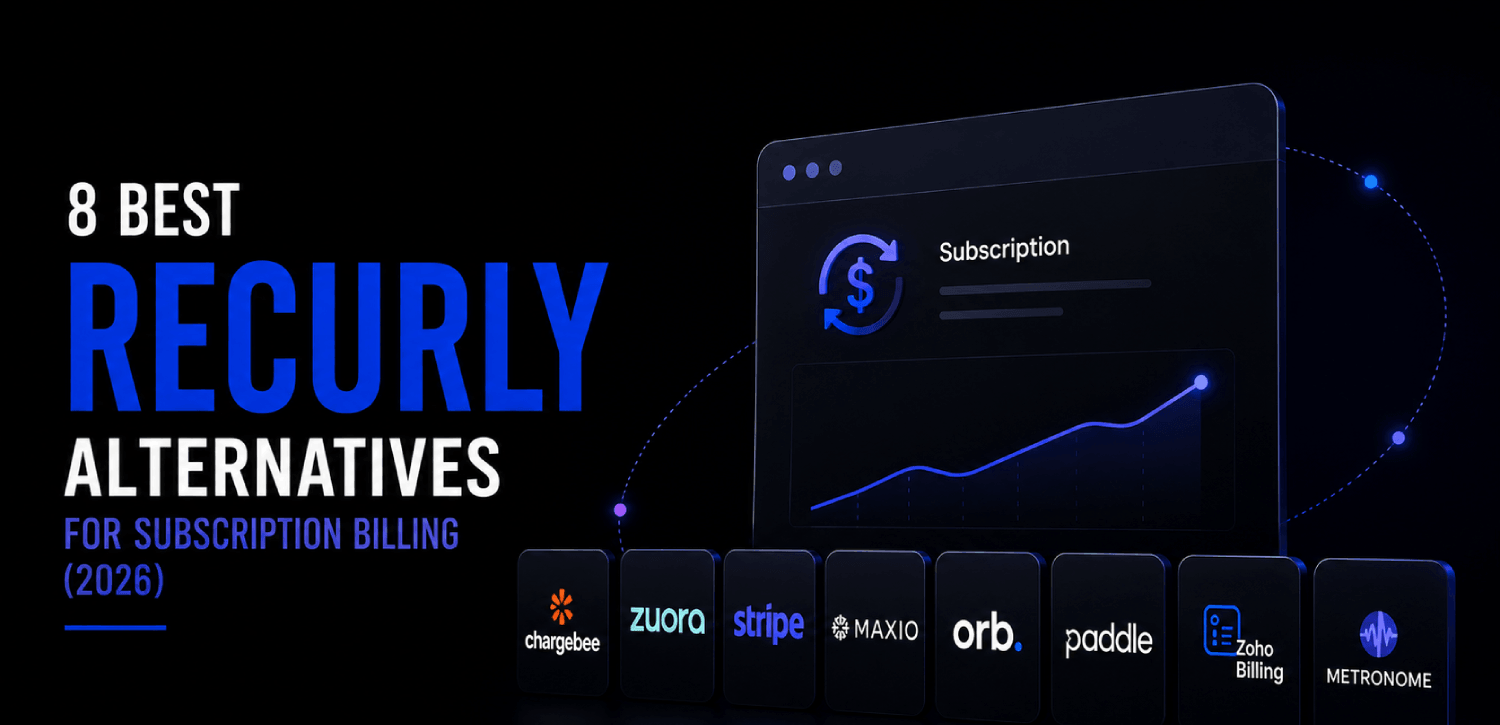
The eight strongest Recurly alternatives are Chargebee, Zuora, Stripe Billing, Maxio, Orb, Paddle, Zoho Billing, and Metronome. Each targets a different exit reason: Chargebee and Maxio for B2B SaaS teams wanting deeper dunning and revenue recognition, Stripe Billing for teams already on the Stripe stack, Orb and Metronome for usage-based pricing, Paddle for companies wanting a merchant of record, and Zoho Billing for cost-sensitive teams under $1M ARR.
Why Are Teams Leaving Recurly Right Now?
Recurly’s pricing structure has always been percentage-based, meaning the platform takes a cut of revenue processed rather than charging a flat monthly fee. That model works well at lower volumes, but it creates a cost problem as you scale. At $1M MRR, a percentage fee starts to feel like a second payment processor.
Beyond cost, three other complaints surface consistently in migration conversations: dunning logic that lacks granularity for complex retry schedules, weak native support for usage-based and hybrid billing without custom workarounds, and reporting that requires exporting to a BI tool for anything beyond surface-level MRR tracking. Recurly is a capable mid-market tool. It is not built for SaaS products that have outgrown vanilla subscription structures.
The other trigger is acquisition anxiety. When a billing platform changes ownership or product direction, finance teams start quietly benchmarking. Evaluating your options before a forced migration is almost always cheaper than reacting to one. If you are also thinking through your broader payment stack, the best payment infrastructure tools for SaaS founders covers the full layer below billing.
How Do These 8 Recurly Alternatives Compare?
| Platform | Best For | Pricing Model | Migration Difficulty (1-5) | Switch If… |
|---|---|---|---|---|
| Chargebee | B2B SaaS, mid-market | Flat tiers + % revenue at scale | 2 | You need deeper dunning and ASC 606 recognition |
| Zuora | Enterprise, contract billing | Custom (enterprise contracts) | 5 | You are selling multi-year contracts with amendments |
| Stripe Billing | Dev-led, Stripe-native teams | 0.5-0.8% of volume (public pricing page) | 2 | You already use Stripe and want to consolidate |
| Maxio | B2B SaaS, revenue recognition | Flat tiers (not public) | 3 | You need combined billing + SaaS metrics + RevRec |
| Orb | Usage-based, hybrid pricing | Custom (usage tier pricing) | 3 | Your pricing model includes metered components |
| Paddle | SaaS with global tax complexity | % of revenue (MoR model) | 3 | You want a single vendor to handle tax in 200+ countries |
| Zoho Billing | SMB, Zoho product users | Flat tiers, starts free | 2 | You are under $1M ARR and price-sensitive |
| Metronome | Infrastructure SaaS, PLG | Custom (usage tier pricing) | 4 | Your customers bill on consumption and usage is complex |
The migration difficulty score uses the FintechSpecs Billing Migration Index, a 1-5 scale built on four factors assessed for each platform: data model compatibility with Recurly’s subscription object structure, API parity for replicating current integrations, native import tooling availability, and typical implementation time reported in vendor documentation and public case studies. A score of 1 means a team of two can complete migration in under a month. A score of 5 means you will likely need a dedicated implementation partner and a parallel-run period of 60 days or more. The scores reflect how each platform stacks up specifically against Recurly as the origin system , not general implementation complexity in isolation.
Which Recurly Alternative Is Best for B2B SaaS Teams?
1. Chargebee
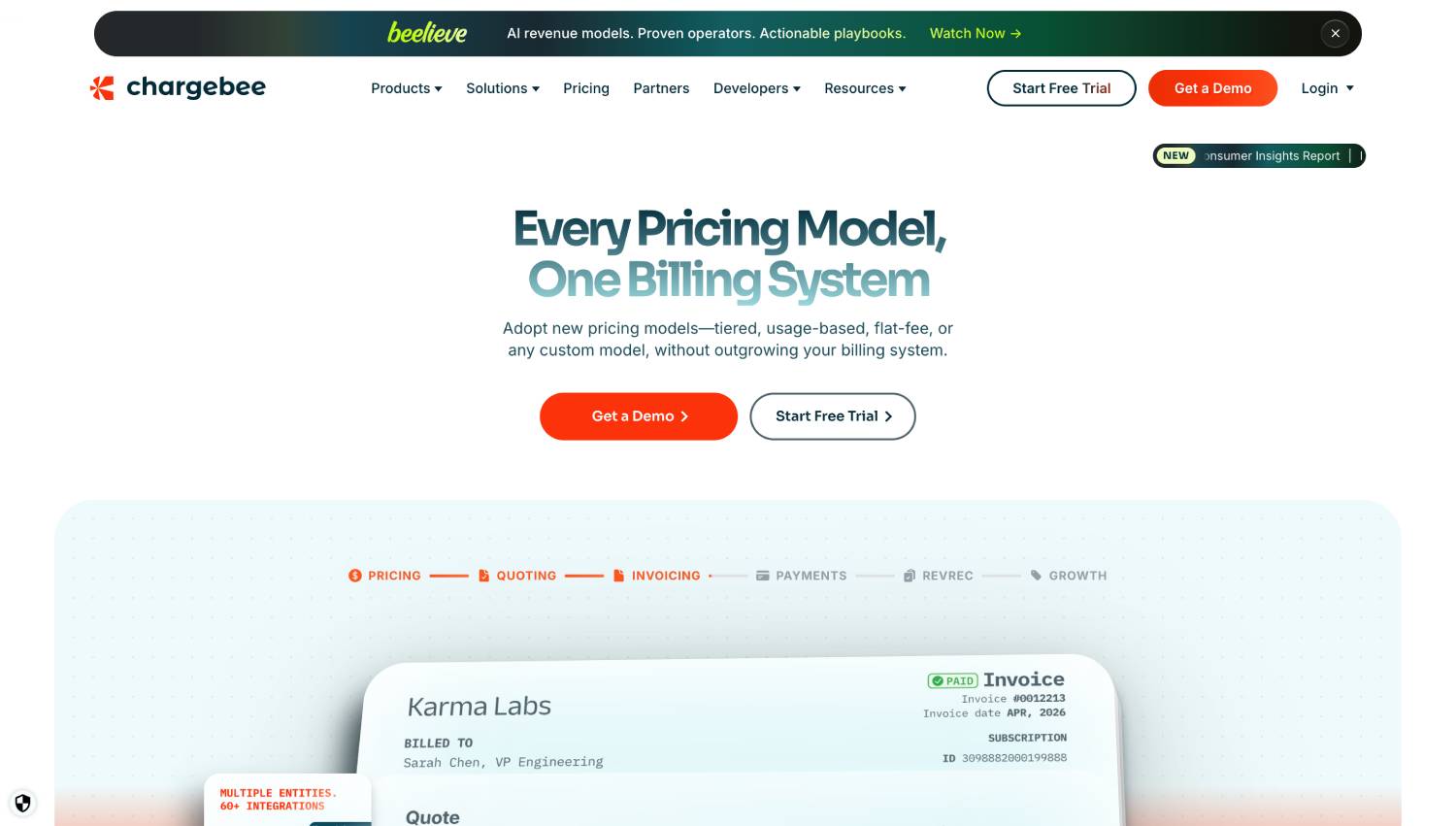
Chargebee is the most direct Recurly replacement for a B2B SaaS billing owner who wants to move without rebuilding billing logic from scratch. The data model maps closely: plans, subscriptions, invoices, and customers translate without significant schema changes. Chargebee has published a migration guide, and several third-party implementation partners have documented the process publicly.
Where Chargebee pulls ahead of Recurly is dunning depth. Chargebee’s Smart Dunning product lets you configure retry logic by card type, failure reason, and customer segment, not just a fixed retry schedule. That level of granularity matters for reducing involuntary churn in the $10K-$50K ACV range, where a single save can justify the platform cost difference for a quarter.
Chargebee also includes revenue recognition (ASC 606 and IFRS 15) in its higher-tier plans, which Recurly requires third-party tools to approximate. The trade-off is that Chargebee’s pricing also scales with revenue at enterprise tiers, so the cost advantage over Recurly narrows once you cross $10M ARR. Migration difficulty: 2 out of 5.
2. Zuora

Zuora is not a Recurly replacement for most teams. It is a destination for companies whose billing complexity has fundamentally outgrown subscription management and entered the territory of order management: multi-year contracts, mid-term amendments, co-term renewals, and multi-element arrangements. If your sales team is closing deals with custom terms on every order, Zuora’s contract-centric model fits. If you are running standard recurring subscriptions, Zuora will be more infrastructure than you need and more cost than you want.
The migration difficulty is real and should not be understated. Zuora’s data model differs substantially from Recurly’s subscription-first structure, and the implementation is typically handled by a certified Zuora partner, not your internal engineering team. Expect a minimum of 90 days for a mid-market migration with clean data. Migration difficulty: 5 out of 5.
3. Stripe Billing

For teams already running payments on Stripe, Stripe Billing is the lowest-friction consolidation move available. The payment method, customer, and subscription objects already exist in your Stripe account. You are essentially turning on billing logic that sits on top of infrastructure you already trust. According to Stripe’s public pricing page, Stripe Billing charges 0.5% of recurring charges on the Starter plan and 0.8% on invoices billed through the platform.
Stripe Billing’s weakness is operational tooling. It is API-first, which means anything beyond basic subscription management requires custom engineering or a third-party layer on top. Dunning automation, revenue recognition, and subscription analytics all require either building or bolting on additional tools. Teams that like Recurly’s out-of-the-box dunning will miss it immediately if they switch to Stripe Billing alone. Migration difficulty: 2 out of 5.
For a broader look at how Stripe compares to other payment processors at the infrastructure layer, the Stripe vs Adyen comparison for B2B SaaS covers the payment stack decision in more depth.
4. Maxio (formerly Chargify + SaaSOptics)
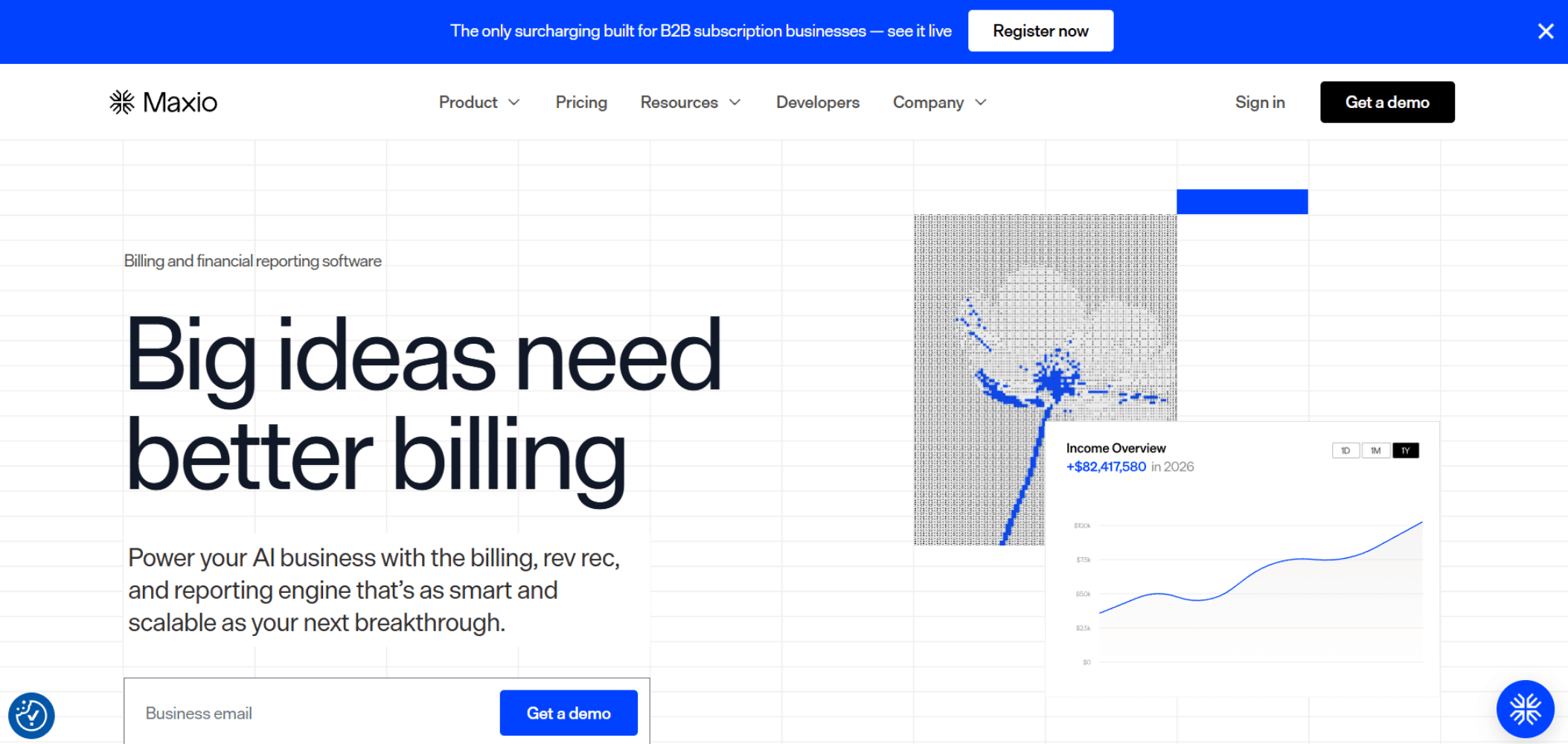
Maxio emerged from the merger of Chargify (subscription billing) and SaaSOptics (SaaS metrics and revenue recognition). That combination gives Maxio a differentiated position: it handles billing operations and the finance reporting layer in a single platform, which reduces the integration work that most billing teams carry between their billing tool and their metrics stack.
The sweet spot is a B2B SaaS company between $1M and $30M ARR that is preparing for a Series B or later fundraise and needs audit-ready revenue recognition alongside functional billing. Maxio’s reporting is stronger than Recurly’s out of the box, and the dunning tooling is competitive with Chargebee. Pricing is not publicly listed, which makes direct cost comparison harder before a demo call. Migration difficulty: 3 out of 5.
Which Recurly Alternative Handles Usage-Based Billing Best?
5. Orb
Orb was built for the specific problem that Recurly handles poorly: pricing models that combine recurring subscriptions with consumption-based components. Think a SaaS product that charges $500 per month for platform access plus $0.02 per API call. Recurly can approximate this, but the implementation requires workarounds that become brittle at scale.
Orb’s core architecture centers on a usage event ledger, meaning every billable event is ingested, stored, and priced at invoice time rather than estimated upfront. This approach eliminates the rounding and timing errors that create customer disputes in metered billing. Engineering teams that have built custom usage billing on top of Recurly frequently cite this ledger model as the single most compelling reason to migrate.
Orb is not the right tool if your pricing is entirely flat-rate subscription. The platform’s strength is metered complexity, not subscription management breadth. If your model is evolving toward consumption, however, switching before you scale is considerably easier than migrating after. Migration difficulty: 3 out of 5.
8. Metronome
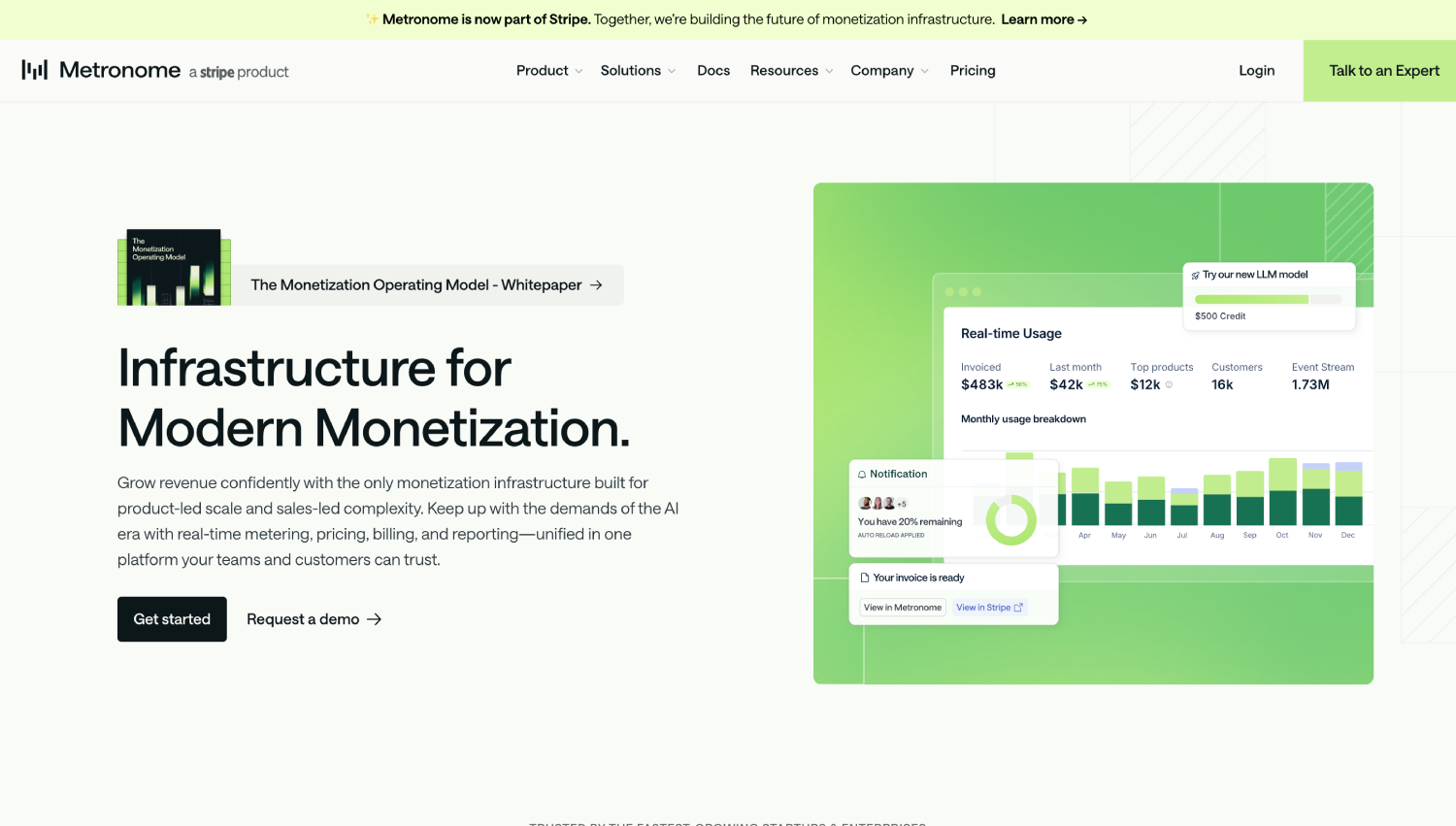
Metronome sits at the more technical end of the usage billing spectrum. It is designed for infrastructure SaaS companies, developer tools, and API-first products where customers are billed on actual consumption data rather than seat counts or plan tiers. Metronome ingests usage events at high volume and applies pricing rules at billing time, similar in architecture to Orb but with stronger integrations for data warehouse pipelines.
The migration difficulty is higher than Orb because Metronome’s implementation typically requires engineering involvement in connecting usage data sources. Teams coming from Recurly will need to rethink how they send events, not just remap subscription data. Migration difficulty: 4 out of 5.
For context on how usage-based billing fits into the broader question of monetization design, the best pricing models in fintech SaaS covers the strategic side of that decision.
Which Recurly Alternative Is Best for Tax Compliance Across Borders?
6. Paddle

Paddle operates as a merchant of record, which is a meaningfully different arrangement than Recurly. When Paddle is your MoR, Paddle is the seller of record on every transaction, which means Paddle handles VAT, GST, and sales tax collection and remittance globally. Your finance team stops managing tax filings in 30+ jurisdictions. That is the entire value proposition, and it is a real one for SaaS companies with significant revenue from outside the US.
The trade-off is control. As a merchant of record, Paddle processes payments through its own accounts, which means you have less direct access to raw transaction data and less flexibility in payment processing customization. Teams that need granular payment routing, specific processor relationships, or detailed chargeback handling at the transaction level often find the MoR structure limiting. Paddle’s pricing is percentage-based, similar to Recurly, which means cost scales with volume the same way. For a complete breakdown of how this structure works, the merchant of record vs payment processor comparison explains the distinction precisely.
Note: ProfitWell was acquired by Paddle and is now Paddle’s analytics layer, not a standalone product. Teams searching for a ProfitWell alternative for subscription analytics should evaluate ChartMogul or Baremetrics. The ChartMogul vs Baremetrics comparison covers that decision directly. Migration difficulty: 3 out of 5.
Which Recurly Alternative Is Most Affordable for Smaller Teams?
7. Zoho Billing
Zoho Billing (previously Zoho Subscriptions) is the only platform on this list with a free tier and flat-rate pricing that does not scale with revenue. For a company under $1M ARR that needs subscription billing without paying a percentage of every dollar collected, Zoho Billing removes the cost friction entirely. According to Zoho’s public pricing page, paid plans start at $15 per month (billed annually) and cap out well below the cost of Recurly’s equivalent tiers.
The limitation is integration fit. Zoho Billing is meaningfully better if you already use Zoho CRM, Zoho Books, or other Zoho products. The integrations are native, and the data flows without custom work. If you are running Salesforce, HubSpot, and NetSuite, Zoho Billing’s integration depth with those tools is shallower, and you will spend engineering time building connectors that Chargebee or Maxio provide out of the box. Migration difficulty: 2 out of 5.
What Does Migration Actually Look Like When Leaving Recurly?
Most billing migrations fail not because the destination platform is technically incompatible, but because the migrating team underestimates data cleanliness requirements. Recurly stores subscription state, add-ons, coupons, trials, and payment methods across several related objects. Before any migration begins, that data needs an audit: duplicate customers, expired subscriptions still marked active, and custom fields without a clear mapping destination.
The teams that execute cleanest migrations run a parallel period, typically 30 to 60 days, where new subscriptions activate on the destination platform while existing subscriptions on Recurly are allowed to churn or renew naturally. This avoids the risk of a big-bang cutover where a failed data import mid-month interrupts invoicing. Most platforms on this list have documented this approach in their migration guides or partner playbooks.
One practical detail: Recurly stores tokenized payment methods through its own vault or via your payment processor. When migrating to Stripe Billing, the path is relatively clean if you are already on Stripe as your processor. Migrating to Chargebee or Maxio while staying on Stripe as a processor is also well-documented. Migrating away from Recurly’s default Braintree or Adyen integrations to a different processor simultaneously is a two-migration problem and should be sequenced, not combined. The best subscription analytics tools for SaaS finance teams covers the reporting layer you will need to rebuild alongside your billing migration.
How Does Recurly Pricing Compare to Alternatives?
Recurly’s public pricing page lists a Core plan and a Professional plan, both of which charge a percentage of revenue processed in addition to a monthly platform fee. The exact percentage for higher tiers is not disclosed publicly and requires a direct sales conversation , the same is true of several competitors on this list, including Maxio and Orb. This structure is common across the billing platform space, and it creates meaningful cost escalation as revenue grows.
To illustrate the inflection point: at $500K MRR, Stripe Billing’s publicly listed rate of 0.5% translates to $2,500 per month in platform fees. A flat-rate platform priced at $2,000 per month becomes cheaper at that volume. The comparison sharpens further at $1M MRR. The 0.9% figure sometimes cited in vendor comparisons reflects mid-tier percentages that individual companies have reported after signing contracts , not a rate confirmed on Recurly’s public pricing page , so treat any such number as directional rather than definitive until you have your own quote in hand.
Zoho Billing at flat rates (starting at $15 per month per their public pricing page) costs a fraction of any percentage-based competitor at equivalent volumes. Chargebee and Maxio do not publish per-percentage rates, which means you need a quote. The critical discipline when comparing any of these platforms is to model total platform cost at your current MRR, your 12-month projected MRR, and your 24-month projected MRR before signing any contract. The hidden costs killing your fintech SaaS margins covers the broader pattern of how billing platform fees compound alongside other infrastructure costs.
Frequently Asked Questions About Recurly Alternatives
What is the easiest Recurly alternative to migrate to?
Chargebee and Stripe Billing both score a 2 out of 5 on the FintechSpecs Billing Migration Index, making them the lowest-friction options. Chargebee maps closely to Recurly’s data model, and its partner network includes migration specialists. Stripe Billing is simplest for teams already using Stripe as their payment processor, because customer and payment method data is already in the Stripe account and does not need to be transferred.
Is Chargebee actually better than Recurly?
Chargebee is better for B2B SaaS teams that need deeper dunning configuration, native revenue recognition, and stronger CRM integrations. Recurly holds an edge for high-volume consumer subscription businesses, particularly those using its native churn reduction features. Chargebee’s publicly documented migration path from Recurly and its stronger ASC 606 reporting make it the more natural choice for SaaS companies heading toward a Series B or preparing for an audit.
What happened to ProfitWell and what should I use instead?
ProfitWell was acquired by Paddle and integrated into the Paddle platform. The standalone free ProfitWell Metrics product was eventually sunset. Teams that relied on ProfitWell for subscription analytics should evaluate ChartMogul or Baremetrics, both of which offer similar MRR, churn, and cohort reporting with direct Recurly and Stripe integrations. ChartMogul supports data from multiple billing sources simultaneously, which is useful during a migration period when subscriptions exist on two platforms.
Which Recurly alternative handles usage-based billing best?
Orb and Metronome are purpose-built for usage-based and hybrid billing models. Orb’s event ledger architecture handles complex metered pricing without the workarounds Recurly requires. Metronome is better for infrastructure and API-first products with high event volumes and data warehouse integrations. Both require more technical implementation than Chargebee or Stripe Billing but produce cleaner billing outcomes for consumption-based pricing models.
Can I run Recurly and a replacement platform at the same time during migration?
Yes, and most experienced billing migration teams recommend it. Running a parallel period of 30 to 60 days allows new subscriptions to activate on the destination platform while existing Recurly subscriptions continue through their natural billing cycle. This approach avoids a big-bang cutover and reduces the risk of invoicing disruption mid-month. Most platforms on this list support this approach explicitly in their migration documentation.
Does Recurly’s revenue percentage get cheaper as you scale?
Recurly’s enterprise pricing is negotiated, so the effective rate can decrease at higher volumes with a custom contract. For companies below the enterprise tier using published plans, the percentage rate does not automatically decrease with volume. This is the core cost argument for switching to a flat-rate platform once you cross roughly $500K MRR, at which point a percentage-based fee can exceed the cost of most flat-tier competitors.
Is Zoho Billing a serious Recurly alternative or just a budget option?
Zoho Billing is a serious alternative within a specific profile: companies under $1M ARR, teams already using other Zoho products, and operators who need straightforward recurring billing without complex dunning, revenue recognition, or usage-based components. Outside that profile, its integration depth with Salesforce, NetSuite, and enterprise data stacks is thinner than Chargebee or Maxio, and the reporting layer requires more manual work to produce the metrics a finance team at $5M ARR would need.
The Most Important Thing to Get Right Before You Switch
The billing decision is not really about features. Every platform on this list handles basic recurring subscriptions. The decision is about which failure modes you can live with at your specific revenue level and product model, and which vendor’s limitations will cost you real money in 18 months.
A team at $300K ARR with flat-rate pricing and a single market should probably not be thinking about Orb or Metronome. A team at $5M ARR with a usage-based component bolted onto Recurly through a custom integration should probably be talking to Orb before that integration becomes load-bearing. The platform switch that costs three engineering sprints now is almost always cheaper than the one you are forced into after a botched renewal cycle at $15M ARR.
Audit your current Recurly usage before you shop. Identify the three features your team uses every day, the one integration that cannot break, and the billing failure mode that has already cost you revenue. That list eliminates half the platforms on this page before you book a single demo, and it gives you the questions that separate a vendor’s marketing from their actual product. The fintech vendor evaluation framework covers how to structure that process before you enter any sales cycle.