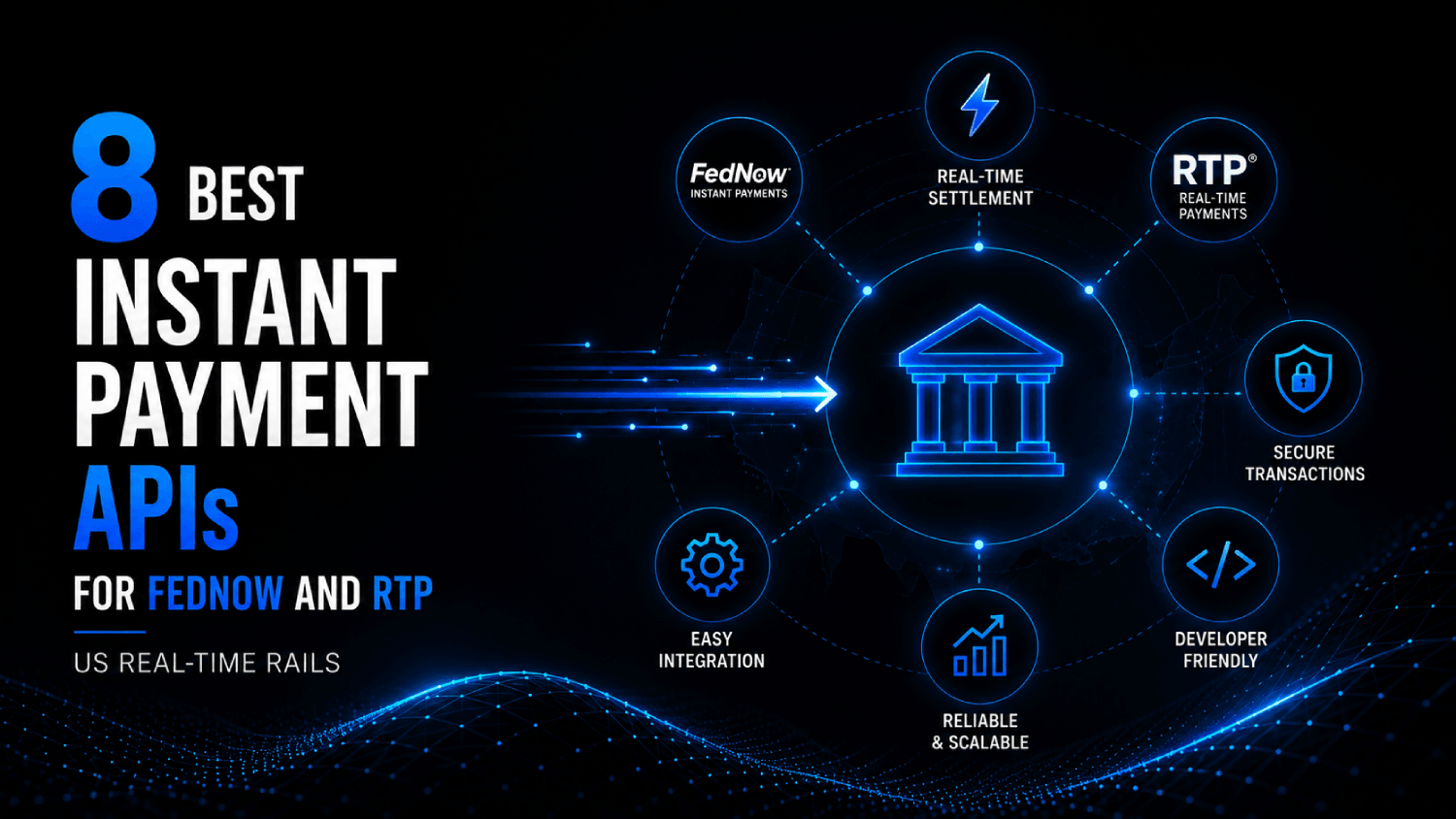

- FedNow and RTP are live US real-time rails, and API providers already abstract both behind a single integration. You do not need to wait for your bank to build a direct connection.
- Provider choice depends on three things: which bank sponsors their rail access, your transaction volume, and whether you need send-only or both send and receive.
- FedNow and RTP are not the same rail. FedNow is operated by the Federal Reserve. RTP is operated by The Clearing House. Coverage and limits differ, and the right FedNow API provider often covers both.
- Same-day ACH is not real-time. Funds settle in hours, not seconds. Do not conflate them in your infrastructure planning.
- Most instant payment API providers charge per transaction, not per seat. At volume, that pricing compounds quickly. Model it before you sign.
Several FedNow API providers already offer production access to both FedNow and RTP through a single REST integration. The leading options include Modern Treasury, Increase, Orum, Stripe Treasury, Column, Finix, Astra, and Dwolla. Provider selection depends on your bank sponsor relationship, whether you need receive capability alongside send, your average transaction size relative to each rail’s limit, and your engineering team’s tolerance for abstraction versus direct rail control.
Why Most Payments Teams Misread the Real-Time Rail Picture
The default assumption is that real-time payments require a direct bank relationship. That was true four years ago. It is not true now. A category of payment infrastructure companies has built the bank relationships, obtained the sponsorships, and wrapped both FedNow and RTP in developer-facing APIs that a three-person engineering team can integrate in a sprint.
The second misread: treating FedNow and RTP as interchangeable. They are parallel rails, operated by different institutions, with different participant lists and different per-transaction limits. A company processing a $750,000 contractor payment hits FedNow’s current limit. RTP’s limit is lower. Same-day ACH will clear it, but not in real time. Knowing which rail handles which use case is foundational before you evaluate any provider.
If your payments stack currently includes outbound payout logic, the outbound payment and payout API comparison on FintechSpecs gives useful context on where real-time rails fit relative to push-to-card and wallet options.
FedNow vs RTP vs Same-Day ACH: What the Rails Actually Look Like
Before evaluating providers, nail down the underlying rail characteristics. The table below reflects publicly documented specifications from the Federal Reserve and The Clearing House.
| Rail | Operator | Settlement | Per-Transaction Limit | Operating Hours | Cost to End User | Coverage |
|---|---|---|---|---|---|---|
| FedNow | Federal Reserve | Seconds (final) | Up to $500,000 (default $100,000; institutions can raise) | 24/7/365 | Varies by provider; Fed charges member institutions $0.045 per credit transfer (as of public Fed pricing) | Growing; over 900 institutions as of Federal Reserve public reports |
| RTP | The Clearing House | Seconds (final) | $1,000,000 | 24/7/365 | Varies by provider; TCH member pricing not public | Reaches over 60% of US demand deposit accounts per TCH reporting |
| Same-Day ACH | Nacha | Hours (same business day) | $1,000,000 | Business days only (three windows) | Lower per-transaction cost than RTP or FedNow | Near-universal US bank coverage |
Two things stand out from that table. First, RTP’s $1,000,000 limit makes it the better rail for large contractor payments, insurance disbursements, or real estate-adjacent payouts. Second, same-day ACH is not a real-time rail regardless of what your vendor deck says. “Same day” and “instant” are different products with meaningfully different user experiences.
The FintechSpecs Rail Fit Test: Four Checks Before Picking a Provider
Before shortlisting specific FedNow API providers, run what we call the Rail Fit Test. It is a four-part check that eliminates roughly half the market for any given use case.
Check 1 , Receive or Send-Only? Most providers offer RTP and FedNow credit sends. Fewer support receive (Request for Payment on RTP, or FedNow receive credit). If your use case involves collecting payments from business accounts in real time, not just disbursing, your list shrinks immediately.
Check 2 , What Is Your Typical Transaction Size? If your median payout is under $25,000, both rails work and FedNow’s expanding coverage may be advantageous. If you regularly move six-figure sums, RTP’s $1,000,000 limit matters and you need a provider with confirmed RTP access through their sponsor bank.
Check 3 , Who Is Their Sponsor Bank? API providers do not hold Fed master accounts. They route through a partner or sponsor bank that does. That bank’s own operational hours, risk appetite, and compliance posture become your operational ceiling. Ask every provider: who is your FedNow participant, who is your RTP participant, and are they the same institution?
Check 4 , What Is the Failure Mode? Real-time settlement is final. There is no ACH return window. If a payment goes to the wrong account, recovery depends on the receiving bank’s cooperation. Confirm how each provider handles misdirected credit disputes and what their API exposes for pre-send account validation.
8 Best Instant Payment API Providers for FedNow and RTP
1. Modern Treasury
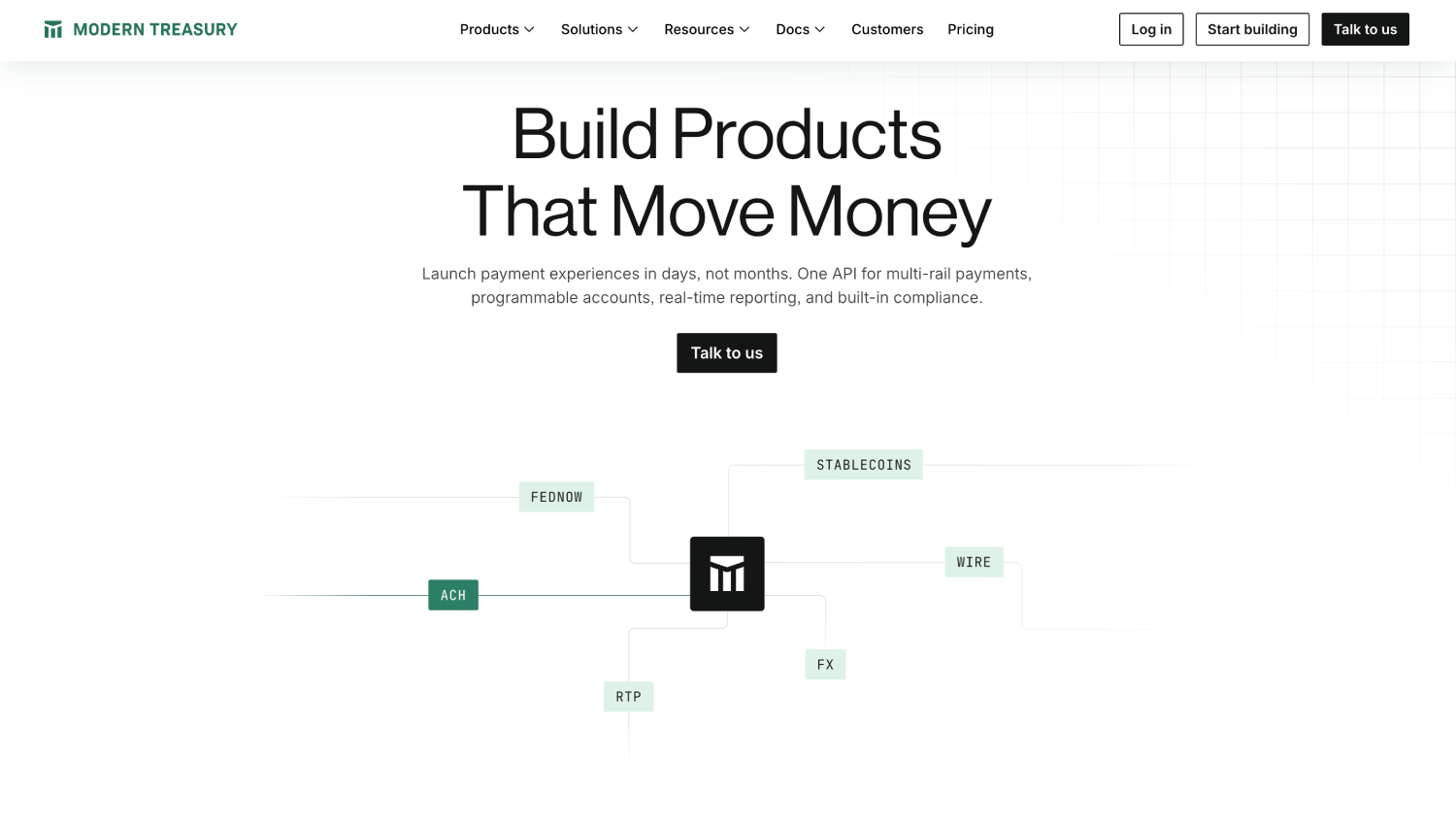
Modern Treasury is the clearest choice for companies that want a payment operations layer, not just a rail API. It supports both FedNow and RTP credit transfers, connects to multiple bank partners, and wraps everything in a reconciliation and ledgering layer. Engineers get a REST API; finance teams get a real-time payments dashboard with counterparty management built in.
Modern Treasury’s public documentation explicitly covers RTP and FedNow initiation, return handling, and webhook delivery for payment status updates. Their pricing is not publicly listed, though they operate on a per-transaction model with contract pricing at scale. The platform fits Series B and later companies that move meaningful volume and want payment operations handled in one place rather than stitched across providers.
The tradeoff: Modern Treasury is not the fastest integration for a team that just needs send-only payouts. The breadth of the platform adds setup time. For a full-stack comparison of Modern Treasury against Increase on architecture and use case fit, see the Modern Treasury vs Increase breakdown on FintechSpecs.
2. Increase
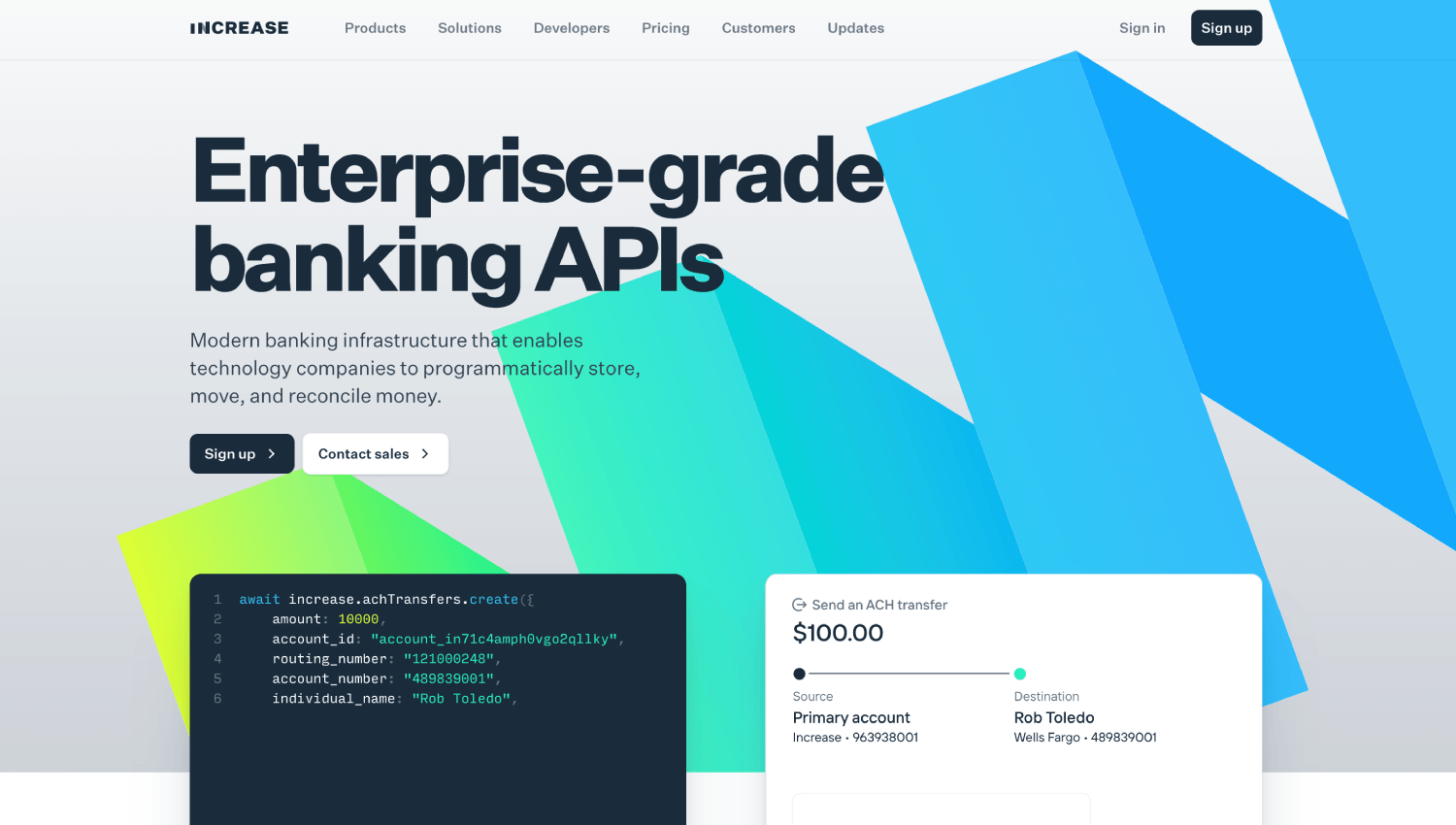
Increase is an API-first bank that holds its own Fed master account and Fedwire access, which means fewer intermediaries between your integration and the rail. For FedNow specifically, that direct access translates to lower operational risk and faster issue resolution compared to providers routing through a third-party sponsor bank.
Increase’s API is designed for engineers who want minimal abstraction. The documentation is precise, the sandbox is complete, and the pricing is published. Real-time payment initiation for both FedNow and RTP is available. Increase suits seed-to-Series B companies that are building payment infrastructure and want to understand exactly what is happening at the rail level, not just that a payment was sent.
3. Orum
Orum positions itself as an intelligent money movement layer, with a specific focus on payout speed and fund availability decisions. Their Foresight product uses bank account intelligence to help clients decide which rail to use for a given payment, optimizing for delivery probability rather than just initiating blindly on a single rail.
For platforms that move money to end users who may or may not have accounts at FedNow or RTP-connected banks, that rail selection logic is genuinely useful. Orum supports FedNow, RTP, and same-day ACH from a single API call. Pricing is not public; they work on contract terms. The platform fits marketplaces and gig platforms making high-volume, variable-recipient payouts where maximizing same-day or instant delivery rate matters more than per-transaction cost minimization.
4. Stripe Treasury
Stripe Treasury offers RTP access for outbound payouts through its financial account infrastructure. For companies already building on Stripe’s payments stack, the integration path is familiar. The API is consistent with Stripe’s design conventions, and the developer experience is strong.
The constraint is that Stripe Treasury is embedded within Stripe’s broader financial account product, not a standalone instant payment API. It is a mature product with broad adoption, but the architecture decision it requires , adopting Stripe’s financial account model , is a meaningful one. If you are a platform looking to move money on behalf of connected accounts, it fits. If you want a standalone real-time payment rail without adopting that model, it does not. FedNow support within Stripe Treasury is worth confirming directly with Stripe, as their rail coverage evolves with their sponsor bank relationships.
5. Column
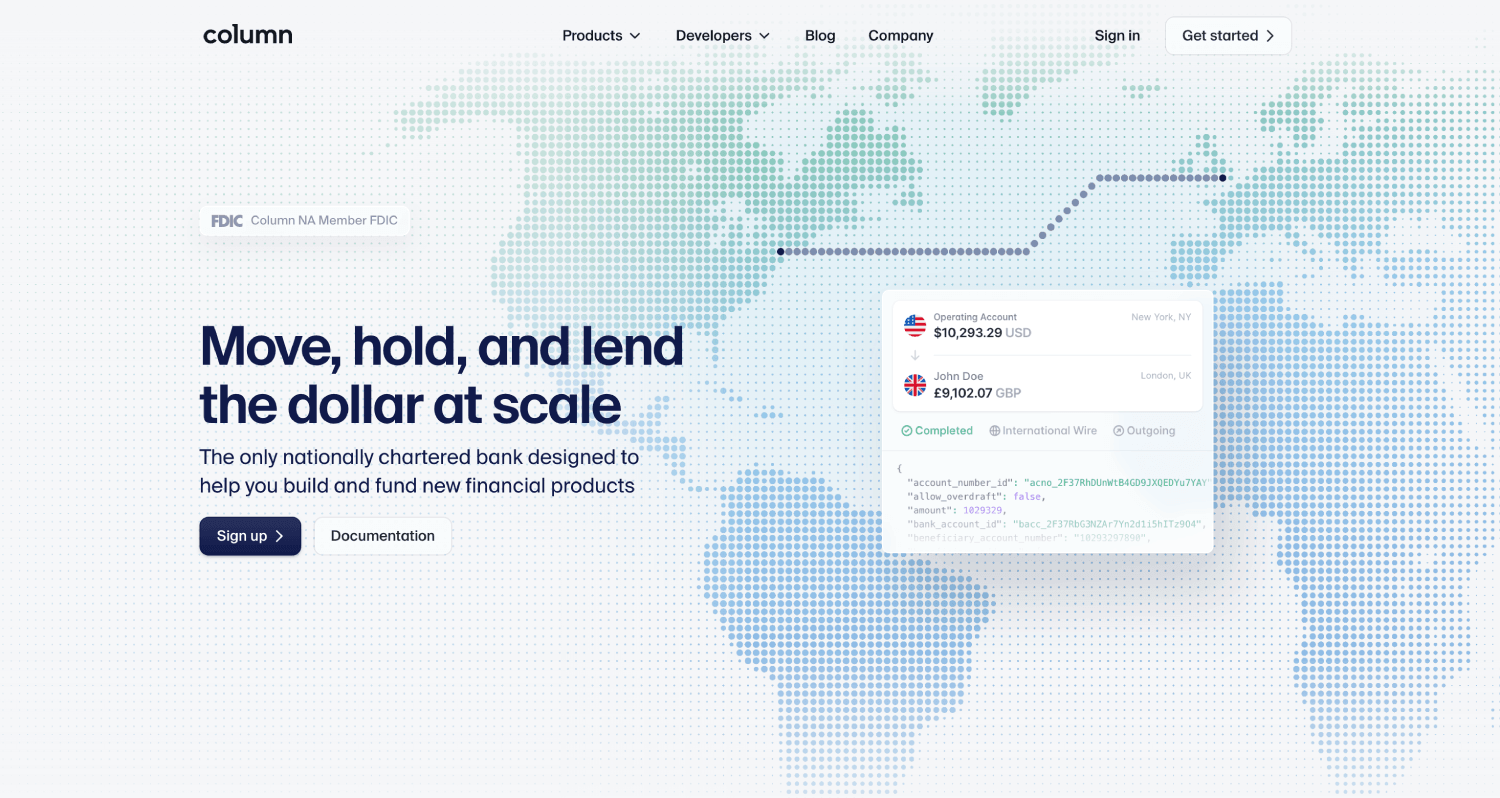
Column is a nationally chartered bank that also operates as an API-first infrastructure provider. Because Column holds its own bank charter, it participates in FedNow and RTP directly, without routing through a sponsor bank. That distinction matters operationally: your counterparty for both the banking layer and the rail access is the same entity.
Column’s API covers FedNow and RTP send and receive, Fedwire, and ACH. The documentation is thorough. Pricing is not public and requires direct engagement. Column fits companies that want bank-level access without building a direct bank relationship themselves, particularly those that have outgrown a BaaS middleware layer and want fewer abstraction points in their stack. For a broader look at how Column fits within the BaaS infrastructure space, the Banking-as-a-Service platform comparison on FintechSpecs covers how direct-charter providers compare to middleware models.
6. Finix
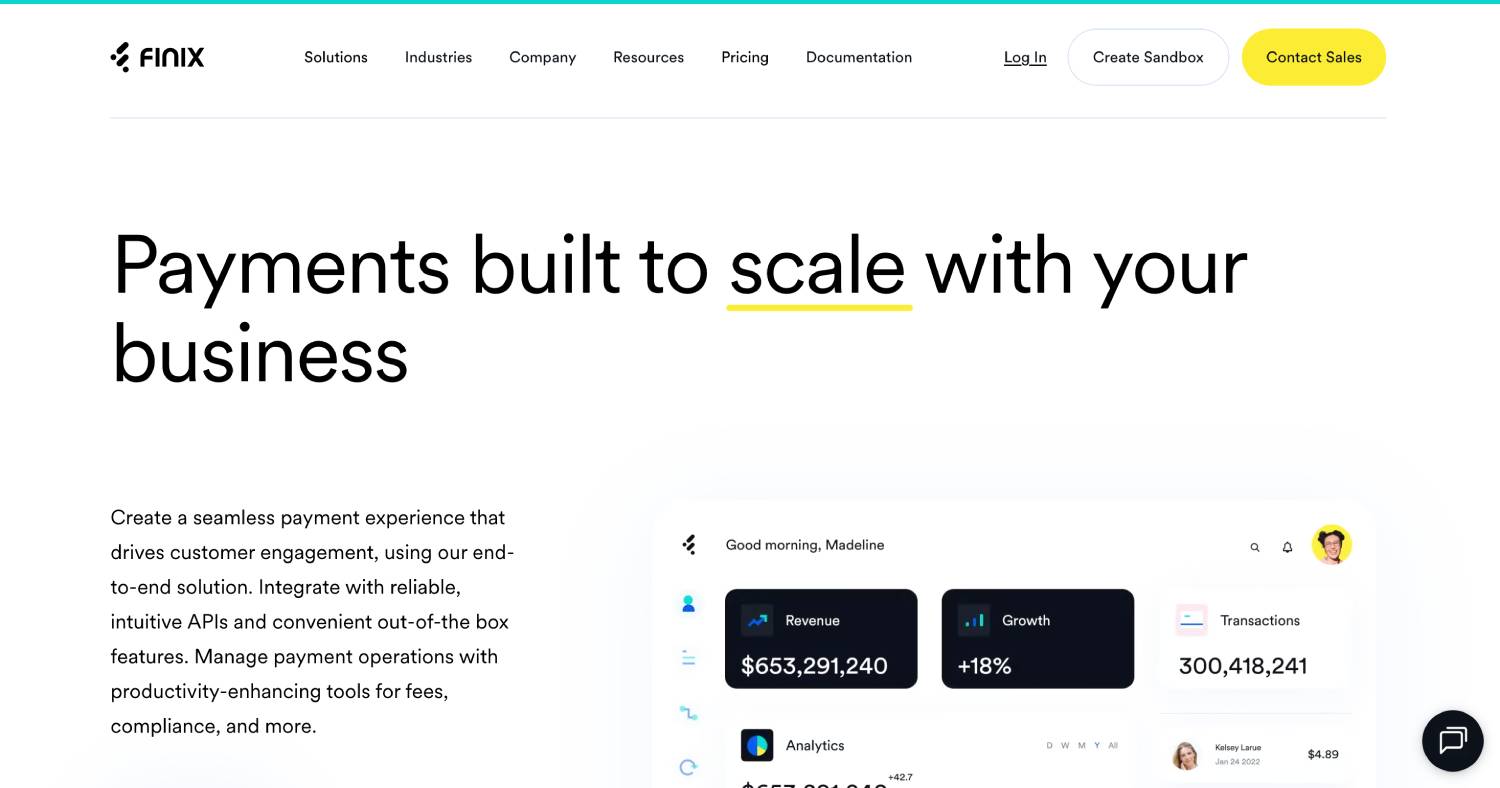
Finix is primarily a payments infrastructure platform for software companies, but it has expanded into real-time payout capabilities including RTP. For vertical SaaS companies that are already using Finix for card processing and want to add instant payouts without integrating a second provider, the consolidated approach reduces reconciliation complexity.
Finix’s RTP access runs through partner bank relationships. Their instant payout product targets platforms making disbursements to service providers or contractors. The pricing model is not publicly detailed. Finix makes the most sense for companies at the PayFac layer that want a single vendor relationship covering card acquiring, merchant onboarding, and real-time rail payouts.
7. Astra
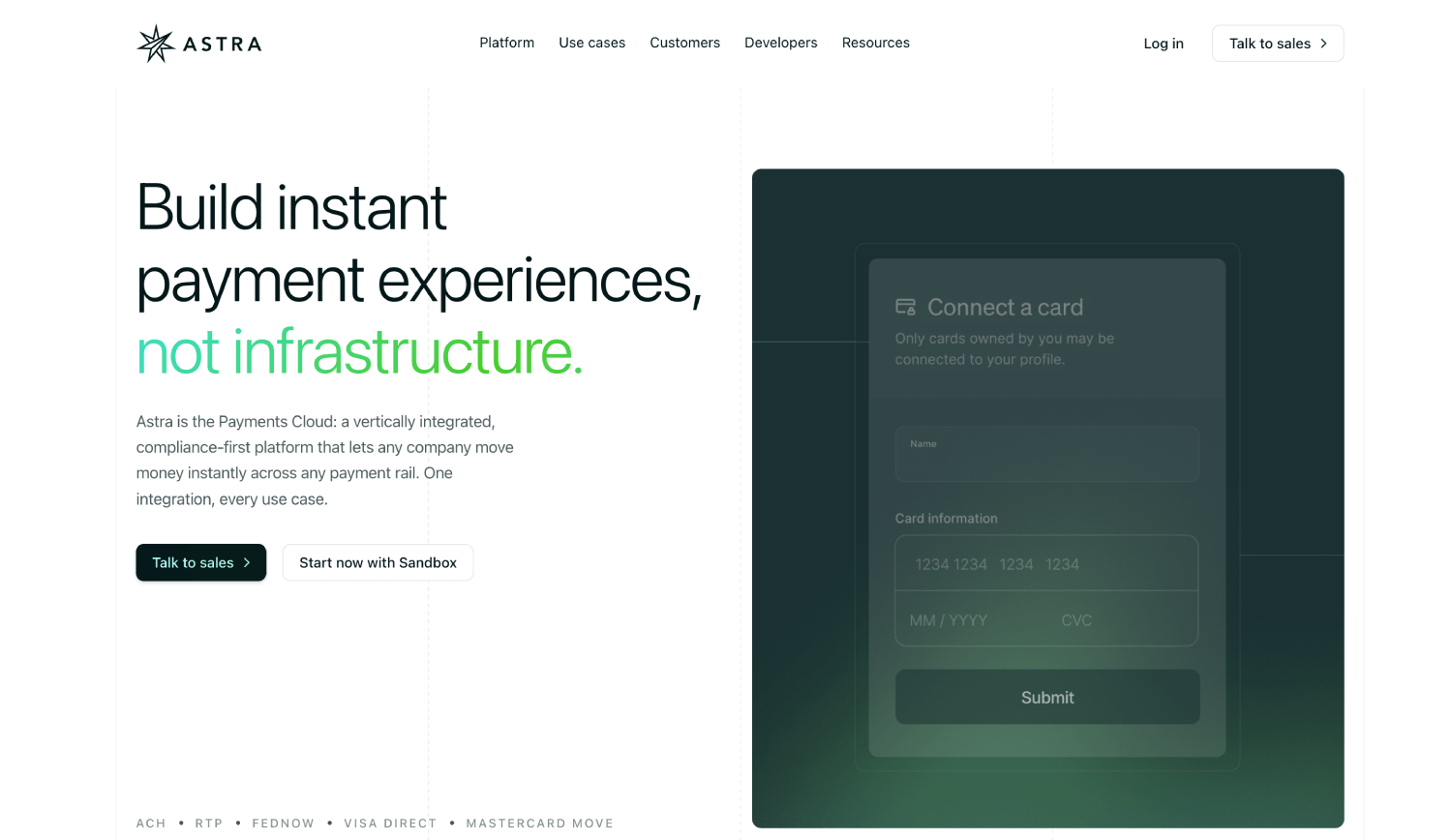
Astra focuses specifically on fund movement for fintech platforms, with an API that covers RTP, FedNow, push-to-card, and ACH from a unified endpoint. Their differentiation is in the developer experience: the integration is designed to be fast, and they market time-to-production as a key metric.
Astra suits early-stage companies that need real-time payouts working quickly without a complex enterprise procurement process. Their rail routing logic selects the fastest available method for a given recipient. Pricing is not publicly listed. The main consideration is that Astra is a smaller provider than Modern Treasury or Increase, which affects the depth of your enterprise agreement options and the breadth of their compliance and reporting tooling.
8. Dwolla
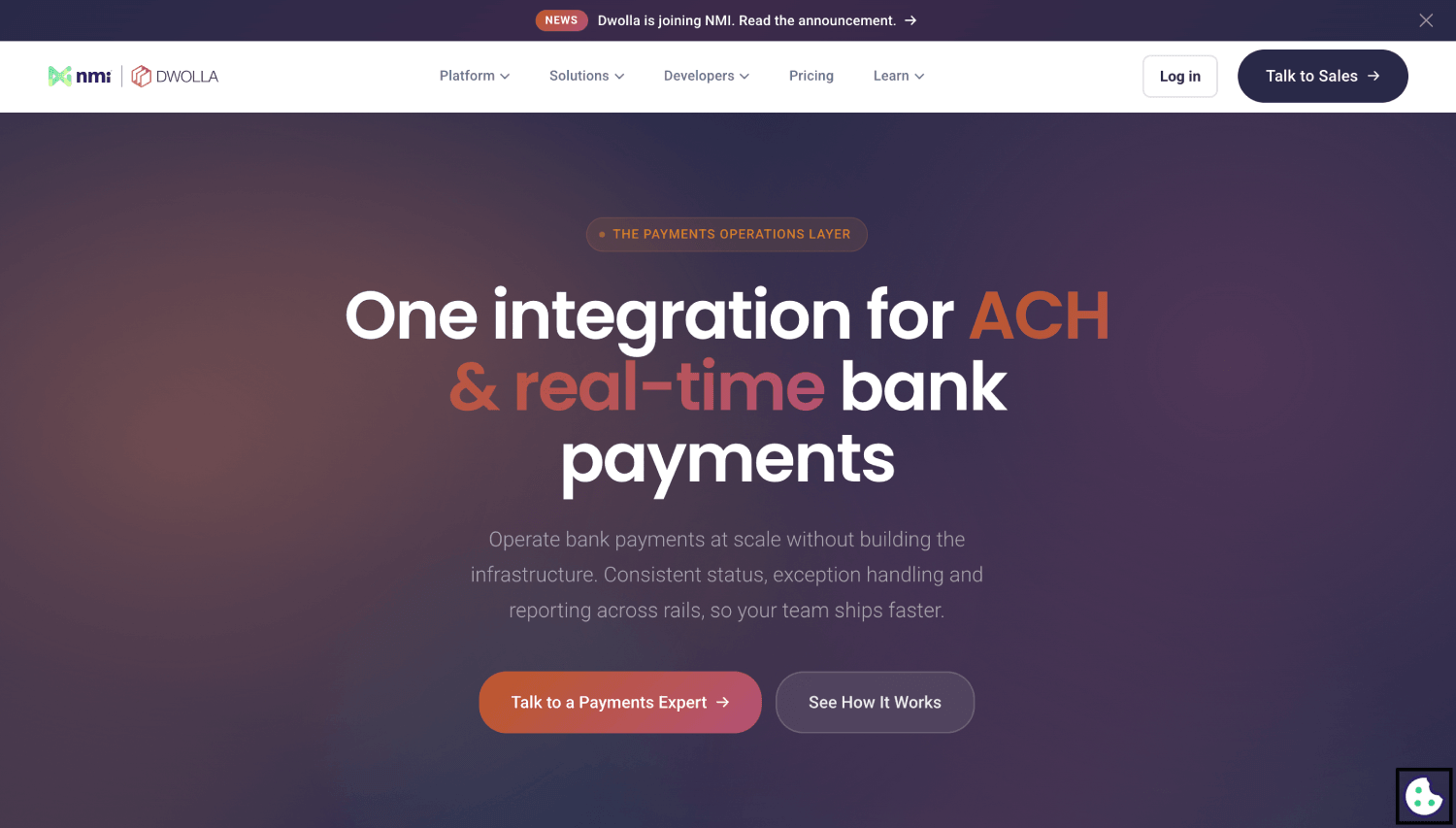
Dwolla has been an ACH-focused payment API for years and has added real-time rail support, including RTP, to its platform. For companies already using Dwolla for bank transfer infrastructure, RTP access through the existing integration is a low-friction add.
Dwolla’s core strength is its established position in the bank transfer API space , extensive documentation, a broad partner network, and a track record in ACH origination. Where it shows gaps relative to newer entrants: the real-time rail tooling is an extension of an ACH-first architecture, not a ground-up instant payment product, and the reconciliation and developer experience layers reflect that lineage. For a team starting fresh and optimizing specifically for FedNow or RTP from day one, that matters. For those with existing Dwolla integrations who want to add instant payout capability, extending the relationship makes operational sense. Their pricing is available through their sales team and varies by volume tier.
Provider Comparison
| Provider | FedNow | RTP | Direct Rail Access | Public Pricing | Best For |
|---|---|---|---|---|---|
| Modern Treasury | Yes | Yes | Via bank partners | No | Series B+ payment ops teams |
| Increase | Yes | Yes | Yes (own Fed account) | Yes | Engineers who want rail-level control |
| Orum | Yes | Yes | Via partners | No | High-volume payout platforms, gig economy |
| Stripe Treasury | Confirm with Stripe | Yes | Via Goldman Sachs / partners | No | Platforms already on Stripe |
| Column | Yes | Yes | Yes (chartered bank) | No | Infra builders wanting bank-level access |
| Finix | Confirm with Finix | Yes | Via partners | No | PayFac-model SaaS consolidating rail and card |
| Astra | Yes | Yes | Via partners | No | Early-stage teams, fast time-to-production |
| Dwolla | Confirm with Dwolla | Yes | Via partners | No | Existing Dwolla customers adding RTP |
Two providers, Increase and Column, hold their own regulatory position with direct rail participation. Every other provider in this list routes through a partner bank. That is not a disqualifying factor, but it is a variable you should surface and document as part of your vendor evaluation, especially if you are operating in a regulated category.
How Does FedNow Integration Actually Work for a SaaS Company?
FedNow integration for a SaaS company means integrating with one of these API providers, not with the Federal Reserve directly. The Fed does not offer a developer API for non-bank businesses. The providers listed here have done the work of becoming FedNow participants (or partnering with participants) and expose that access through their own APIs.
A standard integration flow looks like this: your application calls the provider’s payment initiation endpoint with the recipient’s account and routing number, the transaction amount, and a memo. The provider validates the account, routes the payment over FedNow or RTP based on destination bank availability, and returns a payment status via webhook, typically within seconds. Settlement is final; there is no return window equivalent to ACH’s R-code system.
The compliance layer sits on your side. You are responsible for sanctions screening, fraud checks, and transaction monitoring on outbound payments. Some providers offer these as add-ons; others assume you have handled them upstream. If your compliance stack is not yet built out, review what your provider includes versus what you need to source separately. The Fintech Product and Compliance Readiness Checklist on FintechSpecs maps out what that gap typically looks like for teams at the integration stage.
What Does Real-Time Payment API Pricing Actually Look Like?
Most providers do not publish per-transaction pricing publicly. What is known: the Federal Reserve charges member institutions $0.045 per FedNow credit transfer, per their publicly posted fee schedule. That is the floor cost that any FedNow API provider is paying at minimum before their own margin. End-user pricing for RTP is not published by The Clearing House, but market reports consistently place RTP pricing in the range of a few cents per transaction at the rail level.
What providers charge their customers is a different number. Expect per-transaction fees, monthly minimums, and in some cases a platform or API access fee layered on top. At low volume, this structure can make real-time rails meaningfully more expensive per transaction than same-day ACH. At high volume, providers negotiate custom rates. Model your expected monthly payment volume before your first vendor call. If you are processing under a few thousand transactions per month, some providers may not be worth the procurement overhead relative to alternatives.
For the broader picture of how payment infrastructure pricing compounds as you scale, the hidden cost analysis for fintech SaaS margins breaks down where per-transaction fees show up in ways operators miss.
Frequently Asked Questions
Is RTP cheaper than ACH?
At the rail level, RTP costs more per transaction than standard ACH. The Federal Reserve’s pricing for FedNow credit transfers is posted publicly at $0.045 per transaction for member institutions. ACH origination typically costs fractions of a cent at the network level. API providers mark up both. The practical question is whether the business value of instant settlement, finality, and 24/7 availability justifies the higher per-transaction cost for your specific use case. For high-stakes payouts where delays cause user churn or complaints, the premium is usually justified. For routine batch transfers, it often is not.
Can a SaaS company access FedNow directly without a bank?
No. FedNow participation is limited to depository institutions that hold Federal Reserve accounts. A SaaS company accesses FedNow through a bank that is a FedNow participant, either by building a direct integration with that bank or through an API provider that has already done so. Companies like Increase and Column hold their own bank charters and Fed access. All other API providers in this list route through partner banks. There is no developer program that gives non-bank entities direct FedNow access.
What is the difference between FedNow and RTP for a payments product?
FedNow is operated by the Federal Reserve and launched in July 2023. RTP has been live since 2017, operated by The Clearing House, a private company owned by large commercial banks. RTP has a $1,000,000 per-transaction limit; FedNow’s default is $100,000, though institutions can raise it to $500,000. Both rails settle in seconds and operate 24/7. Coverage differs by financial institution: not every bank is a participant on both rails. A provider with access to both rails is better positioned to maximize successful instant delivery across a diverse recipient base.
What is a sponsor bank in the context of instant payment APIs?
A sponsor bank is a federally chartered depository institution that holds the Fed master account and rail memberships that an API provider routes through. When a provider without its own bank charter initiates a FedNow or RTP payment, the transaction flows through the sponsor bank’s account at the Fed or through its TCH membership. The sponsor bank’s risk policies, compliance requirements, and operational limits cascade down to the API provider’s product. Asking every prospective vendor to name their FedNow and RTP sponsor bank is a standard part of due diligence. For more on how sponsor bank relationships work, see the sponsor bank explainer on FintechSpecs.
Do all US banks receive FedNow and RTP payments?
No. FedNow participation is voluntary for financial institutions. As of publicly available Federal Reserve data, participation has been growing since the 2023 launch, with over 900 institutions listed, but that still excludes a substantial portion of US banks and credit unions. RTP reaches over 60% of US demand deposit accounts according to The Clearing House’s public reporting, but that also means a meaningful share of recipients cannot receive RTP. This is why providers that intelligently fall back to same-day ACH or standard ACH when a recipient’s bank is not on the target rail are meaningfully more useful than single-rail-only solutions.
How long does a FedNow payment actually take to settle?
A FedNow credit transfer settles in seconds, not minutes. The Federal Reserve’s service design targets final, irrevocable settlement within the transaction processing cycle, which operates continuously, 24 hours a day, 365 days a year. “Final” means the receiving bank cannot return funds the way ACH allows; the settlement is immediate and permanent. That finality is what makes FedNow payments categorically different from same-day ACH, which settles in hours and carries a return window. Delivery speed to the end user’s account depends on the receiving bank’s own processing, which can add a small buffer.
Which instant payment API is best for a gig platform?
Orum is the most purpose-built option for gig platforms making high-volume, variable-recipient payouts. Their rail selection logic automatically routes each payment over the fastest available rail for a given recipient’s bank, which matters when you are paying thousands of workers across hundreds of different financial institutions. Modern Treasury is the better choice if you also need reconciliation and payment operations tooling alongside the payouts. For early-stage gig platforms that want fast time-to-production and are not yet negotiating enterprise contracts, Astra’s simplified integration path is worth evaluating.
What compliance requirements apply when using a real-time payment API?
The API provider handles rail-level compliance (Fed membership, TCH membership, their sponsor bank’s BSA/AML program). Your company is responsible for customer-level compliance: OFAC and sanctions screening on payment recipients, transaction monitoring for suspicious activity patterns, and any state-level money transmission obligations that apply to your business model. Some providers offer compliance add-ons; most do not fully replace your own compliance program. If your compliance infrastructure is early-stage, the early-stage fintech compliance blind spots article covers where teams typically underinvest before their first regulatory examination.
Which Provider Should You Actually Start With?
The answer is determined by one question first: does your sponsor bank situation already exist? If you have a banking relationship with an institution that is a FedNow or RTP participant, your cheapest path to real-time payments may be a direct integration with that bank’s developer portal. US Bank, Wells Fargo, and others publish instant payment APIs in their developer programs. If you do not have that relationship, or if your bank’s API is inadequate, an API provider is the correct move.
Among API providers, Increase is the right starting point for teams that want clean, direct rail access with transparent pricing and strong documentation. Modern Treasury is the right starting point if payment operations, reconciliation, and counterparty management matter as much as the rail itself. Orum is the right starting point if you are optimizing for delivery rate across a large and heterogeneous recipient base.
What the rail comparison table makes clear is that “instant payments” is not a single product. It is a category spanning two parallel real-time rails with different operators, different coverage maps, and different transaction limits, layered on top of a provider market where most pricing is negotiated and sponsor bank relationships are the hidden variable that determines your actual ceiling. The providers that give you access to both rails, with fallback logic, and with the compliance and reconciliation tooling to operate at scale, are worth the premium over a single-rail or single-use-case solution. That is a narrower list than it first appears.